Development of SMART CITY Using IOT and BIG Data
Dr.E.N.Ganesh*
*(ECE, Saveetha Engineering College, and Chennai)
---
************************
---Abstract:
The fast growth in the population density in urban areas demands more facilities and resources. To meet the needs of city development, the use of Internet of Things (IoT) devices and the smart systems is the very quick and valuable source. However, thousands of IoT devices are interconnecting and communicating with each other over the Internet results in generating a huge amount of data, termed as Big Data. To integrate IoT services and processing Big Data in an efficient way aimed at smart city is a challenging task. Therefore, in this paper, we proposed a system for smart city development based on IoT using Big Data Analytics. We use sensors deployment including smart home sensors, vehicular networking, weather and water sensors, smart parking sensor, and surveillance objects, etc. initially a four-tier architecture is proposed, which includes 1) Bottom Tier: which is responsible for IoT sources, data generations, and collections 2) Intermediate Tier-1: That is responsible for all type of communication between sensors, relays, base stations, the internet, etc. 3) Intermediate Tier 2: it is responsible for data management and processing using Hadoop framework, and 4) Top tier: is responsible for application and usage of the data analysis and results generated. The collected data from all smart system is processed at real-time to achieve smart cities using Hadoop with Spark, VoltDB, Storm or S4. We use existing datasets by various researchers including smart homes, smart parking weather, pollution, and vehicle for analysis and testing. All the datasets are replayed to test the real-time efficiency of the system. Finally, we evaluated the system by efficiency in term of throughput and processing time.
Keywords —Internet of Things,Big Data, Smart Systems, Smart City and Hadoop.
---
************************
---I. INTRODUCTION
According to the report published by CISCO in 2008, things connected to Internet surpassed the number of people living on earth [1]. It is also added that these things would touch the limit of fifty billion by 2020, taking us to the world of digitization. These things interact and communicate with each other with the help of internet – we call it the Internet of Things (IoT). The advancement in the IoT affecting human lifestyle in a positive manner in the field of healthcare [2], automation, transportation, and emergency response to man-made and natural disasters where it is hard for the human to make decisions. The Internet will be no longer considered as the network of computers. However, it will be involved with the billions of smart devices along with the embedded systems. As a result, Internet of Things (IoT) will greatly increase its size and scope, providing a new way of
opportunities, as well as challenges [3]. The majority of the countries have put forward longstanding national strategies for the implementations of IoT after completing the intangible stage of service level. For instance, Japan’s broadband access is providing the facility of communication between people, people and things, and things and things [4]. Similarly, South Korea’s smart home enables their people to access things remotely [5]. Singapore next generation I-Hub [6] intentions to comprehend the next generation “U” type network through a secure and ubiquitous network [7]. The stated initiatives laid the foundation of IoT [8]. In the literature, extensive research work has been performed on the Smart home technology [9] focusing on individual homes.
Due to the incorporation of ubiquitous and pervasive computing, the trend of living is now
changed. It is noticed that by 2050, seventy percent of the world population will live in cities [10]. Hence, a rapid increase has been seen in the transition of the population towards cities. Therefore, it results in enhancing the number of things to be interconnected with each other, which results in generating an overwhelming amount of the data. Such data comprises of heterogeneous properties, referred as big data. Hence, analyzing such data based on the user needs and choices, the cities would become even smarter. The massive amount of information generated by the embedded and pervasive devices will be shared across assorted platform and applications to enrich the cities smarter and predict accordingly in term of its planning and development.
Having understood the feasibility and potential of the IoT and the smart home, in this paper, we propel the concept of the smart home towards the smart city based on big data analytics. In the paper, we proposed the complete architecture to develop the smart city using IoT-based Big Data analytics. The 4-tier architecture is proposed, which has the capability to analyze thehuge amount of IoT datasets generating from various sources of the smart systems in the city such as smart homes, smart car parking, vehicular traffic, etc. Moreover, the analysis is performed on the IoT datasets to make smart city decision using the proposed system. Finally, the system is tested and evaluated with respect to efficiency measures in terms of throughput and processing time.
II. PROPOSED SYSTEM
The primary concept of the smart city is to get the right information at the right place and on a right device to make the city related decision with easiness and to facilitate thecitizens more quick and fast way. To develop the IoT-based smart city, we deployed several wireless and wired sensors, surveillance cameras, emergency buttons in streets, and other fixed devices. The main challenge in this regard is to achieve smart city system and link smart systems’ generated data at one place. Here we are presenting the proposed system including the detail description, the architecture, and the
2. 1. System Description
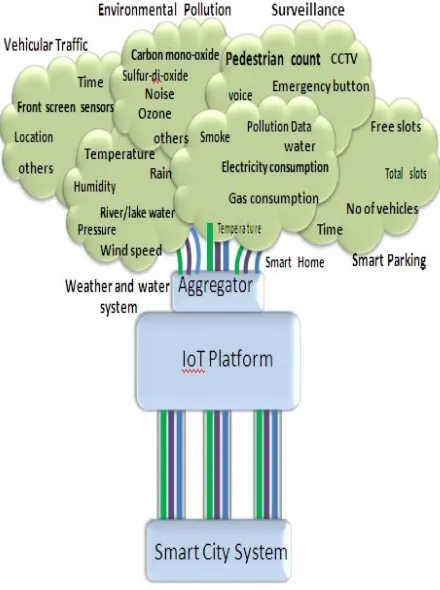
Figure 1 shows the overview of the system including sensors deployment and the smart systems used for building the smart city. We proposed the deployment of various types of sensors at different places to collect and analyzed the data. The ultimate goal is to achieve smart homes, smart parking, weather and water systems, vehicular traffic, environment population and surveillance systems. In a smart home, the home is continuously monitored by sending data generated from the sensors measures the smoke and temperature. Similarly, to detect a fire at real-time, the electricity and gas consumption to effectively manage the power, gas, and water consumption to the houses and different areas of the city. Similarly, monitoring the pollution will help in the health care of the citizens and alert them when the pollution increases than a particular threshold.
The smart parking helps in the checking of vehicles coming and going out of different car parking zones. Thus, an intelligent car parking can be designed. The smart car parking data provides lot facilitation of the citizens as well as merchants as being a part of the smart city. In our system, the citizens easily get the information of the nearest free slot of parking at real-time. Similarly, the citizen gets the information from the smart city about more suitable places to park his/her vehicle. This system reduces the fuel consumption of cars.
Weather and water system provides the weather related data like temperature, rain, humidity, pressure, wind speed, water levels at rivers, lakes, dams, and other reservoirs. All these information is collected by placing the sensors in water reservoirs and other open areas. In the world, most of the flood occur due to the rain and similarly, few others by snow melting and dam breakage. Therefore, we use rain measuring sensors and snow melting parameters in order to predict the flood earlier. We also predict about the water reservoirs in advance in order to meet the need of the water to the citizens.
the citizen and as well as the government can get more benefits. The city travelers also get the destination information based on the current intensity of traffic and the average speed of the vehicles. The traffic can be diverted to other routes from the congested one, and it will reduce the fuel consumption as well as decreases pollution that occurs due to the crowded traffic. Government authorities get the real-time information about the blockage of the road due to the accident or other things. They can make necessary action at real-time to manage the traffic. In our smart city system, we are getting the traffic information by GPRS, vehicular sensors. We get the location of each vehicle the number of vehicles between two pairs of sensors placed at the various location of the city.
A city can never be smart with unhealthy citizens. Therefore, while designing smart city, we set a separate module to get environmental data, which includes gases information such as particular metals, carbon monoxide sulfur dioxide, ozone, and noise as well as. These gases are very dangerous for human health that causes liver disordering, coughing, and heart diseases. People should not go outside when these gasses are more in the environment. Especially the children, old age people, people for physical exercise, already sick people, should not go outside from their homes when any of the polluted gas is more in the environment. This can only be possible when there is an access to all these information to the people at real-time and alerts are generated when any of the gas excesses a particular threshold. Moreover, the places where there are more population, the government should reduce the cause of the pollution like moving industries to other places, diverting traffic to the other routes etc
Figure 1. Sensors Deployment.
2. 2. System Architecture and implementation model
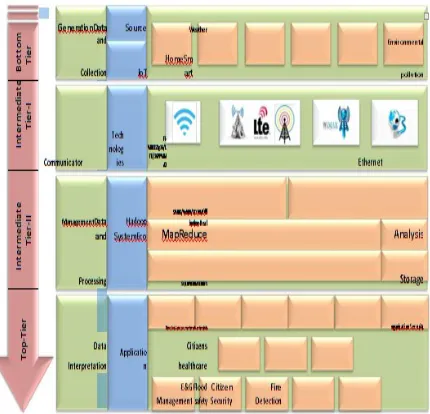
Based on the needs of the smart city, initially, we proposed a 4-tier architecture to analyze IoT-based smart systems’ generated data in order to establish smart cities. The complete architecture is shown in Figure 2.
Tier-II; Intermediate Tier-I: This tier is responsible for the communication betweensensors, sensors to relay through ZigBee technology, rely to GW or base station and then on internet various communication technologies can be used. At the analysis sides between various analysis servers, Ethernet is used.
Tier-III: Intermediate Tier-II: This layer is the central layer of the whole analytical system, which is responsible for the processing the data. Since we need real-time analysis for the smart system. Therefore, we need a third party real-time processing tool to combine with Hadoop. Therefore, for real-time implementation, Spark is used. However, Strom, VoltDb can also be the alternatives. At a lower layer of Hadoop, the same structure of MapReduce and HDFS is used. With this system, we can also use HIVE, HBASE, and SQL for managing Database (in-memory or Offline) to store historical information for urban planning
Figure 2. IV-Tier Architecture for IoT Big data analytics for remote smart city and urban planning
All the data are stored at Hadoop using HDFS and analysis are performed at intermediate tier-II. The last tier is the interpretation tier, which is the usage of the results of analyzed data and then generating reports. Here, the generated results are announced and used by many applications, such as flood detection, security, citizen facilitation, and
The complete implementation model of the system is given in Figure 3. It shows the full details of all the steps performed while data processing till decision making. Initially, every system generate their data, such as smart home generated data, vehicular data, smart parking data, etc. At every system, there is a relay node, which is responsible for collection data from all the sensors in the system. It uses ZigBee technology to communicate with the sensors.
The relay handles collecting data from all sensors and then sending to the analytical system through GW and Internet. As the sensors have a lot of metadata, and they also generate the heterogeneous type of data.
Therefore, all the unnecessary metadata and redundant data are discarded. Moreover, the data is classified by the message type and the identifier. After classification, the classified data is converted to the form, i.e., understandable to the Hadoop ecosystem, such as sequence file.
III.SYSTEMIMPLEMENTATIONAND EVALUATION
Figure 3. Implementation Model.
As all these datasets are offline, but to make it real-time, the datasets are replayed all the datasets at the same time using various computers towards the server, as we shown in the implementation model. The real-time traffic is processed by Hadoop-pcap-lib, Hadoop-pcap-scr-de libraries and converted into sequence file to make it capable of processing on Hadoop. Each facility of the smart city is implemented as a separated class or sub-module. Citizens have limited access to the results of these modules, and the government has full access to them. For evaluation purpose we take single node setup on UBUNTU 14.04 LTS coreTMi5 machine with 3.2 GHz processor and 4 GB memory. Since the system is based on big data analytics, therefore at this level, the systems is only evaluated with respect to the efficiency and response time using offline traffic as well as real-time traffic.
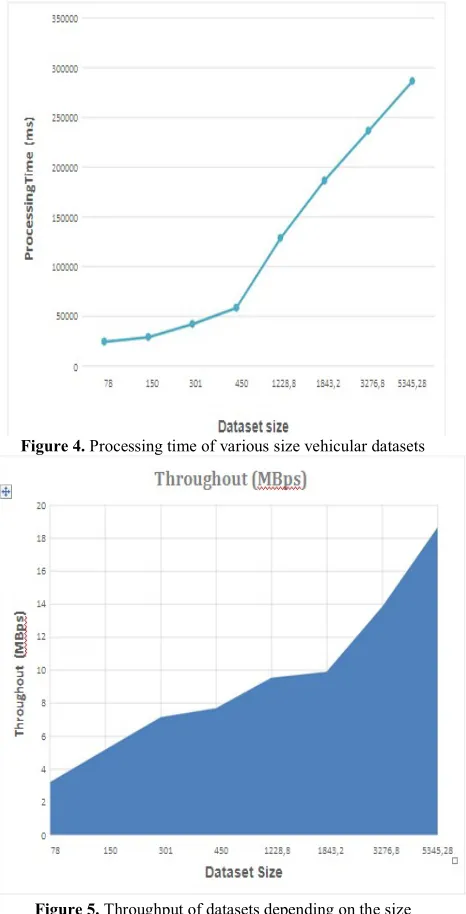
The processing time results with respect to offline datasets size is shown in Figure 4 and the throughput analysis result is shown in Figure 5. It is evident in the graph that when the data size is increased the processing time proportionally increased, both data size and processing time are directly proportional to each other. Moreover, throughput is also directly proportional to data size because of the parallel processing nature of Hadoop system, which is the major achievement of the system.
Figure 4. Processing time of various size vehicular datasets
IV Conclusion and Future Work
In this paper, we proposed an IoT-based system in order to achieve smart city to facilitate the government as well citizens while performing real-time decisions based on current city scenarios. To process ahuge amount of data, coming with very high speed, we use Hadoop ecosystem with Spark at the top layer. The existing smart systems’ datasets are used to test and evaluate the system’s efficiency. In future, we are planning to deploy the system using practical smart systems to test the real world implementation and feasibility of the system.
References
[1] CISCO, “The Internet of Things, Infographic”, available online at: http://blogs.cisco.com/news/the-internet-of-things-infographic, May24, 2015.
[2] Awais Ahmad, Anand Paul, M. Mazhar Rathore, Hangbae Chang, “Smart cyber society:
Integration of capillary devices with high usability based on cyber-physical system,” Elsevier: Future Generation Computer Systems, Available online 14 August 2015 (In Press). doi:10.1016/j.future.2015.08.004.
[3] Zeng, Deze, Song Guo, and Zixue Cheng. "The web of things: A survey." Journal ofCommunications 6(6) (2011) 424-438.
[4] Srivastava Lara. “Japan’s ubiquitous mobile information society”. info 6(4) (2004) 234-251.
[5] Giroux, Sylvain, and Hélène Pigot. “From Smart Homes to Smart Care” ICOST 2005,
3rd International Conference on Smart Homes and Health Telematics. Vol. 15. IOSPress, 2005.
[6] Han, Sun Sheng. "Global city making in Singapore: a real estate perspective." Progressin Planning 64(2) (2005) 69-175.
[7] O'droma Mairtin, and Ivan Ganchev. "The creation of a ubiquitous consumer wireless world through strategic ITU-T standardization." IEEE Communications Magazine, 48(10) (2010) 158-165.
[8] Xia, Feng, Laurence T. Yang, Lizhe Wang, and Alexey Vinel. "Internet of things."
International Journal of Communication Systems 25(9) (2012) 1101.
[9] Dixit, Sudhir, and Ramjee Prasad, eds. Technologies for home networking. John Wiley & Sons, 2007.
[10] Jin, Jiong, Jayavardhana Gubbi, Slaven Marusic, and Marimuthu Palaniswami. "An information framework for creating a smart city through Internet of things." Internet of Things Journal, IEEE 1, no. 2 (2014): 112-121.
[11] http://data.surrey.ca/dataset/water-meters, accessed on June 30, 2015
[12] Vehicular Networks on Two Madrid HighwaysMarco Gramaglia, Oscar Trullols-Cruces, Diala Naboulsi, Marco Fiore, Maria Calderon, IEEE SECON 2014, 3 July, Singapo
[13] S. Uppoor, M. Fiore, Large-scale Urban Vehicular Mobility for Networking Research, IEEE VNC 2011, Amsterdam, The Netherlands, November 20
[14] D. Naboulsi, M. Fiore, On the Instantaneous Topology of a Large-scale Urban Vehicular Network: the Cologne case, ACM MobiHoc 2013, Bangalore, India, July 2013.
[15] S. Uppoor, O. Trullols-Cruces, M. Fiore, J.M. Barcelo-Ordinas, Generation and Analysis of a Large-scale Urban Vehicular Mobility Dataset, IEEE Transactions on Mobile Computing, 13(5) (2014).
[16] Stefan Bischof, Athanasios Karapantelakis, Cosmin-Septimiu Nechifor, Amit Sheth, Alessandra Mileo and Payam Barnaghi, "Semntic Modeling of Smart City Data",
Position Paper in W3C Workshop on the Web of Things: Enablers and services for an open Web of Devices, 25-26 June 2014, Berlin, Germany.
[17] R. Tönjes, P. Barnaghi, M. Ali, A. Mileo, M. Hauswirth, F. Ganz, S. Ganea, B.
Kjærgaard, D. Kuemper, S. Nechifor, D. Puiu, A. Sheth, V. Tsiatsis, L. Vestergaard,
"Real Time IoT Stream Processing and Large-scale Data Analytics for Smart City Applications", poster session, European Conference on Networks and Communications2014.