Doctor of Psychology (PsyD) Theses and Dissertations
2-9-2016
Relationship Competency: An Exploration of
Training and Relationship Assessment in an APA
Doctoral Program
Jacquelyn M. Rodriguez
George Fox University, [email protected]
This research is a product of the Doctor of Psychology (PsyD) program at George Fox University.Find out moreabout the program.
This Dissertation is brought to you for free and open access by the Theses and Dissertations at Digital Commons @ George Fox University. It has been accepted for inclusion in Doctor of Psychology (PsyD) by an authorized administrator of Digital Commons @ George Fox University. For more information, please [email protected].
Recommended Citation
Rodriguez, Jacquelyn M., "Relationship Competency: An Exploration of Training and Relationship Assessment in an APA Doctoral Program" (2016).Doctor of Psychology (PsyD).Paper 180.
Running head: RELATIONSHIP COMPETENCY: AN EXPLORATION
Relationship Competency: An Exploration of Training and Relationship
Assessment in an APA Doctoral Program
by
Jacquelyn M. Rodriguez
Presented to the Faculty of the Graduate Department of Clinical Psychology
George Fox University
in partial fulfillment
of the requirements for the degree of
Doctor of Psychology in Clinical Psychology
Relationship Competency: An Exploration of Training and Relationship
Assessment in an APA Doctoral Program
Jacquelyn M. Rodriguez
Graduate Department of Clinical Psychology George Fox University
Newberg, Oregon
Abstract
Relational competency is regarded as foundational to doctoral psychology training (Mangione & Nadkarni, 2010), yet defining this competency has proven to be an arduous and nebulous task. The connection between relationship competency and strong therapeutic alliance,
combined with the lack of knowledge and research around effective assessment and training of the nontangible relational attitudes, knowledge, and skills begs for more research on the
implementation of this competency. The aim of the current study was to examine the relationship between student therapists’ technique and relational characteristics and therapeutic alliance outcome during 10 therapy sessions. Participants were 24 first year doctoral students in an
APA-accredited doctoral program in clinical psychology. A Q-sort method was used to evaluate the students’ therapeutic approach in working with undergraduate pseudo-clients. The Q-sort results
contribute most to therapeutic alliance, which is indicative of relationship competency.
Therapists who were rated higher on relational based factors did not show stronger therapeutic alliance or better therapeutic outcome than those rated higher on technical based factors. The
only therapist characteristic found in this study that is shown to impact therapy outcome is the area of therapist intelligence. Nuanced secondary findings between therapist factors and therapy alliance were found and implications for future research are discussed.
Table of Contents
Approval Page ... .ii
Abstract ... iii
List of Tables ... vii
Chapter 1: Introduction ...1
Training in Relational Competence ...2
Assessment and Training Challenges ...3
Chapter 2: Methods ...9
Participants ...9
Instruments ...9
Q-Sort ...9
Session Rating Scale (SRS) ...10
Outcome Rating Scale (ORS) ...11
Procedure ...11
Chapter 3: Results ...13
Q-Sort ...13
Correlations ...15
Chapter 4: Discussion ...19
Therapist Factors ...19
Secondary Correlations of Interest ...20
Training Implications ...23
Directions for Further Research ...25
Conclusion ...27
References ...29
Appendix A: Q-Sort Items ...33
Appendix B: Session Rating Scale (SRS) ...34
Appendix C: Outcome Rating Scale (ORS)...35
Appendix D: Informed Consent (First Year Student) ...36
Appendix E: Informed Consent (TA) ...37
List of Tables
Table 1 Rank Ordering of Q-Set Items and their Means and Standard Deviations ...14
Table 2 Factor Analysis Loadings of Q-Set Items ...15
Table 3 Q-Set Item Factor Names and Loadings ...16
Table 4 SRS Item Means and Standard Deviations ...16
Chapter 1
Introduction
Relationship lies at the center of professional life for a psychologist (Despland, Yves,
Martin, Thierry, & Veronique, 2009).
Relationship is the capacity to develop and maintain a constructive working alliance with clients and includes the ability to work in collaboration with others
such as peers, colleagues, students, supervisors, members of other disciplines, consumers of services, and community organizations. The relational functioning
of professional psychologists is greatly impacted by their awareness and connection to their own self-identity, (Peterson, 2007, p. 11).
Given the importance of relationship, it is not surprising that therapeutic alliance is the highest
predictor of success in psychotherapy across all theoretical orientations and intervention methods (Despland et al., 2009; Norcross, 2011). As a basic condition for effective psychotherapy, strong
therapeutic alliance encompasses an inherently collaborative and dynamic interpersonal process between the client and therapist that is directed toward shared goals and the conveyance of hope (Michel, 2011). Empathy, attachment, listening ability, openness, and respect for others are all
crucial aspects in establishing a strong therapeutic alliance (Michel, 2011). While numerous client variables exist (e.g., motivation, the nature of various disorders, and so on), a client must
attachment is established, a bond is created between client and therapist that often lasts beyond
termination (Michel, 2011).
Given that appropriate relationship between therapist and client is essential to building
therapeutic alliance, what relational skills, knowledge, and attitudes are requisite in order to develop relational competency? The attempt to parse out the layers of relationship and define it as a competency has proven a difficult and laborious task for the National Council of Schools
and Programs of Professional Psychology (NCSPP). Training in Relational Competence
Following the overall trend in psychology training toward a competency/benchmark model, the Competency Developmental Achievement Levels (DALS) of the NCSPP are widely used within APA accredited doctoral programs (NCSPP, 2007). Therefore, breaking down and
understanding the components included in relationship has become important for assessment of this competency. The six domains created by which to assess relationship include professional
demeanor, knowledge of self, knowledge of other, interpersonal connection, cultural adaptability, and ethics (NCSPP, 2007). The stated training that informs this competency involves shaping a student’s attitude toward: (a) intellectual curiosity and flexibility, (b)
open-mindedness, (c) belief in the capacity for change in human attitudes and behavior, (d) appreciation of individual and cultural diversity, (e) personal integrity and honesty, and (f) a
value of self-awareness (McHolland, as cited in Mangione & Nadkarni, 2010). The education and development of interpersonal skills, including empathy, respect for others, and personal relatedness, are also viewed as essential to implement in curriculum design (NCSPP, 2007;
Assessment and Training Challenges
Professional psychology educators face unique challenges in training students in relational competence and in assessing the effectiveness of the training. First, the components
that make up the relationship competency are notoriously broad and inclusive of many crucial, yet ambiguous, aspects of training and development (Mangione & Nadkarni, 2010; NSCPP, 2007). Whereas training in an assessment competency might involve mastering particular tests,
including administration, scoring, and interpretation, when training students in a relational competency there is a risk of placing too little focus or training on the more intangible but
essential aspects of relationship (Mangione & Nadkarni, 2010). Relatedly, though some competencies may be perceived as orthogonal in relation to other competencies, the relational competency is closely aligned with various other competencies. That is, relationship is a
foundational competency that supports all other skills in training. Mangione and Nadkarni (2010) assert that it should act as a substrate under all other competencies and take its rightful place as
foremost in the values of a doctoral training program as a normal part of curriculum (instead of training that is simply reserved for problematic students).
Second, it is apparent that defining and attempting to assess relationship is a nebulous
process. Even with the development of the DALS and attempts to clearly define it, there is another dimension of relationship that does not seem to be captured on paper; this aspect is often
“sensed” by faculty, training advisors, or students (Fouad et al., 2009; Mangione & Nadkarni, 2010). Research indicates that institutions screen students initially for a base level of relational skill and then rely mostly on implicit methods to train students in relationship (Mangione &
likely looks different across different training institutions. If, as research suggests (Fouad et al.,
2009; Mangione & Nadkarni, 2010), there are multidimensional aspects of relationship that are nearly impossible to categorize and objectively assess, and these aspects are paramount to
developing a strong and lasting therapeutic alliance, the question remains of how to train and/or assess students in these aspects of relationship in order to ensure the training of competent therapists.
Third, specific training in therapeutic alliance has often proven ineffective for improving psychotherapist-client alliance from the clients’ or independent raters’ points of view (Horvath,
2005). In one study, 57 clinicians across five community health clinics were randomly assigned to a brief alliance-training workshop or a delayed-training control condition. The
psychotherapist-reported use of alliance strategies, psychotherapist-rated alliance quality after
the first session, and the client engagement after four weeks were all measured as well as client and observer ratings. The results revealed no significant differences between the training and
delayed-training conditions from the clients’ or observers’ perspectives. However,
psychotherapists who received the alliance training were significantly more likely to rate the therapist alliance quality higher than psychotherapists in the control condition (Smith-Hansen,
Constantino, Piselli, & Remen, 2011). These results suggest that psychotherapists’ perception of alliance strength differs from objective raters’ perceptions. Research in the assessment of
therapeutic alliance has shown that client ratings of working alliance are generally better correlated with outcome in therapy than therapist ratings (Horvath & Symonds, 1991; Piper, Azim, Joyce, & McCallum, 1991), indicating that therapists tend to misjudge the quality of the
Moreover, specific skills training adversely affects positive alliance outcomes in certain
situations (Michel, 2011). It appears that by focusing intently on specific skills, the
psychotherapist can lose focus on the more foundational aspect of relationship. According to
Michel (2011), the psychotherapist’s focus should be on exploring the client’s rich and personal inner world, especially in the initial phases of treatment; specific therapeutic techniques can then play a secondary role further on in treatment. These findings indicate that there are more
multidimensional factors in the relationship competency that are related to therapeutic alliance than are often recognized, trained for, or assessed. It also emphasizes that relational competency
is something that is difficult to train for and is far more complex than a list of concrete skills to be mastered.
Finally, among licensed psychologists a phenomenon exists of relying on one’s own
self-assessment of professional competency, including self-self-assessment of relational skills that inform therapeutic alliance (Johnson, Barnett, Elman, Forrest, & Kaslow, 2012). However,
self-assessment has been shown to be an inadequate and ineffective measure of actual competence (Dunning, Heath, & Suls, 2004; Kruger & Dunning, 1999), begging for a new model of professional competency assessment (Johnson et al., 2012). Research in social psychology has
identified the Dunning-Kruger effect, which asserts that people who perform poorly in many social and intellectual domains are often unaware of how deficient their expertise actually is
of skill level (Johnson et al., 2012). This fact poses the question of what cues psychotherapists
are using to determine whether their conclusions are right or wrong (Dunning, 2011). Given these challenges in training for and assessing a relational competency in
professional psychology, educators may find themselves in a quandary as they design and evaluate their training programs. Students may also sense the struggle of relationship training, demonstrated by research that indicates that students defined impaired peers as those who
struggle with interpersonal relationships and articulated how the structure of training in their programs was inadequate to help these identified students (Oliver et al., 2004).
Considering that client opinions of the strength of therapeutic alliance differ from psychotherapists’ opinions, it is possible that assessment from others would yield different data than self-assessment when it comes to relational competency. Specifically, psychotherapy clients
may perceive more variation in psychotherapists’ attitudes and pick up on different cues than psychotherapists experience in their relationship (Michel, 2011).
Training programs that have been shown to be successful in improving therapeutic alliance rely on sources of information that go beyond self-assessment. These sources include individual supervision that focuses on relational ruptures and the negotiated goals of therapy and
includes reviewing video and/or audio recordings of the actual psychotherapy sessions (Michel, 2011). Fostering a professional community of dependence on others for feedback and
How, then, do professional psychology training programs promote and evaluate
relationship while moving students beyond their instinctive reliance on self-assessment? Student engagement in relationship with peers and faculty, with the knowledge that one’s interactions are
subject to evaluation, is an important aspect of psychology graduate training for both student support and competency assessment (Mangione & Nadkarni, 2010). Student self-disclosure is part of this experience, but it may feel threatening to students because of the evaluative
component. This creates an inherent challenge—perhaps even a paradox—of creating a safe environment in training programs for students to interact authentically with peers and faculty,
showing vulnerability, while dealing with the fact that their competence is being evaluated based on these interactions. Self-reflection and self-awareness are important, but in a competency framework it is also necessary to actually observe a person performing. Ultimately, it is
imperative that relationship be a centralized focus of training, as a foundational competency, in order to enhance the protection of the public, the profession of psychology, the programs,
students, and faculty. “In this way, the department has to become a monitoring, self-reflective community with myriad possibilities for having, looking at, and evaluating relationships (Mangione & Nadkarni, 2010, p. 84).”
The strong connection between relationship competency and strong therapeutic alliance, combined with the lack of knowledge and research around effective assessment and training of
the nontangible relational attitudes, knowledge, and skills begs for more research on the implementation of this competency.Relational therapeutic qualities are cited in the research as imperative to building relational alliance, which is, in turn, essential for successful therapeutic
order to facilitate therapeutic alliance has not been found to be helpful and has even been
reported to take the therapist’s focus off of the relationship with the client, leading to poorer therapeutic alliance (Horvath, 2005; Michel, 2011). The purpose of this research is to discover to
what extent the use of technical skills and relational characteristics of the therapist can be parsed out and assessed using a sort method. This study hypothesized that a factor analysis on the Q-sort would reveal two distinct categories consisting of technical-based and relational based
factors. A second hypothesis was that therapists who were rated higher on relational characteristics than skill-based techniques would show stronger therapeutic alliance (using
Chapter 2
Methods
Participants
A total of 24 first year doctoral students and 6 fourth year doctoral students from an
APA-accredited clinical psychology program participated in the evaluation of the relationship competency. Each first year student conducted 10 “pseudo therapy” sessions with two
undergraduate volunteers as part of a required Clinical Foundations course, with a fourth year
student acting in a supervisory role as their teaching assistant (TA). The undergraduate students volunteered to be pseudo-clients for class credit in an Introductory Psychology course. The six
TAs participated in rating the therapy videos of their first year students using a Q-sort method roughly modeled after the Q-set method developed by Enrico Jones (Ablon, Levy, & Smith-Hansen, 2011). A total of 24 participants seeing two pseudo-clients each, for a total of 48
therapeutic relationships, were evaluated by the TAs. Instruments
Q-Sort. See Appendix A. A Q-sort method of rating was used for assessment of
relational competency in first year students. Jones developed a 100-item Psychotherapy Process Q-set, providing a language and rating system for a comprehensive clinical description of the
therapist-client interaction adequate for quantitative analysis (Jones & Pulos, 1993). The items consist of statements about the therapist and client interaction and are used by a rater watching a
and is asked to sort the Q cards into piles representing most characteristic of the session and
least characteristic of the session. Inter-rater reliability for the Psychotherapy Process Q-set has been consistently satisfactory, ranging from .83 - .89 with two raters, to .89 - .92 with 3 to 10
raters (Jones & Pulos, 1993).
Based on the Q-set protocol of Jones, the primary researcher of this study developed a shorter Q-sort consisting of 10 items. Five of the Q-set items are statements about therapeutic
relationship that stem from both Norcross’s and Michel’s respective research on factors specifically related to the building of therapeutic alliance (Michel, 2011; Norcross, 2011). The
remaining five statements are descriptive of the application of technical skills stemming from client-centered therapy techniques that are taught in the first year students’ Clinical Foundations course. Four of the 10 items in the Q-sort were taken from Jones’ Psychotherapy Process Q-set
(Jones & Pulos, 1993), as they fit within the research relevant to the present study.
Session Rating Scale (SRS). See Appendix B. The SRS is a widely used 4-item,
in-session assessment of therapeutic alliance that allows a client to rate his or her experience at the end of a given session. Scores below 36 (out of 40) indicate negative or problematic experiences of the therapy alliance (Duncan et al., 2003). The SRS demonstrates an internal consistency
rating of α = .88 and test-retest reliability of r = .64, as well as concurrent validity of r = .48 when compared to a well-established measure, the Helping Alliance Questionnaire II (Duncan et
al., 2003; Luborsky et al., 1996). The SRS’s measurement of therapeutic relationship is based on the Working Alliance Inventory - Short Form (WAI-S; Busseri & Tyler, 2003; Tracey &
Kokotovic, 1989) and emphasizes three aspects of relationship including the affective bond,
three of these subscales within the WAI-S exhibit strong internal consistency (α = .90, .92, and
.90; Tracey & Kokotovic, 1989). As compared with the WAI-S, the SRS demonstrates moderate concurrent validity (r = .63) and strong internal consistency (α = .93; Campbell & Hemsley, 2009).
Outcome Rating Scale (ORS). See Appendix C. The ORS is a widely used four-item, in-session self-report assessment of therapeutic outcome (Miller, Duncan, Brown, Sparks, &
Claud, 2003). The ORS was adapted from the Outcome Questionnaire – 45 (OQ-45), a measure for client progress in therapy looking at individual, relational, and social domains (Lambert et al.,
1996). The ORS boasts high internal consistency (α = .93), moderate test-retest reliability (r = .66), and moderate concurrent validity (r = .59) with the OQ-45 (Campbell & Hemsley, 2009). Procedure
During the winter of 2014, with the support of the Director of Clinical Training, the 6 fourth year TAs and the 24 first year students conducting pseudo therapy were informed about
the conditions of the study and gave written consent to participate (see Appendices D & E). Students were informed that all materials would be de-identified before viewed by this
researcher and that they would have the option to receive a summary of the results of the study
upon completion. The primary researcher in this study conducted a training with the TAs, educating them on how to interpret and rate the Q-set statements while doing the Q-sort for their
first year students’ videotaped pseudo therapy sessions. TAs were given specific examples of what to look for in the videotaped sessions and how to rate the items. Each Q-set item is printed on a separate card so that TAs can easily manipulate the cards to sort them into one of four piles
forced to approximate a normal distribution by requiring TAs to place two cards in the most characteristic pile, three in the somewhat characteristic pile, three in the slightly characteristic
pile, and two in the least characteristic pile. A training case, in which all TAs independently completed the Q-sort for the same therapy video, revealed an inter-rater reliability average of r = .64, indicating marginally acceptable consistency among raters.
TAs completed the Q-sort on a total of 144 sessions combined, including 46 ratings of
video 2 with their respective clients, 2 ratings of session 3, 47 ratings of session 5, 1 rating of session 6, and 48 ratings of session 9. Additionally, each first year student collected SRS data
during each of the 10 therapy sessions and ORS data during the first and last therapy sessions. Each first year student’s Graduate Record Examination (GRE) score, which was submitted prior to admissions to the clinical psychology program, was gathered, de-identified,
Chapter 3
Results
Q-Sort
A total of 144 psychotherapy sessions were evaluated using the Q-sort method (48
psychotherapy relationships, 3 sessions each). For each of these sessions the 10 Q-set items were scored ranging from 1 (most characteristic) to 4 (least characteristic). To identify the skill-based or relationship-based Q-set items that most strongly characterized the 144 sessions, 10 item
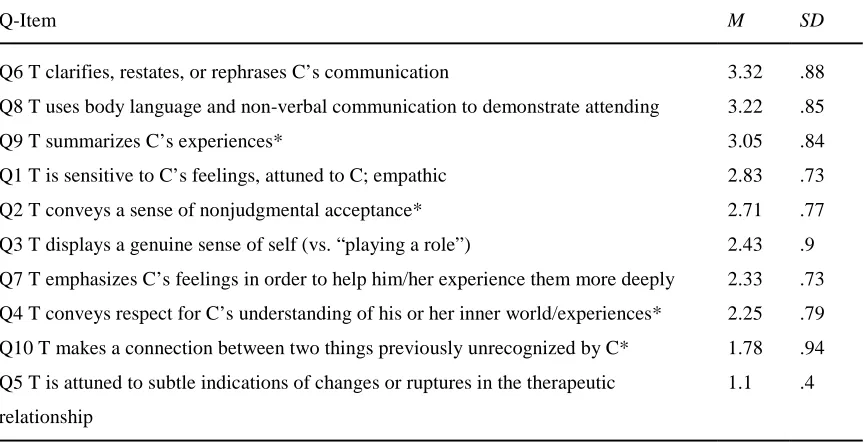
means and standard deviations were calculated for individual Q-set items (see Table 1). The most common Q-set characteristic noted in the ratings of the sessions is “T clarifies, restates, or
rephrases C’s communication” (Q6, M = 3.32, SD = .88). The least commonly rated characteristic is “T is attuned to subtle indications of changes or ruptures in the therapeutic relationship” (Q5, M = 1.1, SD = .4). Multivariate analyses of variance (MANOVA) revealed differences within the Q-set items, Wilks’ λ (9,134) = .063, p < .001, justifying a profile analysis where the mean of each item is compared with the adjacent item using paired-sample t -tests. Items that are significantly higher than the following item are identified in Table 1.
A principal component factor analysis with varimax (orthogonal) rotation was conducted
in order to verify that the Q-set items fit the technical and relational variables intended when the items were developed. However, the factor analysis revealed four different factors within the Q-set items (see Table 2 for factor loadings). Because each of the four factors had both positively
Table 1
Rank Ordering of Q-Set Items and Their Means and Standard Deviations
Q-Item M SD
Q6 T clarifies, restates, or rephrases C’s communication 3.32 .88
Q8 T uses body language and non-verbal communication to demonstrate attending 3.22 .85
Q9 T summarizes C’s experiences* 3.05 .84
Q1 T is sensitive to C’s feelings, attuned to C; empathic 2.83 .73
Q2 T conveys a sense of nonjudgmental acceptance* 2.71 .77
Q3 T displays a genuine sense of self (vs. “playing a role”) 2.43 .9
Q7 T emphasizes C’s feelings in order to help him/her experience them more deeply 2.33 .73
Q4 T conveys respect for C’s understanding of his or her inner world/experiences* 2.25 .79
Q10 T makes a connection between two things previously unrecognized by C* 1.78 .94
Q5 T is attuned to subtle indications of changes or ruptures in the therapeutic
relationship
1.1 .4
Notes. N = 143 psychotherapy sessions. T = Therapist, C = Client. Possible scale responses for each item range from 1 to 10, with 1 = Most Characteristic, 2 = Somewhat Characteristic, 3 = Slightly
Characteristic, 4 = Least Characteristic. Q-items ranked in order of most frequently attributed to observed therapist to least frequently attributed to observed therapist. *Item is significantly higher than the following item, using a pair-samples t-test (p<.05).
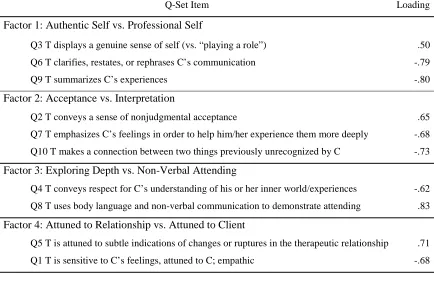
Table 3). Factor names are developed as follows: Authentic Self vs. Professional Self,
Acceptance vs. Interpretation, Exploring Depth vs. Non-Verbal Attending, and Attuned to Relationship vs. Attuned to Client.
Table 2
Factor Analysis Loadings of Q-Set Items
Q-Item Factors
1 2 3 4
Q1 T is sensitive to C’s feelings, attuned to C; empathic .26 .07 .17 -.68
Q2 T conveys a sense of nonjudgmental acceptance .31 .65 -.16 -.29
Q3 T displays a genuine sense of self (vs. “playing a role”) .5 .42 -.1 .18
Q4 T conveys respect for C’s understanding of his or her inner
world/experiences .18 .08 -.62 .31
Q5 T is attuned to subtle indications of changes or ruptures in the
therapeutic relationship .18 .1 .11 .71
Q6 T clarifies, restates, or rephrases C’s communication -.79 .02 .15 -.05
Q7 T emphasizes C’s feelings in order to help him/her experience
them more deeply .32 -.68 .12 -.26
Q8 T uses body language and non-verbal communication to
demonstrate attending .02 .07 .83 .17
Q9 T summarizes C’s experiences -.8 .08 -.04 .15
Q10 T makes a connection between two things previously
unrecognized by C .05 -.73 -.38 -.01
Notes. T = Therapist, C = Client. Q-set items 1 through 5 are relational variables and 6 through 10 are technical variables.
Correlations
Once the therapy process factors were established, they were correlated with ORS and
SRS scores at the beginning, middle, and end of psychotherapy. This is a process similar to that used by Jones and Pulos (1993), but on an abbreviated scale. Therapist GRE scores were also correlated to ORS and SRS ratings. The means and standard deviations for all SRS scores are
Table 3
Q-Set Item Factor Names and Loadings
Q-Set Item Loading
Factor 1: Authentic Self vs. Professional Self
Q3 T displays a genuine sense of self (vs. “playing a role”) .50
Q6 T clarifies, restates, or rephrases C’s communication -.79
Q9 T summarizes C’s experiences -.80
Factor 2: Acceptance vs. Interpretation
Q2 T conveys a sense of nonjudgmental acceptance .65
Q7 T emphasizes C’s feelings in order to help him/her experience them more deeply -.68
Q10 T makes a connection between two things previously unrecognized by C -.73
Factor 3: Exploring Depth vs. Non-Verbal Attending
Q4 T conveys respect for C’s understanding of his or her inner world/experiences -.62
Q8 T uses body language and non-verbal communication to demonstrate attending .83
Factor 4: Attuned to Relationship vs. Attuned to Client
Q5 T is attuned to subtle indications of changes or ruptures in the therapeutic relationship .71
Q1 T is sensitive to C’s feelings, attuned to C; empathic -.68
Notes. T = Therapist, C = Client.
Table 4
SRS Item Means and Standard Deviations
Item M SD
SRS 1: Relationship 9.34 .93
SRS 2: Goals and Topics 9.14 1.12
SRS 3: Approach or Method 9.09 1.18
SRS 4: Overall 9.24 1.01
SRS Sum 36.3 5.82
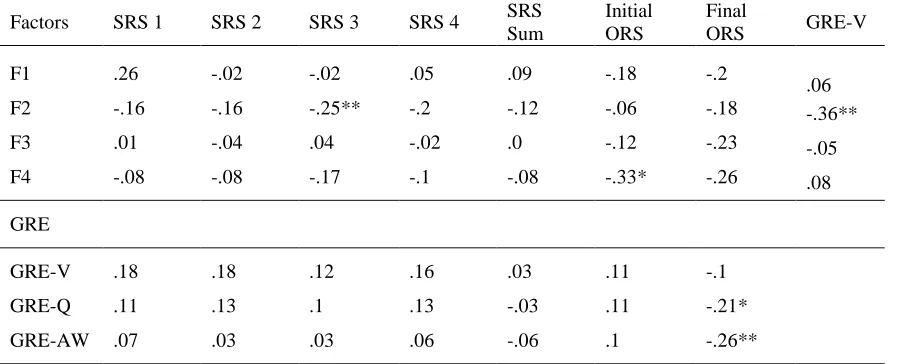
Table 5
Factor Correlations
Factors SRS 1 SRS 2 SRS 3 SRS 4 SRS Sum
Initial ORS
Final
ORS GRE-V
F1 .26 -.02 -.02 .05 .09 -.18 -.2
.06
F2 -.16 -.16 -.25** -.2 -.12 -.06 -.18 -.36**
F3 .01 -.04 .04 -.02 .0 -.12 -.23 -.05
F4 -.08 -.08 -.17 -.1 -.08 -.33* -.26 .08
GRE
GRE-V .18 .18 .12 .16 .03 .11 -.1
GRE-Q .11 .13 .1 .13 -.03 .11 -.21*
GRE-AW .07 .03 .03 .06 -.06 .1 -.26**
Notes. * Correlation is significant at the .05 level. ** Correlation is significant at the .01 level. SRS = Session Rating Scale. Each number next to the SRS indicates a particular question on the SRS form (1-4). ORS = Outcome Rating Scale, GRE = Graduate Record Examination, V = Verbal Reasoning, Q =
Quantitative Reasoning, AW = Analytical Writing.
No relationship was found between the overall SRS sum and any of the four therapist
factors. However, a small correlation was observed between therapist factor 2 and the client’s rating of the therapist’s approach and method in session (SRS item 3) (r = -.252). The more accepting a therapist was (Factor 2), the lower the approach/method score is on the SRS, suggesting that clients preferred the therapist to emphasize feelings and make interpretations rather than practice nonjudgmental acceptance of the client. At least in this sample, more
therapist direction in the session helps the client feel good about the therapist’s approach and method to therapy. Additionally, correlational results suggest that the higher the client’s initial
Further, therapists who emphasize interpretation over acceptance, using skills Q7 (T
emphasizes C’s feelings in order to help him/her experience them more deeply) and Q10 (T makes a connection between two things previously unrecognized by C), have higher GRE scores
Chapter 4
Discussion
The results failed to support this study’s first hypothesis that two distinct categories
consisting of technical-based and relational-based factors would be revealed in the Q-sort. Additionally, therapists who were rated higher on relational based factors did not show stronger therapeutic alliance or better therapeutic outcome than those rated higher on technical based
factors, disconfirming our second hypothesis.
Though this study did not confirm our hypotheses, some secondary findings are worth
considering both for their potential clinical implications and for direction in future research. Therapists Factors
We anticipated two factors to emerge based on Q-set item selection: one for relational
skills and one for technical skills. Instead, we found four factors, and three of the four showed a bipolarity that distinguished relational from technical skills. This factor structure is intriguing
and has implications for future work. For example, one of the factors suggests that the more a therapist practices nonjudgmental acceptance in session, the less active they are in emphasizing the client’s feelings and making interpretations. Additionally, the factor analysis indicates that
the more a therapist explores depth with the client about his or her inner experience, the less the therapist practices non-verbal attending skills. Further, therapists who display a genuine sense of
in the therapeutic relationship, the less empathic, sensitive to the client’s feelings, and attuned to
the client he or she appears to be. This last example indicates that relational attunement to the therapeutic relationship is perceived by independent raters to come at the cost of the therapist’s
attunement to the individual client, or vice versa.
The four factor results indicate that relational characteristics may not be able to be
cleanly categorized together. For example, therapists who practice nonjudgmental acceptance are
not necessarily exploring depth with clients or displaying a genuine sense of self. This finding suggests that the relationship competency may contain multiple factors that do not overlap. Some
therapists may be relationally competent in some areas but not in others. Personality
characteristics or maturity may affect competency or development in these different areas. For example, a therapist may display a genuine sense of self but may not naturally practice
nonjudgmental acceptance due to a lack of maturity and experience with self and others. The results of this study also indicate that we do not know which relational therapist factors are
actually most helpful for successful therapy outcome. Secondary Correlations of Interest
The clients in this study who had therapists who used more verbal emphasis on the
client’s feelings and interpretation rated the therapist’s approach/method for the session higher than clients who had therapists who practiced more nonjudgmental acceptance. This finding
suggests that clients prefer the therapist to be more verbally active or directive in session, at least within a short-term 10-session model. The therapists in this study were learning and practicing Rogerian therapy skills and were instructed to follow the client’s lead in session while avoiding
clients who preferred a more active style in therapy, which may explain why a skill-based
approach appears to be perceived by clients as a better approach, though there is no evidence that this produces superior outcome in therapy. Therapists in this study who verbally emphasized the
client’s feelings and used interpretation had higher overall GRE scores than therapists who did not use these skills as often. This finding may suggest that people who have higher levels of intelligence are more apt to make connections between two things previously unrecognized by
the client and to emphasize the client’s affect. This makes sense given that individuals with high Verbal Reasoning GRE scores are able to analyze and draw conclusions from discourse, identify
the author’s perspective and/or assumptions, understand multiple levels of meaning, distinguish major from minor points, and understand relationships among words and among concepts (Educational Testing Service, 2015). Interpretation and emphasis of affect are also the only
therapist skills that correlated with higher scores on the approach/method question on the SRS. However, the results show that the stronger the therapist is in nonverbal intelligence, the worse
his or her client reports to be doing at the end of therapy. High scores on the quantitative reasoning and analytical writing sections on the GRE indicate that one is able to interpret and analyze quantitative information, solve problems using mathematical models, articulate complex
ideas, examine the evidence for claims, and sustain a well-focused, coherent discussion (Educational Testing Service, 2015). If one is skilled in these areas but lacks the ability to
While these findings may anecdotally shed light on therapy outcome, they should be
viewed cautiously because of the low magnitudes of the correlations observed. Though
statistically significant, the correlations account for only a miniscule amount of variation. While
the evidence is not strong enough to assert that higher scores on quantitative reasoning and analytic writing sections of the GRE mean that one will not succeed in clinical training, it is important to note that in some cases one may struggle with the more verbal, nuanced aspects of
relationship, possibly impeding therapeutic success.
This study also suggests that therapists focus more on the client as an individual versus
attending to the client-therapist relationship when the client starts out with greater satisfaction across multiple domains of his or her life (higher initial ORS scores). Again, this finding should be viewed cautiously because of the small correlations observed, but one possible explanation for
this is that when clients are higher functioning, therapists’ countertransference may be less apparent or intense, hence not signaling awareness of the relational dynamics and possible
ruptures and need for repair within the therapeutic relationship. Understanding that this tendency occurs with clients who are higher functioning is relevant for clinical training of doctoral
candidates, who often complete their initial year of training with clients experiencing minimal
distress, where focus on the management of the relational dyad may not be emphasized because the therapist may not experience it as a pressing issue. This lack of focus on the relationship
Training Implications
The current study carries implications for training in doctoral psychology programs, including admissions considerations, student support, and foundational skills training. While
higher overall intelligence is linked to positive therapeutic outcome, students who score higher on analytical writing and quantitative reasoning scores than verbal reasoning scores on the GRE may struggle with nuanced layers of communication and understanding in relationship.
Psychology doctoral programs may want to proceed cautiously with applicants who fit this profile, even though they may look impressive on paper and be able to articulate ideas well.
While this study does not suggest that such applicants do not have capacity to develop relational characteristics and succeed in training, it is important for doctoral programs to recognize that these students may need extra support in developing specific relational ability and understanding.
The finding that students are shown to have difficulty attending to rupture and repair in the therapeutic relationship with low distress clients is poignant for early training, as students
often work with pre-screened, low distress clients in their first year of graduate school. Paying attention to countertransference and learning how to use oneself as a tool in therapy is an important foundational element of training that may get overlooked if students do not become
aware of their own countertransference with clients in low distress. Since therapists-in-training may not be alerted to pay attention to rupture and repair through their own awareness of
countertransference feelings with such clients, they likely need specific guidance and thorough training in this area. Focused training on self-awareness from the beginning of graduate school is important if students are going to continue to build onto this skillset throughout their training.
developing therapeutic alliance and succeeding in relational competency, yet doctoral programs
often focus on technical skills training in the first year of their programs, viewing relational characteristics as more advanced skills that will develop as time goes on. As foundational as
these characteristics are, the training and development of these traits and skills should take their place at the forefront of clinical psychology training early on, where they can lay the foundation for continued development throughout training and identify and provide support for students who
struggle in these areas. Limitations
There are many limitations to the present study, including the short-term therapy upon which outcome was based, in addition to a non-clinical client population that was prescreened and in low-distress. The SRS scores, which was the only measure of therapeutic alliance in this
study, were self-report and had a significant ceiling effect. Additionally, the student therapists were in their first year of clinical training and they may not have demonstrated the skills or
relational characteristics as clearly as experienced therapists might have. Further, the TAs who completed the Q-sort for the first year students were not expert researchers and had no prior experience rating therapists’ skills or attributes. Finally, the correlations that were found in this
study were mild to moderate, necessitating caution about over interpretation of results.
Another limitation is in the use of self-report measures for both therapeutic alliance and
overall therapy outcome. Self-report provides a depiction of how the client perceives aspects of therapy and outcome, which has inherent value in understanding how the client feels about his or her experience. Depending on the goals of the client in therapy, this may suffice for
However, if the mode of therapy is depth, insight-oriented psychotherapy, the client relies on the
therapist’s expertise to engage in ways that reach past the client’s conscious experience,
requiring measurement of therapy outcome that do not rely exclusively on face-value self-report
from the client or therapist. If, as research suggests, people’s own self-assessment has been shown to be an inadequate and ineffective measure of actual competence (Dunning et al., 2004; Kruger & Dunning, 1999; Johnson et al., 2012), this raises as suspect the idea that clients’ own
self-assessment reports a complete depiction of their underlying health and functioning. Additionally, for clients who are not experiencing acute distress, there is little room for the
impact of therapy on their own health or growth to be captured in a self-report measure, leading to a dramatic ceiling effect. The present study exhibits these limitations, as clients consisted of a pre-screened, low-distressed undergraduate student population. The ceiling effect of the SRS for
the present study is noted and reported in Table 4. Directions for Future Research
While this study points to interesting areas to continue to research, it also reinforces the idea that the relationship competency is complex, nebulous, and involves multidimensional factors that are difficult to recognize, train for, and assess. Measuring therapy outcome through
ways other than self-report is imperative for future research, such as using the Shedler-Westen Assessment Procedure (SWAP; Shedler & Westen, 2007) or assessing characterological change
through pre and post therapy personality assessment and projective measures. Future studies with larger samples from clinical populations could continue to explore the impact of different areas of intelligence on therapeutic alliance and outcome, impacting how training programs screen
who might struggle with more nuanced aspects of relationship and communication. Additionally,
qualitative research remains an important avenue for collecting nuanced data about an individual’s relational capacity, and may act as a precursor to the measurement of this
ambiguous competency benchmark.
Further research on the four factor solution could be conducted by creating more Q-items and using the Q-sort on more experienced therapists, with the goal of further parsing out
technical and relational variables and testing to see if more of the relational variables string together. The factor loadings could then be correlated with more sophisticated outcome measures
in order to decipher which factors affect successful therapy outcome.
Once an appropriate measurement for the relationship competency is established, research on correlation between success in the relationship competency and other competencies
should be done. If a clinical psychology doctoral student has strong ability in the relationship competency, research indicates that he or she will likely perform better across all competencies
than peers who struggle with the relationship competency (Mangione & Nadkarni, 2010).
Research looking into the nuanced data among these competencies could help decipher how they are related. Additionally, self-reflection, curiosity, flexibility, open-mindedness, and the ability
to be one’s genuine self are all paramount for the development of relational competency (Mangione & Nadkarni, 2010; Michel, 2011; Norcross & Lambert, 2011) and are also all areas
of growth encouraged and developed in a depth-oriented therapy. Studying the impact of student’s personal therapy on the development of their relationship competency and
research could have an impact on the level of encouragement or requirement of clinical
psychology programs for their students to engage in their own therapy.
Investigating how clinical psychology doctoral programs are currently training and
assessing for the relationship competency could shed light on current practices and opinions of faculty and students around this issue. Learning about admissions standards, benchmark requirements, and training/remediation in individual programs may open communication
channels within programs about the need and difficulty in this area of training. It is important to assess the current status and attitudes about training in order to thoughtfully develop this
competency area. Additionally, amidst the pressure to accept and retain students for financial reasons within programs, relationship competency should remain at the center of importance for admission criteria and ongoing performance evaluation, as it is imperative to success in various
other competency areas (Mangione & Nadkarni, 2010). Conclusion
The relationship competency is presumably connected to therapeutic alliance, therapy outcome, and success in graduate training, but continues to require research around effective assessment and implementation of this competency into clinical doctoral training. While the
current study aimed to separate this complex competency into relationship and technical factors in order to understand relational characteristics that impact success in therapy, a more
complicated structure was found. The finding of four different relational factors suggests that there are different aspects to relationship competency that do not necessarily overlap. Further, the only therapist characteristic found in this study that is shown to impact therapy outcome is
The relationship competency remains as both the substrate that underlies success in
therapy and other competencies in clinical psychology graduate school training, as well as the most complex and difficult competency to assess and train for. This study’s modest findings and
limitations beg for further research in this area to expand our understanding of relational characteristics, measurement and training of them, and their impact on therapy outcome. If relationship lies at the center of professional life for a psychologist, as Despland et al. (2009)
References
Ablon, J. S., Levy, R. A., & Smith-Hansen, L. (2011) The contributions of the Psychotherapy
Process Q-set to psychotherapy research. Research in Psychotherapy, 14, 14-48.
Retrieved from http://www.researchinpsychotherapy.net
Busseri, M. A., & Tyler, J. D. (2003). Interchangeability of the working alliance inventory and
working alliance inventory, short form. Psychological Assessment, 15, 193-197.
Campbell, A., & Hemsley, S. (2009). Outcome rating scale and session rating scale in
psychological practice: Clinical utility of ultra-brief measures. Clinical Psychologist, 13,
1-9.
Despland, J. N. R., Yves, D., Martin, C., Thierry, B., & Véronique, K. U. (2009). The role of
alliance in relationship between therapist competence and outcome in brief
psychodynamic psychotherapy. Journal of Nervous and Mental Disease, 5, 362-367. doi:
10.1097/NMD.0b013e3181a20849
Duncan, B. L., Miller, S. D., Sparks, J. A., Claud, D. A., Rene Reynolds, L., Brown, J., & Johnson, L. D. (2003). The session rating scale: Preliminary psychometric properties of a “working” alliance measure. Journal of Brief Therapy, 3, 3-12.
Dunning, D. (2011). The dunning-kruger effect: Being ignorant of one’s own ignorance. In J. M.
Olson & M. P. Zanna (Eds.) Advances in experimental social psychology, 44,
247-296. San Diego, CA: Academic Press.
Dunning, D., Heath, C., & Suls, J. M. (2004). Flawed self-assessment: Implications for health,
education, and the workplace. Psychological Science in the Public Interest, 5, 69-106.
Education Testing Service, (2015). GRE test content and structure. Retrieved from
https://www.ets.org/gre/revised_general/about/content/
Fouad, N. A., Gruss, C. L., Hatcher, R. L., Kaslow, N. J., Hutchings, P. S., Madson, M. B., …
Crossman, R. E. (2009). Competency benchmarks: A model for understanding and measuring competence in professional psychology across training levels. Training and Education in Professional Psychology, 3, S5-S26.
Horvath, A. O. (2005). The therapeutic relationship: research and theory. An introduction to the special issue. Psychotherapy Research, 15, 3-7.
Horvath, A. O., & Symonds, B. D. (1991). Relation between working alliance and outcome in psychotherapy: A meta-analysis. Journal of Counseling Psychology, 38, 139-149. Jones, E. E., & Pulos, S. M. (1993). Comparing the process in psychodynamic and
cognitive-behavioral therapies. Journal of Consulting and Clinical Psychology, 61, 306-316. Johnson, W. B., Barnett, J. E., Elman, N. S., Forrest, L., & Kaslow, N. J. (2012). The competent
community: Toward a vital reformulation of professional ethics. American Psychologist,
67(7), 557-569. doi:10.1037/a0027206
Kruger, J., & Dunning, D. (1999). Unskilled and unaware of it: How difficulties in recognizing
one’s own incompetence lead to inflated self-assessments. Journal of Personality and
Social Psychology, 77, 1121–1134. doi:10.1037/0022-3514.77.6.1121
Lambert, M. J., Burlingame, G. M., Umphress, V., Hansen, N. B., Vermeersch, D. A., Clouse, G. C., & Yanchar, S. C. (1996). The reliability and validity of the outcome questionnaire.
Luborsky, L., Barber, J. P., Siqueland, L., Johnson, S., Najavits, L. S., Frank, A., & Daley, D.
(1996). The revised helping alliance questionnaire (HAq-II): Psychometric properties.
The Journal of Psychotherapy Practice and Research, 5, 260-271.
Mangione, L., & Nadkarni, L. (2010). The relationship competency: Broadening and Deepening.
In M. B. Kenkel & R. L. Peterson (Eds.) Competency-based Education for professional
Psychology (pp.69-86). Washington, DC: American Psychological Association.
Michel, K. (2011). General aspects of therapeutic alliance. In K. Michel & D. A. Jobes, (Eds.)
Building a therapeutic alliance with the suicidal patient (pp.13-28). Washington, DC:
American Psychological Association.
Miller, S. D., Duncan, B. L., Brown, J., Sparks, J. A., & Claud, D. A. (2003). The outcome rating scale: A preliminary study of the reliability, validity, and feasibility of a brief visual
analog measure. Journal of Brief Therapy, 2, 91-100.
National Council of Schools of Schools and Programs in Professional Psychology (2007).
Competency development achievement levels. Approved for membership on August 15,
2007 for inclusion in the NCSPP education and training model in professional
psychology.
Norcross, J. C., (Ed.). (2011). Psychotherapy relationships that work: Evidence-based responsiveness (2nd ed.). New York, NY: Oxford University Press.
Norcross, J. C., & Lambert, M. J. (2011). Psychotherapy relationships that work II.
Psychotherapy, 48, 4-8.
Oliver, M. N. I., Bernstein, J. H., Anderson, K. G., Blashfield, R. K., & Roberts, M. C. (2004).
psychology training programs. Professional Psychology: Research and Practice, 35, 141-147.
Peterson, R. L. (2007). Standards for education in professional psychology: National Council of
Schools and Programs in Professional Psychology resolutions through 1996. Un- published manuscript.
Piper, W. E., Azim, H. F. A., Joyce, A. S., & McCallum, M. (1991). Transference
interpretations, therapeutic alliance and outcome in short-term individual therapy.
Archives of General Psychiatry, 48, 946-953.
Shedler, J., & Westen, D. (2007). The Shedler-Westen assessment procedure (SWAP): Making personality diagnosis clinically meaningful. Journal of Personality Assessment, 89, 41-55.
Smith-Hansen, L., Constantino, M. J., Piselli, A., & Remen, A., (2011). Preliminary results of a video-assisted psychotherapist workshop in alliance strategies. Psychotherapy, 48, 148-162. doi: 10.1037/a0022184
Tracey, T. J., & Kokotovic, A. M. (1989). Factor structure of the working alliance inventory.
Appendix A
Q-Sort Items
1. T is sensitive to P's feelings, attuned to P; empathic 2. T conveys a sense of nonjudgmental acceptance
3. T displays a genuine sense of self (vs. "playing a role")
4. T conveys respect for P's understanding of his or her inner world/experiences
5. T is attuned to subtle indications of changes or ruptures in the therapeutic relationship 6. T clarifies, restates, or rephrases P's communication
7. T emphasizes P's feelings in order to help him/her experience them more deeply 8. T uses body language and non-verbal communication to demonstrate attending 9. T summarizes P's experiences
Appendix B
Session Rating Scale (SRS V.3.0)
Name ________________________Age (Yrs):____ ID# _________________________ Gender:_______ Session # ____ Date: ________________________
Please rate today’s session by placing a mark on the line nearest to the description that best fits your experience.
Relationship
I---I
Goals and Topics
I---I
Approach or Method
I---I
Overall
I---I
International Center for Clinical Excellence _______________________________________
www.scottdmiller.com
Appendix C
Outcome Rating Scale (ORS)
Name ________________________Age (Yrs):____ Gender_____________ Session # ____ Date: ________________________
Who is filling out this form? Please check one: Self_______ Other_______ If other, what is your relationship to this person? ____________________________
Looking back over the last week, including today, help us understand how you have been feeling by rating how well you have been doing in the following areas of your life, where marks to the left represent low levels and marks to the right indicate high levels. If you are filling out this form for another person, please fill out according to how you think he or she is doing.
Individually
(Personal well-being)
I---I
Interpersonally
(Family, close relationships)
I---I
Socially
(Work, school, friendships)
I---I
Overall
(General sense of well-being)
I---I
International Center for Clinical Excellence _______________________________________
www.scottdmiller.com
Appendix D
Informed Consent (First Year Student)
Purpose of this study: To gain information regarding training experiences in relationship competency and to explore therapist characteristics that are related to therapeutic alliance. Procedure: You are being asked to give your consent for your Clinical Foundations TA to
observe and categorize different therapeutic characteristics in your videotaped sessions with your pseudo clients, to be collected by this researcher. Your consent is also asked for obtaining your aggregate SRS/ORS scores from your 10 sessions with each pseudo client, as well as use of your GRE score upon entrance to the GDCP, for correlational purposes.
Additionally, your TA will be asked to fill out a Likert-type questionnaire pertaining to your relational characteristics according to their observation.
There is no time-commitment beyond your existing requirements for Clinical Foundations required to participate in this study.
Confidentiality: All materials (including TA observation, questionnaire, SRS/ORS, and GRE scores) will be de-identified and given an identification number for tracking purposes before this researcher sees them. Your TAs will not see any of your identified materials other than what they personally fill out. The information from this study will be kept secure and private in a locked filing cabinet. While results may be reported or published, there will be no identifying
information that could connect you to the results.
Discomfort and risks from participation: Feelings of discomfort can arise with any type of personal or professional evaluation or assessment. The purpose of this study is purely for education about relationship competency training and results will not be used in any way that will reflect on you personally. There are no anticipated risks from participation in this study. Voluntary Nature of the Study: Your participation is completely voluntary. By signing below, you are giving your consent to participate in this study.
Appendix E
Informed Consent (TA)
Purpose of this study: To gain information regarding training experiences in relationship competency and to explore therapist characteristics that are related to therapeutic alliance. Procedure: You will be asked to fill out an 11-item Likert-type questionnaire about the first year students in your TA group pertaining to their relational characteristics based on your observation. You will then be asked to participate in a short training with this researcher about how to use a 10-item Q-sort, with which you will be instructed to observe and categorize different therapeutic characteristics in three of each of your students’ therapy videos throughout the semester.
Confidentiality: All materials will be de-identified and given an identification number for tracking purposes before this researcher sees them. The information from this study will be kept secure and private in a locked filing cabinet. While results may be reported or published, there will be no identifying information that could connect you to the results.
Discomfort and risks from participation: Feelings of discomfort can arise with any type of personal or professional evaluation or assessment. The purpose of this study is purely for education about relationship competency training and results will not be used in any way that will reflect on you or the student you are assessing personally. There are no anticipated risks from participation in this study.
Voluntary Nature of the Study: Your participation is completely voluntary. By signing below, you are giving your consent to participate in this study.
Appendix F
Curriculum Vitae
J
ACQUELYN
M.
R
ODRIGUEZ
39 School Street #3, Montpelier, VT 05602 (503) 422-2727
EDUCATION
Present Doctoral Student in Clinical Psychology Program: George Fox University,
Graduate Department of Clinical Psychology (APA-Accredited),
Newberg, Oregon
Advisor: Mark R. McMinn, PhD, ABPP/CL
Doctoral Dissertation, Prelim Passed: Relationship Competency: An Exploration of Training and Relationship Assessment in an APA Accredited Doctoral Program
2013 Master of Arts, Clinical Psychology: George Fox University, Graduate
Department of Clinical Psychology (APA-Accredited), Newberg, Oregon
2009 Bachelor of Arts, Psychology: Trinity Western University, Langley, British
Columbia
SUPERVISED CLINICAL EXPERIENCE
2015 - Present Internship
Pre-doctoral Psychotherapy Intern
Norwich University Counseling and Psychological Services, Northfield, Vermont
Populations: University students, staff, faculty.
Clinical Duties:
• Conduct weekly and twice weekly psychoanalytically informed therapy with students, faculty, and staff with a caseload of around 25 patients.
• Administer cognitive, personality, and neuropsychological assessments to patients and compose integrated reports with case conceptualizations and treatment recommendations.
• Provide individual and couples therapy.
• One hour of weekly group supervision.
• Two hours of weekly didactics.
2014 - Present Pre-internship
Psychology Student
Kaiser Permanente Northwest, Salem, Oregon
Populations: Various; Community population served.
Clinical Duties:
• Consult with multi-disciplinary team regarding health status, assessment results, and treatment implications for psychiatric and medical conditions.
• Intervene using evidence-based treatments such as interpersonal therapy, time-limited psychodynamic therapy, motivational interviewing, cognitive therapy, and solution-focused therapy.
• Administer neuropsychological assessments to patients and compose integrated reports with case conceptualizations and treatment recommendations.
• Provide individual, couples, and group therapy with patients.
• Supervisors: Catherine E. deCampos, PsyD, CFNP, Robert Schiff, PhD; weekly individual supervision.
• Consultants: Timothy Neary, PsyD, Adriane Sanchez, PsyD; weekly consultation and didactic training.
2013 - Present Supplemental Practicum
Behavioral Heath Consultation Team: On-Call Emergency Department Providence Newberg Medical Center, Newberg, Oregon
Willamette Valley Medical Center, McMinnville, Oregon
Populations: Various; Community population served.
Clinical Duties:
• Provide 12-hour behavioral health consultation services for emergency department and medical/surgical unit one day per two weeks.
• Assess patients for suicidality, homicidality, chronic pain, dementia, and mental status examination, and various other psychological factors affecting medical care.
• Advise hospital staff to discharge or psychiatrically hospitalize patient.
• Arrange inpatient psychiatric placement and transportation for patients who meet criteria for hospitalization.
• Hours: On-call 12 hours every other week, hours of direct service vary.
• Supervisors: Mary Peterson, PhD, ABPP/CL, William Buhrow, Jr, PsyD, Joel Gregor, PsyD; weekly group supervision that includes case presentation and case discussion.
2013 - 2014 Practicum II
Psychology Trainee
Oregon State Hospital, Salem, OR
Clinical Duties:
• Consult with patients and a multi-disciplinary team regarding assessment results and treatment implications for psychiatric and neuropsychological conditions.
• Intervene using motivational interviewing, supportive psychodynamic, insight-oriented intervention, and relational interventions.
• Administer comprehensive psychological assessments to patients and compose integrated reports with case conceptualizations, diagnostic formulations, and treatment recommendations.
• Provide individual, group, and milieu therapy with patients.
• Monthly onsite didactic training and case presentation.
• Present four clinical cases to a supervisory clinical team.
• Supervisors: Carlene Shultz, PsyD, Brian Hartman, PsyD; weekly individual and group supervision.
2012 - 2013 Practicum I
Student Therapist
New Urban High School /Clackamas School District, Clackamas, Oregon
Populations: Adolescents: alternative high school and middle school students.
Clinical Duties:
• Served middle and high school students experiencing a wide range of clinical pathology, relational problems, disabilities, and developmental problems.
• Provided individual psychotherapy and co-facilitated group psychotherapy.
• Participated in consultation with school staff, assessment meetings with parents, students, and individualized education plan teams, and group curriculum
planning.
• Conducted comprehensive intelligence and cognitive assessments, including structured interviews, observations, and report writing.
• Supervisor: Fiorella Kassab, PhD; weekly individual and group supervision.
2011 - 2012 Prepracticum
Student Therapist
University Health and Counseling Center: George Fox University, Newberg, Oregon
Populations: Young adults: college students. Clinical Duties:
• Provided outpatient services to undergraduate students including clinical interview, diagnosis, and individual psychotherapy.
• Conducted intake interviews.
• Administrative responsibilities included report writing, weekly chart notes, case presentations, and consultation.
• Formulated diagnostic impressions, treatment plans, and case formulations.
• Presented clinical case to a supervisory clinical team.
• Consultant: Michael J. Vogel, MA; weekly consultation.
NATIONAL PRESENTATIONS
Rodriguez, J. R., Birch, R., Galuza, T., & McMinn, M. R. (2013, August). Religious and Spiritual Diversity Training at Explicitly Religious Doctoral Programs. Poster presented at the annual meeting of the American Psychological Association, Honolulu, HI.
Block, M. M., Goetsch, B. L., Birch, R. F., Rodriguez, J. M., McMinn, M. R. (2013, August).
Researcher practitioner gap: Bridging the gap in anorexia nervosa treatment. Poster presented at the annual meeting of the American Psychological Association, Honolulu, HI.
McMinn, M. R., Birch, R., Galuza, T., & Rodriguez, J. M., (2013, April). Acomparison of religious and spiritual diversity training at religious and other institutions. Paper presented at the annual meeting of the Christian Association of Psychological Studies, Portland, OR.
Gerdin, T. A., Uhder, J., Rodriguez, J. M., & Modrell, J. (2013, April). The religious nature of life longings in old age. Poster presented at the annual meeting of the Christian Association of Psychological Studies, Portland, OR, and at the annual meeting of the American Psychological Association, Honolulu, HI.
RESEARCH EXPERIENCE
2013 - Present Program Evaluation Consultant: George Fox University, Newberg, Oregon
• Conducted evaluation to assess student attitudes and barriers related to usage of an EPPP preparation program implemented into student curriculum. Presented findings to faculty at George Fox University.
2012 - 2013 Additional Research: Religious and Spiritual Diversity Training at Explicitly Religious Doctoral Programs.
Coauthors: Mark McMinn, PhD, ABPP/CL, Ryan Birch, BA, Timofey Galuza, BA
Current Status: Submitting for publication.
• An empirical investigation comparing the Vogel et al. (2012) findings of diversity training in doctoral programs in the American Psychological Association with that of explicitly religious doctoral programs in the American Psychological Association.
2012 - Present Doctoral Dissertation, Prelim Passed: Relationship Competency: An Exploration of Training and Relationship Assessment in an APA Accredited Doctoral Program. George Fox University, Newberg, Oregon