ORIGINAL ARTICLE
An Experimental Study of Features
Search under Visual Interference in Radar
Situation-Interface
Xiao‑Li Wu
1*, Jing Li
2and Feng Zhou
1Abstract
As was found through information interface analysis of target search in fighter radar situation environment, there are many of visual attention problems caused by complex environment and features, which generate visual interfer‑ ence. This paper extracts the interference environment of situation interface and the feature of information matter as the major factors, also and adopts the interference environment, featured items and quantity as three variables to conduct the experimental study on simulation of the feature search fighter information identification. The experi‑ mental results showed that the information identification under low and high interference environments revealed to a significant difference. Due to the high interference environment formed by various information presented in the radar situation‑interface, only if being forcibly free from interference could the pilots be able to realize the information identification precisely. Three features, i.e., regular shape‑single color, irregular shape‑single color and irregular shape‑ hybrid color, presented a trend of progressive increase of reaction time, which suggested that irregular shape‑hybrid color was the difficult cognition and the long reaction time. The eye movement data also suggested that the target search under high interference environment displayed the longer fixation time, more saccade counts and longer scan path, than under low interference environment. In addition, the first saccade time, the total fixation time and saccade counts of featured items search presented an increasing trend, which is the same as reaction. Therefore, the colors and shapes of featured items exerted a remarkable influence to the judgment of objects target. In conclusion the interference environment and the information matter features both have played the important roles in influence of the information identification in the radar situation‑interface. The environment and the features are the design fac‑ tors, which needed for consideration in the information layout of the complex situation‑interface. Thus, a conclusion provides a design guideline to the rational layout and improvement of the complex information interface.
Keywords: Radar situation‑interface, Goal‑seeking, Visual interference, Interference environment, Information matter features, Target identification, Visual displays
© The Author(s) 2018. This article is distributed under the terms of the Creative Commons Attribution 4.0 International License (http://creat iveco mmons .org/licen ses/by/4.0/), which permits unrestricted use, distribution, and reproduction in any medium, provided you give appropriate credit to the original author(s) and the source, provide a link to the Creative Commons license, and indicate if changes were made.
1 Introduction
In light of the rapid development of industrial design and computer interactive media, visual information interface has become an essential method of information interac-tion in complex systems. Fighter radar situainterac-tion envi-ronment displayed by digital interactive interface and multi-level data units constitutes a complex dynamic
system. The digital interactive interface contains a large amount of information that displays and requires pilots to process large-scale information at the same time. That therefore leads to great interference as it is quite difficult for the pilot to cognize during the executive process. The display format information of matter, e.g., shapes and colors, will also lead to some interference to find various purposes. The mentioned above interferences are prone to cause omission, misreading and misjudgment in task execution. Studies have manifested that, in case of emer-gency, the display format of visual information of pilots
Open Access
*Correspondence: [email protected]
1 China College of Mechanical and Electrical Engineering, Hohai University, Changzhou 213022, China
exerts a remarkable influence on the cognitive perfor-mance of information receivers.
1.1 Literature Review
1.1.1 The Radar Situation‑Interface
Battlefield situation is the major resource for pilots to learn about the flight status data, task information as well as threat and security state information. Pilots must grasp distinct, real and complete information of combat situation, so that to have the initiative to the battlefield in hands. Thus, it is clear that the display of information about the battlefield situation is extremely significant. However, multi-level information contents may cause visual interference, which will result on pilots’ wrong perception about the information at digital display inter-face. For example, a pilot may not be able to precisely capture the target due to misunderstanding when guide probability of the acquisition missile capture in radar sit-uation-interface and thus bungle the chance of winning a battle. European and North American National Aero-nautics, and Space Administrations have conducted lots of experimental studies on improving the naturalness and effectiveness of man–machine interactions in the pilot cockpit (Mark [1]; Heather et al. [2]). These experiments are aimed to avoid nonconforming to human cognition designs or even wrong designs, to relieve the pilots’ bur-dens and reduce the hazard ratio of flight.
However, the experimental study of target search still needs to be carried in the further. The information dis-play regarding to automatic combat identification system has been studied (Heather et al. [2]). First they applied the testing environment of military simulation and vir-tual modeling to investigate the hostile and friendly forces as well as the information display formats of visual targets, for example, uniforms and helmets. The inves-tigation results were displayed respectively in pie chart and mesh chart, as well as in separated and integrated information. This paper discussed how these two groups of forms be presented to conduct the identification of combat information as well as the information analysis with combination of information reliability. After obtain-ing the reliable simulated data, there was found that the display formats of mesh chart and integrated data are more adaptive for combat information identification. Refs. [3–6] have studied the identification performances of the colors, positions and shapes of different symbols and texts, and have obtained a series of valuable results that suit to national conditions. Tong et al. [7] studies controlling machining progress based on information fusion in monitoring computer numerical and has estab-lished the structure model from information source. The layout design of fighter radar situation-interface has been evaluated experimentally and has been analyzed through
an objective evaluation technology of eye’s tracker (Wang et al. [8, 9]). They also have selected a special scheme of rational layout optimization through the evaluation by eye’s moving data indexes. Liu [10] simulated the general operation sequence of enemy attack task in avionics sys-tem to conduct interface design on infrared radar syssys-tem, navigation system, weapon mounting system and flight control system, and evaluated the rationality of inter-face layout, navigation and graphic symbols by the eye’s tracker experiment. Li et al. [11, 12] studied the influence of complex digital interfaces on color and shape codes to explore the identification performances under different time pressures. Refs. [13–26] performed physiological research on the information representation and interface design of human–machine interfaces of complex systems.
For all the mentioned above studies, the experimental data are adopted as the main evaluation method to judge the rationality of complex information interface design. Few scholars have set foot in the fields like interference environment and information matter.
1.1.2 Visual Search Experiment
According to the experimental study above, review of visual search for information symbols color, shape, type-face, position as well as icon quantity and quality have possessed a large experimental study basis, and their interactive interference effects have been primarily dem-onstrated by experiments. Although all of these are basic psychology experiments, they have certain reference value for practical application of radar situation-interface based on which the preliminary presupposition of this experiment could be obtained.
1.2 Proposed Approach
Starting from the visual interference of cognitive psychol-ogy, this paper conducts an experimental study of fighter situation-interface feature search as next:
Simulate the radar situation-interface of radar air-to-ground attack display (AD) of F35 fighter (later referred to a radar situation interface);
Extract the associated factors of visual interference; Apply the technological means of psychological experi-ment on aspects for example, interference environexperi-ment and features of information matter;
Carry out the experiment of visual interference on tar-get search;
Analyze the attentional capture and search strategy of identification the different information matters in differ-ent interference environmdiffer-ents, according to the features of visual selective attention;
Explore the law of the influence interference environ-ment and information matter features on visual search.
2 Design of Experiment 1 2.1 Assumption
During the process of the information identification interface, visual interferences makes users get into the trouble of target search, which easily causes attention shift. Especially in the case where information is highly concentrated, users can hardly identify, thus generat-ing misperception and attention failure. This experiment conducted multiple-factors of visual search tasks in allu-sion to the interference environment and information matter features tasks to analyze the influence of different interference degrees and features of visual search. Two assumptions were proposed:
Assumption 1: The more complex the environment of fighter situation-interface than the higher the interference, the longer the time of target search and the higher the error rate
Assumption 2: Visual display format of information matter (regular and irregular shapes, single color
and hybrid color) is an important factor to contrib-ute the speed of target identification.
2.2 Method
2.2.1 Materials
This experiment was planned to simulate the interface of radar situation display of American Fighter F35, and to simplify relevant icon’s information of the fighter into experimental conceptual symbols as experimental mate-rials. The interface background is colored in black, and the commonly-used colors of navigation station in green, red, yellow, blue and white. These colors were adopted for the color selection of the item features. The Figure 1
below provides the attack display and the defense display the radar situation for F35 fighter.
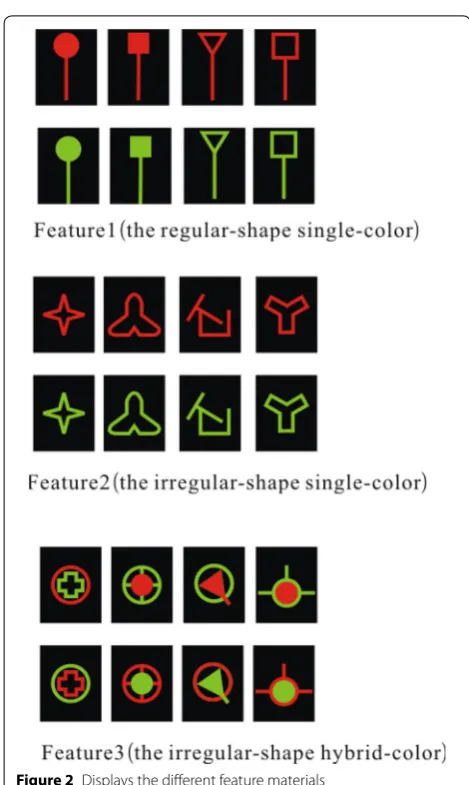
The information matters with different meanings in F35 radar defense-situation interface were extracted and drawn by simulation. 12 kinds of information mat-ters were regarded as the featured items of experimen-tal stimulus. Their size was filled with the black box of 6 mm × 7.5 mm, through of combining the shape’s fea-tures of different information matters, and selecting red and green as the major colors. The features are defined in three types: feature 1 covers the regular-shape (single-shaped, with a vertical line below) single-color presen-tation individuals; feature 2 covers the irregular-shape single-color presentation individuals; feature 3 covers the irregular-shape (mainly internal deformable based on cir-cle objects) hybrid-color integrated from red and green presentation individuals. See details in Figure 2. The experiment basically discussed the mutual interference degrees with different feature items, i.e., the interference effect of other similar sub features on one sub feature, which was taken as the target.
2.2.2 Interference Environment
All these data are all displayed within a circle of radius 78 mm in the fighter situation-interface. In the circle, there is an attack range limit of 39 mm, which presented both the morphology of the lead plane in the center and the various data of current situation around, which is causing constant interferences to subjects. All of these displays on fighter screen are constant. At the same time, randomly presented in the defensive vision: enemy planes, friendly aircrafts and unidentified objects, are variable. However, we use a simulated defense situation-interface as the fixed vision display instead of the actual situation-interface. This interface displays information what involved in experiment and cannot fix the central visual field.
randomly shown, but all concentrate in the visual range of 6°‒11°. We have design two experimental display pan-els, as examination objects both under low-interference and high-interference environments, as indicated in Figure 3.
Based on the analysis above, this experiment adopt the within-group design of 3 × 2 × 4 and apply three factors of stimulus features (1, 2, 3 types) respectively, interfer-ence degree (low-interferinterfer-ence and high-interferinterfer-ence environment), and stimulus item quantity (2, 4, 6, 8 kinds). According to the interference degree, the experi-ment is divided into two groups, and the interference degrees will appear in the experiment alternatively, each accounts for 50%. Each factor has two tries, each group has 3 × 4 × 2 tries, and 48 tries in total.
2.3 Experiment Equipment and Procedure
The experimental procedure was written by the profes-sional psychological experiment development software E-Prime. The experiment was conducted on a computer with a CPU main frequency of 3.0 GHz. The stimulus was presented in the center of the 17-inch display with screen resolution 1280 × 1024 and luminance 92 cd/ m2. The experiment was conducted in the Human– Computer Interaction Lab of Hohai University. The subject of experiment was presented by 20 undergradu-ate students in the university: 10 females and 10 males with age between 19 and 23 years old, with normal or
corrected vision, and without color blindness or color weakness. The relevant information including gender, age, major and vision was input before the experiment, as indicated in Figure 4.
First, the subjects were required to get familiar with the task environment of the radar situation defense of fighter. In this experiment the situation alternated whole time between the two states as the interference interface: low and high interference. Although some efforts should be made to avoid information interference, in time of con-ducting the experiment, a first detection item was pre-sented to remember its features (color and shape) to the subjects in a period of 500 ms. After going to the blank screen, various types of stimulus items (2‒10 in quan-tity) would be presented to judge whether the feature item previously was observed. If yes that key V would be pressed, else key N would be pressed. Also the sub-jects were prompted that two feature items with the same shape, but different colors are two different feature items. For each person, it took about 15 min to complete the whole experiment 1.
3 Design of Experiment 2
In this eye’s movement tracking experiment 2 the fea-tured items, with regular shape-single color, irregular shape-single color and irregular shape-hybrid color were collected, based on the behavior data analysis. The rules
of subjects’ physiological data, including fixation time, gaze plots and fixation points, are discussed later.
The experiment was conducted in the eye’s movement tracking laboratory of HHU (Hohai University). The Switzerland-made tobii1X120 eye tracker with a sam-ple frequency of 120 Hz and gaze location precision of 0.5° was adopted. The computer with a display pixels of 1280 × 1024 (pix), a color quality of 32-bit, and a head movement range of 30 × 16 × 20 cm was accepted. The sight-line gaze location data of the system were delayed to 3 ms and possessed an ideal gaze and instantaneous display. The system took samples from the eyeballs of subjects every 20 ms to investigate and collect the data of subjects’ eyeball movement.
The experiment was conducted in the Human–Com-puter Interaction Lab of Hohai University based on col-lected eye’s movement data of 10 participants. This experiment adopts the within-group of design 2 × 3 and applies three factors of stimulus features (1, 2, 3 types)
respectively. The interference degree (low- and high-interference environment), and 6 stimulus item quan-tity are not changed. The whole process was conducted according to the first procedure of experiment.
4 Results
The experiment 1 mainly analyzed behavioral data of the subjects in the process of target search as next: dif-ferences on reaction time under mutual interdif-ferences among various factors; error rate under various degrees of interference.
4.1 Total Reaction Time and Error Rate
As shown by the results of the 3 × 2 × 4 repeated variance analysis on reaction time, both featured item and quan-tity had shown main significant effects, and also presence of complex multi-factor interactions. Also as the result of the 3 × 2 × 4 repeated variance analysis on error rate, only the main effect of featured item was significant., and There were significant interactions between feature fac-tor and quantity facfac-tor as well as among the three inde-pendent variables (as indicated by Table 1).
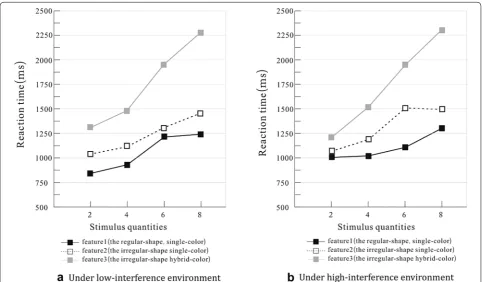
Under both low-interference and high-interference environments the reaction time and error rates of the subjects were tested when the three different featured items were presented by different quantities. The vari-ance analysis of the reaction time indicated that the main effect of featured items under low-interference environ-ment (F = 24.781, P = 0.001, p < 0.05) and the main effect of feature items under high-interference environment (F = 10.184, P = 0.012, p < 0.05) both had reached the significance level (as indicated by Figures 5(a) and (b). The variance analysis on the error rate indicated that the main effect of feature items under low-interference environment (F = 5.297, P = 0.047, p < 0.05) had reached the significance level, while the main effect of feature items under high-interference environment (F = 1.613,
P = 0.275) was insignificant, as indicated by Figures 6(a) and (b).
4.2 Influence of Interference Environment on Different Feature Search
Posterior multiple comparative tests were conducted by the least significant difference method, including both feature and quantity factor, as indicated by the results shown in Table 2. Significant differences were showed between the presentation of features 3 and 1, and that of feature 2 in reaction time under low and high interfer-ence environment. In this way, as showed by the compar-isons between the irregular shape-hybrid colored feature item, the regular shape-single colored feature item and irregular shape-single colored feature item, the informa-tion matter of relatively complex shape and color usually
featured of high search difficulty and long reaction time. Thus, in the radar situation environment the error rate under low-interference environment showed significant difference between feature 3 and feature 1. By the time under high-interference environment significant dif-ference was not showed in error rate. This also suggests that under high-interference environment there is cer-tain correlation between the error rate and error factors, which needs to be clarified through in-depth discussions, as indicated by Figures 7(a) and (b).
5 Discussions
5.1 Effect of Featured Items on Visual Search
Through an experiment of time pressure, the color of fea-tures information matter in higher cognitive capacity and speed than of its shape, regarding to studies of informa-tion matter features in complex informainforma-tion interfaces (Li et al. [9]). Also the researchers verified the influence of different code schemes on visual search through simu-lation of the electronic integrated monitoring system of A320. Based on previous studies, the information matter in the radar situation environment was designed in three kinds of different feature items as per the shape and color type features. As shown on Figure 5, data indicated that under low-interference and high-interference environ-ments, with the progressive increase of quantity, feature items showed an obvious trend of progressive increase in reaction and feature 3 (irregular shape-hybrid colored feature item) consumed the longest time. More reaction time needed in high-interference environment than in low-interference environment. Data also indicated that) the error rate presented a law different from that in reac-tion. In low-interference environment feature items 1, 2 and 3 showed a trend of progressive increase, which sug-gests that regular-shaped single colors are easier to search than irregular-shaped single colors and hybrid colors, and not susceptible to causing misjudgment issues. In high-interference environment the error rate did not show obvious trend of progressive increase, which also suggests that in an environment with multiple interfer-ing object (Figure 6). There are many factors, which may cause errors, so the eye’s movement data should be inte-grated to analyze these interference factors. This may also relate to the randomness of the detection items occurring in the stimulus item, so in the further needed classified statistics of data.
5.2 Influence of Visual Distraction on Target Search
In this experiment the high-interference environment basically simulated the complex environment of the fighter situation, and the subjects conducted visual
Figure 3 Two environments
search in an interference-free environment. Previous experimental studies on interference basically set inter-ference items through sub-feature. In this experiment the single interface (low interference) and real simula-tion scene (high interference) were employed as vari-ables, and the data showed the significant influence in reaction (Figure 7(a)). This suggests that the complexity of radar situation environment significantly interferes with the identification of information matter, which needs in-depth studies. As indicated by the error rate data (Figure 7(b)) there was no regular change. Also it
suggests that error factors are relatively complex and the general law cannot be derived only from interfer-ence and feature. However, multi-angle analysis is needed.
5.3 Influence the Existence of Detection Items on Target Search
During target search by the subjects on the stimulus fea-ture, the detection items will appear or disappear ran-domly accounting for 50% respectively. Statistics show that the reaction time was taken when the target object
Table 1 The main effect on reaction time, error rate, and their interactions for each variable
Note: * p < 0.05, ** p < 0.01, *** p < 0.001
Variation source Reaction time Error rate
Df MS F Df MS F
Interference 1 21530.157 0.129 1 0.000024 0.003
Feature 2 967379.164 11.634*** 2 0.22 3.956*
Quantity 3 443387.417 3.772* 3 0.013 2.060
Interference × Feature 3 652096.162 7.563** 3 0.015 2.514
Interference × Quantity 4 337923.102 2.756 4 0.010 1.469
Feature × Quantity 5 652984.116 28.251*** 5 0.017 3.743*
Interference × Feature × Quantity 6 547741.789 23.603*** 6 0.014 2.948*
has been searched out. It is far less than that of when the target object has not been searched out i.e., when there are no detection items, more time will be taken by the subjects on target search. Statistics on various interfer-ence environments indicate that when there are no detec-tion items, or when target search takes a longer time, the reaction time shows a trend of progressive increase with the differences of information matter features. When there are detection items it’s easy to find the target, and there is no obvious law in reaction, as indicated by the results provided in Table 3.
5.4 Comparison of Heat Maps and Gaze Plots under Different Interference Conditions
Figure 8 extracts the heat maps and gaze plots with the same featured item (irregular-shape single color) from eye movement experiment 2, under low and high inter-ference environments, respectively. Influenced by differ-ent degrees of interferences, the overplayed gaze plots of 10 subjects were obviously different. The average saccade counts 4.1 under low interference environment and 8.2 under high interference environment. Therefore, different
Figure 6 Error rates of the three feature items under different interference environment
Table 2 Posterior multiple comparative test by the least significant difference method
Note: * represents the reaching level of significance (mean error > 0.05)
Evaluation index Low interference High interference
Feature (I) Feature (J) Mean error (I-J) Standard error P Mean error (I-J) Standard error P
Reaction time Feature 1 Feature 2 − 207.65600 106.810958 0.100 − 212.63625 141.720018 0.184 Feature 3 − 729.72050* 106.810958 0.000 − 628.72200* 141.720018 0.004 Feature 2 Feature 1 207.65600 106.810958 0.100 212.63625 141.720018 0.184 Feature 3 − 522.06450* 106.810958 0.003 − 416.08575* 141.720018 0.026 Feature 3 Feature 1 729.72050* 106.810958 0.000 628.72200* 141.720018 0.004 Feature 2 522.06450* 106.810958 0.003 416.08575* 141.720018 0.026 Error rate Feature 1 Feature 2 − 0.06450 0.029148 0.069 − 0.08025 0.064618 0.261 Feature 3 − 0.09250* 0.029148 0.019 − 0.11275 0.064618 0.132
Feature 2 Feature 1 0.06450 0.029148 0.069 0.08025 0.064618 0.261
Feature 3 − 0.02800 0.029148 0.374 − 0.03250 0.064618 0.633
Feature 3 Feature 1 0.09250* 0.029148 0.019 0.11275 0.064618 0.132
interferences under high interference environment had influenced significantly by the reaction time on subjects to search the target. In addition, the heat map under low interference environment revealed to the focused atten-tion of subjects, but a distracatten-tion under high interference environment. Moreover, the attentions of some subjects were even transferred to the data information display in left bottom. The host icon in the middle and mileage play in the right, indicated the attentions, which were dis-tracted during quick search for targets.
5.5 Influence of Different Featured Items on Fixation Time We can analysis the feature areas which are more noticed by participants from point of eye gaze. Creating several AOIs (area of interest) is straightforward and covered in the user’s manual so this post will focus on features that are less commonly used. We’ll also present a few tips and tricks for designing and analyzing with AOIs.
We decide on the proper balance between selectivity and sensitivity which the gaze data around the feature items to include in the AOI calculation. Smaller AOIs increase selectivity and exclude more extraneous gaze at
Figure 7 Reaction time and error rates of the three featured items under various interference environments
Table 3 Influence of the existence of detection items on target search
Variable Reaction time Error rate
With detection items Without detection items With detection items Without detection items
M SD M SD M SD M SD
Low interference 2 1203.833 452.636 1164.158 393.707 0.428 0.222 0.053 0.229
4 1460.474 862.011 1499.526 476.553 0.496 0.368 0.105 0.315
6 1656.895 707.531 1930.529 816.107 0.478 0.316 0.235 0.437
8 2072.950 1306.35 2501.100 1348.64 0.444 0.250 0.300 0.47
High interference 2 1048.200 342.774 1375.100 1029.71 0.366 0.150 0.100 0.308
4 1498.350 666.334 1587.684 734.76 0.366 0.150 0.421 0.496
6 1845.550 595.438 2034.900 774.488 0.41 0.200 0.050 0.224
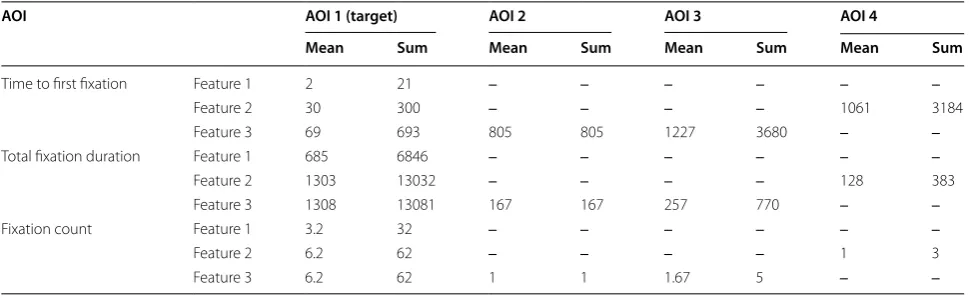
the risk of losing some actual valid looking. Larger AOIs increase sensitivity and may include more extraneous data while potentially capturing more of the actual look-ing to target object and interferent. Therefore, in the fea-tured items as the analytic objects collects the gaze plots contained three different featured items under high inter-ference and divided four AOIs (area of interest) based on the area containing target object and interferent, as it is shown in Figure 9. On this AOI 1 is the location of the featured item. The eye movement data recorded the first fixation time, fixation duration and fixation points.
The data in Table 4 suggested that featured item 1, 2 and 3 presented an increasing trend, with the trend of reaction time showed in the behavior data. Specifically, the fixation time of feature item 1 was the shortest, and the fixation points were aggregated in AOI 1; the fixation
Figure 8 Gaze plot and heat map in different environment
points of featured item 2 and 3 dispersed in AOI 2, AOI 3 and AOI 4, which explained that the interference features in these areas influenced the search tasks of irregular-shape single color and irregular-irregular-shape hybrid color. Also, as indicated the search of task, regular-shape single color was fast and freed from environmental interference.
5.6 Analysis of Error Causes
According to the distribution of error rates in Figure 6, the relationship between error factors and interferences was further analyzed by combining the eye movement data. Featured item 2 and 3 with high error rates were selected as the analytic objects. Figures 10 and 11 shows the gaze plots of two subjects, respectively. Table 5 is the simulation graph, without probe items of the featured items (irregular-shape single color); the target object of featured items was A-4, and the featured items presented by simulation materials were A-1, A-2, A-3, A-4, A-5, A-6, A-7, A-8. Figure 10 shows that the subject displayed
repeated saccades toward three red non-target objects, with total saccade counts of 11 and a reaction duration lasting of 1366 ms (The reaction time = 1517.806 ms, The error rates = 0.278). It indicated that the subject was not influenced by the other non-target objects, and different interference information in interference environments. Probably, the error was caused by the neglecting of the features of original target objects when distinguishing the features with the same color. It further explained the interference of the same color, which was more likely the result of errors. Figure 11 showed the simulation graph, with probe items of featured items (irregular-shape hybrid color). The featured item of target object was B-1, and the feature items presented by simulation materi-als were B-1, B-2, B-3, B-4, B-5, B-6, B-7, B-8. Figure 11
shows that it is going through 8 saccades. The subject was not affected by the interference environment and quickly restored to search for the similar featured items. The sub-ject displayed a longer fixation time and finally remained
Table 4 Fixation time in ms and fixation points with otherwise featured items in different AOI areas
AOI AOI 1 (target) AOI 2 AOI 3 AOI 4
Mean Sum Mean Sum Mean Sum Mean Sum
Time to first fixation Feature 1 2 21 ‒ ‒ ‒ ‒ ‒ ‒
Feature 2 30 300 ‒ ‒ ‒ ‒ 1061 3184
Feature 3 69 693 805 805 1227 3680 ‒ ‒
Total fixation duration Feature 1 685 6846 ‒ ‒ ‒ ‒ ‒ ‒
Feature 2 1303 13032 ‒ ‒ ‒ ‒ 128 383
Feature 3 1308 13081 167 167 257 770 ‒ ‒
Fixation count Feature 1 3.2 32 ‒ ‒ ‒ ‒ ‒ ‒
Feature 2 6.2 62 ‒ ‒ ‒ ‒ 1 3
Feature 3 6.2 62 1 1 1.67 5 ‒ ‒
Figure 10 Path of featured item search by a subject (The
the gaze on the target object when distinguishing two fea-tured items of B-1 and B-4. It explained that during the target search the subject showed a slightly longer fixation time on similar target objects and the similarity of shapes that had influenced the recognition of target objects.
6 Application
According to the results of experiment, the radar situ-ation interface could be optimized from the points of information feature, the information capacity and the position of information blocks. Figure 12 has shown an optimized situation interface display which have been adjusted some information blocks to decrease interfer-ence factor, and the feature items should be displayed to users with regular-shape single color. This optimized project could offer a rational reference for the rational layout and improvement of the radar situation-interface of fighter. The conclusions also can be intended for the improved design of information matter features.
7 Conclusions
(1) Interference environment and the feature of informa-tion matter are two major factors in radar situainforma-tion- situation-interface that influence the information matter iden-tification, which should be considered in information layout of complex situation-interface as a design fac-tor.
(2) Information identification under low and high inter-ference environments shows significant difinter-ference. Various information presented in radar situation-interface has formed a high-interference environ-ment. Pilots could be able to precisely identify the information only in a forcibly interference-free envi-ronment.
(3) In radar situation-interface different information matters constitute three kinds of different feature items, their reaction time, and error rate, which
pre-sent obvious regular changes. The reaction time of three feature items (regular-shape single color, irreg-ular-shape single color and irregirreg-ular-shape hybrid color) reveals a trend of progressive increase, sug-gests that an irregular-shaped hybrid color feature
Table 5 Target object and the featured items presented by simulation materials
item are characterized by identification difficulty and long reaction time.
(4) The eye movement data also suggested that the tar-get search under high interference environment dis-played the longer fixation time, more saccade counts and longer scan path, than under low interference environment. In addition, the first saccade time, the total fixation time and saccade counts of featured items search presented an increasing trend, which is the same as reaction.
Authors’ Contributions
X‑LW was in charge of the whole trial; X‑LW wrote the manuscript; JL and FZ assisted with sampling and laboratory analyses. All authors have read and approved the final manuscript.
Author details
1 China College of Mechanical and Electrical Engineering, Hohai University, Changzhou 213022, China. 2 College of Furnishings and Industrial Design, Nanjing Forestry University, Nanjing 211189, China.
Authors’ Information
Xiao‑li Wu, born in 1980, PhD, is currently an associate professor and a Master supervisor, major research in Human–computer Interaction. She currently is working in College of Mechanical and Electrical Engineering, Hohai University, China. And she graduated from School of Mechanical Engineering, Southeast University, China. Her research is focused on Human–computer Interaction and design‑cognition.
Jing Li, born in 1987, PhD, a lecturer at College of Furnishings and Industrial Design, Nanjing Forestry University, China. And she graduated from School of Mechanical Engineering, Southeast University, China.
Feng Zhou, is currently an associate professor at College of Mechanical and Electrical Engineering, Hohai University, China. Graduated from School of Knowl-edge Science, Advanced Institute of Science and Technology, Japan. Research interests include design computing and cognition.
Competing Interests
The authors declare no competing financial interests.
Funding
Supported by National Natural Science Foundation of China (Grant Nos. 71601068, 61603123), Science and Technology of Changzhou, China (Grant No. CE20175032), Jiangsu Provincial Key Project of Philosophy and the Social Sciences of China (Grant No. 2017ZDIXM023), Outstanding Young Scholars Joint Funds of Chinese Ergonomics‑King Far (Grant No. 2017‑5), Overseas Research Project of Jiangsu Province (Grant No. 2017), and Fundamental Research Funds for the Central Universities of China (Grant Nos. 2015B22714).
Publisher’s Note
Springer Nature remains neutral with regard to jurisdictional claims in pub‑ lished maps and institutional affiliations.
Received: 23 September 2016 Accepted: 30 May 2018
References
[1] Mark T M. Usable advanced visual interfaces in aviation. Proceedings of the International Working Conference on Advanced Visual Interfaces, ACM. New York, USA, 2012: 2–3.
[2] Heather F Neyedli, Justin G Hollands, Greg A Jamieson. Beyond identity: Incorporating system reliability information into an automated combat identification system. Human Factors: The Journal of the Human Factors and Ergonomics Society, 2011, 53(4): 338–355.
[3] D M Zhuang, Y X Yan. Encoding of aircraft cockpit display interface. Journal of Nanjing University of Aeronautics & Astronautics, 2009, 41(4): 466–469. (in Chinese)
[4] L Zhang, D M Zhuang, Color matching of aircraft interface design. Journal of Beijing University of Aeronautics & Astronautics, 2009, 35(8): 1001–1004. (in Chinese)
[5] L Zhang, D M Zhuang, Text and position coding of human‑machine display interface. Journal of Beijing University of Aeronautics & Astronautics, 2011, 37(2): 185–188. (in Chinese)
[6] L Zhang, D M Zhuang, X Wanyan. Information coding for cockpit human‑ machine interface. Chinese Journal of Mechanical Engineering, 2011, 24(4): 707–712.
[7] L Tong, P Yan, F Liu. Monitoring computer numerical control machining progress based on information fusion. Chinese Journal of Mechanical Engineering, 2011, 24(6): 1074–1082.
[8] H Y Wang, T Bian, C Q Xue. Experimental evaluation of fighter’s interface layout based on eye tracking. Electro‑Mechanical Engineering, 2011, 27(6): 50–53. (in Chinese)
[9] H Y Wang, T Bian, C Q Xue. Layout design of display interface for a new generation fighter. Electro‑Mechanical Engineering, 2011, 27(4): 57–61. (in Chinese)
[10] Q Liu. Research on design and experiment method of avionics system display interface. Nanjing: School of Mechanical Engineering, Southeast Univer‑ sity, 2012. (in Chinese)
[11] J Li, C Q Xue, H Y Wang, et al. Information encoding in human‑computer interface on the equilibrium of time pressure. Journal of Computer Aided Design & Computer Graphics, 2013, 25(7): 1022–1028. (in Chinese) [12] J Li, C Q Xue, M H Shi, et al. Information visual structure based on mul‑
tidimensional attributes of information. Journal of southeast University (Natural Science Edition), 2012, 42(6): 1094–1099. (in Chinese) [13] L Zhou, C Q Xue, Tomimatsu, et al. Research of interface composition
design optimization based on visual balance. The 2013 International Con-ference on Intelligent Systems and Knowledge Engineering, Shenzhen, 2013, November 20–23, 279: 483–493.
[14] L Zhou, C Q Xue, W C Tang, et al. Aesthetic evaluation method of interface elements layout design. Journal of Computer‑Aided Design & Computer Graphics, 2013, 25(5): 758–766. (in Chinese)
[15] T Jin, C Q Xue, et al. A new method of building an evaluation model for User Interface. 3rd International Conference on Machinery, Materials Science and Engineering Applications, Wuhan, China, 2013, June 20–12, 2013, 744: 605–609.
[16] T Jin, C Q Xue, H Y Wang, et al. Research on evaluating methods of situa‑ tion awareness of digital graphical interfaces. Chinese Journal of Engineer-ing Design, 2014, 21(1): 87–91. (in Chinese)
[17] X L Wu. Error‑cognition mechanism of task interface in complex information system. Beijing: Science Press, 2017. (in Chinese)
[18] X L Wu. Research on the mechanism of error‑cognition for interaction interface of complex information. Nanjing: Southeast University, 2015. (in Chinese)
[19] X L Wu, C Q Xue, F Zhou. Misperception model‑based analytic method of visual interface design factors. Engineering Psychology and Cognitive Ergonomics—11th International Conference, EPCE 2014, Held as Part of HCI International 2014, Proceedings, Crete, Greece, June 22–27: 8532 LNAI, 284–292.
[20] X L Wu, C Q Xue, H Y Wang. E‑C mapping model of human‑computer interaction interfaces of complicated systems. Journal of Mechanical Engineering, 2014, 50(12): 206–212. (in Chinese)
[21] X L Wu, C Q Xue, W C Tang, et al. Experimental study on visual limita‑ tion experiment of goal‑seeking in radar situation‑interface. Journal of Southeast University (Natural Science Edition), 2014, 44(6): 1166–1170. (in Chinese)
[22] X L Wu, Y Chen, F Zhou. An interface analysis method of complex infor‑ mation system by introducing error factors. 13th International Conference on Engineering Psychology and Cognitive Ergonomics, EPCE 2016 and Held as Part of 18th International Conference on Human‑Computer Interaction, HCI International, Toronto, Canada, July 17–22, 9736 LNAI: 116–124. [23] X L Wu, C Q Xue, W C Tang. Study on eye movement of information omis‑
[24] Y F Niu, C Q Xue. Icon memory research under different time pressures and icon quantities based on event‑related potential. Journal of Southeast University (English Edition), 2014, 30(1): 45–50.
[25] C Q Xue, X L Wu, Y F Niu, et al. Brain mechanism research on visual information cognition of digital human computer interface. Communica-tions in Computer an Information Science—HCI International 2015—Posters’ extended abstracts, PT1, Los Angeles, CA, USA, August 2–7, 2015, 528: 144–149.
[26] C Q Xue, J Li, H Y Wang, et al. Effects of target and distractor saturations on the cognitive performance of an integrated display interface. Chinese Journal of Mechanical Engineering, 2015, 28(1): 208–216.
[27] J Theeuwes, R Burger. Attentional control during visual search the effect of irrelevant singletons. Journal of Experimental Psychology: Human Percep-tion and Performance, 1998, 24: 1342–1353.
[28] J Theeuwes. Top‑down search strategies cannot override attentional capture. Psychonomic Bulletin & Review, 2004, 11(1): 65–70.
[29] M D Fleetwood, M D Byrne. Modeling icon search in ACT‑R/PM. Cognitive Systems Research, 2002, 3: 25–33.
[30] M D Fleetwood, M D Byrne. Modeling the visual search of displays: A revised ACT‑R/PM model of icon search based on eye‑tracking and experimental data. Human‑Computer Interaction, 2006, 21(2): 153–197.
[31] Patrick Monnier. Redundant coding assessed in a visual search task. Displays, 2003, 24(1): 49–55.
[32] B L Yu. An experimental study of effects of character spacing under visual interference. Psychological Science, 1994, 17(3): 129–132. (in Chinese) [33] Y Luo. Exploration to manner of coding of visual object information. Chong
Qing: Development and Education Psychology of Southwest University, 2010. (in Chinese)
[34] K F Van Orden, J Divita, M J Shim. Redundant use of luminance and flashing with shape and color as highlighting codes in symbolic displays. Human Factors, 1993, 35: 195–204.
[35] C D Wickens, A D Andre. Proximity compatibility and information display: effects of color, space, and object display on information integration. Human Factors, 1990, 32(1): 61–77.