R E S E A R C H
Open Access
Note on essential fixed points of
approximable multivalued mappings
Jan Andres
1*and Lech Górniewicz
2*Correspondence:
1Department of Mathematical
Analysis and Applications of Mathematics, Faculty of Science, Palacký University, 17. listopadu 12, Olomouc, 771 46, Czech Republic Full list of author information is available at the end of the article
Abstract
A new definition of essential fixed points is introduced for a large class of multivalued maps. Two abstract existence theorems are presented for approximable maps on compact ANR-spaces in terms of a nontrivial fixed point index, or a nontrivial
Lefschetz number and a zero topological dimension of the fixed point set. The second one is applied to the periodic dissipative Marchaud differential inclusions for
obtaining the existence of a discretely essential subharmonic solution. Three simple illustrative examples are supplied.
MSC: Primary 55M20; 54C60; 55M15; secondary 54H25; 47H04; 47H10; 34A60; 34C25
Keywords: essential fixed points; fixed point index; Lefschetz number; absolute neighborhood retracts; approximable multivalued mappings;J-maps; Poincaré translation operators; dissipative differential inclusions; discretely essential periodic solutions
1 Introduction
In the present note, we will consider for the first time the notion of essential fixed points to multivalued maps as defined below. More concretely, we will present two abstract the-orems about the existence of essential fixed points to a large class of approximable mul-tivalued maps, on compact ANR-spaces, in terms of a nontrivial fixed point index, or a nontrivial Lefschetz number and a zero topological dimension of the fixed point set.
These two theorems can be regarded as a multivalued generalisation of their analogies in our recent paper [] (cf.also [], Section ), where single-valued maps were exclusively examined for the same goal. On the other hand, unlike in [, ], we do not consider here compact multivalued maps, or even multivalued maps with only a certain amount of com-pactness like compact absorbing contractions, on arbitrary ANR-spaces. This remains as a challenge for our future research.
In our approach, we again follow the seminal ideas of Fort, Jr. and O’Neil in their classi-cal papers [, ] from the early s. Hence, roughly speaking, the fixed point, sayx, of a given multivalued approximable mapping is essential if any continuous single-valued map which is sufficiently ‘near’ admits a fixed point in the neighborhood ofx. For a precise formulation, see Definition . below, and for some further results in this field, see the ref-erences in []. Let us note that this definition significantly differs from all the other defini-tions for multivalued maps (seee.g.[, ] and the references therein), because it effectively employs the approximability of given multivalued maps on their graphs by single-valued
maps. In this way, topological invariants like a fixed point index can easily be calculated just by means of these single-valued approximations. This profit naturally connects our approach with the classical theory developed by Fort, Jr. [] and O’Neil [].
There are a lot of important applications of the essential fixed point theory like those in economy and the theory of games (see again the references in []). In [], we concentrated to essential multivalued fractals considered as fixed points of the induced (single-valued) Hutchinson-Barnsley operators in hyperspaces. Here, our application concerns periodic solutions of periodic dissipative (in the sense of Levinson) differential inclusions. From our theoretical results, we will deduce that if a periodic dissipative system of Marchaud inclusions possesses at most a finite number of subharmonic periodic solutions or, in par-ticular, entirely bounded solutions, then it admits a discretely essential periodic solution. As already pointed out in [], the essentiality can be regarded as a sort of structural stability which has a lot to do with the shadowing property for chaotic dynamics. Thus, the main profit consists not only in an additional information as regards the localization of fixed points of ‘near’ single-valued approximations, but in a numerical reliability at all. In order to demonstrate the power of the obtained results, three simple illustrative ex-amples are supplied.
2 Preliminaries
LetX= (X,d) be a metric space. Let us recall thatXis anabsolute neighborhood retract (writtenX∈ANR) if there exist an open setUin a normed space and two single-valued continuous mapsr: U→Xands:X→Usuch thatr◦s= idX, where idXstands for the
identity onX.
IfU is an arbitrary convex set, thenXis called anabsolute retract(writtenX∈AR). Evidently:AR⊂ANR.
A compact space is called anRδ-setif it is an intersection of a decreasing sequence of
compact AR-spaces. For compact sets, in particular:convex⊂AR⊂Rδ.
LetX= (X,dX) andY= (Y,dY) be metric spaces. Bymultivalued mappingsϕ: XY,
we understand here those with nonempty, closed values,i.e.thatϕ:X→Y \ {∅}and a
closed setϕ(x)⊂Y is assigned to every pointx∈X. By afixed pointofϕ: XY, we mean the pointx∈X∩Ysuch thatx∈ϕ(x).
A mappingϕ:XY is said to beupper semicontinuous(written u.s.c.) if, for every openU⊂Y, the setϕ–(U) :={x∈X;ϕ(x)⊂U}is open inXor equivalently if, for every closedU⊂Y, the setϕ–+ (U) :={x∈X;ϕ(x)∩U=∅}is closed inX.
It is well known that, for every u.s.c. mappingϕ:XY, itsgraphϕ:={(x,y)∈X×
Y;y∈ϕ(x)}is a closed subset ofX×Y. The reverse implication does not hold, in general. On the other hand, ifϕ:XY is such thatϕ(X)⊂K, whereK⊂Y is a compact set and the graphϕis closed, thenϕis u.s.c.
For u.s.c. mapsϕ: XYwith compact values, ifK⊂Xis compact, then so isϕ(K)⊂Y. The compositionϕ◦ϕ:XZof two u.s.c. mapsϕ: XY andϕ: YZ with compact values is again u.s.c. with compact values.
If a u.s.c. mappingϕis single-valued,i.e.ϕ:X→Y, then it is continuous.
3 Approximable multivalued mappings
In the entire text, all topological spaces are metric and all single-valued mappings are con-tinuous. Moreover, we shall consider only upper semicontinuous (u.s.c.) multivalued map-pings with compact values.
LetX,Ybe two metric spaces. We shall use the following notation:f: X→Y, for single-valued mappings, andϕ:XY, for multivalued mappings.
For a subsetA⊂Xandε> , we let
Oε(A) :=
x∈X;∃y∈Aandd(x,y) <ε,
wheredis the metric inX. For a singletonx∈X,i.e.forA={x}, we simply putOε(x).
Definition .(cf.[–]) Letε> be a given real number. A mapf: X→Y is anε -approximationofϕ:XYiff⊂Oε(ϕ), where
f:=
(x,y)∈X×Y;y=f(x) and ϕ:=
(x,y)∈X×Y;y∈ϕ(x)
are the graphs off andϕ, respectively.
In the following, inX×Y, we shall consider the max metric. The following property is self-evident (cf. e.g.[]):
ϕ⊂Oε(ϕ)if and only if, for everyx∈X, there isf(x)∈Oε(ϕ(Oε(x))).
Iff:X→Y is anε-approximation ofϕ:XY, then we writef ∈a(ϕ;ε).
Now, we shall define the main, from our point of view, class of multivalued mappings.
Definition . A multivalued map ϕ: X Y is called approximable (written ϕ ∈
A(X,Y)) if the following two conditions are satisfied: (a) for everyε> , we havea(ϕ;ε)=∅,
(b) for everyδ> , there existsε> such that, for everyε( <ε≤ε), iff,g∈a(ϕ;ε), then there exists a homotopyh:X×[, ]→Ylinkingf andgsuch that
ht∈a(ϕ;δ), for everyt∈[, ], whereht(x) =h(x,t).
LetUbe an open subset ofXand let∂Udenote its boundary. We let
AU(X) :=
ϕ∈A(X,Y);Fix(ϕ)∩∂U=∅,
whereFix(ϕ) :={x∈X;x∈ϕ(x)}. We shall employ the following lemma.
Lemma . Assume that X is a compact space andϕ∈AU(X).Then there existsε> such that,for every fε∈a(ϕ;ε),with <ε≤ε,we have
Fix(fε) :=
x∈X;fε(x) =x
∩∂U=∅.
Proof Let, on the contrary, for everyε> , there existfε∈a(ϕ;ε) such thatFix(fε)∩∂U=∅.
For everyn, there existsxn∈∂U∩Fix(fn). Sincefn∈a(ϕ;ε), for everyn, we get (x˜n,y˜n)∈ ϕsuch that
d(xn,x˜n) <
n and d(xn,y˜n) <
n, forn= , , . . . . ()
But∂Uis a compact set, so we can assume thatlimn→∞xn=x∈∂U. Consequently, in view
of (), we obtainlimn→∞x˜n=x, andlimn→∞y˜n=x. Using the fact thatϕis u.s.c., we deduce
that (x,x)∈ϕandx∈∂U. It means thatx∈Fix(ϕ)∩∂U, which is a contradiction.
Now, we shall define the appropriate notion of homotopy inAU(X).
Definition . Two mapsϕ,ψ ∈AU(X) are calledhomotopic(writtenϕ ∼ψ) if there
existsχ∈A(X×[, ],X) such thatχ(x, ) =ϕ(x) andχ(x, ) =ψ(x), for everyx∈X, and x∈/χ(x,t), for everyx∈∂Uandt∈[, ].
To indicate how large the classA(X,Y) is, we let
J(X,Y) :=ϕ:XY;ϕis u.s.c.,ϕ(x) is anRδ-set,
for everyx∈X, andYis an ANR-space.
We recall the following propositions (seee.g.[–]).
Proposition .(cf.[], Corollary .) Ifϕ:XY can be decomposed as
ϕ:X=Y
ϕ Y
ϕ · · · ϕn
Yn=Y,
where X=Yis a compact ANR-space andϕi∈J(Yi–,Yi),i= , . . . ,n,thenϕ is
approx-imable,i.e.ϕ∈A(X,Y).In particular,if X is a compact ANR-space,then J(X,Y)⊂A(X,Y).
Proposition . (cf. [], Theorem .) Let X be a compact space and Y, Z be arbi-trary spaces.If ϕ: XY and ϕ: Y Z are approximable, i.e. ifϕ∈A(X,Y)and
ϕ∈A(Y,Z),then so isϕ◦ϕ:XZ,i.e.ϕ◦ϕ∈A(X,Z).
As a direct consequence of Proposition . and Proposition ., we can give the follow-ing corollary which is quite appropriate for the class of multivalued Poincaré operators considered in the two concluding sections.
Corollary . In particular,ifϕ∈J(X,Y),where X is a compact ANR-space,then f◦ϕ∈
A(X,Z),for any single-valued map f:Y→Z.
Open Problem Is it true that acyclic mappings (cf.[, ]) defined on compact ANR-spaces are approximable? Let us note that by the acyclicity, we mean the one in the sense of the Čech homology theory with rational coefficients.
Proposition . Under the above assumption,we claim that,for eachρ> ,there exists
ε> such that,for anyε( <ε<ε),if f ∈a(ϕ;ε),then i◦f ◦r∈a(ϕ˜;ρ).
The proof of Proposition . is quite analogous to the one in [], Proposition .. (cf. also [], Proposition ..). From Proposition ., we immediately have the following.
Corollary . Ifϕ∈A(B,B),thenϕ˜∈A(X,X).
4 Fixed point index for approximable mappings
LetXbe a compact ANR andUbe an open subset ofX. We shall define the fixed point index:
Ind: AU(X)→Z,
whereZis the set of integers.
Let ϕ ∈AU(X). According to Lemma ., we choose ε > . Then we use Defini-tion .(b), for δ=ε, and we get ε > such that Definition .(b) holds true. Let fε∈a(ϕ;ε). Thus, in view of Lemma ., we haveFix(fε)∩∂U=∅. So the fixed point index
ind(fε,U) offεis well defined (cf.[]).
We put
Ind(ϕ,U) =ind(fε,U). ()
Let us observe that Definition .(b) and Lemma . guarantee that the definition () does not depend on the choice offε∈a(ϕ;ε).
In particular, ifϕ∈A(X,X), we can define the Lefschetz numberλ(ϕ) ofϕby putting
λ(ϕ) =λ(f), ()
wheref is chosen according to Definition .(b) andλ(f) is the ordinary Lefschetz number off (cf. e.g.[]).
Below there are collected the most important properties of the above fixed point index (cf.[, , ]).
Proposition .
(i) (Existence)IfInd(ϕ,U)= ,thenFix(ϕ)∩U=∅.
(ii) (Excision)If{x∈U;x∈ϕ(x)} ⊂V⊂U,thenind(ϕ,V) =ind(ϕ,U),whereVis an open subset ofX.
(iii) (Additivity)LetU,Ube two open subsets ofXsuch thatU=U∪U,U∩U=∅ andFix(ϕ)∩(U\(U∪U)) =∅,then
Ind(ϕ,U) =Ind(ϕ,U) +Ind(ϕ,U).
(iv) (Homotopy)Ifϕ,ψ∈AU(X)are homotopic,thenInd(ϕ,U) =Ind(ψ,U).
Observe that from the properties (i) and (v) in Proposition ., we have the following.
Corollary . Ifϕ∈A(X,X)andλ(ϕ)= ,thenFix(ϕ)=∅.
LetB⊂Xalso be a compact ANR-space andϕ∈AU(X) be such thatϕ(X)⊂B. Let ϕ: BBbe defined by the formulaϕ(x) =ϕ(x), for everyx∈B. Thenϕ∈AU∩B(B) and
Ind(ϕ,U) =Ind(ϕ,U∩B).
LetXbe a compact ANR-space andr: X→Bbe a retraction map. According to Corol-lary ., ifϕ∈A(B,B), thenϕ˜∈A(X,X).
Observe that
Fix(ϕ) =Fix(ϕ˜)⊂B. ()
LetV be an open subset ofBsuch thatFix(ϕ)∩∂V=∅. We letU=r–(V). ThenUis an open subset ofXsuch that∂U∩Fix(ϕ˜) =∅. ConsequentlyInd(ϕ,V) andInd(ϕ˜,U) are well defined. Using the excision property (ii) of the fixed point index, we get
Ind(ϕ,V) =Ind(ϕ˜,U). ()
5 Essential fixed points
In this section, we assume that all the spaces, under our consideration, are compact. Hence, let (X,d) be a compact space. For a given pointx∈Xandε> , we denote by
Oε(x) :=
x∈X;d(x,x) <ε
and Oε(x) :=
x∈X;d(x,x)≤ε
the open and closed balls inX, respectively.
Definition . Letxbe an isolated fixed point ofϕ∈A(X,X). We say thatx∈Xis an essential fixed pointofϕif, for everyε> , there existsδ=δ(ε) > such that iff ∈a(ϕ;δ), thenFix(f)∩Oε(x)=∅.
Observe that ifϕis a single-valued mapping, then the essentiality in the sense of Defini-tion . coincides with the one presented in [], DefiniDefini-tion .. Concretely, an isolated fixed point x of a single-valued mapping f: X→X isessential if, for every openε -neighborhoodOε(x) ofx, there existsδ=δ(ε) > such that any mapg:X→Xwhich is ‘δ-near’ tof,i.e.supx∈Xd(f(x),g(x)) <δ, has a fixed point inOε(x).
For a givenϕ∈A(X,X), we put
Ess(ϕ) :=x∈Fix(ϕ);xis an essential fixed point ofϕ.
We have the following.
Theorem . Let X be a compact ANR-space andϕ∈A(X,X).Assume further that x∈ Fix(ϕ)is an isolated fixed point and U be an open subset of X such that x∈U andFix(ϕ)∩
Proof Lettingε> , we can assume without any loss of generality thatOε(x)⊂U, where
x∈Fix(ϕ) is an isolated fixed point such thatx∈U. From the excision property of the fixed point index, it then follows thatInd(ϕ,Oε(x)) =Ind(ϕ,U)= . Applying Lemma .
we can takeε> such that iffε∈a(ϕ;ε), for every <ε≤ε, thenFix(fε)∩∂Oε(x) =∅.
Thus,ind(fε,Oε(x)) is well defined.
Now, forδ=ε, we apply condition (b) from Definition ., by which we obtainε> such that, for every <ε≤ε, all the mapsfε,gε∈a(ϕ;ε) areε-homotopic,i.e.there exists a homotopyh:X×[, ]→X, linkingf withgsuch thatht:X→X,ht(x) =h(x,t) belongs
toa(ϕ;ε).
We can assume thatε≤ε. Consequently, for every two mappingsfε,gε∈a(ϕ;ε), we haveind(fε,Oε(x)) =ind(gε,Oε(x)), for every <ε≤ε.
Finally, it follows from the definition of the fixed point index forϕthat
Indϕ,Oε(x)
=indfε,Oε(x)
= ,
for every <ε≤ε. Hence, for every <ε≤εand for allfε∈a(ϕ;ε), we can deduce that Fix(fε)∩Oε(x)=∅, which completes the proof.
LetXbe a compact ANR-space andBbe a retract ofX. In view of the arguments pre-sented in the foregoing section forϕ∈A(B,B), we denote byϕ˜∈A(X,X) the map defined by the formulaϕ˜=i◦ϕ◦r, whereris a retraction map andiis an inclusion.
The following proposition is obvious.
Proposition . If x∈Ess(ϕ˜),then x∈Ess(ϕ).
The reverse implication is an open problem. LetXbe a compact ANR-space. We let
A(X,X) :=ϕ∈A(X,X);dim Fix(ϕ) = ,
wheredim(·) stands for the topological (Lebesgue covering) dimension (seee.g.[]).
Lemma .(cf.[]) Let B be a compact space such thatdimB= .Then,for every x∈B and for everyε> ,there exists an open set V⊂Oε(x)such that x∈V and∂V∩B=∅.
Now, we are ready to give the main result of this paper.
Theorem . Let X be a compact ANR-space andϕ∈A(X,X).Ifλ(ϕ)= ,thenEss(ϕ)=
∅.
Proof By the hypothesisλ(ϕ)= , the fixed point setFix(ϕ) is nonempty and compact, and dim Fix(ϕ) = . Letx∈Fix(ϕ). In view of Lemma ., there exists an open setV⊂Oε(x) such that∂V∩Fix(ϕ) =∅, for everyε> .
fixed point index, we get
Ind(ϕ,V) =λ(ϕ)= .
We can consider inthe partial ordering given by the inclusion of subsets ofX. Now, we shall verify the assumptions of the well-known Kuratowski-Zorn lemma. To do it, let us assume that{Ai}i∈J is the chain in. We putA=
{Ai;i∈J}.
To prove thatA∈, assume thatWis an open neighborhood ofAinX. We claim that there existsi∈Jsuch thatAi⊂W. Otherwise, if we would have assumed, on the contrary,
that it is not so, then there is a familyBi= (X\W)∩Ai,i∈J, of nonempty, compact sets
which has nonempty, compact intersectionB. Therefore,B⊂X\W, together withB⊂ A, which is a contradiction, and subsequentlyA∈. Thus, in view of the Kuratowski-Zorn lemma, we get a minimal elementA∗in.
We furthermore claim thatA∗is a singleton. Letz∈A∗. It is sufficient to show that{z} ∈
. SinceA∗∈, we obtain an open neighborhoodV∗ofA∗with the following properties: V∗⊂V,∂V∗∩Fix(ϕ) =∅andInd(ϕ,V∗)= .
LetWbe an arbitrary open neighborhood ofzinX. Applying Lemma ., we can choose an open neighborhoodVzofzinV∗∩Wsuch thatFix(ϕ)∩∂Vz=∅. SinceA∗is a minimal element of, the compact setA∗\Vzis not in, and so there exists an open setU⊂V∗
such that (A∗\Uz)⊂U⊂V∗,Fix(ϕ)∩∂U=∅,Ind(ϕ,U) = andInd(ϕ,V∗) =Ind(ϕ,U∪
Vz).
Now, from the additivity property of the fixed point index, it follows that
Ind(ϕ,V∗) =Ind(ϕ,Vz) +Ind(ϕ,U)= ,
by which we arrive (in view of the above propertiesInd(ϕ,V∗)= andInd(ϕ,U) = ) at Ind(ϕ,Vz)= .
This already implies that{z} ∈and, according to Theorem ., we can conclude that
zis an essential fixed point ofϕ. This completes the proof.
Corollary . If X is a compact AR-space andϕ∈A(X,X),thenEss(ϕ)=∅.
6 Simple examples
At first, we will give two simple illustrative examples of application of the main theorems.
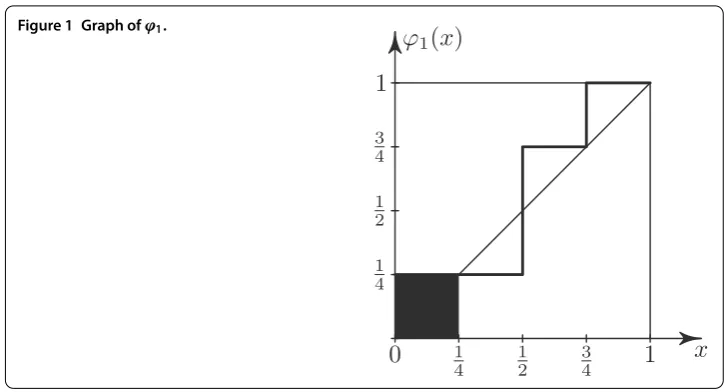
Example . Consider the mappingϕ: [, ][, ] defined as (see Figure ):
ϕ(x) := ⎧ ⎪ ⎪ ⎪ ⎪ ⎪ ⎪ ⎪ ⎪ ⎪ ⎪ ⎪ ⎨ ⎪ ⎪ ⎪ ⎪ ⎪ ⎪ ⎪ ⎪ ⎪ ⎪ ⎪ ⎩
[,], forx∈[,],
, forx∈( ,
), [,], forx=,
, forx∈( ,
), [, ], forx=,
, forx∈(, ].
Since the graphϕofϕ is closed and [, ] is a compact AR-space,ϕis obviously an
Figure 1 Graph ofϕ1.
Hence, in order to apply Theorem ., let us observe that since the interval [,] is a set of non-isolated fixed points such thatdim Fix(ϕ) = (by which Theorem . cannot be applied here) and since the fixed point
is, in view ofInd(ϕ,U) = , non-essential, we
must concentrate on the fixed points and . SinceFix(ϕ)∩∂U
=∅andInd(ϕ,U)=
as well asFix(ϕ)∩∂U=∅andInd(ϕ,U)= , both fixed points are, according to Theo-rem ., essential.
Let us note that although the essentiality of easily follows from the classical results for single-valued maps due to Fort, Jr. [] and O’Neil [], the appropriate application of Theorem . concerns the essential fixed point .
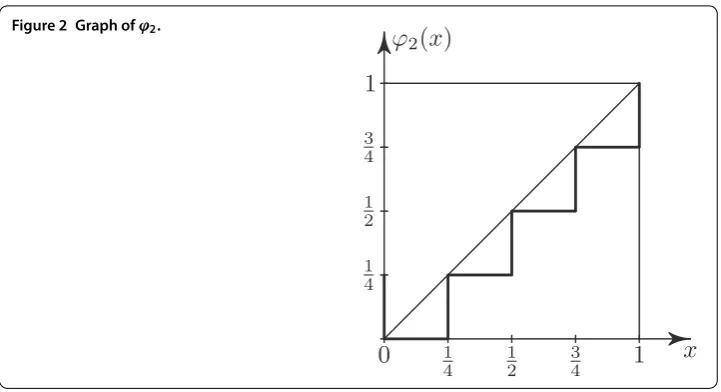
Example . Consider the mappingϕ: [, ][, ] defined as (see Figure ):
ϕ(x) := ⎧ ⎪ ⎪ ⎪ ⎪ ⎪ ⎪ ⎪ ⎪ ⎪ ⎪ ⎪ ⎪ ⎪ ⎪ ⎪ ⎪ ⎪ ⎨ ⎪ ⎪ ⎪ ⎪ ⎪ ⎪ ⎪ ⎪ ⎪ ⎪ ⎪ ⎪ ⎪ ⎪ ⎪ ⎪ ⎪ ⎩ [,
], forx= , , , forx∈(,),
, forx∈( ,
), [,], forx=,
, forx∈( ,
), [,], forx=,
, forx∈( , ), [, ], forx= .
By the same reasoning as in Example .,ϕis obviously an approximableJ-mapping. Hence, in order to apply Theorem ., resp. Corollary ., it is enough to realize that
λ(ϕ) = anddim Fix(ϕ) = . Thus,Ess(ϕ)=∅. SinceInd(ϕ,U
) =Ind(ϕ,U) =Ind(ϕ,U) =Ind(ϕ,U) = , there is (in view of
Figure 2 Graph ofϕ2.
Now, we would like to discuss a possible application of Theorem . and Theorem . to scalar differential equations and inclusions. Hence, consider the scalar differential in-clusion
x∈F(t,x), ()
whereF(t,x)≡F(t+ω,x), for someω> , and assume thatF: [,ω]×RRis an upper semicontinuous mapping with convex, compact values,i.e. Fto be a Marchaud mapping. Let, furthermore, () bedissipative in the sense of Levinson,i.e.
∃D> : lim sup
t→∞
x(t)<D, for all solutionsx(·) of (). ()
This already implies (cf.[], pp.-) that, underF(t,x)≡F(t+ω,x), () isuniformly dissipative,i.e.
∀D> ∃t> ,D> :
t∈R, |x|<D,t≥t+t
⇒x(t)<D, ()
for all solutionsx(·) =x(·;t,x), satisfyingx(t;t,x) =x.
Defining the Poincaré translation operatoralong the trajectories of (),Tω: RR,
namely
Tω(x) :=
x(ω; ,x);x(·; ,x) is a solution of () withx(; ,x) =x
,
it is well known (cf. e.g.[], Chapter .) that, unlike in higher dimensions,Tn
ω∈J(R,R),
where
Tωn=Tω◦ · · · ◦ Tω
n-times
=Tnω,
On the other hand, althoughnωneed not be its minimal period, we have proved in [] that ifn> is minimal then, for eachm∈N, there exists a fixed pointx¯m∈Tωm(x¯m) ofTωm,
determining a subharmonicmω-periodic solution of () with a minimal period. Forn= , the existence of a fixed pointx¯∈Tωn(x¯), determining a harmonicω-periodic solution of (), follows already from the generalised Levinson transformation theory (see [] and the references therein).
In our context, condition () and subsequently () imply the existence of a sufficiently largen∈Nsuch that, for everyn≥n,Tωn|[–D,D]∈J([–D,D], [–D,D]). Thus, a fixed point ofTn
ω|[–D,D]: [–D,D][–D,D] determines annω-periodic solution for (), but in order this fixed point to be essential, we need to satisfy the assumptions of Theorem . or Corollary .. In the latter case, it would mean to suppose still thatdim Fix(Tn
ω|[–D,D]) = dim Fix(Tnω|[–D,D]) = , which seems to be rather difficult to verify in general, because genericallydim Fix(Tn
ω|[–D,D]) = (cf. e.g.[, ]), for multivalued mapsTωin R, i.e.in
the lack of uniquely solvable Cauchy (initial value) problems for (). If additionally
F(t,x)sgnx< , for|x| ≥D, ()
then the interval [–D,D] is obviously positively invariant underTω|[–D,D], by which only dim Fix(Tω|[–D,D]) = should be verified, but the same obstruction remains there again.
In the trivial case of uniqueness,Tω: R→Rmust be strictly increasing (otherwise, we
get a contradiction) by which no purely subharmonic (i.e.those withn> )nω-periodic solutions can exist. Moreover, this behavior highly increases the chance that
dim FixTωn|[–D,D]
=dim Fix(Tω|[–D,D]) = holds, even without ().
Let us therefore give the last simple illustrative related example.
Example . Consider the scalar differential inclusion
x+cx∈–F(x) +cost, withc> , ()
where
F(x) := ⎧ ⎪ ⎪ ⎪ ⎪ ⎪ ⎨ ⎪ ⎪ ⎪ ⎪ ⎪ ⎩
arctanx, for|x|< ,
π
+ [–
π
, ], forx= , –π+ [,π], forx= –, , for|x|> .
Since condition () can easily be verified forF(t,x) := –F(x) –cx+cost, on|x| ≥D, whereD∈(c, ), andF(t,x)≡F(t+ π,x),F(t,x)≡–F(t+π, –x), the associated Poincaré translation operator along the trajectories of (), Tπ: R R, satisfies Tπ|[–,] : [–, ] (–, ). Observe that Tπ|(–,) is even single-valued, because arctanx is, for
|x| ≤, Lipschitzian with constantL= as well ascxwith constantc> . Moreover, one can easily check that the differential equation
has a unique π-periodic solution, provided only c> ; for more details, see e.g. [], pp.-.
Because of an evident one-to-one correspondence between the fixed points x¯ = Tπ|(–,)(x¯) =Tπ|[–,](x¯) of Tπ|[–,]and π-periodic solutionsx(·; ,x¯)≡x(·+ π; ,x¯) of () as well as (), the unique fixed pointx¯must be, in view ofdim Fix(Tπ|[–,]) = , essential by means of Corollary .. The determined π-periodic solutionx(·; ,x¯) of () can be therefore calleddiscretely essential.
Remark . SinceF(t,x)≡–F(t+π, –x), we can still prove by means of the modified operator T˜π|[–,]= –Tπ|[–,]: [–, ](–, ) that the unique discretely essential π -periodic solutionx(·; ,x¯)≡x(·+ π; ,x¯) of () in Example . isπ-antiperiodic,i.e. x(·; ,x¯)≡–x(·+π; ,x¯).
7 Application and concluding remarks
In higher dimensions, i.e. in Rn with n > , the principle of essential fixed points
of the Poincaré translation operators Tω|OD(): OD() OD(), resp. their iterates
Tk
ω|OD():OD()OD(), along the trajectories ofω-periodic dissipative systems, is quite
analogous (see Corollary .). In fact, it again consists in verification of the property
dim FixTωk|OD()
=dim Fix(Tkω|OD()) = .
However, since this verification is not an easy task in general, we have not formulated so far the related statement as a theorem.
Nevertheless, we can finally state as a theorem at least a particular case of it.
Theorem . Let x ∈ F(t,x) be an ω-periodic dissipative Marchaud system, i.e. let F: [,ω]×RnRnbe an upper semicontinuous map with convex,compact values and
F(t,x)≡F(t+ω,x)such that()is satisfied for all solutions of ().If inclusion()possesses at most a finite number of subharmonic solutions x(·),i.e. those with x(t)≡x(t+kω),k∈N, then at least one of them exists to be discretely essential.In other words,then for some k∈N there exists an essential fixed pointx¯∈OD()⊂Rnof the associated Poincaré operator
Tkω=Tωk:OD()OD(),determining this discretely essential subharmonic.
Corollary . If a periodic dissipative system of Marchaud inclusions possesses at most a finite number of entirely bounded solutions,then it admits a discretely essential (subhar-monic)periodic solution.
Open Problem Is, under the same assumptions, the conclusion of Theorem ., resp. Corollary ., true fork= ,i.e.is among the existing (cf.[]) harmonic solutions at least one to be discretely essential?
Remark . For the same conclusion of Theorem ., resp. Corollary ., the Marchaud mapsFcan be replaced by more general upper Carathéodory maps with convex, compact values. For their definition and more details, seee.g.[, ]
π
G(t,s)[–F(x(t)) +cost]dt, where
G(t,s) := ⎧ ⎨ ⎩
e–c(t–s+π)
–e–πc , for ≤t≤s≤π,
e–c(t–s)
–e–πc, for ≤s≤t≤π.
Competing interests
The authors declare that they have no competing interests.
Authors’ contributions
All authors contributed equally in this article. They read and approved the final manuscript.
Author details
1Department of Mathematical Analysis and Applications of Mathematics, Faculty of Science, Palacký University,
17. listopadu 12, Olomouc, 771 46, Czech Republic.2Institute of Mathematics, University of Kazimierz Wielki,
Weyssenhoffa 11, Bydgoszcz, 85-072, Poland.
Acknowledgements
The first author was supported by the grant No. 14-06958S ‘Singularities and impulses in boundary value problems for nonlinear ordinary differential equations’ of the Grant Agency of the Czech Republic.
Received: 25 January 2016 Accepted: 28 June 2016
References
1. Andres, J, Górniewicz, L: On essential fixed points of compact mappings on arbitrary absolute neighborhood retracts and their application to multivalued fractals. Int. J. Bifurc. Chaos26(3), 1650041 (2016)
2. Andres, J, Górniewicz, L: Recent results on the topological fixed point theory of multivalued mappings: a survey. Fixed Point Theory Appl.2015, Article ID 184 (2015). doi:10.1186/s13663-015-0432-0
3. Fort, MK Jr.: Essential and non essential fixed points. Am. J. Math.72, 315-322 (1950) 4. O’Neil, B: Essential sets and fixed points. Am. J. Math.75, 497-509 (1953)
5. Del Prete, I, Naimpally, S, di Iorio, M: Essential fixed points of functions and multifunctions. Real Anal. Exch.25(1), 369-382 (1999)
6. Jiang, J: Essential fixed points of the multivalued mappings. Sci. China Math.11(3), 293-298 (1962)
7. Andres, J, Górniewicz, L: Topological Fixed Point Principles for Boundary Value Problems. Kluwer Academic, Dordrecht (2003)
8. Górniewicz, L: Topological Fixed Point Theory of Multivalued Mappings, 2nd edn. Springer, Berlin (2006) 9. Ben-El-Mechaiekh, H: Spaces and maps approximation and fixed points. J. Comput. Appl. Math.113(1-2), 283-308
(2000)
10. Górniewicz, L, Granas, A, Kryszewski, W: On the homotopy method in the fixed point index theory of multivalued mappings of compact absolute neighborhood retracts. J. Math. Anal. Appl.161(2), 457-473 (1991)
11. Górniewicz, L, Lassonde, M: Approximation and fixed points for compositions ofRδ-maps. Topol. Appl.55(3), 239-250 (1994)
12. Granas, A, Dugundji, J: Fixed Point Theory. Springer, Berlin (2003)
13. Bader, R, Kryszewski, W: Fixed-point index for compositions of set-valued maps with proximally∞-connected values on arbitrary ANR’s. Set-Valued Anal.2(3), 459-480 (1994)
14. Engelking, R: Dimension Theory. North-Holland, Amsterdam (1978)
15. Cheban, DN: Global Attractors of Set Valued Dynamical and Control Systems. Nova Science Publishers, New York (2010)
16. Andres, J, Fürst, T, Pastor, K: Period two implies all periods for a class of ODEs: a multivalued map approach. Proc. Am. Math. Soc.135(10), 3187-3191 (2007)
17. Andres, J, Górniewicz, L: Periodic solutions of dissipative systems revisited. Fixed Point Theory Appl.2006, Article ID 65195 (2006)
18. Augustynowicz, A, Dzedzej, Z, Gel’man, BD: The solution set to BVP for some functional differential inclusions. Set-Valued Anal.6(3), 257-263 (2002)