Reprinted from the Soil Science ,S'ocieiy of America Journal
Volume 62, no. 6, Nov.—Dec. 1998 677 South Segoe Rd., Madison, WI 53711 USA
Sprinkler Irrigation Runoff and Erosion Control
with Polyacrylamide — Laboratory Tests
J. Kristian Aase,* David L. Bjorneberg, and Robert E. Sojka
ABSTRACT
Many semiarid and arid soils are prone to irrigation-induced ero-sion. Polyacrylamide (PAM) greatly reduces erosion from furrow irrigation. We hypothesized that PAM applied via sprinklers will provide erosion control and benefit water infiltration and aggregate stability. Screened (6.4 mm) Rad silt loam (coarse silty, mixed, super-active mesic Durinodic Xeric Haplocambid) was placed in 1.5 by 1.2 by 0.2 m steel boxes with 2.4% slope. An oscillating nozzle, 3 m above the soil, produced a median drop size of 1.2 mm diameter. We applied 0, 1, 2, 4, and 6 kg ha' PAM in 20 mm of water in the first irrigation, followed by two 20-mm water-only irrigations. In a second test, we applied 0, 2, and 4 kg ha ' PAM in 8 mm of water in the first irrigation, followed by two 20-mm water-only irrigations. Two kilograms per hectare PAM in the first 20-mm irrigation reduced runoff 70% and soil loss 75% compared to control. Polyacrylamide in 8 mm of water was less effective. Polyacrylamide in the 20-mm irrigation did not affect tension infiltration; PAM in the 8-mm irrigation doubled tension infiltration following the third irrigation. Wet aggregate stability fol-lowing the first irrigation was greater in all PAM treatments than on the check. With 2 kg ha" PAM in the 20-mm irrigation, it was 55%; in 8 mm, 77%. Polyacrylamide applied in the first irrigation at low rates effectively reduced runoff and erosion. Erosion was more effectively controlled than runoff.
I
RRIGATION predominates agriculture in semiarid and arid climates. About 240 million ha (15-17%) of the world's cultivated lands are irrigated and about one-third of the world's food production is grown on about 50 million irrigated ha (Hoffman et al., 1990; Gleick, 1993; Tribe, 1994). Total irrigated land in the USA was 24 684 055 ha in 1996, a 2.8% increase from 1987. From 1987 to 1996, the percentage of sprinkler-irrigated acre-age increased from about 40 to about 44% (Anony-mous, 1997).
Most semiarid and arid soils supporting irrigated agri-culture have thin, erodible surface soil horizons. There-fore they are prone to irrigation-induced erosion and rapid productivity loss if not well managed (Carter, 1993). Conservation practices such as residue manage-ment and reduced tillage have not been readily adopted in surface irrigated agriculture. Such practices are con-sidered by some to interfere with water flow and some-times with planting and harvesting operations because of excessive residue. Also, following crops such as po-tato (Solanum tuberosum L.), dry bean (Phaseolus vul-garis L.), and sugar beet (Beta vulgaris L. subsp. vul-garis), very little residue is available to protect the soil surface from erosion.
Under such conditions, application of about 1 kg ha- 1
USDA-ARS Northwest Irrigation and Soils Res. Lab., 3793 N. 3600 E., Kimberly, ID 83341. Received 18 Dec. 1997. *Corresponding author ([email protected] ).
Published in Soil Sci. Soc. Am. J. 62:1681-1687 (1998).
of the high molecular weight anionic long-chain organic polymer, PAM, with an 18% negative charge density, in the irrigation furrow advance water has been demon-strated to reduce furrow erosion by as much as 99% (e.g., Lentz et al., 1992; Lentz and Sojka, 1994; Trout et al., 1995; Sojka and Lentz, 1997). The practice has been researched and documented and has become wide-spread and popular enough for the USDA-NRCS to publish an interim conservation practice standard for the use of PAM in furrow irrigation (USDA-NRCS, 1995).
Less studied is the efficacy of PAM when mixed with irrigation sprinkler water or injected directly into over-head sprinkler systems. Shainberg et al. (1990) applied three rates of PAM on dry soil in a small-tray laboratory study prior to sprinkling with a rainfall simulator. They found that 20 kg ha- 1 PAM was most beneficial in main-taining high infiltration rates. Smith et al. (1990) and Levin et al. (1991) in similar studies found that 20 kg ha - 1 of PAM increased infiltration and greatly reduced runoff and erosion. Ben-Hur et al. (1989) concluded from a small-tray laboratory study that applying 5 kg ha- 1 PAM with simulated irrigation water was more effective in maintaining high infiltration rates than was spraying the polymer on the dry soil surface prior to simulated irrigation. Levy et al. (1992) found that applying PAM at 10 mg L- 1 to irrigation water in a small-tray lab study gave optimal effect on final infil-tration rate and cumulative infilinfil-tration as well as on reducing erosion. In a field plot study, Flanagan et al. (1997a,b) found increased water infiltration and attrib-uted this to reduced surface sealing when they applied 10 mg L- 1 of PAM to tap water used in simulated rainfall on wet runs. Sediment concentration was greater in run-off from PAM-treated soil than from untreated soil, but it was not clear if PAM reduced or increased sedi-ment loss.
Surface sealing and soil crusting have been controlled and runoff and erosion significantly reduced in field plot studies by spraying PAM on dry soil surfaces prior to sprinkler irrigation (Levy et al., 1991; Ben-Hur, 1994; Zhang and Miller, 1996). Stern et al. (1992) sprayed a dry soil surface with 20 kg ha- 1 PAM prior to sprinkler irrigation. They found significantly greater wheat (Triti-cum aestivum L.) yields on plots where PAM had been applied as compared with the control. They attributed the greater yields to better soil water distribution and increased irrigation water use efficiency.
Runoff and erosion increase with increasing water drop energy. However, PAM limits physical disintegra-tion of aggregates caused by water drop impact. Smith
Abbreviations: EC, electrical conductivity; PAM, polyacrylamide;
SAR, Na adsorption ratio.
et al. (1990) and Levin et al. (1991) found that the relative effect of PAM increased with increasing kinetic energy of water drops.
Polyacrylamide reportedly does not penetrate aggre-gates. Only the outer surface of aggregates are stabi-lized, and they remain stable as long as they are not broken by impact energy, such as by water drops (Malik and Letey, 1991; Ben-Hur and Keren, 1997). In the irrigation furrow, PAM only penetrates soil 2 to 3 mm (Malik et al., 1991).
Our objectives were to determine if small amounts (0, 1, 2, 4, and 6 kg ha-1) of PAM applied with sprinkler irrigation water at two irrigation rates were effective in controlling runoff and soil loss and in improving infiltra-tion and aggregate stability.
MATERIALS AND METHODS
The study was conducted in the hydraulics laboratory of the Northwest Irrigation and Soils Research Laboratory of the USDA-ARS at Kimberly, ID. Surface soil, classified as Rad silt loam, was obtained for the study and placed in covered storage containers. Soil texture, determined by the hydrome-ter method, was 30% clay, 55% silt, and 15% sand. Organic matter was 14 g kg -I , saturated paste pH 7.6, saturated paste extract electrical conductivity (EC) 1.0 dS m", and Na adsorp-tion ratio (SAR) 1.1.
We used six steel boxes for the study. Each box was 1.5 m long, 1.2 m wide, and 0.2 m deep, except the 1.2-m wide downslope side was only 0.15 m deep to provide for affixing a runoff trough to funnel water and sediment into catch con-tainers. The boxes were affixed to leg supports 0.3 m high and hinged to provide slopes from 0 to 15%.
We removed the soil from the storage containers, without air drying, and removed large clods by passing the soil through a 6.4-mm screen prior to hand shoveling the soil into the steel boxes. To avoid layering and segregation, the soil was then stirred and mixed prior to screeding (similar to concrete level-ing) to achieve a uniform 0.15-m soil depth with a level surface that was lightly packed. The resultant bulk density was about 1.0 Mg m -3 in all tests. The soil surface and soil depth mim-icked a newly prepared dry field seedbed. Soil water content was between 150 and 190 g kg' at the start of each test. The boxes were equipped with suction manifolds so that, if necessary, excess water could be pumped out. (There was never evidence of free water at the end of any test, however.) Irrigation water was applied through an oscillating sprinkler similar to one described by Meyer and Harmon (1979). A Veejet nozzle (8070, Spraying System Co., Wheaton, IL)' was mounted 3 m above the soil surface. Well water was used at a nozzle pressure of 76 kPa, providing a median drop size of 1.2-mm diameter. Droplet energy striking the soil surface was about 25 J kg' (Kincaid, 1996). The well water had EC = 0.73 dS pH = 7.2, and SAR = 1.7.
We used dry granular PAM copolymer with molecular weight -12 to 15 Mg mole' with an 18% negative charge density (Superfloc A836, marketed by American Cyanamid Co., Roanoke, TX). A stock solution of 1920 mg L' active ingredient was prepared, from which PAM was dispensed and mixed with irrigation water in 210-L containers to create the desired concentrations. The irrigation water was then pumped to the irrigation nozzle and applied to the dry soil surface.
Polyacrylamide was added in the first irrigation in every test, followed by two water-only irrigations. Between each
I Mention of trade names does not constitute an endorsement by the USDA over other products not mentioned.
irrigation, the soil was allowed to dry for 10 to 12 d until water contents of the surface 75 mm reached 140 to 180 g kg'. We used three rates of PAM and 2.4% slope for all tests.
Prior to each test we took two soil samples from each box with a 19-mm-diameter core sampler to determine antecedent soil water content in the 0- to 75- and 75- to 150-mm depths. The holes left by the core sampler were filled with soil and gently packed to prevent preferential flow.
Each treatment was replicated four times, but because of limited number of soil boxes and space we divided each test in time. Each test had three treatments of two PAM rates and a check. One block (Day 1), replicated twice, was followed by a second block at a later date (Day 2), replicated twice.
Test la. Water for all three irrigations was applied at 80 mm h" for 15 min, equivalent to a 20-mm irrigation water depth. The PAM concentrations in the irrigation water were 0, 5, and 10 mg L", resulting in 0, 1, and 2 kg PAM ha' applied in the first irrigation.
Test lb. Water application rates and times were the same as in Test la. PAM concentrations in the irrigation water were 0, 20, and 30 mg L", resulting in 0, 4, and 6 kg PAM ha'.
Test 2. The first irrigation was applied at 80 mm h" for 6 min, equivalent to an 8-mm irrigation water depth. The PAM concentrations in the irrigation water were 0, 25, and 50 mg which resulted in 0, 2, and 4 kg PAM ha'. The subsequent two irrigations were applied at 80 mm h" for 15 min, the same as in Tests la and lb.
Following the first and third irrigations, we made tension infiltration measurements in triplicate on each box at 100 and 40-mm tensions, gently placing infiltrometers on a bed of fine quartz-sand contact material (0.1-mm-diam. fine sand). The tension infiltrometers, described by Cook et al. (1993), were similar to the design by Perroux and White (1988). The fine-sand contact material between the infiltrometer and the soil was allowed to dry following infiltrometer measurements. The sand was then vacuumed, leaving the measured areas nearly indistinguishable from the nonmeasured areas.
Following the third irrigation, we took surface 5-mm-deep soil samples from four locations in each box for wet aggregate stability determinations. Because of the disruptive nature of surface soil sampling, the first irrigation treatment for each test was repeated so we could obtain aggregate samples following initial application of PAM. The soil samples were lifted from the soil surface with spatulas, sealed in plastic bags, and refrig-erated prior to analysis according to the procedure described by Kemper and Rosenau (1986) as modified by Lehrsch et al. (1991).
Following the last irrigation of each test, after all measure-ments and samples were taken, the soil was allowed to dry and we removed the surface 30 mm of soil from all boxes to ensure that no residual PAM remained (Malik et al., 1991). New soil was then added and mixed with the remaining soil in preparation for the next test.
The data were analyzed as a two by three factorial (day by concentration) design with two replications per block and three treatments. Analysis of variance at P 0.05 was used to determine differences among PAM treatments. Because of the progression of treatment levels, we chose to depict the results graphically rather than report statistically significant differences among individual treatments.
RESULTS AND DISCUSSION
0 2 3 4 5 6
Irr, 2
Bars = Standard Error of the Mean
20 Irr. 1 with PAM in 8 mm water depth, no runoff In 2 and 3 with 20 mm water depth
Bars = Standard Error of the Mean
120
100
80
60
AASE ET AL.: SPRINKLER IRRIGATION RUNOFF AND EROSION CONTROL WITH POLYACRYLAMIDE 1683
differ among tests, therefore we averaged the check-treatment results from Tests la and lb, combined the results from Tests la and 1b, and analyzed them to-gether.
All tests were done with the soil at less than saturated conditions. At no time was there free water at the bot-tom of the soil boxes; consequently, the drainage/suction manifolds were not used. A possibility exists that prefer-ential flow may have occurred during irrigation events. If so, there may have been a confounding of results, but no visible evidence of macropores to the soil surface was observed. The antecedent soil water content to the 75-mm depth ranged during the tests from n 140 to 180 g kg- '.
Runoff
Runoff was greatly reduced when PAM was applied with the first 20-mm application of irrigation water. Runoff was about 30% of the check treatment (zero PAM) runoff during the first 20-mm-depth irrigation when PAM was applied at rates >2 kg ha' (Fig. 1). The subsequent irrigation reached about 50% of check. Although there was a trend (P = 0.08), there were no runoff differences for that irrigation at P 0.05. Absolute runoff ranged from 6.1 mm for the check treat-ment to 1.5 mm for the 6 kg ha' PAM treattreat-ment during the first irrigation and corresponding 8.2 and 6.5 mm of runoff during the third irrigation.
No runoff was observed from the first irrigation when PAM was applied with 8 mm of water in Test 2 (Fig. 2). During the subsequent water-only 20-mm irrigation, runoff was reduced to about 60% of the check on the 2 and 4 kg ha" PAM treatments. No significant differ-ences in runoff among PAM treatments were observed during the third irrigation. Absolute runoff ranged from 9.2 mm for the check treatment to 5.7 mm for the 4 kg ha" PAM treatment during the second irrigation; the corresponding numbers during the third irrigation were 10.5 and 8.7 mm.
There was no cumulative runoff difference for the three irrigations between the 20- and 8-mm initial
irriga-Polyacrylamide, kg ha -1
Fig. 2. Runoff as a function of polyacrylamide applied with 8-mm water depth in Irrigation 1 and as a function of two subsequent 20-mm water-only irrigations.
tion check treatments, the result being 19.7 mm of runoff for both. For the 2 kg ha' PAM treatments, cumulative runoff was 12.5 mm for the 20-mm initial irrigation ment and 13.6 mm for the 8-mm initial irrigation treat-ment. Corresponding runoff numbers for the 4 kg ha' treatments were 9.8 and 14.4 mm. Effects of PAM treat-ments on reducing runoff, regardless of rate applied, decreased with irrigation events and lasted for two irri-gations, including the initial irrigation. As shown by the absolute cumulative values as well as in Fig. 1 and 2, no additional infiltration or runoff benefit accrued from concentrating the initial PAM application in a small amount of water.
Soil Loss
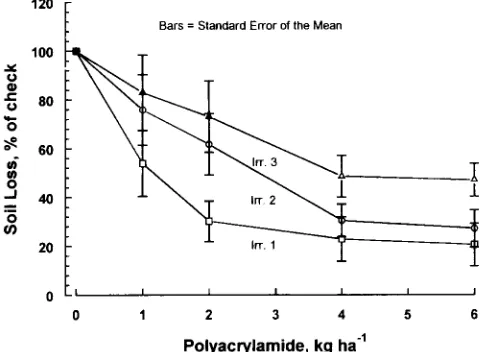
The soil loss curve, as percentage of check, for the first irrigation of Tests la and lb was similar to that of the corresponding runoff curve (Fig. 3). Percentages of soil loss from the subsequent two irrigations were less than percentages of runoff from the corresponding irri-gations, and diverged from the runoff percentage with
120
Bars = Standard Error of the Mean
100
60
1
40
IR. 1
0 I
0 2 3 4 5 6
20
Polyacrylamide, kg ha -1
Fig. 1. Runoff as a function of polyacrylamide applied with 20-mm water depth in Irrigation 1 and as a function of two subsequent 20-mm water-only irrigations. Results from Tests la and lb are combined.
Polyacrylamide, kg ha -1
Bars Standard Error of the Mean
RT. 2
Irr. 1 with PAM in 8 mm water depth. no runoff Irr. 2 and 3 with 20 mm water depth
0 2 3 4 5 6
Polyacrylamide, kg ha-t
Fig. 4. Soil loss as a function of polyacrylamide applied with 8-mm water depth in Irrigation 1 and as a function of two subsequent 20-mm water-only irrigations.
increasing PAM rates. This implies that the relationship between runoff and soil loss is nonlinear. Soil loss also differed from runoff inasmuch as there were statistically significant differences in soil loss among PAM treat-ments during the third irrigation.
At PAM rates greater than about 2 kg ha", soil loss during the first irrigation was about 25% that of the check treatment (Fig. 3). Soil loss from the 4 and 6 kg ha" PAM treatments during the second irrigation was only about 28% that of the check treatment. During the third irrigation, soil loss from the largest PAM treat-ments reached 46% that of the check treatment soil loss. Absolute soil loss was 175 kg ha" from the check treatment and 36 kg ha' from the 6 kg ha" PAM treatment during the first irrigation. During the third irrigation, soil loss was 209 kg ha" from the check treat-ment and 95 kg ha" from the 6 kg ha" treattreat-ment.
In concert with the runoff results, there was no soil loss from the first irrigation with 8-mm water depth (Test 2). However, similar to the 20-mm initial water application, there were significant differences
(P
0.05) in soil loss among PAM treatments during the subse-quent two irrigations (Fig. 4), whereas with runoff, there were no significant differences. Soil loss from PAM treatments during the second irrigation of Test 2 reached about 35% of check treatment soil loss, and during the third irrigation, about 52% of check treat-ment soil loss. Absolute soil loss during the second irri-gation was 379 kg ha- 1 from the check treatment and 122 kg ha from the 4 kg ha" PAM treatment. During the third irrigation, the corresponding runoff amounts were 363 and 193 kg ha", resulting in cumulative soil loss of 742 kg ha' for the check treatment and 315 kg ha" for the 4 kg ha' PAM treatment. These numbers compare with cumulative soil loss of 541 kg ha" for the check treatment and 181 kg ha" for the 4 kg ha" treatment with the 20-mm initial irrigation. Again, as with runoff, there was no advantage to concentrating PAM in a small initial irrigation when considering total soil loss from the three irrigations.The results differ somewhat from those of Lentz and Sojka (1994) and Sojka and Lentz (1997), who reported
that in furrow irrigation 10 g m -3 PAM applied in the furrow advance water reduced furrow erosion by as much as 99% with net application rates of =1 kg PAM ha' per treated irrigation. On the other hand, we found PAM efficacy at rates about ten times less than those from small-tray rainfall simulator studies, with trays at 15% slope, reported by Smith et al. (1990) and Levin et al. (1991).
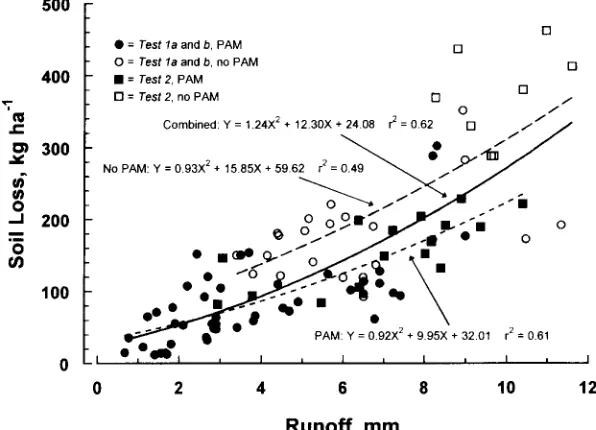
The relationship between soil loss and runoff is shown in Fig. 5. Although there is considerable scatter around the curvilinear best-fit lines, definite relationships are observed. The check treatment from Test 2 is particu-larly conspicuous in its divergence from the combined best fit line along with two check-treatment values from Test 1b that appear to be outliers. The curvilinear rela-tionships are similar to those reported by Kemper et al. (1985) for furrow erosion and indicate that sediment concentration in runoff increased as runoff increased. Kemper et al. (1985) suggested that their data fit power functions. Our data, although similar in form, did not satisfactorily fit any power functions. The data in Fig. 5 also illustrate that runoff and soil loss were less from PAM-treated soil surfaces than from corresponding check treatments.
Tension Infiltration
Because of differences in runoff among PAM treat-ments and by inference, differences in infiltration, we postulated that there also would be differences in steady-state infiltration as determined from tension in-filtrometer measurements. Such differences in steady-state infiltration have been demonstrated, by Sojka et al. (1996), under furrow irrigation, with the greater infil-tration rates under PAM treated furrows. Tensions of 40 and 100 mm, respectively, allow flow through pores of <0.75- and 0.30-mm effective diameters.
Significant differences in tension infiltration among PAM treatments were absent in our simulated irrigation experiment when PAM was applied in initial 20-mm water-depth irrigations. Differences
(P
0.05) among PAM treatments only appeared after the third irrigation when PAM was applied in initial 8-mm water-depth irrigations. Then the infiltration increased from 14 mm h" on the check treatment to 29 mm h" on the 4 kg ha' treatment under 40-mm tension and from 9 to 17 mm h" under 100-mm tension.conclu-I
0
8
2
0 4 6 10 12
500
400
Nr H
0 —I 200
0
• = Test la and b, PAM
O = Test la and b, no PAM n = Test 2, PAM q= Test 2, no PAM
No PAM: Y = 0.93X2 15.85X + 59.62 12 = 0.49
q 0 .•
O ....-
..--q
0 Combined: Y = 1.24X 2 + 12.30X + 24.08 r2 = 0.62
100
•
PAM: Y = 0.92X2 + 9.95X + 32.01 r2 = 0.61
100
80
Bars = Standard Error of the Mean
20
0 1 2
0
3 4 5 6
100
80
-60
40
-20
irr 3
Bars = Standard Error of the Mean
AASE ET AL.: SPRINKLER IRRIGATION RUNOFF AND EROSION CONTROL WITH POLYACRYLAMIDE 1685
Runoff, mm
Fig. 5. Soil loss as a function of runoff for all combinations of polyacrylamide applications and irrigations from all tests.
sion is supported by measurements of aggregate stability (see below). Another possible inference is that water droplet impact may have unevenly dislodged small soil particles, thereby shifting fine deposits and creating an uneven surface seal and large variability in the measure-ments. More tension infiltration measurements than we made may have sorted out variation among measure-ments within all the treatmeasure-ments; however, we tried to limit the effect of the tension infiltration procedure on soil performance, and more measurements may have caused artifactual influences on the primary measure-ment parameters of runoff and sedimeasure-ment loss.
Aggregate Stability
Polyacrylamide will not improve soil structure, only stabilize existing structure; therefore, addition of PAM for erosion control works best on newly prepared, aggre-gated soil surfaces (Cook and Nelson, 1986; Shaviv et al., 1987; Sojka and Lentz, 1997). Polyacrylamide
stabi-o
0 1 2 3 4 5 6
Polyacrylamide, kg ha -I
Fig. 6. Wet aggregate stability as a function of polyacrylamide applied with 20-mm water depth in Irrigation 1 and as a function of two subsequent 20-mm water-only irrigations. Results from Tests la and lb are combined.
lized the newly prepared soil surface following the first irrigation as indicated by wet aggregate stability deter-minations. There were significant aggregate stability dif-ferences
(P
0.05) among treatments following the first irrigation (Fig. 6). Following the third irrigation, there were no significant differences among treatments in Test 1. However, there was an increase in aggregate stability for the check and low-PAM treatments from the first to the third irrigation.Kemper and Rosenau (1984), Kemper et al. (1985), and Bullock et al. (1988) noted that, through natural processes, solid-to-solid bonds reform rapidly in soil similar to the one we used given proper water contents and drying conditions. Bonding mechanisms they sug-gest include selective precipitation of silica, calcium car-bonate, and other solutes that can bond to adjacent particles. They also concluded that a substantial portion of soil cohesion was due to water phase tension and surface tension associated with the air—water interface. These mechanisms could explain the aggregate stability
Polyacrylamide, kg ha-I
increases in Test 1 for check and low-PAM treatments in our study.
In Test 2, there were significant aggregate stability differences among treatments following both the first and third irrigations. Aggregate stability in the check treatment increased following the third irrigation, simi-lar to what happened in Test 1; however, aggregate stability in PAM treatments decreased following the third irrigation.
Following the first irrigation, PAM applied in high concentration and low irrigation application depth (Test 2; Fig. 7) resulted in 77% aggregate stability for the 2 kg ha-' PAM treatment, and in 55% aggregate stabil-ity for the 2 kg ha" PAM treatment when applied in low concentration and high irrigation application depth (Test 1; Fig. 6).
There were apparent differences in response between Tests 1 and 2, probably because less water was applied in Test 2, but because no direct comparisons were made, no firm conclusions can be drawn about reasons for the differences.
CONCLUSIONS
Polyacrylamide applied in the first irrigation at rates as low as 2 kg ha" effectively reduced runoff and ero-sion in laboratory sprinkler irrigation tests. Polyacryl-amide was more effective in reducing erosion than in reducing runoff. The effect of PAM on runoff essentially dissipated by the third irrigation. There was still evi-dence of erosion reduction during the third irrigation at PAM rates >2 kg ha-'. As determined from wet aggregate stability measurements, PAM stabilized the soil surface. Results from tension infiltration showed no PAM effect for the 20-mm application but, following the third irrigation, tension infiltration doubled for the 8-mm application. Although tension infiltration mea-surements were somewhat inconclusive, by inference from runoff measurements, PAM treatments had greater infiltration than check treatments. For repeated PAM applications, the 2 kg ha' rate may be best, whereas for a one-time only application, greater rates may be applicable. Using different soils, slopes, and water quality, laboratory sprinkler irrigation tests are ongoing to determine how PAM affects runoff and ero-sion control. Field application of laboratory results is being tested on commercial farms using large-scale com-mercial sprinkler systems.
REFERENCES
Anonymous. 1997. Annual irrigation survey reveals growth through-out country. Irrig J. 47(1):27-42.
Ben-Hur, M. 1994. Runoff, erosion, and polymer application in mov-ing-sprinkler irrigation. Soil Sci. 158:283-290.
Ben-Hur, M., J. Faris, M. Malik, and J. Letey. 1989. Polymers as soil conditioners under consecutive irrigations and rainfall. Soil Sci. Soc. Am. J. 53:1173-1177.
Ben-Hur, M., and R. Keren. 1997. Polymer effects on water infiltration and soil aggregation. Soil Sci. Soc. Am. J. 61:565-570.
Bullock, M.S., W.D. Kemper, and S.D. Nelson. 1988. Soil cohesion as affected by freezing, water content, time and tillage. Soil Sci. Soc. Am. J. 52:770-776.
Carter, D.L. 1993. Furrow irrigation erosion lowers soil productivity.
J. Irrig. Drain. Eng. 119:964-974.
Cook, D.F., and S.D. Nelson. 1986. Effect of polyacrylamide on seed-ling emergence in crust-forming soils. Soil Sci. 141:328-333. Cook, F.J., G.P. Lilley, and R.A. Nunns. 1993. Unsaturated hydraulic
conductivity and sorptivity: Laboratory measurement. p. 615-625.
In M.R. Carter (ed.) Soil sampling and methods of analysis. Cana-dian Soc. Soil Sci., Lewis Publ., Boca Raton, FL.
Flanagan, D.C., L.D. Norton, and 1. Shainberg. 1997a. Effect of water chemistry and soil amendments on a silt loam soil - Part 1: Infiltra-tion and runoff. Trans. ASAE 40:1549-1554.
Flanagan, D.C., L.D. Norton, and I. Shainberg. 1997b. Effect of water chemistry and soil amendments on a silt loam soil - Part 2: Soil erosion. Trans. ASAE 40:1555-1561.
Gleick, P.H. 1993. An introduction to global fresh water issues. p. 3-12. In P.H. Gleick (ed.) Water in crisis. Oxford Univ. Press, New York.
Hoffman, G.J., T.A. Howell, and K.H. Solomon. 1990. Introduction. p. 5-10. In G.J. Hoffman et al. (ed.) Management of farm irrigation systems. American Soc. of Agric. Engineers, St. Joseph, MI. Kemper, W.D., and R.C. Rosenau. 1984. Soil cohesion as affected by
time and water content. Soil Sci. Soc. Am. J. 48:1001-1006. Kemper, W.D., and R.C. Rosenau. 1986. Aggregate stability and size
distribution. p. 425-442. In A. Klute (ed.) Methods of soil analysis. Part 1. 2nd ed.. Agron. Monogr. 9. ASA and SSSA, Madison, WI. Kemper, W.D., T.J. Trout, M.J. Brown, and R.C. Rosenau. 1985. Furrow erosion and water and soil management. Trans. ASAE 28:1564-1572.
Kincaid, D.C. 1996. Spraydrop kinetic energy from irrigation sprin-klers. Trans. ASAE 39:847-853.
Lehrsch, G.A., R.E. Sojka, D.L. Carter, and P.M. Jolley. 1991. Freez-ing effects on aggregate stability affected by texture, mineralogy, and organic matter. Soil Sci. Soc. Am. J. 55:1401-1406.
Lentz, R.D., I. Shainberg, R.E. Sojka, and D.L. Carter. 1992. Pre-venting irrigation furrow erosion with small applications of poly-mers. Soil Sci. Soc. Am. J. 56:1926-1932.
Lentz, R.D., and R.E. Sojka. 1994. Field results using polyacrylamide to manage furrow erosion and infiltration. Soil Sci. 158:274-282. Levin, J., M. Ben-Hur, M. Gal, and G.J. Levy. 1991. Rain energy
and soil amendments effects on infiltration and erosion of three different soil types. Aust. J. Soil Res. 29:455-465.
Levy, G.J., M. Ben-Hur, and M. Agassi. 1991. The effect of polyacryl-amide on runoff, erosion, and cotton yield from fields irrigated with moving sprinkler systems. Irrig. Sci. 12:55-60.
Levy, G.J., J. Levin, M. Gal, M. Ben-Hur, and I. Shainberg. 1992. Polymers' effects on infiltration and soil erosion during consecutive simulated sprinkler irrigations. Soil Sci. Soc. Am. J. 56:902-907. Malik, M., and J. Letey. 1991. Adsorption of polyacrylamide and
polysaccharide polymers on soil materials. Soil Sci. Soc. Am. J. 55:380-383.
Malik, M., A. Nadler, and J. Letey. 1991. Mobility of polyacrylamide and polysaccharide polymers through soil materials. Soil Tech-nol. 4:255-263.
Meyer, L.D., and W.C. Harmon. 1979. Multiple-intensity rainfall simu-lator for erosion research on row sideslopes. Trans. ASAE 22: 100-103.
Perroux, K.M., and I. White. 1988. Designs for disc permeameters. Soil Sci. Soc. Am. J. 52:1205-1215.
Shainberg, I., D.N. Warrington, and P. Rengasamy. 1990. Water qual-ity and PAM interactions in reducing surface sealing. Soil Sci. 149:301-307.
Shaviv, A., I. Ravina, and D. Zasla ysky. 1987. Field evaluation of method of incorporating soil conditioners. Soil Tillage Res. 9:151-160.
Smith, H.J.C., G.J. Levy, and I. Shainberg. 1990. Water-droplet energy and soil amendments: Effect on infiltration and erosion. Soil Sci. Soc. Am. J. 54:1084-1087.
Sojka, R.E., and R.D. Lentz. 1997. Reducing furrow irrigation erosion with polyacrylamide (PAM). J. Prod. Agric. 10:47-52.
Sojka, R.E., R.D. Lentz, C.W. Ross, and T.J. Trout. 1996. Net and tension infiltration effects of PAM in furrow irrigation. p. 97-102.
AASE ET AL.: SPRINKLER IRRIGATION RUNOFF AND EROSION CONTROL WITH POLYACRYLAMIDE 1687
Stern, R., A.J. Van Der Merwe, M.C. Laker, and I. Shainberg. 1992. Effect of soil surface treatments on runoff and wheat yields under irrigation. Agron. J. 84:114-119.
Tribe, D. 1994. Feeding and greening the world, the role of agricultural research. CAB Intl. Wallingford, England.
Trout, T.J., R.E. Sojka, and R.D. Lentz. 1995. Polyacrylamide effect on furrow erosion and infiltration. Trans. ASAE 38:761-765.
USDA-NRCS. 1995. Interim conservation practice standard – Irriga-tion erosion control (polyacrylamide). WNTC 1-201. USDA-NRCS West Natl. Tech. Cent., Portland, OR.