USB KEY BASED ANTI-PIRACY SOLUTION
Prof.M.M.Gudadhe, Pallavi Bharti, Pranjali Patil
Information Technology DepartmentPriyadarshini College of Engineering Nagpur, India
I.
I
NTRODUCTIONIntellectual property provides the ability to own rights to an individual's creativity and innovation. It also allows for protection through the use of patents, trademarks, designs, and copyrights. In a global economy, software systems play a dominant role, running, protecting, and entertaining the world. The need for software is growing exponentially, and so is the market for pirated software. Software piracy, the unauthorized duplication and distribution of software, is a worldwide problem that is growing at an epidemic pace. Software piracy is the illegal duplication and distribution of software packages and applications, which violate software licenses and copyright laws. Software is protected by the same laws that protect other intellectual property such as music, literature, and movies. Like digital music and digital movies, software is a fairly new type of intellectual property. Software's unique digital existence is a challenge to those protecting the intellectual property attributed with any software.
II. OBJECTIVES OF PROJECT
There is a lot of different ways in which companies are trying to protect their software. They are buying special methods of creating the carrier just to save it from copying. Programmers are also implementing in applications the new techniques to prevent piracy.
Generally to protect shareware applications Programming based methods wear used, which can be used for free only for couple of days, after that user has to buy the full license. These techniques base also on checking hidden information such as license code, install date.
Mentioned data are very important that‟s why companies put a lot of effort to encipher and hide them inside the application or in system registry.
Our approach is to develop a hardware based keys/device. When user buys software he is been provided with hardware device, which has to be plug into our computer. The applications work properly if there is correct hardware-key plugged. The principle of operation would be:
1. The application “ask” device for particular key, this key returns specific code.
2. This code is compared with one stored in application.
3. If the codes are equal the application runs, if not it stops.
Abstract—
Software Piracy has been a huge headache for software vendors for quite a time now. Computer software is Intellectual Property, and is protected by copyright Law. There is a huge amount of research and resources spent during development of software, and hence vendors expect people to pay for using it.III. LITERATURE SURVEY
3.1 Piracy: Extent & Scale
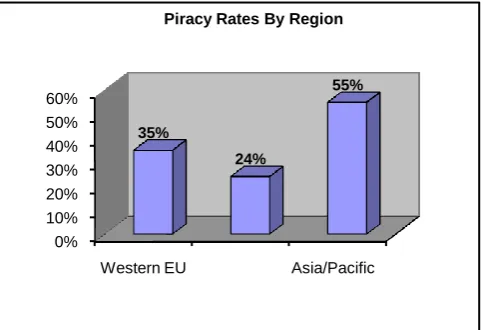
In a software market that is projected to grow to over $70 billion from $40 billion1 within the next five years, the industry is poised for tremendous losses due to piracy. In a study, the Business Software Alliance estimates that 36% percent of software installed in 2003 was illegal. Some research ascertains the extent and scale of the problem of piracy. Figure 1. shows the piracy rates by region, with the North American continent, only ¼ of its software titles being pirated, but Asia/Pacific faring the worst with ½ titles being pirated software, western EU fares slightly better, but over 1/3 of its titles are pirated, all these figures show a significant penetration of pirated software into the commercial sector.
Figure 1:-Piracy Rates By Regions
3.2 CASE STUDY:
2.2.1 United State District Court has ordered Motion Picture Association Of America (MPAA) that it cannot use terms „piracy‟, ‟theft‟ or „stealing‟ during a Hotfile trial.
As per Jury:-
In the present case, there is no evidence that the Defendants (or Hotfile‟s founders) are „pirates‟ or
„thieves,‟ nor is there evidence that they were „stealing‟ or engaged in „piracy‟ or „theft.‟ Even if the Defendants had been found to have directly infringed on the Plaintiffs‟ copyrights, such derogatory terms would add nothing to the Plaintiffs‟ case, but would serve to improperly inflame the jury.
3.3 LAWS FOR PIRACY:
Copyright infringement is the use of works protected by copyright law without permission, infringing certain exclusive rights granted to the copyright holder, such as the right to reproduce, distribute, display or perform the protected work, or to make derivative works.
Piracy:-
0% 10% 20% 30% 40% 50% 60%
Western EU Asia/Pacific
35%
24%
55%
The practice of labeling the infringement of exclusive rights in creative works as "piracy" predates statutory copyright law.
Theft:-
Copyright holders frequently refer to copyright infringement as theft. In copyright law, infringement does not refer to theft of physical objects that take away the owner's possession, but an instance where a person exercises one of the exclusive rights of the copyright holder without authorization. Courts have distinguished between copyright infringement and theft.
Existing and proposed law:-
Most countries extend copyright protections to authors of works. In countries with copyright legislation, enforcement of copyright is generally the responsibility of the copyright holder. However in several jurisdictions there are also criminal penalties for copyright infringement.
Civil law:-
In the U.S., copyright infringement is sometimes confronted via lawsuits in civil court, against alleged infringers directly, or against providers of services and software that support unauthorized copying. For example, major motion-picture corporation MGM Studios filed suit against P2P file-sharing services Grokster and Stream cast for their contributory role in copyright infringement.
IV. METHODOLOGY
There is a lot of different ways in which companies are trying to protect their software. They are buying special methods of creating the carrier just to save it from copying. Programmers are also implementing in applications the new techniques to prevent piracy. Generally to protect shareware applications. These techniques base also on checking hidden information such as license code, install date.
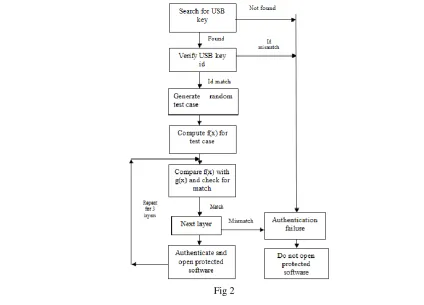
FLOW CHART:-
V.WORKING OF PROJECT /IMPLEMENTATION
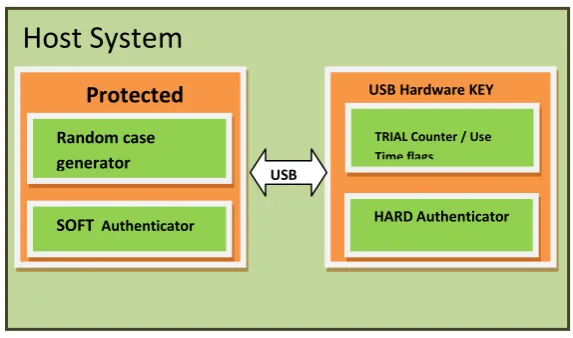
Block diagram of USB key based authentication:-
Figure 3
Functional Module
Host System
The Host System is the PC i.e. the system on which the protected software is intended to run. The protected software is installed on this system and hardware key is inserted into the USB port of this system.
Protected Software
This is the software for which the Anti-Piracy Mechanism is being implemented. The protected software can be any software, developed in any language and designed to run on any platform.
Random Case Generator
For the authentication handshake to take place, the two systems viz. anti-piracy interface within the protected software and the USB key must exchange random test case strings.
SOFT Authenticator
The function f(x) during each level of handshake must be known to both the anti-piracy interface and the USB key. Only then can their results be compared and authentication be allowed. The Soft Authenticator module performs these computations on the test case strings at the protected software end.
USB hardware Key
This is the hardware module that our project uses to authenticate the genuineness of the protected software. Only genuine users who have bought legal versions of the said software are meant to possess such a USB key.
Hard Authentication
Hard Authenticator performs the same computations computing and evaluating a result for the programmed f(x) function over the received random test string. The hard Authenticator
Host System
Protected
software
Random case generator
Generator
SOFT AuthenticatorUSB Hardware KEY
USB Port
TRIAL Counter / Use Time flags
runs on the microcontroller built in the USB key.
Trial Counter/Use Time Flags
The USB key can also be programmed to function as a TRUE trial version enforcer.
VI. 3 level Handshake
Figure 4
Mechanism
(A) The first step is to generate a random number x whose value should be between 1 & 8. 1.1) A microcontroller is required with a programming language visual basic.
1.2)Then a function of x is computed as x is multiplied by x and the result is multiplied by x and then 1 is added to get function of x.
f(x)= ((x*x)+x+1)
1.3) Then the microcontroller is embedded with visual basic program.
1.4) the authentication level is completed or passed successfully only if function of x is equal to function of x‟.
(B) The second step is to generate a random number y whose value should be between 10 & 59.
Then a function of y is generated using function of x.
f(y)= ((y + f(x) + 1) / 2)
Repeat step 1.1 to 1.4 for y.
Then a function of z is computed by
f(z)= z (z+x) (z+y) (Ones Complement(z + x)) (Ones Complement z )
VII. Conclusion
Software companies lose millions, if not billions, each year due to piracy of their software. Various mechanisms have been developed that aim to provide a „protection‟ for original software. „Serial Key‟ or „CD Key‟ as it is popularly known is one such mechanism. However, due to the rising popularity and availability of internet, it has become very easy to obtain illegal serial keys from the internet. An additional protection in the form of „Activation Code‟ had been introduced which provided greater protection, however, it is breakable as well. In this project we propose to develop a hardware based solution to prevent software piracy. A hardware based system consists of a physical device, and hence cannot be shared over the internet, etc., and hence eliminates the flaws of conventional mechanisms.
VIII. REFERENCES
[1]. Bhawana Parihar, Neha Bora,” New Online Modules Model of Software Copy Protection in Serial-Based Method”, International Journal of Computer & Organization Trends –Volume 3 Issue 8 – Sep 2013.
[2]. "MPAA Banned From Using Piracy and Theft Terms in Hotfile Trial". Archived from the original on 30 November 2013. Retrieved November 30, 2013.
[3]. Li MeiHong, Liu JiQiang,” USB Key-Based Approach for Software Protection”, 2009, International Conference on Industrial Mechatronics and Automation.
[4]. I-En Liao a, Cheng-Chi Lee,” A password authentication scheme over insecure networks” Journal of Computer and System Sciences 72 (2006) 727–740, 1 October 2005.
[5]. https://www.techdirt.com/articles/20131130/15263725410/surprise-mpaa-told-it-cantuse-