R E S E A R C H
Open Access
A linear, stabilized, non-spatial iterative,
partitioned time stepping method for the
nonlinear Navier–Stokes/Navier–Stokes
interaction model
Jian Li
1*, Pengzhan Huang
2, Jian Su
3and Zhangxin Chen
4*Correspondence: [email protected]
1Department of Mathematics,
School of Arts and Sciences, Shaanxi University of Science and Technology, Xian, P.R. China Full list of author information is available at the end of the article
Abstract
In this paper, a linear, stabilized, non-spatial iterative, partitioned time stepping method is developed and studied for the nonlinear Navier–Stokes/Navier–Stokes interaction. A backward Euler scheme is utilized for the temporal discretization while a linear Oseen scheme for the trilinear term is used to affect the spatial discretization approximated by the equal order elements. Therefore, we only solve a linear Stokes problem without spatial iterative per time step for each individual domain. Then, the method exploits properties of the Navier–Stokes/Navier–Stokes system to establish the stability and convergence by rigorous analysis. Finally, numerical experiments are presented to show the performance of the proposed method.
MSC: 35Q10; 65N30; 76D05
Keywords: Partitioned time stepping methods; Fluid–fluid interface; Navier–Stokes equations; Convergence; Numerical experiments
1 Introduction
The Navier–Stokes equations are useful because they describe the physics of many realistic problems of academic and industrial interest. They may be used to model weather, ocean currents, water flow, and many other phenomena. Many important applications need an accurate solution of multi-domain, multi-physics coupling of one fluid with another (e.g., the Navier–Stokes with the Navier–Stokes problems) [3,4,31,32]. The uncoupled meth-ods for two fluids are coupled through their shared interface by a rigid-lid coupling con-dition, i.e., no penetration and a slip with a friction condition allowing a jump in the tan-gential velocities across the shared interface [12]. Physics-based uncoupled methods are different from the traditional ones in the sense that they focus on decomposing different physical domains by directly using the given physical interface conditions, which is the key idea of the method proposed in this paper. Moreover, these methods allow existing highly optimized codes for each subproblem to be used in parallel as black boxes at each time step to solve the coupled problem.
Efficient stabilized finite element methods have been widely used in scientific computa-tion to achieve high accuracy for the Navier–Stokes equacomputa-tions approximated by the equal
order elements in practice. While these methods have been shown to be very successful, the theory ensuring their convergence and advantages for a coupled problem is still un-der development. Recently, some results have been obtained for partitioned time stepping methods for the fluid–fluid interaction by using the finite element methods [12,13,25]. In this paper, we shall follow the state-of-the-art convergence theory by using the geometric averaging at three time levels of the slip velocity at the interface to compute a friction co-efficient and further establish stability and convergence of the presented method for the coupled fluid–fluid model. We stress that the extension of the general convergence theory to the partitioned time stepping method for the Navier–Stokes/Navier–Stokes interaction is derived from that in [12]. Here, in order to ensure the balance between the spatial and temporal computing allocation, an unconditional stable backward Euler scheme is utilized for the temporal discretization while the linear Oseen scheme is applied for the trilinear term with a non-spatial iterative correction per time step. The method presented results in a better coefficient matrix of the form (aij)N×N=ν(∇φi,∇φj) + ((C· ∇)φi,φj), improving the model presented with small viscosity [16,17]. However, the difficulty for the numeri-cal analysis arises from the trilinear term and the whole system for the presented discrete finite element scheme.
The rest of paper is organized as follows. In Sect.2, we introduce the fluid–fluid model using two Navier–Stokes problems. In Sect.3, the stability of the Navier–Stokes/Navier– Stokes interaction model is analyzed. In Sect.4, the convergence of the presented method is analyzed. Finally, we present several numerical examples to illustrate the features of the proposed method in Sect.5.
2 Preliminary
A coupled Navier–Stokes/Navier–Stokes problem is stated as follows:
ui,t–νiui+ui· ∇ui+∇pi=fi inΩi, (1)
–νini· ∇ui·τ=k|ui–uj|(ui–uj)·τ onI, (2)
ui·ni= 0 onI, (3)
∇ ·ui= 0 inΩi, (4)
ui(x, 0) =u0i(x) inΩi, (5)
ui= 0 onΓi=∂Ωi\I. (6)
Here,i,j= 1, 2,i=j. Let the domainΩ=Ω1∪Ω2consist of two subdomainsΩ1andΩ2of
Rd,d= 2, 3, with the outward unit normal vectorsn1andn2, respectively, coupled across
the interfaceI. The viscosityνi> 0, the body forcefi: [0,T]→H1(Ωi), and the parameter k∈Rare given,i= 1, 2. Also,ui:Ωi×[0,T]→Rdandpi:Ωi×[0,T]→Rrepresent velocity and pressure on the subdomainsΩi, respectively,i= 1, 2.
For the mathematical problem (1)–(6), the following Hilbert spaces are introduced [1]:
Xi=
vi∈
H1(Ωi)
d
:vi= 0 onΓiandvi·ni= 0 onI
,
Mi=
qi∈L2(Ωi) :
Ωi
qidx= 0
Multiplying (1) byvi∈Xiand (4) byqi∈Mi, integrating and applying the divergence the-orem, the above coupled problem is equivalent to finding (ui,pi)∈(Xi,Mi) such that
(ui,t,vi) +a(ui,vi) –d(vi,pi) +b(ui,ui,vi) +κ
I
[u] [u]vids= (fi,vi),
d(ui,qi) = 0, ∀(vi,qi)∈(Xi,Mi),
(7)
where [·] denotes the jump of the indicated quantity across the interfaceI: [u] =ui–uj and
(ui,t,vi) =
Ωi
∂ui
∂t vidx, i= 1, 2.
The continuous bilinear formsa(·,·) andd(·,·) are defined onXi×XiandXi×Mi, respec-tively, by
a(ui,vi) =νi(∇ui,∇vi), ui,vi∈Xi,
d(vi,qi) = –(vi,∇qi) = (divvi,qi), vi∈Xi,qi∈Mi.
These bilinear terms satisfy the following continuity andinf–supproperties:
a(ui,vi) ≤ν ∇ui 0 ∇vi 0,
d(vi,pi) ≤C ∇vi 0 pi 0,
sup
vi∈Xi
|d(vi,qi)
∇vi 0 ≥
β qi 0 ∀qi∈Mi,β> 0,
(8)
where the positive constantsCandβonly depend onΩ. Similarly, by using the divergence theorem, (3) and (6), the trilinear termb(·,·,·) can be defined as follows [36]:
b(ui,vi,wi) = 1
2(ui· ∇vi,wi) + 1 2
(divui)vi,wi
=1
2(ui· ∇vi,wi) – 1
2(ui· ∇wi,vi), ui,vi,wi∈Xi. (9)
Obviously, the trilinear termb(·,·,·) satisfies the following skew-symmetry property [36]:
b(ui,vi,wi) = –b(ui,wi,vi).
A realistic model would contain many more complex terms. Here, we mainly focus on an algorithmic issue so we assume that the solution of (1)–(6) to be approximated is a strong solution. Moreover, the energetic stability of the monolithic problem is valid:
2
i=1
1 2
d dt ui
2
0+νi ∇ui 20
+κ
I
[u] 3
ds=
2
i=1
3 Stabilizations for Galerkin approximations
Given a respective shape-regular and conforming triangulationThi ofΩi, the finite
ele-ment method is to solve (7) in two pairs of finite dimensional spaces (Xh
i,Mhi)⊂(Xi,Mi) [9,11,15,36].
Stabilization of the Stokes’ problem using local pressure projections dates back to the papers of Silvester [33,34], Brecker and Braack [2], Brezzi and Fortin [6], Brezzi and Pitki-ranta [7], Dohrmann and Bochev [14], Connors [23] and [8]. They provide a wide theoret-ical framework for these methods. The aim of the section is to give an elementary applica-tion in the spirit of these papers for a class of pressure projecapplica-tion method with equal order distribution for both velocity and pressure, which are computationally convenient and ef-ficient in a parallel and multigrid context. Then, the unstable velocity–pressure pairs of the equal-order finite elements are defined as follows [22,26–29,38]:
Xih=vh∈X:vh|K∈
Rr(K)
d
,∀K∈Kh
,
Mhi =qh∈M:qh|K∈Rr(K),∀K∈Kh
, r= 1, 2.
In order to analyze the stabilzation of the Galerkin approximations for the Navier– Stokes/Navier–Stokes interaction, we assume thatπihdenotes the interpolation operator from the richer spaceMhinto the smaller spaceM¯h⊂Mhsuch thatXh× ¯Mhsatisfies the inf–sup condition anddivXh⊂Mh.
Lemma 3.1 It holds that
sup
vhi∈Xih d(vh
i,qhi)
∇vh i 0
+G1/2qhi,qhi≥β0qhi0, q
h i ∈Mih,
where the positive constantβ0only depends onΩand the stabilized term G(·,·)is defined
as follows:
Gqhi,qhi∼
⎧ ⎨ ⎩
qh
i –πiqhi0, r= 1,
h∇
qhi –πiqhi0, r= 2.
(11)
Proof For a bounded Lipschitz connected domainΩand for anyphi ∈L2(Ω), there exist a positive constantC0> 0 andvi∈[H1(Ωi)]dsatisfying
divvi=phi
such that
vi 1≤C0phi0
and
phi20=dvi,phi
Then, there exists a linear operatorπ˜ih: [H1(Ω
i)]d→Xhsuch that the orthogonality rela-tion holds [5,10]:
vi–π˜ihvi,qh
= 0, ∀qh∈Mh, (12)
∇ ˜πihvi0≤C vi 1≤C1phi0, (13)
whereC1only depends onΩ. Noting thatdivπ˜hv∈Mhand thusd(π˜hv,phi –πhphi) = 0, and using the definition ofπ˜h, we obtain
phi20=dvi,phi
=dvi,phi –πihphi
+dvi,πihphi
=dvi–π˜hvi,phi –πihphi
+dπ˜hvi,πihphi
=dvi–π˜hvi,phi –πihphi
+dπ˜ihvi,phi
, (14)
where
dvi–π˜ihvi,phi –πihphi
≤Cphi –πihphi0 vi 1
≤G1/2phi,pihphi0, r= 1, (15)
and
dvi–π˜ihvi,phi –πihphi
= –∇phi –πihphi,vi–π˜ihvi
≤Ch∇phi –πihphi0 vi 1
≤G1/2phi,pihphi0, r= 2.
Therefore,
sup
vhi∈Xih
d(vhi,qhi)
∇vhi 0 +G
1/2ph i,phi
≥ d(π˜ivi,qhi)
∇ ˜πivi 0
+G1/2phi,phi
≥β0phi
2 0.
For more details, the result related to the well-posedness of the Navier–Stokes/Navier– Stokes interaction can be found in [12,13,18,20,30,37].
4 Stability
In this section, we are now in a position to state a discrete finite element scheme. We let (un
i,pni) =: (uni,h,pni,h),i= 1, 2, denote a discrete approximation toui(tn), where the discrete timetnis calculated from the uniform time step sizeτ =T/Nbytn=nτ,n= 0, 1, . . . ,N.
From the point of view of implementation, the method presented consists of several subroutines for solving the nonlinear fluid–fluid interaction. First, the first guessu0
uni+1,n= 0, 1, 2, . . . , can be obtained by the following equations (16) and (17). For the nu-merical treatment of the time derivative term, we use the fully discrete backward Euler ap-proximation. As for the partitioned scheme, we apply the Oseen scheme with a non-spatial iterative correction to simplify the trilinear term per time step and further obtain a better stiffness matrix. Especially, recalling the standard geometric averaging of the jump in [12,
13], we replace the termunj+1|uni+1–ujn+1|by|uni –unj|uin+1andunj|uni–unj|1/2|uni–1–unj–1|1/2 in order to decouple the fluid–fluid interaction, which is also a key idea to obtain the un-conditionally stable partitioning.
The linear, stabilized, non-spatial iterative, partitioned time stepping method is defined as follows:
Step I.Find(u1
i,p1i)∈Xih×Mihsatisfying the followingStokesequations:
au1i,vi
–dvi,p1i
+du1i,qi
+Gp1i,qi
= (f,vi) ∀(vi,qi)∈Xih×Mhi.
Moreover, set the iterative stepm= 1, 2, . . . , the error of two successive solutions
emi =umi –umi –12+pmi –pmi –12<ε
with a sufficiently small iterative toleranceε> 0.
Step II.Solve the Navier–Stokes/Navier–Stokes interaction: Givenτ> 0,fi∈[H–1(Ωi)]d (i= 1, 2),find(un1+1,p1n+1)∈Xh1×M1hsuch that
(un+1
1 –un1,v1)
τ +a
un1+1,v1
–dv1,pn1+1
+dun1+1,q1
+Gpn1+1,q1
+b1
un1,un1+1,v1
+k
I
un un1+1v1ds–k
I
un 1/2 un–1 1/2un2·v1ds
=f1
tn+1,v1
, ∀(v1,q1)∈X1h×M1h, (16)
and(un2+1,pn2+1)∈X2h×Mh2such that
(un2+1–un2,v2)
τ +a
un2+1,v2
–dv2,pn2+1
+dun2+1,q2
+Gpn2+1,q2
+b2
un2,un2+1,v2
+k
I
un un2+1v2ds–k
I
un 1/2 un–1 1/2un1·v2ds
=f2
tn+1,v2
∀(v2,q2)∈X2h×Mh2. (17)
This, of course, dictates that the overall structure of the linear, stablized, non-spatial iterative, partition time step method will be much the same as for a standard finite el-ement method, as described in [12]. The key point of the presented method is to use a linear, non-spatial iterative, partitioned time stepping method for the nonlinear Navier– Stokes/Navier–Stokes interaction model.
Routine: [u0
[umh,pmh] = LNS(Th,umh–1,f); end while
end for
In this section, we aim to establish a result concerning the unconditional stability of the scheme (16)–(17).
Lemma 4.1 Let uni,i= 1, 2,n= 1, 2, . . . ,m,be the solutions of equations(16)and(17).Then we have the following energy inequality:
um+12
0+
m
n=1
un+1– un20+τ
m
n=1
ν1∇un1+1 2
0+ν2∇u
n+1
2
2 0
+κτ
I
un un1+1 2+ un2+1 2ds
≤u120+κτ
I
u0 u11 2+ u12 2ds
+ m
n=1
τ ν1
f1
tn+120+ τ
ν2
f2
tn+12–1
, (18)
where un
i = (un1,un2)with the norm un 0= (
2
i=1 uni 20)1/2.
Proof Noting that
buni,uin+1,uni+1= 0,
we start by testing (16) and (17) with (vi,qi) = 2(τuni+1,pni+1), respectively, to obtain 2uni+1–uni,uin+1+ 2νiτ∇uni+1
2 0+ 2G
pni+1,pni+1
+ 2κτ
I
uni+1 2 un ds–
I
un 1/2 un–1 1/2uni+1·uni+1ds
= 2τfi
tn+1,uni+1 ∀(vi,qi)∈Xih×Mhi,i= 1, 2, (19)
whereu3=u1when the index is out of bounds. Using the identity
2(a–b,a) =a2+ (a–b)2–b2, (20)
and combing with (19) withi= 1, 2, we obtain the following result:
un+12
0–u
n2 0+u
n+1– un2
0+ 2ν1τ∇u
n+1
1
2
0+ 2ν2τ∇u
n+1
2
2 0
+ 2κτ
2
i=1
I
un+1
i
2
un ds–
I
un 1/2 un–1 1/2uni+1·uni+1ds
+ 2Gpni+1,pni+1
= 2τ
2
i=1
fi
where
κ
I
uni+1 2 un ds–
I
un 1/2 un–1 1/2uni+1·uni+1ds
=κ 2
I
uni+1 2 un ds–κ 2
I
uni+1 2 un–1 ds
+κ 2
I
uni+1 un 1/2–uni+1 un–1 1/2 2ds,
2τ 2 i=1 fi
tn+1,uni+1
≤2τ γ
2
i=1
fi
tn+10∇uni+10
≤ 2
i=1
τ νi∇uni+1
2 0+
τ γ2 νi
fi
tn+120
,
(22)
where the positive constant is derived from the Poincaré inequality. Then, substituting these into (21), we infer that
un+120–un20+un+1– un20+ν1τ∇un1+1 2
0+ν2τ∇u
n+1 2 2 0 +κτ I
un1+1 2+ u2n+1 2 un ds–κτ
I
un1 2+ un2 2 un–1 ds
+κτ
2
i=1
un+1
i un
1/2
–un
i+1 un–1 1/2 2
ds
≤τ
2
i=1
fi(tn+1) 20
νi
. (23)
Summing overn= 1, 2, . . . ,myields the desired result.
5 Convergence
In this section, we consider the convergence of the presented method for the Navier– Stokes/Navier–Stokes interaction. First, we provide the discrete Gronwall’s inequality [21,
24], which will be useful in the subsequent analysis.
Letan+1,bn+1,cn+1,dn+1andDn+1,n= 0, 1, 2, . . . ,m, be five nonnegative sequences
satis-fying
am+1+ m
n=0
bn+1+τ
m
n=0
cn+1≤C1+C2τ
m
n=0
Dn+1an+1+C3τ
m
n=0
dn+1. (24)
Then we have the following result:
am+1+ m
n=0
bn+1+τ
m
n=0
cn+1≤exp
C2τ
m
n=0
σn+1
C1+C3τ
m
n=0
dn+1
where
σn+1= D n+1
1 –τDn+1.
In order to analyze convergence of the partitioned time stepping methods for the fluid–fluid interaction, we introduce the following Stokes projection by finding (Rh(vi,qi), Qh(vi,qi))∈Xih×Mhi such that
avi–Rh(vi,qi),vh
–dvh,qi–Qh(vi,qi)
+dvi–Rh(vi,qi),qh
= 0,
(vh,qh)∈Xih×Mhi, (26)
which is well-defined and satisfies the following optimal approximation property:
vi–Rh(vi,qi)0+h∇
vi–Rh(vi,qi)0+qi–Qh(vi,qi)0
≤Ch2 vi 2+ qi 1
, i= 1, 2. (27)
Theorem 5.1 Assume that the initial data u0
i and u1i satisfy the following estimate:
∇
ui
t0–u0i0+∇ui
t1–u1i0≤Ch, i= 1, 2. (28)
Moreover,the time stepτ satisfies the relationτ < 1/Dn+1with Dn+1 defined by(43)
be-low. Let (ui,pi) and (uni+1,pin+1)be the solutions of (1)–(6) and(16)–(17), respectively, with ui∈L2([0,T],H2(Ωi)∩Xi),pi∈L2([0,T],H1(Ωi)∩Mi),ui,t∈L2([0,T],Xi)and ui,tt∈ L2([0,T],L2(Ω
i)).Then it holds that
τ
m
n=0
ν1∇
u1
tn+1–u1n+120+ν2∇
u2
tn+1–un2+120
≤Cτ2+h2r, r= 1, 2, (29)
where C denotes a positive constant depending on the data(νi,Ωi,ui,pi,fi),i= 1, 2,which may stand for different values at different occurrences.
Proof Here, we analyze convergence on each subdomain independently. For convenience, we set (eji,ηij) = (Rhui(tj) –uji,Qhpi(tj) –pji) andE
j
i=ui(tj) –Rhui(tj). First, using the Stokes projection, we subtract (16) or (17) from (7) with (vi,qi) = (eni+1,ηni+1)∈Xih×Mihto obtain
∂ui(tn+1)
∂t –
(un+1
i –uni)
τ ,e
n+1
i
+aeni+1,eni+1+ 2Gηni+1,ηni+1
+bui
tn+1,ui
tn+1,eni+1–buni,uni+1,eni+1
+κ
I ui
tn+1 utn+1 ·eni+1ds–
I
uni+1 un ·eni+1ds
+κ
I
unj un 1/2 un–1 1/2·eni+1ds–
I uj
tn+1 utn+1 ·eni+1ds
= 2Gpi
tj+1,ηi
wherei= 1,j= 2 ori= 2,j= 1. We analyze each term in the above equality. Note that
∂ui(tn+1)
∂t –
(uni+1–uni)
τ ,e
n+1
i
=1
τ
ui
tn+1–uni+1–ui
tn–uni,eni+1–1
τ
ui
tn+1–ui
tn,eni+1
+
∂ui(tn+1)
∂t ,e n+1
i
=1
τ
Eni+1–Ein,eni+1+1
τ
eni+1–eni,eni+1–RHSni+1,eni+1,
where (RHSn+1
i ,v) = (ui
(tn+1)–ui(tn)
τ –
∂ui(tn+1)
∂t ,vi),i= 1, 2. Also, we see that
En+1
i –Eni,eni+1 ≤ 1 4ε1νi
En+1
i –Eni
2
–1+ε1νi∇e
n+1
i
2
0, (31)
RHSi,eni+1 ≤ 1 4ε2νi
RHSin+12–1+ε2νi∇eni+1
2
0, (32)
whereεi> 0,i= 1, 2. For the trilinear terms, it is easy to see that
bui
tn+1,ui
tn+1,eni+1–buni,uni+1,eni+1
=bui
tn+1–ui
tn,ui
tn+1,eni+1+bEni,ui
tn+1,eni+1
+beni,ui
tn+1,eni+1–buni,ui
tn+1–uni+1,eni+1
=I1+I2+I3+I4. (33)
To estimate these trilinear terms, using a classical result in [36], we see that
|I1| ≤C∇ui
tn+1–ui
tn0∇ui
tn+10∇eni+10
≤ε3νi∇eni+1
2 0+
C 4ε3νi
∇ui
tn+120∇ui
tn+1–ui
tn20.
Applying the Young inequality and the skew-symmetry of the trilinear term yields that
|I2+I4|= b
Ein,ui
tn+1,eni+1–buni,Eni+1,eni+1
≤∇uni0+∇ui
tn+10∇Eni0+∇Eni+10∇eni+10
≤ε4νi∇eni+1
2 0+
c 4ε4νi
∇un i
2 0+∇ui
tn+120Eni02+Eni+120.
For the third termI3, using the following inequality [20]:
φ L4≤C φ 1 2–14(d–2)
0 ∇φ
1 2+14(d–2)
and applying the Young inequality and the Cauchy–Schwarz inequality, we have
|I3| ≤Ceni1/20 ∇eni1/20 ∇ui
tn+10∇eni+10
≤ε5νi∇eni+1
2 0+Ce
n i0∇e
n i0∇ui
tn+120
≤ε5νi∇eni+1
2
0+ε6νi∇e
n i
2 0+Ce
n i
2 0∇ui
tn+140
ford= 2, and
|I3| ≤Ceni1/40 ∇eni3/40 ∇ui
tn+10∇eni+10
≤ε5νi∇eni+1
2 0+Ce
n i
1/2 0 ∇e
n i
3/2 0 ∇ui
tn+120
≤ε5νi∇eni+1
2
0+ε6νi∇e
n i
2 0+Ce
n i
2 0∇ui
tn+180
ford= 3. Setting
utn+1 =1
2 u
tn+1 + utn ,
un =1 2 u
n + un–1 ,
and using the same approach as in [12], we get
I5 =
I ui
tn+1 utn+1 ·eni+1ds–
I
uni+1 un ·eni+1ds
=
I ui
tn+1 utn+1 – utn ·eni+1ds
+
I ui
tn+1 utn – Phu
tn ·eni+1ds
+
I ui
tn+1 Phu
tn – un ·eni+1ds
+
I
Ein+1 un ·eni+1ds+
I
un eni+1 2ds
≤
I ui
tn+1 utn+1 – utn ·en+1
i ds+
I ui
tn+1 En i ·en
+1 i ds + I ui
tn+1 eni ·eni+1ds
+
I
Ein+1 un ·eni+1ds+
I
un eni+1 2ds. (35)
Noting that
utn – utn+1
=1 2 u
tn – utn+1 +1 2 u
tn–1 – utn+1
≤1
2 u
and
un 1/2 un–1 1/2– un |
=1 2 u
n 1/2– un–1 1/22
≤1
2 u
n – un–1
≤1
2 u
n– un–1
≤1
2 u
n– utn+ utn–1– un–1 +1
2 u
tn– utn–1
≤ en + En + en–1+En–1 +1
2 u
tn– utn–1 , (37)
the following error bound holds:
I6 =
I
unj un 1/2 un–1 1/2·eni+1ds–
I uj
tn+1 utn+1 ·eni+1ds
≤
I
unj un 1/2 un–1 1/2– un ·en+1
i ds+
I
unj un –P
h un ·eni+1ds
+
I
unjPh un – u
tn ·eni+1ds
+
I
unj utn+1 – utn+1 ·en+1
i ds
–
I
Enj +enj utn+1 ·eni+1ds
+
I
uj
tn–uj
tn+1 utn+1 ·eni+1ds
≤
I
unj utn– utn–1 ·eni+1ds+
I
unj En ·en+1
i ds+
I
unj en ·en+1
i ds
+
I
unj utn– utn+1 + utn–1– utn+1 ·eni+1ds
+
I
uj
tn–uj
tn+1 utn+1 ·eni+1ds
–
I
Enj +enj utn+1 ·eni+1ds. (38)
Applying the same approach as in [12], we obtain
|I5+I6|
≤ε7νi∇eni+1
2 0+Cν
–3
i
1 +un24I +utn+14Ieni+120
+ε8 2
i=1
νi∇eni
2 0+∇e
n–1
i
2 0
+CLn+1Pn+1
+CMn+1
2
i=1
whereLn+1,Mn+1andPn+1can be defined by the following bound terms on interfaceIas
follows:
Ln+1= 2
i=1
ui
tn+12
I +u n+1
i
2
I +u n i 2 I ,
Mn+1=
2
i=1
ui
tn+14I +uni4I,
Pn+1=
2
i=1
ui
tn+1–ui
tn2I +ui
tn+1–ui
tn–12I
+Ein–12I +Eni2I +Eni+12I.
Obviously, · I is bounded by the correspondingL2-norm. In addition, we can infer that the estimate ofPn+1has the order ofO(τ2+h2r),r= 1, 2.
Choosingε1+ε2+ε3+ε4+ε5+ε7= 1/4,ε6= 1/8, andε8= 1/16, and combining all these
inequalities with (30) yields that 1
2τe
n+1
i
2 0–e
n i
2 0+e
n+1
i –eni
2 0
+3νi 4 ∇e
n+1 i 2 0 ≤C 1
τE
n+1
i –Eni
2
–1+RHS
n+1
i
2
–1+ pi–Πhpi 2 0
+C∇ui
tn+120∇ui
tn+1–ui
tn20
+∇uni20+∇ui
tn+120Eni20+Ein+120+Ceni20∇ui
tn+120d
+Cνi–31 +un24I +utn+14Ieni+120+CLn+1Pn+1
+
2
i=1
νi 16∇e
n i
2 0+∇e
n–1
i
2 0
+νi 8∇e
n i
2 0
+CMn+1
2
i=1
νi–3eni20+eni–120. (40)
Summing overi= 1, 2 for the above inequality and moving the term on the 5th line on the right-hand side of (40) to its left-hand side, t the term νi
8 ∇e
n
i 20can be exactly absorbed.
Thus we find that
1 2τe
n+12 0–e
n2 0+e
n+1– en2 0 + 2 i=1 νi 2∇e
n+1 i 2 0 + 2 i=1 νi 4∇e
n+1
i
2 0–∇e
n i 2 0 + 2 i=1 νi 16∇e
n i
2 0–∇e
n–1 i 2 0 ≤C 2 i=1 1
τE
n+1
i –Eni
2
–1+RHS
n+1
i
2
–1+ pi–Πhpi 2 0 +C 2 i=1
∇ui
tn+120∇ui
tn+1–ui
+C
2
i=1
∇un i
2 0+∇ui
tn+120Eni02+Eni+120+C
2
i=1
Ln+1Pn+1
+C
2
i=1
νi–31 +un24I +utn+14Ieni+120+C
2
i=1
eni20∇ui
tn+120d
+C
2
i=1
νi–3Mn+1eni02+eni–120.
Noting the bounds of ∇ui(tn+1) 0,
m–1
n=0 ∇uni+1 0, and utt 0yields
Ein+1–Ein–12 +τRHSni+12–1
≤Cτ2+h2 utt 2L2([t
n–1,tn+1],L2(Ωi))
+ u L2([t
n–1,tn+1],H2(Ωi))+ p L2([tn–1,tn+1],H1(Ωi))
,
Ln+1Pn+1
≤Cτ2+h2r ut 2L2([tn–1,tn+1],L2(Ω
i))+ u
2
L2([tn–1,tn+1],H2(Ω
i))
.
Summing over n= 1, 2, . . . ,m– 1, multiplying by 2τ, using the classical estimates, and rewritting the last term of the right-hand side of the above inequality as
m–1
n=1
2
i=1
νi–3Mn+1eni20+eni–120
≤C
2
i=1
νi–3M2+M3e1i20+e0i20+C m–1
n=1
νi–3Mn+1+Mn+2en20, (41)
we obtain
em2
0+
m–1
n=1
en+1– en20+τ
m–1
n=1 2
i=1
νi 2∇e
n+1
i
2 0
+τ
2
i=1
νi 16∇e
m–1
i
2 0+ 4∇e
m i
2 0
≤τ
2
i=1
νi 16∇e
0
i
2 0+ 4∇e
1
i
2 0
+1 +Cτ νi–3M2+M3e020+e120
+Cτ2+h2r+Cτ
m–1
n=1
Dn+1en+12
0, (42)
whereDn+1is defined by
Dn+1=νi–31 +Mn+Mn+1+un24I +utn+14I
andCis dependent of the data (Ωi,νi,fi). Setting
aj+1=ej+120, bj+1=ej+1–ej20, cj+1=
2
i=1
∇eji+120,
and using Gronwall’s inequality in Lemma4.1, (28) and (42) yields the desired result.
6 Numerical results
In this section, we assess numerical performance of the stabilized methods for the pre-sented model. It will be checked by a known analytical solution problem. The main goal of the experiment is to verify convergence rates of the scheme (16)–(17). Here, we denote errors by
Err(ui) =
τ
m
n=0
∇
ui
tn+1–uni+120,Ω
i
1/2
,
Err(pi) =
τ
m
n=0
pi
tn+1–pni+120,Ω
i
1/2
,
where i= 1, 2. All numerical computations are implemented by open source software Freefem [19].
Example1 The computations of the experiment are carried out in the domains Ω1=
(0, 1)×(0, 1) andΩ2= (0, 1)×(–1, 0). The prescribed exact solutions are given [13,37]
by
p1(t,x,y) =p2(t,x,y) =exp(–t)cos(πx)sin(πy),
u1,1(t,x,y) = –αx2exp(–t)(x– 1)2(y– 1),
u1,2(t,x,y) =αxyexp(–t)
6x+y– 3xy+ 2x2y– 4x2– 2,
u2,1(t,x,y) = –αxexp(–t)(x– 1)
y2x(x– 1)
μ1
μ2
+ 1
–μ
1/2
1 y2exp(t/2)
(ακ)1/2 –x(x– 1) +
μ1/21 exp(t/2) (ακ)1/2 +
μ1xy(x– 1)
μ2
,
u2,2(t,x,y) = –
αyexp(–t)(2x– 1) 3μ2(ακ)1/2
6μ2x2(ακ)1/2– 6μ2x(ακ)1/2– 3μ1/21 μ2exp(t/2)
– 2μ1x2y2(ακ)1/2– 2μ2x2y2(ακ)1/2+ 3μ1xy(ακ)1/2+ 2μ1xy2(ακ)1/2
– 3μ1x2y(ακ)1/2+ 2μ2xy2(ακ)1/2+μ1/21 μ2y2exp(t/2)
,
with an arbitrary positive constantα. Here, (ui,pi),i= 1, 2 are the solutions of the original problem (1)–(6) and the right-hand sidesf = (f1,f2) can be obtained by (1). Moreover,
u2= (u2,1,u2,2) satisfies the three interface conditions in [13].
Firstly, in the first example, we choose the same parameter valuesμ1= 0.5,μ2= 0.05,
Table 1 Errors for stabilizedP1–P1pair withτ=h
1/h Err(u1) Rate Err(u2) Rate Err(p1) Rate Err(p2) Rate
8 7.2271E–2 – 2.9717E–1 – 1.4967E–2 – 1.1617E–2 –
32 1.7025E–2 1.043 7.0463E–2 1.038 1.8549E–3 1.506 1.9019E–3 1.305 64 8.4129E–3 1.017 3.4862E–2 1.015 6.8180E–4 1.444 7.2067E–4 1.400
Table 2 Errors for stabilizedP2–P2pair withτ=h2
1/h Err(u1) Rate Err(u2) Rate Err(p1) Rate Err(p2) Rate
4 2.6926E–2 – 1.7999E–1 – 1.7270E–2 – 1.6852E–2 –
8 5.7926E–3 2.215 3.4207E–2 2.396 4.2766E–3 2.014 4.2613E–3 1.984 16 1.3445E–3 2.107 6.9341E–3 2.303 1.0623E–3 2.009 1.1131E–3 1.914
Table 3 Errors for the different small viscosities based on stabilizedP1–P1pair
μ1= 1.0E–4 μ1= 1.0E–4 μ1= 1.0E–5
μ2= 1.0E–4 μ2= 1.0E–5 μ2= 1.0E–5
Err(u1) 1.3843E–2 1.3838E–2 1.3864E–2
Err(u2) 2.0461E–2 5.3043E–2 2.0475E–2
Err(p1) 1.9068E–3 1.9070E–3 1.9063E–3
Err(p2) 9.7819E–4 2.6972E–3 9.7897E–4
Table 4 Errors for the different small viscosities based on stabilizedP2–P2pair
μ1= 1.0E– 4 μ1= 1.0E– 4 μ1= 1.0E– 5
μ2= 1.0E– 4 μ2= 1.0E– 5 μ2= 1.0E– 5
Err(u1) 4.9393E–2 4.9283E–2 5.4135E–2
Err(u2) 4.9196E–2 5.3924E–2 5.3904E–2
Err(p1) 3.0189E–4 3.0190E–4 3.0190E–4
Err(p2) 3.1022E–4 7.7659E–4 3.1042E–4
with the time step τ =h. Three values of space sizeh= 1/8, 1/32, 1/64 are chosen. We display the convergence orders and errors of the presented method in Tables1–2byPr– Pr,r= 1, 2. From Tables1–2, it can be easily seen that the method completely agree with the expected results in theory.
Secondly, we test the presented method with small viscosities. Here, we chooseα= 1,
κ = 100,h= 1/20 and the time stepτ = 0.005. Then, we list the numerical errors with different small viscosities atT= 0.1 in Tables3–4. Obviously, the presented method can deal with these problems involving small viscosities.
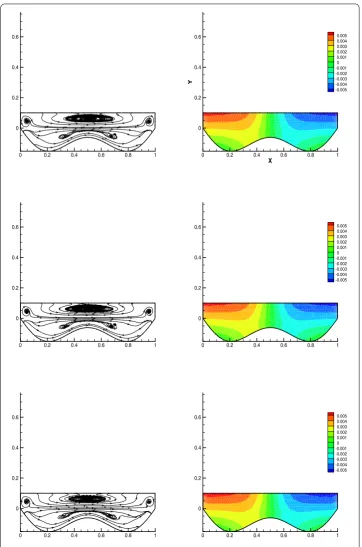
Example2 In this example, we test the presented method for a submarine mountain prob-lem. This problem describes the fluid, which flows in a domain including the submarine mountain. In this case, the subdomainΩ2is nonconvex. As is known, the viscosity of the
fluid at submarine location is bigger than that at surface location. So we takeμ1= 0.001
andμ2= 0.01 in this example.
SetΩ1= [0, 1]×[0, 0.1] andΩ2={(x,y) :407(1 – (2x– 1)sin(7x– 3.5))≤y≤0}. The initial
conditions are chosen as follows:
p1(0,x,y) =p2(0,x,y) =cos(πx)sin(πy),
Figure 1The numerical streamlines and isobars: the stabilizedP2–P2pair (the first line), theP2–P1pair (the second line) and the stabilizedP1–P1pair (the third line)
u1,2(0,x,y) =xy
–0.2 +y+ 0.6x– 3xy– 0.4x2+ 2x2y,
u2,1(0,x,y) =x2(1 –x)2(0.1 +y),
u2,2(0,x,y) =xy
We apply the presented method to get the numerical solution withh= 1/70 andτ= 1/40. In Fig.1, we present profiles for the numerical velocity and pressure with different methods at the final timeT= 5 andκ= 100. From this figure, we can see that the stabilized methods are stable and the unphysical oscillations do not appear, and the numerical results of these stabilized methods completely agreement with those obtained by the classicalP2–P1pair
[35]. Besides, we can find that the presence of the submarine mountain affects the fluid.
Acknowledgements
The authors express their sincere thanks to the anonymous reviewers for their valuable suggestions and corrections for improving the quality of this paper.
Funding
This work is supported by NSF of China (No. 11771259 and 11861067).
Availability of data and materials
Data sharing not applicable to this article as no datasets were generated or analyzed during the current study.
Competing interests
The authors declare that they have no competing interests.
Authors’ contributions
All authors contributed equally to the writing of this paper. All authors read and approved the final manuscript.
Author details
1Department of Mathematics, School of Arts and Sciences, Shaanxi University of Science and Technology, Xian, P.R. China. 2College of Mathematics and System Sciences, Xinjiang University, Urumqi, China.3School of Mathematics and Statistics,
Xi’an Jiaotong University, Xi’an, P.R. China.4Department of Chemical & Petroleum Engineering, Schulich School of
Engineering, University of Calgary, Calgary, Canada.
Publisher’s Note
Springer Nature remains neutral with regard to jurisdictional claims in published maps and institutional affiliations.
Received: 27 December 2018 Accepted: 4 June 2019
References
1. Adams, R.A.: Sobolev Spaces. Academic Press, New York (1975)
2. Becker, R., Braack, M.: A finite element pressure gradient stabilization for the Stokes equations based on local projections. Calcolo38, 173–199 (2001)
3. Bernardi, C., Chacón-Rebollo, T., Lewandowski, R., Murat, F.: Existence of a solution for a model of two coupled turbulent fluids. SIAM J. Numer. Anal.40, 2368–2394 (2002)
4. Bresch, D., Koko, J.: Operator-splitting and Lagrange multiplier domain decomposition methods for numerical simulation of two coupled Navier–Stokes fluids. Int. J. Appl. Math. Comput. Sci.16, 419–429 (2006)
5. Brezzi, F., Fortin, M.: Mixed and Hybrid Finite Element Methods. Springer, New York (1991)
6. Brezzi, F., Fortin, M.: A minimal stabilisation procedure for mixed finite element methods. Numer. Math.89, 457–491 (2001)
7. Brezzi, F., Pitkäranta, J.: On the stabilization of finite element approximations of the Stokes equations. In: Proceedings on the Efficient Solutions of Elliptic Systems, Kiel, 1984. Notes on Numerical Fluid Mechanics, vol. 10, p. 11. Vieweg, Braunschweig (1984)
8. Burman, E.: Pressure projection stabilizations for Galerkin approximations of Stokes’ and Darcy’s problem. Numer. Methods Partial Differ. Equ.24, 127–143 (2008)
9. Chen, Z.: Finite Element Methods and Their Applications. Springer, Heidelberg (2005)
10. Chen, Z., Wang, Z., Zhu, L., Li, J.: Analysis of the pressure projection stabilization method for the Darcy and coupled Darcy–Stokes flows. Comput. Geosci.17, 1079–1091 (2013)
11. Ciarlet, P.G.: The Finite Element Method for Elliptic Problems. North-Holland, Amsterdam (1978)
12. Connors, J., Howell, J., Layton, W.: Decoupled time stepping methods for fluid–fluid interaction. SIAM J. Numer. Anal.
50, 1297–1319 (2012)
13. Connors, J.M., Howell, J.S.: A fluid–fluid interaction method using decoupled subproblems and differing time steps. Numer. Methods Partial Differ. Equ.28, 1283–1308 (2012)
14. Dohrmann, C.R., Bochev, P.B.: A stabilized finite element method for the Stokes problem based on polynomial pressure projections. Int. J. Numer. Methods Fluids46, 183–201 (2004)
15. Girault, V., Raviart, P.A.: Finite Element Method for Navier–Stokes Equations: Theory and Algorithms. Springer, Berlin (1987)
16. He, Y., Li, J.: Convergence of three iterative methods based on the finite element discretization for the stationary Navier–Stokes equations. Comput. Methods Appl. Mech. Eng.198, 1351–1359 (2009)
18. He, Y., Lin, Y., Sun, W.: Stabilized finite element method for the non-stationary Navier–Stokes problem. Discrete Contin. Dyn. Syst., Ser. B6, 41–68 (2006)
19. Hecht, F., LeHyaric, A., Pironneau, O.: Freefem++ version 3.23 (2013)http://www.freefem.org/ff++
20. Heywood, J.G., Rannacher, R.: Finite-element approximations of the nonstationary Navier–Stokes problem. Part I: regularity of solutions and second-order spatial discretization. SIAM J. Numer. Anal.19, 275–311 (1982) 21. Heywood, J.G., Rannacher, R.: Finite-element approximation of the nonstationary Navier–Stokes problem part IV:
error analysis for second-order time discretization. SIAM J. Numer. Anal.27, 353–384 (1990)
22. Huang, P., Feng, X., He, Y.: A quadratic equal-order stabilized finite element method for the conduction–convection equations. Comput. Fluids86, 169–176 (2013)
23. Layton, W.: Model reduction by constraints, discretization of flow problems and an induced pressure stabilization. Numer. Linear Algebra Appl.12, 547–562 (2005)
24. Layton, W.: Introduction to the Numerical Analysis of Incompressible Viscous Flows. Comput. Sci. Eng., vol. 6. SIAM, Philadelphia (2008)
25. Layton, W., Tran, H., Trenchea, C.: Analysis of long time stability and errors of two partitioned methods for uncoupling evolutionary groundwater–surface water flows. SIAM J. Numer. Anal.51, 248–272 (2013)
26. Li, J., Chen, Z.: A new stabilized finite volume method for the stationary Stokes equations. Adv. Comput. Math.30, 141–152 (2009)
27. Li, J., Chen, Z.: OptimalL2,H1andL∞analysis of finite volume methods for the stationary Navier–Stokes equations
with large data. Numer. Math.126, 75–101 (2014)
28. Li, J., Chen, Z., He, Y.: A stabilized multi-level method for non-singular finite volume solutions of the stationary 3D Navier–Stokes equations. Numer. Math.122, 279–304 (2012)
29. Li, J., He, Y.: A new stabilized finite element method based on two local Gauss integration for the Stokes equations. J. Comput. Appl. Math.214, 58–65 (2008)
30. Li, J., He, Y., Chen, Z.: A new stabilized finite element method for the transient Navier–Stokes equations. Comput. Methods Appl. Mech. Eng.197, 22–35 (2007)
31. Lions, J.L., Temam, R., Wang, S.: Models for the coupled atmosphere and ocean (CAO I). Comput. Mech. Adv.1, 1–54 (1993)
32. Lions, J.L., Temam, R., Wang, S.: Numerical analysis of the coupled atmosphere–ocean models (CAO II). Comput. Mech. Adv.1, 55–119 (1993)
33. Nasserdine, K., Silvester, D.: Analysis of locally stabilized mixed finite element methods for the Stokes problem. Math. Compet.58, 1–10 (1992)
34. Silvester, D.: Optimal low order finite element methods for incompressible flow. Comput. Methods Appl. Mech. Eng.
111, 357–368 (1994)
35. Taylor, C., Hood, P.: A numerical solution of the Navier–Stokes equations using the finite element technique. Comput. Fluids1, 73–100 (1973)
36. Temam, R.: Navier–Stokes Equations, Theory and Numerical Analysis, 3rd edn. North-Holland, Amsterdam (1984) 37. Zhang, H., Hou, Y., Shan, L.: Stability and convergence analysis of decoupled algorithm for fluid–fluid interaction.
SIAM J. Numer. Anal.54, 2833–2867 (2016)