Microencapsulation of Probiotic Bacteria and its
Potential Application in Food Technology
Arpita Das1, Sohini Ray1, Utpal Raychaudhuri1 and Runu Chakraborty1,2
1Dept. of Food Technology and Biochemical Engineering. Jadavpur University, Kolkata, India.
2Corresponding Author: Dr. Runu Chakraborty, Professor, Department of Food Technology and Biochemical Engineering, Jadavpur University, Kolkata, India.
Email: [email protected]
Paper No. 178 Received: November 04, 2013 Accepted: January 09, 2014 Published: March 04, 2014
Abstract
Today the use of probiotic bacteria in food is of increasing interest to provide beneficial health effects in the food industry. Microencapsulation technology can be used to maintain the viability of probiotic bacteria during food product processing and storage. However, it is unknown to consumers how these beneficial bacteria sustain viability in food products and in our bodies. These microcapsules are artificially created to support the growth of the probiotic and provide protection from harsh external environments. Polysaccharides like alginate, gelan, carrageenan, chitosan and starch are the most commonly used materials in microencapsulation of bifidobacteria and lactobacilli. Techniques commonly applied for probiotic microencapsulation are emulsion, extrusion, spray drying, and adhesion to starch. It is done on bakery products, ready to eat cereals, dairy products etc. Now a days aseptic microencapsulation is introduced to biodegradable material. New creation and future progress will be carried by double microencapsulation, improving strain & culture.
Highlights
• The use of microencapsulated probiotics for controlled release applications is a promising alternative to solving the major problems of organisms that are faced by food industries.
• Microencapsulation has proven one of the most potent methods for maintaining high viability and stability of probiotic bacteria, as it protects probiotics both during food processing and storage.
• The entrapment in conventions Ca-alginate beads has been a popular method for immobilization of lactic acid bacteria; Use of different encapsulation technologies for protection of health ingredients achieved high ingredient efficiency.
Key words: Probiotic, Microencapsulation, Alginate, Lactic acid bacteria, Carrageenan, Food technology.
©2014 New Delhi Publishers. All rights reserved
DOI 10.5958/j.2230-732X.7.1.007
Introduction
Microencapsulation is a process by which individual particles or droplets of solid or liquid material (the core) are surrounded or coated with a continuous film of
order to form a particle which offer protection against oxygen, heat, humidity and light. In addition, it offers the possibility of controlled diffusion of lipophilic functional food ingredients. It has been used by many researchers in order to promote better protection against lipid oxidation as well as better volatile retention, thus it increases the shelf life of oils and flavours (Charve and Reineccius, 2009 Drusch et al. ,2007; Fuchs et al., 2006; Fang et al., 2005). This method is used to entrap particles or droplets by coating materials and has been widely applied in the food industry to mask off-taste and color and protect functional materials also (Gharsallaoui et al., 2007). The resultant product of the microencapsulation process is termed a “microcapsule”. Such capsules are of micrometer size (>1 µm), and have a spherical or irregular shape. Microcapsules can be divided into two parts, namely the core and the shell. The core (the intrinsic part) contains the active ingredient (e.g, a hardener or a biocide), while the shell (the extrinsic part) protects the core permanently or temporarily from the external atmosphere. The core materials are used most often in the form of a solution, dispersion or emulsion. Compatibility of the core material with the shell is an important criterion for enhancing the efficiency of microencapsulation and pretreatment of the core material is very often carried out to improve such compatibility (Koleske, 2000). Fig.1 shows the microcapsule diagram & principle of encapsulation (Kailasapathy, 2002).
Microencapsulation of the probiotic cells is one of the newest and highly efficient methods, which is now under the special attention and is being developed by various
researchers. Probiotics have been defined as ‘‘live microbial feed supplements that have beneficial effects on the host by improving their intestinal microbial balance’’ (Adhikari et al., 2002). Various health benefits have been attributed to probiotics such as antimutagenic and anticarcinogenic properties, antiinfection properties, immune system stimulation, serum cholesterol reduction, alleviation of lactose intolerance and nutritional enhancement (Mombelli and Gismondo, 2000). Probiotic bacteria, lactic acid bacteria (LAB), which are typically associated with the human gastrointestinal tract, can suppress the growth of pathogens and stabilize the digestive system by increasing intestinal barrier functions (Axelesson, 1993; Gorbach, 2009). Probiotic bacteria ferment food-derived indigestible carbohydrates to produce short-chain fatty acids in the gut, which can then cause a decrease in the systemic levels of blood lipids by inhibiting hepatic cholesterol synthesis. Other efficacies of probiotic bacteria include prevention of diarrhea and constipation diseases, improvement of lactose utilization by producing β-galactosidase, nutrients synthesis and their bioavailability enhancement, and prevention of cancer and mutation activities in the human gut (Kailasapathy and Rybka 1997; Sultana et al., 2000; Kopp-Hoolihan 2001; Femia et al., 2002; Kailasapathy and Chin, 2000 ). The capsule has a core surrounded by a thin membrane and the membrane serves as a barrier to LAB release (Dembczynski and Jankowski, 2002). After encapsulation technique was introduced, microencap sulation techniques were successfully used to improve the survival of microorganisms in dairy products (Adhikari et al., 2002). The following Table-1 shows food media used for microencapsulated probiotics (Rokka and Rantamaki, 2010).
Table 1: Food media used for microencapsulated probiotics (Dubey
et al. 2009)
Food (Dairy products) Probiotics
Milk B.bifidum, B.lactis, L.acidophilus,
L.casei
Ice cream,ice milk, Bifidobacterium spp, B.lactis, L.casei frozen deserts
Yoghurt,fermented milk Bifidobacterium spp, B.lactis, L.casei, B.longum, B.infantis, B.breve.
Cheese B.bifidum, B.infantis, B.lactis,
B.longum
Cereal based Bifidobacterium spp, B.lactis, B.longum
Mayonnaise B.infantis, B.bifidum,
Sausage E.coli, L.reuteri
Juice L.rhamnosus
Benefits of Microencapsulation
Microcapsules have a number of interesting advantages. They protect unstable sensitive materials from their environment prior to use, microencapsulation increases better processability, improving solubility, dispersibility, flowability, it increases shelf life by preventing these reactions (oxidation, dehydration), the process is safe and convenient handling of toxic materials, it immobilize microorganism and enzyme (Benita, 1996). The release of microparticle content at controlled rates can be triggered by shearing, solubilization, heating, pH or enzyme action. This technology has different applications in the food, biomedical, pharmaceutical and cosmetic industries as well as in agriculture and catalysis (Dubey et al., 2009).
Defferent Techniques for Microencapsulation
There are some techniques which are used for microencapsulation, such as- chemical (suspension, dispersion, emulsion, and polymerization); physicochemical (layer by layer assembly, sol gel encapsulation, supercritical CO2 extraction); physico mechanical (spray drying, fluid bed coating, electrostatic encapsulation).
Coating materials formicro encapsulation
There are different types of coating material for microencapsulation. Such as- gums (gum Arabic, sodium alginate); carbohydrates (starch, dextran, sucrose); lipids (bee wax, phosphor lipids); cellulose (methyl cellulose); proteins (gelatin, albumin). Coating material stabilizes core material, they are inert toward active ingredients, they control release under specific condition, they are economical, flexible, non hygroscopic, tasteless, stable and soluble in aqueous media or solvent (Campos et al., 2011).
Techniques for Probiotic Microencapsulation
Encapsulation of probiotics for use in food application or biomass production can be achieved in several ways. The processes are - spray drying, extrusion, emulsion etc.
Spray drying technique: Spray-drying can be used to encapsulate active material within a protective matrix formed from a polymer or melt. Although many techniques have been developed to microencapsulate food ingredients, spray-drying is the most common technology used in food industry due to low cost and available equipment. Microencapsulation by spray-drying has been successfully used in the food industry for several decades (Gouin, 2004). Aseptic microencapsulation is increasingly demanded because numerous biodegradable materials cannot be
heat-sterilised and sterilisation by gamma rays may harm the encapsulated drug and degrade the polymer (Sergio et al., 2004). However, aseptic preparation of microspheres by conventional spray drying is difficult to achieve.
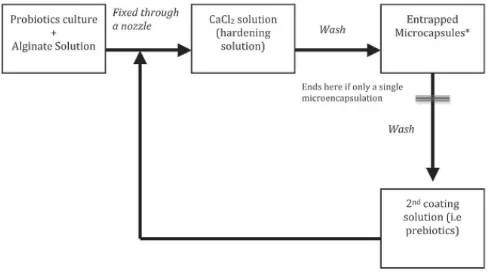
Extrusion technique: Extrusion is the simplest and most common technique used to produce probiotics capsules with hydrocolloids. The technique involves preparing a hydrocolloid solution, adding the probiotics ingredient to the solution and dripping the cell suspension through a nozzle spray machine in the form of droplets which are allowed to fall freely into a hardening solution (King, 1995).
Emulsion technique: The principle of this emulsion technique is based on the relationship between the discontinuous and continuous phase. Various supporting materials have been used to encapsulate probiotics by emulsion method including alginate, chitosan, and gelatin. This type of probiotics has been successfully applied to yoghurt cheedar cheese, icecream (Adhikari et al., 2002). However, conventional emulsion-based processes bear some critical issues in relation to difficulty in the removal of an organic solvent, limitations in manufacturing facility, instability and coalescence of emulsion droplets during hardening, and so on. This event led to the transformation of emulsion droplets to hardened microspheres in an efficient way. In the practice of this technique, halogenated ester organic solvents such as methyl chloroacetate and ethyl chloroacetate were chosen as dispersed solvents (Kim et al., 2007; Chung et al., 2009).
equipment. Microcapsules also help fragile and sensitive materials survive processing and packaging conditions and stabilize the shelf life of the active ingredient (Schrooyen et al., 2000). Microencapsulation is used to overcome all challenge by providing viable texture blending, appealing aroma releases. Disease preventing and health promoting properties of different nutrients and bio-agents have been demonstrated (Ananta et al., 2005).
Ingredients in foods are encapsulated for several reasons. Most flavorings are volatile; therefore encapsulation of these components extends the shelf-life of these products. Some ingredients are encapsulated to mask taste, such as nutrients added to fortify a product without compromising the product’s intended taste. Alternatively, flavors are sometimes encapsulated to last longer, as in chewing gum. Many varieties of both oral and injected pharmaceutical formulations are microencapsulated to release over longer periods of time or at certain locations in the body. Aspirin, for example, can cause peptic ulcers and bleeding if doses are introduced all at once. Therefore aspirin tablets are often produced by compressing quantities of microcapsules that will gradually release the aspirin through their shells, decreasing risk of stomach damage (Pothakamury and Barbosa-Cánovas, 1995). Consistent with the raising demand for functional foods, probiotics became one of the most important healths promoting food enhancement in recent years, especially for dairy foods. They represent about 65% of the world functional food market (Agrawal, 2005). The probiotics effect has been attributed to the production of acid, bacteriocins, competition of pathogens and enhancement of immune system. Good probiotic viability and activity are considered essential for optimal functionality (Sandholm et al., 2005). Nevertheless, for food applications, there are only a few documented attempts for the entrapment of microorganisms in water insoluble dairy-based protein microcapsules, because the gelation of food proteins is traditionally achieved through heat treatment, and therefore not applicable for heat sensitive core materials, such as live microorganisms (Chen et al., 2006). The proteins of cereals (oat, wheat, barley and corn) are more advantageous from the nutritional standpoint, and they have attracted research and commercial attention for this reason. Due to their interesting functional properties and potential food applications, these proteins were also studied as wall material for microencapsulation (Ducel et al., 2004a; Nur Syarfa Aqilah Mohammed Akhiar, 2010). Recent advances in microencapsulation and controlled release technologies have contributed in a shelf stable
bakery products. Bakery manufacturers have been adopting these technologies due to cost saving provided by extended shelf life, eliminating fermentations, shortening dough proofing time along with minimal impact on processibility of bakery products. Alginate is a liner heteropolysaccharide extracted from different types of algae, with two structural units consisting of D-mannuronic and L-guluronic acids (Wang et al., 2011b). Fig. 2 shows the relation between probiotics culture and microcapsules (Krasaekoopt et al., 2004). Calcium alginate has been widely used for the encapsulation of lactic acid and probiotic bacteria. Alginate capsules have some advantages. They easily form gel matrices around bacterial cells, they are not poisonous to the body (is safe or biocompatible), they are cheap, mild process conditions (such as temperature) are needed for their performance, 0.5-4% concentration can easily be prepared and performed for experiment. Blending alginate with starch is a common practice and it has been shown that encapsulation effectiveness of different bacterial cells especially lactic acid bacteria were improved by applying this method (Krasaekoopt et al., 2003). Besides good protection from bacterial cells, alginate-starch blends render the advantage of micronutrients and metabolites diffusing through the capsules, inside and outside of the entrapped cell. Blending calcium alginate with Hi maize starch produces capsules with high cell viability due to formation of capsules with a good integrated structure as well as prebiotic effect of the latter compound (Sultana et al., 2000). Cross-linked alginate matrix (produced at low pH) is obtained from modified alginate structures applied to probiotics encapsulation. A mixture of xanthan and gelan gum has been used for the microencapsulation of
Fig 2: Flow diagram of extrusion process. The bacterial culture
probiotics. It should be noted that although gelan gum is able to generate gel-bead structure for microencapsulation, it is not used on its own for this purpose because of having a high gel-setting temperature (80-90°C) for which results in heat injuries to the probiotic cells (Sun and Griffiths, 2000). In laboratory orange-peel oil was encapsulated in four different matrices, they are- emulsion spray-drying: gum arabic, gum arabic–maltodextrin, caseinate– maltodextrin, a plant polysaccharide (Schrooyen et al., 2000). In other hand, Carrageenan and its mixtures have been widely used for microencapsulation of probiotics in fermented products. However, gel formation of k-carrageenan-locustbean mixture is dependent on calcium ions, which have adverse effects on both viability of Bifidobacterium spp. and the human body. Carrageenan-locust been gives a strong gel for microencapsulation low-concentration chitosan solution (e.g. 0.4%) is applied for shell-making on capsules such as gelatin (Zhou et al., 1998). Recently, Doleyres, Fliss, and Lacroix (2002, 2004) and Doleyres, Paquin, LeRoy, and Lacroix (2002) reported that immobilized probiotic cells in carrageenan and locust bean gum gel beads by ionotropic gelation method to produce a mixed lactic culture containing a non-competitive strain of bifidobacteria and a competitive LAB strain, during repeated batches and continuous cultures. It has been reported that mixture of chitosan and hexamethylene diisocyanate or chitosan and glutaraldehyde make stronger coats compared with chitosan alone (Doleyres et al., 2002; Doleyres et al., 2004; Doleyres et al., 2002; Groboillot et al., 1993). Microencapsulation can be used efficiently for preparation of bacterial starter cultures with higher viability. It has been shown that the shelf life of encapsulated Lactobacillus rhamnosus (VTT E-97800) which is kept under room temperature and relatively high relative humidity is at least 6 months. This shelf life was successfully increased to at least 18 months when the encapsulated cells were deep frozen in liquid nitrogen. Microencapsulation of starter cells with the mixture of alginate-glycerol can significantly increase their survivability after the deep freezing. The improvement of B. bifidum viability in yogurt after encapsulation with calcium alginate was in a way similar that throughout the 3 weeks refrigerated storage at 4ºC, its viable counts did not fall below 107 cfu/ml. Also, no undesirable sensory properties
were observed in the final product. The above mentioned results were also obtained after frozen storage of the product procedure (Sultana et al., 2000). Coating of the calcium chloride on sodium alginate capsules containing L. acidophilus increased tolerance of the bacteria against
harsh acidic (pH 2) and bile (1%) conditions (Chandramouli et al., 2004). Microencapsulation with controlled atmosphere packaging has also been claimed to have a suitable effect on the viability of B. pseudolongum. Nowadays, by applying encapsulated starter culture bacteria, new innovations have been achieved in the manufacture of dairy probiotic products such as yogurt. Specific encapsulation of probiotic (even traditional yoghurt bacteria) cells can cause desirable rate of cellular metabolic activity. For example, new continuous method of yogurt production with encapsulated traditional yogurt bacteria such as Streptococcus salivarius ssp. thermophilus and Streptococcus delbrueckii (Krasaekoopt et al., 2004). By encapsulation of Lactococci with alginate (as a capsule) the incubation time decreased by 17% compared with the conditions in which yogurt was fermented by free cells (Larisch et al., 1994). Acetic acid produced by Bifidobacterium sp. gives a vinegar taint to the fermented probiotic products such as yogurt (Adhikari et al., 2002). Encapsulation of bifidobacteria in the fermented products not only improves their sensory characteristics, but also improves the viability of probiotic microorganisms (Mortazavian and Sohrabvandi, 2006).
Conclusion
The use of microencapsulated probiotics for controlled release applications is a promising alternative to solving the major problems of these organisms that are faced by food industries. Even so, the challenges are to select the appropriate microencapsulation technique and encapsulating materials. Microencapsulation has proven one of the most potent methods for maintaining high viability and stability of probiotic bacteria, as it protects probiotics both during food processing and storage as well as in gastric conditions. Future progress of microencapsulation in food industry is increasing day by day following new methods, and it is applied on different conditions in food products. Double microencapsulation is very primary stage in food application but it is highly beneficial. New food regulations may specify labeling including the strains and the number of viable probiotic bacteria at the end of shelf life of a food or supplement claimed to be probiotic.
Acknowledgement
References
Adhikari, K., Mu stapha, A., Grun, I.U., Fermando, L. 2002. Viability of microencapsulated bifidobacteria in set yoghurt during refrigerated storage. Journal of dairy science 83:1946-1951. Agrawal, R. 2005. Probiotics: an emerging food supplement with
health benefits. Food Biotechnology 19(3): 227-246. Ananta, E., Volkert, M., Knorr, K. 2005. Cellular injuries & storage
stabilities of spray dried Lactobacillus rhamanous GG.
International Dairy Journal 15: 399-409.
Axelesson, L.T. 1993. Lactic acid bacteria, classification & physiology. In: Salminen S (eds) Lactic acid bacteria: New York, USA.1-64.
Benita, S. 1996. Microencapsulation: Methods and Industrial applications. Marcel Dekker. New York.
Campos, C.A., Gerschenson, L.N., Flores, S.K. 2011. Development of Edible Films and Coatings with Antimicrobial Activity. Food
and Bioprocess Technology 4: 849-875.
Chandramouli, V., Kalasapathy, K., Peiri, P., Jones, M. 2004. An improved method of microencapsulation and its evaluation to protect Lactobacillus spp. In simulated gastric conditions.
Journal of Microbiological Methods 56: 27-35.
Charve, J., Reineccius, G.A. 2009. Encapsulation performance of proteins and traditional materials for spray dried flavors.
Journal of agricultural and food chemistry 57 (6): 2486-2492.
Chen, L.Y., Remondetto, G.E., Subirade, M. 2006. Food protein-based materials as nutraceutical delivery systems. Trends in Food
Science & Technology 17(5): 272-283.
Chung, Y., Kim, J., Sah, H. 2009. Reactivity of ethyl acetate and its derivatives toward ammonolysis: ramificatins for ammonolysis-based microencapsulation process.
Advanced Polymer Technology 20: 785-794.
Dembczynski, R. Jankowski, T. 2002. Growth characteristics and acidifying activity of Lactobacillus rhamnosus in alginate/starch liquid-core capsules. Enzyme Microbial Technology 31 (1-2): 111-115.
Doleyres, Y., Fliss, I., Lacroix, C. 2002. Quantitative determination of the spatial distribution of pure- and mixed-strain immobilized cells in gel beads by immunofluorescence.
Applied Microbiology and Biotechnology 59: 297-302.
Doleyres, Y., Fliss, I., Lacroix, C. 2004. Continuous production of mixed lactic starters containing probiotics using immobilized cell technology. Biotechnology Progress 20: 145-150. Doleyres, Y., Paquin, C., LeRoy, M., Lacroix, C. 2002. Bifidobacterium
longum ATCC 15707 cell production during free- and immobilized-cell cultures in MRS-whey permeate medium.
Applied Microbiology and Biotechnology 60: 168-173.
Drusch, S., Serfert, Y., Scampicchio, M., Schmidt-Hansberg, B., Schwarz, K. 2007. Impact of physicochemical characteristics on the oxidative stability of fish oil microencapsulated by spray drying. Journal of agricultural and food chemistry 55
(26): 11044-11051.
Dubey, R., Shami, T.C., Bhasker Rao, K.U. 2004a. Microencapsulation technology and application. Defence science journal 59: 82-9. Ducel, V., Richard, J., Popineau, Y., Boury, F. 2004. Adsorption kinetics and rheological interfacial properties of plant proteins at the oil–water interface. Biomacromolecules 5: 2088-2093.
Fang, X., Shima, M., Adachi, S. 2005. Effects of drying conditions on the oxidation of linoleic acid encapsulated with gum Arabic by spray-drying. Food Science and Technology Research 11 (4): 380-384.
Femia, A.P., Luceri, C., Dolara, P., Giannini, A., Biggeri, A., Salvadori, M. 2002. Antitumorigenic activity of the prebiotic inulin enriched with oligofructose in combination with the probiotics Lactobacillus rhamnosus and Bifidobacterium lactis on azoxymethaneinduced colon carcinogenesis in rats. Journal of
Carcinogenesis and Mutagenesis 23(11): 1953-1960.
Fuchs, C., Turchiuli, C., Bohin, M., Cuvelier, M.E., Ordonnaud, C., Peyrat-Maillard, M.N. 2006. Encapsulation of oil in powder using spray drying and fluidized bed agglomeration. Journal
of Food Engineering 75 (1): 27-35.
Gharsallaoui, A., Roudaut, G., Chambin, O., Vioilley, A., and Saurel, R. 2007. Applications of spray-drying in microencapsulation of food ingredients: an overview. Food Research International
40(9): 1107-1121.
Gorbach, S.L. 2000. Probiotics and gastrointestinal health. The
American Journal of Gastroenterology 95(1): S2-S4.
Gouin, S. 2004. Micro-encapsulation: Industrial appraisal of existing technologies and trends. Trends in Food Science & Technology
15: 330-347.
Groboillot, A.F., Champagne, C.P., Darling, G.D., Poncelet, D. 1993. Membrane formation by interfacial cross-linking of chitosan for encapsulation of Lactobacillus lactis. Biotechnology and
Bioengineering 42: 1157-1163.
Kailasapathy, K. 2002. Microencapsulation of Probiotic Bacteria: Technology and Potential Applications. Current Issues
Intestinal Microbiology 3: 39-48.
Kailasapathy, K., Chin, J. 2000. Survival and therapeutic potential of probiotic organisms with reference to Lactobacillus acidophilus and Bifidobacterium spp. Immunology & Cell Biology 78(1): 80-88.
Kailasapathy, K., Rybka, S. 1997. Lactobacillus acidophilus and
Bifidobacterium spp.: their therapeutic potential and survival
in yoghurt. . Australian journal of Dairy Technology 52 (April): 28-35.
Kim, J., Hong, D., Chung, Y., Sah, H. 2007. Ammonolysis-induced solvent removal: facile approach for solidifying emulsion droplets into PLGA microspheres. Biomacromolecules 8: 3900-3907.
King, A.H. 1995. Encapsulation of food ingredients: a review of available technology, focusing on hydrocolloids in encapsulation and control release of food ingredient. In: Rischand RS, G.A. Reineccius GA (eds) American Chemical Society. USA.213-220.
Koleske, J.V. 2000. Encyclopedia of Analytical Chemistry. John Wiley & Sons Ltd. Chichester
Kopp-Hoolihan, L. 2001. Prophylactic and therapeutic uses of probiotics. A review Journal of American Dietatic Association
101(2): 229-241.
Krasaekoopt, W., Bhandari, B., Deeth, H. 2003. Evaluation of encapsulation techniques of probiotics for yoghurt.
International Dairy Journal 13: 3-13.
survivability of microencapsulated probiotic bacteria.
Internatioanal Journal of Dairy Science 14: 737-743.
Larisch, B.C., Poncelet, D., Champagne, C.P., Neufeld, R.J. 1994. Microencapsulation of Lctococcus lactis subsp. Creamoris.
Journal of Microencapsulation 11: 189-195.
Mombelli, B., Gismondo, M.R. 2000. The use of probiotics in medical practice. International journal of antimicrobial agents 16: 531-536.
Mortazavian, A.M., Sohrabvandi, S. 2006. Probiotics and food Probiotic products. Eta Publication. Iran.
Nur Syarfa Aqilah Mohammed Akhiar 2010. Enhancement of probiotics survival by microencapsulation with alginate and prebiotics.
MMG Basic Biotechnology Journal 6: 13-18.
Pothakamury, U.R., Barbosa-Cánovas, G.V. 1995. Fundamental aspects of controlled release in foods. Trends in Food Science
and Technology 6: 397-406.
Rokka, S., Rantamaki, P. 2010. Protecting probiotic bacteria by microencapsulation: challenges for industrial applications.
European Food Research and Technology 231: 1-12.
Sandholm, M., Myllarinen, T.P., Crittenden, R., Mogensen, G., Fonden, R., and Saarela, M. 2005. Technological challenges for future probiotic food. International Dairy Journal 12: 173-182.
Schrooyen, P., De Ruiter, G., and De Kruif, C. 2000. Spray-dried orange oil emulsions: influence of cold water dispersible matrices on retention and shelf life; Proceedings of the International
Symposium on the Controlled Release of BioactiveMaterials: Deerfield, Controlled Release Society, 1317-1318.
Sergio, F., Hans Peter, M., Bruno, G. 2004. Ultrasonic atomisation into reduced pressure atmosphere-envisaging aseptic spray-drying for microencapsulation. Journal of Controlled Release
95: 185- 195.
Sultana, K., Godward, G., Reynolds, N., Arumugaswamy, R., Peiris, P., Kailasapathy, K. 2000. Encapsulation of probiotic bacteria with alginate-starch and evaluation of survival in simulated gastrointestinal conditions and in yoghurt. International
Journal of Food Microbiology 62: 47-55.
Sun, W., Griffiths, M.W. 2000. Survival of bifidobacteria in yogurt and simulate gastric juice following immobilization in gellanxanthan beads. International Journal of Food
Microbiology 61: 17-25.
Vidhyalakshmi, R., Bhakyaraj, R., Subhasree, R.S. 2009. Encapsulation “The Future of Probiotics”-A Review. Advances in Biological
Research 3 (3-4): 96-103.
Wang, R., Tian, Z., Chen, L. 2011b. A novel process for microencapsulation of fish oil with barley protein. Food
Research International 44: 2735-2741.