Introduction: The present study aimed to compare self-assessment forms of coursework taught in the school of public health at undergraduate, graduate, and postgraduate levels and students’ evaluation of the performance of the faculty members at these levels.
Methods: The subjects in this cross-sectional study were the faculty members and students of the School of Public Health and Nutrition, Shiraz University of Medical Sciences, Shiraz, Iran. The data were collected using a socio-demographic information form and evaluation forms of professors prepared by the Educational Development Center (EDC). The faculty members were assessed by the students in undergraduate and graduate classes. Among the study subjects, 23 faculty members filled out the self-assessment forms which were then evaluated by 23 students. Then, the data were analyzed using the SPSS 14. Paired t-test was used to compare the students’ evaluation of the faculty members’ performance and the professors’ self-assessment.
Results: The mean score of self-assessment of the faculty members who taught undergraduate courses was 289.7+8.3, while that of the students’ evaluation was 281.3+16.1; the difference was statistically significant (t=3.56, p=0.001). Besides, the mean score of the self-assessment of the faculty members who taught graduate courses was 269.0+9.7, while that of the students’ evaluation was 265.7+14.6 but the difference was not statistically significant (t=1.09, p=0.28).
Conclusion: Teaching performance perceptions of the faculty were similar to those of the graduate students as compared to the undergraduate ones. This may reflect better understanding of coursework at this level compared to the undergraduate students. Faculty members may need to adjust teaching methods to improve students’ performance and understanding especially in the undergraduate level.
Student, Evaluation, Perforance, Faculty Keywords:
Corresponding author:
Nader Parsa,
Address: Cardiovascular Research Center, Shahid Faghihi Hospital, Zand Ave., Shiraz, Iran.
Tel: +98-711-2343529 Email: drnaderparsabe@yahoo. com
Please cite this paper as:
Azizi K, Aghamolaei T, Parsa N, Dabbaghmanesh T. Comparison of Faculty Mambers’ Self-Assessment and Their Evaluation by Students. J Adv Med Educ Prof. 2014;2(3): 108-113.
Received : 06 Sep 2013 Accepted : 12 Apr 2014
Comparison of differences in performance evaluation of faculty by
students with faculty’s self-assessment
KOUROSH AZIZI1, TEAMUR AGHAMOLAEI2, NADER PARSA3*, TAHEREH DABBAGHMANESH1
1Medical entomology department, Health and Nutrition School, Health Sciences Research Centre, Shiraz University of Medical Sciences, Shiraz, Iran; 2Public health department, Health School, Hormozgan University of Medical Sciences, Bandar Abbas, Iran; 3Cardiovascular Research Center, Shahid Faghihi Hospital, Shiraz University of Medical Sciences, Shiraz, Iran
Introduction
E
ducation is a service which is directly impactedby the provider. Higher education institutions place greater emphasis on meeting the students' expectations and needs. As universities continue to become more student-oriented, students’ perceptions of higher educational facilities and services are becoming more important (1).
Evaluation of coursework and teaching methods are an essential part of the educational process aiming at improving the quality of education. Evaluation by
and fulfillment of the students’ learning needs (2). Evaluating the capability, performance, knowledge, and competence of a school's faculty is an important factor for higher education institutions. Thus, senior managers of higher education institutions seek for appropriate methods of evaluation for these important issues (3). Evaluations by students and faculty have been routinely used in academic institutions and have long been an integral part of colleges and universities in driving curricular change and faculty performance (4).
Faculty evaluation is a complex process which contains various interconnected activities and actions, all of which being related to a specific purpose. Without capable, high quality teachers, no education reform effort can possibly succeed. Moreover, without high quality evaluation systems, we cannot know if we have high quality teachers (5).
Evaluation of university faculty members which aims to improve teaching quality is performed through several methods. One of the most common and conflicting methods is evaluation of the faculty by students. This method is commonly used in most universities in spite of controversy over its
validity (6). Another method is self-assessments of
the faculty (7, 8). There has been debate for decades as to what should be the subject of evaluation of faculty for higher education institutions (9, 10). Although evaluation of students is a necessary part of educational performance, it is not the only and gold standard method to evaluate the role of the faculty. Physical environment, facilities, higher level of managers, and even university personnel should be taken into account in systematic evaluation of the faculty’s training performance (11).
Altman believed that evaluation of the faculty by students could be a key component of educational performance for quality improvement of the
training methods (12).He believed it necessary to
have a continuous and formative evaluation of the faculty by students. He suggested that assessment of these results could provide immediate change to improve training methods, learning, and educational performance. Finally, he believed that evaluation should not only be performed at the end of courses.
Another method for evaluation of educational performance is the faculty’s self-assessment. This type of evaluation helps the faculty to gain information on teaching methods, discipline, class control, and level of knowledge. We could propose that self-assessment is the best method of evaluation. When the faculty members evaluate themselves, they are responsible for their own level of performance. Consequently, if there are some deficits in their teaching method, they could correct or improve their own performance (3).
Comparison of students’ evaluation and faculty’s self-assessment can lead to better recognition of strengths and weaknesses of teaching. Thus, it can be a part of the faculty’s training performance evaluation (7).
The present study aims to compare evaluation of the faculty members’ educational performance by students and their self-assessment in Health and Nutrition School of Shiraz University of Medical Sciences, Shiraz, Iran.
Methods
This cross-sectional research was conducted on 23 faculty members who taught theoretical courses in the first and second semesters of 2013 and the students who took these courses in School of Health and Nutrition, Shiraz University of Medical Sciences. The study data were collected using demographic information questionnaires and evaluation forms of the faculty by undergraduate and graduate students prepared by the Educational Development Center (EDC) for training performance evaluation of the faculty of Shiraz University of Medical Sciences. The data included information about the faculty’s self-assessment and evaluation of the faculty by the students who had taken the theoretical courses.
The questionnaire of educational performance evaluation of faculty by undergraduate students had 15 items. Each item was responded through a Likert scale and the scores ranged from 0 to 20. Higher scores showed the faculty’ capability and strength, while lower scores represented the faculty’ lack of capability and weakness. The maximum score of the questionnaire was 300, indicating the faculty’s excellent performance. The questionnaire of educational performance evaluation of faculty by graduate students had 14 items. Each item was responded based on a Likert scale and the scores ranged from 0 to 20. Similar to the previous questionnaire, higher scores represented the faculty’ capability and strength, while lower scores represented the faculty’ lack of capability and weakness. Besides, the maximum score of the questionnaire was 280, indicating the faculty members’ excellent training method. These questionnaires were approved by the experts in Educational Development Center (EDC) in Shiraz University of Medical Sciences.
Additionally, the Cronbach’s alpha coefficient of questionnaires of educational performance evaluation of faculty by undergraduate and graduate students was between 0.94 and 0.89, which shows the questionnaires’ reliability.
bias, the faculty’s personal information was removed from the questionnaires and they were given a pin code. In addition, the students filled out the questionnaires anonymously. Before administering the questionnaires, the students and the faculty were informed regarding the study objectives; they were also ensured about their confidentiality.
After all, the data were analyzed using SPSS 14 (SPSS Inc, Chicago, IL, USA) statistical software. Normal distribution of the data was confirmed using Kolmogorov-Smirnov test. Besides, t-test was used to compare evaluation of the faculty by students and faculty’ self-assessment.
Results
Overall, the data of 23 faculties who had completed self-assessment questionnaires were analyzed. The faculty who taught courses in undergraduate and graduate levels was evaluated on average by 18 and 5 students, respectively.
Among the professors, 65% were male and 35% were females. Moreover, 17% of the faculty members were instructors, 52% assistant professors, 17% associate professors, and 14% full professors.
The mean score of the faculty’s self-assessment was 289.7±8.3 in undergraduate coursework performance and 281.3±16.1 by undergraduate students’ evaluation. Consequently, the difference was statistically significant (t=3.56, p=0.001). In addition, the results showed a mild correlation
(r≈0.4) between the faculty’ self-assessment and
undergraduate students’ evaluation. The faculty’ and students’ evaluation scores were significantly different regarding 12 out of the 15 questions. Overall, the faculty members’s self-assessment scores were higher than those of the students for all the questions (Table 1).
The mean score of the faculty' self-assessment was 269.0±9.7 in the graduate level. On the other hand, the mean score of the faculty’ evaluation by graduate students was 265.7±14.6. However, no statistically significant difference was found between the two evaluation scores (t=1.09, p=0.28). The results showed
a weak correlation (r≈0.1) between the faculty'
self-assessment scores and graduate students' evaluation scores.
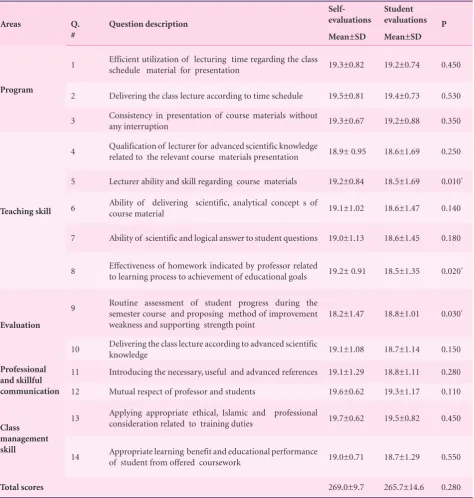
In this study, a statistically significant difference was observed between the faculty’s self-assessment and students’ evaluation in only 3 out of 14 questions of the questionnaire. The faculty’s self-evaluation was higher than the students’ evaluation in two questions, while the students’ evaluation was higher in the remaining ones (Table 2).
The mean score of the male faculty members’ self-assessment was 269.3±8.4, while that of the female
faculty was 268.0±13.1; however, the difference was not statistically significant (t=0.35, p=0.720). Additionally, the mean score of male and female faculty members’ evaluation by students was 266.2±15.2 and 262.5±12.3, respectively. Therefore, the difference was not statistically significant (t=0.74, p=0.46).
Discussion
Faculty members and students have different perceptions of which behaviors an ideal faculty member should possess. For instance, the faculty indicated that ideal faculty should help their students develop general learn ing skills as well as an intrinsic interest in learning. On the other hand, the students emphasized that the ideal faculty should make educational materials, such as handouts, accessible to students and have socially appropriate behaviors. The faculty and students also disagreed about which behaviors faculty should actually pos sess (13).
The present study aimed to compare the evaluation of the faculty’s educational performance by students and the faculty’s self-assessment in School of Health and Nutrition, Shiraz University of Medical Sciences. According to the results, the total score of faculty’ evaluation by undergraduate students was significantly lower than the faculty’s self- assessment. These results were supported by those obtained by Aghamolaei and Abedini (14), Goharian (15) and Sooki (16). In the research by Aghamolaei and Abedini, educational performance evaluation scores by undergraduate students were lower than the faculty’s self-assessment scores (14). In addition, Goharian and colleagues indicated that the educational performance evaluation scores by residency students were lower than the attending faculty’ self-assessment scores (15). Sooki also compared the educational performance evaluation of the faculty members of the midwifery department by midwifery students and faculty (16). The midwifery faculty’ self-assessments showed that they had higher scores and more positive points of view about their training performance compared to the students. Furthermore, Rafaee and Safi carried out a study to identify the factors related to the students’ evaluation of the educational performance of the faculty of Arak University of Medical Sciences (17). The results indicated that the faculty members’ understanding of the quality and content of educational performance was different from the students’ viewpoints.
be due to the fact that the previous studies were conducted on undergraduate students (14-17). Another explanation might be that undergraduate students are more dependent on their faculty, while graduate ones have a better understanding of the educational system and, consequently, their point of view is closer to the faculty’s perspective and expectation.
Also, the results of this study showed a weak correlation between the faculty’s self-assessment and their evaluation by students. These findings are in the same line with those of the studies by Aghamolaei and Abedini (14), Vahidshahi et al. (18), and Miron (19). Vahidshahi et al. (18) studied the consistency of clinical faculty’ training method and students'
perspective in Sari Medical School. That study indicated a weak correlation between the students’ evaluation of the faculty’ educational performance and the faculty’s self-assessment.
Similar to other studies(14, 19), the findings of
the current study showed a statistically significant
difference between the undergraduate students’ evaluation of the faculty’ educational performance and the faculty’s self-assessment. In case no statistically significant difference was observed in this regard, it would imply that both parties realized their weaknesses and strengths. Nonetheless, a significant difference was found between the faculty’ and undergraduate students’ evaluation scores in 12 out of 15 questions. If a statistically significant
Areas Q.
# Question description
Self-
evaluations Student evaluations P
Mean±SD Mean±SD
Program
1 Efficient utilization of lecturing time regarding the class schedule material for presentation 19.5±0.62 18.6±1.09 <0.001*
2 Using educational regulation (Course syllabus, Being on time, Controlling present-Absent of student ) 19.4±0.81 18.9±0.85 0.002*
3 Consistency of course materials 19.4±0.69 18.6±1.20 <0.001*
Teaching skill
4 Being scientifically knowledgeable and ability of course materials presentation 19.1±1.06 18.5±1.44 0.006*
5 Lecturing capability and delivering main point of course materials 19.2±0.91 18.2±1.60 <0.001*
6 Delivering important point of course and introducing the necessary, appropriate and useful references 19.1±0.94 18.5±1.40 0.020*
7 Ability of scientific and logical answer to student questions 19.2±0.89 18.2±1.72 <0.001*
8 Using Audio-Video or other necessary equipments for training of course materials 19.3±0.76 18.5±1.24 <0.001*
Evaluation
9 Identifying method of evaluation at the beginning of semester for student 18.9±1.33 18.4±1.45 0.060
10 Routine assessment of student progress during the semester and evaluating educational performance feedback 18.3±1.57 18.1±1.37 0.290
Professional and skillful communication
11 Applying appropriate ethical, Islamic and professional consideration related to training duties 19.9±0.14 19.3±0.72 <0.001*
12 Appropriate professional attitude, behavior toward to student 19.8±0.34 19.1±1.33 <0.001*
Class management skill
13 Faculty ability regarding class guidance and management 19.6±0.63 18.7±1.38 <0.001*
14 Faculty ability regarding creative motivation related to scientific issues among student 19.3±0.76 18.7±1.38 0.030*
15 Appropriate learning benefit and educational performance of student from offered coursework 18.9±1.07 18.7±1.38 0.700
Total scores 289.7±8.3 281.3±16.1 <0.001*
Table 1. Comparison of evaluation of the faculty’s educational performance by undergraduate students and the faculty’s self-assessment
difference was found between evaluation of faculty by undergraduate students and faculty’s self-assessment, it would imply that the faculty members and students had different views about a similar issue. The results indicated a statistically significant difference between the faculty’s self-assessment and evaluation of the faculty by graduate students in 3 out of 14 questions in the questionnaire. Thus, it seems that the faculty and graduate students had a similar understanding of similar questions.
The small number of graduate students compared to the large number of undergraduate students allows the former to have better communication with the faculty members and a better chance to understand
the educational system. On the other hand, the small sample of the students in the graduate school could not lead to a reliable comparison and, as a result, further studies with larger sample sizes are required to be conducted on the issue.
The findings of this study revealed no statistically significant difference between the faculty’ self-assessment scores and the students’ evaluation scores based on their gender. These findings are compatible with those of the study by Aghamolaei and Abedini (14). However, Fleischman and Williams performed a study in Indiana St. College of USA and showed that female students’ evaluation of the faculty’s educational performance was more reasonable
Areas Q.
#
Question description
Self-
evaluations Student evaluations P
Mean±SD Mean±SD
Program
1 Efficient utilization of lecturing time regarding the class schedule material for presentation 19.3±0.82 19.2±0.74 0.450
2 Delivering the class lecture according to time schedule 19.5±0.81 19.4±0.73 0.530
3 Consistency in presentation of course materials without any interruption 19.3±0.67 19.2±0.88 0.350
Teaching skill
4 Qualification of lecturer for advanced scientific knowledge related to the relevant course materials presentation 18.9± 0.95 18.6±1.69 0.250
5 Lecturer ability and skill regarding course materials 19.2±0.84 18.5±1.69 0.010*
6 Ability of delivering scientific, analytical concept s of course material 19.1±1.02 18.6±1.47 0.140
7 Ability of scientific and logical answer to student questions 19.0±1.13 18.6±1.45 0.180
8 Effectiveness of homework indicated by professor related to learning process to achievement of educational goals 19.2± 0.91 18.5±1.35 0.020*
Evaluation
9 Routine assessment of student progress during the semester course and proposing method of improvement
weakness and supporting strength point 18.2±1.47 18.8±1.01 0.030
*
10 Delivering the class lecture according to advanced scientific
knowledge 19.1±1.08 18.7±1.14 0.150
Professional and skillful communication
11 Introducing the necessary, useful and advanced references 19.1±1.29 18.8±1.11 0.280
12 Mutual respect of professor and students 19.6±0.62 19.3±1.17 0.110
Class management skill
13 Applying appropriate ethical, Islamic and professional consideration related to training duties 19.7±0.62 19.5±0.82 0.450
14 Appropriate learning benefit and educational performance of student from offered coursework 19.0±0.71 18.7±1.29 0.550
Total scores 269.0±9.7 265.7±14.6 0.280
Table 2. Comparison of evaluation of the faculty’s educational performance by undergraduate students and the faculty’s self-assessment
compared to the males (21).
One of the limitations of this study was the small number of the faculty members and the students who evaluated them. Thus, future studies with larger sample sizes should be conducted to better understand the differences between the faculty' self-assessment and their evaluation by students.
Conclusion
Students and faculty members are two essential elements in evaluation of the educational performance. Therefore, having a view of their idea about teaching methods is of great importance. The results of the faculty’s self-assessment should be used to improve the quality of the course content and their teaching method. Consequently, faculty should count on the students’ evaluation and improve their weaknesses. Overall, we conclude that mutual appropriate communication and analytical understanding of the faculty and students in the graduate school are more feasible compared to undergraduate school. According to the findings of this study, whether or not there is a correlation, similarity, or compatibility between the students' opinions about the faculty’s training performance and the faculty members’ beliefs, it is necessary to focus on needs and educational performance of the undergraduate students.
Acknowledgments
This study was financially supported by the research vice chancellor of Shiraz University of Medical Sciences (grant No. 91- 6048). The authors would like to thank Dr. Choobineh and Miss Arvinfar for their assistance in data collection.
Conflict of Interest:
None declaredReferences
1. Anci DT. How satisfied are our students? Quality management unit. Johannesburg, South Africa: Office for institutional effectiveness university of Johannesburg; 2006.
2. Morrison J. ABC of learning and teaching in medicine: Evaluation. BMJ: British Medical Journal. 2003;326(7385):385. 3. Saif AA. Measurement, assessment and evaluation of training.
fourth edition ed: Douran publication; 2004. Persian. 4. Hatfield CL, Coyle EA. Factors that influence student
completion of course and faculty evaluations. American journal of pharmaceutical education. 2013;77(2):27.
5. Aslam MN. Student rating as an effective tool for teacher evaluation. Journal of the College of Physicians and Surgeons--Pakistan: JCPSP. 2013;23(1):37-41. Persian. 6. Dargahi H, Mohammadzadeh N. Faculty members’
evaluation by students: valid or invalid. Iranian Journal of
Medical Education. 2013;13(1):39-48. Persian.
7. Avi-Itzhak T. Teaching effectiveness as measured by student ratings and instructor self-evaluation. Higher Education. 1982;11(6):629-34.
8. Rahnema S, Jennings F, Kroll Ph. Student perception of the “Student evaluation of Instruction” form as a tool for assessing instructor’s teaching effectiveness. NACTA Journal. 2003; 47(3).
9. Ory JC. Faculty thoughts and concerns about student ratings. New directions for teaching and learning. 2002;2001(87):3-15.
10. Trout P. Flunking the test: The dismal record of student evaluations. Academe.2000;86(4):58-61.
11. Baylows C. Faculty and Contract Staff Handbook, Instructional policies, Responsibilities and Guidelines. San Antonio, Texas (America): Trinity University; 2006.
12. Aultman LP. An unexpected benefit of formative student evaluations. College teaching. 2006;54(3):251-85.
13. Accalia RK, Afful SE, Brent A. Students’ perceptions of and preferences for professors. The New School Psychology Bulletin. 2010; 11(1):47.
14. Aghamolaei T, Abedini S. Comparison of public heath school of Hormozgan University of Medical Sciences’faculty member’s self- assessment and educational performance evaluation by students. Iranian Journal of Medical Education. 2007;7(2):191-9. Persian.
15. Goharian V, Kafamy Z, Yamani N, Omidifar N, Safaei M. Comparison of attending Surgery faculty member’s self-assessment and educational performance evaluation by residents. Iranian Journal of Medical Education. 2005;5(1):62-9. Persian.
16. Sooki Z, editor. Comparison of midwifery faculty member’s self-assessment and theoretical-clinical educational performance evaluation by midwifery students; First International Conference on Medical Education Reform and Change Management; Tehran. Shahid Beheshti University of Medical Sciences and Health Services publication; 2003. p. 68. Persian.
17. Rafiee M, editor. Assessment the factors associated with faculty member’s evaluation by Students of Arak University of Medical Sciences; First International Conference on Medical Education Reform and Change Management; Tehran. Shahid Beheshti University of Medical Sciences and Health Services publication; 2003. pp. 66. Persian.
18. Vahidshahi K, editor. Comparison of faculty member’s self- assessment of training clinical course consistent and educational performance evaluation by Medical students of Sari Medical School; 8th Conference of Medical Education; Kerman. University of Medical Sciences and Health Services publication; 2006. Persian.
19. Miron M. Students' evaluation and instructors' self-evaluation of university instruction. Higher Education. 1988;17(2):175-81.
20. Khatibi R, editor. Evaluation results are consistent with the views of teachers on their students' evaluation of teacher performance in Kurdistan University of Medical Sciences. 8th Conference on Medical Education; Kerman. Kerman University of Medical Sciences; 2006. Persian.