International Doctorate School in Information and
Communication Technologies
DISI - University of Trento
Desiree: a Refinement Calculus for
Requirements Engineering
Feng-Lin Li
Advisor:
Prof. John Mylopoulos
Universit`
a degli Studi di Trento
The requirements elicited from stakeholders suffer from various afflictions, including in-formality, incompleteness, ambiguity, vagueness, inconsistencies, and more. It is the task of requirements engineering pREq processes to derive from these an eligible (formal, com-plete enough, unambiguous, consistent, measurable, satisfiable, modifiable and traceable) requirements specification that truly captures stakeholder needs.
We proposeDesiree, a refinement calculus for systematically transforming stakehold-er requirements into an eligible specification. The core of the calculus is a rich set of requirements operators that iteratively transform stakeholder requirements by strengthen-ing or weakenstrengthen-ing them, thereby reducstrengthen-ing incompleteness, removstrengthen-ing ambiguities and vague-ness, eliminating unattainability and conflicts, turning them into an eligible specification. The framework also includes an ontology for modeling and classifying requirements, a description-based language for representing requirements, as well as a systematic method for applying the concepts and operators in order to engineer an eligible specification from s-takeholder requirements. In addition, we define the semantics of the requirements concepts and operators, and develop a graphical modeling tool in support of the entire framework.
To evaluate our proposal, we have conducted a series of empirical evaluations, in-cluding an ontology evaluation by classifying a large public requirements set, a language evaluation by rewriting the large set of requirements using our description-based syntax, a method evaluation through a realistic case study, and an evaluation of the entire framework through three controlled experiments. The results of our evaluations show that our ontol-ogy, language, and method are adequate in capturing requirements in practice, and offer strong evidence that with sufficient training, our framework indeed helps people conduct more effective requirements engineering.
Keywords
This thesis would not have been possible without the help of several important people1.
I would also like to recognize and thank colleagues, friends and family for their help and efforts during these past four years.
To John Mylopoulos, my supervisor, thank you for your sagacious guidance on every piece of my work, for your great enthusiasm and support that has encouraged my research over the last four years. Thank you, Prof. John Mylopoulos, with a four-year research training, I gained a more wonderful view and a much deeper understanding of the things in the same world. In short, thank you for helping me get to where I am now.
To Lin Liu, my co-supervisor, thank you for encouraging me to pursue my Ph.D. degree, for your insightful guidance and constructive suggestions on my work, for your great help in the evaluation of our framework.
To Alexander Borgida, Giancarlo Guizzardi, Renata Guizzardi, and Jennifer Horkoff, my main colleagues, thank you for your large amount of efforts put on the discussions, and for your insightful and useful comments and suggestions. Especially, Prof. Alexander Borgida has helped a lot on the semantics of the framework, Prof. Giancarlo Guizzardi and Renata Guizzardi have helped a lot on the ontological foundation part, Jennifer Horkoff has helped a lot on the requirement operators.
To Paolo Giorgini (University of Trento), Barbara Pernici (Politecnico di Milano), and Alexander Borgida (Rutgers University), the professors of my thesis committee, thank you for accepting the invitation to participate in.
To Mauro Poggianella, thank you for your help in developing the prototype tool. To my colleagues in the research group of Software Engineering and Formal Methods, University of Trento, thank you for helping me in conducting the controlled experimen-t in Universiexperimen-ty of Trenexperimen-to; experimen-to my colleagues in experimen-the Insexperimen-tiexperimen-tuexperimen-te of Informaexperimen-tion Sysexperimen-tem and Engineering, School of Software, Tsinghua University, thank you for volunteering to par-ticipate in and for helping me to organize the two controlled experiments in Tsinghua University. I apologize for not listing your names.
Last, but definitely not least, to my wife and family. For your unconditional love and support, and for always taking care of me.
To all of you, my many thanks,grazie mille !
1As for research funding, this research has been funded by the ERC advanced grant 267856 “Lucretius:
1 Introduction 1
1.1 Requirements Engineering . . . 2
1.1.1 RE in Traditional Software Development . . . 2
1.1.2 RE in Agile Software Development . . . 3
1.2 The RE Problem . . . 5
1.2.1 Problem Definition . . . 5
1.2.2 Existing Solutions . . . 6
1.3 Our Research Objectives . . . 9
1.4 Overview and Contribution . . . 11
1.5 Structure of the Thesis . . . 18
1.6 Published Papers . . . 19
2 State of the Art 21 2.1 Requirements Ontology . . . 21
2.1.1 Functional Requirements (FRs) . . . 22
2.1.2 Non-functional Requirements (NFRs) . . . 23
2.2 Requirements Specification and Modeling Language . . . 25
2.2.1 Requirements Specification Language . . . 26
2.2.2 Requirements Modeling Language . . . 31
2.3 Requirements Transformation . . . 34
2.3.1 Structural and Object-Oriented Decomposition . . . 35
2.3.2 Goal-Oriented Refinement and Operationalization . . . 36
2.3.3 Problem-Oriented Decomposition and Reduction . . . 39
2.3.4 Others Aspects . . . 42
2.4 Chapter Summary . . . 44
3 Research Baseline 45 3.1 Goal-Oriented Requirements Engineering . . . 45
3.2 Ontological Foundations . . . 47
3.3 Chapter Summary . . . 50
4 Ontological Interpretation of Requirements 51 4.1 Requirements . . . 51
4.2 Functional Requirements (FRs) . . . 52
4.2.1 Representing FRs . . . 55
4.2.2 Refining Functions . . . 56
4.3 Non-functional Requirements (NFRs) . . . 57
4.3.1 NFRs as Quality Requirements . . . 58
4.3.2 QRs vs. Softgoals . . . 62
4.3.3 Refining QRs . . . 62
4.3.4 Operationalizing QRs . . . 63
4.3.5 Satisficing QRs . . . 64
4.4 Practical Implications . . . 66
4.4.1 Distinguishing between FRs and NFRs . . . 66
4.4.2 Addressing Inconsistency between Quality Models . . . 67
4.4.3 The Satisfaction of QRs . . . 68
4.5 Chapter Summary . . . 68
5 The Desiree Framework 69 5.1 Requirements Concepts . . . 69
5.2 Requirements Operators . . . 72
5.3 A Transformation Methodology . . . 78
5.3.1 Informal Phase. . . 78
5.3.2 Interpretation Phase. . . 81
5.3.3 Smithing Phase. . . 82
5.4 Chapter Summary . . . 85
6 The Semantics of Desiree 87 6.1 The Semantics of the Desiree Language . . . 87
6.2 The Semantics of the Requirement Operators . . . 94
6.2.1 Entailment Semantics . . . 95
6.2.2 Fulfillment Semantics . . . 103
7 The Desiree Tool 107
7.1 Overview . . . 107
7.1.1 The Textual Editor . . . 109
7.1.2 The Graphical Editor . . . 110
7.1.3 The Reasoning Component . . . 111
7.2 An Illustrative Example . . . 112
7.3 Chapter summary . . . 113
8 Evaluation 115 8.1 The PROMISE Requirements Dataset . . . 115
8.2 Evaluating the Requirements Ontology . . . 116
8.3 Evaluating the Requirements Language . . . 118
8.3.1 Evaluating the Language Expressiveness . . . 118
8.3.2 Evaluating the Need of the U, G, O Operators . . . 119
8.3.3 Lessons Learned . . . 120
8.4 Evaluating the Methodology . . . 126
8.4.1 Meeting Scheduler: Modeling . . . 126
8.4.2 Meeting Scheduler: Reasoning . . . 130
8.5 Evaluating the Desiree Framework . . . 132
8.5.1 Experiment Setup . . . 132
8.5.2 Research Question . . . 133
8.5.3 Experiment Design . . . 134
8.5.4 Data Collection . . . 136
8.5.5 Descriptive Statistics . . . 137
8.5.6 Hypothesis Testing . . . 139
8.5.7 Analysis . . . 144
8.5.8 Feedback . . . 146
8.5.9 Threats to Validity . . . 147
8.6 Chapter summary . . . 149
9 Conclusion and Future Work 151 9.1 Contributions . . . 151
9.2 Limitations . . . 153
9.3 Future Work . . . 155
A Quality Mapping 173
B Graded Membership 177
B.1 Prototype Points . . . 177
B.2 Prototype Intervals . . . 178
C The Desiree Syntax 183 D The Semantics of the U operator 185 E Detailed Requirements Issues 189 E.1 Meeting Scheduler . . . 189
E.1.1 Project Background . . . 189
E.1.2 The Chosen Stakeholder Requirements . . . 189
E.1.3 Issues in the Chosen Requirements . . . 190
E.2 Realtor Buddy . . . 195
E.2.1 Project Background . . . 195
E.2.2 The Chosen Stakeholder Requirements . . . 195
E.2.3 Issues in the Chosen Requirements . . . 196
F Desiree Feedback 203 F.1 TheDesiree Questionnaire . . . 203
1.1 The building blocks of the Desiree framework . . . 11
2.1 The classification of requirements specification languages . . . 26
4.1 The domain and codomain of 10 frequent qualities in our evaluation . . . . 61
5.1 An overview of the requirements operators . . . 72
6.1 The semantics of Desiree descriptions . . . 88
6.2 The semantics of requirement operators . . . 96
8.1 Statistics of the PROMISE requirements data set . . . 116
8.2 The classification scheme for the ontology evaluation . . . 116
8.3 The ontological classification of the 625 requirements . . . 117
8.4 The statistics of satisfaction type . . . 120
8.5 Implicit presence of the U, G, O operators on the 370 NFRs . . . 120
8.6 Example queries over the Meeting Scheduler requirements specification . . 131
8.7 Seven kinds of requirements issues . . . 133
8.8 The Statistics of the reference issues in the two testing projects . . . 135
8.9 The design of the three controlled experiments . . . 136
8.10 Statistics of collected data: discussions, texts and models . . . 137
8.11 Statistics of issues identified by participants in the three experiments . . . 138
8.12 Detailed number of issues identified by the 16 participants in experiment one140 8.13 Detailed number of issues identified by the 15 participants in experiment two140 8.14 Detailed number of issues identified by the 29 participants in experiment three . . . 141
8.15 Statistical p-value for issues identified by participants . . . 142
8.16 Analyzing experiment three: p-values, statistics, and effect . . . 143
8.17 Effect analysis for experiment three . . . 144
A.1 The basic quality-related functions . . . 174
C.1 The BNF styleDesiree syntax . . . 183
E.1 Number of requirements issues in theMeeting Scheduler project . . . 190
E.2 Detailed requirements issues in theMeeting Scheduler project . . . 191
E.2 Detailed requirements issues in theMeeting Scheduler project . . . 192
E.2 Detailed requirements issues in theMeeting Scheduler project . . . 193
E.2 Detailed requirements issues in theMeeting Scheduler project . . . 194
E.3 Number of requirements issues in theRealtor Buddy project . . . 196
E.4 Detailed requirements issues in theRealtor Buddy project . . . 196
E.4 Detailed requirements issues in theRealtor Buddy project . . . 197
E.4 Detailed requirements issues in theRealtor Buddy project . . . 198
E.4 Detailed requirements issues in theRealtor Buddy project . . . 199
E.4 Detailed requirements issues in theRealtor Buddy project . . . 200
E.4 Detailed requirements issues in theRealtor Buddy project . . . 201
F.1 Participants’ feedback on the learnability of the two methods . . . 206
F.2 Participants’ feedback on the usability of the two methods . . . 207
F.3 Participants’ feedback on the usefulness of the two methods . . . 207
F.4 Participants’ feedback on the complexity of the two methods . . . 207
F.5 Participants’ feedback on the usability of the Desiree tool . . . 207
2.1 A simple problem diagram (adapted from [48]) . . . 40
3.1 A simple example of the Techne syntax . . . 46
3.2 A fragment of UFO representing function and quality related categories . . 48
4.1 The ontological meaning of function (adopted from [78]) . . . 52
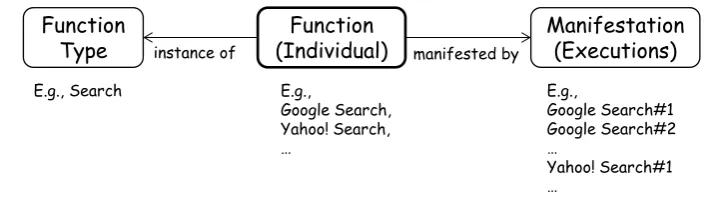
4.2 Function individual, function type and function manifestation . . . 54
4.3 The ontological meaning of quality (adopted from [78]) . . . 58
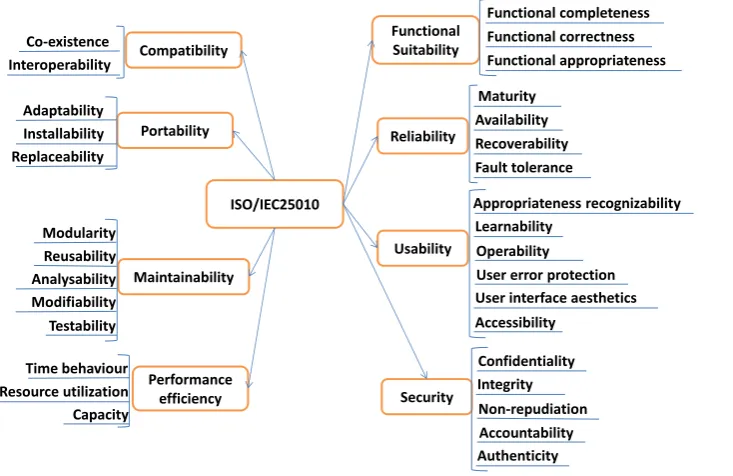
4.4 The eight product qualities in ISO/IEC 25010 (with refinements) . . . 60
4.5 Two-dimensional Voronoi and collated Voronoi diagrams (adapted from [54]) 65 5.1 The requirements ontology . . . 70
7.1 The usage of the Desiree tool . . . 107
7.2 The architecture of the Desiree tool . . . 108
7.3 The textual editor . . . 109
7.4 The graphical editor . . . 110
7.5 An illustrative example for the Desiree method (with stereotypes on nodes) 113 7.6 An example DL query . . . 114
8.1 The overall functionality of the Meeting Scheduler project . . . 129
8.2 Example Usability NFRs of the Meeting Scheduler project . . . 129
B.1 The graded membership functions for Low,Medium and High . . . 181
Introduction
“The requirements for a system, in enough detail for its development, do not arise naturally; instead, they need to be engineered and have continuing review and revision.”
— T.E. Bell and T.A. Thayer
In general, software or software-intensive systems are designed for solving real-world problems. For example, a meeting scheduler is designed for scheduling meetings, and probably also for managing resources (meeting rooms, room equipments); an online flight reservation system is designed for distributing airline tickets in a more efficient way, and providing promotional or profitable services to customers. To make sure that a software(-intensive) system correctly solves a real-world problem, we need to clearly understand and define what things we need to achieve in the word (requirements), what conditions will the system be built on (domain assumptions/properties), and what the system needs to do in order to meet the requirements (specification).
As problems nowadays are often complicated, getting the problem right is not easy, and sometimes surprisingly difficult. For example, when designing an online flight reservation system, we need to consider various kinds of customers (e.g., first-class, business-class, economic-class, adults, kids, infants), different kinds of nationalities (that may need spe-cial kinds of in-flight meals), spespe-cial kinds of consignments (e.g., pets, baby carriages, wheelchairs), etc. It is the task of Requirements Engineering (RE) to discover, under-stand, analyze and formulate the requirements that the system we are designing needs to fulfill, the context in which the system will be used, and the functions and quali-ties that the system needs to operationalize. Put differently, Requirements Engineering bridges the gap between the initial recognition of a problem and the task of building a software(-intensive) system to address that problem.
In this chapter, we review the role of Requirements Engineering in software develop-ment, and discuss the RE problem. At the end, we present an overview of this thesis’s proposal: Desiree, a refinement calculus for addressing the RE problem (we refer to the calculus as requirements calculus in the rest of the thesis, since the objects of refinement here are requirements).
1.1
Requirements Engineering
Requirements Engineering (RE) was born in the middle of ’70s [131], partially thanks to Ross and his SADT proposal (Structured Analysis and Design Technique [144], a language for communicating ideas), and partially thanks to others who established that the rumored ‘requirements problems’ are a reality [23]. In their seminar work [145], Ross and Schoman have defined ‘requirements definition’ (the early name of requirements engineering) as “a careful assessment of the needs that a system is to fulfill”, and pointed out that it must deal with “context analysis” (why a system is needed, based on current or foreseen conditions), “functional specification” (what the system is to be, in terms of functions that the system must accomplish), and “design constraints” (how the functions are to be designed and implemented). Later work by Zave [177] has further developed this idea and suggested that RE also needs to correlate the real-word (contextual) goals for, the functions of, and the constraints on a software system to precise specifications of software behavior, and concern their evolution over time.
These definitions suggest that the subject of RE is inherently broad [165]: it needs to deal with the discovery of requirements (requirements elicitation), the analysis of domain assumptions/properties (domain analysis), the check of requirements deficiencies such as inadequacy, incompleteness and inconsistency (requirements analysis), documentation, the management of requirements and specifications, etc.
Roughly, these activities be categorized into two processes [132][135]: (1) the process of eliciting stakeholder requirements/needs; and (2) the process of developing elicited stakeholder requirements into a requirements specification that can serve as the basis for later on system development activities. In addition, evolution/change management, shall also be seriously considered as stakeholder requirements/needs appear to be more changeable nowadays [114].
1.1.1
RE in Traditional Software Development
implemen-tation, testing and maintenance. In such development processes, business analysts (or requirements engineers) have to mediate between customers and software engineers: they translate informal requirements elicited from customers into a formal specification that can be handed over to software engineers for downstream development.
RE has been argued be to be of key importance to traditional software development processes for two main reasons: (1) the cost of fixing errors in later software development process is much higher that that in the RE process, e.g. Boehm and Papaccio [26] reported that it costs 5 times more to detect and fix requirements defects during design, 10 times more during implementation, 20 times more during unit testing and up to 200 times more after system delivery; (2) poor requirements are the leading factor of project failure, as shown in the empirical evaluations and investigations below.
Software requirements have been recognized as a real problem since the ’70s. In their early empirical study, Bell and Thayer [23] have reported that software requirements, of both small and large systems, are often incorrect, ambiguous, inconsistent, or incomplete. In the sequel, more studies have confirmed the requirements problems [76][92][170]. One broadly circulated report is the survey over a total of 8380 projects in 350 US companies, which is conducted by the Standish Group in 1994 [76]. The survey revealed that 31.1% of the investigated projects were failed, and 52.7% of them were challenged (e.g., offering only partial functionalities, being over budget or over time). Poor requirements, such as the lack of user involvement, requirements incompleteness, changing requirements, unrealistic expectations and unclear objectives, were identified as the major source of problems (47%). Similarly, in a survey conducted with 3800 organizations over 17 countries in Europe, most software problems are in the area of requirements specifications (50%) and requirements management (50%) [92].
More recently, in a survey of 12 UK companies [82], it was reported that require-ments problems accounted for 48% of all software development problems (2002). In 2014, the Project Management Institute (PMI) has conducted a comprehensive survey with more than 2,000 practitioners, and found that 47% of unsuccessful projects failed to meet goals due to poor requirements management, including interpreting and clearly articulat-ing requirements, alignarticulat-ing them to the strategic vision for projects, communicatarticulat-ing with stakeholders, dealing with ambiguities, etc. [136].
1.1.2
RE in Agile Software Development
waterfall-oriented methods [1]. As suggested in the Agile Manifesto [4], agile development encour-ages creating minimum amount of documentations needed to accurately guide developers and testers (note that it does not mean no documentation). That is, one does not need to prepare a comprehensive requirements document when starting a software project.
Due to its lightweight nature, agile development has enjoyed much attention in recent years. By checking Standish Group’s report in 2010 and 2012, one may notice that they have suggested “agile process” as a factor of success to small projects (with less than $1 million in labor content) [122]. Also, a recent IT survey in 2014 [15] revealed that 52% of the 231 respondents responded that their teams were using agile development.
One may feel that requirements engineering is not important any more in nowadays software development at first sight. However, this is not the case. First, agile development has strong assumptions (e.g., all stakeholder roles, including customers and users, can be reduced to one single role) and is not applicable to all projects, especially mission-critical projects [169]. For example, we would obviously not like our air traffic control, transporta-tion, power plant, medical operation or e-banking systems to be obtained through agile development of critical parts of the software [169]. Second, agile development has its own challenges, e.g., the very limited documentation would make a software system hard to maintain [133], the ignorance of non-functional requirements would result in major issues as the system matures and becomes ready for larger-scale deployment [32], etc.
More importantly, agile development also needs requirements engineering. Through a survey over 12,000 software projects between 1984 and 2003, Jones [100] has shown that almost any project includes some RE activities, whatever its type and size. Specifically, Wiegers et al. [172] have pointed out that “agile projects require fundamentally the same types of requirements activities as traditional development project”, and the difference is that “detailed requirements are not documented all at once at the beginning of an agile project, and will be developed in small portions through the entire project”.
In an industrial keynote “Agile RE – recipe for success or project wish-list?”1 in
REF-SQ 2015, a solution designer from 1&1 Internet, Germany has shared their experiences on adopting agile development (which is not successful). He pointed out that “pure scrum is over-simplistic in complex, commercial environment”, and RE is needed for several objectives, e.g., completeness, consistency, model-driven elicitation and analysis.
In agile development, requirements are often specified as user stories, which are allo-cated to specific iterations of for implementations [172]. As such, in each iteration, the allocated user stories need to be further analyzed, clarified, specified and verified. This new characteristic of agile development indicates that traditional RE needs to be adapted:
to embrace agile processes, RE shall be able to produce small requirements specifications, which can be easily modified and integrated with requirements specifications produced in other iterations, before and after. That is, a requirements specification shall be easily modifiable (i.e., offering effective support for evolution/change management).
1.2
The RE Problem
Upon elicitation, requirements are typically mere informal approximations of stakeholder needs that the system-to-be must fulfill. It is the task of the requirements engineering process to transform these requirements into a specification that describes formally and precisely the functions and qualities of the system-to-be. However, this is complicated by the very nature of requirements elicited from stakeholders, which are often ambiguous, incomplete, unverifiable, unattainable/unsatisfiable, etc. In our earlier studies on the PROMISE requirements data set [129], we found that 3.84% of all the 625 (functional and non-functional) requirements are ambiguous [115], 25.22% of the 370 non-functional requirements (NFRs) are vague, and 15.17% of the NFRs are potentially unattainable (e.g., they implicitly or explicitly use universals like “any” as in “any time”) [116].
1.2.1
Problem Definition
The problem of transforming informal stakeholder requirements into precise specifications (i.e., the requirements problem) was elegantly characterized by Jackson and Zave [98] as finding the specification S that for certain domain assumptions DA satisfies the given requirementsR, and was formulated as in Eq. 1.1.
DA, S |ùR (1.1)
This formulation determines what does it mean to successfully complete RE: once the specification S is found such that Eq. 1.1 holds, the requirements problem will be solved [102]. The transformation of requirements to specifications, or alternatively, the derivation of specifications from requirements, is thus of key importance to RE: the process will determine the quality of requirements (e.g., are they complete enough? are they measurable? etc.), and the way how requirements are specified will influence requirements management (e.g., if well structured, the resulting requirements specification could have good modifiability and traceability). In fact, this is the core problem of RE.
environment, and stated that a machine can affect, or can be affected by the environment only when they have some shared phenomena, which are events or states located at the interface/boundary of the machine [98]. Take a turnstile at the entry to a zoo for example, inserting a coin and pushing the barrier to its intermediate position are shared phenomena, entering the zoo is merely an environment phenomenon, and the lock and unlock of the turnstile are only machine phenomena.
Based on this, they distinguish between requirements and specifications as follows: a “requirement” states desired property in the environment – properties that will be brought about or maintained by the machine; a “specification” for the machine is restricted to im-plementable behaviour of a machine that can ensure the satisfaction of the requirements, and can only be written in terms of shared phenomena. Further, they define “domain assumption” as an indicative property of the environment irrespective of whether we build the machine or not [178]. As such, ideally, a specification shall not refer to private phe-nomena in the environment, because a machine has no access to them; it also shall not include private phenomena in the machine, which shall be in the design.
We favor this distinction, as it makes the requirements problem quite clear, and sug-gests the need of a systematic methodology for transforming stakeholder requirements into specifications. Note that this distinction between (stakeholder) requirements and (software) specifications is sometimes captured using other terms, e.g., user requirements (needs) vs. (software) system requirements as in Maiden [121]. Moreover, we general-ize a machine (a pure software system) in Jackson and Zave’s characterization [98] to a software ecosystem, as the solution for a real-world problem often involves other agents (e.g., other software systems, or human beings) in addition to the software system we are designing. That is, by specification, we mean software ecosystem specification, in which a function will not necessarily be performed by the software system being designed. For example, maintaining a software will be performed by software maintainers, who are external agents.
1.2.2
Existing Solutions
where word processors and spreadsheets continue to constitute the main tools for engi-neering requirements. For example, according to a webcast audience poll2 conducted by
Blueprint Software System in 2014, more than 50% of the participants said that they are using documents and spreadsheets for conducting requirements engineering. To address the poor support offered by such vanilla tools, there have been many RE tools (e.g., Rational DOORS [3]) that support RE-specific activities, such as elicitation, specifica-tion and traceability management. However, the existing RE tools mainly focus on the management of individual requirements, and pay little attention to the transformation of requirements to specifications.
Generally speaking, current solutions have (some of) the following deficiencies:
• Leaving out non-functional requirements. In traditional structural analysis and object-oriented analysis, non-functional requirements (NFRs) are generally left outside [168]. Early work by Fraser et al. [63] have proposed guidelines for devel-oping VDM specifications from Structural Analysis (mostly Data Flow Diagrams). More recently, Giese at al. [67] have tried to relate informal requirements specified in UML use cases to formal specifications written in Object Constraint Language (OCL). Seater et al. [154] have discussed how to derive system specifications from Problem Frame descriptions through a series of incremental problem reduction. Such approaches focused on functional requirements (FRs), but left out non-functional ones (NFRs), a very important class of requirements in RE.
• Lacking a unified language for representing both FRs and NFRs. Although a multitude of langues have been proposed for specifying requirements, few of them offer a syntax for both functional and non-functional requirements. For example, EARS (the Easy Approach to Requirements Syntax) [125] is designed mainly for functional requirements (FRs), while Planguage [68] is a keyword-driven language developed for writing measurable quality requirements. Similarly, the NFR Frame-work (NFR-F) [37] has proposed to use “softgoals” (goals without clear criteria for success) to capture NFRs, and offered a simple syntactic form for softgoals; however, it does not offer a companion syntax for goals, which are used to model functional requirements. Natural language is known to everyone and can be used to specify any kind of requirements, but many experiences have shown that requirements written in natural language is inherently vague and error prone [57][25][109][174][105].
• Lacking capture of interrelations based on requirements details. Often, in
current RE research (e.g., goal modeling approaches such as i* [176]) and practice (e.g., RE tools such as Rational DOORS [3]), individual requirements are treated as propositions, and traces between requirements are done on the basis of propositional (whole) requirements without considering requirements details. This treatment has several flaws: (1) the establishment and maintenance of traces is quite laborious and need to be done manually [159], resulting in poor modifiability of requirement specifications and making change/evolution management harder 3; (2) some kinds
of relations have been missing in current RE techniques [117], e.g., the existential dependency relation between qualities and functions as in “the processing time of file search shall be less than 30 seconds”; (3) requirements specification/modeling languages do not have precise links to the domain vocabulary, hence the vocabulary is often used inconsistently throughout the whole specification, e.g., (“interest rate” vs. “loan interest”) [159].
• Lacking support for weakening requirements. Goal-oriented techniques, such as KAOS [50], i* [176], Tropos [30], and Techne [101], have provided an elegant way for going from high-level strategic goals to low-level technical goals through AND/OR refinements, and finally tasks (aka functions) through operationalization. In these classic goal modeling frameworks, the AND/OR refinements are generally strengthening: the resulting sub-goal(s) of a refinement logically imply the refined goal, or, alternatively, the resulting set of sub-goal(s) has less solutions than the re-fined goal4. However, stakeholder requirements are sometimes practically
unattain-able and need to be relaxed. For example, is it possible to require every surveyed user to agree that the system under test is attractive? Is it possible to require a file search function to take less than 30 seconds all the time? How about if there are some exceptions (e.g., when having heavy workload)? In such cases, a weakening from 100% of the individuals in a domain to x%p0 x 100q is needed. These kinds of weakening refinements are not supported by current goal-oriented techniques.
• Lacking support for incremental formalization. Formal languages have been advocated for specifying requirements specifications as they have a clear syntax and
3Approaches for dynamic link generation have been proposed but they suffer from a certain level of
imprecision, and user evaluation over the generated links is necessary [39].
4Strengthening can be interpreted as shrinking the solution space (reducing the choices for satisfying)
a requirement: if a requirementr is strengthened to a set of sub-goals (one or more), sayrs, then each
solution for rs is also a solution for r, not vice versa. For example, the refinement of the goal G“trip
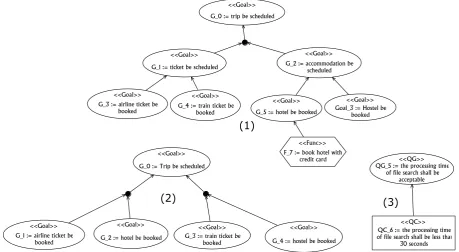
be scheduled” into “airline ticket be booked” and “hotel be booked” is a strengthening, because Gcan be
semantics, and support automatic analysis such as ambiguity detection, inconsisten-cy check and verification. However, their limitations are also obvious: they are hard to write and understand for non-experts. To alleviate the pain of directly writing formal specifications, many controlled natural languages (CNLs) based (e.g., Fuchs et al. [64], Konrad et al. [108]) and natural language processing (NLP) based ap-proaches (e.g., Fantechi et al. [59], Gervasi et al. [66]) have been suggested. In such approaches, NL requirements are first mapped to an intermediate representation, which is then further translated into targeted formal specification language(s).
One important issue with these approaches is that they just deal with what stake-holders have stated and do not support refining either stakeholder requirements or formalized specification, probably giving rise to requirements inadequacy, incom-pleteness and incorrectness. Moreover, the NLP-based techniques inevitably suffer from the incompleteness issue (e.g., missing information from the original require-ments docurequire-ments), being challenged in the RE field [24].
1.3
Our Research Objectives
We have reviewed the role of Requirements Engineering in nowadays software development in section 1.1, and discussed the RE problem and the deficiencies of current solutions to it in section 1.2. As we can see, although many efforts have been put on the RE problem, it has not been addressed effectively and has remained open. We want to tackle this problem in this thesis.
We specify our research objective as follows.
Research objective: to develop a holistic framework for incrementally trans-forming stakeholder requirements into an eligible (formal, complete enough, u-nambiguous, consistent, measurable, attainable, modifiable and traceable) spec-ification.
We decompose the research objective into four research questions (RQs):
RQ1: What are the proper concepts for modeling requirements?
that refer to qualities, and look to foundational ontologies (e.g., the Unified Foundational Ontology [78], UFO for short) to tell us precisely what functions and qualities are, respec-tively. Further, we propose new concepts to capture what have been traditionally called NFRs but do not refer to qualities.
RQ2: What are the proper representation for capturing requirements?
Based on our ontological interpretation for requirements, and inspired by AI frames and Description Logics (DL) [20], we propose to use a description-based representation for requirements, both functional and non-functional. We treat a requirement as a descrip-tion consisting of a set of constituent parts rather than a simple proposidescrip-tional sentence. As such, we allow analysts/engineers to reference the already defined constituent parts of another requirement when specifying the current one, and to refine any constituent part of a requirement description by using proper requirements operators (introduced for addressing RQ3). We also provide precise semantics for this language by using set theory.
RQ3: How to transform stakeholder requirements into an eligible specifica-tion?
To address this question, we revise the classic ideas of AND/OR refinements and opera-tionalization in existing goal modeling techniques, which allow us going from high-level goals to low-level goals, and finally functions (aka tasks). To make sure that resulting specification is eligible (i.e., formal, complete, unambiguous, measurable, attainable, and consistent), we propose a set of new requirements operators based on our language for requirements, and offer a methodology for applying the operators to incrementally trans-form stakeholder requirements into an eligible specification.
RQ4: How well is this approach when applied to realistic settings?
1.4
Overview and Contribution
We proposeDesiree, a requirements calculus for systematically transforming stakeholder requirements into a specification. The framework includes six main building blocks: (1) an ontology for classifying requirements; (2) a language for representing requirements; (3) a set of requirements operators for transforming (refining or operationalizing) requirements; (4) a methodology for applying the operators on requirements concepts; (5) a prototype tool in support of the entire framework; (6) a set of empirical evaluations conducted to evaluate the framework. The relations between the building blocks and the contributed research questions are shown in Table 1.1.
Table 1.1: The building blocks of the Desiree framework
Id Building blocks Contributed research questions
1 An ontology for requirements RQ1
2 A language for requirements and semantics RQ2
3 A set of requirements operators and semantics RQ3
4 A methodology for applying operators RQ3
5 A prototype tool RQ4
6 A set of empirical evaluations RQ4
We overview now each building block, showing its contribution in advancing the state of the art.
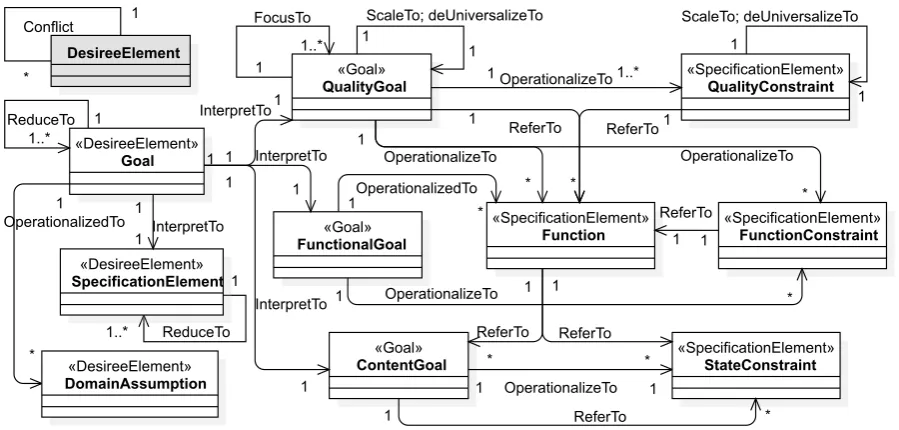
• An Ontology for Requirements. In general, we take a goal-oriented perspective and capture stakeholder requirements as goals (G). We have 8 kinds of concepts except the most generalgoal: 3 sub-kinds of goals (i.e., requirements), 4 sub-kinds of specification elements, and domain assumptions. Orthogonally, these 8 requirements concepts can be classified into into four categories: (1) function-related; (2) quality-related; (3) content-quality-related; and (4) domain assumptions.
– Function-related requirements. If a requirement specifies a desired state, and needs some functions to make it true (e.g., “airline tickets be booked”), it is a
functional goal(FG); if a requirement specifies what the software ecosystem shall do (e.g., “the system shall allow users to book airline tickets”), it is a
– Quality-related requirements. If a requirement refers to a quality and specifies a vague quality region (e.g., “the file search function shall be fast”), it is a
quality goal (QG); if a requirement refers to a quality but has a measurable quality region (e.g., “the file search function shall take less than 30 sec.”), it is a quality constraint(QC).
– Content-related requirements. We use acontent goal (CTG) to specify a set of properties of a real world entity (e.g., “a student shall have Id, name and GPA”), and a state constraint (SC) specify the system state that represents the desired word entity/sate, capturing conventional data requirements (e.g., the student record table shall include three columns: Id, name and GPA).
– Domain assumptions. We use “domain assumption” (DA) to describe the environment of the system-to-be (e.g., “the system shall have a functioning power supply”) or domain knowledge (e.g., “Tomcat is a web server”).
Contribution in advancing the state of the art. Our ontological interpreta-tion for requirements clarifies the concepts of funcinterpreta-tional and non-funcinterpreta-tional require-ments, enabling us to (1) effectively distinguish between FRs and NFRs; (2) address the inconsistency between quality classifications; (3) reasonably measure the satis-faction of “good-enough” NFRs. It also offers support for designing requirements specification language. In our ontology, we have revised the concept “functional goal” in the Core Ontology for Requirements Engineering (aka CORE) [102][103], the state of the art requirements ontology, and enriched this CORE ontology with new requirements concepts “functional constraint”, “content goal” and “state con-straint”. Moreover, we have validated our ontology for requirements by classifying all the 625 requirements in the PROMISE requirements set [129]. To the best of our knowledge, our evaluation is the first attempt of applying an ontology for re-quirements to realistic rere-quirements data.
• A Description-based Language for Requirements. We propose a description-based language for representing requirements, both functional and non-functional. We treat a FR/NFR as a description consisting of slot-description pairs, and capture the intention of an entity (e.g., a physical object, a software function) to be in certain state/situation by using an assertion-like syntax. We define the semantics for the syntax using set theory, and capture part of the meaning by automatically
(e.g., what kinds of requirements will be affected if we change a function?), detect inconsistencies (e.g., “user” as a physical entity in the real word vs. “user” as an information entity stored in a system), and “what-if” analysis (e.g., what kinds of elements in a model will be affected if some Function, FCs, or QCs are fulfilled while others are not).
Descriptions, inspired AI frames and DL, have the general form “Concept slot1 :
D1 ¡... slotn:Dn¡” whereDi is a description that restrictssloti. For example, the requirementR1“the system shall be able to backup data at weekdays” can be
cap-tured as “Backup actor :tthe systemu ¡ object:Data¡ when:W eekday ¡”. This form offers intuitive ways to strengthen or weaken5 requirements. For
in-stance, R1 can be strengthened into “Backup actor : tthe systemu ¡ object :
Data ¡ when : tM on, W ed, F riu ¡”, or weakened into “Backup actor :
tthe systemu ¡ object : Data ¡ when : W eekday_ tSatu ¡”. With this
syn-tax, the interrelations between qualities and functions can be captured by writing
“Quality inheres in : F unction ¡”, or more elegantly, “QualitypF unctionq”.
For example, the requirement “the file search function shall take less than 30 sec.” can be denoted as “P rocessing timepF ile searchq::¤30psec.q”, where “::” means taking value in the region “r0,30psec.qs”. The syntax for each requirement concept is sketched as follows.
– Functions (Fs) have the syntactic form “F :F N ame slot:D ¡”, where “FName” is the function name that describes the desired capability, “*” means zero or more. For example, the requirement “the system shall allow users to book airline tickets” can be captured as “F1 : Book actor : U ser ¡
object : Airline ticket ¡”. Both functional goals (FGs) and functional
constraints(FCs) have an assertion-like syntax. For example, “airline tickets be booked” will be captured as an FG “F G1 : Airline ticket : Booked”;
“only managers are able to activate pre-paid cards” can be captured as an FC
“F C1 :Active object:P repaid card¡: actor :ON LY M anager¡”.
– Quality goals (QGs) have the form “QG : QpSubjTq :: QRG”, meaning that each quality (of type “Q”) shall map its subject/bearer (of type “SubjT”), if exist, to a quality value that is in the desired region “QRG”. For example,
5Weakening a requirement means that one will have more choices to satisfy that requirement, while
the requirement “the file search function shall be fast” can be captured as
“QG1 : P rocessing timepF ile searchq :: F ast”. Here “File search” is a
function that is defined elsewhere. Quality constraints (QCs) have the same syntax as QGs, but with measurable quality regions. For example, “QC1 :
P rocessing timepF ile searchq::¤30psec.q”.
– Content goals (CTGs) and state constraints (SCs) share an assertion-like syntax. For example, “CT G1 : Student : has id : ID ¡ has name :
N ame ¡ has gpa : GP A ¡” and “SC2 : Student record : ID :
String ¡ name :String ¡ GP A:F loat ¡”.
– Domain assumptions (DAs) have a syntax similar to that for FCs. For instance, “DA1 : tthe systemu : has power : P ower ¡” or “DA2 :=
Tomcat : Web server”.
Contribution in advancing the state of the art. Our description-based rep-resentation for requirements makes several contributions: (1) unlike many formal languages that are able to capture only functional requirements (e.g., Linear Tem-poral Language, Z and Software Cost Reduction, see a summary and discussion in [166]), our language is able to represent both functional and non-functional re-quirements; (2) our description-based syntax facilitates the identification of require-ments issues such as incompleteness, ambiguity and unverifiability because it drives analysts/engineers to think about the properties (slots) of a function capability (e.g., actor, object, means, etc.), the cardinality of the description of a slot, the quantifica-tion of a vague quality region, etc. (see the analysis in Secquantifica-tion 8.5.7 for more detail); (3) our syntax suggests operational guidelines for refining requirements, e.g., one can specialize the description of a slot in a function (F) description via an “IsA” hier-archy, or refine a QG/QC via standard quality hierarchies like the ISO/IEC 25010 standard [93]; (4) it captures the interrelation between requirements based on re-quirements details, especially the existential dependency relation between qualities and functions, which has been missing in current RE techniques [117]; moreover, this allows us to systematically identify the requirements to be affected when changes oc-cur to a requirement specification (i.e., requirements specifications will have better modifiability).
deUniversal-ize”(U), “Scale”(G), and “Resolve” (Rs); for operationalization, we have “
Oper-ationalize”(Op) and “Observe”(Ob). The Rd and Op operators are adapted from existing goal modeling techniques, while the other 6 operators are newly proposed in this thesis. These 8 operators can be applied as follows.
– The “Reduce” (Rd) operator is used for refining a higher-level modeling element to lower-level elements of the same type. That is, we allow reducing a goal to goals, a FG to FG(s), an F to F(s), etc. For example, the goal G1 “collect
real time traffic info” can be reduced to G2 “traffic info be collected” and G3
“collected traffic info be in real time”.
– The “Interpret” (I) operator is used for disambiguating a requirement (if need-ed), and encoding a goal written in natural language using our syntax. For ex-ample, the ambiguous goalG1 “notify users with email” can be disambiguated
and encoded as F2 “N otif y object : U ser ¡ means : Email ¡” (another
possible interpretation isN otif y object:U ser has email:Email¡¡).
– “Focus” (Fk), “de-Universalize” (U) and “Scale” (G) are used for refining QGs/QCs: Fk refines QGs/QCs via quality type or subject type (e.g., for the
QG “Securityptthe systemuq::Good”, one can focus the quality type “
Secu-rity” to its sub-dimensions like “Integrity”, or focus the subject “{the system}” into its parts, e.g., “{the data storage}”); U is used to relax a QG/QC such that it is no longer expected to hold for 100% of the individuals in the subject domain (e.g., “the file search function take less than 30 sec. all the time ” to “(at least) 80% of the time”); Gis used to enlarge or shrink the quality region of a QG/QC (e.g., enlarging “r0, 30psec.qs” to “r0, 35psec.qs” or shrinking it to “r0, 25psec.qs”). In addition, the Ob operator is used to operationalize subjec-tive QGs such as “the interface shall be simple” into QCs by asking obervers, in order to make them measurable.
– The “Operationalize”(Op) is used to operationalize a FG as F(s) and/or FC(s), e.g., the operationalization of the FG “U ser access: Controlled” as functions
“Authenticate object :: U ser ¡” and “Authorize object :: U ser ¡”;
operationalize a QG as QC(s) to make it measurable, or operationalize the QG as F(s) and/or FC(s) to make it implementable; operationalize a CTG as SC(s). Note that any goal (G, FG, QG, or CTG) can be simply operationalized as a domain assumption, i.e., assuming it to be true.
do not necessarily mean logical inconsistency, but can also be other kinds such as normative conflict or infeasibility.
Contribution in advancing state of the art. Our set of 8 operators enables us to: (1) go from informal to formal through disambiguating natural language requirements, and translating them into the Desiree syntax; (2) repeatedly refine requirements and specification-elements, which are written in Desireesyntax, mak-ing them complete enough, measurable, and consistent; (3) waken requirements if they are too hard or costly to attain, making them practically satisfiable. The in-cremental transition from informal to formal and the weakening of requirements are lacking in current RE techniques.
• Transformation Methodology. We provide a three-staged methodology for ap-plying the operators to transform stakeholder requirements into an eligible specifi-cation. We outline the important steps as follows.
– The informal phase. In this phase, we identify the concern of each stakeholder requirement, and useRdto separate its concerns if a requirement has multiple ones (i.e., it is complex). Meanwhile, if conflicts are found, we capture the conflicting requirements by using the “Conflict” relation.
– The interpretation phase. In this phase, we use theI operator to disambiguate stakeholder requirements (if needed), classify and encode each atomic stake-holder requirement (i.e., a requirement with a single concern) by using our description-based syntax. In this phase, we allow interpreting stakeholder re-quirements as sub-kinds of goals (FG, QG, CTG) or directly as specification elements (F, FC, QC, SC).
– The smithing phase. In this phase, we incrementally refine the structurally specified goals (FG, QG, and CTG) and operationalize them as specification elements. Moreover, if needed, we keep refining specification elements (F, FC, QC, and SC). Specifically,
∗ FGs, FCs, CTGs, SCs can be refined by using the Rd operator.
∗ QGs and QCs can be refined by usingFk, relaxed using U and G.
∗ Conflicts can be resolved by using the Rs operator.
Contribution in advancing state of the art. The methodology tells ana-lysts/engineers when to use which operator, in order to remove ambiguities and vagueness, reducing incompleteness, eliminating unattainability and conflict, turn-ing informal requirements into an eligible specification. The existturn-ing goal-oriented frameworks often lack such a methodology, especially guidelines for going from in-formal to in-formal and weakening requirements during requirements analysis.
• Prototype Tool. We have developed a prototype tool in support of the Desiree
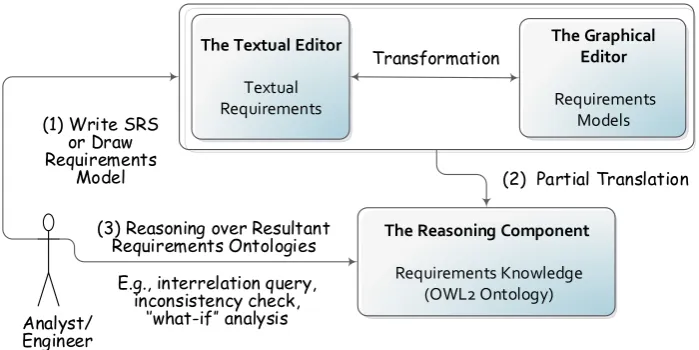
framework, including all 9 requirements concepts, the 8 operators and the trans-formation process. The tool includes three key components: (1) a textual editor, which allows analysts to write requirements using our language; (2) a graphical editor, which allows analysts to draw models through a graphic interface; (3) a reasoning component, which (partially 6) translates requirement specifications,
ei-ther texts or models, to DL ontologies, and make use of existing reasoners (e.g., Hermit [157]) to perform reasoning tasks such as interrelations query, inconsistency check, and “what-if” analysis.
Contribution in advancing state of the art. The prototype tool supports the entire framework, and provides hints for applying requirements operators. It automatically translates the Desiree syntax to DL [20], allowing us to do some interesting reasoning (see Section 8.4 for more detail).
• Empirical Evaluations. We have conducted a set of empirical evaluations to assess our proposal, including case studies and controlled experiments. We use the PROMISE requirements set [129] as our requirements and projects repository.
– We evaluated the coverage of our ontology for requirements by classifying all the 625 requirements, functional and non-functional, in this repository.
– We evaluated the expressiveness of our language by rewriting the 625 require-ments in the data set.
– We evaluated the effectiveness of our methodology by conducting a realistic
“Meeting Scheduler” case study chosen from the data set.
– We evaluated the effectiveness of the entire Desiree framework by conducting a series of three controlled experiments, using two testing projects chosen from the data set: “Meeting Scheduler” and “Realtor Buddy”.
Contribution in advancing state of the art. The evaluations show that our ontology and language are adequate in capturing requirements, our methodology is effective in engineering requirements specifications from stakeholder requirements. The controlled experiments provide strong evidence that Desiree can indeed help people to conduct better requirements analysis (i.e., identifying and addressing more issues when transforming requirements into specifications). These empirical eval-uations also allow us to identify the limitations of our language, and give useful feedback on improving the methodology and tool.
1.5
Structure of the Thesis
The remainder of the thesis is structured as follows:
• Chapter 2 summarizes the state of the art related to our work. We mainly review the related work on requirements ontologies/classifications, requirements specification and modeling, and requirements transformation (i.e., deriving specifications from requirements).
• Chapter 3 presents the research baseline of this thesis, including (1) goal-oriented requirements engineering; and (2) the ontological foundations offunctionsand qual-ities.
• Chapter 4 introduces the ontological interpretations of requirements. We first pro-vide an ontological interpretation for functional and non-functional requirements based on the ontological meaning of functions and qualities, and then accordingly propose a syntax for representing both of them.
• Chapter 5 presents the Desiree framework, which includes a set of requirements concepts, a set of requirement operators, a description-based syntax for represent-ing these concepts and operators, and a systematic methodology for transformrepresent-ing stakeholder requirements into an eligible requirements specification.
• Chapter 6 presents the semantics of the Desiree framework. We first define the se-mantics of requirements concepts and operators, and then discuss the partial trans-lation of Desiree syntax to DL ontologies.
• Chapter 7 introduces a prototype tool. In this chapter, we introduce the key com-ponents and features of our prototype tool. This tool supports the entire Desiree
• Chapter 8 presents a set of empirical evaluations, which are conducted in order to evaluate: (1) the coverage of our requirements ontology; (2) the expressiveness of our language; (3) the effectiveness of our methodology; (4) the effectiveness of the entire framework.
• Chapter 9 concludes the thesis by listing the contributions and limitations of the
Desiree framework, and sketches directions for further research.
1.6
Published Papers
We list here published work related to this thesis, ordered by date of publication.
• Feng-Lin Li, Jennifer Horkoff, John Mylopoulos, Lin Liu, and Alexander Borgida. Non-Functional Requirements Revisited. iStar’13, pp. 109-114, 2013.
• Renata Guizzardi, Feng-Lin Li, Alexander Borgida, Giancarlo Guizzardi, Jennifer Horkoff, and John Mylopoulos. An ontological interpretation of non-functional re-quirements. FOIS’14, pp. 344–347, 2014.
• Feng-Lin Li, Jennifer Horkoff, John Mylopoulos, Renata SS Guizzardi, Giancarlo Guizzardi, Alexander Borgida, and Lin Liu. Non-functional requirements as quali-ties, with a spice of ontology. RE’14, pp. 293–302, 2014.
• Feng-Lin Li, Jennifer Horkoff, Alexander Borgida, Giancarlo Guizzardi, Lin Liu, and John Mylopoulos. From Stakeholder Requirements to Formal Specifications Through Refinement. REFSQ’15, pp. 164–180, 2015.
• Jennifer Horkoff, Fatma Baak Aydemir, Feng-Lin Li, Tong Li, and John Mylopou-los. Evaluating Modeling Languages: An Example from the Requirements Domain. ER’14, pp. 260–274, 2014.
• Jennifer Horkoff, Tong Li, Feng-Lin Li, Mattia Salnitri, Elsa Cardoso, Paolo Giorgi-ni,John Mylopoulos, and Joo Pimentel. Taking goal models downstream: A sys-tematic roadmap. RCIS’14, pp. 1–12, 2014.
• Feng-Lin Li, Jennifer Horkoff, Lin Liu, Alexander Borgida, Giancarlo Guizzardi, and John Mylopoulos. Engineering Requirements with Desiree : An Empirical Evaluation. Submitted to CAiSE’16.
State of the Art
The state of the art in our research area can be generally classified into three categories: (1) requirements ontologies/classifications; (2) requirements specification and modeling; (3) requirements transformation (i.e., deriving specifications from requirements). We review these sub-areas and assess their adequacy in addressing the RE problem.
2.1
Requirements Ontology
An initial conceptualization for RE was offered by Jackson and Zave [98] nearly two decades ago, founded on three basic concepts: requirement, specification and domain assumption. Based on this characterization, the classical requirements problem is defined as finding the specificationS consistent with the given domain assumptionsDAto satisfy the given requirementsR. For example, to satisfy the requirement “make online payment” (R), a software or service needs to support a function “pay with credit card” (S) under the (implicit) domain assumption of “having a credit card with available credits” (DA).
On observing that this initial characterization leaves out important notions such as non-functional requirements, Jureta et al. [102][103] have proposed the CORE ontology based on goal-oriented requirements engineering (GORE), which is founded on the premise that requirements are stakeholder goals. Based on the understanding that functional requirements (FRs) describe what the system should do, whereas non-functional ones (NFRs) describe how well the system should perform its functions [134], the CORE ontology distinguishes between non-functional and functional requirements usingqualities
introduced in the DOLCE foundational ontology [123]: (1) a requirement is non-functional if it refers to a quality; further, this requirement will be asoftgoal if it is vague for agreed success, or, alternatively, aquality constraint if it is clear for success; (2) a requirement is
a functional goal if it refers to a perdurant (something accumulates parts over time, e.g., a process, an event) and does not refer to a quality.
Since its proposal in 2008, the CORE ontology has enjoyed considerable attention, and has served as the baseline of new research directions in RE [101][118]. However, in our experience, it has several deficiencies in classifying requirements. First, it is ineffective on capturing requirements that refer to neither qualities nor perdurants, but endurants (whose proper parts are wholly present at any time, e.g., physical objects). For exam-ple, “the user interface shall have menu buttons for navigation”, where “menu buttons” are endurants. We could classify this requirement as a general goal, but can not further specialize it since it is neither functional nor non-functional according to CORE. This is insufficient if we want to transform such requirements into a specification. Second, it is d-ifficult to capture requirements that are vague for success but do not refer to qualities. For example, requirements such as “attract customers” and “increase sales” refer to perdu-rants (processes/events) rather than qualities, and are accordingly classified as functional goals. However, this conclusion contradicts Jureta et al. [103]’s claim that “functional goals are Boolean, i.e., true or false” since these examples, like softgoals, have no clear-cut criteria for success. Third, requirements could refer to both qualities and functions. For example, although we can classify the requirement “the system shall collect real-time traffic information” as a softgoal according to CORE (“real-time”, i.e., timeliness, is a quality of traffic information), we are still left with the question “is it only an NFR?”. It seems to be a combination of functional and non-functional concerns, which should be refined into distinct sub-goals.
Also, ontologies of specific domains, for which requirements are desired, have been em-ployed in RE mainly for activities (e.g., requirements elicitation [104] and evolution [120]) or processes (e.g., [58]). These efforts, however, are not proposals for an ontological anal-ysis of requirements notions. In fact, few researchers have attempted to ontologically analyze requirements. Our goal here is in the ontological classification and conceptual clarification of different requirement kinds.
2.1.1
Functional Requirements (FRs)
inputs (stimuli) to the system, the outputs (responses) from the system, and behavioral relationships between them”. As a (software) function often includes input and out-put [45][173], these two threads of definitions (“what kinds of functions a software system shall have” and “what kinds of behavior a software system shall exhibit”) are compati-ble: a function can be treated as an input-output relation, and be specified using input, output, and maybe other things such as pre-, post- and trigger conditions as in Letier et al. [113].
There are two points to be noted about these definitions for functional requirements. First, they focus narrowly on the software part of the system to be designed, and do not consider its environment. For example, how can one classify the requirement “the product shall be supported by the corporate support center”, which specifies a function (“support”) that will not be performed by the system but by an external agent (“the corporate support center”) in a system-to-be ecosystem? Second, they do not acknowledge that a requirement can be a mix of concerns (e.g., having more than one function/quality, or including both functions and qualities). For instance, how to classify the requirement “the system shall have standard menu buttons for navigation”? This one has several concerns: (1) it refers to a (software) system function “navigatepusersq”; (2) it restricts the way to implement the function to “use menu buttons”; (3) it requires the menu buttons to be “standard”, which is about qualities (e.g., size, color).
2.1.2
Non-functional Requirements (NFRs)
Unlike FRs, “non-functional requirements” (NFRs) is debatable in RE: despite the wide acceptance of their importance and the many efforts devoted to them, there is still no ultimate consensus on what NFRs are and how to capture them [71].
NFRs Definition. Recently, there are two important reviews on NFRs by Martin Glinz [71] and Chung et al. [36]. Glinz [71] surveyed 13 NFR definitions, and suggested his own on the basis of attributes and constraints. However, his definition focuses on only (software) system NFRs, and does not consider project and process requirements (e.g., development, deployment, maintenance, etc.). Moreover, his proposal does not offer methodological guidance for designing language and method for capturing NFRs.
the system to check who is updating, and is not about the quality of updating), but an NFR according to Chung et al. [36]’s definition.
NFRs Classification. NFRs are often classified into sub-categories. For example, the IEEE Std 830 [45] classifies NFRs into interface requirements, performance requirements, attributes and design constraints, and documents them in a separate section from FRs using natural language. Similarly, the Volere template [141] categories NFRs as look and feel, usability and humanity, performance, operational and environmental, maintain-ability and support, security, cultural and political, and legal requirements, and captures requirements (functional and non-functional) sentences as informal text using a structured template which includes attributes like ID, requirements type, description, rationale, fit criterion, etc.
There are several deficiencies in such approaches. First, they classify requirements strictly as functional or non-functional, leading to difficulties when classifying require-ments that mix both functional and quality concerns (as shown in our evaluation in Sec-tion 8.2, also observed in the work of Svensson et al. [164]). Second, the sub-categories of NFRs in these approaches are open-ended, and would probably change as time, domain, or researcher varies. Third, such approaches document FRs and NFRs separately, hence do not capture the interrelations between them and do not reflect the cross-cutting concerns of NFRs (i.e., an NFR could refer to multiple system functions, parts or artifacts).
NFRs as Qualities. Quality is the most popular term adopted to specify NFRs. Many efforts have been made towards modeling and classifying qualities, resulting in fruitful quality models. The well-known models include McCall et al. [46], Boehm et al. [27], ISO/IEC 9126-1 [10], ISO/IEC 25010 [93], etc., in which qualities and their interdepen-dencies are usually organized in a hierarchical structure. One issue with these quality models is that they, even the well-known ones, are neither terminologically nor categor-ically consistent with each other [36]. For example, “understandability” is a sub-quality of “usability” in ISO/IEC 9126-1 [10], but is a sub-class of “maintainability” in Boehm et al. [27]. The inconsistency in the classifications of software qualities has been also observed in comparative studies over quality models, e.g., [11].
Although Chung et al. [36] have suggested be aware of some of the well-known classi-fication schemes and consider one or more to adopt with some tailoring, we are still left with the question: why these quality models differ from, and sometimes even conflict with each other?
have used “softgoals” (goals without clear criteria for success) to model non-functional requirements. However, goals lacking a clear criterion of satisfaction (i.e., softgoals) turn out to be not always NFRs – most early requirements, as elicited from stakeholders are also “soft”. For instance, when a stakeholder says “Upon request, the system shall schedule a meeting”, this is also vague and needs to be made more firm: do we allow requests for any time (e.g., weekends)? Should the system notify participants about the scheduled meeting? Should it account for contingencies (e.g., power outage)? etc. Similarly, NFRs are not necessarily vague, e.g., the “the processing time of file search shall be less than 30 seconds” is an NFR but is clear for success.
So, softgoals constitute a useful abstraction for early (vague) requirements, both func-tional and non-funcfunc-tional, rather than just non-funcfunc-tional ones. However, this conclusion begs the next question: what then are non-functional requirements, how do we model them and how do we use these models in RE processes?
2.2
Requirements Specification and Modeling
Lan-guage
In RE, great efforts have been placed to designing effective language for capturing require-ments, resulting in various kinds of requirement specification and modeling techniques, including (1) natural language (NL); (2) requirements specification (RS) templates, e.g., the IEEE Std 830 [45], the Volere template [141]; (3) writing guidelines, e.g., Alexander et al. [14], Wiegers et al. [172]; (4) structured languages, e.g., EARS (the Easy Approach to Requirements Syntax) [125], Planguage [68]; (5) controlled natural languages, e.g., ACE [64], Gervasi et al. [66]; (6) visual modeling languages, e.g., SADTT M (Structured Analysis and Design Technique [144], UML [148], KAOS [50], the NFR Framework (NFR-F) [37], i* [176]; (7) formal languages, e.g., RML [75][74], VDM (Vienna Development Method) [62], Linear Temporal Logic [50], and SCR (Software Cost Reduction) table [85].
Table 2.1: The classification of requirements specification languages
Type Kind Formality Examples
Guideline Writing Guidelines – Alexander et al. [14], Wiegers et al. [172]
Specification
Natural Language Informal English
RS Template Semi-formal IEEE Std 830 [45], Volere [141]
Structured Language Semi-formal EARS [125], Planguage [68]
Controlled NL Semi-formal ACE [64], Gervasi et al. [66]
Formal Language Formal RML [75], SCR [85], VDM [62]
Modeling
Structural Analysis Semi-formal SADTT M<
![Fig ur e 2 .1 : A s imple pr o ble m dia g r a m ( a da pt e d f r o m [4 8 ])](https://thumb-us.123doks.com/thumbv2/123dok_us/534871.2053250/54.595.61.509.538.670/fig-ur-a-imple-pr-ble-dia-da.webp)
![Fig ur e 4 .1 : T he o nt o lo g ic a l me a ningo f f unc t io n ( a do pt e d f r o m [7 8 ])](https://thumb-us.123doks.com/thumbv2/123dok_us/534871.2053250/66.595.89.486.485.624/fig-ur-me-ningo-unc-io-do-pt.webp)
![Fig ur e 4 .3 : T he o nt o lo g ic a l me a ningo f q ua lit y( a do pt e d f r o m [7 8 ])](https://thumb-us.123doks.com/thumbv2/123dok_us/534871.2053250/72.595.60.511.133.266/fig-he-nt-me-ningo-ua-lit-pt.webp)
![Fig ur e 4 .5 : T w o - dime ns io na l Vo r o no i a nd c o lla t e d Vo r o no i dia g r a ms ( a da pt e d f r o m [5 4 ])](https://thumb-us.123doks.com/thumbv2/123dok_us/534871.2053250/79.595.114.519.276.422/fig-ur-dime-vo-nd-lla-vo-dia.webp)