R E S E A R C H
Open Access
A comparative multidimensional LC-MS proteomic
analysis reveals mechanisms for furan aldehyde
detoxification in
Thermoanaerobacter
pseudethanolicus
39E
Sonya M Clarkson
1,2, Scott D Hamilton-Brehm
1,2,4, Richard J Giannone
1,3, Nancy L Engle
1,2, Timothy J Tschaplinski
1,2,
Robert L Hettich
1,3and James G Elkins
1,2*Abstract
Background:Chemical and physical pretreatment of lignocellulosic biomass improves substrate reactivity for increased microbial biofuel production, but also restricts growth via the release of furan aldehydes, such as furfural and 5-hydroxymethylfurfural (5-HMF). The physiological effects of these inhibitors on thermophilic, fermentative bacteria are important to understand; especially as cellulolytic strains are being developed for consolidated
bioprocessing (CBP) of lignocellulosic feedstocks. Identifying mechanisms for detoxification of aldehydes in naturally resistant strains, such asThermoanaerobacterspp., may also enable improvements in candidate CBP microorganisms.
Results:Thermoanaerobacter pseudethanolicus39E, an anaerobic, saccharolytic thermophile, was found to grow readily in the presence of 30 mM furfural and 20 mM 5-HMF and reduce these aldehydes to their respective alcohols
in situ. The proteomes ofT. pseudethanolicus39E grown in the presence or absence of 15 mM furfural were compared to identify upregulated enzymes potentially responsible for the observed reduction. A total of 225 proteins were differentially regulated in response to the 15 mM furfural treatment with 152 upregulated versus 73 downregulated. Only 87 proteins exhibited a twofold or greater change in abundance in either direction. Of these, 54 were upregulated in the presence of furfural and 33 were downregulated. Two oxidoreductases were upregulated at least twofold by furfural and were targeted for further investigation. Teth39_1597 encodes a predicted butanol dehydrogenase (BdhA) and Teth39_1598, a predicted aldo/keto reductase (AKR). Both genes were cloned fromT. pseudethanolicus39E, with the respective enzymes overexpressed inE. coliand specific activities determined against a variety of aldehydes. Overexpressed BdhA showed significant activity with all aldehydes tested, including furfural and 5-HMF, using NADPH as the cofactor. Cell extracts with AKR also showed activity with NADPH, but only with four-carbon butyraldehyde and isobutyraldehyde.
Conclusions:T. pseudethanolicus39E displays intrinsic tolerance to the common pretreatment inhibitors furfural and 5-HMF. Multidimensional proteomic analysis was used as an effective tool to identify putative mechanisms for detoxification of furfural and 5-HMF.T. pseudethanolicuswas found to upregulate an NADPH-dependent alcohol dehydrogenase 6.8-fold in response to furfural.In vitroenzyme assays confirmed the reduction of furfural and 5-HMF to their respective alcohols.
Keywords:Thermophiles, Lignocellulosic, Biofuels, Proteomics, Inhibitor, Pretreatment, Furfural, 5-hydroxymethylfurfural, Butanol dehydrogenase
* Correspondence:[email protected]
1BioEnergy Science Center, Oak Ridge National Laboratory, Oak Ridge, TN
37831-6341, USA
2Biosciences Division, Oak Ridge National Laboratory, Oak Ridge, TN
37831-6341, USA
Full list of author information is available at the end of the article
Background
Thermophilic bacteria, such as Clostridium thermocellum and Caldicellulosiruptor species have gained interest for their possible use as biocatalysts for converting lignocellu-losic biomass into renewable fuels and chemicals [1-4]. The potential advantages of thermal bioprocessing include improved kinetics, reduced viscosities of concentrated slur-ries, lower oxygen solubility, and reduced process cooling requirements [2]. In addition, several bacterial phyla include thermophiles that are able to utilize plant cell walls directly through the action of complex (hemi)cellulase systems expressed either as free enzymes, cellulosomes, or multifunctional enzymes [5]. Relying on these native enzymes in a bioprocessing scheme could substantially reduce or even eliminate the need for exogenous enzymes for cellulose solubilization with a resulting improvement in process economics [3,6,7].
To render plant material more reactive to microbial or enzymatic digestion, physical and chemical pretreatment methods are generally applied, and improvement in pretreatment technologies remains a highly active field of research [8,9]. Pretreatment with dilute acid at high temperatures has the benefit of solubilizing the hemicel-lulose fraction of biomass, which produces fermentable C5 oligomers and monomers [9]. However, one disad-vantage of dilute acid pretreatment is that the process is non-specific and, depending on its severity, generates a number of toxic by-products [10]. Inhibitory compounds generated by dilute acid pretreatment typically fall into four categories: organic acids (acetic acid, ferulic acid), ketones (acetovanillone), phenolics (coniferyl alcohol, catechol), and aldehydes (furfural, hydroxymethylfurfural, vanillin). Mixtures of inhibitors, especially those including the furan aldehyde furfural, often have a synergistic effect on inhibiting cell growth and fermentation. For example, furfural increases the toxicity of acetate in yeast [11] and phenols inEscherichia coli[12,13]. Furfural is estimated to be responsible for 33% of the toxic effect of sugar cane hydrolysate onE. coliLYO1 [14].
In order to compete with more robust ethanologens such as Saccharomyces cerevisiae, several limitations inherent to fermentative thermophilic bacteria must be overcome. These limitations include relatively low ethanol titer and yield from mixed-acid fermentation pathways, although breakthroughs in metabolic engineering have improved the yield of ethanol from carbohydrates in some thermophiles to near theoretical limits [15]. Another major hurdle for thermophilic bioprocessing is growth inhibition by a wide range of compounds encountered in biomass fermentations. Insights into overcoming end-product inhibition in C. thermocellum have recently emerged [16,17]; however, growth inhibition from other biomass-derived compounds remains underexplored in thermophilic microbes relative toS. cerevisiae [18-20] or
engineered strains of E. coli [12,21-23]. Interestingly, members of the genus Thermoanaerobacter have been shown to tolerate pretreated biomass hydrolysates [24,25], and engineered strains give improved ethanol yields from both C5 and C6 sugars [26]. These properties have en-couraged the development of severalThermoanaerobacter species for bioethanol production from hydrolysates (primarily xylose) and on cellulose when paired with a cellulolytic partner [27]. While surveying thermophilic bacteria for intrinsic tolerance to furfural (unpublished), we observed robust growth and rapid reduction of the compound by Thermoanaerobacter pseudethanolicus39E (formally known asT. ethanolicus[28]). This study aims to identify and characterize traits that enable this organism to grow in the presence of and to simultaneously detoxify furan aldehydes through reduction to less toxic alcohols.
Results and Discussion
T. pseudethanolicus39E furan aldehyde tolerance
We initially investigated the growth tolerance of T. pseu-dethanolicus 39E to the furan aldehydes furfural and 5-hydroxymethylfurfural (5-HMF). The addition of 10 mM and 15 mM furfural increased specific growth rates to 0.52 ± 0.03 h-1 and 0.49 ± 0.01 h-1, respectively, versus the control at 0.38 ± 0.01 h-1 (Figure 1A). 5-HMF also stimu-lated growth at 10 mM compared to no addition (0.51 ± 0.03 versus 0.41 ± 0.02 h-1), while growth rates were similar to the control at 15 mM 5-HMF (0.45 ± 0.02 versus 0.41 ± 0.02 h-1; Figure 1B). Both 10 mM furfural and 5-HMF slightly increased cell yield at 12 h by approximately 11% and 12%, respectively (Figure 1). Higher growth rates and increased cell yield from the addition of subinhibitory concentrations of furfural and 5-HMF suggest that 39E metabolism is constrained by electron flow, which is relieved by the furan aldehydes serving as an alternative dissimilatory electron acceptor. The concentration resulting in 50% inhibition of growth (IC50) with furfural was 30 mM
after 12 h and 30 to 40 mM after 24 h. The IC50 for
5-HMF was between 20 and 30 mM after both 12 and 24 h. As shown in Table 1, the determined values are com-parable to or slightly higher than those of other thermo-philic bacteria, while they are higher than reported values for E. coli, S. cerevisiae,and Zymomonas mobilis. Though direct comparisons are difficult due to differences in the growth conditions used in the various studies, these results suggest that T. pseudethanolicus 39E has a comparable if not higher tolerance to the furan aldehydes furfural and 5-HMF than other studied organisms.
alcohol concentrations were measured. As shown in Figure 2, concomitant with growth, furfural and 5-HMF concentrations decreased while 2,5-furandimethanol concentration increased, indicating thatT.
pseudethano-licus 39E reduced 5-HMF to 2,5-furandimethanol.
Furfural was most likely also reduced to furfuryl alcohol; however, quantitation of this compound is complicated by its polymerization at the growth temperature of T. pseudethanolicus39E.
The addition of furan aldehydes affected end-product formation by T. pseudethanolicus39E, as determined by HPLC analysis (Figure 3). At 10 mM concentrations, more acetate and lactate are produced, while ethanol production remains constant. At furan aldehyde concentrations above 10 mM where growth is observed (15, 20, 30 mM furfural and 15, 20 mM 5-HMF), ethanol decrease and acetate increase are directly proportional, suggesting that acetyl
coenzyme A is converted to acetate through phosphotran-sacetylase (PTA) and acetate kinase (AK) rather than serving as an electron acceptor for ethanol production via NAD(P)H-dependent bifunctional alcohol dehydrogenase (ADH) activity. T. pseudethanolicus 39E possesses seven ADHs, but ethanol is primarily produced from NADPH-dependent AdhB [34-36]. The oxidative branch of the pentose phosphate pathway is also present in 39E, which could supply NADPH [34]. Reduction of furfural/5-HMF to their corresponding alcohols during growth competes with ethanol production for electrons delivered by NADPH. This is also suggested by stoichiometric shifts in end products, where added aldehydes resulted in about a 0.5 times decrease in corresponding molar ethanol concentrations (that is, the 30 mM furfural addition resulted in a decrease of 15 mM ethanol versus the control). This shift in ethanol/ acetate concentrations is consistent with an electron balance Figure 1T. pseudethanolicusfuran aldehyde tolerance.T. pseudethanolicuswas grown at 65°C with 40 mM glucose and increasing concentrations of(A)furfural or(B)5-HMF. Growth was measured by optical density at 600 nm. Error bars are the standard deviation of three replicate cultures.
Table 1 IC50(g/L)* for furfural and 5-hydroxymethylfurfural in thermophilic bacteria and ethanologenic microorganisms Organism Furfural 5-HMF YE (% w/v) Carbon (% w/v) Time (h) Temp (°C) pH Ref.
T. pseudethanolicus39E 3 2 - 3 0.1 0.7 12 65 7.0 TS
T. pseudethanolicus39E 3 - 4 2 - 3 0.1 0.7 24 65 7.0 TS
Bacillus coagulansMXL-9 2.5 - 5 5 0.5# 5-10 24 50 7.0 [29]
C. saccharolyticus 1 - 2 1 - 2 0.1 1 16, 40 72 7.0 [30]
Thermoanaerobacteriumstrain AK17† 2 3 0.2 0.4 120 60 6.0 [11]
Tm. thermosaccharolyticum 1.25 1 0.2 1 40 60 7.0 [31]
Thermotoga neapolitana 2 - 4 2 - 4 0.1 1 16, 40 80 7.0 [30]
E. coliLY180 1 - 1.5 nd none 5 48 37 6.5 [23]
E. coliLY180 < 0.4 nd none 5 (xyl) 48 37 6.5 [23]
E. coliLY180 1.5 nd 0.1 5 (xyl) 48 37 6.5 [23]
S. cerevisiaeCBS 1200 0.5 < 1 0.3 2 24 26 5.8 [32]
S. cerevisiaeNSI 113 2 nd 0.3 1 48 30 5.3 [33]
Z. mobilisATCC 10988 2 5 0.3 2 24 30 5.6 [32]
of one NAD(P)H per furan aldehyde and two NAD(P)H per ethanol. The reason for increased lactate with added furan aldehyde, especially 5-HMF, is less clear. Further redox im-balances from the presence of furfural or 5-HMF may direct more NADH generated from glycolysis to be oxidized via lactate dehydrogenase (LdhA). Furfural addition to a grow-ing culture of the related thermophilic bacteriumC. thermo-cellum also resulted in increased lactate production and cessation of ethanol production [37], although the reason for these changes is unknown. The mesophilic ethanologen S. cerevisiaehas also been shown to remove furan aldehydes by reduction to their respective alcohols at the expense of ethanol production [38]. This has been shown to involve an upregulation of central carbon metabolism, especially the
NADPH-generating pentose phosphate pathway [39], and downregulation of enzymes involved in ethanol formation, thereby increasing the availability of reducing equivalents for aldehyde detoxification [40].
Cell-wide proteomic response to furfural
In order to identify potential enzymes involved in reducing furfural and 5-HMF and also to examine cell-wide physio-logical effects of furan aldehyde exposure, proteomic analysis was performed comparing T. pseudethanolicus 39E grown with and without furfural. A concentration of 15 mM furfural was used to challenge the cells since this was the maximum amount that displayed a stimulatory ef-fect during the growth experiments (Figure 1A). Triplicate
0.02 0.20 2.00
0 2 4 6 8 10 12 14 16 18 20
0 5 10 15 20 25
C
el
ld
ens
it
y(
O
D
600
)
C
o
ncentration
(mM
)
Time (h)
furfural cell growth
0.02 0.20 2.00
0 2 4 6 8 10 12 14 16 18 20
0 5 10 15 20 25
Cel
l
de
ns
ity
(OD
6
0
0)
Concentrati
o
n(
m
M
)
Time (h)
5-HMF 2,5-furandimethanol cell growth
A B
Figure 2T. pseudethanolicusfuran aldehyde reduction.T. pseudethanolicuswas grown at 65°C with 40 mM glucose and 15 mM(A)furfural or
(B)5-HMF. Growth was measured by optical density at 600 nm. Furan aldehyde concentration was measured spectrophotometrically, while furan alcohol concentration was measured by gas chromatography-mass spectrometry. Error bars are the standard deviation of three replicate cultures.
-25 -20 -15 -10 -5 0 5 10 15 20 25 30
Concentration (mM)
Furfural concentration (mM)
glucose lactate acetate ethanol
-25 -20 -15 -10 -5 0 5 10 15 20 25 30
0 10 15 20 30 40 0 10 15 20 30
Concentration (mM)
5-HMF concentration (mM)
A
B
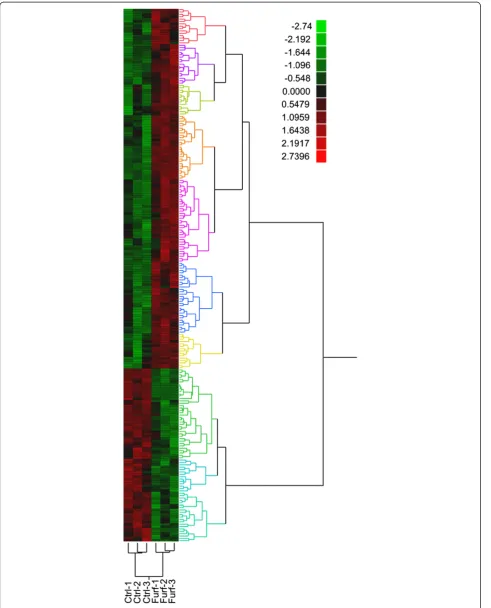
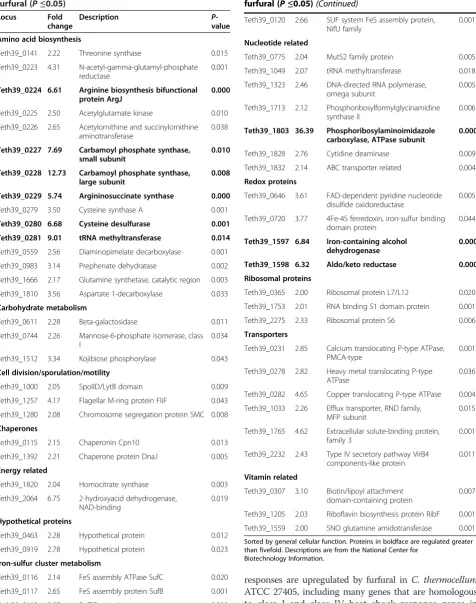
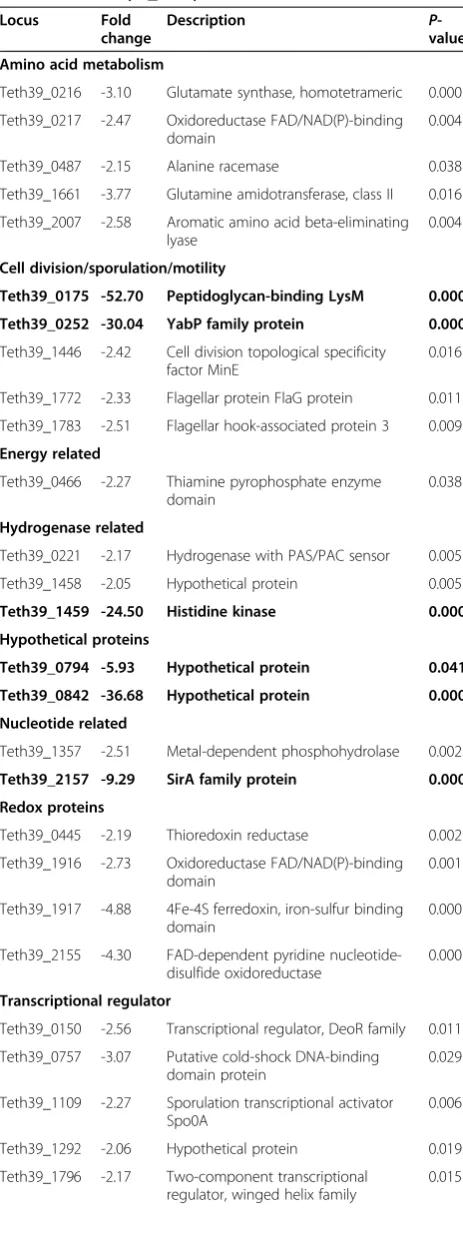
cultures were grown in parallel either in the presence or absence (control) of furfural and harvested at 8 h after inoculation, which corresponded to the time interval necessary for complete reduction of furfural to furfuryl alcohol (Figure 2A). Peptide samples were prepared and analyzed as described in the Methods section. The mass spectrometry proteomics data have been deposited to the ProteomeXchange Consortium [41] via the PRIDE partner repository with the dataset identifier PXD001446. The complete proteomics dataset and statistical analysis are also provided in Additional file 1: Table S1, which includes an in-table, color-coded heat map corresponding to Figure 4. In total, 1,294 proteins were identified across both condi-tions with roughly 300,000 spectra (SpC) assigned to con-stituent peptides. Of the 1,294 proteins, only 918 passed the 99% SpC cutoff and were moved to the ANOVA ana-lysis. Using a P-value cutoff of 0.05, 225 proteins were found to be differentially expressed with 152 upregulated in furfural treated cells versus 73 downregulated. Culling this list even further, only 87 proteins exhibited a twofold or greater change in abundance in either direction. Of these, 54 were upregulated in the presence of furfural (Table 2) and 33 were downregulated (Table 3). Significantly regulated proteins were grouped into 11 clusters based on abundance pattern across all replicates (Figure 4). Many cellular functions were affected by furfural, with the most highly downregulated proteins involved in cell wall biosyn-thesis or sporulation. Hydrogenase-related proteins were also downregulated, along with several redox proteins predicted to use NAD(P)H. Upregulated proteins fell into 12 general cellular functions, with those regulated fivefold or higher falling into three categories: polar amino acid bio-synthesis (arginine, cysteine), nucleotide metabolism, and redox proteins.
Energy production and carbohydrate metabolism
Comparatively, the proteomic response ofT. pseudethanoli-cus 39E to furfural showed similarities at the functional level to the responses ofC. thermocellum, as well asS. cere-visiaeandE. coli. While central carbon metabolism did not appear to be significantly impacted by furfural inT. pseu-dethanolicus 39E, upregulated carbohydrate-related pro-teins included beta-galactosidase, mannose-6-phosphate isomerase, and kojibiose phosphorylase, while dihydroxy-acetone kinase and two fructose-specific, phosphoenol -pyruvate-dependent sugar phosphotransferase system transport proteins were downregulated. Genes involved in energy production and conversion, as well as carbohydrate
transport and metabolism, were also regulated inC. ther-mocellum ATCC 27405 [37]. Acetate kinase and phos-phoacetyltransferase were both downregulated, though this is likely a general stress response rather than furfural-specific. As inT. pseudethanolicus39E, beta-galactosidase was upregulated in C. thermocellum ATCC 27405 upon furfural exposure, as were several glycosyl transferase family proteins, though the reason for this regulation is unclear. On the other hand, central carbon metabolism is significantly upregulated in both the S. cerevisiae and E. coliresponse to furfural. In anaerobicS. cerevisiae fermen-tations, an 8 g/L furfural treatment repressed the synthesis of enzymes involved in glucose catabolism and the tricarb-oxylic acid (TCA) cycle. Conversely, addition of 17 g/L furfural to an aerobic S. cerevisiae culture increased expression of proteins involved in glycolysis and the TCA cycle, while repressing expression of proteins involved in glycerol and ethanol production [42]. Analysis of a single-gene disruption library of S. cerevisiae BY4741 against growth with furfural identified several genes in the pen-tose phosphate pathway as important in furfural tolerance [39], especially ZWF1, whose overexpression allowed for growth with 50 mM furfural. In an ethanologenic strain of E. coli (LY180), a moderate furfural challenge (0.5 g/L) perturbed the expression of about 400 genes at least twofold, 15 min after exposure, with central carbon and energy metabolism being among the pathways regulated [22]. It is interesting to note that central carbon metabol-ism is significantly regulated in the mesophilicS. cerevisiae and E. coliand is much less affected in the thermophilic C. thermocellumandT. pseudethanolicus, though the rea-son for this difference remains unclear.
Stress response
With 15 mM furfural,T. pseudethanolicus39E did not dis-play a typical stress phenotype indicated by a reduced growth rate. Nevertheless, some functions associated with stress were differentially regulated. The expression of eight predicted transporters was affected by furfural, including upregulation of three metal transporters and one efflux transporter. A variety of nucleotide-related genes were also upregulated, including two de novo purine biosynthesis genes (Teth39_1713 and Teth39_1803) and two genes involved in nucleoside degradation (Teth39_1828 and Teth39_1832). Additionally, Teth39_1216, predicted to be involved in isoprenoid biosynthesis, and Teth39_0175, pre-dicted to function in cell wall turnover, are downregulated in response to furfural. Similarly, a number of stress (See figure on previous page.)
responses are upregulated by furfural in C. thermocellum ATCC 27405, including many genes that are homologous to class I and class IV heat shock response genes in Bacillus subtilis, though these genes were also upregulated by heat [37] and ethanol treatment [43]. A number of Table 2 Proteins upregulated twofold or more by 15 mM
furfural (P≤0.05)
Locus Fold change
Description P
-value
Amino acid biosynthesis
Teth39_0141 2.22 Threonine synthase 0.015
Teth39_0223 4.31 N-acetyl-gamma-glutamyl-phosphate reductase
0.001
Teth39_0224 6.61 Arginine biosynthesis bifunctional protein ArgJ
0.000
Teth39_0225 2.50 Acetylglutamate kinase 0.010
Teth39_0226 2.65 Acetylornithine and succinylornithine aminotransferase
0.038
Teth39_0227 7.69 Carbamoyl phosphate synthase, small subunit
0.010
Teth39_0228 12.73 Carbamoyl phosphate synthase, large subunit
0.008
Teth39_0229 5.74 Argininosuccinate synthase 0.000
Teth39_0279 3.50 Cysteine synthase A 0.001
Teth39_0280 6.68 Cysteine desulfurase 0.001
Teth39_0281 9.01 tRNA methyltransferase 0.014
Teth39_0559 2.56 Diaminopimelate decarboxylase 0.001
Teth39_0983 3.14 Prephenate dehydratase 0.002
Teth39_1666 2.17 Glutamine synthetase, catalytic region 0.003
Teth39_1810 3.56 Aspartate 1-decarboxylase 0.033
Carbohydrate metabolism
Teth39_0611 2.28 Beta-galactosidase 0.011
Teth39_0744 2.26 Mannose-6-phosphate isomerase, class I
0.034
Teth39_1512 3.34 Kojibiose phosphorylase 0.043
Cell division/sporulation/motility
Teth39_1000 2.05 SpoIID/LytB domain 0.009
Teth39_1257 4.17 Flagellar M-ring protein FliF 0.043
Teth39_1280 2.08 Chromosome segregation protein SMC 0.008
Chaperones
Teth39_0115 2.15 Chaperonin Cpn10 0.013
Teth39_1392 2.21 Chaperone protein DnaJ 0.005
Energy related
Teth39_1820 2.04 Homocitrate synthase 0.003
Teth39_2064 6.75 2-hydroxyacid dehydrogenase, NAD-binding
0.019
Hypothetical proteins
Teth39_0463 2.28 Hypothetical protein 0.012
Teth39_0919 2.78 Hypothetical protein 0.023
Iron-sulfur cluster metabolism
Teth39_0116 2.14 FeS assembly ATPase SufC 0.020
Teth39_0117 2.65 FeS assembly protein SufB 0.001
Teth39_0118 2.97 SufBD protein 0.000
Table 2 Proteins upregulated twofold or more by 15 mM furfural (P≤0.05)(Continued)
Teth39_0120 2.66 SUF system FeS assembly protein, NifU family
0.001
Nucleotide related
Teth39_0775 2.04 MutS2 family protein 0.005
Teth39_1049 2.07 tRNA methyltransferase 0.018
Teth39_1323 2.46 DNA-directed RNA polymerase, omega subunit
0.005
Teth39_1713 2.12 Phosphoribosylformylglycinamidine synthase II
0.006
Teth39_1803 36.39 Phosphoribosylaminoimidazole carboxylase, ATPase subunit
0.000
Teth39_1828 2.76 Cytidine deaminase 0.009
Teth39_1832 2.14 ABC transporter related 0.004
Redox proteins
Teth39_0646 3.61 FAD-dependent pyridine nucleotide disulfide oxidoreductase
0.005
Teth39_0720 3.77 4Fe-4S ferredoxin, iron-sulfur binding domain protein
0.044
Teth39_1597 6.84 Iron-containing alcohol dehydrogenase
0.000
Teth39_1598 6.32 Aldo/keto reductase 0.000
Ribosomal proteins
Teth39_0365 2.00 Ribosomal protein L7/L12 0.020
Teth39_1753 2.01 RNA binding S1 domain protein 0.001
Teth39_2275 2.33 Ribosomal protein S6 0.006
Transporters
Teth39_0231 2.85 Calcium translocating P-type ATPase, PMCA-type
0.001
Teth39_0278 2.82 Heavy metal translocating P-type ATPase
0.036
Teth39_0282 4.65 Copper translocating P-type ATPase 0.004
Teth39_1033 2.26 Efflux transporter, RND family, MFP subunit
0.015
Teth39_1765 4.62 Extracellular solute-binding protein, family 3
0.001
Teth39_2232 2.43 Type IV secretory pathway VirB4 components-like protein
0.011
Vitamin related
Teth39_0307 3.10 Biotin/lipoyl attachment domain-containing protein
0.007
Teth39_1205 2.03 Riboflavin biosynthesis protein RibF 0.001
Teth39_1559 2.00 SNO glutamine amidotransferase 0.001
Sorted by general cellular function. Proteins in boldface are regulated greater than fivefold. Descriptions are from the National Center for
uncharacterized transporters were also regulated, as well as genes involved in transcription, RNA processing and modification, chromatin structure and dynamics, and DNA replication, recombination, and repair. InS. cerevi-siae, stress responses upregulated by furfural include os-motic and salt stress, DNA damage, and pH stress [40].S. cerevisiae also responds to furan aldehydes by regulating cell adaptation and survival processes, especially with re-spect to drug resistance, transport, and cell membrane composition [38]. InE. coliLY180, transport functions, as well as cell structure, DNA, and lipid synthesis functions are also regulated by furfural [22]. A general stress re-sponse to furfural thus appears to include upregulation of transport functions and nucleotide metabolism.
Amino acid metabolism
In T. pseudethanolicus 39E grown with 15 mM furfural, both cysteine and arginine biosynthetic genes were upreg-ulated (cysteine synthase A, Teth39_0279; cysteine desul-furase, Teth39_0280; arginine biosynthesis, Teth39_0223-0229). Amino acid metabolism is also affected by furfural stress in C. thermocellum, S. cerevisiae,and E. coli. InC. thermocellum ATCC 27405, arginine biosynthetic genes are upregulated upon furfural addition [37]. While sulfur amino acid biosynthesis is not directly regulated, genes involved in sulfate transport and sulfur assimilation are upregulated by furfural. InS. cerevisiae, proteins involved in sulfur amino acid biosynthesis are downregulated upon exposure to 8 g/L furfural under anaerobic conditions [40]. InE. coliLY180, 0.5 g/L furfural also repressed genes involved in arginine biosynthesis, but induced expression of sulfur-containing amino acid biosynthetic genes [22]. This is due to a decrease in NADPH availability, which is instead used by the aldehyde reductases YqhD and DkgA Table 3 Proteins downregulated twofold or more by
15 mM furfural (P≤0.05)
Locus Fold change
Description P
-value
Amino acid metabolism
Teth39_0216 -3.10 Glutamate synthase, homotetrameric 0.000
Teth39_0217 -2.47 Oxidoreductase FAD/NAD(P)-binding domain
0.004
Teth39_0487 -2.15 Alanine racemase 0.038
Teth39_1661 -3.77 Glutamine amidotransferase, class II 0.016
Teth39_2007 -2.58 Aromatic amino acid beta-eliminating lyase
0.004
Cell division/sporulation/motility
Teth39_0175 -52.70 Peptidoglycan-binding LysM 0.000
Teth39_0252 -30.04 YabP family protein 0.000
Teth39_1446 -2.42 Cell division topological specificity factor MinE
0.016
Teth39_1772 -2.33 Flagellar protein FlaG protein 0.011
Teth39_1783 -2.51 Flagellar hook-associated protein 3 0.009
Energy related
Teth39_0466 -2.27 Thiamine pyrophosphate enzyme domain
0.038
Hydrogenase related
Teth39_0221 -2.17 Hydrogenase with PAS/PAC sensor 0.005
Teth39_1458 -2.05 Hypothetical protein 0.005
Teth39_1459 -24.50 Histidine kinase 0.000
Hypothetical proteins
Teth39_0794 -5.93 Hypothetical protein 0.041
Teth39_0842 -36.68 Hypothetical protein 0.000
Nucleotide related
Teth39_1357 -2.51 Metal-dependent phosphohydrolase 0.002
Teth39_2157 -9.29 SirA family protein 0.000
Redox proteins
Teth39_0445 -2.19 Thioredoxin reductase 0.002
Teth39_1916 -2.73 Oxidoreductase FAD/NAD(P)-binding domain
0.001
Teth39_1917 -4.88 4Fe-4S ferredoxin, iron-sulfur binding domain
0.000
Teth39_2155 -4.30 FAD-dependent pyridine nucleotide-disulfide oxidoreductase
0.000
Transcriptional regulator
Teth39_0150 -2.56 Transcriptional regulator, DeoR family 0.011
Teth39_0757 -3.07 Putative cold-shock DNA-binding domain protein
0.029
Teth39_1109 -2.27 Sporulation transcriptional activator Spo0A
0.006
Teth39_1292 -2.06 Hypothetical protein 0.019
Teth39_1796 -2.17 Two-component transcriptional regulator, winged helix family
0.015
Table 3 Proteins downregulated twofold or more by 15 mM furfural (P≤0.05)(Continued)
Transporters
Teth39_0333 -2.98 PTS system, fructose subfamily, IIC subunit
0.001
Teth39_0334 -2.90 PTS system, fructose-specific, IIB subunit
0.019
Vitamin related
Teth39_0787 -4.71 Lipoic acid synthetase 0.033
Other
Teth39_0542 -2.43 Dihydroxyacetone kinase, DhaK subunit
0.006
Teth39_1065 -2.21 HAD superfamily (subfamily IIIA) phosphatase, TIGR01668
0.024
Teth39_1216 -2.04 1-hydroxy-2-methyl-2-(E)-butenyl 4-diphosphate synthase
0.011
for furfural reduction [22]. Upregulation of cysteine bio-synthetic pathways in T. pseudethanolicus 39E suggests that, as in E. coli, increased expression of NAD(P)H-dependent aldehyde reductases (described below) may decrease NADPH availability for sulfur amino acid biosynthesis.
Redox metabolism
Six alcohol dehydrogenases (ADHs) identified in T. pseudethanolicus 39E were differentially regulated. The three functionally characterized ADHs [36,44], AdhA
(Teth39_0220), AdhB (Teth39_0218), and AdhE
(Teth39_0206), were all downregulated (P <0.05); how-ever, none more than twofold (AdhA 1.27-fold, AdhB 1.81-fold, and AdhE 1.59-fold). Of the other three identified alcohol dehydrogenases inT. pseudethanolicus 39E (Teth39_0878, Teth39_1597, Teth39_1979), only Teth39_1597 was significantly upregulated (6.8-fold; P <0.001). Another oxidoreductase upregulated byT. pseu-dethanolicus39E in response to furfural is Teth39_1598 (6.3-fold; P <0.001). These genes potentially encode en-zymes involved in reducing furfural and 5-HMF and will be discussed in more detail below. In C. thermocellum ATCC 27405, the bifunctional alcohol/aldehyde de-hydrogenase Cthe_0423 and the redox regulator Rex (Cthe_0422) were downregulated upon furfural addition [37]. No other alcohol dehydrogenase or aldehyde reduc-tase was differentially regulated; however, a putative carbon monoxide dehydrogenase (Cthe_0281) was up-regulated by furfural and may play a role in redox balance in C. thermocellum ATCC 27405 [37]. In S. cerevisiae, NAD(P)H-dependent aldehyde reductases or alcohol dehydrogenases (ADH) have also been shown to affect furan aldehyde tolerance [45] and be regulated by furan aldehydes [40]. Transcriptomic expression analysis of known reductase and dehydrogenase genes showed that ADH2was highly expressed in hydrolysate-tolerant S. cerevisiaestrain TMB3000 compared to the wild-type CBS8066 and was also induced by 5-HMF [45]. In a proteomic analysis of the response of S. cerevisiae to 17 g/L furfural, six ADHs showed differential regulation, with Adh1p, Adh5p, and Adh6p upregulated, Adh2p and Sfa1p downregulated, and Adh4p unregulated by furfural [42]. Adh6p and Adh7p have furfural and 5-HMF reduc-tase activity, with the former using both NADH and NADPH and the latter only NADH [46]. In E. coli LY180, energy functional groups are also highly regu-lated [22]. As in S. cerevisiae, NADPH-dependent alde-hyde reductases with furfural reducing capacity are upregulated, namelyyqhDanddkgA.
Enzyme cloning and activity measurements
Teth39_1597 [GenBank GeneID:5874751] shares 36% identity/54% similarity with yqhD from E. coli LY180
[22]. Teth39_1597 belongs to the Fe-dependent alcohol dehydrogenase superfamily (pfam00465) with predicted butanol dehydrogenase activity (BDH, cd08187). The gene product appears to be a close homolog of BdhA in Thermoanaerobacter mathranii(88% identity/94% simi-larity), which has been experimentally verified to have BDH activity [47]. Thus, Teth39_1597 is considered to be a butanol dehydrogenase and will be referred to as Teth39bdhA. Teth39_1598 [GenBank GeneID:5874752] has 27% identity/41% similarity to dkgA from E. coli LY180, another enzyme shown to have NADPH-dependent furfural reductase activity [22]. Teth39_1598 is a predicted aldo/keto oxidoreductase and will be re-ferred to as Teth39akr.
Since both Teth39bdhA and Teth39 akrwere signifi-cantly upregulated in response to furfural and are homo-logs to similarly upregulated E. coli genes yqhD and dkgA, further biochemical characterization was per-formed to determine their cofactor and substrate speci-ficities. The coding regions for Teth39bdhAand Teth39 akr were PCR amplified from T. pseudethanolicus 39E genomic DNA and cloned into pET-30a behind a T7-lac promoter and N-terminal 6xHis- and S-tags. Overex-pression plasmids, as well as the pET-30a plasmid alone, were transformed into E. coli BL21 (DE3) and Teth39 BdhA and Teth39 AKR were overexpressed (Figure 5). Whole cell lysates were prepared and assayed for alde-hyde reductase activity aerobically at 60°C with acetalde-hyde, furfural, and 5-HMF. Furfural was also assayed under anaerobic conditions. Teth39 BdhA and Teth39 AKR activities were compared to the vector-only control (Table 4). Neither enzyme showed any activity with NADH as cofactor. Teth39 AKR had minimal activity with both furan aldehydes using NADPH as the cofactor, but not above the vector control. In contrast, Teth39 BdhA showed activity above the vector control using NADPH as the cofactor with both furan aldehydes. The specific activity was 4.97 ± 0.17 U with furfural and 10.06 ± 0.80 U with 5-HMF.
downregulated (Teth39_0216, Teth39_0217, Teth39_1916), perhaps to increase NADPH availability for furfural reduc-tion. Thus, while overexpression of Teth39 BdhA alone may increase furan aldehyde tolerance, coexpression of other genes may be required to achieve the phenotype overall.
Teth39 BdhA and Teth39 AKR also exhibited butyralde-hyde and isobutyraldebutyralde-hyde reduction activity (Table 4), presumably forming butanol and isobutanol, with the Teth39 BdhA activity 2.7-fold higher than that of Teth39 AKR with isobutyraldehyde and 44.2-fold higher with bu-tyraldehyde. Expression of Teth39bdhA might therefore alternatively be used to biologically produce these higher energy fuel compounds in thermophilic microbes.
Conclusions
Inhibitors, such as furfural and 5-HMF, are generated from common pretreatment methods used for improving the reactivity of lignocellulosic biomass toward enzymatic solubilization. The physiological response and tolerance to these inhibitors must be understood in order to develop
improved microorganisms such as C. thermocellum or a Caldicellulosiruptor sp. for thermophilic consolidated bioprocessing of biomass. We measured rapid growth in the presence of 10 to 15 mM furan aldehydes and their detoxification in situ by a thermophilic anaerobe, T. pseudethanolicus39E. Physiological effects resulting from higher furfural and 5-HMF concentrations included decreased ethanol yield with increases in acetate and lactate production from glucose. A bottom-up proteomics approach was applied to screen for potential enzymes or pathways directly involved in furan aldehyde detoxifica-tion. While a number of cellular functions were impacted, including a decrease in expression of ADHs involved in ethanol production, an ADH encoded by Teth39_1597 was upregulated nearly sevenfold in the presence of 15 mM furfural. The enzyme, a putative butanol dehydro-genase, was cloned and overexpressed in E. coli and displayed NADPH-dependent activity against furfural and 5-HMF, suggesting a direct role in detoxifying furan alde-hyde inhibitorsin situ.
Methods
Growth experiments
Thermoanaerobacter pseudethanolicus39E (DSMZ 2355) was purchased from Deutsche Sammlung von Mikroorga-nismen und Zellkulturen GmbH (DSMZ, Braunschweig, Germany). All chemicals were purchased from Sigma-Aldrich (St. Louis, MO) unless otherwise indicated. The anaerobic growth medium was prepared using a modified Hungate technique [48] and consisted of 4.5 mM KCl, 4.7 mM NH4Cl, 2.5 mM MgSO4 ∙7H2O, 1.0 mM NaCl,
0.7 mM CaCl2 ∙2H2O, 0.25 mg/mL resazurin, 2.8 mM
cysteine-HCl, 6.0 mM NaHCO3, 1 mM potassium
phos-phate buffer (pH 6.8), 10 mM 3-(N-morpholino)propane-sulfonic acid (pH 6.8), 1x Wolfe’s trace minerals [49], 1× Wolfe’s vitamin supplement [49], 0.1% (w/v) yeast extract (Fisher Scientific, Pittsburgh, PA), and 40 mM glucose. Furan aldehydes were added from degassed concentrated stock solutions. Cultures were grown at 65°C from a 1% inoculum in Balch tubes (10 mL) or 125-mL serum bottles Figure 5Overexpression of Teth39_1597 and Teth39_1598 in
Escherichia coli.Teth39_1597 (48.4 kDa) and Teth39_1598 (42.1 kDa) were cloned fromT. pseudethanolicusinto pET-30a and overexpressed from a T7 promoter after induction with IPTG. Overexpression was determined in whole cell extract by Coomassie-stained SDS-PAGE.
Table 4 Specific activity (μmol/min/mg protein) of putative T. pseudethanolicus39E aldehyde reductases
Vector control Teth39 BdhA Teth39 AKR
Furfural 0.33 ± 0.13 4.97 ± 0.17 0.27 ± 0.04
5-Hydroxymethylfurfural 0.44 ± 0.16 10.06 ± 0.80 0.39 ± 0.07
Acetaldehyde 0.02 ± 0.15 4.54 ± 0.76 0.02 ± 0.01
Butyraldehyde 0.09 ± 0.05 14.58 ± 3.57 0.33 ± 0.04
Isobutyraldehyde −0.10 ± 0.21 0.63 ± 0.29 0.23 ± 0.05
(50 mL). Cell growth was monitored by optical density at 600 nm, either directly in the Balch tube using a Spectronic 200 spectrophotometer (Thermo Fisher Scientific, Waltham, MA) or as 200-μL samples transferred to a 96-well plate and read on a Synergy Mx plate reader (BioTek, Winooski, VT). All growth experiments were performed in triplicate.
Small molecule measurement
Glucose, lactate, acetate, and ethanol were measured via HPLC as previously described using an HPX-87H column (Bio-Rad Laboratories, Hercules, CA) at 60°C with detec-tion via refractive index and 5 mM H2SO4as the mobile
phase [50]. Furfural and 5-HMF were measured spectro-photometrically (DU 800, Beckman Coulter, Brea, CA) at 304 and 323 nm, respectively, and concentrations were determined using standard curves generated in growth medium. 2,5-furandimethanol was measured using gas chromatography-mass spectrometry (GC-MS) following trimethylsilylation, with an Agilent 5975C standard quad-rupole GC-MS using electron impact ionization (970 eV), as described previously [51].
Proteomic analysis: sample preparation
Cell pellets (10 to 50 mg) from cultures grown for 8 h (early stationary phase) with and without 15 mM furfural were frozen at -80°C prior to preparation. The thawed pellets were resuspended in 1 mL lysis buffer (4% SDS, 100 mM Tris-HCl pH 8.0, 50 mM dithiothreitol) and boiled for 5 min. Samples were then pulse-sonicated (10 s on, 10 s off) for 2 min with an ultrasonic disruptor (Branson, Danbury, CT) at 20% amplitude. The samples were boiled again for 5 min, cleared by centrifugation (21,000 × g, 10 min, RT), and immediately precipitated with 20% trichloroacetic acid overnight at -20°C. Precipitated proteins were washed twice with ice-cold acetone, air dried, and re-suspended in 8 M urea in 100 mM Tris-HCl, pH 8.0. The samples were sonicated as before and incubated for 30 min at room temperature (RT). Samples were adjusted to 10 mM dithiothreitol (10 min, RT) and then 10 mM iodoa-cetamide (10 min, RT, in the dark) to both reduce and block cysteine residues. Sample aliquots containing about 1.5 mg of crude protein were diluted 1:1 (v/v) with 100 mM Tris-HCl, pH 8.0 and 20 mM CaCl2and digested
with sequencing-grade trypsin (Promega, San Luis Obispo, CA) at a 1:75 (w/w) enzyme:protein ratio (16 h, RT). The samples were again diluted 1:1 (v/v) and digested with a second aliquot of trypsin (1:75; w/w) for an additional 4 h. Following digestion, each sample was adjusted to 200 mM NaCl and 0.1% formic acid and filtered through a 10-kDa cutoff spin column filter (Vivaspin 2, GE Healthcare, Pittsburgh, PA). The peptide-enriched flow-through was then quantified by the bicinchoninic acid assay.
Proteomic analysis: measurement of peptides by two-dimensional liquid chromatography-tandem mass spectrometry (LC-MS/MS)
For each sample, 100 μg of peptides were bomb-loaded onto a biphasic MudPIT back column [52] packed with about 5 cm of strong cation exchange (SCX) resin for charge-based separation of peptides followed by about 3 cm C18 reversed phase (RP) for online desalting (Luna and Aqua respectively, Phenomenex, Torrance, CA). Once loaded, the sample columns were washed offline with solvent A (5% acetonitrile, 95% HPLC-grade water, 0.1% formic acid) for 15 min, followed by a gradient to 100% solvent B (70% acetonitrile, 30% HPLC-grade water, 0.1% formic acid) over 30 min. The washed samples were then placed in-line with an in-house pulled nanospray emitter (100-μm inner diameter) packed with 15 cm of C18 RP material and analyzed via 24-h MudPIT two-dimensional LC-MS/MS (eleven salt pulses: 5, 7.5, 10, 12.5, 15, 17.5, 20, 25, 35, 50, 100% of 500 mM ammonium acetate followed by a 100-min gradient to 50% solvent B) with an LTQ XL mass spectrometer (Thermo Fisher Scientific) op-erating in data-dependent mode. A total of three biological replicate measurements were obtained for each sample.
Proteomic analysis: MS data analysis and evaluation Acquired MS/MS spectra were assigned to specific pep-tide sequences using the SEQUEST search algorithm [53] with a FASTA proteome database specific toT. pseudetha-nolicus. The database contained common contaminant protein entries as well as reversed decoy sequences to as-sess protein-level false discovery rates. SEQUEST-scored peptide sequence data were filtered and assembled into protein loci using DTASelect [54] with the following con-servative criteria: XCorr: +1 = 1.8, +2 = 2.5, +3 = 3.5, DeltCN 0.08, and two peptides per protein identification with at least one required to be unique.
dataset so that 99% of the total raw SpC assigned to each (summed across all replicates and conditions) remained.
These remaining proteins were log2 transformed, and statistically assessed by ANOVA with JMP Genomics ver. 4.1 (SAS Institute, Cary, NC) to identify proteins in the furfural treated samples that were significantly (P ≤0.05) up- or downregulated relative to the control. These differ-entially expressed proteins were then hierarchically clus-tered based on their abundance patterns across all replicates and conditions using the“Fast Ward”algorithm. To remove differences based on raw magnitude differ-ences in nSpC, each protein’s abundance was standardized to represent the number of standard deviations away from the row mean.
Aldehyde reductase cloning and overexpression
T. pseudethanolicus genomic DNA was isolated using the Wizard Genomic DNA Purification kit (Promega, Madison, WI). Teth39_1597 and Teth39_1598 were PCR amplified using Phusion Polymerase (New England Biolabs, Ipswich, MA), cloned into pET-30a (EMD Millipore, Billerica, MA) behind 6xHis- and S-tags, and the final constructs were sequence verified (University of Tennessee, Knoxville, Molecular Biology Resource Facility). Expression plasmids were transformed in BL21 (DE3)Escherichia coli according to the manufacturer’s protocol (Invitrogen, Grand Island, NY). Cells were grown in 50 mL 2×YT medium at 37°C to OD600 of 0.8-1.0, then induced with
100 μM isopropyl-β-D-thiogalactopyranoside (IPTG) and switched to 30°C for 16 h. Cells were harvested at 4°C (3,000 × g, 30 min), washed in 50 mL 100 mM sodium phosphate buffer, pH 7 (buffer A), and resuspended in 5 mL buffer A. The cell suspension (450μL) was added to 0.1 mm zirconia beads (300μL) and vortexed 4 × 60 s with 30 s on ice in between. The samples were centrifuged (14,000 ×g, 2 min), and the resulting supernatant was used for enzyme assays.
Enyzme assays
Thein vitroaldehyde reductase activity was measured as previously described [23] in 100 mM sodium phosphate buffer (pH 7) with 0.2 mM NAD(P)H and 20 mM sub-strate. The assay mix was added to a sealed 2-mL quartz cuvette and equilibrated to 60°C. Assays were read at 340 nm (DU 800) for 150 s to establish a baseline slope before whole cell lysate was added (1 to 5 μL). The cu-vettes were inverted once to mix and read an additional 450 s. The decrease in absorbance over time was calculated and the baseline slope was subtracted. The NAD(P)H con-centration was determined using the extinction coefficient (NADH: 6,220 M-1 cm-1, NADPH: 6,270 M-1 cm-1), and the specific activity was calculated as the change in μmol NAD(P)H/min/mg of whole cell lysate protein. Protein concentration was determined using the Bradford assay
(Bio-Rad, Hercules, CA) with bovine serum albumin as a standard. The specific activity was measured for the pET-30a vector (control) and overexpressed Teth39_1597 and Teth39_1598 with acetaldehyde, butyraldehyde, isobutyral-dehyde, furfural, and 5-HMF.
Additional file
Additional file 1: Table S1.Description of data. Proteomics data file for 225 proteins that were differentially regulated in response to a 15 mM furfural treatment. Color-coded hierarchical cluster analysis, cluster number, cluster order, average nSpC per condition, fold change, andP-value are provided for all replicates. The raw output for all detected proteins and statistical analyses are also included.
Abbreviations
5-HMF:5-hydroxymethylfurfural; ADH: alcohol dehydrogenase; AKR: Aldo/ keto reductase; ANOVA: analysis of variance; BDH: butanol dehydrogenase; CBP: consolidated bioprocessing; GC-MS: gas chromatography-mass spec-trometry; HPLC: high performance liquid chromatography; IPTG: isopropyl-β -D-thiogalactopyranoside; LC-MS: liquid chromatography-mass spectrometry; nSpC: normalized spectral counts; OD: optical density; RP: reverse phase; SpC: spectral counts; TCA: tricarboxylic acid.
Competing interests
The authors declare that they have no competing interests.
Authors’contributions
SMC, SDH-B, and JGE conceived and designed the study; SMC, SDH-B, and JGE performed growth experiments; SMC measured furan aldehydes; SMC and JGE performed HPLC analyses; SDH-B prepared samples for proteomic analysis; RJG and RLH performed proteomic experiments and statistical analyses; NLE and TJT performed GC-MS quantifications; SMC performed cloning and enzyme activity assays; SMC, RJG, and JGE analyzed the data and wrote the manuscript. All authors read and approved the final manuscript.
Acknowledgements
We thank Sarah Kaufmann for laboratory assistance and Adam M. Guss for providing helpful comments on the manuscript. This work was supported by the BioEnergy Science Center (BESC), which is a U.S. Department of Energy Bioenergy Research Center supported by the Office of Biological and Environmental Research in the DOE Office of Science, Oak Ridge National Laboratory. Oak Ridge National Laboratory is managed by UT-Battelle, LLC, for the U.S. Department of Energy under contract DE-AC05-00OR22725. This manuscript has been authored by UT-Battelle, LLC, under Contract DE-AC05-00OR22725 with the U.S. Department of Energy. The United States Government retains, and the publisher by accepting the article for publication acknowledges, that the United States Government retains a non-exclusive, paid-up, irrevocable, worldwide license to publish or reproduce the published form of this manuscript, or allow others to do so, for United States Government purposes.
Author details
1BioEnergy Science Center, Oak Ridge National Laboratory, Oak Ridge, TN
37831-6341, USA.2Biosciences Division, Oak Ridge National Laboratory, Oak Ridge, TN 37831-6341, USA.3Chemical Sciences Division, Oak Ridge National
Laboratory, Oak Ridge, TN 37831-6341, USA.4Current address: Division of Earth and Ecosystem Sciences, Desert Research Institute, Las Vegas, NV, USA.
Received: 28 August 2014 Accepted: 7 November 2014
References
2. Taylor MP, Eley KL, Martin S, Tuffin MI, Burton SG, Cowan DA:Thermophilic ethanologenesis: future prospects for second-generation bioethanol production.Trends Biotechnol2009,27:398–405.
3. Lynd LR, Weimer PJ, van Zyl WH, Pretorius IS:Microbial cellulose utilization: fundamentals and biotechnology.Microbiol Mol Biol Rev2002,66:739–739. 4. Chung D, Cha M, Guss AM, Westpheling J:Direct conversion of plant
biomass to ethanol by engineeredCaldicellulosiruptor bescii.Proc Natl Acad Sci USA2014,111:8931–8936.
5. Bayer E, Shoham Y, Lamed R:Cellulose-decomposing bacteria and their enzyme systems.InThe Prokaryotes. Volume 2. Part 1.Edited by Dworkin M, Falkow S, Rosenberg E, Schleifer K-H, Stackebrandt E. New York: Springer; 2006:578–617.
6. Lynd LR, Laser MS, Brandsby D, Dale BE, Davison B, Hamilton R, Himmel M, Keller M, McMillan JD, Sheehan, Wyman CE:How biotech can transform biofuels.Nat Biotechnol2008,26:169–172.
7. Olson DG, McBride JE, Shaw AJ, Lynd LR:Recent progress in consolidated bioprocessing.Curr Opin Biotech2012,23:396–405.
8. Alvira P, Tomas-Pejo E, Ballesteros M, Negro MJ:Pretreatment technologies for an efficient bioethanol production process based on enzymatic hydrolysis: a review.Bioresour Technol2010,101:4851–4861. 9. Hendriks A, Zeeman G:Pretreatments to enhance the digestibility of
lignocellulosic biomass.Bioresour Technol2009,100:10–18.
10. Klinke HB, Thomsen AB, Ahring BK:Inhibition of ethanol-producing yeast and bacteria by degradation products produced during pre-treatment of biomass.Appl Microbiol Biotechnol2004,66:10–26.
11. Almarsdottir AR, Sigurbjornsdottir MA, Orlygsson J:Effect of various factors on ethanol yields from lignocellulosic biomass by
ThermoanaerobacteriumAK17.Biotechnol Bioeng2012,109:686–694. 12. Zaldivar J, Martinez A, Ingram LO:Effect of selected aldehydes on the
growth and fermentation of ethanologenicEscherichia coli.Biotechnol Bioeng1999,65:24–33.
13. Zaldivar J, Martinez A, Ingram LO:Effect of alcohol compounds found in hemicellulose hydrolysate on the growth and fermentation of ethanologenicEscherichia coli.Biotechnol Bioeng2000,68:524–530. 14. Martinez A, Rodriguez ME, York SW, Preston JF, Ingram LO:Effects of Ca
(OH)2treatments ("overliming") on the composition and toxicity of
bagasse hemicellulose hydrolysates.Biotechnol Bioeng2000,69:526–536. 15. Shaw AJ, Podkaminer KK, Desai SG, Bardsley JS, Rogers SR, Thorne PG, Hogsett DA, Lynd LR:Metabolic engineering of a thermophilic bacterium to produce ethanol at high yield.Proc Natl Acad Sci USA2008,105:13769–13774. 16. Shao XJ, Raman B, Zhu MJ, Mielenz JR, Brown SD, Guss AM, Lynd LR:
Mutant selection and phenotypic and genetic characterization of ethanol-tolerant strains ofClostridium thermocellum.Appl Microbiol Biot
2011,92:641–652.
17. Brown SD, Guss AM, Karpinets TV, Parks JM, Smolin N, Yang SH, Land ML, Klingeman DM, Bhandiwad A, Rodriguez M, Raman B, Shao XJ, Mielenz JR, Smith JC, Keller M, Lynd LR:Mutant alcohol dehydrogenase leads to improved ethanol tolerance inClostridium thermocellum.Proc Natl Acad Sci USA2011,108:13752–13757.
18. Liu ZL, Blaschek HP:Biomass conversion inhibitors andin situ detoxification.InBiomass to Biofuels: Strategies for Global Industries.Edited by Vertès AA, Oureshi A, Blaschek HP, Yukawa H. West Sussex, United Kingdom: Wiley; 2010:233–259.
19. Liu ZL:Molecular mechanisms of yeast tolerance andin situ detoxification of lignocellulose hydrolysates.Appl Microbiol Biotechnol
2011,90:809–825.
20. Jonsson LJ, Alriksson B, Nilvebrant N-O:Bioconversion of lignocellulose: inhibitors and detoxification.Biotechnol Biofuels2013,6:16.
21. Mills TY, Sandoval NR, Gill RT:Cellulosic hydrolysate toxicity and tolerance mechanisms inEscherichia coli.Biotechnol Biofuels2009,2:26.
22. Miller EN, Jarboe LR, Turner PC, Pharkya P, Yomano LP, York SW, Nunn D, Shanmugam KT, Ingram LO:Furfural inhibits growth by limiting sulfur assimilation in ethanologenicEscherichia colistrain LY180.Appl Environ Microbiol2009,75:6132–6141.
23. Miller EN, Jarboe LR, Yomano LP, York SW, Shanmugam KT, Ingram LO:
Silencing of NADPH-dependent oxidoreductase genes (yqhDanddkgA) in furfural-resistant ethanologenicEscherichia coli.Appl Environ Microbiol
2009,75:4315–4323.
24. Ahring BK, Licht D, Schmidt AS, Sommer P, Thomsen AB:Production of ethanol from wet oxidised wheat straw byThermoanaerobacter mathranii.Bioresour Technol1999,68:3–9.
25. Georgieva TI, Ahring BK:Evaluation of continuous ethanol fermentation of dilute-acid corn stover hydrolysate using thermophilic anaerobic bacteriumThermoanaerobacterBG1L1.Appl Microbiol Biotechnol2007,
77:61–68.
26. Yao S, Mikkelsen MJ:Metabolic engineering to improve ethanol production inThermoanaerobacter mathranii.Appl Microbiol Biotechnol
2010,88:199–208.
27. He Q, Hemme CL, Jiang HL, He ZL, Zhou JZ:Mechanisms of enhanced cellulosic bioethanol fermentation by co-cultivation ofClostridiumand Thermoanaerobacterspp.Bioresour Technol2011,102:9586–9592. 28. Onyenwoke RU, Kevbrin VV, Lysenko AM, Wiegel J:Thermoanaerobacter
pseudethanolicussp. nov., a thermophilic heterotrophic anaerobe from Yellowstone National Park.Int J Syst Evol Microbiol2007,57:2191–2193. 29. Bischoff KM, Liu SQ, Hughes SR, Rich JO:Fermentation of corn fiber
hydrolysate to lactic acid by the moderate thermophileBacillus coagulans.Biotechnol Lett2010,32:823–828.
30. de Vrije T, Bakker RR, Budde MAW, Lai MH, Mars AE, Claassen PAM:
Efficient hydrogen production from the lignocellulosic energy crop Miscanthusby the extreme thermophilic bacteriaCaldicellulosiruptor saccharolyticusandThermotoga neapolitana.Biotechnol Biofuels2009,2:12. 31. Cao GL, Ren NQ, Wang AJ, Guo WQ, Xu JF, Liu BF:Effect of
lignocellulose-derived inhibitors on growth and hydrogen production by Thermoanaerobacterium thermosaccharolyticumW16.Int J Hydrogen Energy2010,35:13475–13480.
32. Delgenes JP, Moletta R, Navarro JM:Effects of lignocellulose degradation products on ethanol fermentations of glucose and xylose by
Saccharomyces cerevisiae,Zymomonas mobilis,Pichia stipitis, andCandida shehatae.Enzyme Microb Technol1996,19:220–225.
33. Banerjee N, Bhatnagar R, Viswanathan L:Inhibition of glycolysis by furfural in Saccharomyces cerevisiae.Eur J Appl Microbiol Biotechnol1981,11:226–228. 34. Hemme CL, Fields MW, He Q, Deng Y, Lin L, Tu QC, Mouttaki H, Zhou AF,
Feng XY, Zuo Z, Ramsay BD, He Z, Wu L, Van Nostrand J, Xu J, Tang YJ, Wiegel J, Phelps TJ, Zhou J:Correlation of genomic and physiological traits ofThermoanaerobacterspecies with biofuel yields.Appl Environ Microbiol2011,77:7998–8008.
35. Burdette DS, Vieille C, Zeikus JG:Cloning and expression of the gene encoding theThermoanaerobacter ethanolicus39E secondary-alcohol dehydrogenase and biochemical characterization of the enzyme.
Biochem J1996,316:115–122.
36. Burdette D, Zeikus JG:Purification of acetaldehyde dehydrogenase and alcohol dehydrogenases fromThermoanaerobacter ethanolicus39E and characterization of the secondary-alcohol dehydrogenase (2° Adh) as a bifunctional alcohol-dehydrogenase acetyl-CoA reductive thioesterase.
Biochem J1994,302:163–170.
37. Wilson CM, Yang S, Rodriguez M Jr, Ma Q, Johnson CM, Dice L, Xu Y, Brown SD:Clostridium thermocellumtranscriptomic profiles after exposure to furfural or heat stress.Biotechnol Biofuels2013,6:131.
38. Ma M, Liu ZL:Comparative transcriptome profiling analyses during the lag phase uncover YAP1, PDR1, PDR3, RPN4, and HSF1 as key regulatory genes in genomic adaptation to the lignocellulose derived inhibitor HMF forSaccharomyces cerevisiae.BMC Genomics2010,11:660. 39. Gorsich SW, Dien BS, Nichols NN, Slininger PJ, Liu ZL, Skory CD:Tolerance
to furfural-induced stress is associated with pentose phosphate pathway genes ZWF1, GND1, RPE1, and TKL1 inSaccharomyces cerevisiae.Appl Microbiol Biotechnol2006,71:339–349.
40. Lin F-M, Tan Y, Yuan YJ:Temporal quantitative proteomics ofSaccharomyces cerevisiaein response to a nonlethal concentration of furfural.Proteomics
2009,9:5471–5483.
41. Vizcaíno JA, Deutsch EW, Wang R, Csordas A, Reisinger F, Ríos D, Dianes JA, Sun Z, Farrah T, Bandeira N, Binz PA, Xenarios I, Eisenacher M, Mayer G, Gatto L, Campos A, Chalkley RJ, Kraus HJ, Albar JP, Martinez-Bartolomé S, Apweiler R, Omenn GS, Martens L, Jones AR, Hermjakob H: ProteomeX-change provides globally coordinated proteomics data submission and dissemination.Nature Biotechnol2014,30:223–226.
42. Lin FM, Qiao B, Yuan YJ:Comparative proteomic analysis of tolerance and adaptation of ethanologenicSaccharomyces cerevisiaeto furfural, a lignocellulosic inhibitory compound.Appl Environ Microbiol2009,75:3765–3776. 43. Yang S, Giannone RJ, Dice L, Yang ZK, Engle NL, Tschaplinski TJ, Hettich RL,
Brown SD:Clostridium thermocellumATCC27405 transcriptomic, metabolomic and proteomic profiles after ethanol stress.BMC Genomics
44. Peng H, Wu G, Shao W:The aldehyde/alcohol dehydrogenase (AdhE) in relation to the ethanol formation inThermoanaerobacter ethanolicus JW200.Anaerobe2008,14:125–127.
45. Petersson A, Almeida JRM, Modig T, Karhumaa K, Hahn-Hagerdal B, Gorwa-Grauslund MF, Liden G:A 5-hydroxymethyl furfural reducing enzyme encoded by theSaccharomyces cerevisiaeADH6 gene conveys HMF tolerance.Yeast2006,23:455–464.
46. Liu ZL, Moon J, Andersh BJ, Slininger PJ, Weber S:Multiple gene-mediated NAD(P)H-dependent aldehyde reduction is a mechanism ofin situ detoxification of furfural and 5-hydroxymethylfurfural bySaccharomyces cerevisiae.Appl Microbiol Biotechnol2008,81:743–753.
47. Yao S, Mikkelsen MJ:Identification and overexpression of a bifunctional aldehyde/alcohol dehydrogenase responsible for ethanol production in Thermoanaerobacter mathranii.J Mol Microbiol Biotechnol2010,19:123–133. 48. Miller TL, Wolin MJ:A serum bottle modification of the Hungate technique
for cultivating obligate anaerobes.Appl Microbiol1974,27:985–987. 49. Wolin EA, Wolin MJ, Wolfe RS:Formation of methane by bacterial extracts.
J Biol Chem1963,238:2882–2886.
50. Hamilton-Brehm SD, Mosher JJ, Vishnivetskaya T, Podar M, Carroll S, Allman S, Phelps TJ, Keller M, Elkins JG:Caldicellulosiruptor obsidiansissp nov., an anaerobic, extremely thermophilic, cellulolytic bacterium isolated from Obsidian Pool, Yellowstone National Park.Appl Environ Microbiol2010,
76:1014–1020.
51. Li YC, Tschaplinski TJ, Engle NL, Hamilton CY, Rodriguez M, Liao JC, Schadt CW, Guss AM, Yang YF, Graham DE:Combined inactivation of the Clostridium cellulolyticumlactate and malate dehydrogenase genes substantially increases ethanol yield from cellulose and switchgrass fermentations.Biotechnol Biofuels2012,5:2.
52. McDonald WH, Ohi R, Miyamoto DT, Mitchison TJ, Yates JR:Comparison of three directly coupled HPLC MS/MS strategies for identification of proteins from complex mixtures: single-dimension LC-MS/MS, 2-phase MudPIT, and 3-phase MudPIT.Int J Mass Spectrom2002,219:245–251. 53. Eng JK, McCormack AL, Yates JR:An approach to correlate tandem
mass-spectral data of peptides with amino-acid-sequences in a protein database.J Am Soc Mass Spectrom1994,5:976–989. 54. Tabb DL, McDonald WH, Yates JR:DTASelect and Contrast: tools for
assembling and comparing protein identifications from shotgun proteomics.J Proteome Res2002,1:21–26.
55. Giannone RJ, Huber H, Karpinets T, Heimerl T, Kuper U, Rachel R, Keller M, Hettich RL, Podar M:Proteomic characterization of cellular and molecular processes that enable theNanoarchaeum equitans-Ignicoccus hospitalis relationship.PLoS One2011,6:e22942.
56. Lochner A, Giannone RJ, Keller M, Antranikian G, Graham DE, Hettich RL:
Label-free quantitative proteomics for the extremely thermophilic bacteriumCaldicellulosiruptor obsidiansisreveal distinct abundance patterns upon growth on cellobiose, crystalline cellulose, and switchgrass.J Proteome Res2011,10:5302–5314.
57. Zybailov B, Mosley AL, Sardiu ME, Coleman MK, Florens L, Washburn MP:
Statistical analysis of membrane proteome expression changes in Saccharomyces cerevisiae.J Proteome Res2006,5:2339–2347. doi:10.1186/s13068-014-0165-z
Cite this article as:Clarksonet al.:A comparative multidimensional LC-MS proteomic analysis reveals mechanisms for furan aldehyde detoxification inThermoanaerobacter pseudethanolicus39E.Biotechnology for Biofuels
20147:165.
Submit your next manuscript to BioMed Central and take full advantage of:
• Convenient online submission
• Thorough peer review
• No space constraints or color figure charges
• Immediate publication on acceptance
• Inclusion in PubMed, CAS, Scopus and Google Scholar
• Research which is freely available for redistribution