DOI: 10.30954/0974-1712.03.2019.8
©2019 New Delhi Publishers. All rights reserved
A Study on Content Analysis of ICT Enabled Web Portal
(Krishinet)
Vinod Singh* and V.L.V. Kameswari
Department of Agriculture Communication, G.B.P.U.A & T. Pantnagar, Uttarakhand, India *Corresponding author: [email protected] (ORCID ID: 0000-0003-0748-5883)
Paper No. 764 Received: 03-09-2018 Accepted: 14-01-2019
ABSTRACT
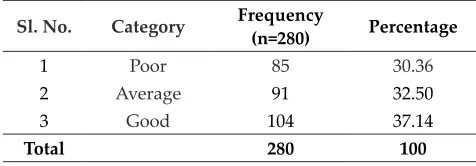
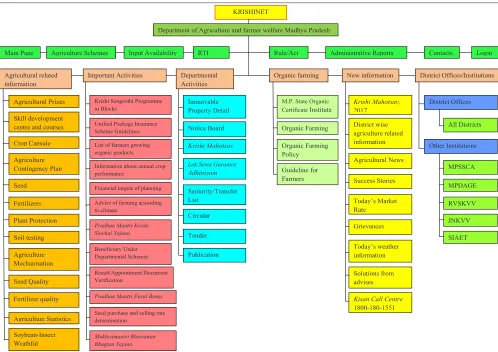
This research evaluates a web-based ICT enabled portal (Krishinet) on the basis of practical application of farmers in the study area. In this study we use quantitative approach for analysis. It includes three major parts, first content inventory, in this the entire content of the portal was catalogued, second content audit, in this quantitative method was used and it was found that 37.14 percent respondents felt that the content of the Krishinet portal was good, followed by 32.50 percent respondents felt that the portal was of average quality and only 30.36 percent respondents felt that the portal was of poor quality and the third part was content mapping, in which linear type of content mapping was done in which head content of single segment was presented in coloured rectangular boxes and subhead segment were presented in different coloured boxes with links to each other.
Highlights
mThis paper address the importance of content of Information Communication and Technology initiative in agriculture.
mThis research paper also address the problems felt by farmers in using such type of portal, which is specially designed for use in agriculture.
Keywords: Content analysis, information communication technology, web portal Today people around the globe are accessing
internet for day to day affairs such as inter-personal communication (e-mail), search of desired information, search of jobs, access to e-journals, academic organizations etc. Hence the presence of internet became mandatory for all sectors/fields and all the sectors/fields have understood the importance of their own portal or Website which would reflect all the activities of the concerned area. Some organizations and institutions are designing and developing their own specialized portal or Web sites. It has been observed that despite the effort made by the in house expert or outside agency, most of the Websites or portals are not updated regularly. At the same time the quality of content and information of the Websites or portal are also not up to the mark (Bhattacharjee et al. 2006). The Krishinet portal site might be able to function as fulfilling the gap between farmers and
technology in short we can say as on time and good information source and address a number of problems in the existing provision of extension services and information services in the field of agriculture (Palmer, Katherine 1999). It is a greater responsibility on the part of Krishinet portal managers as a portal content managers in the internet world to be more meticulous in providing the information on the Krishinet portal sites keeping in view of the user community. In this context here an attempt has been made to evaluate the content Krishinet portal. Krishnet is an ICT based project to provide information to farmers in their local (Hindi) language for improving their living standards by increasing their income from farming.
Krishinet project mainly targets farming community,
agriculture related agencies, agriculture related
societies, NGOs, trainings centres, students, research
workers, Agricultural Universities and Krishi Vigyan
48
Print ISSN : 1974-1712
Kendras, traders, processing industry, government departments, extension workers and policy makers.
Portal also ensures that every farmer has an easy and round the clock access to all possible relevant information at the door-step and farmers and field level workers equipped with advance information on weather, anticipated pest problems, probable market trends to minimize the risk and optimize the returns. Portal also provide information on various departmental schemes and programs. It ensures effective monitoring and evaluation of departmental schemes and programmes. Portal develops realistic actual demand estimation system for accessing requirement of agricultural inputs from village level, to ensure their quality and timely distribution. Portal reduces the time, cost and energy spent by farming community for registering and tracking their application status. It optimizes the use of available human resource spread through the out state by introducing employee management system. Keeping all the things in mind the present study has been undertaken to analysis the content of Krishinet portal.
Research Methodology
The present study was purposively conducted in Jabalpur, patan, sihora and panagar block of Jabalpur district of Madhya Pradesh to evaluate the content of Krishinet portal. Total 280 farmers were selected for the present study to simple random sampling by using chit method. Eight percent farmers from the registered list of users from the selected blocks were chosen for the study. In this study, quantitative method of content analysis was used. This consisted of mainly three parts:
(i) Content inventory: In this part researcher catalogued the entire contents of the website.
(ii) Content audit: In this part researcher evaluates
content elements and information assets of a website. In present study, the researcher developed a scale comprising of 22 statements which was used for content audit. Respondents opinion about Krishinet portal was categorised into three types positive, neutral and negative based on the total score obtained.
(iii) Content mapping: In present study, linear type
of content mapping was done in which contents heads of single segment were presented in coloured
rectangular type boxes and subhead segments were
presented in white boxes with links to each other.
RESULTS AND DISCUSSION
Content analysis is the analysis of texts of various types including written documents, images, recordings and cultural artifacts. Content analysis includes both qualitative and quantitative approaches. Content of KRISHINET portal consisted of three parts:
(i) Content inventory: It is the process of cataloguing the entire content of the portal. (ii) Content audit: It is the process of evaluating
content elements and information assets of the portal. In this study quantitative method for evaluating the content of the portal was used.
(iii) Content mapping: It is a visual technique that helps in organizing and understanding the content of a website.
(i) Content Inventory: The entire content of a KRISHINET Portal was divided into twelve major parts:
1. Agriculture Related Information
(a) Agriculture Prizes: This section provides information related to prizes that were awarded to the Government of Madhya Pradesh in the area of agriculture.
(b) Skill development centre and course curriculum: This section provides information related to skill development centers and different courses which were being offered in different agricultural training centers. (c) Crop capsules: This section provides
(d) Agriculture contingency plan: This part provides information about the agricultural plan prepared by the government for farmers for any type of contingency situation such as late or early monsoon, heavy rainfall, drought, etc.
(e) Seed: This section provides information about the importance of seed, type of seeds, seed treatment, seed rate, seed quality and detail information about Madhya Pradesh Seed Certification Institute.
(f) Fertilizers: This section provides information about fertilizer management in major crops of rabi and kharif seasons. It also provides information about quantity and method of application of fertilizers at different stages of growth.
(g) Plant protection: This unit provides information on insect management, disease management and integrated pest management of rabi and kharif crops with photographs. (h) Soil testing: Information in this section
mainly pertains to need for soil testing, aim of soil testing, how to collect soil sample, detailed information about soil health card, soil testing fees and contact information about soil testing laboratories in the area. (i) Agriculture mechanization: The section
on agriculture mechanization provides information on latest agricultural equipment such as cleaners, separators, cultivators with photographs. Information about characteristics of particular equipment and their uses has also been provided.
(j) Seed quality: This part has information about laws, rules and regulations for maintaining the quality of seed and information on how to produce high quality seeds.
(k) Fertilizer quality: This section provides information about laboratories which have been established for checking the quality of fertilizers and gives details about procedures for testing the quality of fertilizers.
(l) Agriculture statistics: District wise information about yield of different rabi and kharif crops has been provided here. It also provides information about cropping pattern in Madhya Pradesh, district wise fertilizer
consumption, land use classification, district wise number, area and size of operational land holdings, crop wise irrigated area, livestock in Madhya Pradesh and rainfall distribution.
2. District Offices and Institutes
This component has two types of information. The first part covers district offices and provides district wise information about agricultural planning,market price, success stories and agricultural service centers. Through this section, farmers can register their mobile number, name and village name to get all agricultural information on time. The second section gives information about various institutes viz; Madhya Pradesh Seed Certification Agency, Madhya Pradesh Directorate of Agricultural Engineering and Rajmata Vijayaraje Scindhiya Krishi Vishwavidyalaya, Gwalior.
3. Organic Farming
This section provides general information on organic farming, benefits of organic farming, important organic fertilizers and pesticides for organic farming, types of organic fertilizers, method of preparing organic fertilizers and controlling pests using organic fertilizers. It also gives information about organic farming policy of the government of Madhya Pradesh.
4. Departmental Activities
This section contains a wide variety of information-related to the Department of Agriculture, Government of Madhya Pradesh.
(a) Krishi Mahotsav: Krishi Mahotsav was started by Government of Madhya Pradesh in 2005 for doubling the farmers’ income using an innovative approach. This section provides the daily schedule of this programme in different districts of the state.
(b) Seniority list of employee: Information about list of employees, promoted employees, transferred employees, permanent employees and retired employees of all classes was given in this section.
50
Print ISSN : 1974-1712
(d) Publication: Information about latest publications of the Department of Agriculture, Government of Madhya Pradesh related to new initiative, new schemes, vision and workshop, etc. are given under this section. (e) Krishi Calendar: This section provides
information about monthly planning of Government of Madhya Pradesh regarding agricultural practices.
5. Agriculture Planning
Under this section, information has been provided about all agricultural planning of the Government of Madhya Pradesh. Through this, farmers can apply online for any scheme and they can also download application forms for various schemes.
6. Availability of Seeds/Fertilisers
The section on seeds and fertilizers provides information about their availability and prices from different companies in different districts.
7. Right to Information
This section provides full information about duties of all the officers of the department. This content also provides information about how and where to make appeal for any type of information.
8. Rules and Regulations
This section provides information on all the Acts and Guidelines of Government of Madhya Pradesh related to fertilizers, pesticides, seeds and sugarcane.
9. Government Report
All the reports of Department of Agriculture, Government of Madhya Pradesh are available in this section.
10. Contact
This section provides latest information about full address, designation, contact number (office and home), email and fax number of all the officers of the Department of Agriculture.
11. Login
Through this section, staff can login by using password given by the department.
12. Important Activities
A variety of information was covered under this
head and it include:
(a) List of farmers producing organic products: This section provides year wise list of organic products grown by farmers. This content also provides, district wise, tehsil wise and village wise information about farmers with their contact number and product details.
(b) Manual on Agriculture Law: This section provides information about Central Government and State Government Laws pertaining to agricultural products such as grading, marketing, etc.
(c) Information Technology Investment Policy 2014: Information about Rules and Guidelines for promoting Information Technology in Madhya Pradesh in all the sectors has been given in this unit.
(d) Mukhya Mantri Khet Tirth Yojana Guidelines: This section provides information about aim, working area, place selection, administrative arrangement, content of the scheme, financial arrangement, strategy, target determination, coordinating partners, target group, selection of beneficiaries and monitoring and evaluation of the scheme. (e) Rainfall and sowing situation: Under this
information has been provided on district wise data on rainfall, sowing target and actual sowing in a particular year.
(f) List of beneficiaries under departmental schemes: This section provides last five years data on all the farmers who were beneficiaries of Government schemes. (g) Financial target of planning: This section
provides information about district wise fund allotment under all government schemes for the current financial year.
(h) Result/appointment/proof of documents: This section provides detailed information about new departmental appointments through special process. This content also provides detailed information about the candidate such as name, address, grade, post, etc.
(j) Agriculture Minister’s message: Through this section people can access the latest message of Agricultural Minister’s of the state to the farmers.
(k) Photo Gallery: This content provides information about insect and crop management, agriculture mechanisation, herbicide use, seed treatment, etc. through photographs.
(l) Video Gallery: Through this section people can access instructional videos on different agricultural practices and schemes.
(m) Krishi Samachar: This section provides access to agricultural information published in news papers. This content also provides information about upcoming agricultural events in all the districts of Madhya Pradesh. (n) Success stories: This content provides
detailed information about farmers who were benefitted by any scheme and the progress made by them. This content also provides details of that particular scheme, name of the village and block, total area and irrigated area.
(o) Today’s market rate: This section provides information about daily market rate of cereals, pulses, oilseed, fruits and vegetables. (p) Today’s weather information: Under this
information has been provided on daily weather information in all the districts of Madhya Pradesh such as maximum and minimum temperature and rainfall data. (q) Your Complaints/ Grievances: Through this
section people can lodge complains online and get redressal.
(r) Kisan call centre: This section provides the contact number of Kisan Call Centre i.e. 18001801551 along with a free of cost tag line to inform farmers about this free service.
(ii) Content Audit
Content audit is a complete and comprehensive accounting of portal content. For content audit of Krishinet Portal a scale was developed by the researcher. The scale comprised of 22 statements (13 positive and 9 negative) and was used for content audit of the portal. The scale was administered to
the farmers of the study area and the response were collected.
Table 1: Distribution of respondents based on their evaluation of Krishinet portal
Sl. No. Category Frequency (n=280) Percentage
1 Poor 85 30.36
2 Average 91 32.50
3 Good 104 37.14
Total 280 100
It was found that maximum number of the farmers (37.14%) felt the content of the Krishinet portal was good. They were of the opinion that the content was well organized, it saved time, had relevant information and helped them to reach contact the relevant department or officers. It was seen that 32.50 percent of the farmers felt that the portal was of average quality. The farmers who fell under this category were the ones who had not used all the features of the portal. This was either due to low internet speed or lack of requirement. Results of the farmers’ responses are given in Table 2.
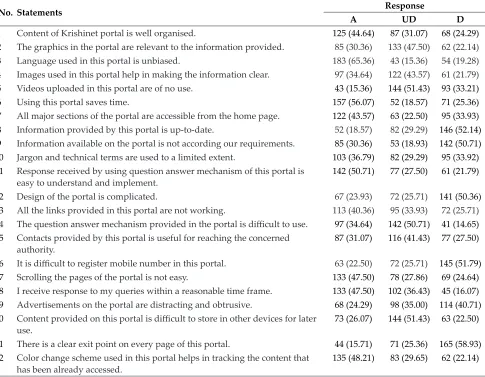
1. Content of Krishinet portal is well organized: According to responses received from the respondents, it was found that maximum number of respondents (44.64%) felt that the content of Krishinet portal was well organised because they were able to find the information easily on the portal.
2. The graphics in the portal are relevant to the information provided: It was found that maximum numbers of respondents were undecided (47.50%) about relevance of the graphics because graphics were not located at proper place.
3. Language used in this portal is unbiased: It was found that majority of the respondents (65.35%) agreed with the statement because they found that language used in the portal is clear and very easy to understand.
52
Print ISSN : 1974-1712 of images.
5. Videos uploaded in this portal are of no use: It was found that majority of the respondents (51.42%) were undecided about the usefulness of uploaded videos as they were unable to watch or download the videos due to slow internet speed and unable to download the video.
6. Using this portal saves time: Majority of the respondents (56.07%) agreed with the statement because they feel that using Krishinet portal saves their time as it acts as a single platform for farmers to access all agricultural related information.
7. All major sections of the portal are accessible from the home page: It was found that maximum number of the respondents
(43.57%) felt that they were able to access all major sections from the home page because portal had all icons in its main page with different colors.
8. Information provided by this portal is up-to-date: Majority of the respondents (52.14%) felt that the portal was not up-to-date because information was not updated on time (such as market information, new varieties and any disease control measures).
9. Information available on the portal is not according our requirements: It was found that half of the respondents (50.71%) disagreed with this statement because they felt that information available on the portal was according to their requirements and they applied it in their field.
Table 2: Distribution of farmers’ responses to content audit of Krishinet portal
Sl. No. Statements Response
A UD D
1 Content of Krishinet portal is well organised. 125 (44.64) 87 (31.07) 68 (24.29) 2 The graphics in the portal are relevant to the information provided. 85 (30.36) 133 (47.50) 62 (22.14)
3 Language used in this portal is unbiased. 183 (65.36) 43 (15.36) 54 (19.28)
4 Images used in this portal help in making the information clear. 97 (34.64) 122 (43.57) 61 (21.79) 5 Videos uploaded in this portal are of no use. 43 (15.36) 144 (51.43) 93 (33.21)
6 Using this portal saves time. 157 (56.07) 52 (18.57) 71 (25.36)
7 All major sections of the portal are accessible from the home page. 122 (43.57) 63 (22.50) 95 (33.93) 8 Information provided by this portal is up-to-date. 52 (18.57) 82 (29.29) 146 (52.14) 9 Information available on the portal is not according our requirements. 85 (30.36) 53 (18.93) 142 (50.71) 10 Jargon and technical terms are used to a limited extent. 103 (36.79) 82 (29.29) 95 (33.92) 11 Response received by using question answer mechanism of this portal is
easy to understand and implement. 142 (50.71) 77 (27.50) 61 (21.79)
12 Design of the portal is complicated. 67 (23.93) 72 (25.71) 141 (50.36)
13 All the links provided in this portal are not working. 113 (40.36) 95 (33.93) 72 (25.71) 14 The question answer mechanism provided in the portal is difficult to use. 97 (34.64) 142 (50.71) 41 (14.65) 15 Contacts provided by this portal is useful for reaching the concerned
authority. 87 (31.07) 116 (41.43) 77 (27.50)
16 It is difficult to register mobile number in this portal. 63 (22.50) 72 (25.71) 145 (51.79) 17 Scrolling the pages of the portal is not easy. 133 (47.50) 78 (27.86) 69 (24.64) 18 I receive response to my queries within a reasonable time frame. 133 (47.50) 102 (36.43) 45 (16.07) 19 Advertisements on the portal are distracting and obtrusive. 68 (24.29) 98 (35.00) 114 (40.71) 20 Content provided on this portal is difficult to store in other devices for later
use. 73 (26.07) 144 (51.43) 63 (22.50)
21 There is a clear exit point on every page of this portal. 44 (15.71) 71 (25.36) 165 (58.93) 22 Color change scheme used in this portal helps in tracking the content that
has been already accessed. 135 (48.21) 83 (29.65) 62 (22.14)
10. Jargon and technical terms are used to a limited extent: It was found that maximum number of the respondents (36.78%) felt that jargon and technical terms were used in portal to a limited extent because portal used very simple language and made minimum use of scientific words.
11. Response received by using question answer mechanism of this portal is easy to understand and implement: It was found that, half of the respondents (50.71%) felt that the response received by using question answer mechanism of the portal was easy to understand and implement because they found that response was quick and useful. 12. Design of the portal is complicated: It was
found that half of the respondents (50.36%) disagreed with the statement as they were satisfied with the design of the portal, 25.71 percent respondents were undecided and only 23.92 percent respondents felt that portal design was complicated and difficult to use.
13. All the links provided in this portal are not working: Data analysis indicate that maximum number of the respondents (40.35%) agreed with that statement and it was found that through the links provided in the portal to agricultural universities, seed certification centres and district offices, these links often yielded response such as ‘work in progress’ and ‘updated soon’. 14) The question answer mechanism provided in the portal is difficult to use: According to responses received from the farmers it was found that half of the respondents were undecided (50.71%) about that statement because they had not used this mechanism. 15. Contacts provided by this portal are useful
for reaching the concerned authority: According to responses received from the respondents, it was found that maximum number of the respondents were undecided (41.42%) about the statements because they had not used the contact information provided by the portal.
16. It is difficult to register mobile number in this portal: It was found that a little more than half of the respondents (51.78%) felt
that it was not difficult to register the mobile number on the portal because they were able to easily register their mobile number. 17. Scrolling the pages of the portal is not
easy: It was found that maximum number of respondents (47.50%) felt that scrolling the pages of the portal was difficult because scrolling tab was not properly visible and farmers were unable to handle the scrolling tab.
18. I receive response to my queries within a reasonable time frame: It was found that maximum number of the respondents (47.50%) felt that they received the response to their queries within reasonable time frame. 19. Advertisements on the portal are distracting
and obtrusive: It was found that maximum number of the respondents (40.71%) felt that advertisements on the portal were very specific and properly presented because portal had very low advertisements and they were very short and clear.
20. Content provided on this portal is difficult to store in other devices for later use: It was found that majority of the respondents (51.42%) were undecided because they had not transferred the data to other devices, 26.07 percent respondents felt that storing the content of the portal in other devices was not easy.
21. There is a clear exit point on every page of this portal: It was found that maximum number of the respondents (58.92%) felt that there was no clear exit point on every page of this portal because many pages did not have any exit icon.
22. Color change scheme used in this portal helps in tracking the content that has been already accessed: According to responses received from the respondents, it was found that maximum number of the respondents (48.21%) felt that color change scheme was very useful in tracking the content that has been already accessed.
(iii) Content Mapping
54
Print ISSN : 1974-1712
present study, linear type of content mapping was done in which head content of single segments was presented in colored rectangular boxes and subhead segments were presented in different colored boxes with links to each other. Content map of Krishinet portal is given in figure below (Fig. 1).
CONCLUSION
In present study, content management and usability of Krishinet portal have been examined. It was found that content of portal is well organized. The main criteria for quality of a portal can be summarized as unbiased language, time saving, all major sections are accessible from the home page, response received by using question answer mechanism is easy to understand and implement, all links are not working, difficult to register mobile number, design of the portal is good, no clear exit point on every page and quarries answered in a reasonable time frame. The best preparation for creating a portals or websites for farmers and
researchers in the field of agriculture to spend some time by surfing the similar portals. This activity will give the staff an indication of what works and what does not, what is interesting to the online visitor and what is not pleasant to use. The portal authority also needs to be identifying the skilled manpower and form a portal team who will be responsible to present such type of portal to the global community through WWW.
REFERENCES
Bhattacharjee et al. 2006. Quality control Issues for design, development and maintenance of Web sites. In Dynamic Interoperable Web based information systems. 4th International Convention CALIBER-2006, February 2-4, 2006: 13-22.
Palmer, Katherine. 1999. Signposts to information for community mental health works: A research project funded by the south and west health care libraries unit.
Bournemouth: Bournemouth university library and
information services. KRISHINET
Department of Agriculture and farmer welfare Madhya Pradesh
Main Page Agriculture Schemes Input Availability RTI Rule/Act Administrative Reports Contacts Login
Agricultural related
information Important Activities Departmental Activities Organic farming New information District Offices/Institutions
Agricultural Prizes
Skill development centre and courses
Crop Capsule
Agriculture Contingency Plan
Seed
Fertilizers
Plant Protection
Soil testing
Agriculture Mechanisation
Seed Quality
Fertilizer quality
Agriculture Statistics
Soybean-Insect Wrathful
Krishi Sangosthi Programme in Blocks
Unified Package Insurance Scheme Guidelines
List of farmers growing organic products
Information about annual crop performance
Financial targets of planning
Advise of farming according to climate
Pradhan Mantri Krishi Sinchai Yojana
Beneficiary Under Departmental Schemes
Result/Appointment/Document Verification
Pradhan Mantri Fasal Bema
Seed purchase and selling rate determination
Mukhyamantri Bhawantar Bhugtan Yajana
Immovable Property Detail
Notice Board
Krishi Mahotsav
Lok Sewa Gurantee Adhiniyam
Seniority/Transfer List
Circular
Tender
Publication
M.P. State Organic Certificate Institute
Organic Farming
Organic Farming Policy
Guideline for Farmers
Krishi Mahotsav, 2017 District wise agriculture related information
Agricultural News
Success Stories
Today’s Market Rate
Grievances
Today’s weather information
Solutions from advises
Kisan Call Centre 1800-180-1551
District Offices
All Districts
Other Institutions
MPSSCA
MPDAGE
RVSKVV
JNKVV
SIAET