Wireless Sensor Network: A Survey
Mr. Prabhat Singh Yadav1, Prof. Mrs. Priyanka Saxena2,
1,2 Department of Computer Science & Engineering,
Sagar Institute of Research & Technology, Bhopal, India
Abstract: Wireless sensor networks (WSNs) are be-coming popular research area from last few decades due to their various modern applications. With the recent technological growth in Internet of Things (IoT) and em-bedded electronics, the wireless sensors attracted these smart devices for rapid research and development. The increasing applications of wireless sensors in industries, smart cities and agricultures are presenting the challeng-ing ideas for future research. In this paper, we are sur-veying the modern energy efficient routing algorithms in wireless sensor networks. The energy efficiency is ma-jor concern for research because the sensors nodes are equipped with some limited low power battery backup. The battery recharge and replacements are not possible once the sensor networks are deployed and they work until the batteries of the nodes die out. This survey con-cludes along with future enhancement and improvement in the energy efficiency of wireless sensor networks.
Keywords: Wireless Sensor Network, Energy Efficient Routing, Clustering, Cluster Head, Base Station, Low Energy.
1
Introduction
A regular wireless sensor network (WSN) is considered as an particular variety of wireless ad hoc networks with reduced or no mobility. In WSN, sensor gather informa-tion about environmental phenomenon or the occurrence of events such as rise or drop in temperature [1][2]. Sen-sor networks are usually composed of “nodes”, it has a specific name that is “Sensor” because these nodes are furnished with automatic sensors [3]. A sensor node is a type of electro-mechanical device which converts a sensed attribute like temperature, humidity, pressure, vi-brations into a data pattern readout by the users [4]. In WSN, nodes are not mobile however, it is a category of adhoc networks. So in case of ad-hoc network, the mobil-ity characteristic is more. Data are inquired depending on bounded physical quantity in wireless sensor network.
A sensor node have transducer, an embedded processor with small memory unit and a wireless transceiver, all these devices run on the power supplied by an attached battery [5][6]. The modern wireless sensors nodes are electromechanical and they have been used today they are widely used in industry process control, healthcare applications, traffic control, home automation, environ-mental monitoring and battle field surveillance [7].
The microelectronic mechanical systems (MEMS) is a modern technology which improved and developed low-cost, small, power efficient and multi-functional sensor devices for WSN [8][9]. For military, industrial and scien-tific applications sensor nodes are positioned and linked through the Internet. The nodes basically sense phys-ical or environmental conditions like sound, humidity, light, temperature, radiation, motion, vibration, pres-sure etc [10]. The table 1 shows various sensor clas-sifications with examples. The modern networks are bi-directional, user can send control signal for sensor activity [11]. WSNs have specific properties such as node heterogeneity, denser level of node deployment, ca-pability to withstand polluted or harsh environmental conditions, severe energy, computation and storage con-straints, which represent much new technological ad-vancement in the development and application of WSNs [12][13].
The hundreds or thousands of “nodes” built a WSN, node is connected to one or more sensors. Each sensor node has main components: a microcontroller, a basic radio transceiver integrated with antenna or connection to an external antenna, an electronic circuit for interfac-ing with the sensors and an battery as one time power source [14][15]. The cost and size of the sensor depends on memory, power back up, bandwidth and processing speed [13]. Also cost of sensor nodes varies, depending on the applications, accuracy, functionality, range and com-plexity of the individual sensor nodes. The geographical topology of the WSNs vary from a simple star network topology to a complex multi-hop wireless mesh network. The data transmission technique between the hops of the
Table 1: Sensors Classifications with Examples
Type Examples
Humidity MEMS-based Humidity Sensors, Hygrometers, Capacitive and Resistive Sensors.
Temperature Thermocouples, Thermistors. Motion, Photo Sensors, Gyroscopes, Vibration Accelerometers.
Radiation Geiger–Mueller Counters, Ionization Detectors. Position GPS, Inclinometers,
Ultrasound-based Sensors, Infrared-based Sensors. Mechanical Piezo Resistive Cells, Strain
Gauges, Capacitive Diaphragms, Tactile Sensors.
Flow Anemometers, Mass Air Flow Sensors.
Pressure Barometers, Pressure Gauges, Ionization Gauges.
Chemical Infrared Gas Sensors, pH Sensors, Electrochemical Sensors.
Optical CCD Sensors, Photodiodes, Infrared Sensors,
Phototransistors.
Acoustic Piezoelectric Resonators, Microphones.
Electromagnetic Magnetometers, Hall-effect Sensors.
sensor network can be routing or flooding [16].
This paper provides a comprehensive survey and is-sues regarding energy efficiency and network lifetime of wireless sensor network. An exploratory analysis is pre-sented on energy efficient protocols and methods used in wireless sensor networks.
2
WSN System Model
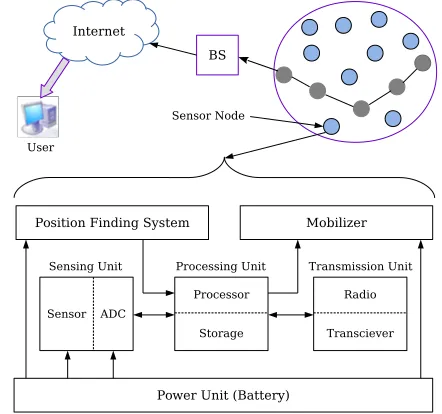
The hundreds or thousands of sensor nodes construct the sensor network to monitor and gain information about their environment. The functionalities such as sensing, processing, storing, location finding, data packet trans-mission, power consumption etc. are available in each of the nodes [17][18].
The major components of WSN are:
Sensor Node
Sensor Node is the main component of a WSN. It take multiple works in a network, like as simple sensing, pro-cessing, data storing, routing, path searching and data transmission.
Figure 1: Architecture of Wireless Sensor Network
Clusters
It is a group of sensor nodes. Normally sensor nodes are collected into clusters. Clusters are the organizational unit for WSNs. The cluster simplify the task of commu-nication by dividing the dense network into groups.
Cluster Head
Cluster heads (CHs) are the group leader of a cluster. All sensor node send their data to the cluster head within a cluster. CHs are required to organize activities in the cluster. These tasks include data-aggregation and orga-nizing the communication schedule of a cluster. Cluster head directly communicates with the base station.
Base Station
End User
It is the user or observer of the WSN. The sensed data in a wireless sensor network can be used for various appli-cations. Therefore, a general application may make use of the network data over the internet, using a Laptop, PDA, a desktop computer. In a basic queried sensor net-work where the required data is collected from a query sent through the network which is produced by the end user.
The structural model of sensor network is shown in figure 1. Transmission unit, sensing unit, processing unit, and power unit (battery) are the four major in-gredients of sensor nodes assigned with dissimilar jobs. To detect the physical environment, sensing unit is used and reports the CPU to compute or process and store the sensed data. Transmission unit is tasked to accept the information from CPU and convey it to the cluster head or base station. Power unit regulate battery power to sensor node [14].
Due to various characteristics that distinguish WSNs from other kind of wireless networks like mobile ad hoc networks (MANET) or cellular networks, routing in WSN is major challenging task [19]. These include very dense deployment of sensor nodes, significant redundancy of data, limited bandwidth and limited power of transmis-sion.
3
Survey
of
Clustering
Based
Routing Algorithms
A comprehensive survey on energy optimizing protocols [20] based on their classifications is presented in this sec-tion. The main objective of this survey is how to de-sign an effective and energy optimizing protocol in order to improve the networks lifetime for many application specific environments because the sensor nodes are con-strained to one time battery power resources itself which is very limited, so [21].
The main classifications of routing protocols are:
• Data Centric Protocols.
• Hierarchical Based Routing Protocol (Clustering).
• Location-Based Routing Protocol (Geographic).
• Network Flow and QoS Aware Protocol.
These are the network structure dependent protocols in WSNs. In this survey, only some prominent hierarchical routing protocols such as LEACH [22], PEGASIS [23], H-PEGASIS [24], SEP [25], ESEP [26], TEEN [27] and APTEEN [28] are discussed as shown in Table 2.
Table 2: Categories of Routing Protocols
Category Representative Protocols
Hierarchical LEACH, PEGASIS, H-PEGASIS, Protocols SEP, ESEP, TEEN & APTEEN.
Hierarchical-Based (Clustering) Protocols:
Hierarchical-Based routing [29] is used for point-to-point routing with minimum routing state. It has certain ad-vantage of scalability and efficient data packet transmis-sion. Hierarchical routing [30] maintains the power con-sumption of sensor nodes and performs data aggregation for helping in minimizing the number of transmitted data packets to the base station. The whole wireless sensor network is divided into a number of clusters in term with the specific rules [31][32]. Some hierarchical protocols are discussed here.
3.1
LEACH
LEACH (Low-Energy Adaptive Clustering Hierarchy) [22] is the first hierarchical-based routing protocol. When-ever, the sensor node in the WSN breaks down or its battery power becomes low then LEACH [22] protocol is used in the network. In LEACH, [22] wireless sensor nodes are grouped into local clusters and its cluster mem-bers elect their cluster head (CH) to keep off extra en-ergy consumption by sensor nodes and incorporate data aggregation which minimizes the amount of data packet sent to the base station, to enhance the life time of the network. Therefore this protocol has an effect in the context of energy saving.
Two-Level Hierarchy LEACH (TL-LEACH) [33] is an improved form of the LEACH protocol which has of two levels of cluster heads called primary and secondary, in place of a single cluster head. The advantage of two-level structure of TL-LEACH is that it minimizes the amount of sensor nodes that transmit data packets to the base station, effectively reducing the total energy consumption [33].
Cross-Layer protocol based on LEACH (CL-LEACH) [34] is based on LEACH for energy conservation of clus-tered WSNs. CL-LEACH especially in he application with a large and aparse monitoring region and remote sink node. The cross-layer design is a mostly-used tech-nique for improving energy conservation and network performance.
3.2
PEGASIS and H–PEGASIS
is an improved modification over LEACH. PEAGSIS [13] designs a node chain whenever sensor nodes are deployed randomly in the environment then each sensor node com-municates only with its nearer neighbor, take its turns and transmit data packet to the base station, so it de-creases the amount of energy consumption per round.
PEGASIS [23] performs better than LEACH [22] by elimination of taking dynamic cluster formation scheme, since data packet transmission is asynchronous, the trans-mission time will be very long. Hierarchical-PEGASIS [24] makes a further improvement, it allows simultane-ous data packet transmission when the nodes are not adjacent.
As compared to LEACH [22], the two protocols elim-inate the overhead of cluster formation, but both of them do not analyze the energy condition of next hop into consideration while choosing a routing path, for heavy-loaded network, they are not applicable. For large quan-tity of sensor nodes in WSNs, the delay of data packet communication is larger, so they are not appropriate and unsuitable for sensor networks where global identifica-tion is difficult to obtain.
3.3
TEEN
TEEN [27] (Threshold Sensitive Energy Efficient Sensor Network) protocol and it was first developed for reac-tive routing networks. It is mostly applied in temper-ature sensing application. TEEN [27] is based on hi-erarchical clustering which separates the sensor nodes twice for clustering for detecting the sudden variations in the sensed data such as temperature. After the clus-ters formation, TEEN [27] divides the cluster head (CH) into the second-level cluster head and uses “Hard” and “Soft” threshold values to detect the sudden variations. Hard threshold minimizes the number of packet trans-missions by providing the sensor nodes to transmit packet only when the sensed data value is in the high range of consideration. The soft threshold minimizes the num-ber of packet transmissions by forbidding all the packet transmissions which occurs when there is minimum vari-ation in the sensed value.
The disadvantage of TEEN [27] is that it is not ap-plicable for applications where data is needed on regular basis. The practical implementation is not reliable that there are no collisions in the cluster. TDMA schedul-ing of the sensor nodes can be applied for this type of problem but it creates some delay in the reporting of the time-critical data. For this problem, CDMA may be a possible solution. TEEN [27] is best applicable for time critical applications such as explosion detection, intru-sion detection, radiation detection etc.
3.4
APTEEN
The Adaptive Threshold Sensitive Energy Efficient Ssor Network protocol (APTEEN) [28] is a modified en-hancement of TEEN and targeted at both capturing pe-riodic sensed data collections and reacting to time criti-cal events. The architecture of APTEEN is similar as in TEEN. In APTEEN, once the cluster heads are selected, in each cluster period, the cluster head broadcasts the parameter such as sensed values, threshold and count time to all its cluster nodes.
The performance of APTEEN [28] lies between TEEN [27] and LEACH [22] in terms of battery power consump-tion and lifetime of the sensor network. While sensing the environment, TEEN [27] protocol only transmits the time critical sensing data, whereas APTEEN [28] sup-ports periodic report for time-critical events. The dis-advantages of the two protocols are the overhead and complexity of forming clusters.
3.5
FLEACH
Factor-based LEACH (FLEACH) [35] investigated the impact of secondary cluster aggregation on the network lifetime of WSN. We systematically consider various clus-ter head energy-levels and distances to the base station as thresholds to control when secondary cluster head ag-gregation occurs. The idea behind this is to increase the secondary cluster heads chances for data aggrega-tion to understand how it affects the network life-time. This approach achieves a considerable increase in the network lifetime of the network terrain. this research has led to the optimal-case i.e. FLEACH which is to ensure that the highest residual energy node within each cluster performs data fusion all through the network operation, while the CH transfers to the base station. Afterwards, a deterministic component is included called FLEACH-E to give more chances to higher energy nodes to be CHs. FLEACH presents a considerable performance with re-spect to the network lifetime and energy consumed.
4
Problem Formulation
limitations of modern energy efficient routing protocols which was analyzed in the section of literature survey.
Equal Sized Clustering
Clusters are formed of equal size, in LEACH[22], SEP [25], ESEP [26], TEEN [27] protocols, the cluster heads (CHs) nearer to the base station (BS) have high work load as compared to other cluster heads which are farther away from their base station (BS), because cluster heads nearer to base station receive data packets from sensor node of his cluster as well as from other cluster head (CH) through multi-hopping and so they have to work with heavily data traffic.
As a result, the battery power of the cluster head (CH) nearer to the base station will die soon as com-pared to other cluster heads. This equal sized clustering concept creates some unbalancing condition in wireless sensor network for network lifetime enhancement point of view. Also according to requirements, attribute values can be changed at the time of cluster head selection in equal sized clustering.
Probability Based Cluster Head Selection
In LEACH, SEP, ESEP and TEEN protocols, the clus-ter head (CH) selection is on the bases of the probabil-ity. There are no calculations of energy level of the sensor nodes from cluster during the cluster head selection. Be-cause the ratio of current energy to initial energy among the sensor nodes are different so cluster head selection on probability based create unbalancing in selection of cluster head.
Proactive Routing Protocol
In LEACH[22], SEP [25] and ESEP [26], protocols, all sensor nodes continuously sense their environment and continuously send the data packets to their base station so they work as a proactive routing protocol. Because transmission of data packets consumes more energy as compared to sensing so proactive routing protocol has this limitation.
The continuously received sensed data packets have same repeated attributed or values in the data which may be useless for the observer of the sensor network.
Limitation of Heterogeneity
SEP [25] and ESEP [26] protocols are heterogeneity aware protocols which improve stability period and network lifetime but here a limitation of heterogeneity is this
that throughput is also increased which decrease net-work lifetime. To improve energy efficiency, accuracy and to enhance network lifetime, our proposed protocol is observed to be better than other protocols.
5
Proposed Approach
To improve and enhance the lifetime of a wireless sen-sor network, clustering provides an efficient and effective way [36]. The clustering protocols discussed in previous section usually apply two techniques, selection of cluster heads with more residual energy and rotation of clus-ter heads (CHs) on the probability basis periodically, for fairly even distribution of energy consumption among sensor nodes in each cluster and enhance the network lifetime. When cluster heads cooperate with other clus-ter heads for forwarding their data packets to the base station, then the cluster heads nearer to the base station are loaded with high data packet transmission traffic and it tend to die early, leaving areas of the network uncov-ered and produce network partition.
To minimize this problem, the concept of unequal clustering mechanism can be proposed for periodical gath-ering of data packets in wireless sensor networks. It groups the sensor nodes into the clusters of unequal size, and clusters closer to the base station (sink) have smaller in size than those farther away from the base station. Thus cluster heads nearer to the base station can pre-serve some energy for the inter-cluster data packet for-warding.
6
Conclusion
References
[1] T. Y. Chen, H. W. Wei, Y. C. Cheng, W. K. Shih, and H. Y. Chen, “An efficient routing algorithm to optimize the lifetime of sensor network using wireless charging vehicle,” in 2014 IEEE 11th International Conference
on Mobile Ad Hoc and Sensor Systems, pp. 501–502,
IEEE, Oct 2014.
[2] T. Fujii, S. Takegi, T. Nakayama, M. Ohta, and O. Takyu, “Highly efficient environment aware wire-less sensor network,” in 2016 13th IEEE Annual
Consumer Communications Networking Conference
(CCNC), pp. 256–257, Jan 2016.
[3] K. Zheng, H. Wang, H. Li, W. Xiang, L. Lei, J. Qiao, and X. S. Shen, “Energy-efficient localization and track-ing of mobile devices in wireless sensor networks,”IEEE
Transactions on Vehicular Technology, vol. 66, pp. 2714–
2726, March 2017.
[4] M. Kuorilehto, M. H¨annik¨ainen, and T. D. H¨am¨al¨ainen, “A survey of application distribution in wireless sensor networks,”EURASIP Journal on Wireless
Communica-tions and Networking, vol. 2005, no. 5, pp. 1–15, 2005.
[5] C. Ma and Y. Yang, “Battery-aware routing for stream-ing data transmissions in wireless sensor networks,” in
2nd International Conference on Broadband Networks,
2005., pp. 464–473 Vol. 1, IEEE, Oct 2005.
[6] S. Emami, “Battery life time of coin cell operated wire-less sensor networks,” in 2014 IEEE 11th Consumer
Communications and Networking Conference (CCNC),
pp. 7–10, Jan 2014.
[7] N. M. Boers, P. Gburzy´nski, I. Nikolaidis, and W. Olesi´nski, “Developing wireless sensor network ap-plications in a virtual environment,”Telecommunication
Systems, vol. 45, no. 2, pp. 165–176, 2010.
[8] H. Saboonchi, D. Ozevin, and M. Kabir, “Mems sensor fusion: Acoustic emission and strain,”Sensors and
Actu-ators A: PhysicalVolume, vol. 247, pp. 566–578, August
2016.
[9] C. C. Enz, J. Baborowski, J. Chabloz, M. Kucera, C. Muller, D. Ruffieux, and N. Scolari, “Ultra low-power mems-based radio for wireless sensor networks,” in Cir-cuit Theory and Design, 2007. ECCTD 2007. 18th
Eu-ropean Conference on, pp. 320–331, IEEE, Aug 2007.
[10] J. Hwang, C. Shin, and H. Yoe, “Study on an agricul-tural environment monitoring server system using wire-less sensor networks,”Sensors, vol. 10, no. 12, p. 11189, 2010.
[11] F. Ashraf, R. Crepaldi, and R. H. Kravets, “Synchro-nization vs. signaling: Energy-efficient coordination in wsn,” in2010 Fifth IEEE Workshop on Wireless Mesh
Networks, pp. 1–6, June 2010.
[12] Y. Gui, Z.-g. Tao, C.-j. Wang, and X. Xie, “Study on remote monitoring system for landslide hazard based on
wireless sensor network and its application,”Journal of
Coal Science and Engineering (China), vol. 17, no. 4,
pp. 464–468, 2011.
[13] L. Brisolara, P. R. Ferreira, and L. S. Indrusiak, “Ap-plication modeling for performance evaluation on event-triggered wireless sensor networks,”Design Automation
for Embedded Systems, pp. 1–19, 2016.
[14] S. Emami, “Parallel battery configuration for coin cell operated wireless sensor networks,” in2013 IEEE 24th Annual International Symposium on Personal, Indoor,
and Mobile Radio Communications (PIMRC), pp. 2317–
2320, Sept 2013.
[15] T. Qiuling, L. Ye, Q. Yongming, and W. Huan, “Joint scaling of battery discharge and modulation scheme in wireless sensor networks,” inComputer Science and
Ed-ucation (ICCSE), 2010 5th International Conference on,
pp. 1689–1693, Aug 2010.
[16] R. Yueqing and X. Lixin, “A study on topological char-acteristics of wireless sensor network based on com-plex network,” in 2010 International Conference on Computer Application and System Modeling (ICCASM
2010), vol. 15, pp. V15–486–V15–489, IEEE, Oct 2010.
[17] W. R. Heinzelman, A. Chandrakasan, and H. Balakrish-nan, “An application-specific protocol architecture for wireless microsensor networks,” IEEE Transactions on
Wireless Communication, vol. 1, p. 660–670, Oct. 2002.
[18] L. Song and D. Hatzinakos, “Architecture of wireless sensor networks with mobile sinks: Sparsely deployed sensors,” IEEE Transactions on Vehicular Technology, vol. 56, pp. 1826–1836, July 2007.
[19] J. N. Al-Karaki and A. E. Kamal, “Routing techniques in wireless sensor networks: a survey,” IEEE Wireless
Communications, vol. 11, pp. 6–28, Dec 2004.
[20] L. Jian-qi, C. Bin-fang, W. Li, and W. Wen-Hu, “Energy optimized approach based on clustering routing protocol for wireless sensor networks,” in2013 25th Chinese
Con-trol and Decision Conference (CCDC), pp. 3710–3715,
IEEE, May 2013.
[21] S. Pandey and R. Mahapatra, “A centralized compari-son of energy efficient routing protocol for mobile and static wireless sensor network,”Procedia Computer Sci-ence, vol. 48, pp. 467–471, 2015.
[22] W. R. Heinzelman, A. Chandrakasan, and H. Balakr-ishnan, “Energy efficient communication protocol for wireless micro sensor networks,” in Proceedings of the 33rd Hawaii International Conference on System
Sci-ences (HICSS-33), (New York, USA), pp. 1–10, IEEE,
2010.
[23] S. Lindsey and C. S. Raghavendra, “Pegasis: Power-efficient gathering in sensor information systems,” in
Proceedings, IEEE Aerospace Conference, vol. 3, pp. 3–
[24] T. Li, F. Ruan, Z. Fan, J. Wang, and J. U. Kim, “An improved pegasis protocol for wireless sensor network,”
in2015 3rd International Conference on Computer and
Computing Science (COMCOMS), pp. 16–19, Oct 2015.
[25] M. Bouraoui and A. Meddeb, “Optimal number of clus-ter heads for random topology wsns using the stable election protocol,” in2015 Global Summit on Computer
Information Technology (GSCIT), pp. 1–5, June 2015.
[26] R. Pal, R. Sindhu, and A. K. Sharma, SEP-E (RCH): Enhanced Stable Election Protocol Based on Redundant
Cluster Head Selection for HWSNs, pp. 104–114. Berlin,
Heidelberg: Springer Berlin Heidelberg, 2013.
[27] A. Manjeshwar and D. P. Agrawal, “Teen: a rout-ing protocol for enhanced efficiency in wireless sensor networks,” in Proceedings 15th International Parallel
and Distributed Processing Symposium. IPDPS 2001,
pp. 2009–2015, April 2001.
[28] A. Manjeshwar and D. Agrawal, “Apteen: a hybrid pro-tocol for efficient routing and comprehensive informa-tion retrieval in wireless,” in Proceedings 16th
Interna-tional Parallel and Distributed Processing Symposium,
p. 8, April 2002.
[29] R. Khadim, M. Erritali, and A. Maaden, “Hierarchi-cal location-based services for wireless sensor networks,”
in 2016 13th International Conference on Computer
Graphics, Imaging and Visualization (CGiV), pp. 457–
463, March 2016.
[30] X. Hu, Y. Li, and H. Xu, “Multi-mode clustering model for hierarchical wireless sensor networks,” Physica A:
Statistical Mechanics and its Applications, vol. 469,
pp. 665 – 675, 2017.
[31] V. Geetha, P. Kallapur, and S. Tellajeera, “Clustering in wireless sensor networks: Performance comparison of leach & leach-c protocols using ns2,” Procedia Technol-ogy, vol. 4, pp. 163 – 170, 2012. 2nd International Con-ference on Computer, Communication, Control and In-formation Technology( C3IT-2012) on February 25 - 26, 2012.
[32] Y. S. Yen, R. S. Chang, and S. L. Ke, “An energy-efficient clustering protocol for wireless sensor net-works,” in 2010 Second International Conference on
Computer and Network Technology, pp. 18–22, April
2010.
[33] V. Loscri, G. Morabito, and S. Marano, “A two-levels hierarchy for low-energy adaptive clustering hierarchy (tl-leach),” inVTC-2005-Fall. 2005 IEEE 62nd
Vehicu-lar Technology Conference, 2005., vol. 3, pp. 1809–1813,
Sept 2005.
[34] Y. Liang, Q. Tang, X. Yue, X. Li, and Y. Liao, “A cross-layer protocol based on leach in wireless sensor net-works,” inIET International Conference on Information
Science and Control Engineering 2012 (ICISCE 2012),
pp. 1–6, Dec 2012.
[35] O. A. Amodu and R. A. Raja Mahmood, “Impact of the energy-based and location-based leach secondary cluster aggregation on wsn lifetime,”Wireless Networks, vol. 24, pp. 1379–1402, Jul 2018.