STRESS DEGRADATION STUDIES FOR SIMULTANEOUS
ESTIMATION OF RESVERATROL AND GALLIC ACID BY RP-HPLC
1AMANDEEP KAUR*, 2MONIKA GUPTA
1Department of Pharmaceutical Chemistry, A.S.B.A.S.J.S.M. College of Pharmacy, Bela (Ropar)-140111 Pb.
Email: [email protected]
2HOD of Pharmaceutical Chemistry, A.S.B.A.S.J.S.M. College of Pharmacy, Bela (Ropar)-140111 Pb.
Email: [email protected]
1. INTRODUCTION:
Resveratrol(3,5,4′-trihydroxy-trans-stilbene) is a stilbenoid (Fig. 1.1) [1]. It is white powder with slight yellow cast, practically very slightly in water, but soluble in organic solvents such as methanol, acetone, DMSO, acetonitrile etc. It has molecular formula C14H12O3 and molecular weight 228.25 with a melting point of 261 to 263 ºC. It has intracellular antioxidant activity [2] and activates SIRT1, a NAD+-dependent histone deacetylase involved in mitochondrial biogenesis and the enhancement of peroxisome proliferator-γ-activated receptor coactivator-1α (PGC-1α) and FOXO activity [9-10]. The anti-diabetic, neuroprotective and anti-adipogenic actions of resveratrol may be mediated via SIRT1activation [7-8].
Gallic acid (also known as 3,4,5-trihydroxybenzoic acid) is a trihydroxybenzoic acid, a type of phenolic acid (Fig. 1.2) [3]. It is white, yellowish-white, or pale fawn- colored crystals, soluble in alcohol, ether, glycerol, acetone negligible in benzene, chloroform, petroleum ether [11]. It has molecular formula of C7H6O5 and molecular weight 170.12 with a melting point of 260 ºC. Gallic acid is a water soluble phenolic acid present in grapes and in the leaves of many plants [4]. Gallic acid esters, such as tannins, catechin gallates and aliphatic gallates are potent antioxidants in vitro [5]. However, gallic acid itself also appears to have antioxidant, anticarcinogenic and antiangiogenic activity in vitro [6].
HO
OH
OH
Fig. 1.1: Chemical structure of Resveratrol
OH OH HO
O OH
Fig. 1.2: Chemical structure of Gallic acid
Literature survey revealed that there is no method has been reported or published that is extensively focused on stress stability studies for simultaneous estimation of the gallic acid and resveratrol. Therefore, the aim of the present work is to establish the inherent stability of gallic acid and resveratrol through forced degradation studies. Aim of stability testing is to prove how the quality of a drug substance or drug product changes with time under the influence of a variety of factors such as excipients, temperature, pH, oxygen, light etc. Thus, stress studies are required in order to generate the method development, and its validation.
Abstract:A stability indicating reversed- phase HPLC method has been developed for simultaneous estimation of
gallic acid and resveratrol. The proposed RP-HPLC method utilizes a Nucleodur C18 having dimensions 5µ
(250×4.6 mm) column, mobile phase consisting of Phosphate buffer pH 3 ±0.02 pH adjusted with ortho phosphoric acid and methanol and acetonitrile in the proportion of 50: 30: 20 v/v and UV detection at 263 nm and 301 nm for gallic acid and resveratrol, respectively using a shimadzu SPD-10AVP UV-Visible detector. Gallic acid and Resveratrol were exposed to acidic, basic, thermal, photolytic and oxidative stress conditions and stressed samples were analysed by the proposed method.
Keywords:Resveratrol, Gallic acid, Forced degradation study, stress testing.
2. MATERIAL AND METHOD:
The drug Resveratrol (RES) was gifted from Lupin laboratories [Aurangabad, Bihar] and Gallic acid was procured as a gift sample from Symbiosis pharmaceuticals private limited [Sirmor, H.P.]. Acetonitrile [HPLC grade] and triethylamine were procured from Thermo fisher scientific india private limited [Mumbai] and glacial acetic acid purchased from Fischer scientific [Mumbai]. Orthophosphoric acid was procured from Thermo fisher scientific india private limited [Mumbai], hydrochloric acid (Merck, India), sodium hydroxide (Loba Chem, Mumbai) and hydrogen peroxide (Loba Chem, Mumbai) were used for analytical purposes.
2.1 HPLC Instrumentation and Chromatographic Parameters:
The chromatographic system used for the investigation was on shimadzu LC-2010 ATVP prominence liquid chromatograph and using shimadzu SPD-10AVP UV-Visible detector composed of binary pump, degasser, auto injector, and column oven. The chromatographic analysis was performed on a Nucleodur C18 having dimensions 5µ (250×4.6 mm) column. The mobile phase was a consisting of Phosphate buffer pH 3 ±0.02, pH adjusted with ortho phosphoric acid and methanol and acetonitrile (50: 30: 20 v/v), pumped at a flow rate of 1mL/min. The column temperature was maintained at 40°C, and the detection wavelength were 306 nm and 263 nm for Resveratrol and Gallic acid, respectively. Measurements were made with injection volume 20 µL and the run time was 7 min for each injection of stressed sample.
2.2 Preparation of buffer solution:
The buffer solution was prepared by dissolving 7.0g of potassium di hydrogen ortho phosphate in 1000ml of HPLC grade water and pH 3.0 was adjusted with orthophosphoric acid. It was filtered through 0.45µm nylon membrane filter and degassed with sonicator.
2.3 Preparation of blank solution:
Acetonitrile and methanol in ratio of 50: 50 was used as blank solution.
2.4 Preparation of standard solution:
The quantity of powder equivalent to 10 mg of resveratrolandgallic acid were weighed and transferred into 10 ml volumetric flask , 5 ml of diluent was added and sonicated for 15 minutes and the volume was made upto the mark with diluent. From this further dilution was made to get the final concentrations of resveratrol and gallic acid.
2.5 Stress degradation studies of Gallic acid and Resveratrol:
Intentional degradation was attempted to stress conditions of UV degradation, photolytic degradation, acid hydrolysis (using HCl), base hydrolysis (using NaOH) and oxidative degradation (using H2O2). Drug concentration of 1 mg/ml was used in all the degradation studies. After completion of the degradation processes, the solutions were neutralized and diluted with mobile phase.
2.5.1 Acid hydrolysis:
Sample solution containing 1 ml aliquot of mixture of both drugs was transferred into a 10 ml of amber volumetric flask, then mixed with 1 ml of 0.1M HCl and left to stand for 1 hr, 2 hr, 4 hr at 60°C ± 2°C after heating on bath samples were neutralized with 1 ml 0.1M NaOH and diluted up to 10 ml with diluents, sonicated and filtered through 0.22 μm membrane filter paper and injected in to HPLC system. All determinations were conducted in triplicate
2.5.2 Basic hydrolysis:
Sample solution containing 1 ml aliquot of mixtures of both drugs was transferred into a 10 ml of amber volumetric flask, then mixed with 1 ml of 0.1M NaOH and left to stand for 1 hr, 2 hr, 4 hr at 60°C ± 2°C after heating on bath samples were neutralized with 1 ml 0.1M HCl and diluted up to 10 ml with diluents, sonicated and filtered through 0.22 μm membrane filter paper and injected into HPLC system. All determinations were conducted in triplicate.
2.5.3 Oxidative degradation:
Sample solution containing 1 ml aliquot of mixture of both drugs was transferred into a 10 ml amber volumetric flask, then mixed with 1 ml of 1% (v/v) hydrogen peroxide and left to stand for 1 hr, 2 hr and 4 hr at 60 °C ± 2°C after heating on bath samples were diluted up to 10 ml with mobile phase. All three solutions were injected in triplicate.
2.5.4 Thermal degradation:
2.5.5 UV degradation:
Photolytic degradation was studied by placing a mixture of both solution in a clear volumetric flask and exposing it to direct UV light (254nm) for 1 hr, 2 hr and 4 hr. The resultant solution was injected in triplicate.
3. RESULTS AND DISCUSSION:
3.1 Degradation in Acid:
The chromatogram for acid degradation of gallic acid dose not showed any significant degradation or additional peak of sample after 1 hr, 2 hr and 4 hr at 60 °C ± 2 °C degradation study (Figure 3.1). Resveratrol gradually decreased with time.
Table 3.1: Acid degradation of Gallic acid
Conditions (μg/ml)Conc. Time period
Peak area Mean
% Degradation Before After Before After
Acid degradation
5 1 hr
188216 179259
187615.7 184421 1.7027718 184653 185212
189978 188792
5 2 hr
188216 184218
187615.7 184396.7 1.71574158 184653 184516
189978 184456
5 4 hr
188216 182408
187615.7 182307.7 2.82918804 184653 182320
189978 182195
Table 3.2: Acid degradation of Resveratrol
Conditions (μg/ml)Conc. Time period
Peak area Mean
% Degradation Before After Before After
Acid degradation
5 1 hr
731859 53231
732355 36481.33 95.0186271 731831 33897
733375 22316
5 2 hr
731859 17444
732355 17134.33 97.6603787 731831 16567
733375 17392
5 4 hr
731859 7344
732355 7270.667 99.007221 731831 7144
733375 7324
3.2. Degradation in Alkali:
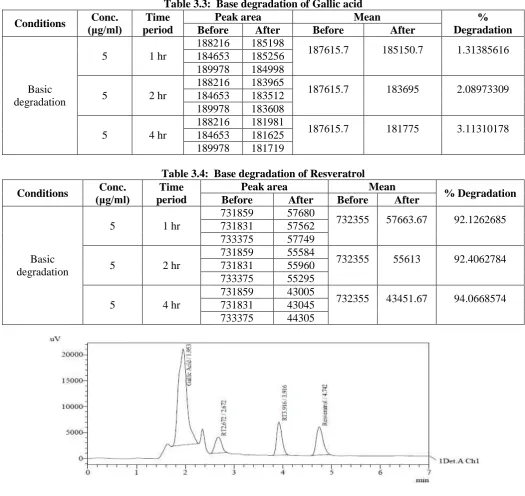
The chromatogram for base degradation of Gallic acid do not showed any significant degradation of sample after 1 hr, 2 hr and 4 hr at 60 °C ± 2 °C degradation study but Resveratrol shows significant degradation after 1 hr, 2 hr and 4 hr at 60 °C ± 2 °C degradation study. (Figure 3.2)
Table 3.3: Base degradation of Gallic acid
Conditions (μg/ml)Conc. Time period
Peak area Mean %
Degradation Before After Before After
Basic degradation
5 1 hr
188216 185198
187615.7 185150.7 1.31385616 184653 185256
189978 184998
5 2 hr
188216 183965
187615.7 183695 2.08973309 184653 183512
189978 183608
5 4 hr
188216 181981
187615.7 181775 3.11310178 184653 181625
189978 181719
Table 3.4: Base degradation of Resveratrol
Conditions Conc. (μg/ml)
Time period
Peak area Mean
% Degradation Before After Before After
Basic degradation
5 1 hr
731859 57680
732355 57663.67 92.1262685 731831 57562
733375 57749
5 2 hr
731859 55584
732355 55613 92.4062784 731831 55960
733375 55295
5 4 hr
731859 43005
732355 43451.67 94.0668574 731831 43045
733375 44305
Fig. 3.2: Base degradation
3.3 Oxidative Stress:
The chromatogram for oxidative degradation of both drugs showed significant degradation in area, symmetry and additional peaks after 1 hr, 2 hr and 4 hr at 60 °C ± 2 °C of oxidative degradation study (Figure 3.3).
Table 3.5: Oxidative degradation of Gallic acid
Conditions (μg/ml)Conc. Time period
Peak area Mean
% Degradation Before After Before After
Oxidative Degradation
5 1 hr
188216 39692
187615.7 39451.33 78.9722607 184653 39850
189978 38812
184653 37047 189978 36542
5 4 hr
188216 32282
187615.7 31745.33 83.0795936 184653 31729
189978 31225
Table 3.6: Oxidative degradation of Resveratrol
Conditions (μg/ml)Conc. Time period
Peak area Mean
% Degradation Before After Before After
Oxidative degradation
5 1 hr
731859 221573
732355 215553
70.567143 731831 214794
733375 210292
5 2 hr
731859 123607
732355 120844.7 83.4991682 731831 120510
733375 118417
5 4 hr
731859 5340
732355 5445.667 99.2564171 731831 5512
733375 5485
Fig. 3.3: Oxidative degradation
3.4 Thermal Stress:
The chromatogram for thermal degradation of Gallic acid do not showed any significant degradation or additional peak of sample after 1 hr, 2 hr and 4 hr at 60 °C ± 2 °C degradation study but Resveratrol shows significant degradation after 1 hr, 2 hr and 4 hr at 60 °C ± 2 °C degradation study. (Figure 3.4)
Table 3.7: Thermal degradation of Gallic acid
Conditions (μg/ml)Conc. Time period
Peak area Mean
% Degradation Before After Before After
Thermal Degradation
5 1 hr
188216 187601
187615.7 187600.7 0.00799507 184653 187425
189978 187776
5 2 hr
188216 185002
187615.7 185215.3 1.27938854 184653 185212
189978 185432
5 4 hr
188216 183639
187615.7 183082.3 2.4162872 184653 182408
Table 3.8: Thermal degradation of Resveratrol
Conditions (μg/ml)Conc. Time period
Peak area Mean
% Degradation Before After Before After
Thermal degradation
5 1 hr
731859 376192
732355 376240.3 48.6259624 731831 376531
733375 375998
5 2 hr
731859 285018
732355 285087.3 61.0725218 731831 285315
733375 284929
5 4 hr
731859 217139
732355 217374 70.3184931 731831 217591
733375 217392
Fig. 3.4: Thermal degradation
3.5 UV degradation:
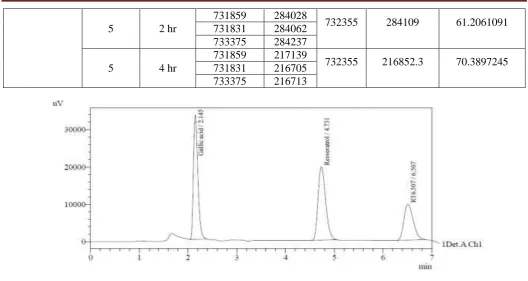
The chromatogram for UV degradation of Gallic acid do not showed any significant degradation or additional peak of sample after 1 hr, 2 hr and 4 hr at 60 °C ± 2 °C degradation study but Resveratrol shows significant degradation after 1 hr, 2 hr and 4 hr at 60 °C ± 2 °C degradation study. (Figure 3.5)
Table 3.9: UV degradation of Gallic acid
Conditions (μg/ml)Conc. Time period
Peak area Mean
% Degradation Before After Before After
UV degradation
5 1 hr
188216 184912
187615.7 184369.7 1.7301327 184653 184198
189978 183999
5 2 hr
188216 182468
187615.7 182406.3 2.77659826 184653 182191
189978 182560
5 4 hr
188216 180108
187615.7 180289.3 3.90496885 184653 180512
189978 180248
Table 3.10: UV degradation of Resveratrol
Conditions Conc. (μg/ml)
Time period
Peak area Mean
% Degradation Before After Before After
UV
degradation 5 1 hr
731859 384031
732355 385666.7 47.3388361 731831 386706
5 2 hr
731859 284028
732355 284109 61.2061091 731831 284062
733375 284237
5 4 hr
731859 217139
732355 216852.3 70.3897245 731831 216705
733375 216713
Fig. 3.5: UV degradation 4. CONCLUSION:
Forced degradation studies revealed that reveratrol prone to degraded under all the performed conditions. Moreover, the content of degradation of gallic acid and resveratrol in various conditions, such as alkaline, acidic, oxidation, thermal and photolytic, were observed and quantitatively analyzed by this HPLC method. The information, thus, obtained will facilitate pharmaceutical development in areas such as formulation development, manufacturing, and packaging, where knowledge of chemical behavior can be used to improve the quality of drug product.
5. ACKNOWLEDGMENT:
I would like to acknowledge ASBASJSM College of Pharmacy, Bela(Ropar) for his support and help to maintain balanced circumstances during project work. And I would like to acknowledge Oniosome Pvt. Ltd. Mohali, for providing the facilities for this research work.
REFERENCES:
1. Figueiras TS, Petersen MTN, Petersen SB. Activation energy of light induced isomerization of resveratrol. J. Fluoresc, 2011; 21: 1897–1906.
2. Ortuno J, Covas MI, Farre M. Matrix effects on the bioavailability of resveratrol in humans. Food Chemistry, 2010; 120: 1123–1130.
3. Singh G, Roopa SP, Pandit V. Development and validation of a HPLC method for the determination of trans-resveratrol in spiked human plasma. J. Adv. Pharm. Tech. Res, 2016; 3: 130-135.
4. Kumar S, Lather V, Pandita D. Stability indicating simplified HPLC method for simultaneous analysis of resveratrol and quercetin in nanoparticles amd human plasma. Food Chemistry, 2016; 197: 959-964.
5. Urbaniaka A, Delgado M, Kacprzak K, Chambers TC. Activity of Resveratrol trimesters against primary acute lymphoblastic leukemia cells. Bioorganic & Medicinal Chemistry Letters, 2017; 27: 2766-2770.
6. Cvetkovic ZS, Nikolic VD, Savic IM, Nikolic LB. Development and validation of an RP-HPLC method for quantification of trans-resveratrol in the plant extracts. Hem. Ind, 2015; 69: 679–687.
7. Kubo I, Masuoka N, Joung T. Multifunctional Antioxidant Activities of Alkyl Gallates. The Open Bioactive Compounds Journal, 2010; 3: 1-11.
8. Damle M, Dalavi N. Development and Validation of Stability Indicating HPLC Method for Determination of Ellagic and Gallic acid in Jambul Seeds (Syzygium Cumini). Int J Appl Sci Biotechnol, 2015; 3: 434-438. 9. Samee W, Vorarat S. Simultaneous Determination of Gallic acid, Catechin, Rutin, Ellagic Acid and Quercetin in
Flower Extracts of Michelia alba, Caesalpinia pulcherrima and Nelumbo nuciferaby HPLC. Thai Pharm Health Sci J, 2007; 2(2): 131-137.
10. Badhani B, Sharma N, Kakkar R. Gallic acid: a versatile antioxidant with promising therapeutic and industrial applications. RSC Adv, 2015; 5: 27540-27557.