Redefining the Boundaries of Healthcare
Technology Policy
Simran Modi
University of Georgia, Department of Economics, 310 Herty Drive, Athens, GA 30602 Corresponding author: [email protected]
Keywords: healthcare, health technology, telemedicine, access
Executive Summary: In recent years, the rise of healthcare technology such as mobile applications, telemedicine, and remote patient monitoring systems has become more prominent. However, the regulations that govern these devices and applications are not clear and do not serve to benefit the patient population. For example, in 2011, Teladoc, a telemedicine company that provides physician services to patients, filed a suit against a Texas Medical Board for limiting the scope use of telemedicine practice in the state. This This and other cases and lack of clear definition calls for a synthesis of evidence to assess these policies. This study examines several state and international policies that can be expanded to the federal sphere to benefit the patient population. The purpose of this study is to identify policy initiatives, both domestic and international, that will provide clarity for the scope of use of medical technology in the United States. The effectiveness of the healthcare technology policies will be analyzed using three criteria: ability to manage complex health conditions, increased access to healthcare, and physician support for medical technology. The analysis offers solutions that will extend the points toward extended benefits of healthcare technology for patients and provide appropriate implementation techniques that will provide a result.
I. Introduction
In recent years, the rise of healthcare technology such as mobile applications, telemedicine, and remote patient monitoring systems has become more prominent. However, the regulations that govern these devices and applications are not clear and do not serve to benefit the patient population. For example, in 2011, Teladoc, a telemedicine company that provides physician services to patients, filed a suit against a Texas Medical Board for limiting the use of telemedicine in the state. This lack of clear definition calls for a synthesis of evidence to assess these policies. This study examines several state and international policies that can be expanded to the federal sphere to benefit the
patient population. The purpose of this study is to identify policy initiatives, both domestic and international, that will provide clarity for the scope of use of medical technology in the United States. The effectiveness of the healthcare technology policies will be analyzed using three criteria: ability to manage complex health conditions, increased access to healthcare, and physician support for medical technology. The analysis offers solutions that will extend the benefits of healthcare technology for patients and provide appropriate implementation techniques.
II. Background
problem. It is a rising field with many applications that benefit the entire health system. However, there is no single definition for healthcare technology among agencies charged with overseeing healthcare technology policy. Addressing this issue is important because healthcare technology has the ability to benefit those in need while making it easier for doctors to care for their patients. For example, people in rural regions often do not have access to specialty healthcare, and providing access through improved healthcare technology policy will help proliferate access to medical care.
To determine the types of healthcare technology policies that would be most effective in the United States, well-‐functioning policies implemented by other countries, as well as several state policies, were considered. In order to see how effective these policies are, we analyzed three categories of outcomes based on established models: management of complex health conditions, increased access to healthcare, and physician support for healthcare technology. The analysis will focus on how these outcomes are improved as a result of medical technology implemented into healthcare systems.
III. Literature Review
i. Management of Complex Health Conditions Healthcare technology policies that improve quality of life by providing much needed solutions to patients also help the economy. For example, assisted living technologies provided through Medicare for the elderly allow them to access social and health services. The Food and Drug Administration has approved several of these technologies. Both private and public sector actors are turning to assisted living technologies to fulfill a market need for elderly patient care. Professors at Newcastle University conducted an analysis of the cost-‐effectiveness of health care technologies, such as telehealth and telecare, and found that they are economically profitable and help people
manage several health issues at the same time.1 Examples of a combination of health issues that one can be struggling with are diabetes, asthma, and nerve pain. Each of these is quite different and requires unique medical care regimens.
Healthcare technology policies also provide support for complex rehabilitation technology for people who are recovering from an injury or for the chronically disabled. The Independence Care System is a long-‐term care program supported by the New York State Medicaid Program with provisions that provide support for use of medical technology. Examples of these technologies include motorized wheelchairs, prosthetic devices, and other items that eliminate barriers for those with long-‐term disabilities. New York’s Medicare Part B program provides similar assistance in relation to healthcare technology. The cooperation of the federal government and state programs in the distribution of healthcare technology is what allows these patients to manage their long-‐ term, complex issues at a low cost.2
ii. Increased Access to Healthcare
level hospitals. Government healthcare officials also gather qualitative data by conducting interviews with hospitals, doctors, and patients to evaluate outcomes of government healthcare technology policy. Benin has also developed a 5-‐year action plan to implement policies that have successful evidence-‐based outcomes, which will help the citizens of Benin get much needed healthcare.4
Increasing access to healthcare is especially important in rural regions, where there is often a lack in primary care. The American College of Physicians (ACP) recently released a statement about its support for the development of telemedicine policies that aid in primary care, calling for increased funding for telemedicine, remote patient monitoring, and mobile health services.5 The ACP has also expressed support for the 2011 ruling made by the Centers for Medicare and Medicaid Services (CMS) outlining a “privilege by proxy” program, in which doctors in hospitals with plentiful resources aid doctors in hospitals that are understaffed and may not have the necessary training to treat patients with complex conditions. “Privilege by proxy” allows hospitals to access telehealth services while complying with government regulations.5 The cooperation of governmental agencies and medical groups will make the process of developing and disseminating healthcare technology policy more efficient and accessible; government agencies have extensive reach, so this increased coordination of services will facilitate efficient expansion of health technology.6
iii. Physician Support for Health Technology One of the essential components to a successful healthcare policy framework is the support of doctors to implement and monitor health technologies. Physicians are key stakeholders in this process, and while they may not always be on board, their support is crucial. Since healthcare decision making is complex, it must be efficient and transparent. A group of clinicians and policymakers in
Canada set out to address this need by generating an adaptable decision-‐making framework incorporating multiple criteria decision analysis for healthcare technology. They analyzed components of medical technologies including severity of disease treated, public health interest, impact on healthcare plan, efficacy, and effectiveness, among others. One example of this type of technology is Electronic Health Records, which help integrate different levels of healthcare and allow seamless care management. The doctors reached the conclusion that 6 out of the 10 analyzed technologies were indeed effective, and they provided support for the creation of policies that promoted these health technologies.7
Other studies point out the impact that the Affordable Care Act has had on funding for medical technology over the past few years, and doctors are concerned that medical research funding is decreasing in areas related to healthcare technology. Several studies conducted by the Center for Healthcare Research and Transformation across the United States indicate that no funding has been allotted to medical research and technology. The majority of funds are going to the National Health Service Corps and market reform. One example of this is in Michigan, a state in which funding has been provided solely for base level care.8 Emergency medicine doctors recently gave statements to the American Medical Association about the pressure to stop performing expensive tests like MRIs unless it is necessary, due to limited resources. Even when it is not necessary for survival, doctors attest that performing an MRI could be critical to uncovering underlying issues, such as a concussion in the case of trauma.9 However, the volatility of politics is complicated, and the future direction of healthcare technology policy is yet to be determined for U.S. citizens.
would like to supplement patient care with technology to ease the burden on the healthcare system. However, there is less conclusive evidence on how health technology implemented through policies into the American healthcare system would affect these outcomes.
IV. Analysis
i. Management of Complex Health Conditions One of the most challenging things for a healthcare system to manage is long-‐term care for chronic health conditions. This is especially important given longer life expectancy, aging populations, and increasing the survival of childhood disabilities. Currently, the American healthcare system does not have a working plan on how to integrate multiple levels of care. Under current policies, patients are tasked with seeking and coordinating their own follow-‐up care, often leading to them falling out of the system. For example, various medical departments, such as dermatology, nephrology, and orthopedics, do not work with each other cohesively, making cooperatively integrated treatment difficult. Even for veterans who are cared for in specialized hospitals, there is no professional monitoring of care to ensure that people are receiving the help that they need every day.
The Australian Department of Health has developed a comprehensive model that outlines a procedure for caring for high-‐need and high-‐cost patients. The first step is to target the population that is most likely to benefit. In the American healthcare system, this would apply to veterans and people who are served through Medicare and Medicaid. By assessing patients’ needs and developing holistic care plans that involve family, doctors will be able to provide better quality as well as continuity of care. In addition, coordination of care between several departments and long-‐term monitoring through medical technology can help cut costs in the long run, particularly for people with physical disabilities.
The specific system that the Australian government uses to care for its most chronic patients is called Health Care Home. This system integrates the use of medicine and technology in both the clinical setting and at home. We recommend an allotment of funds in the federal budget to allow for development and implementation of a system like Health Care Home for patients who have complex conditions. Health Care Home uses a secure server to keep track of patient medical histories, and it also collects all the data that is necessary to allow individual providers, as well as the government, to monitor how well the program is working. Patient information is anonymized in order to protect privacy, and providers are only given access to the information that is needed for treatment. In addition, patient feedback and data analysis by the Commonwealth Agency guides continuous improvement of healthcare. The Australian government reported that giving personalized care at home to people with chronic conditions has cut the cost of care by over 50%, particularly for those who live in nursing homes.10 The development of a similar system by expanding Electronic Health Records in the U.S. could help cut costs and provide better care in the face of a fluctuating and unknown health insurance market.
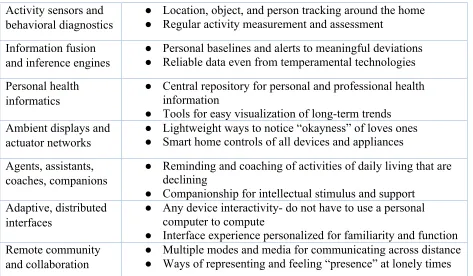
medication dosages. To provide personal care and familiarity, companions, ambient displays, and adaptive interfaces can allow a sick person to feel cared for by a real human being. All of these measures, as seen in Table 1, will help cut the costs of healthcare while allowing a more centralized, yet individualized, system for management of chronic conditions.11
The use of healthcare technology has the ability to impact all spheres of healthcare from diagnostics to treatment and ultimately to improvement of health nationwide.9 Currently, an integrated platform that uses patient data to improve healthcare and provide a greater benefit to the population does not exist. Automated diagnostics can lead to better treatment and preventative care. One of the major areas where this could be of use is in psychiatry. The key challenge of psychiatry is analyzing a patient’s behaviors and developing a treatment plan. While privacy may be a concern, short-‐term monitoring can help provide more comprehensive clinical treatments. For other types of data collection, anonymization is used. Medical technologies, like remote behavioral monitoring, can facilitate this easily.
In the bigger picture, the use of medical technology and the analysis of data on an integrated platform will allow for closer monitoring of drug reactions to measure the effectiveness of pharmaceuticals, such as vaccinations, across the country. Implementing systems like this could also provide epidemiological insight into the source of a virus or outbreak since the data will be readily available. While the CDC does have monitoring protocols in place, technology can help connect the dots faster and save more lives. In addition to long-‐term care and larger health implications, healthcare technology will provide increased access to healthcare, particularly in rural and low-‐access regions.
ii. Increased Access to Healthcare
With less than 5% of federal healthcare funding currently going to medical research and development and only 19% of NIH funding toward this field, federal funding for medical research and development needs to increase by 8% to allow new medical technologies to be developed.6 Research grants should go to researchers who are developing medical technology, such as devices that use artificial intelligence and robotic machines. By investing in new innovations, this will lead to the advancement of preventative care and rapid diagnostics, in turn reducing treatment costs. Currently, the United States is the lead developer of biotechnology, and it also accounts for almost 50% of research in the world. On the other hand, the United Kingdom funds innovations in moderation and provides more funding for implementation and access to healthcare technology.12The specific percentages relating to innovative solutions are seen in Table 2.
Both the United States and the United Kingdom report an interest in medical discoveries and the development of new technology. One result of a survey conducted by Sampat and Drummond in 2013 found that 38% of people in the U.K. and 47% of people in the U.S believe that insurance should not have to pay for all new treatments and technologies, as seen in Table 3. A way to overcome this bias is to provide financing plans to patients and conduct studies to demonstrate the ability of this technology to cut costs for insurance companies. Overall, there is a positive push towards the development of new medical technologies, and this will help patients get the care that they need.12
medication allows a physician to order a refill remotely or prescribe a new medication without a follow-‐up visit. This method of medication dispensing provides the doctor with the opportunity to see if the pill is working and if any dosage changes need to be made, without any action by the patient. This is particularly important for patients who may live far from a healthcare provider, and a medication system like this will also cut costs for wasted and ineffective treatments. Automated medication systems are also proven to increase patient safety by eliminating “as-‐needed” dosages and controlling the dispensing of medication
through a computer. Currently,
approximately 12 states cover the cost of medication dispensing systems through Medicaid.9 however, this needs to be implemented across the United States to cut pharmaceutical costs and provide greater access to healthcare in rural regions.
Another way that healthcare technology can improve access to healthcare is through telemedicine, as evidenced in Malaysia. Telemedicine provides more convenient and accessible healthcare in rural regions and for those who cannot make multiple follow-‐up appointments. Telehealth systems can allow patients to interact with a device and record vital measurements. This allows for more accurate monitoring and takes the burden away from patients who must monitor vitals such as blood sugar levels for those who have diabetes. The result of this is that there is better communication between the patient, a caregiver, and various healthcare providers.
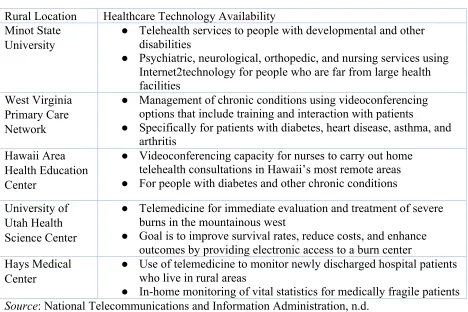
Several telemedicine initiatives have been implemented and tested in rural areas. For example, in the mountains of West Virginia, the West Virginia Primary Care Network has implemented a system that allows patients who have chronic diseases to receive the care that they need in their homes. Other remote areas, such as Hawaii, are also carrying out similar telehealth programs. Through educational initiatives, people in Hawaii’s remote regions have reported that they are
better able to manage conditions like diabetes that ever before.13 One unique telemedicine program has been created by the University of Utah’s Health Science Center for immediate evaluation and treatment of serious burns. Since the closest burn center to the mountains in Utah is four states away, patients often die before they can get the help that they need. By providing electronic access to a burn center, the University of Utah has helped improve survival rates for those with severe burns while reducing costs at the same time.14 Many of these programs are seen in Table 4. Implementing nationwide telehealth will allow rural areas to get medical attention in a timely manner, improving mortality and reducing costs overall; however, there must be funding for these policies to develop into successful programs.
iii. Physician Support for Health Technology A critical component of successful implementation of medical technology is physician support for these initiatives. Based on interviews conducted by Salzberg and his research team in 2012,15 physicians recognize that the integration of all types of healthcare systems through medical technology will allow continuity of care, as seen in Table 5. Healthcare technology will also cut costs for inpatient care and shift resources towards outpatient care. In addition, physicians recognize the value that data sharing through medical technology will allow them to provide better comprehensive care.
has led to physician support for Electronic Health Records, and this support is vital for other technological initiatives in healthcare as well.16
Physicians also benefit from the use of patient support tools such as email and text communication. Another benefit that patient support tools can provide is online scheduling and access to test results online. 29% of primary care providers use this technology in order to benefit their patients as well as their practice16, and the implementation of this has allowed physicians the ability to serve a larger number of patients while minimizing unnecessary follow-‐up visits. Two other popular tools that doctors use to help their patients include online prescription refills and telemedicine follow-‐ups. These two initiatives are used by primary care providers, surgeons, and non-‐surgical specialists to increase the quality of care. Overall, doctors support the use of patient support tools, with primary care providers implementing the most patient support tools to help their practices.17Rolling out these tools in phases after the mandatory implementation of Electronic Health Records will allow for better physician and patient connectivity.
Even though the use of medical technology is supported by physicians, the majority do not use this technology for a variety of reasons. 44% of physicians report that their work-‐ setting does not provide devices, and they are unwilling to use personal devices17. To encourage more physicians to adopt healthcare technology, the NIH should promote continuing education programs that teach doctors about the benefits of these innovations as well as how technology will help cut costs in the long run. Another concern that 29% of physicians have is that mobile health technologies do not protect patient privacy. However, most platforms remove specific patient identifiers, and they also protect any patient data with passwords and specialized encryption.16 26% of physicians state that they do not use health
technology because it is not suited to their needs.17 With the adoption of new tools, there will be those who are slow to embrace change, but physicians generally continue to show an increased interest in medical technologies, based on data about a variety of different technologies.
Doctors also support more complex applications of technology to medicine, such as using smartphones for smartphones for blood tests. In 2 years, there was a 4% increase from 63% to 67% in physicians who believe that smartphones should be used to perform blood tests. In the same time period, patient support for this type of technology was twice that of physicians, at 8%. An increase in physician and patient support for medical technologies indicates a high likelihood that more tools like this will be used in the future.17
The federal mandate of Electronic Health Records has received almost split support from physicians. 54% of physicians agree that EHRs help improve practice efficiency, while 46% of physicians disagree with this. However, 80% of patients agree that EHRs help improve practice efficiency, while only 20% of patients disagree.18 As more doctors’ offices and medical settings adapt EHRs and get used to direct prescription as well as tablet monitoring, the number of doctors who believe that efficiency is improving will increase.
most beneficial in areas with decreased access to healthcare, providing options for those who have very few. For other patients, telemedicine may simply be used as a long-‐ term monitoring tool rather than for diagnostics.
Overall, there is a positive attitude toward new technology among physicians. 58% believe that the use of medical technology must be mastered to remain up-‐to-‐date, and this can be achieved through continuing education initiatives administered by state medical boards. In addition, 34% of physicians state that new technology is exciting and they would like to use it as much as possible to improve patient care.17 These types of attitudes will be more likely to surface in the coming years as doctors want to implement healthcare technology into their practices.
V. Conclusion
The implementation of healthcare technology in a variety of different medical settings will allow for better care. From increasing federal funding for medical devices and telemedicine to the development of education and implementation programs, the United States needs to fund research to develop, monitor, and implement healthcare technology and generate healthcare policy that will benefit the citizens and allow physicians to supplement and improve their practices. For example, implementing a Health Care Home system, similar to the one used in Australia, will assist in providing better quality of care to patients with chronic health conditions
while ensuring that it is reaching citizens most in need of access to high-‐quality health care.
Another advantage of redefining healthcare technology policy is that this will provide greater access to healthcare, particularly for those who live in rural regions. Currently, there are several telehealth programs that cater to rural communities in the Midwest, but there are ways to extend this coverage to rural areas in all 50 states. This solution should be developed in a way that uses already existing technologies as pilot models and is adapted to fit the needs of specific geographical regions. Partnering with regional and state medical boards will allow this process to be streamlined, while focusing on eliminating limitations.
Lastly, physicians support the use of healthcare technology in their practices, and using this support will help refine medical technologies to better suit the needs of both physicians and patients. Looking at all of these outcomes, policy should be developed in a way that allows a step-‐by-‐step rollout of healthcare technology, as well as programs that educate both physicians and patients on the benefits of using healthcare technology to supplement a traditional practice. Overall, redefining the boundaries of healthcare technology policy with the support of physicians and other healthcare providers will allow for management of chronic and complex conditions and improve access to healthcare.
Table 1
: Selected core technologies and their capabilities.
Technology
Values to Aging in Place
Wireless broadband
●
Anywhere in the home, any device connectivity
●
Rich and multiple streams of health information delivery
Biosensors and bodily
diagnostics
●
Real-time routine chemical analysis
Activity sensors and
behavioral diagnostics
●
Location, object, and person tracking around the home
●
Regular activity measurement and assessment
Information fusion
and inference engines
●
Personal baselines and alerts to meaningful deviations
●
Reliable data even from temperamental technologies
Personal health
informatics
●
Central repository for personal and professional health
information
●
Tools for easy visualization of long-term trends
Ambient displays and
actuator networks
●
Lightweight ways to notice “okayness” of loves ones
●
Smart home controls of all devices and appliances
Agents, assistants,
coaches, companions
●
Reminding and coaching of activities of daily living that are
declining
●
Companionship for intellectual stimulus and support
Adaptive, distributed
interfaces
●
Any device interactivity- do not have to use a personal
computer to compute
●
Interface experience personalized for familiarity and function
Remote community
and collaboration
●
Multiple modes and media for communicating across distance
●
Ways of representing and feeling “presence” at lonely times
Source
: Dishman, Matthews, and Dunbar-Jacob, 2003.
Table 2
: Differences in innovative inputs and outputs.
UK (%) US (%)
Share of government-funded civilian R&D invested in health
22
41
Total share of worldwide drug research
9.3
47.8
Share of new chemical entities from country
8.2
34.7
Share of EPO-issued pharmaceutical patents emanating from country
7.73
44.98
Share of EPO-issued biotech patents emanating from country
7.65
45.25
Source
: Sampat and Drummond, 2011
Table 3
: Attitudes toward new technologies.
UK (%) US (%)
“Very interested in” new medical discoveries
51
67
“Very interested in” new inventions and technology
39
45
“Very interested in” new scientific discoveries
41
47
health insurance to pay for new medical treatments and technologies”
Source
: Sampat & Drummond, 2011.
Table 4.
Technology initiatives in rural communities.
Rural Location
Healthcare Technology Availability
Minot State
University
●
Telehealth services to people with developmental and other
disabilities
●
Psychiatric, neurological, orthopedic, and nursing services using
Internet2technology for people who are far from large health
facilities
West Virginia
Primary Care
Network
●
Management of chronic conditions using videoconferencing
options that include training and interaction with patients
●
Specifically for patients with diabetes, heart disease, asthma, and
arthritis
Hawaii Area
Health Education
Center
●
Videoconferencing capacity for nurses to carry out home
telehealth consultations in Hawaii’s most remote areas
●
For people with diabetes and other chronic conditions
University of
Utah Health
Science Center
●
Telemedicine for immediate evaluation and treatment of severe
burns in the mountainous west
●
Goal is to improve survival rates, reduce costs, and enhance
outcomes by providing electronic access to a burn center
Hays Medical
Center
●
Use of telemedicine to monitor newly discharged hospital patients
who live in rural areas
●
In-home monitoring of vital statistics for medically fragile patients
Source
: National Telecommunications and Information Administration, n.d.
Table 5.
Physician quotes for policy concerning health information technology.
Quotes
1 “It is critical to address all healthcare settings if you want to maintain continuity of care”.
2 “Interoperability standards should be at multiple levels: consistent, complementary and
not in conflict and address all healthcare settings. If we look at where the future of
healthcare may go – there is tremendous focus on inpatient because that is where the
bulk of the people are and the bulk of the money is spent. But over time that is going to
shift to outpatient in different kinds of settings.”
one another.”
Source
: Salzberg et al., 2012
Table 6:
Benefits of electronic health records use.
Percent responding strongly agree or
agree
Total Primary
Care
Provider
Surgical
specialist
Non-surgical
specialist
Other
Faster and more accurate billing for
services
74%
80%
67%
77%
72%
Time savings though e-prescribing
67%
78%
64%
64%
71%
Improved communication and care
coordination capabilities due to
interoperability
67%
56%
64%
70%
76%
Clinical benefit due to immediately
available data
59%
63%
53%
56%
77%
Cost saving by no longer managing and
storing paper records
59%
66%
51%
58%
66%
Patient care improvement through
clinical guideline prompts and faster lab
results
56%
64%
49%
55%
63%
Practice or worksite efficiency increase
53%
61%
50%
51%
60%
Patient opportunity to submit
information to their health record
41%
43%
42%
38%
51%
Source
: Greenspun, Coughlin, and Stanley, 2013.
_______________________________________________________________________________________________________________
References
1. Wildman, John, Peter McMeekin, Eleanor Grieve, and Andrew Briggs. "Economic evaluation of integrated new technologies for health and social care: Suggestions for policy makers, users and
evaluators." Social science & medicine 169 (2016):141-‐148.
2. Minkel, Jean L. "Integration of Complex Rehabilitation Technology (CRT) into Long-‐term Care Supports: Case Study of
Independence Care System's Seating and Mobility Program and Practices." Topics in Geriatric Rehabilitation 31, no. 1 (2015): 3-‐9.
3. Marzuki, Nuraidah, Saimy Ismail, Nabilla Al-‐Sadat, Fauziah Z. Ehsan, Chee-‐Khoon Chan, and Chiu-‐Wan Ng. "Integrating information and communication
4. Houngbo, P. Th, H. L. S. Coleman, M. Zweekhorst, Tj De Cock Buning, D. Medenou, and J. F. G. Bunders. "A model for good governance of healthcare technology management in the public sector: learning from evidence-‐informed policy development and implementation in Benin." PloS one 12, no. 1 (2017): e0168842.
5. Douglas, Megan Daugherty, Daniel E. Dawes, Kisha B. Holden, and Dominic Mack. "Missed policy opportunities to advance health equity by recording demographic data in electronic health records." American journal of public health105, no. S3 (2015): S380-‐S388. 6. Research!America. “U.S. investments in
medical and health research and development 2013-‐2015.” Research America Report (2015): 1-‐12.
7. Zimlichman, Eyal, Ronen Rozenblum, Claudia A. Salzberg, Yeona Jang, Melissa Tamblyn, Robyn Tamblyn, and David W. Bates. "Lessons from the Canadian national health information technology plan for the United States: opinions of key Canadian experts." Journal of the
American Medical Informatics
Association 19, no. 3 (2011): 453-‐459. 8. Bondlapati, Kirsten, Joshua Fangmeier,
and Marianne Udow-‐Phillips. “Affordable Care Act funding: an analysis of grant programs under health care reform-‐FY 2010 -‐ FY 2015.Center for Healthcare Research & Transformation (2016). 9. Schoenfeld, Andrew J., Mitchel B. Harris,
and Matthew Davis. "Clinical uncertainty at the intersection of advancing
technology, evidence-‐based medicine, and health care policy." JAMA Surgery 149, no. 12 (2014): 1221-‐1222.
10. Australian Department of Health. “Better outcomes for people with chronic and complex health conditions.” Primary
Health Care Advisory Group Report
(2015): Commonwealth of Australia. 11. Dishman, Eric, Judith Matthews, and
Jacqueline Dunbar-‐Jacob. "Everyday health: Technology for adaptive aging." (2004).
12. Sampat, Bhaven., and Michael Drummond (2011). “Another special relationship? Interactions between health technology policies and health care systems in the United States and the United Kingdom.” Journal of health politics, policy and law 36, no. 1 (2011): 119-‐139.
13. Higa, C. "Telehealth Solutions for Rural Hawaii." Hawaii State Rural Health
Association Annual Conference, October
23, 2014, 1-‐29.
14. National Telecommunications
Information Administration. “Technology improves rural health care.” Washington, D.C.: Technology Opportunities Program (n.d.).
15. Salzberg, Claudia A., Yeona Jang, Ronen Rozenblum, Eyal Zimlichman, Robyn Tamblyn, and David W. Bates. "Policy initiatives for health information technology: a qualitative study of US expectations and Canada's
experience." International journal of medical informatics 81, no. 10 (2012): 713-‐722.
16. Greenspun, H., S. Coughlin, and E. Stanley. "Physician adoption of health information technology: Implications for medical practice leaders and business
partners." Washington, DC: Deloitte Center for Health Solutions (2013).
17. Miller, Gabriel. “Physician and patient attitudes toward technology in medicine.”
Medscape (September 28, 2016).
https://www.medscape.com/features/s lideshow/public/technology-‐in-‐
medicine
18. Ventola, C. Lee. "Mobile devices and apps for health care professionals: uses and benefits." Pharmacy and Therapeutics 39, no. 5 (2014): 356.
19. Kumar, Santosh, Wendy J. Nilsen, Amy Abernethy, Audie Atienza, Kevin Patrick, Misha Pavel, William T. Riley et al. "Mobile health technology evaluation: the mHealth evidence workshop." American journal of preventive medicine 45, no. 2 (2013): 228-‐236.
Simran Modi is a junior at the University of Georgia majoring in Psychology and Business with a certificate in Legal Studies. She is from Lawrenceville, GA and hopes to pursue a career in law. She is passionate about healthcare policy and entrepreneurship, with a focus on start-‐up businesses. Simran has presented her research at various conferences, including the National Conference on Undergraduate Research, Spring CURO Research Symposium, and the Atlanta Conference on Science and Innovation Policy. Simran is also involved in the Roosevelt Institute, which is a policy think tank, and the UGA Moot Court Team. In her free time, she loves traveling, dancing, and trying new foods.
Acknowledgements
I would like to express my sincere gratitude to my advisor, Professor R. Vincent Pohl in the Terry College of Business, Economics Department. His support and guidance helped me to complete this research project, and he provided insightful commentary into my work. Also, this work is supported by the Center for Undergraduate Research Opportunities and the University of Georgia Honors Program.