Available Online At www.ijpret.com
INTERNATIONAL JOURNAL OF PURE AND
APPLIED RESEARCH IN ENGINEERING AND
TECHNOLOGY
A PATH FOR HORIZING YOUR INNOVATIVE WORKVISUAL CRYPTOGRAPHYIN IMAGES
S. R. JADHAO, S .P. RAJPUT
1. Assistant Professor,Department of CSE, BNCOE, India. 2. M. E. Student,Department of CSE, BNCOE, India.
Accepted Date:
27/02/2013 Publish Date:
01/04/2013
Keywords
Cryptography,
Steganography,
Visual Steganography,
Public Key Cryptography,
Joint Key
Cryptography,
Asymmetric Key Cipher,
Symmetric Key Cipher,
Image Steganography.
Corresponding Author
Mr. S. R. Jadhao
Abstract
Available Online At www.ijpret.com INTRODUCTION
I. BASIC OVERVIEW ON CRYPTOGRAPHY
A large number of cryptography algorithms
have been created till date with the primary
objective of converting information into
unreadable ciphers (an encrypted piece of
text). We will discuss the two basic and
most commonly used algorithms – The joint
key cryptography and the public key
cryptography.
THE JOINT KEY CRYPTOGRAPHY (Symmetric
key cipher) uses a common key for
encryption and decryption of the message.
This key is shared privately by the sender
and the receiver. The sender encrypts the
data using the joint key and then sends it to
the receiver who decrypts the data using
the same key to retrieve the original
message. Joint key cipher algorithms are
less complex and execute faster as
compared to other forms of cryptography
but have an additional need to securely
share the key. In this type of cryptography
the security of data is equal to the security
of the key. In other words it serves the
purpose of hiding a smaller key instead of
the huge chunk of message data.
THE PUBLIC KEY CRYPTOGRAPHY:
(asymmetric key cipher) is a technique that
uses a different key for encryption as the
one used for decryption. Public key systems
require each user to have two keys – a
public key and a private key (secret key).
The sender of the data encrypts the
message using the receiver’s public key. The
receiver then decrypts this message using
his private key. This technique eliminates
the need to privately share a key as in case
of symmetric key cipher. Asymmetric
cryptography is comparatively slower but
more secure than symmetric cryptography
technique. The public key cryptography is a
fundamental and most widely used
technique, and is the approach which
underlies Internet standards such as
Transport Layer Security (TLS) (successor to
SSL). The most common algorithm used for
secret key systems is the Data Encryption
Algorithm (DEA) defined by the Data
Encryption Standard (DES) [3].A HYBRID
CRYPTOSYSTEM is a more complex
cryptography system that combines the
features of both joint and public key
Available Online At www.ijpret.com
traditional public key cryptography
techniques to covert the message into a
cipher. For embedding the cipher into
images, a modified joint key technique wills
be used.
II. BASIC OVERVIEW ON STEGANOGRAPHY
Steganography is the art of hiding the
existence of the communication message
before sending it to the receiver. It has
been practiced since 440 B.C. in many ways
like writing information on the back of
cattle in a herd, invisible ink etc. Some
relatively modern ways include hiding the
information in newspaper articles and
magazines etc. Multimedia steganography
is one of the most recent and secure forms
of steganography. It started in 1985 with
the advent of the personal computer
applied to classical steganography
problems. Visual steganography is the most
widely practiced form of steganography and
is usually done
using image files. It started with concealing
messages within the lowest bits of noisy
images or sound files. Images in various
formats like jpeg have wide color spectrum
and hence do not reflect much distortion on
embedding data into them. We shall
perform steganography on image files and
we shall hide the encrypted message into
image files in an encrypted format thus
achieving a multiple cryptographic system.
The most commonly used technique for
image steganography is bit insertion where
the LSB of a pixel can be modified. Ref[4]
explains various other techniques involve
spread spectrum, patch work, JPEG
compression etc. Instead often additional
LSB encoding, we will use a modified bit
encoding technique to achieve image
steganography in which each pixel will store
one byte of data.
III. MULTIMEDIA IMAGE FILES
Multimedia content basically comprises of
images, videos and audio files. Images form
the basis of visual multimedia. Videos are
streams of images displayed in sequence at
a certain speed. We shall focus on image
files to achieve visual steganography.
Images are visual data stored in a picture
frame. Images basically are made up of
various regions consisting of pixels. These
pixels in turn consist of three basic colors R
(red), G (green) and B (blue). The pixel
values (R, G, B values) can be manipulated
Available Online At www.ijpret.com
deviation in these pixel values does not
alter the images as a whole but a slight
shade difference occurs in the altered
region that is not visible in normal
conditions. The image can hence serve as a
cover for the information so as to achieve
steganography. The edited image can be
transmitted to the
receiver along with the original image. The
receiver then can decode the data from the
image by pixel based image comparison [6].
The process involved in encoding and
decoding uses a blend of media
cryptography and asymmetric cryptographic
algorithms. An image or a multimedia data
has 5 + 1 properties which include the
position of color pixel on the x-axis, the
position of color pixel in the y-axis, the R
component of color, the G component of
color, the B component of color and the
sixth is the image description properties like
size, timestamp etc. These properties are
stored in the first few lines of image
property description. The number of bits
per pixel is also a property that varies in
different images. To achieve a more general
bit encoding system we shall use 8-bits per
pixel image.
IV. THE VISUAL CRYPTOGRAPHIC
STEGANOGRAPHY SYSTEM
In the multimedia steganocryptic system,
the message will first be encrypted using
public key encryption algorithm, and then
this encrypted data will be hidden into an
image file thus accomplishing both data
encoding and hiding. The multimedia data
will be used to provide the cover for the
information. Each color in the multimedia
data when considered as an element in an
arrangement of 3D matrix with R, G and B
as axis can be used to write cipher (encoded
message) on a 3D space. The method which
we will use to map the data is a block or a
grid cipher. This cipher will contain the data
which will be mapped in a 3-D matrix form
where the x-axis can be for R (red), y-axis
can be for G
Available Online At www.ijpret.com
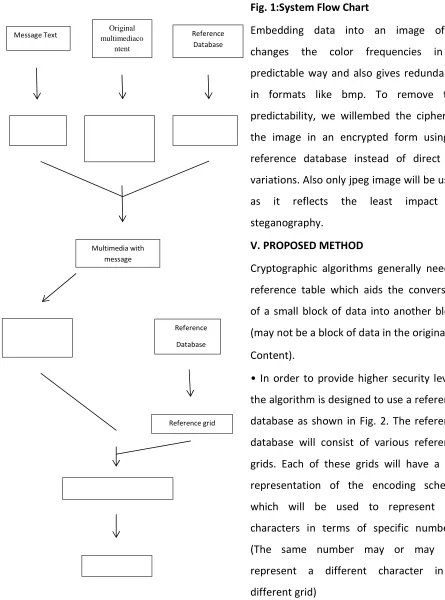
Fig. 1:System Flow Chart
Embedding data into an image often
changes the color frequencies in a
predictable way and also gives redundancy
in formats like bmp. To remove this
predictability, we willembed the cipher in
the image in an encrypted form using a
reference database instead of direct bit
variations. Also only jpeg image will be used
as it reflects the least impact of
steganography.
V. PROPOSED METHOD
Cryptographic algorithms generally need a
reference table which aids the conversion
of a small block of data into another block
(may not be a block of data in the original
Content).
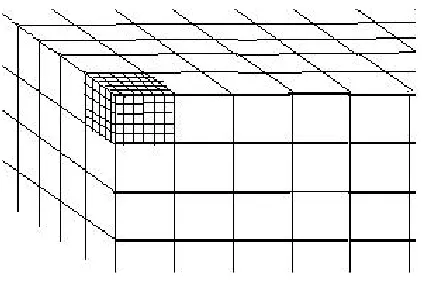
• In order to provide higher security levels
the algorithm is designed to use a reference
database as shown in Fig. 2. The reference
database will consist of various reference
grids. Each of these grids will have a 3-d
representation of the encoding schema
which will be used to represent the
characters in terms of specific numbers.
(The same number may or may not
represent a different character in a
different grid)
Reference grid
Added Number From Multimedia
content
Truncated Multimedia
Content Opter Text
Multimedia with message
Original multimediaco
ntent
Cipher Text
Message Text
Reference
Database
Reference grid Reference
Available Online At www.ijpret.com Fig. 2 Matrices in a Grid of the
Reference database
1. Encryption Algorithm
• The message will first be encrypted using
Asymmetric Key Cryptography technique.
The data will be encrypted using basic DES
algorithm [9].This cipher will now be hidden
into a multimedia file.
• The cipher will be saved in the image
using a modified bit encoding technique by
truncating the pixel values to the nearest
zero digit (or a predefined digit) and then a
specific number which defines the 3-D
representation of the character in the
cipher code sequence can be added to this
number. For every character in the message
a specific change will be made in the RGB
values of a pixel. (This change
should be less than 5 for each of R,G and B
values)This deviation from the original
value will be unique for each character of
the message. This deviation also depends
on the specific data block (grid) selected
from the reference database. For each byte
in the data one pixel will be edited. Thus
one byte of data will be stored per pixel in
the image.
• In this method the cipher sequence can
be decoded without the original image and
only the edited image will be transmitted to
the receiver.
• In the first few lines of image properties,
the attributes of the image will be
encrypted and saved so as to provide us the
information if the image is edited or
modified or the image extension has been
changed like jpg to gif. These properties can
be used in the decoding (identifying the
correct block of data from the data grid). So
only the correct encrypted image in the
correct format will produce the sent
message.
• For decryption, the receiver must know
which image to decode and in which format
as changing the image format changes the
Available Online At www.ijpret.com
gives a random data on decryption that has
no meaning. But only the correct format
decryption gives the original message.
• After hiding the data in the image, the
image will be sent to the receiver. The
receiver should have the decryption key
(private key) which will be used to decode
the data.
2. Decryption Algorithm
• The message can be decoded using an
inverse function (as used in traditional
techniques) using the receiver’s private key.
This key can be a part of the image or a text
or any attribute of the image.
• The receiver’s private key is used to
identify the reference grid from the
reference database.
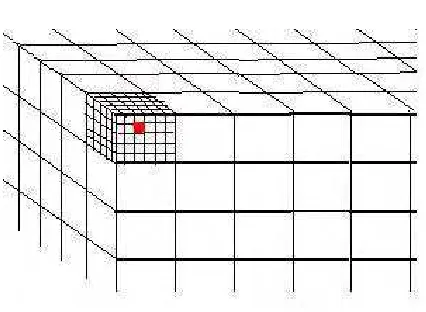
• After selecting the correct grid, the x and
ycomponent of the image can define the
block that has been used to encrypt the
message and the RGB values can point to
the data in the block identified by the x, y
component as shown in Fig. 3.
Fig. 3 Matrix in a grid of Reference database
• The cipher is retrieved by obtaining the
difference in the pixel value from the
closest predefined value (zero truncation).
These numbers will now define the saved
bit and will form the cipher text.
• This cipher can now be decrypted using an
inverse function of the DEA algorithm to get
the message text.
VI. EXPERIMRNTAL RESULTS AND
ADVANTAGES OF THE ALGORITHM
The system was designed using an image of
size 200x150 (30000) pixels. Initially, the
pixel values were incremented to the next
higher multiple of 5. The message text was
converted into cipher text using DEA
algorithm. The secret key used was ‘This is
the Secret Key’. Maximum possible size (29
Available Online At www.ijpret.com
one byte per pixel. The cipher text was then
embedded into the jpeg image by pixel
variation (decrement) of the selected value
that was between 3 for R, 4 for G and
0-4 for B values of the pixel. The reference
database consisted of 3 data grids. The data
grid was selected on the basis of the
number of pixels of the image. If the pixels
were less than 1, 00,000 pixels the data grid
1 was selected, if they were between 1,
00,000 and 10, 00,000 then the data grid 2
was selected else the data grid 3 was
selected. Each data grid had 20 matrices
which were selected on the basis of the
height to width ratio. The image containing
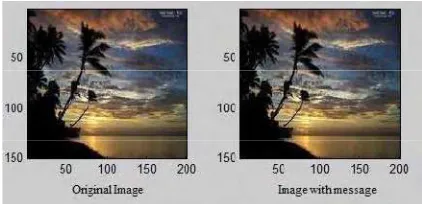
message data was found to have no
visible distortion.
Fig. 4 Encryption result of the application.
For decryption the cipher was retrieved by
checking the pixel variations and inverse
DEA function was applied to retrieve the
message. To retrieve the cipher from the
image, the difference in the pixel value
from the next higher multiple of 5 was
calculated. The correct data grid from the
reference database was selected on the
basis of the number of pixels in the image.
The correct matrix from the data grid was
selected on the basis of the height to width
ratio. After this the encrypted message was
retrieved from the image. The inverse DEA
function was applied to this encrypted
message in order to retrieve the original
message text. The steganocryptic algorithm
combines the features of cryptography and
steganography and hence provides a higher
level of security than either of the
techniques alone. The algorithm also is
more secure than abnormal cryptographic
system as the encrypted data is hidden into
a multimedia file and then transmitted. It is
also more secure than a Steganography
system as the data to be hidden is in an
encrypted format. The algorithm scores
over traditional visual steganography
systems like LSB encoding as it implements
multiple encryptions. The image bits are
used not to store the message but a slight
deviation which correspond to a unique
Available Online At www.ijpret.com
deviation is then retrieved from the image
and used to decrypt the original message.
The image used for encryption is jpeg as it
has the least deviation of embedding data.
VII. APPLICATION AREAS AND FUTURE SCOPE
This method can be used to increase the
security on web based applications. The
user will be asked to provide the secret key
and the password can be compared from
image files using the key. It can be used as
advancement over the existing option to
input the security phrase in various web
Based applications. In the case of a secret
message being transferred the information
can be kept inside a multimedia data which
will be the normal cipher which had to be
transferred. This multimedia data can be
transferred in the normal way. Video
Files and image streams can also be used to
transmit data. In case of image streams part
of message can be sent in each image. This
will increase the security of the system,
however the time consumption will
increase in this case.
CONCLUSION:
Thus we have conclude that This method
can be used to increase the security on web
based applications It can be used as
advancement over the existing option to
input the security phrase in various web
based applications.
REFERENCES
1. Mizuho NAKAJIMA, “Extended use of
Visual Cryptography for natural images,
Department of Graphics and Computer
Sciences”, Graduate School of Arts and
Sciences, The University of Tokyo
2. Bart Preneel, “Cryptographic
Algorithms: Basic concepts and application
to multimedia security”, Katholieke
University, Belgium
3. “Information Security”, National
Institute of Standards and Technology,
Special Publication, 2004
4. T. Morkel, “An Overview of Image
Steganography”, Department of Computer
Science, University of Pretoria, South Africa
5. Pradosh Kumar Mohapatra, “Public Key
Crytography”, Crossroads: ACM Student
Magazine, Sep 2000
6. PareshMarwaha, PiyushMarwaha,
Available Online At www.ijpret.com
Retrieval in Multimedia Databases”,
International Journal of Recent Trends in
Engineering, May 2009
7. Nameer N. EL-Emam, “Hiding a Large
Amount of Data with High Security Using
Steganography Algorithm”, Applied
Computer Science Department,
Philadelphia University, Jordan,2007
8. Elvin M. Pastorfide and Giovanni A.
Flores, “An Image Steganography Algorithm
for 24-bit Color Images Using
Edge-Detection Filter”, Institute of Computer
Science, 2007
9. “Data Encryption Standard (DES)”,
Federal Information Processing Standards
Publication (FIPS PUB) 46-3, National
Institute of Standards and Technology,
Gaithersburg, 1999.
10. Abdel-Karim Al Tamimi, “Performance
Analysis of Data Encryption Algorithms”,
Department of Computer Sciences,
Washington University, 2006 Publication
11. Debashish Jena, “A Novel Visual
Cryptography Scheme”, IEEE International
Conference on AdvancedComputer Control,