Available Online at www.ijpret.com 173
INTERNATIONAL JOURNAL OF PURE AND
APPLIED RESEARCH IN ENGINEERING AND
TECHNOLOGY
A PATH FOR HORIZING YOUR INNOVATIVE WORK
A NOVEL METHOD FOR ENERGY-EFFICIENT RESOURCE ALLOCATION IN
OFDM WITH DISTRIBUTED ANTENNAS
S. G. KALAM1, G. PRAMESWAR REDDY2
1.M. Tech Student, DSCE 2nd DEPT OF ECE ,KMM Institute of Technology and Science, Ramireddipalle, Chandragiri, Mandal, Tirupati, Chittoor, Andhra Pradesh.
2.Asst. Professor, DEPT OF ECE, KMM Institute of Technology and Science ,Ramireddipalle, Chandragiri Mandal, Tirupati, Chittoor ,Andhra Pradesh.
Accepted Date: 24/07/2015; Published Date: 01/08/2015
\
Abstract: - In this paper, we build up a vitality productive asset portion plan with corresponding reasonableness for downlink multiuser orthogonal recurrence division multiplexing (OFDM) frameworks with circulated receiving wires. Our point is to boost vitality proficiency (EE) under the limitations of the general transmit force of every remote access unit (RAU), corresponding reasonableness information rates, and bit mistake rates (BERs). In view of the non convex way of the streamlining issue, getting the ideal arrangement is to a great degree computationally complex. Along these lines, we build up a low-unpredictability problematic calculation, which isolates subcarrier designation and force portion. For the low-many-sided quality calculation, we change the non convex streamlining issue in fragmentary structure into an identical improvement issue in subtractive structure, which incorporates a tractable arrangement. Next, an ideal vitality productive force allotment calculation is created to expand EE while keeping up corresponding decency. Through PC reenactment, we show the adequacy of the proposed low-many-sided quality calculation and represent the major tradeoff between energy and unearthly effective transmission outlines.
Keywords: Distributed receiving wire frameworks (DASs), vitality effectiveness (EE), partial programming, relative reasonableness, asset portion, unearthly productivity (SE).
Corresponding Author: MR. S. G. KALAM
Access Online On:
www.ijpret.com
How to Cite This Article:
S. G. Kalam, IJPRET, 2015; Volume 3 (12): 173-181
Available Online at www.ijpret.com 174
INTRODUCTION
Available Online at www.ijpret.com 175 than C-MIMO frameworks. We have exhibited in [23] that a tradeoff exists in the middle of EE and SE in a downlink DAS when relative reasonableness among MSs is considered. On the other hand, to the best of our insight, there is no study about vitality productive asset assignment with relative reasonableness among MSs in OFDM with a DAS. In this paper, we abuse the fragmentary programming technique to examine vitality proficient asset portion with relative decency over composite blurring channels comprising of little and extensive scale blurring for a downlink multiuser OFDM DAS. The streamlining goal is to augment EE under the limitations of general transmit force of each RAU, corresponding reasonableness information rates, and bit slip rates (BER). In view of the non convex way of the advancement issue, getting the ideal arrangement is greatly computationally complex. By misusing the properties of partial programming, we change the no convex streamlining issue in fragmentary structure into an identical enhancement issue in subtractive structure, which incorporate a tractable arrangement. At that point, a low-intricacy problematic calculation is created to amplify EE while keeping up relative reasonableness for the downlink multiuser OFDM DAS. This paper is sorted out as takes after. In Section II, we first portray the multiuser OFDM DAS and circuit and fiber optic force utilization models, and we then figure the issue of vitality productive asset distribution advancement for the downlink multiuser OFDM DAS with corresponding decency. an imperfect vitality effective asset designation plan is produced. Numerical results are displayed to exhibit the viability of the proposed vitality productive asset allotment conspire.
II. ENERGY EFFICIENCY OF AN ORTHOGONAL FREQUENCY-DIVISION MULTI PLEXING DISTRIBUTED ANTENNA SYSTEM
After quickly examining OFDM DAS and circuit and fiber optic force utilization models, we present the EE of an OFDM DAS.
A. OFDM DAS Model
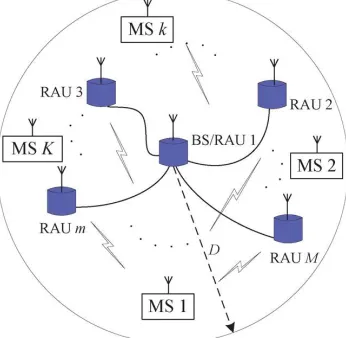
We consider the downlink of a multiuser OFDM DAS in a solitary cell with N subcarriers, K MSs, and M RAUs; both MSs and RAUs are outfitted with a solitary reception apparatus, as indicated in Fig. 1 [24]. The base station (BS) can be viewed as an exceptional RAU and is indicated by RAU 1. The consistent RAUs are furnished with just up/down converters and low-clamor intensifiers (LNAs). Each RAU is physically associated with BS/RAU 1 by means of an optical fiber. We expect that channel state data (CSI) is accessible at both transmitter and collector.
Available Online at www.ijpret.com 176
Figure 1. Round format of the OFDM DAS setup.
B. Circuit Power Consumption
To outline vitality effective correspondence frameworks, the aggregate force utilization ought to be incorporated in the enhancement model. It contains three sections: 1) the force utilization of intensifiers; 2) the circuit power utilization by RAUs; and 3) the force utilization by the fiber-optic transmission, by the fiber-optic transmission. The transmit force can be communicated
The circuit power utilization in the given mathematical statement incorporates the force dissemination in the advanced to-simple converter, the blender, the dynamic channels at the transmitter side, the recurrence synthesizer, the LNAs, the middle of the road recurrence enhancer, the dynamic channels at the collector side, and the simple to-computerized converter. In addition, the circuit power utilization is autonomous of the genuine transmit power.
C. EE of an OFDM DAS
As in most literature, the EE of an OFDM DAS is defined as the ratio of the overall data rate or SE over the total power consumption (in bits/J/Hz) [20], i.e.,
Available Online at www.ijpret.com 177
III. ENERGY-EFFICIENT RESOURCE ALLOCATION
Here, we will investigate the energy-efficient resource allocation scheme for an OFDM DAS.
A. Subcarrier Allocation
The improvement issue in (7) is non convex and combinatorial and has nonlinear limitations. It is difficult to get a shut structure arrangement. It is additionally exceptionally convoluted to acquire a numerical arrangement. Consequently, we concentrate on the low-many-sided quality and problematic arrangement of (7). In this paper, we accept that the extent of subcarriers appointed to every MS is more or less the same as their information rates after force assignment, which has been affirmed in [30].
IV. NUMERICAL RESULTS
Here, the proposed vitality proficient asset assignment plan is assessed through Monte Carlo reproductions. In our reproduction, the quantity of RAUs M = 5 and subcarriers N = 64. Commotion power σ2 z is − 104 dBm [23], and the most extreme force pmax n is 36 dBm. Cell span R is 1 km, and the framework BER prerequisite is 0.001. Circuit power utilization Pc is 40 dBm [28], and fiber-optic force utilization Po is −0.6 dBm [32]. Power intensifier productivity τ = 38%. Way misfortune example α = 3.7, and the standard deviation of the shadow blurring is σsh = 8 dB [23]. The rate imperatives are recorded in Table IV. For accommodation, expect that the cell shape is approximated by a circle of sweep D. The polar directions of RAUs with respect to the focal point of the cell are indicated as (d, θm),m = 1, 2, . . . , M. We expect that the MSs are consistently conveyed in the cell. For the cell with five RAUs, the polar directions of the RAUs are [5].
(0, 0), (d, 0), (d, π/2), (d, π), (d, 3π/2)
Available Online at www.ijpret.com 178
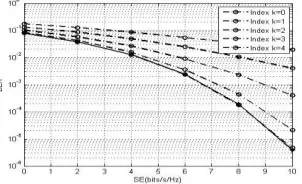
Fig. 2. SE and EE versus number of iterations with different rate constraints for pmax m = 30 dBm and K = 10.
Fig. 3. SE and EE versus number of iterations with different rate constraints for pmax m = 30 dBm and K = 10.
Available Online at www.ijpret.com 179
Fig. 4. SE versus total power of RAU with different rate constraints for Pmax m = 30 dBm and K = 10.
Fig. 5. EE versus SE with different rate constraints and transmit power for Pmax m = 30 dBm and K = 10.
b) SE and EE Versus Different Transmit Power
Available Online at www.ijpret.com 180 proficient asset portion plan is give or take 169.3% higher than the equivalent resource allocation plan when SE is 5 bit/s/Hz. In Fig. 5, the EE–SE bend demonstrates the presence of an immersion point, past which the EE no more increments with SE, paying little heed to how much extra transmit force is utilized, which concurs with [23]. In light of this outcome, we can outline ideal vitality proficient systems. Then again, we can diminish however much power utilization as could reasonably be expected while fulfilling the given SE necessity. In Figs. 4 and 5, in the low-transmit-power administration, the proposed vitality productive asset portion plot that accomplishes the greatest EE likewise accomplishes the most extreme SE. Be that as it may, in the high-transmit-power administration, no arrangement exists for an OFDM DAS to enhance both SE and EE all the while. The SE and EE accomplished by the proposed energy efficient asset distribution plan differ with the information rate imperatives. This outcome exhibits that the corresponding reasonableness requirements can expressly control the SE and EE proportions among Consequently, we can simply guarantee the objective information rates and EE for every MS if there is adequate transmit power for RAU.
a) SE and EE Versus Number of MSs
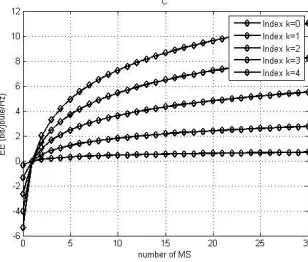
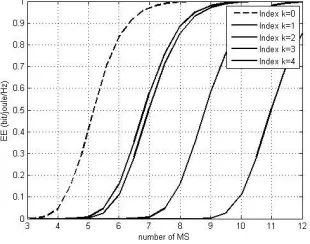
Fig. 6 demonstrates the EE and SE versus the quantity of MSs for distinctive rate limitations and p max m = 30 dB m, separately. Both the EE and SE develop with the quantity of MSs under distinctive rate requirements since the proposed vitality proficient resource allocation plan has the capacity abuse multiuser assorted qualities.
V. CONCLUSION
In this paper, we have examined the ideal vitality proficient asset allotment systems for the downlink multiuser OFDM DAS with relative decency, and proposed a problematic vitality effective asset distribution plan to boost EE. Numerical results have demonstrated that the proposed calculation joins to the ideal arrangement inside of a little number of emphasess and exhibited the tradeoff in the middle of EE and SE, which is critical for future remote correspondence frameworks.
REFERENCES
1. X.-H. You, D.-M. Wang, B. Sheng, X.-Q. Gao, X.-S. Zhao, and M. Chen, “Cooperative distributed antenna systems for mobile communications,” IEEE Wireless Commun., vol. 17, no. 3, pp. 35–43, Jun. 2010.
Available Online at www.ijpret.com 181 3. H.-L. Zhu, S. Karachontzitis, and D. Toumpakaris, “Low-complexity resource allocation and its application to distributed antenna systems,” IEEE Wireless Commun., vol. 17, no. 3, pp. 44– 50, Jun. 2010.
4. H. Kim, S.-R. Lee, K.-J. Lee, and I. Lee, “Transmission schemes based on sum rate analysis in distributed antenna systems,” IEEE Trans. Wireless Commun., vol. 11, no. 3, pp. 1201–1209, Mar. 2012.
5. X.-H. You, D.-M.Wang, P.-C. Zhu, and B. Sheng, “Cell edge performance of cellular mobile systems,” IEEE J. Sel. Areas Commun., vol. 29, no. 6, pp. 1139–1150, Jun. 2011.
6. Z.-K. Shen, J. Andrews, and B. Evans, “Adaptive resource allocation in multiuser OFDM systems with proportional rate constraints,” IEEE Trans. Wireless Commun., vol. 4, no. 6, pp. 2726–2737, Nov. 2005.
7. G.-W. Miao, N. Himayat, G. Y. Li, and A. Swami, “Cross-layer optimization for energy-efficient wireless communications: A survey,” J. Wireless Commun. Mobile Comput., vol. 9, no. 4, pp. 529–542, Apr. 2009.
8. Z. Hasan, H. Boostanimehr, and V. K. Bhargava, “Green cellular networks: A survey, some research issues and challenges,” IEEE Commun. Surveys Tuts., vol. 13, no. 4, pp. 524–540, 4th Quart., 2011.
9. G.-W. Miao, N. Himayat, G. Y. Li, and S. Talwar, “Distributed interference-aware energy-efficient power optimization,” IEEE Trans. Wireless Commun., vol. 10, no. 4, pp. 1323–1333, Apr. 2011.