Organized by C.O.E.T, Akola. Available Online at www.ijpret.com110
INTERNATIONAL JOURNAL OF PURE AND
APPLIED RESEARCH IN ENGINEERING AND
TECHNOLOGY
A PATH FOR HORIZING YOUR INNOVATIVE WORK
THERMAL PERFORMANCE OF CLOSED LOOP PULSATING HEAT PIPE USING
DIFFERENT WORKING FLUID
ATUL N. POTE1, KISHORKUMAR K. KHANDARE2
1. Assistant professor, Department of mechanical engineering B. N .College of Engineering, Pusad – 445215 [M.S.] India, 2. Assistant professor, Department of mechanical engineering B. N. College of Engineering , Pusad – 445215 [M.S.] India
Accepted Date: 12/03/2016; Published Date: 02/04/2016
Abstract:Due to huge development in electronic field, thermal management of high performance chips has become a challenging issue to direct heat transfer investigations, and again in industries, there had been always a great demand for having robust and promising cooling devices. For this reason pulsating heat pipe is best option due to simplicity of structure, reliability, and low manufacturing cost. Moreover, working fluid has an important effect on PHP's performance. Having high thermal conductivity, nanofluids are outstanding substitutes for PHP's conventional working fluids. Focusing on recent advances on nanofluidic PHPs, this paper reviews operating principles and conducted experiments in this field. Furthermore, unsolved concerns regarding this field are mentioned.
Keywords: Closed loop Pulsating Heat Pipes (CLPHPs), Nanofluid Conference Stream: Mechanical Engg.
Corresponding Author: MR. ATUL N. POTE
Co Author: MR. KISHORKUMAR K. KHANDARE
Access Online On:
www.ijpret.com
How to Cite This Article:
Atul N. Pote, IJPRET, 2016; Volume 4 (8): 110-121 PAPER-QR CODE
SPECIAL ISSUE FOR
NATIONAL LEVEL CONFERENCE
"RENEWABLE ENERGY
Organized by C.O.E.T, Akola. Available Online at www.ijpret.com111
INTRODUCTION
Due to huge development in electronic field, thermal management of high performance chips has become a challenging issue to direct heat transfer investigations, and again in industries, there had been always a great demand for having robust and promising cooling devices. For this reason pulsating heat pipe is best option due to simplicity of structure, reliability, and low manufacturing cost.
A heat pipe is a type of heat exchanger that is very easy and straightforward to use. Heat pipes used for heat transfer have been improved over time. Over the years, researchers have continuously explored new methods of heat transfer enhancement. The results of employing different cooling liquids proved to be one effective way of improving the system’s overall performance. Nanofluid is a new working fluid for heat exchangers which does not pollute because it uses water as a base fluid. Nanofluids are engineered by suspending ultra-fine metallic or nonmetallic nanometer dimension particles in base fluids (water, oil, and ethylene glycol). So the nanofluid is placed in the pulsating heat pipe and analyzed the improvement of the whole efficiency.
Heat pipe and the PHP are applied in the phase change to take away the heat. Because of the phase change, it will cause to absorb a large amount of latent heat. So the heat from the heat source can be rapidly excluded from the condenser. The temperature of the heat source will not increase and influence the whole working efficiency. The pulsating heat pipe proposed and presented by Akachi. H. in 1990[1], due to its excellent features the device used in many electronic cooling application.
CONSTRUCTION
Pulsating heat pipe (PHP) is made from long capillary tube bent into many U-turns, with the evaporator and adiabatic section is optional depends on the locations of evaporator and condenser. The diameter of the tube must be small enough such that liquid vapor plugs and slugs exist. The unique feature of PHPs compared with the conventional heat pipe is that there is no wick structure to return the condensate to the heating section.
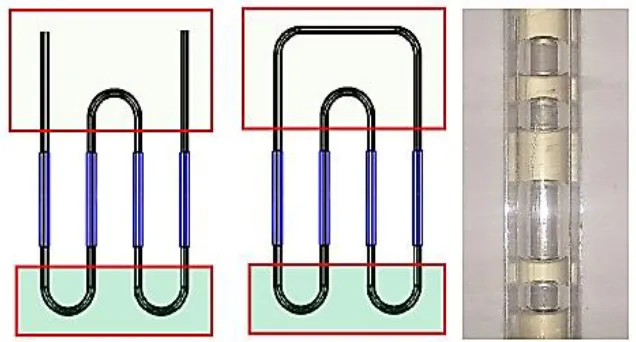
The basic PHP geometry usually consists of a planar sequence of U-turns and parallel channels forming a serpentine with the two possible layouts shown in Figure 1.
Organized by C.O.E.T, Akola. Available Online at www.ijpret.com112 b) Closed Loop Pulsating Heat Pipe (CLPHP): Tube ends connected to each other in a closed
loop.
Fig 1. Schematic diagram of Pulsating Heat Pipe and its variations physical configuration from “An introduction to pulsating heat pipe”, by Manfred Groll et.al. 2003.
Tube Diameter
The internal tube diameter is one of the parameters which essentially define a PHP. The physical behaviour adheres to the "pulsating" mode only under a certain range of diameters. The critical Bond number (or Eötvös) criterion gives the tentative design rule for the diameter[16]. The theoretical maximum inner diameter of capillary tube can be calculated as-
....(1)
If D < Dcri, surface tension forces dominate and stable liquid plugs are formed. However, if D > Dcri, the surface tension is reduced and the working fluid will stratify by gravity and oscillations will cease. The OHP may operate as an interconnected array of two-phase thermosyphons.
PRINCIPLES OF OPERATION
1. Thermodynamic Principles
Organized by C.O.E.T, Akola. Available Online at www.ijpret.com113
2. Fluid Dynamic Principles
Fluid flow in a capillary tube consists of liquid slugs and vapour plugs moving in unison. The slugs and plugs initially distribute themselves in the partially filled tube. The liquid slugs are able to completely bridge the tube because surface tension forces overcome gravitational forces. There is a meniscus region on either end of each slug caused by surface tension at the solid/liquid/vapour interface. The slugs are separated by plugs of the working fluid in the vapour phase. The vapour plug is surrounded by a thin liquid film trailing from the slug.
3. Heat Transfer Principles
As the liquid slugs oscillate, they enter the evaporator section of the PHP. Sensible heat is transferred to the slug as its temperature increases, and when the slug moves back to the condenser end of the PHP, it gives up its heat. Latent heat transfer generates the pressure differential that drives the oscillating flow. The phase change heat transfer takes place in the thin liquid film between the tube wall and a vapour plug and in the meniscus region between the plug and slug, which requires complex analysis.
I. Desirable Properties Of Working Fluid
The experience gained so far by earlier studies suggests that the working fluid employed for pulsating heat pipes should have the following properties[17]:
High value of (dP/dT)sat: ensuring that a small change in evaporator temperature generates a large change in corresponding Psat inside the generated bubble which aids in the bubble pumping action of the device. The same is true in reverse manner in the condenser .
Low dynamic viscosity: This generates lower shear stress.
Low latent heat: should be desirable, aiding quick bubble generation and collapse, given the fact that sensible heat is the predominant heat transfer mode.
High specific heat: is desirable complimenting the low latent heat requirement; although there are no specific studies which explicitly suggest the effect of specific heat of the liquid on the thermal performance. It is to be noted that if a flow regime change from slug to annular takes place, the respective roles of latent and sensible heat transport mechanism may considerably change, as explained earlier. This aspect requires further investigation.
Organized by C.O.E.T, Akola. Available Online at www.ijpret.com114
II. Effect Of Working Fluid on PHP
Although Loop Heat Pipes (LHPs) were first developed and tested with water or acetone as working fluids for power electronic cooling, most of the detailed results on PHP performance were presented when ammonia was used as the working fluid for the spacecraft thermal control. With the new interest of using PHPs for computer cooling, fluids like water, acetone, methanol or ethanol have been used. The first experimental results showed a significant effect of the working fluid on the LHP performance
Fig 2:- Effect of working fluid on thermal resistance at P = 0.7 bar[2]
K. Rama Narasimha et al [2] are carried out experiment on CLPHP using different working fluids(acetone, ethanol, methanol, water), heat input and for different evacuation levels. The derived parameters are thermal resistance and heat transfer coefficient of PHP. The results of these experiments show the variation of thermal resistance with heat input for different working fluids at P = 0.7 bar. The figure shows that the thermal resistance decreases with increase in heat input in case of all the working fluids considered. Further, it is seen that acetone exhibits lower values of thermal resistance compared to other working fluids. This is due to lower value of temperature difference between evaporator and condenser in case of acetone. The lower values of thermal resistance of acetone indicate that acetone has better heat transport capability compared to other working fluids considered.
Organized by C.O.E.T, Akola. Available Online at www.ijpret.com115 working fluid . no quantifiable difference has been recorded between the PHP running with the azeotropic mixture and that running with pure ethanol.
Fig 4:-Temporal evolution of overall thermal resistance for different heat inputs[3].
Pramod R. Pachghare[6] experimentally investigates the PHP using Methanol, ethanol, acetone, water and different binary mixtures closed loop pulsating heat pipe (PHP) using copper tube having internal and external diameter with 2.0 mm and 3.6 mm respectively filling ratio (FR) was 50 %, ten turns and different heat inputs of 10 to 100W was supplied The result shows that, the thermal resistance decreases more rapidly with the increase of the heating power from 20 to 60 W, whereas slowly decreases above 60 W. Pure acetone gives best thermal performance in comparisons with the other working fluid. No measurable difference has been recorded between the PHP running with pure and binary mixture working fluids.
Organized by C.O.E.T, Akola. Available Online at www.ijpret.com116 S. Wannapakhe[5] investigated the effect of aspect ratios (evaporator length to inner diameter of capillary tube), inclination angles, and concentrations of silver nanofluid on the heat transfer rate of a closed-loop oscillating heat pipe with check valves (CLOHP/CV). The CLOHP/CV was made from copper tubing with an internal diameter of 2 mm. Two check valves were inserted into the tube. The tube had 40 meandering turns. The concentration of silver nanofluid was 0.25, 0.5, 0.75, and 1 %w/v, and the operating temperature was 40, 50, and, 60o C. It was found that the heat transfer rate of the CLOHP/CV using silver nanofluid as a working fluid was better than that the heat transfer rate when pure water is used because the silver nanofluid increases the heat flux by more than 10%.
Fig 6:- A comparison of the heat transfer rates of silver nanoflid with water [5] .
Qu et al. (2011)[15] found that charging a PHP with water-SiO2 nanofluid at different concentrations, increased the thermal resistance of the PHP by maximum value of 23.7% in comparison to using pure water as the working fluid. They repeated the experiment for the water-Al2O3 nanofluid at the same operating situation. A maximum 25.7% reduction in thermal resistance was obtained this time.
Organized by C.O.E.T, Akola. Available Online at www.ijpret.com117
Fig 7:- Thermal resistance as a function of heat input for two different concentrations of ferrofluid (Mohammadi et al., 2012)[10].
Md. Riyad Tanshen et al (2013)[4] investigated multi-loop oscillating heat pipe (OHP) charged by aqueous nanofluids with MWCNT loadings of 0.05 wt.%, 0.1 wt.%, 0.2 wt.% and 0.3 wt.%. The multi-loop OHP with 3 mm inner diameter at at 60% filling ratio. The investigation shows that the 0.2 wt.% MWCNTs based aqueous nanofluids low thermal resistance at any evaporator power input.
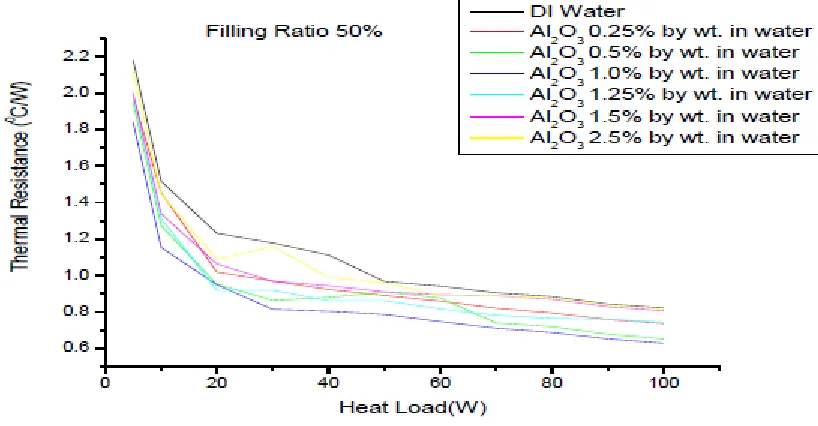
Organized by C.O.E.T, Akola. Available Online at www.ijpret.com118 Wang et.al[12]. compared the performance of base fluid water Al2O3nanofluid on a PHP made of copper with a filling ratio 50%. The heat transport capability of PHP with Al2O3 was better than pure water above 40 W regardless of horizontal or vertical mode of operation. The optimum concentration in vertical mode was 0.5 wt% and 1% in horizontal mode.
Qu et.al[13] also studied the effect of concentration of Al2O3 nanoparticles (56 nm) solution in water on the thermal resistance of PHP. The thermal resistance decreased from 0% to 0.9% but it increased for 1.2% concentration of nanofluid. The maximum decrease was about 0.14 0C/W (32.5%) as compared to that of water for 70% filling ratio
Jian Qu et al. [13] investigated the effect of four different particle sizes of Al2O3 viz. 20 μm, 2.2 μm, 80 nm, and 50 nm and the base fluid water on the startup temperature and thermal resistance of a PHP/OHP. When the particle size became smaller, the startup temperature decreased. For the largest particles of 20 μm tested herein, the startup temperature was 48.5 0C, while for the 50 nm particles the startup temperature was 40.6 0C. As the particle size
reduced from 20 μm to 80 nm, the heat transport capability increased or the thermal resistance decreased. But if the particle size further decreased less than 50 nm, the thermal resistance could not be further reduced, i.e., there exists an optimal particle size for the maximum heat transport capability. Among four particles of 20 μm, 2.2 μm, 80 nm, and 50 nm tested herein, 80 nm particles resulted in the best heat transport capability for the OHP investigated herein, the thermal resistance was 0.113 0C/W at 25 0C and a power input of 200 W.
Organized by C.O.E.T, Akola. Available Online at www.ijpret.com119
Fig 9:- Effect of concentration of Al2O3 on thermal resistance of PHP at FR 50%
CONCLUSIONS
From the above discussion it can be said that working fluid play an important role in operation of PHP, but Nanofluid charged PHPs have proven to be high performance thermal devices. Presence of nano particles can improve performance and affect the startup temperature of the PHP. However, the startup temperature depends on the particle size, as the nanoparticle size is reduced, the thermal conductivity of the nanofluid increases. However, the nanoparticles may agglomerate, settle, or coalesce to the walls with long-term operation of the nanofluid PHP. There is an optimum concentration for nanofluid charged phps. Every nanofluid charged PHP has its own optimum charging ratio.
Still, there are too many nanoparticles that are not tested in PHPs and their performance is indescribable. Examples for these nanoparticles are CNT, SiC, Fe, Ni, Zn, Zr, ZnO, CeO2, etc. Plus, the kind of base fluid has a considerable impact on thermal behavior. Effect of changing the base fluid (alcohols, refrigerants, oils, and etc.) is not considered so much and most of the studies are focused on water as the base fluid up to now
REFERENCES
Organized by C.O.E.T, Akola. Available Online at www.ijpret.com120 2. K. Rama Narasimha1†, S.N. Sridhara, M.S. Rajagopal and K.N. Seetharamu ” Influence of Heat Input, Working Fluid and Evacuation Level on the Performance of Pulsating Heat Pipe”, Journal of Applied Fluid Mechanics, Vol. 5, No. 2, pp. 33-42, 2012.
3. Mauro Mameli, Sameer Khandekar, Marco Marenga, "An Exploratory Study Of A Pulsating Heat Pipe Operated With A Two Component Fluid Mixture", Proceedings of the 21st National and 10th ISHMT-ASME Heat and Mass Transfer conference, December 27-30, 2011, IIT Madras, India.
4. Md. Riyad Tanshen, B. Munkhbayar, Md. J. Nine, Hanshik Chung, Hyomin Jeong, “Effect of functionalized MWCNTs/water nanofluids on thermal resistance and pressure fluctuation characteristics in oscillating heat pipe” International Communications in Heat and Mass Transfer 2013
5. S. Wannapakhe, S. Rittidech, B. Bubphachot and O. Watanabe,“Heat transfer rate of a closed-loop oscillating heat pipe with check valves using silver nanofluid as working fluid", Journal of Mechanical Science and Technology 23 (2009) 1576~1582
6. Pramod R. Pachghare, Ashish M. Mahalle, “Effect of pure and binary fluids on closed loop pulsating heat pipe thermal performance”, Chemical, Civil and Mechanical Engineering Tracks of 3rd Nirma University International Conference, Procedia Engineering 51 ( 2013 ) 624 – 629
7. Yu-Hsing Lin, Shung-Wen Kang, Hui-Lun Chen, “Effect of silver nano-fluid on pulsating heat pipe thermal performance”, Applied Thermal Engineering 28 (2008) 1312–1317
8. Bhawna Verma, V.L.Yadav, K.K.Srivastava, “Nano fluid- An alternative fluid in Pulsating Heat Pipe/Oscillating Heat Pipe”, Journal of Electronics and Communication Engineering, Volume 3, Issue 3 (Sep-Oct. 2012), PP 28-37
9. Niloofar mohammadi, maziar mohammadi, mohammad behshad shafii, “a review of nanofluidic pulsating heat pipes: suitable choices for thermal management of electronics”, frontiers in heat pipes (fhp), 3, 033001 (2012)
Organized by C.O.E.T, Akola. Available Online at www.ijpret.com121 11. Yulongji, hongbinmaa, Fengmin Su, Guoyou Wang, "Particle size effect on heat transfer performance in an oscillating heat pipe", Experimental Thermal and Fluid Science 35, 2011, 724–727.
12. S. Wang, Z. Lin, W. Zhang & J. Chen, "Experimental study on pulsating heat pipe with functional thermal fluids", International Journal of Heat and Mass Transfer52,2009, 5276-5279.
13. Jian Qu, Hui-ying Wu, Ping Cheng,"Thermal performance of an oscillating heat pipe with Al2O3-water Nanofluids", International communications in Heat and Mass Transfer 37,2010, 111-115.
14. Prashant B. Dukare, Dr. Nilesh Diwakar, Dr.Rajiv Arya," The Experimental Analysis Of Close Loop Pulsating Heat Pipe By Using R-134a At 83%,70%And 50% Fr", International Journal for Scientific Research & Development| Vol. 2, Issue 05, 2014,ISSN (online): 2321-0613
15. Qu, J., and Wu, H., 2011, “Thermal Performance Comparison of Oscillating Heat Pipes with SiO2/Water and Al2O3/Water Nanofluids,” International Journal of Thermal Sciences, 50(10), 1954–1962.
16. Piyanun Charoensawan, Sameer Khandeka, Manfred Groll, Pradit Terdtoon, " Closed loop pulsating heat pipes Part A: parametric experimental investigations", Applied Thermal Engineering 23 (2003) 2009–2020.
![Fig 2:- Effect of working fluid on thermal resistance at P = 0.7 bar[2]](https://thumb-us.123doks.com/thumbv2/123dok_us/8709952.1740781/5.612.159.446.229.402/fig-effect-working-fluid-thermal-resistance-p-bar.webp)
![Fig 4:-Temporal evolution of overall thermal resistance for different heat inputs[3].](https://thumb-us.123doks.com/thumbv2/123dok_us/8709952.1740781/6.612.165.440.491.633/fig-temporal-evolution-overall-thermal-resistance-different-inputs.webp)
![Fig 6:- A comparison of the heat transfer rates of silver nanoflid with water [5] .](https://thumb-us.123doks.com/thumbv2/123dok_us/8709952.1740781/7.612.184.431.242.440/fig-comparison-heat-transfer-rates-silver-nanoflid-water.webp)
![Fig 7:- Thermal resistance as a function of heat input for two different concentrations of ferrofluid (Mohammadi et al., 2012)[10]](https://thumb-us.123doks.com/thumbv2/123dok_us/8709952.1740781/8.612.137.472.407.630/thermal-resistance-function-input-different-concentrations-ferrofluid-mohammadi.webp)