METHODOLOGICAL BASES DEFINITION OF INNOVATION FOR
WATER DEVELOPMENT AND INVESTMENT EFFICIENCY IN THE
SYSTEM
Umarov S.R.
Doctor of Economics, Professor of the Department "Economics", Tashkent Institute of Irrigation and Agricultural Mechanization Engineers, Uzbekistan
1. INTRODUCTION:
Evaluation of innovative processes in water management enterprises is carried out using such indicators as: the share of allocated investments from the budget for the innovative development of the system, the share of profit from the total profit of the enterprise received in the course of core activities aimed at innovative purposes, the share of new types of equipment from the total production Fund, the share of intangible assets acquired by the enterprise over the past 5 years from the total Fund of intangible assets, the share of new types of goods, produced by the company and implemented over the past five years of total revenue, indicators of the intensity of innovation processes over the past 5-6 years, as well as indicators of the enterprise's propensity to innovation. At the enterprises of water management through performance evaluation of the innovation process determines the innovation performance of the water sector as a result of marked paths of development of innovation industry.
2. LITERATURE REVIEW:
Scientists and economists of our country and foreign countries conducted research in various areas to improve the efficiency of the water system in a market economy, improving the organizational and economic mechanism of effective management of the system, the problems of development of the industry on the basis of innovation.
In particular, it considers and examines the scientific work of such scientists of the CIS countries, as Krylov E. I., Zhuravkova M. V., Vlasova V. M., Fatkhutdinova R. A., Hucka M., Sandu I. S., Aleksanova, D. S. and Kosheleva, V. M., Igonina L. L., Podshivalenko G. P., the leading scientists and agricultural economists of the Republic Kayumov F. K., Karieva K. A. umurzakova U. P., integral I. L., Gozibekov D. G., djalalova S. C., Sultonov A. S., hudayberganova Z. Y., Abdullajonov R., Hasanov, B. U., Masharipova M. and other scientists.
3. MATERIALS AND METHODS:
During the research the methods of economic analysis, comparative analysis, statistical grouping, monographic research, logical and abstract thinking were widely used. It consists in the following: developed scientific and theoretical approaches to the formation of innovative processes and innovative market, the development of innovative infrastructures in the water sector, as well as the use of factors affecting the use of innovative potential; the methods of evaluation of the obtained economic efficiency as a result of attracting investments for the introduction of innovations in the water sector taking into account the use of discount opportunities are improved; proposals for improving the mechanism of development of innovative infrastructure, ensuring the effective use of the existing innovative potential, intellectual property and attracted investments in the industry are developed; proposals for improving the organizational and economic basis of innovation in the water management system on the basis of effective distribution of water resources, as well as the introduction of the regime of water saving and optimal reclamation measures have been prepared; scientifically grounded recommendations on the organizational and economic directions of state support for the development of the industry on an innovative basis have been developed.
Abstract. The issues of water management development are considered, innovative processes in water management are highlighted. The main factors influencing the development of innovations in this field are identified. The analysis of foreign experience and the possibility of its use. The estimation of theoretical and practical developments of scientists of Uzbekistan is given. In conclusion, it is concluded that it is necessary to improve the process and make more efficient use of organizational mechanisms.
4. ANALYSIS AND DISCUSSION:
We have proposed a methodological basis for assessing the economic efficiency of innovation in the modernization of irrigation and drainage systems. Thus, as the main indicator of assessing the socio-economic efficiency of investments in the First version of the modernization of the irrigation and drainage system in the year T of the calculation period, an increase in net discounted income is proposed:
T t t н кт кол кт с кт ижт кт амм кт кх кт мел кт кт ктк B У С С С С С У К Е
CДД
1
max )
1
( , (1)
where: ∆СДДк - the increase in net discounted income, the sum;
Вкт - increase in revenue from the sale of agricultural products, sum;
Укт - amount of prevented damage, sum;
∆Сктмел - increase in annual costs associated with the maintenance and operation of the irrigation and drainage system, sum;
ΔСктқх - increase in annual costs associated with the production of crops on reclaimed land, sum;
ΔСктамм - environmental costs of preventive measures aimed at enhanced reproduction and preservation of soil fertility and other types of resources;
ΔСктижт - increase in annual costs of unemployment benefits to employees, amounts;
ΔСктс - increase in direct and indirect taxes, sum;
Уктқол - amount of residual damage, sum;
Ккт - the volume of capital investments spent on the modernization of irrigation and drainage systems, sum. The increase in revenue from the sale of agricultural products during the First version of the modernization of the reclamation system in a particular year of the calculation period, which is determined by the following formula:
n 1 j j j мел ктj мод ктjкт
(
У
У
)
F
α
ЕФК
Ц
ΔB
, (2)where: Уктjмод - crop yields due to innovations in the modernization of irrigation and drainage system, C/ha;
Уктjмел - crop yields before the modernization of irrigation and drainage systems, C/ha;
F - area of cultivated agricultural land on which the modernization of irrigation and drainage system is carried out, ha;
ЕФК - land use ratio;
Цj - the market price of the implementation of j-month of the culture in year t calculation period, sum/n.
Based on the above study, carried out by doctor of technical Sciences R. Muradov [2], we analyze as an innovative development the optimization of the distribution of irrigation norms of n-types of crops. The main economic indicators of agricultural production were adopted crop yields.
In particular, the author proposed an economic and mathematical model for calculating the expected yield depending on the distribution of water between the areas of crops in conditions of water scarcity. Solving the problem for two crops is not difficult, but with an increase in their number there are certain problems. The proposed economic and mathematical model allows farmers to take measures to prevent loss of benefits while reducing water consumption.
The above examples were implemented on a computer model. The model is calculated based on the following formula:
max
)
(
1
i i
n
i
i i
Х
Y
F
СН
Ф
, (3)where: Ф - expected income from agricultural products, sum/t;
СНi - sale price of agricultural products, sum/c;
Хi - costs of agricultural production sum/c;
Yi - the yield of agricultural crops kg/ha;
Fi - area of agricultural crops, ha.
(4)
where: Gmax - profit from the sale of agricultural products, sum/c;
Pi - sale price of agricultural products, sum/c;
Ci - production costs in agricultural production, sum/c;
Yi, Fi - crop yield, area, C/ha, ha.
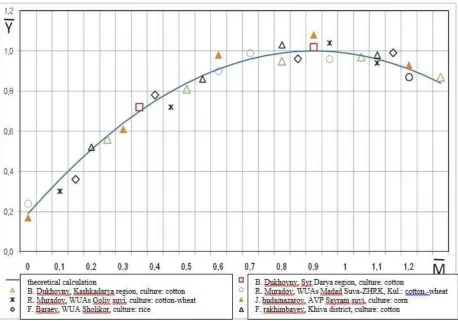
As a result of our research, we have identified the relationship between crop yields and their water availability, and confirmed the functions proposed by R. Muradov (figure 1).
Figure 1. Relationship between crop yields and water availability
The figure shows the dependence of the relative yield Ȳ (the ratio of the experimental yield to the maximum
yield) on the relative irrigation rate M (the ratio of the amount of water in the experiment to the optimal seasonal irrigation rate). The analysis of this graph shows that the yield of agricultural crops (cotton, wheat, rice, corn, etc.) is subject to the optimal law of agriculture, i.e. to create optimal conditions (the norm optimal irrigation) increase
on the type of culture, the natural-climatic conditions, irrigation technology, irrigation water, varieties of culture, applicable agro technology), which assumes a parabolic form.
Currently, the scientific potential in the system of the Ministry of agriculture and water resources is concentrated in higher education institutions. In particular, a system of joint research in 4 higher educational institutions has been established, namely, the Tashkent state agrarian University, the Tashkent Institute of irrigation engineers and agricultural mechanization, the Andijan agricultural Institute, the Samarkand agricultural Institute. In 2016, the total number of professors and teachers in these institutions of higher education was 1,636. Of these, 82% or 5.0% are doctors of science, 554 people or 33.9% are candidates of science, 1000% or 61.1% are researchers without any degree (table 1).
Table 1. Degree of qualification of research scientists to higher education institutions under the Ministry of agriculture and water resources
(01.01.2016)
The Name Of The University
Total number of researchers
From them:
Doctor of science candidate of Sciences
Researchers without a degree
number % number % number %
Tashkent state agrarian University 466 19 4,1 125 26,8 322 69,1
including in the Nukus branch
of 92 4 4,3 25 27,2 63 68,5 Tashkent Institute of Irrigation
and Agricultural Mechanization Engineers
397 25 6,3 133 33,5 239 60,2
including: Bukhara branch 49 4 8,2 21 42,6 24 49,2 Samarkand agricultural Institute 343 22 6,4 159 46,3 162 47,3
Andijan agricultural Institute 289 8 2,8 91 31,5 190 65,7
Number: 1636 82 5,0 554 33,9 1000 61,1
As can be seen from the table, the scientific potential in the Tashkent state agrarian University (with a branch of Nukus) is 31.0%, in the Tashkent Institute of irrigation engineers and agricultural mechanization (with Bukhara branch) - 41.0 %, in the Samarkand agricultural Institute - 52.7%, in the Andijan agricultural Institute - 34.3 %. The low scientific potential of universities is observed in almost all higher education institutions. These negative changes, in turn, have an impact on the quality of highly qualified specialists trained for agriculture and water management and the level of human resources in the sector.
Conducting research only in the center leads to adverse consequences, firstly, limits the possibility of covering the features of agriculture in the regions, secondly, the scientific recommendations are of a General nature and, thirdly, the implementation of research results in practice makes it difficult and limited the participation of the regions.
Based on the above, it is necessary to create " Small innovative enterprises "at research and higher educational institutions and to attract intellectual property owners who are engaged in innovative activities to these enterprises, which will increase the efficiency of innovative processes in the agricultural sector.
As in other sectors of the economy, intellectual property plays an important role in the development of innovation in the water sector, and in the industry it is observed mainly in research. Innovative studies show that patents and inventions received by the holders of intellectual property did not affect the stable growth in the system of water management. Received in 2012 14 (5.1%) patents, and in 2016 4 (1.4%) patents belong to the structure of the water sector.
According to the results of sociological surveys conducted among scientists engaged in scientific and innovative activities in the water management system, the following results were obtained:
- the question "did you Get a patent for your innovations and discoveries created during your scientific and practical activities" - 27% of respondents answered "Yes", and 73% - "no»;
Integrated water resources management, training and retraining of specialists working in existing water management institutions, as well as training of qualified personnel in higher education institutions is a necessary condition. In addition, from the results of the survey conducted under the theme of the study, it should be noted the need for some changes in the structure of specialists prepared for the water management system.
For example, the question asked to respondents who participated in sociological surveys" what should be paid attention to when training specialists in quantity and quality in the country and in the regions", 10% of respondents will answer or that it is necessary to make appropriate changes to the requirements and rules in their training and practical skills; 32% said that it is necessary to be based on specific territorial requirements for the establishment of training quotas and their admission to educational institutions, 41% said that in order to provide personnel of the water management system, improve their quality, it is necessary to prepare (train) these specialists for a certain targeted program, in particular, the payment of the contract amount of students studying on a contract basis, should be made by the Ministry on a centralized basis or introduce a procedure for payment of contracts by the fabled management, 17% of respondents believe that for students, students on a grant basis, it is necessary to develop and implement the exact order, which States that these students must work at least 3-5 years in their specialty based on directions.
It is important to emphasize that for the innovative development of water management, which is an important sector of the economy, it is necessary to improve the organizational and economic mechanisms of uninterrupted supply of personnel involved in the management of organizational, economic and technological processes in all enterprises and organizations for the innovative development of water management, which is an important sector of the economy. In our opinion, according to the results of the study, the organizational and economic mechanism for providing water management personnel with highly qualified scientific, organizational, managerial and technological specialists should include four blocks: organizational management, economic, legal and motivational.
The structure of the organizational and management unit includes government agencies, relevant ministries, basin management, Universities and secondary special colleges. The economic unit includes the training of researchers and practitioners, Finance, taxes, credit system and control and analytical work.
The legal block includes Laws and regulations, Decrees of the President, the Cabinet of Ministers and other regulations on the activities of the system. The motivational block is the main block in the organizational and economic mechanism. Because this block includes the support of the state in the implementation of innovations in the water management system, material and moral incentives for personnel.
In our country, the level of funding for the development and improvement of science has a great impact. That is why funding is identified as a tool that determines the effectiveness of research and effective management. And this, in turn, allows you to pre-determine the research work.
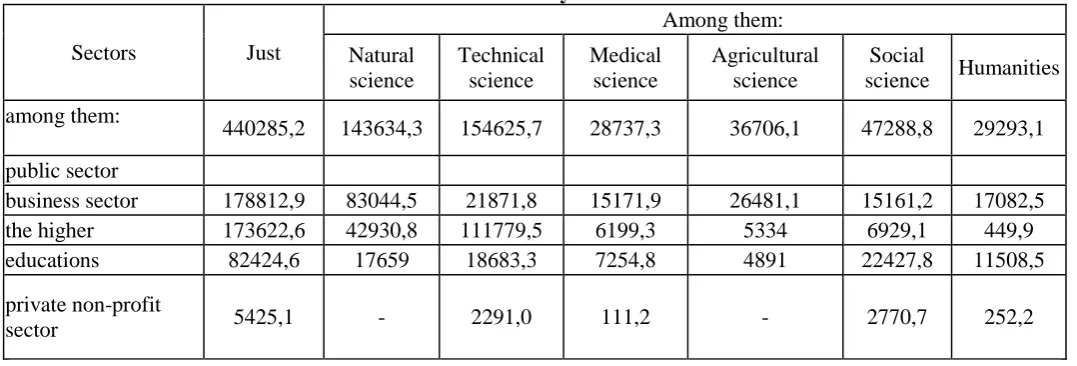
Expenditures for 2016 for research and development in the context of branches of science are given in table 2. As can be seen from the table, in 2016, a significant part of the expenditure on research and development in public sector organizations is the share of natural Sciences (only 46.4% of total expenditure), technical Sciences (64.4%) in the business sector, social Sciences (27.2% and 51.1%, respectively) in higher education and the private non-profit sector.
Table 2. Analysis of expenditure on research and development in the context of branches of science, million sym
Sectors Just
Among them: Natural
science
Technical science
Medical science
Agricultural science
Social
science Humanities among them:
440285,2 143634,3 154625,7 28737,3 36706,1 47288,8 29293,1
public sector
business sector 178812,9 83044,5 21871,8 15171,9 26481,1 15161,2 17082,5 the higher 173622,6 42930,8 111779,5 6199,3 5334 6929,1 449,9 educations 82424,6 17659 18683,3 7254,8 4891 22427,8 11508,5
private non-profit
sector 5425,1 - 2291,0 111,2 - 2770,7 252,2
(64.4%) in the business sector, social Sciences (27.2% and 51.1%, respectively) in higher education and the private non-profit sector.
Most of the expenditure on agricultural science is in the public sector, and 72.1 per cent of the total expenditure is in the same sector.
Over the past seventeen years, there have been significant changes in the structure of sources of funding for research and development carried out by scientific institutions. In particular, in 2000, the financing of research works was carried out at the expense of the customer (44.3% of total costs), in recent years, the financing of these works was mainly carried out by the state budget (57.7%) and own funds (22.3%). In addition, the share of the use of foreign resources and extra-budgetary funds in the financing of scientific research has increased significantly. In 2000 - mainly at the expense of customers and the state budget (84% of the total funding), and in 2016 increased the share of financing from own funds.
According to the forecast, the volume of water entering the country will not increase, but with the growth of global warming and the population, the water flow will decrease to 0.2-1% per year. Given all this, the importance of efficient water use in irrigation and the introduction of water-saving technologies will increase.
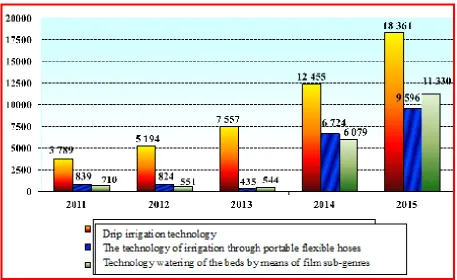
Figure 4 shows the area where modern irrigation methods were introduced in our country in the period 2011-2015. As you can see, the amount of areas using modern irrigation methods is growing every year.
Figure 4. Sowing areas of the Republic, in which 2011-2015 the modern method of irrigation was applied, ha
In 2013, as a result of the successful implementation of the above-mentioned modern irrigation technologies, 25.3 million m3 were saved, in 2014 - 99.6 million m3, in 2015 - 114.6 million m3, and in 2016 - 139.0 million m3 of water. In 2017, this figure was 157.2 million m3.
In 2013-2017, according to the state program and as a result of the measures taken, about 535.7 million m3 of water will be saved. The possibility of solving the issues of sustainable development of the country's economy, as well as the problem of water scarcity and land reclamation is expanding to the saved water resources.
5. CONCLUSION :
Each saved m3 of water will be mastered by other subjects that will allow to make other socially significant
REFERENCES:
1. Decree of the President of the Republic of Uzbekistan dated February 7, 2017 №up-4947 "On the strategy for further development of the Republic of Uzbekistan". - Vol.: Adolat, 2017. - 112 p.
2. Muradov R. A. Technological bases of irrigation and reclamation systems operation in water users associations. Abstract of doctoral dissertation for the degree of doctor of technical Sciences. – Tashkent, 2015. – page 80. 3. Sources: data of the State Committee on statistics of the Republic of Uzbekistan.
4. Krylov E. I., Zhuravkova M. V., Vlasova V. M. Analysis of the efficiency of investment and innovative activity of the enterprise. - Moscow: Finance and statistics, 2001. - 8 PP.;
5. Umarov SR (2017). Features of innovative water management . TRANS Asian Journal of Marketing & Management Research (TAJMMR). Vol. 6, Issue 1, 2017, 45-53.
6. Umarov S.R., Umurzakov UP (2010) Increasing investment activity portfolio in Uzbekistan. “Water management - prospects of development” // Collected articles of young scientists. Rivne, 2010. 128-130 p. 7. Fatkhutdinov R. A. Innovation management. - Moscow: Intel-Sintez, 2000. - 19 p.
8. Hocek M. Innovation in enterprises and their implementation. - Moscow: Luch, 1992.
9. Sandu I. S. and others Organizational and economic mechanism of development of innovative processes in agriculture: method. recommendation. – M.: Rosaka APK, 2005.
10. Aleksanov D. S., Koshelev V. M. Economic evaluation of investments. – Moscow, 2002. – 382 p.; Igonina L. L. Investment. – M.: Economist, 2005. – 478 p.
11. Podshivalenko G. P. Investments: textbook. – M.: KNORUS, 2004. – 208 p.
12. Kayumov F. K. Efficiency of agriculture in the transition to the market. - M.: PolyGram, 1992. 72 p. 13. Jalalov S. CH. Irrigated agriculture in conditions of water scarcity. -Tashkent, 2000. – 38 p.
14. Choriev Q.The A. Prospects for the formation and promotion of the system of introduction of innovations in agriculture (methodological recommendations). - Tashkent, 2014. - Ten P.
15. Umurzakov O.The P., Abdurakhimov I.The L. Water management (tutorial). - What?: Economics-Finance, 2008. - Two volumes.
16. Gazibekov D.Other Issues of financing investments. - Tashkent, 2003. - 332 B.
17.
Durmanov, A. S., Tillaev, A. X., Ismayilova, S. S., Djamalova X. S. & Murodov, S. M. ogli.
“Economic
-mathematical modeling of optimal level costs in the greenhouse vegetables in
Uzbekistan”, Espacios, Vol 40, No 10, pp. 20, 2019.
18.
Tkachenko Serhii, Berezovska Liudmyla, Protas Oksana, Parashchenko Liudmyla, Durmanov Akmal.
Social Partnership of Services Sector Professionals in the Entrepreneurship Education. Journal of
Entrepreneurs
hip Education, Vol: 22 № 4 pp. 6, 2019.
19. Sultanov A.S., Khudoyberganov Z.Eat it., Ram S.The A. Economy of Water Resources. - Tashkent, 2007. 20. Khudoyberganov Z.Eat it. Organizational and economic basis of effective use of Water Resources. -
Monograph. - Tashkent, 2009.
21. Abdullakhanov R. Water Resources Management in Uzbekistan and its problems. Monographs. Tashkent: -2002. – Pp-44 p.