A Modified Finite Newton Method for Fast Solution
of Large Scale Linear SVMs
S. Sathiya Keerthi [email protected]
Dennis DeCoste [email protected]
Yahoo! Research Labs 210 South Delacey Avenue Pasadena, CA 91105, USA
Editor: Thorsten Joachims
Abstract
This paper develops a fast method for solving linear SVMs with L2loss function that is suited for
large scale data mining tasks such as text classification. This is done by modifying the finite Newton method of Mangasarian in several ways. Experiments indicate that the method is much faster than decomposition methods such as SVMlight, SMO and BSVM (e.g., 4-100 fold), especially when the number of examples is large. The paper also suggests ways of extending the method to other loss functions such as the modified Huber’s loss function and the L1loss function, and also for
solving ordinal regression.
Keywords: linear SVMs, classification, conjugate gradient
1. Introduction
Linear SVMs (SVMs whose feature space is the same as the input space of the problem) are power-ful tools for solving large-scale data-mining tasks such as those arising in the textual domain. Quite often, these large-scale problems have a large number of examples as well as a large number of features and the data matrix is very sparse (e.g. >99.9% sparse “bag of words” in text classifica-tion). In spite of their excellent accuracy, SVMs are sometimes not preferred because of the huge training times involved (Chakrabarti et al., 2003). Thus, it is important to have fast algorithms for solving them. Traditionally, linear SVMs have been trained using decomposition techniques such as SVMlight (Joachims, 1999), SMO (Platt, 1999), and BSVM (Hsu and Lin, 2002), which solve the dual problem by optimizing a small subset of the variables in each iteration. Each iteration costs O(nnz)time, where nnzis the number of non-zeros in the data matrix (nnz=mn if the data matrix is full where m is the number of examples and n is the number of features). The number of iterations, which is a function of m and the number of support vectors, tends to grow super-linearly with m and thus these algorithms can be inefficient when m is large.
the final classifier is directly implemented using the weight vector in feature space. In this paper we focus on L2-SVMs.
Since linear SVMs are directly formulated in the input space, it is possible and worthwhile to think of direct methods of solving the primal problem without using the kernel trick. Primal approaches are attractive because they assure a continuous decrease in the primal objective function. Recently some promising primal algorithms have been given for training linear classifiers. Fung and Mangasarian (Fung and Mangasarian, 2001) have given a primal version of the least squares formulation of SVMs given by Suykens and Vandewalle (1999). Komarek (2004) has effectively applied conjugate gradient schemes to logistic regression. Zhang et al. (2003) have given an indirect algorithm for linear L1-SVMs that works by approximating the L1 loss function by a sequence of smooth modified logistic regression loss functions and then sequentially solving the resulting smooth primal modified logistic regression problems by nonlinear conjugate gradient methods. A particular drawback of that method is its inability to exploit the sparsity property of SVMs: that only the support vectors determine the final solution.
A direct primal algorithm for L2-SVMs that exploits the sparsity property, called the finite New-ton method, was given by Mangasarian (2002). It was mainly presented for problems in which the number of features is small. The main aim of this paper is to introduce appropriate tools that transform this method into a powerfully fast technique for solving large scale data mining problems (with a large number of examples and/or a large number of features). Our main contributions are: (1) we modify the finite Newton method by keeping the least squares nature of the problem intact in each iteration and using exact line search; (2) we bring in special, numerically robust conjugate gra-dient techniques to implement the Newton iterations; and (3) we introduce heuristics that speed-up the baseline implementation considerably. The result is an algorithm that is numerically robust and very fast. An attractive feature of the algorithm is that it is also very easy to implement; Appendix A gives a pseudocode that can be easily transcribed into a working code.
We show that the method that we develop for L2-SVMs can be extended in a straight-forward way to the modified Huber’s loss function (Zhang, 2004) and, in a slightly more complicated way to the L1loss function. We also show how the algorithm can be modifed to solve ordinal regression. The paper is organized as follows. Section 2 formulates the problem and gives basic results. The modified finite Newton algorithm is developed in Section 3. Section 4 gives full details associ-ated with a practical implementation of this algorithm. Section 5 gives computational experiments demonstrating the efficiency of the method in comparison with standard methods such as SVMlight (Joachims, 1999) and BSVM (Hsu and Lin, 2002). Section 6 suggests ways for extending the method to other loss functions and Section 7 explains how ordinal regression can be solved. Section 8 contains some concluding remarks.
2. Problem Formulation and Some Basic Results
Consider a binary classification problem with training examples,{xi,ti}m
i=1where xi∈Rnand ti∈
{+1,−1}. To obtain a linear classifier y=w·x+b, L2-SVM solves the following primal problem: min
(w,b) 1 2(kwk
2+b2) +C 2
m
∑
i ξ2
i s.t. ti(w·xi+b)≥1−ξi ∀i (1)
is not affected by this inclusion. In a particular problem if there is reason to believe that the added term does affect performance, one can proceed as follows: takeγ2b2/2 as the term to be included; then define ˜b=γb as the new bias variable and take the classifier to be y=w·x+ (1/γ)˜b. The parameterγcan either be chosen to be a small positive value or be tuned by cross validation.
For applying least squares ideas neatly, it is convenient to transform (1) to an equivalent formu-lation by eliminating theξi’s and dividing the objective function by the factor C. This gives1
min
β f(β) =
λ 2kβk
2+1 2i
∑
∈I(β)
di2(β) (2)
whereβ= (w,b),λ=1/C, di(β) =yi(β)−ti, yi(β) =w·xi+b, and I(β) ={i : tiyi(β)<1}. Least Squares SVM (LS-SVM) (Suykens and Vandewalle, 1999) corresponds to (1) with the inequality constraints replaced by the equality constraints, ti(w·xi+b) =1−ξi for all i. When transformed to the form (2), this is equivalent to setting I(β)={1, . . . ,m}; thus, LS-SVM is solved via a single regularized least squares solution. In contrast, the dependance of I(β)onβcomplicates the L2-SVM solution. In spite of this complexity, it can be advantageous to opt for using L2-SVMs because they do not allow well-classified examples to disturb the classifier design. This is especially true in problems where the support vectors are a small subset of all examples.2
Let us now review several basic results concerning f , some of which are given in Mangasarian (2002). First note that f is a piecewise quadratic function. The presence of theλkβk2/2 term makes f strictly convex. Thus it has a unique minimizer. f is continuously differentiable in spite of the jumps in I(β), the reason for this being that when an index i causes a jump in I(β)at someβ, its di is 0. The gradient of f is given by
∇f(β) =λβ+
∑
i∈I(β)di(β)
xi 1
. (3)
Given an index set I⊂ {1, . . . ,m}, let us define the function fI as
fI(β) = λ 2kβk
2+1 2
∑
i∈Id2
i(β). (4)
Clearly fIis a strictly convex quadratic function and so it has a unique minimizer. It follows directly from (3) that, for any ¯β,∇f(β)|β=β¯ =∇fI¯(β)|β=β¯ where ¯I=I(β¯). In fact, there exists an open set around ¯βin which f and fI¯are identical. It follows that ¯βminimizes f iff it minimizes fI¯.
3. The Modified Finite Newton Algorithm
Mangasarian’s finite newton method (Mangasarian, 2002) does iterations of the form
βk+1=βk+δkpk,
1. To help see the equivalence of (1) and (2), note that at a given(w,b), the minimization ofξ2i in (1) will automatically chooseξi=0 for all i6∈I(β).
2. We find that L2-SVMs usually achieve better generalization performance over LS-SVMs. Interestingly, we also find
where the search direction pkis based on a second order approximation of the objective function at βk:
pk=−H(βk)−1∇f(βk).
Since f is not twice differentiable atβ where at least one of the di is zero, H(β) is taken to be the generalized Hessian defined by H(β) =λJ+CTDC where J is the n×n identity matrix, C is a matrix whose rows are(xTi ,1)and D is a diagonal matrix whose diagonal elements are given by:
Dii=
1 if tiyi(β)<1
some specific element of [0,1] if tiyi(β) =1
0 if tiyi(β)>1
(5)
Note that examples with indices satisfying tiyi(β)>1 do not affect H(β)and pk. (This property contributes greatly to the overall efficiency of the method.) The step sizeδk is chosen to satisfy an Armijo condition that ensures convergence, and it is found by applying a halving method of line search in the[0,1]interval. (If C in (1) is sufficiently small then it is shown in Mangasarian (2002) that the fixed step size,δk=1 suffices for convergence.)
Algorithm L2-SVM-MFN.
1. Choose a suitable startingβ0. Set k=0 and go to step 2.
2. Check ifβkis the optimal solution of (2). If so, stop withβkas the solution. Else go to step 3.
3. Let Ik=I(βk). Solve
min
β fIk(β). (6)
Let ¯βdenote the solution obtained.
4. Do a line search to decrease the “full” objective function, f :
min
β∈L f(β), (7)
where L={β=βk+δ(β¯−βk):δ≥0}. Letδ? denote the solution of this line search. Set βk+1=βk+δ?(β¯−βk), k :=k+1 and go back to step 2 for another iteration.
Theorem 1. Algorithm L2-SVM-MFN converges to the solution of (1) in a finite number of iterations.
Proof. Let pk = (β¯ −βk). Note that pk =−HI−k1∇f(βk) and λI ≤HIk ≤Hall where HIk is
the Hessian of fIk and Hallis the Hessian of f{1,...,m}. By Proposition 1.2.1 of Bertsekas (1999) it
follows3 that{βk} converges to the minimizer of f . Proof of finite convergence is exactly as in Mangasarian’s proof of finite convergence of his algorithm, and goes as follows. Letβ?denote the minimizer of f and I?=I(β?). Let O={β: I(β) =I?}. Clearly O is an open set that containsβ?. Since{βk}converges toβ?, there exists a k such thatβk∈O. When this happens in step 2 of the algorithm, we get ¯β=β?in step 3 and soβk+1=β?.
4. Practical Implementation
In this section we discuss details associated with the implementation of the various steps of the modified finite Newton algorithm and also introduce some useful heuristics for speeding up the algorithm. The discussion leads to a fast and robust implementation of L2-SVM-MFN. The fi-nal algorithm is also very easy to implement; Appendix A gives a pseudocode that can be easily transcribed into a working code. A number of data sets are used in this section to illustrate the effectiveness of various implementation features. These data sets are described in Appendix B. All our computations were done on a 2.4 GHz machine with Intel Xeon processor and having four Gb RAM.
4.1 Step 1: Initialization
If no guess ofβis available, then the simplest starting point isβ0=0. For this point we have yi=0 for all i and so I0={1, . . . ,m}. Therefore, with such a zero initialization, the ¯βobtained in step 3 is exactly the LS-SVM solution.
3. To apply Proposition 1.2.1 of Bertsekas (1999) note the following: (a) Becauseλ>0 and Hallis positive definite,
Adult-9 Web-8 News20 Financial Yahoo Noβ-seeding 60.26 105.16 1321.87 1130.35 11650.56
β-seeding 36.80 24.43 944.27 692.47 4419.89
Table 1: Effectiveness ofβ-seeding on five data sets. The following 21 C values were used: √2k, k=−10,−9, . . . ,9,10. All computational times are in seconds.
Suppose we have a guess ˜w for the weight vector w. It is possible that ˜w comes from an in-expensive classification method, such as the Naive-Bayes classifier. In that case it is necessary to rescale ˜w and also choose b0 so as to form aβ0 that is good for starting the SVM solution. So we setβ0= (γw,˜ b0)and choose suitable values forγand b0. Suppose we also assume that I, a guess of the optimal set of active indices, is available. (If no guess is available, we can simply let I be the set of all training indices.) Then chooseγand b0to minimize the cost
λ 2[γ
2
kw˜k2+b20] +1
2
∑
i∈I[γw˜·xi+b0−ti]2. (8)
It is easy to check that the resultingγand b0are given by
γ= (p22q1−p12q2)/d and b0= (p11q2−p12q1)/d. (9)
where p11=λkw˜k2+∑i∈I(w˜·xi)2, p22=λ+|I|, p12=∑i∈Iw˜·xi, q1 =∑i∈Itiw˜·xi, q2=∑i∈Iti and d=p11p22−(p12)2. Onceγand b0are thus obtained, we can set β
0= (γw,˜ b0)and start the algorithm.4Note that the set of initial indices I0chosen by the algorithm in step 3 is the set of active indices atβ0and so it could be different from I.
There is another situation where the above initialization comes in handy. Suppose we solve (2) for one C and want to re-solve (2) for a slightly changed C. Then we can use the ˜w and I that are obtained from the optimal solution of the first value of C to do the above mentioned initialization process for the second value of C. For this situation we have also tried simply choosingγ=1 and b0equal to the b that is optimal for the first value of C. This simple initialization also works quite well. We will refer to this initialization for the ‘slightly changed C’ situation asβ-seeding; seeding is crucial to efficiency when (2) is to be solved for many C values (such as when tuning C via cross-validation). Theβ-seeding idea used here is very much similar to the idea ofα-seeding popularly employed in the solution of SVM duals(DeCoste and Wagstaff, 2000).
Eventhough full details of the final version of our implementation of L2-SVM-MFN is only developed further below, here let us compare the final implementation5with and withoutβ-seeding. Table 1 gives computational times for several data sets. Clearly,β-seeding gives useful speed-ups.
4. To get a betterβ0one can also reset I=I(β0)and repeat (9) and get revised values forγand b0. This computation is cheap since ˜w·xineed not be recomputed.
5. For noβ-seeding, the implementation corresponds to the use of ‘both heuristics’ mentioned in Table 3. Forβ-seeding,
4.2 Step 2: Checking Convergence
Checking of the optimality ofβkis done by first calculating yi(βk)and di(βk)for all i, determining the active index set Ikand then checking if
k∇fIk(βk)k=0. (10)
For practical reasons it is necessary to employ a tolerance parameter when checking (10). We deal with this important issue below after the discussion of the implementation of step 3.
4.3 Step 3: Regularized Least Squares Solution
The solution of (6) can be approached in one of the following ways: using factorization methods such as QR or SVD; or, using an iterative method such as the conjugate gradient (CG) method. We prefer the latter method due to the following reasons: (a) it can make effective use of knowledge of good starting vectors; and (b) it is much better suited for large-scale problems having sparse data sets. To setup the details of the CG method, let: X be the matrix whose rows are (xTi ,1), i∈Ik; and t be a vector whose elements are ti, i∈Ik. Then (6) is the same as the regularized least squares problem
min
β fIk(β) = λ 2kβk
2+1
2kXβ−tk
2. (11)
This corresponds to the solution of the normal system,
(λI+XTX)β=XTt. (12)
With CG methods there are several ways of approaching the solution of (11/12). A simple approach is to solve (12) using the CG method meant for solving positive definite systems. However, such an approach will not be numerically well-conditioned, especially whenλis small. As pointed out by Paige and Saunders (Paige and Saunders, 1982) this is mainly due to the explicit use of vectors of the form XTX p. An algorithm with better numerical properties can be easily derived by an algorithmic rearrangement that is special to the regularized least squares solution, which makes use of the intermediate vector X p. LSQR (Paige and Saunders, 1982) and CGLS (Bj¨orck, 1996) are two such special CG algorithms. Another very important reason for using one of these algorithms (as opposed to using a general purpose CG solver) is that, for the special methods it is easy to derive a good stopping criterion to approximately terminate the CG iterations using the intermediate residual vector. We discuss this issue in more detail below.
For our work we have used the version of the CGLS algorithm given in Algorithm 3 of Frommer and Maaß (Frommer and Maaß, 1999) which uses initial seed solutions neatly.6 Following is the CGLS algorithm for solving (11).
Algorithm CGLS. Set β0=βk (whereβk is as in steps 2 and 3 of Algorithm L2-SVM-MFN). Compute z0=t−Xβ0, r0=XTz0−λβ0,7set p0=r0and do the following steps for j=0,1, . . .
6. Frommer and Maaß have also given interesting variations of the CGLS method for efficiently solving (12) for several
values ofλ. But we have not tried those methods in this work.
7. It is useful to note that, at any point of the CGLS algorithm−zjis the vector containing the classifier residuals, di,
i∈Ikand rjis the negative of the gradient of fIk(β)atβ
j. At the beginning ( j=0), z0and r0are already available in
qj=X pj
γj=krjk2/(kqjk2+λkpjk2) βj+1=βj+γjpj
zj+1=zj−γjqj rj+1=XTzj+1−λβj+1
If rj+1=0 stop withβj+1as the solution. ωj=krj+1k2/krjk2
pj+1=rj+1+ωjpj
There are exactly two matrix-vector operations in each iteration; sparsity of the data matrix can be effectively used to do these operations in O(nz)time where nzis the number of non-zero elements in the data matrix.
Let us now discuss the convergence properties of CGLS. It is known that the algorithm will take at most l iterations where l is the rank of X . Note that l≤min{m,n}where m is the number of examples and n is the number of features. The actual number of iterations required to achieve good practical convergence is usually much smaller than min{m,n}and it depends on the number of singular values of X that are really significant.
Stopping the CG iterations with the right accuracy is very important because, an excessively accurate solution would lead to too much work while an inaccurate solution will not give good descent. Using a simple absolute tolerance on the size of the gradient of fIk in order to stop is a bad
idea, even for a given data set since the typical size of the gradient varies a lot asλis varied over a range of values. For a method such as CGLS it is easy to find effective practical stopping criteria. We can decide to stop when the negative gradient vector rj+1has come near zero up to some relative precision. To do this we can use the bound,krj+1k ≤ kXkkzj+1k+kλβj+1k. Thus a good stopping criterion is
krj+1k ≤ε(ρkzj+1k+λkβj+1k),
whereρ=kXk. Since X varies at different major iterations of the L2-SVM-MFN algorithm, we can simply takeρ=kXˆkwhere ˆX is the entire m×n data matrix.
In most datamining tasks the data is normalized so that all values in the data matrix are in the unity range. For such data sets we have kXk ≤√n. One can take a conservative approach and simply use the stopping criterion
krj+1k ≤εkzj+1k. (13) We have found this criterion to be very effective and have used it for all the computational experi-ments reported in this paper. The parameterεis a relative tolerance parameter. A value ofε=10−6, which roughly yields solutions accurate up to six decimal digits, is a good choice.
Since r=−∇fIk we can apply exactly the same criteria as in (13) for approximately checking
(10) also. Almost always, termination of L2-SVM-MFN occurs when, after the least squares solu-tion at step 3, exact line search in step 4 givesβk+1=β¯ (i.e.,δ?=1), and the active set remains unchanged, i.e., I(βk) =I(β¯) =I(βk+1).
Table 2: Ratio of the computational cost (averaged over C=2−5,2−4, . . . ,25) of the proximal SVM algorithm to that of LS-SVM-CG. s is the sparsity factor, s=nnz/(nm).
Australian Web-7
(n=14, m=690, s=1.0) (n=300, m=24692, s=0.04)
Ratio 0.72 15.72
data sets. The complexity of the original proximal SVM implementation is O(nnzn+n3)whereas the complexity of the CGLS implementation is O(nnzl), where l is the number of iterations needed by the CGLS algorithm.8 When the data matrix is dense (e.g., Australian) the factorization approach is slightly faster than the CGLS approach. But, when the data matrix is sparse (e.g., Web-7) the CGLS approach is considerably faster, even with n being small.
Similar observations hold for Mangasarian’s finite Newton method as well as our L2-SVM-MFN. When the data matrix is sparse, factorization techniques are much more expensive compared to CG methods, even when n is not too big. Of course, factorization methods get completely ruled out when both m and n are large.
4.4 Step 4: Exact Line Search
Letβ(δ) =βk+δ(β¯−βk). The one dimensional function,φ(δ) = f(β(δ))is a continuously differ-entiable, strictly convex, piecewise quadratic function. To determine the minimizer of this function analytically, we compute the points at which the second derivative jumps. For any given i, let us define:δi= (ti−yki)/(yi¯ −yki), where ¯yi=yi(β¯)and yki =yi(βk). The jump points mentioned above are given by
∆=∆1∪∆2, (14)
where
∆1={δi: i∈Ik,ti(y¯i−yki)>0} and ∆2={δi: i6∈Ik,ti(y¯i−yki)<0}. (15) For∆1 we are not using i with ti(y¯i−yki)≤0 because they do not cause switching at a positiveδ; similarly, for∆2we are not using i with ti(y¯i−yki)≥0.
Take oneδi∈∆1. When we increaseδacrossδi, the index i leaves I(β(δ)). Thus, the term di2/2 has to be left out of the objective function for allδ>δi. Similarly, forδi ∈∆2, when we increase δacross δi, the index i enters I(β(δ)). Thus, the term d2i/2 has to be included into the objective function for allδ>δi.
The slope,φ0(δ)is a continuous piecewise linear function that changes its slope only at one of theδi’s. The optimal pointδ?is the point at whichφ0(δ)crosses 0.9 To determine this point we first sort allδi’s in∆in non-decreasing order. To simplify the notations, let us assume thatδi, i=1,2, . . . denotes that ordering. Betweenδiandδi+1 we know thatφ0(δ)is a linear function. Just for doing calculations extend this line both sides (left and right) to meet theδ=0 andδ=1 vertical lines.
8. It is useful to note here that the proximal SVM implementation solves (12) exactly while LS-SVM-CG uses the practical stopping condition (13) that contributes further to its efficiency.
Let us call the ordinate values at these two meeting points as liand rirespectively. It is very easy to keep track of the changes in liand rias indices get dropped and added to the active set of indices.
We move from left to right to find the zero crossing ofφ0(δ). At the beginning we are atδ0=0. Betweenδ0andδ1we have Ikas the active set. It is easy to get, from the definition ofφ(δ)that
l0=λβk·(β¯−βk) +
∑
i∈Ik(yki −ti)(yi¯ −yki) (16)
and
r0=λβ¯·(β¯−βk) +
∑
i∈Ik(yi¯ −ti)(yi¯ −yki). (17)
(If, at step 3 of the L2-SVM-MFN algorithm, we solve (6) exactly, then it is easy to check that r0=0. However, in view of the use of the approximate termination mentioned in (13) it is better to compute r0using (17).) Find the point where the line joining(0,l0)and(1,r0)points on the(δ,φ0) plane crosses zero. If the zero crossing point of this line is between 0 andδ1then that point isδ?. If not, we move over to searching betweenδ1 andδ2. Here l1and r1need to be computed. This can be done by a simple updating over l0 and r0 since only the term di2/2 enters or leaves. Thus, for a general situation where we already have li, ricomputed for the intervalδitoδi+1and we need to get li+1, ri+1for the intervalδi+1toδi+2, we use the update formula
li+1=li+s(yki −ti)(yi¯ −yki) and ri+1=ri+s(y¯ki −ti)(yi¯ −yki), (18) where s=−1 ifδi∈∆1and s=1 ifδi∈∆2. Thus we keep moving to the right until we get a zero satisfying the condition that the root determined by interpolating(0,li) and(1,ri)lies between δi andδi+1. The process is bound to converge since we know the existence of the minimizer (we are dealing with a strictly convex function). In a typical application of the above line search algorithm, manyδi’s are crossed beforeδ? is reached, especially in the early stages of the algorithm, causing
|I(βk+1)|to be much different from|I(βk)|. This is the crucial step where the support vectors of the problem get identified.
The complexity of the above exact line search algorithm is O(m log m). Since the least squares solution (step 3) is much more expensive, the cost of exact line search is negligible.
4.5 Complexity Analysis
The bulk of the cost of the algorithm is associated with step 3, which only deals with examples that are active at the current point. (The full set of examples is involved only in step 4.) This crucial factor greatly contributes to the overall efficiency of the algorithm. The number of iterations, i.e., loops of steps 2-4 is usually small, say 5-20. Thus, the empirical complexity of the algorithm is
O(nnzlav) where lav, the average number of CG iterations in step 3, is bounded by the rank of the
data matrix and so lav≤min{m,n}. As already mentioned, lavusually turns out to be much smaller than both, m and n. For example, when applied to the financial data set that has 198788 examples and 252472 features, for C=1 and β=0 initialization, L2-SVM-MFN took 11 iterations, with
lav=102.
4.6 Speed-up Heuristics
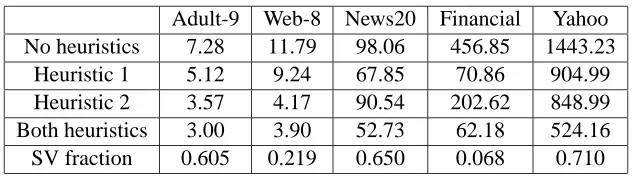
Adult-9 Web-8 News20 Financial Yahoo No heuristics 7.28 11.79 98.06 456.85 1443.23
Heuristic 1 5.12 9.24 67.85 70.86 904.99 Heuristic 2 3.57 4.17 90.54 202.62 848.99 Both heuristics 3.00 3.90 52.73 62.18 524.16 SV fraction 0.605 0.219 0.650 0.068 0.710
Table 3: Effectiveness of the two speed-up heuristics on five data sets. The value C=1 was used. All computational times are in seconds. SV fraction is the ratio of the number of support vectors to the number of training examples.
solving an unnecessarily large least squares problem; it is wasteful to solve it accurately. One (or both) of the following two heuristics can be employed to avoid this.
Heuristic 1. Whenever β0 is a crude approximation (say,β0=0), terminate the least squares
solution of (6) after a fixed, small number (say, 10) of CGLS iterations at the first call to step 3. Even with the crude ¯βthus generated, the following step 4 usually leads to a pointβ1with|I(β1)| much smaller than m, and a good bulk of the non-support vectors get identified correctly.
Heuristic 2. First run the L2-SVM-MFN algorithm using a crude tolerance, sayε=10−2. Use
theβ thus generated as the starting vector and make another run withε=10−6, the final desired accuracy.
Table 3 gives the effectiveness of the above heuristics on a few data sets. Clearly both heuristics are useful. It is not easy to say which one is more effective and so using both of them is the appropriate thing to do. This gives at least a 2-fold speed-up. As expected, the amount of speed-up is big if the fraction of examples that are support vectors is small. The pseudocode of Appendix B uses both heuristics.
A third heuristic may also be used when working with a very large number of examples. First choose a small random subset of the examples and run the algorithm. Then use theβthus generated to seed a second run, this time using all the examples for training.
We end this section on implementation by explaining how a solution of the SVM dual can be obtained after L2-SVM-MFN solves the primal.
4.7 Obtaining a Dual Solution
Note that the SVM dual variables,αi, i=1, . . . ,m are not involved anywhere in the algorithm. But it is easy to recover them once we solve (2) using L2-SVM-MFN. From the structure of (3) it is easy to see thatαi=−tidi/λ, if i∈I(β)andαi=0 otherwise. In a practical solution we do not get the true solution due to the use of (13). In such a situation it is useful to ask as to how well theα defined above satisfies the KKT optimality conditions of the dual. This can be easily done. After computingαas mentioned above, set ˆβ=∑iαiti(xTi ,1)T,ξi=λαi ∀i, gi=tiyi(βˆ) +ξi−1∀i, and obtain the maximum dual KKT violation as max{maxi:αi>0|gi|,maxi:αi=0max{0,−gi}}. If, keeping
check the maximum dual KKT violation as described above. If it does not satisfy the required tolerance then continue the L2-SVM-MFN solution with a suitably chosen smaller value ofε.
5. Comparison with SVMlight and BSVM
The experiments of this section compare L2-SVM-MFN against two dual-based methods: the pop-ular SVMlight (Joachims, 1999)10 and the more modern BSVM (Hsu and Lin, 2002). In order to make a proper comparison L2-SVM-MFN was forced to satisfy the same dual KKT tolerance of τ=0.001 as the other methods. (The procedure given at the end of the last section was used to do this.) We used default-q(subproblem size) for SVMlight & BSVM; other values tried were not faster.11 We also tried SMO (Platt, 1999), but found it slower than the others for these linear problems. An explanation for this is given by Kao et al (Kao et al., 2004) in Section 4 of their paper via the fact that, for the linear SVM implementation, the cost of updating the gradient of the dual is independent of the number of dual variables that are optimized in each basic iteration.
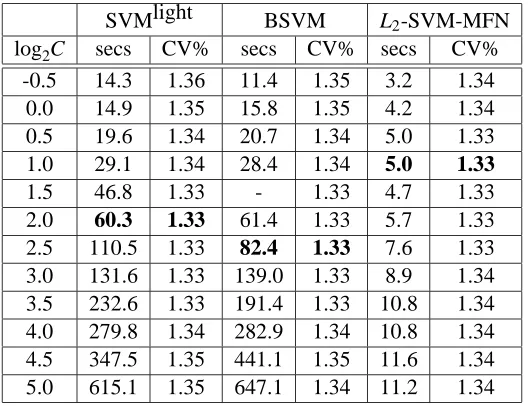
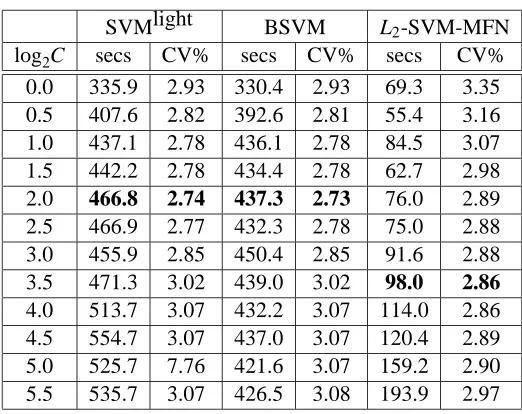
Tables 4-6 report training times and 10-fold cross-validation (CV) error rates for Adult-9, Web-8 and News20 data sets.
We show training times for various C’s, with optimal (lowest) mean CV error rate for each method shown in bold. Due to the different loss functions used, a direct comparison of these meth-ods is challenging and necessarily approximate on non-separable data. Therefore, in the following tables we show results for a range of C values around values of C yielding minimum cross-validation errors for each of the three methods. A reasonable conservative speedup for our method can then be determined by selecting the slowest training time for a near-optimal C value for our method versus the fastest training time for a near-optimal C value for an alternative method.
For example, for Adult-9 one could compare the time for SVMlight’s CV-optimal (112.6 secs) versus the time for L2-SVM-MFN’s CV-optimal (1.6 secs), yielding a speedup ratio of 70.4. Al-ternatively, nearly-CV-optimal cases for Adult-9 (e.g. 15.23%>15.22% for SVMlight with C=2−3) yield other speedups (e.g. 13.2 if both SVMlight and L2-SVM-MFN use C=2−3). Over all such nearly-optimal cases for all three data sets, speedups are consistently significant (e.g. 4-100 over SVMlight and 4-40 over BSVM). Even for News20 which has more than a million features12 L2 -SVM-MFN is more than four times faster than SVMlight and BSVM.
For the Yahoo data set having a million examples, SVMlight and BSVM could not complete the solution even after one full day, while L2-SVM-MFN took only about 10 minutes to obtain a solution.
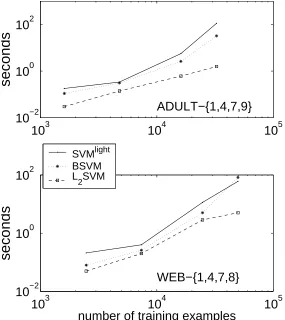
We also did an experiment to study how the algorithms scale with m, the number of examples. Figure 1 gives log-log plots showing the variation of training times as a function of m, for four of the conventional Adult and Web subsets. The times plotted for each data subset/method pair are for the corresponding CV-optimal C’s. These plots show that not only was L2-SVM-MFN always faster, but it also scaled much better with m.
10. We report results using version 5.0 of SVMlight. We also tried the newer version 6.0, but found for our particular experiments with linear kernels that it was no faster, and sometimes even slower.
11. Specifically, the values used for q were 10 for SVMlight and 30 for BSVM.
SVMlight BSVM L2-SVM-MFN log2C secs CV% secs CV% secs CV%
-4.5 16.8 15.29 7.3 15.29 1.2 15.30 -4.0 15.3 15.28 8.1 15.27 1.3 15.26 -3.5 18.6 15.25 8.9 15.27 1.4 15.22 -3.0 21.1 15.23 10.0 15.23 1.6 15.21 -2.5 25.8 15.24 11.7 15.23 1.8 15.21 -2.0 44.4 15.25 13.3 15.24 1.9 15.23 -1.5 47.0 15.23 15.9 15.24 2.2 15.23 -1.0 58.9 15.26 20.3 15.25 3.1 15.22 -0.5 80.9 15.23 25.8 15.24 2.9 15.22 0.0 112.6 15.22 32.4 15.22 2.9 15.23 0.5 189.2 15.23 41.7 15.23 3.1 15.23 1.0 235.9 15.24 54.4 15.22 3.5 15.23
Table 4: Results for Adult-9
SVMlight BSVM L2-SVM-MFN log2C secs CV% secs CV% secs CV%
-0.5 14.3 1.36 11.4 1.35 3.2 1.34 0.0 14.9 1.35 15.8 1.35 4.2 1.34 0.5 19.6 1.34 20.7 1.34 5.0 1.33 1.0 29.1 1.34 28.4 1.34 5.0 1.33 1.5 46.8 1.33 - 1.33 4.7 1.33 2.0 60.3 1.33 61.4 1.33 5.7 1.33 2.5 110.5 1.33 82.4 1.33 7.6 1.33 3.0 131.6 1.33 139.0 1.33 8.9 1.34 3.5 232.6 1.33 191.4 1.33 10.8 1.34 4.0 279.8 1.34 282.9 1.34 10.8 1.34 4.5 347.5 1.35 441.1 1.35 11.6 1.34 5.0 615.1 1.35 647.1 1.34 11.2 1.34
10
310
410
510
−210
010
2seconds
ADULT−{1,4,7,9}
10
310
410
510
−210
010
2number of training examples
seconds
WEB−{1,4,7,8}
SVMlight
BSVM L
2SVM
SVMlight BSVM L2-SVM-MFN log2C secs CV% secs CV% secs CV%
0.0 335.9 2.93 330.4 2.93 69.3 3.35 0.5 407.6 2.82 392.6 2.81 55.4 3.16 1.0 437.1 2.78 436.1 2.78 84.5 3.07 1.5 442.2 2.78 434.4 2.78 62.7 2.98 2.0 466.8 2.74 437.3 2.73 76.0 2.89 2.5 466.9 2.77 432.3 2.78 75.0 2.88 3.0 455.9 2.85 450.4 2.85 91.6 2.88 3.5 471.3 3.02 439.0 3.02 98.0 2.86 4.0 513.7 3.07 432.2 3.07 114.0 2.86 4.5 554.7 3.07 437.0 3.07 120.4 2.89 5.0 525.7 7.76 421.6 3.07 159.2 2.90 5.5 535.7 3.07 426.5 3.08 193.9 2.97
Table 6: Results for News20
6. Extension to Other Loss Functions
The previous sections addressed the solution of L2-SVM, i.e., the SVM primal problem that uses the L2loss function:
min
β f(β) =
λ 2kβk
2+
∑
iL(ξi) (19)
whereξi=1−tiyi(β)and L=L2where L2(ξi) =
0 if ξi≤0 ξ2
i/2 if ξi>0
(20)
The modified Newton algorithm can be adapted for other loss functions too. We briefly explain how to do this for the following loss functions: the modifed Huber’s loss function (Zhang, 2004) and the L1loss function.
Consider, first, the modified Huber’s loss function. The solution for this loss function forms the basis of the solution for the L1 loss function. Recently, Zhang (Zhang, 2004) pointed out that the modified Huber’s loss function has some attractive theoretical properties. The loss function is given by
Lh(ξi) =
0 if ξi≤0 ξ2
i/2 if 0<ξi<2 2(ξi−1) if ξi≥2
(21)
With L=Lh, the primal objective function f in (19) is strictly convex, continuously differentiable and piecewise quadratic, very much as when (20) is used. So the extension of the modified Newton algorithm to Lhis rather easy. A basic iteration proceeds as follows. Givenβklet I0={i :ξi(βk)≤ 0}, I1={i : 0<ξi(βk)<2}and I2={i :ξi(βk)≥2}. The natural quadratic approximation of f to minimize is the one which keeps these index sets unchanged, i.e.,
min
β f˜(β) =
λ 2kβk
2+1 2i
∑
∈I1
(yi(β)−ti)2−2
∑
i∈I2Let
q= 2
λi
∑
∈I2ti
xi 1
and ˜β=β−q so that (22) can be equivalently rewritten as the solution of
min
β f¯(β) =
λ
2kβ−qk 2+1
2i
∑
∈I1
(yi(β)−ti)2. (23)
This is nothing but a regularized least squares solution that is shifted inβspace; the CG techniques described in Section 4 can be used to solve for ˜β=β−q and then βcan be obtained. The exact line search for minimizing f on a ray is only slightly more complicated than the one in Section 4: with (21) we need to watch for jumps of examples from/to three sets of the type I0, I1and I2defined above. The proof of finite convergence of the overall algorithm is very much as for the L2 loss function.
Let us now consider the L1loss function given by
L1(ξi) =
0 if ξi≤0 ξi if ξi>0.
(24)
Choose τ, a positive tolerance parameter and define ˜ξ= (ξi/τ) +1. The L1 loss function can be approximated by Lh(ξ˜). Thus, we can solve the primal problem corresponding to the L1loss function as follows. Take a sequence ofτ values, sayτj=2−j, j=0,1, . . .. Start by solving the problem for j=0. Use theβthus obtained to seed the solution of the problem for j=1 and so on until a solution that approximates the true solution of the L1loss function satisfactorily is obtained. This is only a rough outline of the main scheme. Several details need to be worked out in order to arrive at an overall method that is actually very efficient. Currently we are working on these details; we will report the results in a future paper.
Recently Zhang et al (Zhang et al., 2003) gave a primal algorithm for SVMs with L1loss func-tion in which a modified logistic regression funcfunc-tion is used to approximate the L1loss function and a sequential approximation scheme similar to what we described above is employed. Our method is expected to be more efficient since the approximating loss function (modified Huber) helps keep the sparsity propery, i.e., examples with|ξi| ≥τare inactive during the solution of the linear least squares problem at each iteration. However, this claim needs to be corraborated by proper imple-mentation of both methods and detailed numerical experiments.
7. Extension to Ordinal Regression
In this section we explain how the L2-SVM-MFN algorithm can be adapted to solve ordinal re-gression problems. In ordinal rere-gression the target variable, ti takes a value from a finite set, say,
{1,2, . . . ,p}. Thus, p is the total number of possible ordinal values. Let Js={i : ti=s}. Let w denote the weight vector and yi(w) =w·xi denote the ‘score’ of the SVM for the i-th example. To set up the SVM formulation we follow the approach given in Chu and Keerthi (2005) and use p−1 thresholds, bs, s=1, . . . ,p−1 to divide the scores into p bins so that the interval,(bs−1,bs)is assigned for examples which have ti=s.13 Letβdenote the vector which contains w together with
bs, s=1, . . . ,p−1. For a givenβand an s∈ {1, . . . ,p−1}define the following ‘margin-violating’ index sets:
L
s(β) ={i : i∈Jl for some l≤s and yi(w)−bs>−1}U
s(β) ={i : i∈Jl for some l>s and yi(w)−bs<1}.Then the primal SVM problem can be written as
min
β f(β) =
λ 2kβk
2+ p−1
∑
s=1 (1
2i
∑
∈Ls(w)(yi(w)−bs+1)2+1 2i
∑
∈Us(w)
(yi(w)−bs−1)2). (25)
A nice property of the above formulation is that, as shown in Chu and Keerthi (2005), the solution of (25) automatically satisfies the condition, b1≤b2≤ ··· ≤bp−1.
Clearly, f is a differentiable, strictly convex, piecewise quadratic function of β, very much like the f in (2). So, the extension of L2-SVM-MFN to solve (25) is easy. A basic iteration goes as follows. Givenβk, let ¯
L
k=L
s(βk), ¯U
k=U
s(βk) for s=1, . . . ,p−1 and solve the following quadratic approximation of f corresponding to keeping those index sets unchanged:min
β f˜(β) =
λ 2kβk
2+ p−1
∑
s=1 (1
2i
∑
∈L¯k(yi(w)−bs+1)2+ 1 2i
∑
∈U¯k
(yi(w)−bs−1)2). (26)
Let ¯βdenote the solution of (26). Exact line search to minimize f on the ray fromβk to ¯βis more complicated than the line search we described in Section 4, but it is quite easy to program in code; also, if p is small, the algorithm is not expensive. As in Section 4, we need to identify the points along the ray at which jumps in the second derivative of f take place. Take one example, say the i-th. Let ¯β= (w,¯ ¯b1, . . . ,¯bp−1), ¯yi=yi(w¯)and l =ti. For each s=1, . . . ,l−1, calculate δsi such that yi(βk) +δsi(y¯i−yi(βk)) =bs+1. Similarly, for each s=l, . . . ,p−1, calculate δsi such that yi(βk) +δsi(y¯i−yi(βk)) =bs−1. Each positiveδsi is a point where the second derivative jumps. By calculating all such points (there are at most pm of them, where m is the number of training examples), sorting them and using the ideas of Section 4 to locate the minimizer where the slope crosses the zero value, exact line search can be performed. The proof of convergence of the overall algorithm is very much similar to the proof of Theorem 1.
The ideas outlined above for the L2loss function can be extended to other loss functions such as the modified Huber’s loss function and the L1loss function using the ideas of Section 6.
8. Conclusion
In this paper we have modified the finite Newton method of Mangasarian in several ways to ob-tain a very fast method for solving linear SVMs that is easy to implement and trains much faster than existing alternative SVM methods, making it attractive for solving large-scale classification problems.
the nonlinear CG method has to necessarily deal with all examples in each iteration, unless clever shrinking strategies are designed.
It is interesting to ask if the modified finite Newton algorithm can be extended to nonlinear kernels. If (6) is solved via its dual (say, by using an algorithm for LS-SVMs) the new algorithm can indeed be extended to nonlinear kernels. That would be an interesting primal algorithm that is implemented using dual variables. But it is not yet clear whether such an algorithm will be more efficient than existing good dual methods (e.g. SMO or SVMlight).
Appendix A. A Pseudocode for L2-SVM-MFN
Below, βrepresents the current point; y and I denote the output vector and active index set at β. F= f(β)and Iall ={1, . . . ,m}.
1. Initialization.
• If no initial guess ofβis available, set ini=0,β=0, yi=0∀i∈Iall and I=Iall.
• If a guess of w is obtained from another method (say, the Naive Bayes method), set ini=0, use (9) to formβand then compute yi∀i∈Iall and the active index set I atβ.
• If continuing the solution from one C value to another nearby C value, set ini=1 and simply start with theβ, yi, i∈Ialland I available from the previous C solution.
If ini=0 setε=10−2and Need Second Round=1. If ini=1 setε=10−6and Need Second Round=0. Compute F= f(β).14Set Fprevious=F.
2. Set iter=0 and itermax=50.
3. Define X to be a restricted data matrix whose rows are (xTi ,1), i∈Ik and t to be the corre-sponding target vector whose elements are ti, i∈Ik. (X and t are defined just for stating the steps easily here. In the actual implementation there is no need to actually form them.15) Set: iter=iter+1, ¯β=β, z=t−Xβ, r=XTz−λβ,φ1=krk2, p=r,φ2=φ1. If (ini=0 and iter=1) set cgitermax=10; else set cgitermax=5000. Set cgiter=0, optimality=0 and
exit=0.
4. Repeat the following steps until exit=1 occurs:
cgiter=cgiter+1
q=X p,φ3=kqk2
γ=φ1/(φ3+λφ2), ¯β=β¯+γp z=z−γq,φ4=kzk2
r=−λβ¯+XTz,φold1 =φ1,φ1=krk2 Ifφ1≤ε2φ4set optimality=1
If (optimality=1 or cgiter≥cgitermax) set exit=1 ω=φ1/φold
1 , p=r+ωp,φ2=kpk2
14. Ifβ=0 then note that F=m/2.
5. Compute16 yi¯ =yi(β¯),∀i∈Iall. Check if the following conditions hold: (a) optimality = 1; (b) tiyi¯ ≤1+tol ∀i∈I; and (c) tiyi¯ ≥1−tol ∀i6∈I.17 If all three conditions hold, go to step 8.
6. Compute18 ∆1, ∆2and∆using (14) and (15). Sort theδi in∆in non-decreasing order. Let
{i1,i2, . . . ,iq}denote the list of ordered indices obtained. Compute ls and rs using (16) and (17). Set exit=0, j=0. Repeat the following steps until exit=1 occurs:
j= j+1,δ=δij
delslope=ls+δ(rs−ls)
If delslope≥0 setδ?=−δls/(delslope−ls)and exit=1 Use (18) to update ls and rs using i=ij.
7. Setβ:=β+δ?(β¯−β), y :=y+δ?(y¯−y), and compute the new active index set: I={i∈Iall: tiyi<1}. Compute F=f(β). If (iter≥itermax or F>Fprevious) stop with an error message. Else, set Fprevious=F and go back to step 3 for another iteration.
8. If Need Second Round=0 stop withβ=β¯, y=y and I¯ k as the optimal active index set. Else, setε=10−6, Need Second Round=0 and go back to step 3.
Appendix B. A Description of Data Sets Used
As in the main paper, let m, n and nnz denote, respectively, the number of examples, the number of features and the number of non-zero elements in the data matrix. Let s=nnz/(mn)denote the sparsity in the data matrix.
Australian is a small dense data set taken from the UCI repository(Blake and Merz, 1998) and it has m=690, n=14 and s=1.
Adult and Web are data sets exactly as those used by Platt(Platt, 1999). For Adult, n is 120 and
s is 0.21, while, for Web, n is 300 and s=0.04. With each of these two data sets, Platt created a
sequence of data sets with increasing number of examples in order to study the scaling properties of his SMO algorithm with respect to m. Adult-1, Adult-4, Adult-7 and Adult-9 have the m values 1605, 4781, 16100 and 32561. Web-1, Web-4, Web-7 and Web-8 have the m values 2477, 7366, 24692 and 49749.
We generated News20 for easily reproducible results on a text classification task having both n and m large. It is a size-balanced two-class variant of the UCI “20 Newsgroups” data set (Blake and Merz, 1998). The positive class consists of the 10 groups with names of formsci.*,comp.*, or misc.forsale, and the negative class consists of the other 10 groups. We tokenized via McCal-lum’s Rainbow(McCallum, 1996), using:rainbow -g 3 -h -s -O 2 -i(i.e. trigrams, skip mes-sage headers, no stoplist, drop terms occurring less than two times), giving m=19996, n=1355191
16. The arrays, p, r, q and z are local to step 4 and are not used elsewhere. Hence it is alright to use the same arrays
elsewhere in the implementation. This can help save some memory. For example, p can be used to store the ¯yi
computed in step 5 and r can be used to store theδicomputed in step 6.
17. In view of numerical errors it is a good idea to employ the parameter tol in these checks. A value of tol=10−8is a
good choice.
18. This step refers to several equations from the main paper. To match the notations given there, take: yiin this algorithm
to be yki of the main paper; ls in this pseudocode to stand for l0, li, li+1etc; and rs in this pseudocode to stand for r0,
and s=0.000336. We used binary term frequencies and normalized each example vector to unit length.
Financial is a text classification data set that we created and corresponds to classifying news stories as financial or non-financial. Unigrams occuring in the news texts were taken as the features and a tf-idf representation was used to form the data. The data set has m=198788, n=252472 and s=0.00094.
Yahoo is a large data set obtained from Yahoo! and is a classification problem concerning the prediction of behavior of customers. It has m=1 million, n=80 and s=0.098.
References
D. P. Bertsekas. Nonlinear Programming. Athena Scientific, Belmont, Massachussetts, 1999.
A. Bj¨orck. Numerical Methods for Least Squares Problems. SIAM, Philadelphia, 1996.
C. L. Blake and C. J. Merz. UCI repository of machine learning databases. Technical report, University of California, Irvine, 1998. www.ics.uci.edu/∼mlearn/MLRepository.html.
S. Chakrabarti, S. Roy, and M. V. Soundalgekar. Fast and accurate text classification via multiple linear discriminant projections. The VLDB Journal, 12:170–185, 2003.
W. Chu and S. S. Keerthi. New approaches to support vector ordinal regression. Technical report, Yahoo! Research Labs, Pasadena, California, USA, 2005.
D. DeCoste and K. Wagstaff. Alpha seeding for support vector machines. In Proceedings of the International Conference on Knowledge Discovery and Data Mining, pages 345–359, 2000.
A. Frommer and P. Maaß. Fast CG-based methods for Tikhonov-Phillips regularization. SIAM Journal of Scientific Computing, 20(5):1831–1850, 1999.
G. Fung and O. L. Mangasarian. Proximal support vector machine classifiers. In Proceedings of the Seventh ACM SIGKDD International Conference on Knowledge Discovery and Data Mining, pages 77–86, 2001.
C. W. Hsu and C. J. Lin. A simple decomposition method for support vector machines. Machine Learning, 46:291–314, 2002.
T. Joachims. Making large-scale SVM learning practical. In Advances in Kernel Methods - Support Vector Learning. MIT Press, Cambridge, Massachussetts, 1999.
W. C. Kao, K.M. Chung, T. Sun, and C. J. Lin. Decomposition methods for linear support vector machines. Neural Computation, 16:1689–1704, 2004.
P. Komarek. Logistic regression for data mining and high-dimensional classification. Ph.d. thesis, Carnegie Mellon University, Pittsburgh, Pennsylvania, USA, 2004.
A. McCallum. Bow: A toolkit for statistical language modeling, text retrieval, classification and clustering. Technical report, University of Massachssetts, Amherst, Massachussetts, USA, 1996. www.cs.cmu.edu/∼mccallum/bow.
C. C. Paige and M. A. Saunders. LSQR: An algorithm for sparse linear equations and sparse least squares,. ACM Transactions on Mathematical Software, 8:43–71, 1982.
J. Platt. Sequential minimal optimization: A fast algorithm for training support vector machines. In Advances in Kernel Methods - Support Vector Learning. MIT Press, Cambridge, Massachussetts, 1999.
J. Suykens and J. Vandewalle. Least squares support vector machine classifiers. Neural Processing Letters, 9(3):293–300, 1999.
J. Zhang, R. Jin, Y. Yang, and A. Hauptmann. Modified logistic regression: An approximation to SVM and its applications in large-scale text categorization. In Twentieth International Conference on Machine Learning, pages 472–479, 2003.