Priyanka Mathur et al, International Journal of Computer Science and Mobile Applications, Vol.5 Issue. 10, October- 2017, pg. 1-9 ISSN: 2321-8363 Impact Factor: 4.123
Usability Testing Methods for Mobile
Learning Applications
Priyanka Mathur
11
Research Scholar, Department of C S and IT, The IIS University, Jaipur, INDIA [email protected]
Swati V. Chande
22
Professor, Department of Computer Science, International School of Informatics and Management, Jaipur, INDIA [email protected]
Abstract: “The search for common ground in a divided market” is how Ben Feigin (2013) describes mobile application development. The reach of mobile devices has grown exponentially in the past decade, with it grew the requirement and subsequently the need of developing mobile applications. As mobile phones have become popular in the society and many people can afford the cost, the demand of mobility is extended to teaching and learning purposes says Leung (2003). To cope with frequent development of Mobile Learning Applications, engineers need a reusable and cost-effective environment for testing mobile applications. In the fleet of mobile applications being developed everyday it is imperative that an application is of high usability to the user otherwise the rate of acceptance for the application falls. To make sure of its acceptance it needs to be ensured that is application is of high usability for the end user. It necessitates that; the application needs to be tested for usability thoroughly. Usability testing is a type of testing done from an end-user’s perspective to determine if the system is easily usable. It refers to evaluating the ease with which users can learn to use a product. But, usability techniques to be carried out are large in numbers, so it becomes difficult to study all of them and then to decide the most appropriate one to be used. It is therefore required that an extensive study for the identification of the most suitable and relevant usability testing method is carried out.
This paper aims to identify the most preferred usability testing method which is recommended by software practitioners and testers for testing a Mobile Learning Application (m-LA). To find out the most preferred testing method evidence based approach is used, where the evidences of usability testing methods being used by researchers are congregated through systematic literature review.
1. Introduction
Priyanka Mathur et al, International Journal of Computer Science and Mobile Applications, Vol.5 Issue. 10, October- 2017, pg. 1-9 ISSN: 2321-8363 Impact Factor: 4.123
usability. Usability Testing according to Harrison et al (2013) in the light of mobile applications is evaluated in terms of four main attributes: effectiveness, efficiency, satisfaction and cognitive load.
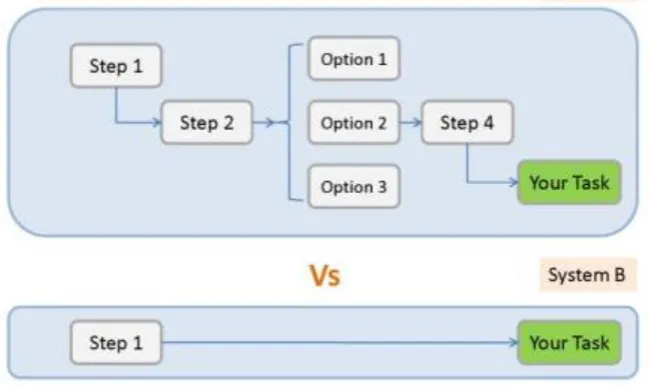
As shown in Figure 1 usability testing is done to make the applications convenient and practicable for use. The purpose of this this testing is to review the application user interface with the end users using the application. This is to ensure that the design (layout, buttons and color schemes, etc.) enables the application functions to be executed easily and intuitively. Although Systems may be built 100% in accordance with the specifications, yet they may be ‘unusable’ for the end-users.
Figure 1: Usability Testing in Mobile Learning Applications
So to check for usability, it is required that applications are tested with appropriate techniques of Usability Testing. The number of Usability Testing methods is many reports Muccini et al. (2012). So to gather evidences for an appropriate method(s) suitable for m-LA a literature search was conducted to see the existing studies done in Usability Testing in m-LA.
2. Literature Review
As discussed by Muccinni et al (2012) mobile application testing techniques needs to be identified in particular due to the diversity of mobile platforms and different features of different mobile devices. So a literature search was done to identify the techniques used by researchers to test Mobile Learning Applications.
Priyanka Mathur et al, International Journal of Computer Science and Mobile Applications, Vol.5 Issue. 10, October- 2017, pg. 1-9 ISSN: 2321-8363 Impact Factor: 4.123
application more usable and user friendly. They further suggest that very few m-LA are tested for usability despite a hike in their development rate.
Alsumait and Al-Osaimi (2015) further reinforced that for a Mobile Learning Application [m-LA] to perform optimally, it must be scrutinized in terms of its usability like educational benefits and its ability to interact with users. This is important because e-learning and m-learning applications should satisfy some factors like effectiveness, satisfaction of interfaces and effectiveness. Dirin (2015) in his research proposed a mLUX (mobile Learning Usability and User Experience) framework for multitasking mLA. They suggest that efficiency in usability is a highly motivating force for the users to opt in for such applications. As Traxler (2005) had emphasized very early that mobile learning using handheld computers is a juvenile pedagogical tool; and it is developing rapidly. Mere technology is not enough, there is an obvious need to design these applications so that they are user-centered and have high usability.
A study by Oyomno et al (2013) tries to solve the usability issues with a different user perspective, they suggest usability studies be focused on the leitmotifs of effectiveness, efficiency, learnability, memorability, error-rate, and scope. Kronbauer et al (2012) found lack of approaches in the literature which suggest techniques to implement usability testing in mobile applications except for few methods like quantitative data (metrics), subjective evaluation (users' impressions) and context data.
3. Method
This section discusses the Systematic Literature Review (SLR) for Usability Testing in m-LA. In this study, our research methodology for a SLR was based on the guidelines laid by Kitchenham and Charters (2004). In order to gather the evidences the following stages were followed for systematic review:
Priyanka Mathur et al, International Journal of Computer Science and Mobile Applications, Vol.5 Issue. 10, October- 2017, pg. 1-9 ISSN: 2321-8363 Impact Factor: 4.123
3.1 Formation of research questions
This study aims to build a classification scheme of all the related evidences gathered by studying empirical studies of Mobile Learning Application testing through Usability Testing techniques. The study tries to identify the contributions made by various researchers through their studies on Usability Testing on m-LA reported till the current year.
To achieve this, the following research question (RQ) was specified: RQ. Which of the existing Usability Methods (UM) are frequently applied for Mobile Learning Application development specifically?
The RQ was framed to discover if the UMs have been specifically crafted for the Mobile Application field or they have been taken from already existing UMs and which of them are most favoured amongst the researchers for m-LA.
3.2 Definition of search strategy
In this SLR, both qualitative and quantitative empirical research studies have been included. The research studies have to be directly focussing on Usability Testing methods or approaches. To search for evidences we constructed a search string for which we adopted the approach recommended by Kitchenham and Charters (2007):
a) Search for keywords in Research Question(s) and then search for their synonyms and alternative keywords.
b) Use of Boolean AND/OR to incorporate alternate spellings and synonyms. c) Use Boolean AND to join important terms together.
The search terms were taken from the research question (see Table 1). The terms “mobile application”, “testing”, and “challenges” represented the main terms. Additionally, we aggregated additional terms as synonyms such as “verification”, “fault”, “approach” and “limitation” to make the search broader and to ensure that we cover larger area.
The primary search process involved the use of standard online databases that index Computer Science and ICT related literature. These include: ACM Digital Library, IEEExplore, Scopus, ScienceDirect, SpringerLink and ProQuest.
# String Search string
1 ((mobile) AND (learning application OR learning software) AND (testing OR verification) AND (technique OR approach OR method))
2 ((mobile) AND (learning application OR learning software) AND (testing OR verification) AND (technique OR approach OR method))
Priyanka Mathur et al, International Journal of Computer Science and Mobile Applications, Vol.5 Issue. 10, October- 2017, pg. 1-9 ISSN: 2321-8363 Impact Factor: 4.123
verification OR fault) AND (technique OR approach OR method)))
4 (((("mobile learning application" OR "mobile learning applications" OR “mobile learning apps” ) AND ( testing OR verification) AND (technique OR approach OR method))))
Table 1: Search strings to identify Usability Methods 3.3 Selection of primary studies
These search strings were applied on all databases using advanced command search feature. Additionally to keep the results relevant with the changing environment in mobile applications the search years were restricted to 2010 to 2016. One study published in 2017was also included. The search process was constrained for studies related to computer science field only due to the fact that the term mobile is frequently used in many engineering disciplines.
The SLR was iterative in nature i.e. each paper passed through three steps of filtration:
a) We searched the database using search string, and the papers whose titles and abstracts were related to m-LA were included rest were filtered out.
b) In the second step the resulting studies from the first step were scrutinized on the basis of their complete text.
c) In the final phase all the related studies that were totally relevant with the RQ were grouped together and this constituted our primary data set.
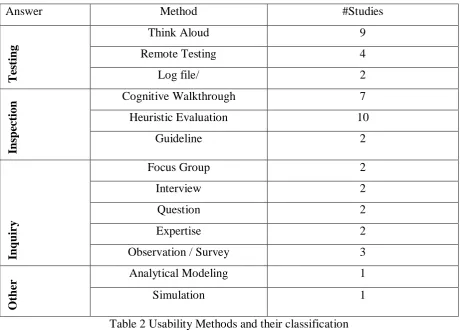
This primary data set was then considered for result analysis. The first step shortlisted 218 studies and after the second step, 35 studies were found appropriate for finding the best suitable evidence for finding Usability Testing methods in Mobile Learning Applications . The methods identified are given in Table 2. The methods identified are Think Aloud, Remote Testing, Log file/Cognitive Walkthrough, Heuristic Evaluation, Guideline, Focus Group, Interview, Question, Expertise, Observation / Survey, Analytical Modeling and Simulation. These methods are further classified on the basis of classification given by Ivory and Hearst (2001).
3.4 Extraction of data
Priyanka Mathur et al, International Journal of Computer Science and Mobile Applications, Vol.5 Issue. 10, October- 2017, pg. 1-9 ISSN: 2321-8363 Impact Factor: 4.123
Table 2 Usability Methods and their classification
From this primary data set some additional information (along with the usability testing
methods used) that contributed to the research question was also fetched. Information like
research approach of the study, study setting while testing (i.e. Field study or Lab Controlled
experiments) settings was also analyzed. All the extracted data was collated on spread sheets
and the frequencies of the publications was noted.
3.5
Results Analysis
The research question that was framed for the study was:
RQ. Which of the existing Usability Methods (UM) are frequently applied for Mobile Learning Application development specifically?
To answer this RQ, the studies included in this SLR were grouped and classified according to
the classification scheme described by Ivory and Hearst (see Table 2). There were multiple
occurrences of studies that suggested two usability methods to be used together. For such
studies the frequency count was added in both methods. The main Usability Methods that are
Answer
Method
#Studies
T
es
tin
g
Think Aloud
9
Remote Testing
4
Log file/
2
In
sp
ec
tion
Cognitive Walkthrough
7
Heuristic Evaluation
10
Guideline
2
In
q
u
iry
Focus Group
2
Interview
2
Question
2
Expertise
2
Observation / Survey
3
Ot
h
er
Analytical Modeling
1
Priyanka Mathur et al, International Journal of Computer Science and Mobile Applications, Vol.5 Issue. 10, October- 2017, pg. 1-9 ISSN: 2321-8363 Impact Factor: 4.123
recommended by researchers for testing mobile learning applications are Think Aloud
(recommended by 9 researchers), Cognitive Walkthrough (recommended by 7 researchers)
and Heuristic Evaluation (recommended by 10 researchers).
In the present work, as can be seen from Table 2 Heuristic Evaluation is by far the most
widely used evaluation method which is implemented to perform Usability Testing. Another
effective method is Think Aloud.
Researchers like M. E. Marwan et al.[2014], S. Al Roobaea et al.[2013], Abdoasslam Hatab
M Katy [2016], Mohammed Rajab [2016], Ingrid Nascimento [2016], Medvidovic [2010],
Marc Ericson C. et al.[2013] and a few more mentioned Cognitive Walkthrough (CW) as an
effective UEM for Mobile Applications. Cognitive Walkthrough is when a usability expert
simulates the actions of a novice user of the system. During this interaction, the inspector has
to identify potential issues of usability.
Heuristic Evaluation is another method which is widely used by the researchers and
practitioners as can be seen in representative studies conducted by Yong Gu Ji [2006],
Roobaea AlRoobaea et al. [2013], Lin Chou Cheng [2016], Bettina Biel et al. [2010], Ingrid
Nascimento, et al. [2016], Rodolfo Inostroza et al. [2010], Chul-Kang Yoo, Jung Yoon Kim
[2015], Luis Rivero, et al. [2014], M.Fetaji, B.Fetaji [2011], Azham Bin Hussain [2015],
Andrés Solano [2016], Rosa Yáñez Gómez et al.[2014] and many more. In Heuristic
Evaluation/ Expertise
/
Heuristic
Assessment a group of usability specialists/experts decide
whether or not every dialogue part of the software follows established usability principles, it
is referred to as “heuristics”.
And a very few studies suggested Guideline Walkthrough/ Review as a desired UM under
Inspection method.
Priyanka Mathur et al, International Journal of Computer Science and Mobile Applications, Vol.5 Issue. 10, October- 2017, pg. 1-9 ISSN: 2321-8363 Impact Factor: 4.123
protocol”. Users have to verbalize their thoughts while they interact with the software system.
Supervisors should encourage end-users to express their opinions during the activity.
We believe that test engineers would find it difficult to choose among techniques available
under the different categories of usability testing, based on our observation researchers
suggest using Heuristic Evaluation or Think Aloud Method to be used imperatively while
testing any m-LA.. These results will solve the problems of test engineers because several test
methods and techniques exist with no clear road-map available for test engineers guiding
them on which method or technique to choose while testing. We recommend future studies
that can compare and confirm the literature results empirically.
References
1. Leung, C. H., & Chan, Y. Y. (2003, July). Mobile learning: A new paradigm in electronic learning. In Advanced learning technologies, 2003. Proceedings. The 3rd IEEE international conference on (pp. 76-80). IEEE.
2. www.businesswire.com (http://www.businesswire.com/news/home/20161227005069/en/Education-Apps-Market-Grow-28-CAGR-Owing)
3. Hao, S., Li, D., Halfond, W. G., & Govindan, R. (2013, June). SIF: a selective instrumentation
framework for mobile applications. In Proceeding of the 11th annual international conference on
Mobile systems, applications, and services (pp. 167-180). ACM.
4. I., Nguyen, B., Garousi, V., & Memon, A. (2013). Graphical user interface (GUI) testing: Systematic
mapping and repository. Information and Software Technology, 55(10), 1679-1694.
5. Itkonen, J. (2008). Do test cases really matter? An experiment comparing test case based and
exploratory testing.Licentiate, Helsinki University of Technology.
6. Jaworska, J., & Hoffmann, S. (2010). Integrated testing Strategy (ItS)–Opportunities to better use
existing data and guide future testing in toxicology. Altex, 27(4), 231-242
7. Kasoju, A., Petersen, K., & Mäntylä, M. V. (2013). Analyzing an automotive testing process with
evidence-based software engineering. Information and Software Technology, 55(7), 1237-1259.
8. Kitchenham B, Brereton OP, Budgen D, Turner M, Bailey J, Linkman S. Systematic literature reviews
in software engineering a systematic literature review. Information and Software
Technology. 2009;51(1):7–15.
9. Marchetto, A., Ricca, F., & Tonella, P. (2008). A case study-based comparison of web testing
techniques applied to AJAX web applications. International journal on software tools for technology
transfer, 10(6), 477-492.
Priyanka Mathur et al, International Journal of Computer Science and Mobile Applications, Vol.5 Issue. 10, October- 2017, pg. 1-9 ISSN: 2321-8363 Impact Factor: 4.123
11. N. Alshahwan and M. Harman, “Automated web application testing using search based software engineering,” in IEEE/ACM Int. Conference on Automated Software Engineering (ASE), 2011, pp. 3–
12
12. Orso, A., & Rothermel, G. (2014, May). Software testing: a research travelogue (2000–2014). In
Proceedings of the on Future of Software Engineering (pp. 117-132). ACM.
13. P. McMinn. Search-based software test data generation: A survey. Software Testing, Verification and
Reliability, 14(2):105–156, 2004.
14. Rao, K. N., & Sastri, A. P. (2011). Overcoming testing challenges in project life cycle using risk based
validation approach. International Journal on Computer Science & Engineering, 3(3), 1232-1239.
15. Rashid, M., Ardito, L., & Torchiano, M. (2015, October). Energy consumption analysis of algorithms
implementations. In Empirical Software Engineering and Measurement (ESEM), 2015 ACM/IEEE
International Symposium on (pp. 1-4). IEEE.
16. Sharples M. Taylor J. Vavoula G. “Towards a Theory of Mobile Learning”. Proceedings of mLearn
2005 Conference, 2005.
17. Simon Poulding, Robert Alexander, John A. Clark, and Mark J.Hadley.The optimisation of stochastic
grammars to enable cost-effective probabilistic structural testing. In 15th Annual Conference on Genetic and Evolutionary Computation (GECCO ’13), pages 1477–1484, New York, Y, USA, 2013.
ACM