MedLDA: Maximum Margin Supervised Topic Models
Jun Zhu [email protected]
State Key Lab of Intelligent Technology and Systems
Tsinghua National Lab for Information Science and Technology Department of Computer Science and Technology
Tsinghua University Beijing, 100084, China
Amr Ahmed [email protected]
Eric P. Xing [email protected]
School of Computer Science Carnegie Mellon University Pittsburgh, PA 15213, USA
Editor:David Blei
Abstract
A supervised topic model can use side information such as ratings or labels associated with doc-uments or images to discover more predictive low dimensional topical representations of the data. However, existing supervised topic models predominantly employ likelihood-driven objective func-tions for learning and inference, leaving the popular and potentially powerful max-margin principle unexploited for seeking predictive representations of data and more discriminative topic bases for the corpus. In this paper, we propose the maximum entropy discrimination latent Dirichlet alloca-tion (MedLDA) model, which integrates the mechanism behind the max-margin predicalloca-tion models (e.g., SVMs) with the mechanism behind the hierarchical Bayesian topic models (e.g., LDA) un-der a unified constrained optimization framework, and yields latent topical representations that are more discriminative and more suitable for prediction tasks such as document classification or re-gression. The principle underlying the MedLDA formalism is quite general and can be applied for jointly max-margin and maximum likelihood learning of directed or undirected topic models when supervising side information is available. Efficient variational methods for posterior inference and parameter estimation are derived and extensive empirical studies on several real data sets are also provided. Our experimental results demonstrate qualitatively and quantitatively that MedLDA could: 1) discover sparse and highly discriminative topical representations; 2) achieve state of the art prediction performance; and 3) be more efficient than existing supervised topic models, espe-cially for classification.
Keywords: supervised topic models, max-margin learning, maximum entropy discrimination,
latent Dirichlet allocation, support vector machines
1. Introduction
over a given vocabulary. The document-specific admixture proportion vectorθθθ, also known as the
topic vector, is modeled as a latent Dirichlet random variable, and can be regarded as a low dimen-sional representation of the document in a topical space. This low dimendimen-sional representation can be used for downstream tasks such as classification, clustering, or merely as a tool for structurally visualizing the otherwise unstructured document collection.
The original LDA is an unsupervised model and is typically built on a discrete bag-of-words representation of input contents, which can be text documents (Blei et al., 2003), images (Fei-Fei and Perona, 2005), or even network entities (Airoldi et al., 2008). However, in many practical ap-plications, we can easily obtain useful side information besides the document or image contents. For example, when online users post their reviews for products or restaurants, they usually associate each review with a rating score or a thumb-up/thumb-down opinion; web sites or pages in the pub-lic Yahoo! Directory1 can have their categorical labels; and images in the LabelMe (Russell et al., 2008) database are organized by a visual ontology and additionally each image is associated with a set of annotation tags. Furthermore, there is an increasing trend towards using online crowdsourc-ing services (such as Amazon Mechanical Turk2) to collect large collections of labeled data with a reasonably low price (Snow et al., 2008). Such side information often provides useful high-level or direct summarization of the content, but it is not directly used in the original LDA or models alike to influence topic inference. One would expect that incorporating such information into latent aspect modeling could guide a topic model towards discovering secondary or non-dominant, albeit seman-tically more salient statistical patterns (Chechik and Tishby, 2002) that may be more interesting or relevant to the user’s goal, such as prediction on unlabeled data.
To explore this potential, developing new topic models that appropriately capture side infor-mation mentioned above has recently gained increasing attention. Representative attempts include supervised topic model (sLDA) (Blei and McAuliffe, 2007), which captures real-valued document rating as a regression response; multi-class sLDA (Wang et al., 2009), which directly captures dis-crete labels of documents as a classification response; and discriminative LDA (DiscLDA) (Lacoste-Julien et al., 2008), which also performs classification, but with a mechanism different from that of sLDA. All these models focus on the document-level side information such as document categories or review rating scores to supervise model learning. More variants of supervised topic models can be found in a number of applied domains, such as the aspect rating model (Titov and McDonald, 2008) for predicting ratings for each aspect of a hotel and the credit attribution model (Ramage et al., 2009) that associates each word with a label. In computer vision, several supervised topic models have been designed for understanding complex scene images (Sudderth et al., 2005; Fei-Fei and Perona, 2005; Li et al., 2009). Mimno and McCallum (2008) also proposed a topic model for considering document-level meta-data, for example, publication date and venue of a paper.
It is worth pointing out that among existing supervised topic models for incorporating side infor-mation, there are two classes of approaches, namely,downstream supervised topic model(DSTM) andupstream supervised topic model(USTM). In a DSTM the response variable is predicted based on the latent representation of the document, whereas in an USTM the response variable is being conditioned on to generate the latent representation of the document. Examples of USTM3include DiscLDA and the scene understanding models (Sudderth et al., 2005; Li et al., 2009), whereas
1. Yahoo directory can be found athttp://dir.yahoo.com/.
2. Amazon Mechanical Turk can be found athttps://www.mturk.com/.
sLDA is an example of DSTM. Another distinction between existing supervised topic models is the training criterion, or more precisely, the choice of objective function in the optimization-based learning. The sLDA model is trained by maximizing thejointlikelihood of the content data (e.g., text or image) and the responses (e.g., labeling or rating), whereas DiscLDA is trained by maximiz-ing theconditionallikelihood of the responses given contents. To the best of our knowledge, all the existing supervised topic models are trained by optimizing a likelihood-based objective; the highly successful margin-based objectives such as the hinge loss commonly used in discriminative models such as SVMs have never been employed.
In this paper, we proposemaximum entropy discrimination latent Dirichlet allocation(MedLDA), a supervised topic model leveraging the maximum margin principle for making more effective use of side information during estimation of latent topical representations. Unlike existing supervised topic models mentioned above, MedLDA employs an arguably more discriminative max-margin learning technique within a probabilistic framework; and unlike the commonly adopted two-stage heuristic which first estimates a latent topic vector for each document using a topic model and then feeds them to another downstream prediction model, MedLDA integrates the mechanism behind the max-margin prediction models (e.g., SVMs) with the mechanism behind the hierarchical Bayesian topic models (e.g., LDA) under a unified constrained optimization framework. It employs a com-posite objective motivated by a tradeoff between two components—the negative log-likelihood of an underlying topic model which measures the goodness of fit for document contents, and a measure of prediction error on training data. It then seeks a regularized posterior distribution of the predic-tive function in a feasible space defined by a set ofexpectedmargin constraints generalized from the SVM-style margin constraints. The resultant inference problem is intractable; to circumvent this, we relax the original objective by using a variational upper bound of the negative log-likelihood and a surrogate convex loss function that upper bounds the training error. Our proposed approach builds on earlier developments in maximum entropy discrimination (MED) (Jaakkola et al., 1999; Jebara, 2001) and partially observed maximum entropy discrimination Markov network (PoMEN) (Zhu et al., 2008), but is significantly different and more powerful. In MedLDA, because of the influence of both the likelihood function over content data (e.g., text or image) and margin con-straints induced by the side information, the discovery of latent topics is therefore coupled with the max-margin estimation of model parameters. This interplay can yield latent topical representations that are more discriminative and more suitable for supervised prediction tasks, as we demonstrate in the experimental section.
In fact, the methodology we develop in this paper generalizes beyond learning topic models; it can be applied to perform max-margin learning for various types of graphical models, including di-rected Bayesian networks, for example, LDA, sLDA and topic models with different priors such as the correlated topic models (Blei and Lafferty, 2005), and undirected Markov networks, for example, exponential family harmoniums (Welling et al., 2004) and replicated softmax (Salakhutdinov and Hinton, 2009) (See Section 4 for an extensive discussion). In this paper, we focus on the scenario of downstream supervised topic models, and we present several concrete examples of MedLDA that build on the original LDA to learn “discriminative topics” that allow more salient topic proportion vectorθθθto be inferred for every document, evidenced by a significant improvement of accuracy of both regression and classification of documents based on theθθθresulted from MedLDA, over the θ
D
N
W
dnZ
dn˥
d˞
˟
kK
D N Wdn
Zdn
˥d
Yd
˞
ˤ,ˡ2
˟k
K
Figure 1: Graphical illustration of (Left) unsupervised LDA (Blei et al., 2003); and (Right) super-vised LDA (Blei and McAuliffe, 2007).
LDAs. This advantage stems from the fact that MedLDA can directly optimize a margin-based loss instead of a likelihood-based one, and thereby avoids dealing with the normalization factor resul-tant from a full probabilistic generative formulation (e.g., sLDA), which generally makes learning harder.
The remainder of this paper is structured as follows. Section 2 introduces the preliminaries that are needed to present MedLDA. Section 3 presents MedLDA models for both regression and clas-sification, together with efficient variational algorithms. Section 4 discusses the generalization of MedLDA to other topic models. Section 5 presents empirical studies of MedLDA. Finally, Section 6 concludes this paper with future research directions discussed. Part of the materials of this paper build on conference proceedings presented earlier in Zhu et al. (2009); Zhu and Xing (2010).
2. Preliminaries
We begin with a brief overview of the fundamentals of topic models, support vector machines, and the maximum entropy discrimination formulism (Jaakkola et al., 1999), which constitute the major building blocks of the proposed MedLDA model.
2.1 Unsupervised and Supervised Topic Models
Latent Dirichlet allocation (LDA) (Blei et al., 2003) is a hierarchical Bayesian model that projects a text document into a latent low dimensional space spanned by a set of automatically learned topical bases. Each topic is a multinomial distribution over Mwords in a given vocabulary. Let
w= (w1, . . . ,wN) denote the vector of words appearing in a document (for notation simplicity,
we suppress the indexing subscript ofN and assume that all documents have the same lengthN); assume the number of topics to be an integerK, whereKcan be manually specified by a user or via cross-validation; and letβββ= [βββ1, . . . ,βββK]denote theM×Kmatrix of topic distribution parameters, of which eachβββkparameterizes a topic-specific multinomial word distribution. Under an LDA, the likelihood of a documentdcorresponds to the following generative process:
1. Draw a topic mixing proportion vector θθθd according to a K-dimensional Dirichlet prior:
θ
θθd|ααα∼Dir(ααα);
2. For then-th word in documentd, where 1≤n≤N,
(a) draw a topic assignmentzdnaccording toθθθd: zdn|θθθd∼Mult(θθθd);
where zdn is a K-dimensional indicator vector (i.e., only one element is 1; all others are 0), an instance of the topic assignment random variableZdn. With a little abuse of notations, we useβββzdn to denote the topic that is selected by the non-zero element ofzdn.
According to the above generative process, an unsupervised LDA defines the following joint distribution for a corpus
D
that containsDdocuments:p({θθθd,zd},W|ααα,βββ) =
D
∏
d=1
p(θθθd|ααα)
N
∏
n=1
p(zdn|θθθd)p(wdn|zdn,βββ)
,
where W,{w1;· · ·;wD} denotes all the words in
D
, and zd ,{zd1;· · ·;zdN}. To estimate the unknown parameters(ααα,βββ), and to infer the posterior distributions of latent variables{θθθd,zd}, an EM procedure is developed to maximize the marginal data likelihood4 p(W|ααα,βββ). As we have stated,θθθd represents the mixing proportion overKtopics for documentd, which can be treated asa low-dimensional representation of the document. Moreover, since the posterior ofzdnrepresents the probability distribution that wordnis assigned to one of theKtopics; the average topic assign-ment ¯zd, N1∑nzdncan also be treated as a representation of the document, as commonly done in
downstream supervised topic models (Blei and McAuliffe, 2007; Wang et al., 2009).
Due to intractability of the likelihood p(W|ααα,βββ), approximate inference algorithms based on variational (Blei et al., 2003) or Markov Chain Monte Carlo (MCMC) (Griffiths and Steyvers, 2004) methods have been widely used for parameter estimation and posterior inference under LDA. We focus on variational inference in this paper. The following variational bound for unsupervised LDA will be used later. Let q({θθθd,zd}) represent a variational distribution that approximates the true
model posterior p({θθθd,zd}|ααα,βββ,W), one can derive a variational bound
L
u(q;ααα,βββ)for thelikeli-hood under unsupervised LDA:
L
u(q;ααα,βββ) ,−Eq[logp({θθθd,zd},W|ααα,βββ)]−
H
(q({θθθd,zd})) (1) ≥ −logp(W|ααα,βββ),where
H
(q),−Eq[logq]is the entropy of q. By making some independence assumption (e.g.,mean field) aboutq,
L
u(q)can be efficiently optimized (Blei et al., 2003).As we have stated, the unsupervised LDA described above does not use side information for learning topics and inferring topic vectorsθθθ. In order to consider side information appropriately for discovering more predictive representations, supervised topic models (sLDA) (Blei and McAuliffe, 2007) introduce a response variable Y to LDA for each document, as shown in Figure 1. For regression, wherey∈R, the generative process of sLDA is similar to LDA, but with an additional step—draw a response variable: y|zd,ηηη,δ2∼
N
(ηηη⊤z¯d,δ2)for each document d, whereηηηis theregression weight vector andδ2is a noise variance parameter. Then, the joint distribution of sLDA is:
p({θθθd,zd},y,W|ααα,βββ,ηηη,δ2) =
D
∏
d=1
p(θθθd|ααα)
N
∏
n=1
p(zdn|θθθd)p(wdn|zdn,βββ)
p(yd|ηηη⊤z¯d,δ2), (2)
wherey,{y1;· · ·;yD}. In this case, the joint likelihood is p(y,W|ααα,βββ,ηηη,δ2). Given a new docu-ment, the prediction is the expected response value
ˆ
y,E[Y|w,ααα,βββ,ηηη,δ2] =ηηη⊤E[Z|¯ w,ααα,βββ,δ2], (3) where the average topic assignment random variable ¯Z,N1∑nZn(¯zis an instance of ¯Z), and the
ex-pectation is taken with respect to the posterior distribution ofZ,{Z1;· · ·;ZN}. However, exact
in-ference is again intractable, and one can use the following variational upper bound
L
s(q;ααα,βββ,ηηη,δ2) forsupervisedsLDA for approximate inference:L
s(q;ααα,βββ,ηηη,δ2) ,−Eq[logp({θθθd,zd},y,W|ααα,βββ,ηηη,δ2)]−H
(q({θd,zd})) (4)≥ −logp(y,W|ααα,βββ,ηηη,δ2).
By changing the model of generatingY, sLDA can deal with other types of response variables, such as discrete ones for classification (Wang et al., 2009) using the multi-class logistic regression
p(y|ηηη,z) = exp(ηηη
⊤
yz¯)
∑y′exp(ηηη⊤y′¯z)
, (5)
whereηηηy is the parameter vector associated with class labely. However, posterior inference in an sLDA classification model can be more challenging than that in the sLDA regression model. This is because the non-Gaussian probability distribution in Equation (5) is highly nonlinear ofηηηandzand its normalization factor can make the topic assignments of different words in the same document strongly coupled. Variational methods were successfully used to approximate the normalization factor (Wang et al., 2009), but they can be computationally expensive as we shall demonstrate in the experimental section.
DiscLDA (Lacoste-Julien et al., 2008) is yet another supervised topic model for classification. DiscLDA is an upstream supervised topic model and as such the unknown parameter is the transfor-mation matrix that is used to generate the document latent representations conditioned on the class label; and this transformation matrix is learned by maximizing the conditional marginal likelihood of the text given class labels.
This progress notwithstanding, to the best of our knowledge, current developments of super-vised topic models have been solely built on a likelihood-driven probabilistic inference paradigm. The arguably sometimes more powerful max-margin based techniques widely used in learning dis-criminative models have not been exploited to learn supervised topic models. The main goal of this paper is to systematically investigate how the max-margin principe can be exploited inside a topic model to learn topics that are better at discriminating documents than current likelihood-driven learning achieves while retaining semantic interpretability as the later allows. For this purpose, be-low we briefly review the max-margin principle underlying a major technique built on this principle, the support vector machines.
2.2 Support Vector Machines
et al., 2003). Depending on the nature of the response variable, the max-margin principle can be exploited in both classification and regression. Below we use document rating prediction as an example to recapitulate the ideas behind support vector regression (SVR) (Smola and Sch¨olkopf, 2003), which we will shortly leverage to build our first instance of max-margin topic model.
Let
D
={(x1,y1),· · ·,(xD,yD)} be a training set, wherex∈X
are inputs such asdocument-feature vectors, and y∈R are response values such as user ratings. Using SVR, one obtains a functionh(x)∈
F
that makes at mostεdeviation from the true response valueyfor each training example, and at the same time is as flat as possible. One common choice of the function familyF
is linear functions, that is,h(x;ηηη) =ηηη⊤f(x), wheref={f
1,· · ·,fI}is a vector of feature functions
fi :
X
→R, andηηηis the corresponding weight vector. Formally, the linear SVR finds an optimal linear function by solving the following constrained optimization problem:P0(SVR): min η η η,ξξξ,ξξξ∗
1 2kηηηk
2 2+C
D
∑
d=1
(ξd+ξ∗d)
∀d,s.t.:
yd−ηηη⊤f(xd) ≤ε+ξd −yd+ηηη⊤f(x
d) ≤ε+ξ∗d
ξd,ξ∗d ≥0 ,
wherekηηηk2,
p
η η
η⊤ηηηis theℓ
2-norm;ξξξandξξξ∗ are slack variables that tolerate some errors in the training data; εis a precision parameter; andCis a positive regularization constant. Problem P0 can be equivalently formulated as a regularized empirical loss minimization, where the loss is the so-calledε-insensitive loss (Smola and Sch¨olkopf, 2003).
Under a standard SVR, P0 is a quadratic programming (QP) problem and can be easily solved in a Lagrangian dual formulation. Samples with non-zero lagrange multipliers are called support vectors, as in the SVM classification model. There exist several free packages for solving standard SVR, such as SVM-light (Joachims, 1999). We will use these methods as a sub-routine in our proposed approach, as we will detail in the sequel.
2.3 Maximum Entropy Discrimination
To unite the principles behind topic models and SVR, namely, Bayesian inference and max-margin learning, we employ a formalism known as maximum entropy discrimination (MED) (Jaakkola et al., 1999; Jebara, 2001), which learns a distribution of all possible regression/classification models that belong to a particular parametric family, subject to a set of margin-based constraints. For instance, the MED regression model, or simply MEDr, learns a distributionq(ηηη)through solving
the following optimization problem:
P1(MEDr): min
q(ηηη),ξξξ,ξξξ∗ KL(q(ηηη)kp0(ηηη)) +C
D
∑
d=1
(ξd+ξ∗d)
∀d, s.t.:
yd−E[ηηη]⊤f(xd) ≤ε+ξd −yd+E[ηηη]⊤f(xd) ≤ε+ξ∗d
ξd,ξ∗d ≥0 ,
wherep0(ηηη)is a prior distribution over the parameters andKL(pkq),Ep[log(p/q)]is the
As studied in Jebara (2001), this MED problem leads to an entropic-regularized posterior dis-tribution of the SVR coefficients,q(ηηη); and the resultant predictor ˆy=Eq(ηηη)[h(x;ηηη)]enjoys several nice properties and subsumes the standard SVR as special cases when the prior p0(η) is standard normal (Jebara, 2001). Moreover, as shown in Zhu and Xing (2009); Zhu et al. (2011a), with dif-ferent choices of the prior overηηη, such as a sparsity-inducing Laplace or a nonparametric Dirichlet process, the resultantq(ηηη)can exhibit a wide variety of characteristics and are suitable for diverse utilities such as feature selection or learning complex non-linear discriminating functions. Finally, the recent developments of the maximum entropy discrimination Markov network (MaxEnDNet) (Zhu and Xing, 2009) and partially observed MaxEnDNet (PoMEN) (Zhu et al., 2008) have ex-tended the basic MED to the much broader scenarios of learning structured prediction functions with or without latent variables.
To apply the MED idea to learn a supervised topic model, a major difficulty is the presence of heterogeneous latent variables in the topic models, such as the topic vectorθθθand topic indica-tor Z. In the sequel, we present a novel formalism calledmaximum entropy discrimination LDA
(MedLDA) that extends the basic MED to make this possible, and at the same time discovers latent discriminating topics present in the study corpus based on available discriminant side information.
3. MedLDA: Maximum Margin Supervised Topic Models
Now we present a new class of supervised topic models that explicitly employ labeling information in the context of document classification or regression, under a unified statistical framework that jointly optimizes over the cross entropy between a user supplied model prior and the aimed model posterior, and over the margin of ensuing predictive tasks based on the learned model. This is to contrast conventional heuristics that first learn a topic model, and then independently train a classifier such as SVM using the per-document topic vectors resultant from the first step as inputs. In such a heuristic, the document labels are never able to influence the way topics can be learned, and the per-document topic vectors are often found to be not strongly predictive (Xing et al., 2005).
3.1 Regressional MedLDA
We first consider the scenario where the numerical-valued rating of documents in the corpus is available, and our goal is to learn a supervised topic model specialized at predicting the rating of new documents through a regression function. We call this model a Regressional MedLDA, or simply,MedLDAr.
Instead of learning a point estimate of regression coefficient ηηηas in sLDA or SVR, we take the more general Bayesian-style (i.e., an averaging model) approach as in MED and learn a joint distribution5 q(ηηη,z)in a max-margin manner. For prediction, we take a weighted average over all the possible models (represented byηηη) and latent topical representationsz, or more precisely, an expectation of the prediction overq(ηηη,z), which is similar to that in Equation (3), but now over both η
ηηandZ, rather than only overZ:
ˆ
y,E[Y|w,ααα,βββ,δ2] =E[ηηη⊤Z|¯ w,ααα,βββ,δ2]. (6) Now, the question underlying the prediction rule (6) is how we can devise an appropriate objec-tive function as well as constraints to learn aq(·)that leverages both the max-margin principle (for
strong predictivity) and the topic model architecture (for topic discovery). Below we begin with a simple reformulation of the sLDA that makes this possible.
3.1.1 MAX-MARGINTRAINING OF SLDA
Without loss of generality, we letq(ηηη,z) =Rθθθq(ηηη)q(z,θθθ|ηηη), whereq(ηηη)is the learned distribution of the predictive regression coefficient, andq(z,θθθ|ηηη)is the learned distribution of the topic elements of the documents analogous to an sLDA-style topic model, but estimated from a different learning paradigm that leverages margin-based supervised training. As reviewed in Section 2.1, two good templates for q(z,θθθ|ηηη)can be the original LDA or sLDA. For brevity, here we present a regres-sional MedLDA that uses the supervised sLDA as the underlying topic model. As we shall see in Section 3.2 and Appendix B, the underlying topic model can also be an unsupervised LDA.
Let p0(ηηη)denote a prior distribution ofηηη, then MedLDArdefines a joint distribution
p(ηηη,{θθθd,zd},y,W|ααα,βββ,δ2) =p0(ηηη)p({θθθd,zd},y,W|ααα,βββ,ηηη,δ2),
where the second factor has the same form as Equation (2) for sLDA, except that nowηηηis a random variable and follows a priorp0(ηηη). Accordingly, the likelihood p(y,W|ααα,βββ,δ2)is an expectation of the likelihood of sLDA underp0(ηηη), which makes it even harder than in sLDA to directly optimize. Therefore, we choose to optimize a variational upper bound of the log-likelihood. We will discuss other approximation methods in Section 4.
Letq(ηηη,{θθθd,zd}) be a variational approximation to the posterior p(ηηη,{θθθd,zd}|ααα,βββ,δ2,y,W).
Then, an upper bound6
L
bs(q;ααα,βββ,δ2)of the negative log-likelihood isL
bs(q;ααα,βββ,δ2) ,−Eq[logp(ηηη,{θθθd,zd},y,W|ααα,βββ,δ2)]−
H
(q(ηηη,{θθθd,zd}))=KL(q(ηηη)kp0(ηηη)) +Eq(ηηη)[
L
s]. (7)We can see that the bound is also an expectation of sLDA’s variational bound
L
sin Equation (4). Toderive Equation (7), we should note that the variational distribution for sLDA is “conditioned on” its model parameters, which includeηηη. Similarly, the distributionqin
L
bsdepends on the parameters(ααα,βββ,δ2). For notation clarity, we have omitted the explicit dependence on parameters in variational distributions.
Based on the MED principle and the variational bound in Equation (7), we define the learning problem of MedLDAras follows:
P2(MedLDAr): min
q,ααα,βββ,δ2,ξξξ,ξξξ∗ Eq(ηηη)[
L
s(q;ααα,βββ,δ2)] +KL(q(ηηη)kp0(ηηη)) +CD
∑
d=1
(ξd+ξ∗d)
∀d, s.t.:
yd−E[ηηη⊤Z¯d]≤ε+ξd −yd+E[ηηη⊤Zd¯ ]≤ε+ξ∗
d
ξd,ξ∗d ≥0,
whereξξξ,ξξξ∗ are slack variables, andεis a precision parameter as in SVR. The margin constraints in P2 are of the same form as those in P0, but in an expectation version because both the topic assignmentsZand parametersηηηare latent random variables in MedLDAr.
It is easy to verify that at the optimum, at most one ofξdandξ∗dcan be non-zero andξd+ξ∗d=
max(0,|yd−E[ηηη⊤Zd¯ ]| −ε), which is known asε-insensitive loss (Smola and Sch¨olkopf, 2003), that is, if the current prediction ˆyas in Equation (6) does not deviate from the true response value too much (i.e., less than ε), there is no loss; otherwise, a linear loss will be penalized. Mathemati-cally, problem P2 can be equivalently written as a loss minimization problem without using slack variables:
min
q,ααα,βββ,δ2
L
bs(q;ααα,βββ,δ2) +C∑
Dd=1
max(0,|yd−E[ηηη⊤Zd¯ ]| −ε), (8)
where the variational bound
L
bsplays two roles—regularization andmaximum likelihood estima-tion. Specifically, as shown in Equation (7),L
bs decomposes into two parts. The first part ofKL-divergence is an entropic regularizer forq(ηηη); and the second term is an expected bound of the data likelihood, as we have discussed. Therefore, problem P2 is a joint maximum margin learning and maximum likelihood estimation (with appropriate regularization), and the two components are coupled by sharing latent topic assignmentsZand parametersηηη.
The rationale underlying MedLDAris that: by minimizing an integrated objective function, we aim to find a latent topical representation and a document-rating prediction function which, on one hand, can predict accurately on unseen data with a sufficient margin, and on the other hand, can explain the data well (i.e., minimizing a variational bound of the negative log-likelihood). The max-margin learning and topic discovery procedure are coupled together via the constraints, which are defined on the expectations of model parametersηηηand latent topical assignmentsZ. This interplay will yield a topical representation that could be more suitable for prediction tasks, as explained below and verified in experiments.
3.1.2 VARIATIONALAPPROXIMATIONALGORITHM FORMEDLDAr
Minimizing
L
bs is intractable. Here, we use mean field methods (Jordan et al., 1999) widelyem-ployed in fitting LDA and sLDA to efficiently obtain an approximateqfor problem P2. Specifically, we assume thatqis a fully factorized mean-field approximation to p:
q(ηηη,{θθθd,zd}) =q(ηηη)
D
∏
d=1
q(θθθd|γγγd) N
∏
n=1
q(zdn|φφφdn),
whereγγγd is aK-dimensional vector of Dirichlet parameters and eachφφφdnparameterizes a multino-mial distribution overKtopics. It is easy to verify that:
E[Zdn] =φφφdn,andE[ηηη⊤Zd¯ ] =E[ηηη]⊤(1
N N
∑
n=1 φ φφdn).
Now, we develop a coordinate descent algorithm to solve the equivalent “unconstrained” for-mulation (8). The algorithm is outlined in Algorithm 1 and detailed below.
(1) Solve for (ααα,βββ,δ2)and q(ηηη): Whenq({θθθd,zd}) is fixed, this substep (in an equivalent con-strained form) is to solve
min
q(ηηη),ααα,βββ,δ2,ξξξ,ξξξ∗ Eq(ηηη)[
L
s(q;ααα,βββ,δ2)] +KL(q(ηηη)kp0(ηηη)) +C
D
∑
d=1
Algorithm 1Variational MedLDAr
1: Input:corpus
D
={(y,W)}, constantsCandε, and topic numberK.2: Output:Dirichlet parametersγγγ, posterior distributionq(ηηη), parametersααα,βββandδ2. 3: repeat
4: ford=1toDdo
5: Updateγγγd as in Equation (13). 6: forn=1toNdo
7: Updateφφφdnas in Equation (14).
8: end for
9: end for
10: Solve the dual problem D2 to getq(ηηη), ˆµµµand ˆµµµ∗.
11: Updateβββusing Equation (10), and updateδ2using Equation (11). Optimizeαααwith gradient descent or fixαααas 1/Ktimes the ones vector.
12: untilconvergence
∀d,s.t.:
yd−E[ηηη⊤Z¯d]≤ε+ξd, (µd) −yd+E[ηηη⊤Zd¯ ]≤ε+ξ∗
d, (µ∗d)
ξd≥0, (vd)
ξ∗
d≥0, (v∗d),
where{µd,µ∗
d,vd,v∗d}are lagrange multipliers. Since the margin constraints are not dependent
on (ααα,βββ,δ2), we can solve for them using the same procedure as in sLDA, when q(ηηη) and
q({θθθd,zd})are given. Specifically, for ααα, the same gradient descent method as in Blei et al.
(2003) can be applied; forβββ, the update equations are the same as for sLDA:
βkw∝ D
∑
d=1
N
∑
n=1
I(wdn=w)φkdn, (10)
whereI(·)is an indicator function that equals to 1 if the condition holds; otherwise 0; and for δ2, the update rule is similar as that of sLDA but in an expected version, becauseηηηis a random variable:
δ2= 1
D
y⊤y−2y⊤E[A]E[ηηη] +E[ηηη⊤E[A⊤A]ηηη], (11)
whereE[ηηη⊤E[A⊤A]ηηη] =tr(E[A⊤A]E[ηηηηηη⊤]), andAis aD×Kmatrix whose rows are the vectors ¯
Zd⊤.
Solving for q(ηηη) can be done using Lagrangian methods, but it is a bit more delicate. For brevity, we postpone the details of this step after we have finished presenting the overall proce-dure. We denote the optimum lagrange multipliers by(µµµ,ˆ µµµˆ∗)and the optimum slack variables by(ξξξˆ,ξξξˆ∗).
(2) Solve for q({θθθd,zd}): By fixingq(ηηη)and(ααα,βββ,δ2), this substep (in an equivalent constrained
form) is to solve
min
q({θθθd,zd}),ξξξ,ξξξ∗ Eq(ηηη)
[
L
s(q;ααα,βββ,δ2)] +C∑
Dd=1
∀d,s.t.:
yd−E[ηηη⊤Z¯d]≤ε+ξd −yd+E[ηηη⊤Zd¯ ]≤ε+ξ∗
d
ξd,ξ∗d≥0,
Since the constraints are not dependent onγγγd andq(ηηη)is also not directly connected withθθθd,
we get the same update rule forγγγd as in sLDA:
γγγd=ααα+
N
∑
n=1
φφφdn. (13)
Forq(zd), in theory, we can do the optimization to get the optimal solution ofφφφand the
corre-sponding optimal lagrange multipliers. But the full optimization would be expensive, especially considering that this sub-step is within the most inner iteration loop and it would be performed for many times. Here, we adopt an approximation strategy, which performs a single step update ofφφφ, rather than a full optimization. Note that this one-step approximation could lead to a slight increase of the objective function during the iterations. Our empirical studies show that this increase is usually within an acceptable range. More specifically, we fix(ξξξ,ξξξ∗)at(ξξξˆ,ξξξˆ∗) (the optimum solution of the previous step) and set the lagrange multipliers to be(µµµ,ˆ µµµˆ∗). Then, we have the closed-form update equation7
φ φ
φdn∝exp
E[logθθθd|γγγd] +logp(wdn|βββ) + yd
Nδ2E[ηηη]−
2E[ηηη⊤φφφd,−nηηη] +E[ηηη◦ηηη]
2N2δ2
+E[ηηη]
N (µdˆ −µˆ
∗
d)
, (14)
whereφφφd,−n,∑i6=nφφφdi;ηηη◦ηηηis the element-wise product; and the result of exponentiating a
vector is a vector of the exponentials of its corresponding components. Note that the first two terms in the exponential are the same as those in LDA.
Remark 1 From the update rule ofφφφin Equation (14), we can see that the essential differences between MedLDArand sLDA lie in the last three terms in the exponential ofφφφdn. Firstly, the third and fourth terms are similar to those of sLDA, but in an expected version since we are learning the distribution q(ηηη)instead of a point estimate ofηηη. The second-order expectationsE[ηηη⊤φφφd,−nηηη]and
E[ηηη◦ηηη]mean that the co-variances ofηηη(See Corollary 3 for an example) affect the distribution over topics. This makes our approach significantly different from a point estimation method, like sLDA, where no expectations or co-variances are involved in updatingφφφdn. Secondly, the last term is from the max-margin regression formulation. For a document d, which lies on the decision boundary, that is, a support vector, either µd or µ∗d is non-zero, and the last term biasesφφφdntowards a distribution that favors a more accurate prediction on the document. Moreover, the last term is fixed for words in the document and thus will directly affect the latent representation of the document, that is,γγγd. Therefore, the latent representationθθθdinferred under MedLDArcan be more suitable for supervised prediction tasks. Our empirical studies further verify this, as we shall see in Section 5.
Now, we turn to the sub-step of solving for q(ηηη), as well as the slack variables and lagrange multipliers. Specifically, we have the following result.
Proposition 2 For MedLDAr, the optimum solution of q(ηηη)has the form:
q(ηηη) = p0(ηηη)
Z exp
η η η⊤
D
∑
d=1
(µˆd−µˆ∗d+ yd
δ2)E[Z¯d]−ηηη
⊤E[A⊤A] 2δ2 ηηη
,
where E[A⊤A] =∑Dd=1E[Zd¯ Z¯⊤d], and E[Zd¯ Z¯d⊤] = N12(∑
N
n=1∑m6=nφφφdnφφφdm⊤ +∑Nn=1diag{φφφdn}). The lagrange multipliers(µµµ,ˆ µµµˆ∗)are the solution of the dual problem of (9):
D2 : max
µµµ,µµµ∗ −logZ−ε
D
∑
d=1
(µd+µ∗d) + D
∑
d=1
yd(µd−µ∗d)
∀d,s.t.: µd,µ∗d∈[0,C].
Proof(sketch) By setting the partial derivative of the Lagrangian functional overq(ηηη)equal to zero, we can get the solution ofq(ηηη). Pluggingq(ηηη)into the Lagrangian functional and solving for the optimal(vd,v∗
d)and(ξd,ξ∗d)as in the standard SVR to get the box constraints, we get the dual
prob-lem.
In MedLDAr, we can choose different priors to introduce some regularization effects. For the standard normal prior, we have the following corollary:
Corollary 3 Assume the prior p0(ηηη) =
N
(0,I), where I is the identity matrix, then the optimumsolution of q(ηηη)is
q(ηηη) =
N
(λλλ,Σ),whereλλλ=Σ(∑Dd=1(µˆd−µˆ∗d+ yd
δ2)E[Z¯d])is the mean andΣ= (I+1/δ2E[A⊤A])−1 is a K×K co-variance matrix. The dual problem D2 is now:
max
µµµ,µµµ∗ −
1 2ωωω
⊤Σωωω−ε
∑
Dd=1
(µd+µ∗d) + D
∑
d=1
yd(µd−µ∗d) (15)
∀d,s.t.: µd,µ∗d∈[0,C],
whereωωω=∑Dd=1(µd−µ∗d+ yd δ2)E[Zd¯ ].
Corollary 4 Assume the prior p0(ηηη) =
N
(0,I), then the mean λλλ of q(ηηη) in problem (9) is theoptimum solution of the following problem:
min λ λ λ,ξξξ,ξξξ∗
1 2λλλ
⊤
Σ−1λλλ−λλλ⊤(
D
∑
d=1
yd
δ2E[Z¯d]) +C
D
∑
d=1
(ξd+ξ∗d) (16)
∀d, s.t.:
yd−λλλ⊤E[Z¯d]≤ε+ξd −yd+λλλ⊤E[Zd¯ ]≤ε+ξ∗
d
ξd,ξ∗d≥0
Proof See Appendix A for details.
The above primal form can be re-formulated as a standard SVR problem. Specifically, we do Cholesky decompositionΣ−1=U⊤U, whereU is an upper triangular matrix with strict positive diagonal entries. Letννν=∑Dd=1δyd2E[Zd¯ ], and we defineλλλ
′
=U(λλλ−Σννν);yd′ =yd−ννν⊤ΣE[Zd¯ ]; and
xd = (U−1)⊤E[Z¯d]. Then, the above primal problem in Corollary 4 can be re-formulated as the
following standard form:
min λ λ λ′,ξξξ,ξξξ∗
1 2kλλλ
′
k22+C D
∑
d=1
(ξd+ξ∗d) (17)
∀d, s.t.:
y′d−(λλλ′)⊤x
d≤ε+ξd −y′d+ (λλλ′)⊤xd≤ε+ξ∗d
ξd,ξ∗d≥0 .
Then, we can solve the standard SVR problem using existing algorithms, such as the working set selection algorithm implemented in SVM-light (Joachims, 1999), to get the dual parameters8µµµˆ and ˆµµµ∗(as well as slack variables ˆξξξand ˆξξξ∗), which are needed to inferφφφas defined in (14), and the primal parametersλλλ′which we use to getλλλby doing a reverse transformation sinceλλλ′=U(λλλ−Σννν)
as defined above. The other lagrange multipliers, which are not explicitly involved in topic inference and estimation ofq(ηηη), are solved according to KKT conditions.
3.2 Classificational MedLDA
Now, we present the MedLDA classification model, of which the discrete labels of the documents are available, and our goal is to learn a supervised topic model specialized at predicting the labels of new documents through a discriminant function. We call this model a Classificational MedLDA, or simply,MedLDAc.
Denoting the discrete response variable by Y, for brevity, we only consider the multi-class classification, where y takes values from a finite set
C
,{1,2,· · ·,J}. The binary case, whereC
,{+1,−1}, can be easily defined based on a binary SVM and the optimization problem can be solved similarly. For classification, if the latent topic assignmentsz,{z1;· · ·;zN}of all the words in a document are given, we define thelatentlinear discriminant functionF(y,z,ηηη;w) =ηηη⊤yz¯,
where ¯z,1/N∑nzn, the same as in the case of MedLDA regression model;ηηηy is a class-specific K-dimensional parameter vector associated with class y; and ηηηis a |
C
|K-dimensional vector by stacking the elements of ηηηy. Equivalently, F can be written as F(y,z,ηηη;w) =ηηη⊤f(y,¯z), wheref(y,¯z)is a feature vector whose components from(y−1)K+1 toyK are those of the vector ¯zand all the others are 0.
However, we cannot directly use the latent functionF(y,z,ηηη;w)to make prediction for an ob-served inputwof a document because the topic assignmentszare hidden variables. Here, we also treatηηηas a random vector and consider the general case to learn a distribution ofq(ηηη). In order to deal with the uncertainty ofzandηηη, similar to MedLDAr, we take the expectation overq(ηηη,z)and
define theeffectivediscriminant function
F(y;w) =E[F(y,Z,ηηη;w)] =E[ηηη⊤f(y,Z¯)|ααα,βββ,w],
whereZ,{Z1;· · ·;ZN}is the set of topic assignment random variables and ¯Z,1/N∑nZn is the
average topic assignment random variable as defined before. Then, the prediction rule for multi-class multi-classification is naturally
ˆ
y=argmax
y∈C
F(y;w) =argmax
y∈C E
[ηηη⊤f(y,Z¯)|ααα,βββ,w]. (18)
Our goal here is to learn an optimal set of parameters (ααα,βββ) and distribution q(ηηη). As in MedLDAr, we have the option of using either a supervised sLDA (Wang et al., 2009) or an unsuper-vised LDA as a building block of MedLDAc to discover latent topical representations. However, as
we have discussed in Section 2.1 and shown by Wang et al. (2009) as well as Section 5.3.1, inference under sLDA can be harder and slower because the probability model of discreteY in Equation (5) is highly nonlinear overηηηandZ, both of which are latent variables in our case, and its normalization factor strongly couples the topic assignments of different words in the same document. Therefore, in this paper we focus on the case of using an LDA that only models the likelihood of document contentsW but not document labelY as the underlying topic model to discover latent represen-tationsZ. Even with this likelihood model, document labels can still influence topic learning and inference because they induce margin constraints pertinent to the topical distributions. As we shall see, the resultant MedLDA classification model can be easily and efficiently learned by using exist-ing high-performance SVM solvers. Moreover, since the goal of max-margin learnexist-ing is to directly minimize a hinge loss (i.e., an upper bound of the empirical loss), we do not need a normalized distribution model for response variablesY.
3.2.1 MAX-MARGINLEARNING OFLDAFORCLASSIFICATION
The LDA component inside the MedLDAc defines a likelihood function p(W|ααα,βββ) over the cor-pus
D
, which is known to be intractable. Therefore, we choose to optimize its variational boundL
u(q;ααα,βββ) in Equation (1), which facilitates efficient approximation algorithms. The integratedproblem of discovering latent topical representations and learning a distribution of classifiers is defined as follows:
P3(MedLDAc): min
q,q(ηηη),ααα,βββ,ξξξ
L
u(q;ααα,βββ) +KL(q(ηηη)||p
0(ηηη)) +
C D
D
∑
d=1 ξd
∀d,y∈
C
,s.t.:
E[ηηη⊤∆fd(y)]≥∆ℓd(y)−ξd
whereqdenotes the variational distributionq({θθθd,zd});∆ℓd(y)is a non-negative cost function (e.g.,
0/1 cost as typically used in SVMs) that measures how different the prediction yis from the true class labelyd;∆fd(y),f(yd,Z¯d)−f(y,Z¯d); andξξξare slack variables.9 It is typically assumed that
∆ℓd(yd) =0, that is, no cost for a correct prediction. Finally,
E[ηηη⊤∆fd(y)] =F(yd;wd)−F(y;wd)
is the “expectedmargin” by which the true labelyd is favored over a predictiony.
Note that we have taken a full expectation to define F(y;w), instead of taking the mode as done in latent SVMs (Felzenszwalb et al., 2010; Yu and Joachims, 2009), because expectation is a nice linear functional of the distributions under which it is taken, whereas taking the mode involves the highly nonlinearargmax function for discreteZ, which could lead to a harder inference task. Furthermore, due to the same reason to avoid dealing with a highly nonlinear discriminant function, we did not adopt the method in Jebara (2001) either, which uses log-likelihood ratio to define the discriminant function when considering latent variables in MED. Specifically, in our case, the max-margin constraints of the standard MED would be
∀d,∀y∈
C
, logp(yd|wd,ααα,βββ)p(y|wd,ααα,βββ)
≥∆ℓd(y)−ξd,
which are highly nonlinear due to the complex form of the marginal likelihood p(y|wd,ααα,βββ) =
R θ
θθd∑zd p(y,θθθd,zd|wd,ααα,βββ). Our linear expectation operator is an effective tool to deal with latent variables in the context of maximum margin learning. In fact, besides the present work, we have successfully applied this operator to other challenging settings of learning latent variable structured prediction models with nontrivial dependence structures among output variables (Zhu et al., 2008) and learning nonparametric Bayesian models (Zhu et al., 2011b,a). These expected margin con-straints also make MedLDAc fundamentally different from the mixture of conditional max-entropy
models (Pavlov et al., 2003), where constraints are based on moment matching, that is, empirical expectations of features equal to their model expectations.
By setting ξξξto their optimum solutions, that is, ξd =maxy(∆ℓd(y)−E[ηηη⊤∆fd(y)]), we can
rewrite problem P3 in the form of regularized empirical loss minimization
min
q,q(ηηη),ααα,βββ
L
u(q;ααα,βββ) +KL(q(ηηη)||p0(ηηη)) +C
R
(q,q(ηηη)), (19) whereR
(q,q(ηηη)), 1D D
∑
d=1 max
y∈C(∆ℓd(y)−E[ηηη
⊤∆f
d(y)])
is an upper bound of the training error of the prediction rule in Equation (18) andC is again the regularization constant. However, different from MedLDAr, which uses a Bayesian supervised sLDA as the underlying likelihood model, here the variational bound
L
udoes not contain across-entropy term onq(ηηη) for its regularization (as in
L
bsin Equation (7)). Therefore, we include theKL-divergence in problem P3 as an explicit entropic regularizer for the distributionq(ηηη).
The rationale underlying MedLDAcis similar to that of MedLDAr, that is, we want to find latent
topical representationsq({θθθd,zd})and a model parameter distributionq(ηηη)which on one hand tend to predict as accurate as possible on training data, while on the other hand tend to explain the data well. The two parts are closely coupled by the expected margin constraints.
3.2.2 VARIATIONALALGORITHM FORMEDLDAc
As in MedLDAr, we make the fully-factorized mean field assumption that
q({θθθd,zd}) = D
∏
d=1
q(θθθd|γγγd) N
∏
n=1
q(zdn|φφφdn),
whereγγγd andφφφdnare variational parameters, having the same meaning as in MedLDAr. Then, we haveE[ηηη⊤f(y,Z¯d)] =E[ηηη]⊤f(y,1/N∑Nn=1φφφdn). We develop a similar coordinate descent algorithm
to solve the “unconstrained” formulation in (19). Since the constraints in P3 are not onγγγ,αααorβββ, their update rules are the same as in the case of MedLDAr and we omit the details here. Below, we explain the optimization overq({zd})andq(ηηη)and show the insights of the max-margin topic
model.
Optimize over q(ηηη): As in the case of regression, we have the following solution:
Corollary 5 When (ααα,βββ) and q({θθθd,zd}) are fixed, the optimum solution q(ηηη) of MedLDAc in problem P3 has the form:
q(ηηη) = 1
Zp0(ηηη)exp
η η η⊤(
D
∑
d=1y
∑
∈Cˆ
µydE[∆fd(y)])
,
where the lagrange multipliersµµµ are the optimum solution of the dual problem:ˆ
D3 : max
µµµ −logZ+ D
∑
d=1y
∑
∈Cµyd∆ℓd(y)
∀d,s.t.:
∑
y∈C
µyd∈[0,C D],
Again, we can choose different priors in MedLDAcfor different regularization effects. We consider the normal prior in this paper. For the standard normal prior p0(ηηη) =
N
(0,I), we can get: q(ηηη) is a normal with a shifted mean, that is,q(ηηη) =N
(λλλ,I), whereλλλ=∑Dd=1∑y∈CµdyE[∆fd(y)], andthe dual problem D3 thus becomes the same as the dual problem of a standard multi-class SVM (Crammer and Singer, 2001):
max
µ µµ −
1 2k
D
∑
d=1y
∑
∈CµydE[∆fd(y)]k22+
D
∑
d=1y
∑
∈Cµyd∆ℓd(y) (20)
∀d,s.t.:
∑
y∈C
µyd∈[0,C D].
The primal form of problem (20) is
min λ λ λ,ξξξ
1 2kλλλk
2 2+ C D D
∑
d=1 ξd∀d,∀y∈
C
, s.t.:
λλλ⊤E[∆fd(y)]≥∆ℓd(y)−ξd
Optimize over q({zd}): again, sinceqis fully factorized, we can perform the optimization on
each document separately. We have
φ
φφdn∝exp
E[logθθθd|γγγd] +logp(wdn|βββ) +
1
Ny
∑
∈Cµˆ ydE[ηηηyd−ηηηy]
, (21)
where we can see that the first two terms in Equation (21) are the same as in unsupervised LDA (Blei et al., 2003), and the last term is due to the max-margin formulation of P3 and reflects our in-tuition that the discovered latent topical representation is influenced by the margin constraints. For those examples that are on the decision boundary, that is, support vectors, their associated lagrange multipliers are non-zero and thus the last term acts as a regularizer that biases the model towards discovering latent representations that tend to make more accurate prediction on these difficult ex-amples. Moreover, this term is fixed for words in the document and thus will directly affect the latent representation of the document (i.e.,γγγd) and therefore leads to a discriminative latent repre-sentation. As we shall see in Section 5, such an estimate is more suitable for the classification task: for instance, MedLDAcneeds much fewer support vectors than the max-margin classifiers that are built on raw text or the topical representations discovered by LDA.
The above formulation of MedLDAc has a slack variable associated with each document. This is known as then-slackformulation (Joachims et al., 2009). Another equivalent formulation, which can be more efficiently solved, is the so called1-slackformulation. The 1-slack MedLDAccan be written as follows
P4(1-slack MedLDAc): min
q,q(ηηη),ααα,βββ,ξ
L
u(q) +KL(q(ηηη)||p
0(ηηη)) +Cξ
∀(y¯1,· · ·,yD¯ ),s.t.:
1
D∑ D
d=1E[ηηη⊤∆fd(yd¯ )] ≥D1∑Dd=1∆ℓd(yd¯ )−ξ ξ ≥0.
By using the above developed variational algorithm and the cutting plane algorithm for solving the 1-slack as well asn-slack multi-class SVMs (Joachims et al., 2009), which is implemented in the SVMstruct package,10 we can solve the 1-slack orn-slack MedLDAc model efficiently, as we shall see in Section 5.3.1. SVMstructprovides the solutions of the primal parametersλλλas well as the dual parametersµµµ, which are needed to do inference.
4. MedTM: A General Framework
We have presented two variants of MedLDA for discovering predictive latent topical representations of documents, as well as learning discriminating topics from the corpus; and we have shown that the underlying topic model that defines data likelihood can be either a supervised or an unsuper-vised LDA. In fact, the likelihood component of MedLDA can be any other form of generative topic model, such as correlated topic models (Blei and Lafferty, 2005), or latent space Markov random fields, such as exponential family harmoniums (Welling et al., 2004; Xing et al., 2005; Chen et al., 2010). The same principle can also be applied to upstream latent topic models, which have been widely used in computer vision applications (Sudderth et al., 2005; Fei-Fei and Perona, 2005; Zhu et al., 2010). In this section, we formulate a general framework of applying the max-margin princi-ple to learn discriminative latent topic models when supervising side information is available, and we discuss more insights on developing approximate inference algorithms.
Formally, amaximum entropy discrimination topic model(MedTM) consists of two components— an underlying topic model that fits observed data and a MED max-margin model that performs prediction. In an MedTM, we distinguish two types of latent variables—we use ϒto denote the parameters of the model pertaining to the prediction task (e.g.,ηηηin sLDA), and H to denote the topic assignment and mixing variables (e.g., zandθθθ). LetΨdenote the parameters of the under-lying topic model (e.g., the Dirichlet parameterααα and topics βββ). Then, p(
D
|Ψ) is the marginal data likelihood of the corpusD
, which may or may not include the supervising side information depending on choice of specific form of the underlying topic model.As discussed before, for a general topic model, p(
D
|Ψ)is intractable, therefore a generic vari-ational method can be employed. Letq(ϒ,H)be a variational distribution to approximate the pos-terior p(ϒ,H|D
,Ψ). By the properties of KL-divergence, the following equality holds if we do not make any restricting assumption ofq(ϒ,H)−logp(
D
|Ψ) = minq(ϒ,H)
−Eq(ϒ,H)[logp(ϒ,H,
D
|Ψ)]−H
(q(ϒ,H))
= min
q(ϒ,H)
Eq(ϒ)
h
−Eq(H|ϒ)[logp(H,
D
|Ψ,ϒ)]−H
(q(H|ϒ))i
+KL(q(ϒ)kp0(ϒ))
,
wherep0(ϒ)is the prior distribution ofϒ. Let us define
L
t(q(H|ϒ);Ψ,ϒ),−Eq(H|ϒ)[logp(H,
D
|Ψ,ϒ)]−H
(q(H|ϒ)).Then,
L
t(q(H|ϒ);Ψ,ϒ)is the variational bound of the data likelihood associated with the underlyingtopic model. For instance, when the underlying topic model is supervised sLDA,
L
t reduces toL
s,as we discussed in Equation (7). When the underlying topic model is unsupervised LDA, the corpus
D
only contains document contents, and p(H,D
|Ψ,ϒ) =p(H,D
|Ψ). The reduction ofL
t toL
uneeds a simplifying assumption thatq(ϒ,H) =q(ϒ)q(H) (in fact, much stricter assumptions onq
are usually needed to make the learning of MedLDActractable).
Mathematically, we define MedTM as solving the following entropic-regularized problem:
P5(MedTM): min
q(ϒ,H),Ψ,ξξξEq(ϒ)
h
L
t(q(H|ϒ);Ψ,ϒ)i+KL(q(ϒ)kp0(ϒ)) +U(ξξξ) s.t.: q(ϒ,H)satisfies the expected margin constraints.
where U is a convex function over slack variables, such as U(ξξξ) = C
D∑dξd in MedLDAc. As
we have discussed in Section 3.2.1, by using the linear expectation operator, our expected margin constraints are different from and simpler than those derived using a log-likelihood ratio function in the standard MED with latent variables (Jebara, 2001).
assumptions, such as the commonly used mean field assumption, about the distribution q(ϒ,H). Then, P5 can be efficiently solved with a coordinate descent procedure, similar to what we have done for MedLDArand MedLDAc. For MCMC methods, the difference lies in sampling from the distributionq(ϒ,H)under margin constraints—evaluating the expected margin constraints is easy once we obtain samples from the posterior. Several approaches were proposed to deal with the problem of sampling from a distribution under some constraints such as Schofield (2007), Griffiths (2002), Rodriguez-Yam et al. (2004) and Damien and Walker (2001) to name a few, and we plan to investigate their suitability to our case in the future.
Finally, based on the recent extensions of MED to the structured prediction setting (Zhu and Xing, 2009; Zhu et al., 2008), the basic principle of MedLDA can be similarly extended to perform structured prediction, where multiple response variables are predicted simultaneously and thus their mutual dependencies can be exploited to achieve globally consistent and optimal predictions. Like-lihood based structured prediction latent topic models have been developed in different scenarios, such as image annotation (He and Zemel, 2008) and statistical machine translation (Zhao and Xing, 2007). Extension of MedLDA to the structured prediction setting could provide a promising alter-native for such problems.
5. Experiments
In this section, we provide qualitative as well as quantitative evaluation of MedLDA on topic esti-mation, document classification and regression. For MedLDA and other topic models (except Dis-cLDA whose implementation details are explained in footnote 14), we optimize theK-dimensional Dirichlet parametersαααusing the Newton-Raphson method (Blei et al., 2003). For initialization, we setφφφto be uniform and each topicβββk to be a uniform distribution plus a very small random noise, and the posterior mean ofηηη to be zero. We have published our implementation on the website:
http://www.ml-thu.net/∼jun/software.html. In all the experimental results, by default, we also report the standard deviation for a topic model with five randomly initialized runs.
5.1 Topic Estimation
We begin with an empirical assessment of topic estimation by MedLDA on the 20 Newsgroups data set with a standard list of stop words11 removed. The data set contains about 20,000 postings in 20 related categories. We compare with unsupervised LDA.12 We fit the data set to a 110-topic MedLDAc model, which exploits the supervising category information, and a 110-topic
unsuper-vised LDA, which ignores category information.
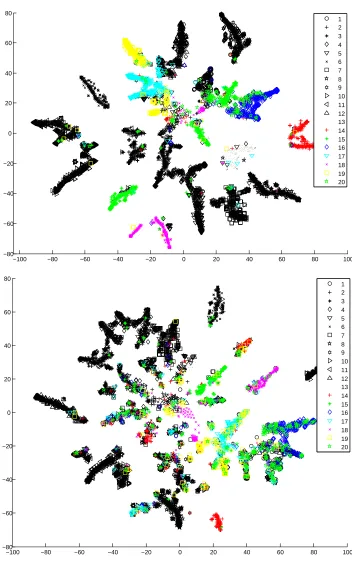
Figure 2 shows the 2D embedding of the inferred topic proportionsθθθ(approximated by the in-ferred variational posterior means) by MedLDAcand LDA using the t-SNE stochastic neighborhood
embedding (van der Maaten and Hinton, 2008) method, where each dot represents a document and each color-shape pair represents a category. Visually, the max-margin based MedLDAcproduces a better grouping and separation of the documents in different categories. In contrast, unsupervised LDA does not produce a well separated embedding, and documents in different categories tend to mix together. Intuitively, a well-separated representation is more discriminative for document cat-egorization. This is further empirically supported in Section 5.2. Note that a similar embedding
11. Stop word list can be found athttp://mallet.cs.umass.edu/.
−100 −80 −60 −40 −20 0 20 40 60 80 100 −80
−60 −40 −20 0 20 40 60 80
3 53
1 2 3 4 5 6 7 8 9 10 11 12 13
14 15 16 17 18 19 20
−100 −80 −60 −40 −20 0 20 40 60 80 100
−80 −60 −40 −20 0 20 40 60 80
3 53
1 2 3 4
5 6 7 8 9
10 11 12 13 14 15 16 17 18 19 20
Class MedLDA LDA Averageθper class
comp.graphics
T 69 T 11 T 80 T 59 T 104 T 31
image graphics db image ftp card
jpeg image key jpeg pub monitor
gif data chip color graphics dos
file ftp encryption file mail video
color software clipper gif version apple
files pub system images tar windows
bit mail government format file drivers
images package keys bit information vga
format fax law files send cards
program images escrow display server graphics
sci.electronics
T 32 T 95 T 46 T 30 T 84 T 44
ground audio source power water sale
wire output rs ground energy price
power input time wire air offer
wiring signal john circuit nuclear shipping
don chip cycle supply loop sell
current high low voltage hot interested
circuit data dixie current cold mail
neutral mhz dog wiring cooling condition
writes time weeks signal heat email
work good face cable temperature cd
politics.mideast
T 30 T 40 T 51 T 42 T 78 T 47
israel turkish israel israel jews armenian
israeli armenian lebanese israeli jewish turkish
jews armenians israeli peace israel armenians
arab armenia lebanon writes israeli armenia
writes people people article arab turks
people turks attacks arab people genocide
article greek soldiers war arabs russian
jewish turkey villages lebanese center soviet
state government peace lebanon jew people
rights soviet writes people nazi muslim
misc.forsale
T 109 T 110 T 84 T 44 T 94 T 49
sale drive mac sale don drive
price scsi apple price mail scsi
shipping mb monitor offer call disk
offer drives bit shipping package hard
mail controller mhz sell writes mb
condition disk card interested send drives
interested ide video mail number ide
sell hard speed condition ve controller
email bus memory email hotel floppy
dos system system cd credit system
Figure 3: Top topics under each class as discovered by the MedLDA and LDA models.
was presented by Lacoste-Julien et al. (2008), where the transformation matrix in their model is pre-designed. The results of MedLDAcin Figure 2 areautomaticallylearned.
20 40 60 80 100 120 1
1.2 1.4 1.6 1.8 2 2.2
# Topics
Average Entropy
MedLDAc multi−sLDA DiscLDA LDA
Figure 4: The average entropy ofθθθover documents of different topic models on 20 Newsgroups data.
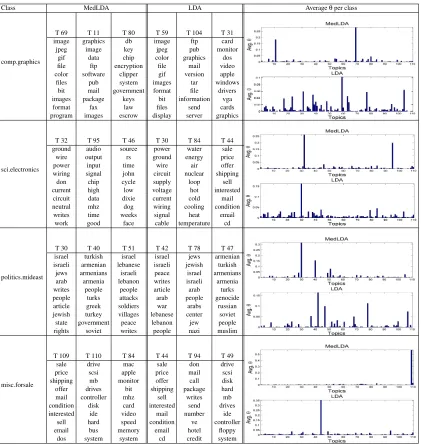
can see that their per-class average distributions over topics are very different, which suggests that the topical representations by MedLDAc have a good discrimination power. Also, the sharper and sparser representations by MedLDAccan result in a simpler max-margin classifier (e.g., with fewer support vectors), as we shall see in Section 5.2.1. All these observations suggest that the topical representations discovered by MedLDAc have a better discriminative power and are more suitable for prediction tasks (Please see Section 5.2 for prediction performance). This behavior of MedLDAc is in fact due to the regularization effect enforced overφφφas shown in Equation (21). On the other hand, LDA seems to discover topics that model the fine details of documents, possibly at the cost of achieving weaker discrimination power (i.e., it discovers different variations of the same topic which results in a flat per-class distribution over topics). For instance, in the classcomp.graphics, MedLDAcmainly models documents in this class using two salient, discriminative topics (T69 and T11) whereas LDA results in a much flatter distribution. Moreover, in the cases where LDA and MedLDAc discover comparably the same set of topics in a given class (like politics.mideastand
misc.forsale), MedLDAcresults in a sharper low dimensional representation.
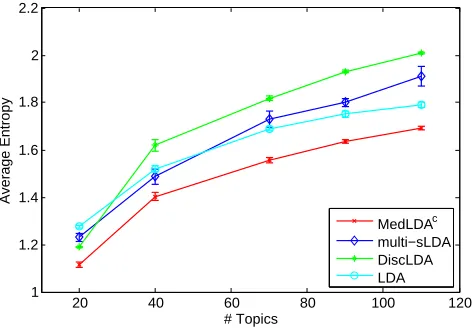
A quantitative measure for the sparsity or sharpness of the distributions over topics is the en-tropy. We compute the entropy of the inferred topic proportion for each document and take the average over the corpus. Here, we compare MedLDAc with unsupervised LDA, supervised sLDA for multi-class classification (multi-sLDA)13 (Wang et al., 2009) and DiscLDA14 (Lacoste-Julien 13. We thank the authors for providing their implementation, on which we made necessary slight modifications, for
example, improving the time efficiency and optimizingααα.
14. DiscLDA is a conditional model that uses class-specific topics and shared topics. Since the code is not publicly available, we implemented an in-house version by following the same strategy in the original paper and shareK1
topics across classes and allocateK0topics to each class, whereK1=2K0, and we variedK0={1,2,· · ·}. We should
note here that Lacoste-Julien et al. (2008); Lacoste-Julien (2009) gave an optimization algorithm for learning the topic structure (i.e., a transformation matrix), however since the code is not available, we resorted to one of the fixed splitting strategies mentioned in the paper. Moreover, for the multi-class case, the authors only reported results using the same fixed splitting strategy we mentioned above. For the number of iterations for training and inference, we followed Lacoste-Julien (2009). Moreover, following Lacoste-Julien (2009) and personal communication with the first author, we used symmetric Dirichlet priors onβββandθθθ, and set the Dirichlet parameters at 0.01 and 0.1/(K0+K1),