I
t was well said that ICT alone is only a tool. That means its value depends onwhose hands it is in. We also know how cruel and harmful Knowledge and Skill can be when it goes without heart and consideration for others. Working as a coordinator and a researcher of Service-Learning (S-L) for about 10 years, I think it is not only a way to educate better but also, more meaningfully, a good way to make all participants to ask themselves why I am teaching or why I’m learning. S-L wakes up their sleeping hearts and feel joy and grief with others and then demands them to answer how to teach or how to learn better and more to help others. So the catch-phrase for S-L at Seoul Women’s University is “Wake up to Myself, wake Society, and wake the Future.”
I belong to the Center for Teaching and Learning (CTL) because we think Service-Learning is an educational method, more than the external activities. CTL has 4 divisions; teaching, learning, multimedia technology and S-L support division. These are the services of each division, teaching part is supporting faculty members to teach better. In learning part, they help students improve their learning motivations and strategies. Multimedia Technology staffs develop teaching materials and give rental service of multimedia for classes offered on the boundary of university.
As I’m in-charge of S-L support division, I undertake jobs to: 1) support professors who want to open and operate Service-Learning; 2) encourage professors to decide on improving their teaching methods and consider how they can contribute to our society and our future by the knowledge which is taught in their classes. These intellectuals
have difficulty in finding appropriate
social works and good partners in our community for they are teaching some fragments of the whole knowledge in
their fields. Moreover the students start
their service before they learn them completely. However the problems to be solved in the real context require us to use whole knowledge and it is very
difficult for us to control the period and
the level of the knowledge needed for solving it. That means the professors are invited to the process of this solution indirectly which is real teaching. This allows them to develop a closer and better relationship with students.
We help students who decide to take Service-Learning only to get more credit. As a result of a survey, we found that most students take S-L to get one more credit rather than to devote their time and themselves for others with warm hearts. As S-L is an educational
method, we think they will experience the joy of serving others and learn that giving is much better than receiving.
SERVICE-LEARNING: A BRIDGE BETWEEN CLASSROOM
AND COMMUNITY
We encourage them to learn how to use the knowledge that was dealt in the classroom and how to create their own knowledge from experience mainly
with reflection. Good questions help them to reflect on what they take for
granted, common, and right. It is the main role of professors that facilitate
reflection with feedback, and we assist
them to do this better. We also invite community members to SWU education as our important teaching partner, even our faculty members, to take this role in
the real field.
We also develop materials for better service and give rental service of multimedia outside the fence of university. If not with Service-Learning, it is prohibited to take these equipment and materials outside.
Moreover, we ourselves serve the community that does not know S-L from community service. We put a lot of hard work into helping all participants to understand what S-L is.
As higher education often ends up with the inert knowledge that cannot be applied in reality, the college authorities decided to introduce Service-Learning as a new learning method. Service-Learning is a teaching and learning method that integrates meaningful community service with instruction and
reflection to enrich the whole learning
experience, teach civic responsibility, and strengthen communities (Seifer & Connors, 2007). Therefore, Service and Learning should be considered equally important, integrating academic objectives and social community service. Service and Learning are linked and
interact through reflection and feedback. Through reflection, participants make
knowledge from experiences, while they grow considerate and expert through feedback from co-learners, experts in
the fields, and professors. The fields of
experience cannot be clearly divided
into two separated fields: community
and classroom, but integrated in one big circle incubating service and learning inside. Based on the need of community, Social Community Service has its objective of contribution to social change or development. Learning in regular course of higher education should be well designed based on the learning objectives, which can be fully
achieved through reflection and active
voluntary participation.
S-L as Community Service is to contribute to development of society, positive change. For this, we have to design S-L based on community needs. At the same time, S-L as learning should be recognised as a regular course, and developed based on learning objectives. To differentiate S-L from community
service, we emphasise reflection as
effective way of learning. S-L is different from internship because S-L combines class and service. As for internship, students go outside to practice and serve just after they have learned enough from lecture, book reading, and practice at the laboratories.
In South Korea, Christian colleges have already tried ‘Service-Learning’ programs as a way of applying ‘social service in connection with students’ majors.’ Included are internship courses
in the fields of Social Welfare, Nursing
found in Seoul Women’s University (SWU). Service-Learning courses were developed as a project for better teaching in 2001 and became a one credit regular course entitled “Knowledge and
Community” in the first semester of 2005. SWU first opened 4 one-credit
S-L courses, and built S-L support system in the Center for Teaching and Learning. SWU is actually the only university that has succeeded in adopting Service-Learning(S-L) as a regular academic curriculum in Korea. Established based on Christianity in 1961, SWU set the mission that it would train female servant leaders who have Knowledge, Virtue, and Expertise. The United Board for Christian Higher Education supported SWU to begin Service-Learning for 8 years from 2001 to 2008. In 2005 SWU began to offer one credit S-L related to majoring class or liberal Arts Class only to the students who enroll the S-L classes. Then it expanded from 4 courses in spring of 2005, 13 in Spring of 2006, and 25 in
Fall of 2007. At first, it was leading
in the department of Public Welfare Service whose emphasis is service and practice. However, it is now actively applied in Humanities, Social Sciences and in the areas of Art and Information
& Media, drawing significant attention
from professors these days (Lee, 2005; Park, 2006a; Lee, 2006b; Ryu, 2007a, 2007b).
In 2009 the course title of S-L is changed from ‘Knowledge and Community’ to ‘Service-Learning’,
because people are difficult to notice
what it is from its title. Service-Learning courses are related to other courses in 6 colleges of Seoul Women’s
University; General Education Program, Humanities, Social Science, Natural
Sciences, Information & Media, and Fine Arts. The number of S-L courses has increased tremendously from 20’s and 30’s in 2009 to about 50’s in 2011 (43 in Spring, and 49 in Fall semester).
Most Service beneficiaries are low
income, poor, aged, and homeless community members. About 70% of the activities, 37 of 53 in Spring of 2014 are educational outreach. Others see students engage in community-based research, space design, clerical assistance, and others that will contribute to development of community.
The process of S-L consists of three steps; development, management, and evaluation of S-L course. When we develop S-L course, we analyse needs of a community and at the same time check the learning objectives. We build partnership with the community. The
office of education, Community welfare network, and Council of NPO are our
good partners that connect our S-L with the community. We help professors to make syllabus based on needs of the community and inform students on which S-L are open in this semester and encourage them to take this special opportunity of S-L.
On the step of management of S-L, we give orientation to all participants; professors, students, and community. S-L assistants take the most important role as channels of communication among all participants. While helping
all these participants reflect on their
own experience of S-L and give good feedback to one another, we provide them feedback directly.
for evaluation, hold mid-term, and
final-term group meetings for professors
and community. The final celebration
meeting for all participants mainly consists of presentations of students and encouraging compliments from community partners.
We expect positive changes on three parts; professors, community, and students. Among them, I want to think on the changes of students, especially educational effects. For cognitive development, they acquire tacit knowledge from learning through practice. They experience affective changes and have responsibility when they are called “teacher”, or “expert”. However, they are not good teachers or experts yet, and experience frustration or make some mistakes. These make them realise why they have to learn harder and harder. It’s because they now really want to be really good teacher or skillful specialist and to help others better. S-L is usually performed in teams and for somebody. There is no S-L that student can do alone for himself. S-L requires students to understand, participate, collaborate, and sometimes to have a lot of patience. Through these experiences they can accept differences among them and feel empathy for other people’s situations and feelings. Therefore, we expect a whole-person development through S-L.
Regarding SWU S-L, 53 courses are offered in this semester. It means that 53 professors and 90 of our partner institutes are joining our university education of about 500 students through S-L. They are teaching English, Math, gardening, and teaching society with newspaper. Students majoring in
Social Physical Education help old women to exercise. Students studying Computer Science help staff of living cooperative association to use computer better. Students specialising in Korean Language Teaching become good friends to foreign women and help them to adapt themselves to the new surroundings better. Students majoring in Library and Information Science are clearing books donated.
Final evaluation meeting is held two times in each class, and a celebration ceremony. We have 4 workshops for S-L assistants before the semester, in the beginning, in mid-term, and in
final-term. These are various meetings
between professors and community partners. Sometimes they visit each other, professor’s laboratory or living
cooperative association office. In
the presentation of the Celebration Ceremony, students reported what they had learned.
As for Global S-L, we have 7
village of the lowest class people. That proposal was submitted to Asian Friends,
our partner development NGO.
Reflection is very important in Global S-L too. According to a student of Global Service-Learner Inbound in
Seoul, she said she could have deeper
understanding about Korean Society and culture, and the real world through engagement in the Korean community. For such educational effects on students, I think that engagement of faculty members and of community will be absolutely necessary.
References
Kuutti, K. (1996). Activity theory as a potential framework for human-computer interaction research. In B. A. Nardi (Ed.), Context and Consciousness: Activity Theory and Human-Computer Interaction (pp. 17-44). Cambridge, MA: MIT Press.
Nardi, B. A. (1996). Activity Theory and human-computer interaction. In B. A. Nardi (Ed.), Context and Consciousness: Activity Theory and Human-Computer Interaction (pp. 7-16). Cambridge, MA: MIT Press.
Seifer, S. D. & Connors, K. (2007). Faculty Toolkit for Service-Learning in Higher Education. Retrived September 19, 2007, from http://www..servicelearning.org/index.php
Lee, G. W. (2005). Institutionalising Service-Learning at SWU III (Report for 2005-2006 Grant of Seoul Women’s University)
Lee, G. W. (2006, April). Learning as regular courses in SWU. Paper presented at the Service-Learning Conference, Seoul, South Korea.
Park, S. H. (2006). Service-Learning at SWU in Connection with other Universities (Report for 2006-2007 Grant of Seoul Women’s University)
Ryu, S. Y. (2007a). Report on 2007-1 Knowledge and Community Courses in SWU. Ryu, S. Y. (2007b). Report on 2007-2 Knowledge and Community Courses in SWU. Ryu, S. Y. (2007c). Report on 2007-Summer Service-Learning in SWU.
Sook Young Ryu Assistant Professor Seoul Women’s University, Republic of Korea
MODES OF ENGAGEMENT: CREATING REFLECTIVE
PRACTITIONERS THROUGH ENGAGED LEARNING
M
any disciplines within academia offer an essential combination of practical and theoretical education. The teaching of skills seamlessly leads into an understanding of the conceptual basis on which those skills rest. Even where concepts form the introductory portion of what is essentially a practical course, they are quickly followed up with opportunities for application, andhands on learning.
Communication is one such field
where theory and practice draw from each other constantly, with practitioners generating knowledge about strategy and impact and theoreticians testing conceptual frameworks on the ground. This has been particularly
true in the disciplinary sub-fields of
and more specifically, Information
& Communication Technologies for Development (ICT4D). Academic
programmes in these fields have
traditionally combined concepts related to development and communication with skill building and understanding of application in the form of case studies and critiques of implementation.
The Master’s programme in the Department of Communication, University of Hyderabad, in the effort to
create reflective practitioners, has built
a curriculum that integrates theory and practice in several ways. The faculty includes individuals with considerable
field experience as practitioners as well
as those whose strength is theory. The course load includes almost an even distribution of theory and skills courses. The programme requires an internship and mandates skill-based outputs in the form of printed and audio-visual projects in addition to term papers and a master’s thesis. The Master’s programme in Communication offers three streams of specialisation: print and new media journalism, radio and video production,
and media and communication studies.
While the first two are considered to be
professional streams, the third is a more academic or research oriented stream. Running through all three is a strong focus on social change and critical thinking.
Over the years, we have found that
it is important to build field experience
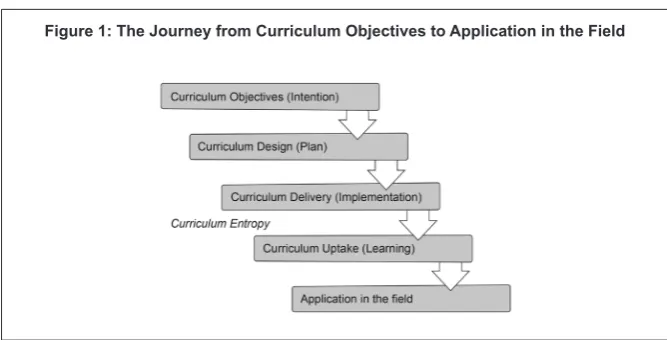
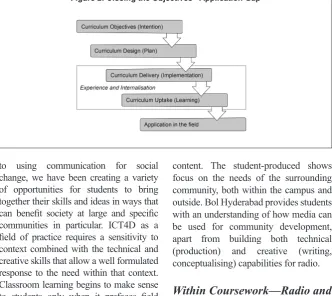
into the curriculum so that the classroom discussions are given concrete form. We have found that in the journey from curriculum planning to delivery, there is considerable loss of purpose and
content, something I would like to define
as “curriculum entropy” (Figure 1). This gap, we found, could be closed to a large extent by creating opportunities for engaged learning (Figure 2). At our University, engaged learning is seen as something that allows students to engage
(i) with the field, which is either the
community, or a media institution, (ii) with the ideas they have encountered in the classroom, and (iii) with an application context for skills they are beginning to acquire.
As an organisation that is committed
to using communication for social change, we have been creating a variety of opportunities for students to bring together their skills and ideas in ways that
can benefit society at large and specific
communities in particular. ICT4D as a
field of practice requires a sensitivity to
context combined with the technical and creative skills that allow a well formulated response to the need within that context. Classroom learning begins to make sense
to students only when it prefaces field
level engagement, which allows for the experience and internalisation of that learning. Some of the opportunities we have created for such engagement are described in this paper.
Bol Hyderabad—Doing
Community Media:
Bol Hyderabad, the campus community radio station, is an intrinsic part of the department’s ongoing activities, and students play a role in creating programming for the station as well as motivating the surrounding communities to participate in creating
content. The student-produced shows focus on the needs of the surrounding community, both within the campus and outside. Bol Hyderabad provides students with an understanding of how media can be used for community development, apart from building both technical (production) and creative (writing, conceptualising) capabilities for radio.
Within Coursework—Radio and
Magazine Production
As part of a course on community media and the public sphere, students plan and produce radio shows that feature civil society organisations in and around Hyderabad city. They are required to work closely with these organisations, understand their activities and their philosophies, and strategically use radio to advance the goals of the selected organisation and its cause. Called “Community Connect”, these radio shows air on the campus radio station, Bol Hyderabad.
The students in the print media stream undertake an immersive study tour
in a specific rural area that has suffered
particular forms of marginalisation, such as displacement, drought or other environmental crisis, and based on their research, bring out a 40 page magazine called “Vantage”, containing in depth analytical and investigative stories. Their understanding of deprivation deepens as does their ability to write about such issues with sensitivity and thoroughness.
Faculty-Student Collaboration
on Research and Consulting
Projects
The department collaborates with a variety of development organisations
and multilateral agencies on ICT4D field
research and strategy implementation and monitoring. Invariably students
are drawn into these projects as field
assistants, documentation teams, or data analysts, thus affording them the opportunity to learn from live projects.
Radio Women of Patara:
a Student-led Learning
Engagement
1Following a semester of discussing how media could be used in participatory and community-led ways to become a tool of empowerment and change, three students decided to spend some time in a remote rural community in central India to understand the dynamics of media use by the people. They began as observers, learning from the women who ran the
small radio station and figuring out
how the concepts they had learned in
class fitted into the patterns of life in the
village. Their engagement resulted in a
short reflective video documenting the
role of radio in the community’s life and in particular, in the lives of the women. We believe that engaged learning is crucial to developing sensitivity to the contexts within which skills need to be applied. For media practitioners, especially ICT4D practitioners, engagement is not an option—it is mandatory, if programmes are to be planned, implemented and documented
in a way that truly benefits communities.
The students who produce Vantage and Community Connect will have a better appreciation of the lives of the people they hope to impact when they are in a position to plan and implement ICT4D programmes in similar communities.
Our experience with creating such opportunities has led us to observe that in planning for engaged learning, it is:
• Important to talk about theory before, during and after field
engagement.
• Crucial to select field tasks that
reinforce or contribute to classroom discussion within the disciplinary framework.
• Necessary to retain a willingness to
be surprised.
• Essential to be flexible about
learning styles, directions and reporting formats.
Of course, engaged learning does call for considerable investment of time and energy and of course faculty resources that can provide both. But
1 The video that resulted from this field engagement was produced by a team of three students: Tejasvi Dantluri, Shawn
when it is built into the curriculum and provided for in the academic schedule, this challenge is to some extent met. It may take some time for the rewards to become visible, but, as in the case of the
student film, they ultimately do get their
fair recognition, apart from holding
important lessons both for the producers
and the community they seek to benefit.
Usha Raman Associate Professor and Head Department of Communication University of Hyderabad, India
T
he Indonesian tertiary education system consists of more than 3500 higher education institutions housingmore than five million students. Out
of those 3500 institutions, only around 500 institutions are comprehensive universities. The rest are small institutions offering vocational or
specialised degrees in a specific field of
academic discipline. As in many other developing countries, there is a growing need to expand the system by increasing the participation rate1 while at the same
time improving the quality.
While information and communication technology (ICT) has been one of the most popular courses offered by Indonesian higher education institutions during the last three decades, ICT for development (ICTD) is a new concept to most higher education stakeholders in Indonesia.
Nonetheless, it is indeed widely felt that
ICT can be effectively used to support human development as well as the nation’s development at large. There are many examples already apparent where people at all levels of society
ICTD IN INDONESIAN UNIVERSITIES
make use of ICTs to support their daily affairs productively and creatively. Small and home industries are using the Internet to market their products, the government has made e-procurement as a compulsory method for any procurement activity using public money, people are using social media
to express their political views ― these
are to name a few examples where ICTs have been used in Indonesian society. This is one of the positive impacts of the ICT in the society.
ICTD in Indonesian
Universities
As discussed earlier, ICTD is relatively new concept including within universities in Indonesia. Based on our survey in 2008, none of the universities in Indonesia offer a special course on ICTD. Having said that, however, the contents of ICTD have been covered
in many fields of study particularly
those within the discipline of ICT. Students taking the subject within
1 The participation rate is the total number of students divided by the number of persons in the age bracket of 19-23 (the age where they
Computer Science or Information Systems as their major will be exposed to courses where ICTD contents are included, such as ‘Computer and
Society’, ‘e-Government’, ‘e-Business
or e-Commerce’, etc. Other forms of exposure to ICTD are through IT projects or on-the-job training, which are commonly found in undergraduate curricula in Indonesia.
Also from our survey in 2008, we found that most university consider that ICT basic skills should be acquired by their students irrespective of the discipline students choose to study. Thus it is commonly seen that a course such as “Introduction to ICT” is made compulsory for all undergraduate students. Such a course was, however, still using ICT literacy as its main contents. Such contents are now considered less relevant because students are already digitally sophisticated.
In early 2012, the Universitas Indonesia, in collaboration with the
UN’s Asia and Pacific Centre for
Information and Communication Technology for Development Training (APCICT), conducted a training on ICTD. The training focused on the steps and strategies for rolling out its Primer Series and was attended by representatives from several universities. In addition to Universitas Indonesia, other institutions which took part in the training and were committed to adopt the ICTD in their curriculum include: Bandung Institute of Technology, Bogor Agricultural
University, Sepuluh November
Institute Technology of Surabaya, and Universitas Pancasila. The way the ICTD contents were adopted
varies from one institution to another. Except at the Universitas Indonesia, the contents were adopted in a more informal way and at smaller scale, such as at the department or faculty level.
The Incorporation of ICTD in
Universitas Indonesia
Universitas Indonesia (UI) is one of the biggest and most established universities in Indonesia. It is currently housing more than 45,000 students who are spread in 13 faculties/schools. As a comprehensive university, UI offers
various field of disciplines including
science, engineering, humanities, social sciences, and life and health sciences. Annual intake for the undergraduate program is around 6,000 students.
As part of its commitment to equip its students with appropriate professional and academic skills, UI has a strong commitment to make ICT as one of the generic skills that has to be acquired by all its students. Before 2012, the ICT contents put more emphasise on ICT literacy and operating skills. But it is becoming vividly apparent that such skills and literacy are already acquired by most if not all students when they enter the university.
The launching of the Primer Series
at the end of 2011 by the UNAPCICT
was very timely because at the time UI was in the process of reviewing its ICT contents for its undergraduate students. Thus the “Primer Series on ICTD for youth and university students” was immediately seen by UI as the solution to its outdated ICT contents.
is compulsory for all undergraduate students, are imbedded within the university common course called “MPKT” (an abbreviation of “Matakuliah Pengembangan Karakter
Terintegrasi” ― translated as: an
integrated characters development course). It is a 6 credit/unit course with the instructional aim to provide students with necessary skills, knowledge and attitude particularly on how students should see themselves as part of the society and the natural environment. It consists of four main topics, namely: numeracy and reasoning, human being and nature, healthy life, and ICT. The course is taken by undergraduate
students in their first year of study (in the first or second semester).
The ICTD content is focused on the application of ICT on core sectors such as agriculture and poverty alleviation, genders, health services, and education. It occupies four sessions which are delivered in four weeks. The delivery of the contents involves using the
flipped-class model, where all teaching
materials are put online and in-class activities are alloted for discussions and problem solving. Each semester around 3,000 students enroll in the course.
Currently, around 300 faculty members involved in the course serve as facilitators. These facilitators underwent
a five-day training prior to their
assignment. They come from various
disciplinary fields and they include
junior as well as senior professors. They serve as the facilitators not only for the ICTD part, but for the whole
course. New faciliators are recruited and
trained every year, and some refreshing workshops are conducted annually to
evaluate the implementation of the course.
ICTD for ICT Students at UI
The Faculty of Computer Science is one of the 13 faculties within the Universitas Indonesia. It currently enrolls around 1500 students and offers two subjects, i.e. Computer Science (CS) and Information System (IS). Undergraduate students taking either of these two subjects are exposed to more courses pertaining to ICTD, both in the form of in class lectures andfield activities. IS students have more
opportunities to familiarise themselve with ICTD since there are more courses that are relevant to the ICTD contents.
Such courses are spread from first to final year of the programme.
The IT Project course usually addresses real world problems
indentified by students in the society.
Here students usually work in groups to solve a particular problem in the society using ICT. The project can take various forms ranging from web-page development to more elaborate software application development needed by some community or schools. Since the project is to be completed within one semester, it is usually kept as a simple software project. Hardware is assumed to be available already because there is no budget to procure a computer unit, for example. Upon completion of the project, students submit and present a group report before a team of examiners
for final assessment.
compulsory for all undergraduate students. Students usually spend around two months in an organisation outside the university (can be an IT or non IT companies) working on the problem prescribed by the host organisation. Unlike the IT project, the topic here is not necessarily in the form of IT applied to development.
Challenges and Lessons
Learned
The implementation of ICTD course at the university level, which involve around 8000 students per year, is indeed a very challenging task. Since its commencement in September 2012 there has yet any rigorous evaluation on the effectiveness of the implementation. Some informal evaluation however reveals the following issues and challenges:
a. As it involves a big number of facilitators (lecturers), it is
tremendously difficult to prepare
a good pool of facilitators with
sufficient interest and knowledge
about ICTD. Meanwhile, these facilitators are already specialists
in their own field of discipline.
In addition, not all of them are technologically savy.
b. Since ICT is a very fast moving technology, obsolesence of knowledge in this area is very fast. So regular and frequent retraining is deemed necessary for the teachers. c. The delivery modality which is
taking the flipped class format
would require reliable IT infrastructure. Students will have to be able to access teaching materials as well as submit their papers and assignment through online
system without much difficulty.
Apparently it is not always the case. This creates growing concerns and dissatisfaction from the students