Edmar Clemente (Correspondence)
[email protected]
+55 (44)3011-3659
1Department of Food Technology and Engineering .UNESP - State University of Sao Paulo, São José do Rio Preto, Sao Paulo, Brazil. ZIP: 15054-000, Brazil.Phone: +55 (17) 3221 2251; fax: +55 (17) 3221 2299
2Department of Food Technology, Federal University of Ceara- UFC, ZIP: 60356-000, Fortaleza, Ceara, Brazil.
Phone/Fax: +55(85) 3366 9752
3Department of Food Technology, Federal University of Ceara- UFC, ZIP: 60356-000, Fortaleza, Ceara, Brazil.
Phone/Fax: +55(85) 3366 9752
4Laboratory of Food Biochemistry – DQI. State University of Maringa- UEM. Av. Colombo, 5790. ZIP 87020-480,
Maringa, Parana, Brazil. Phone: +55 (44)3011-3659; Fax: +55 (44)3011-8940
Abstract: This work was carried out to study the storage of dehydrated pulp of red mombin stored in polyethylene and laminated packages for 120 days at 25°C ± 2°C and relative humidity of 85 % ± 5%. Red mombin powder was obtained by drying a solution containing 90% of integral pulp and 10% of maltodextrin in a spray-dryer with air temperature of 120°C. Every 30 days the following evaluations were made: sugars (sucrose, glucose and fructose), moisture, water activity and colour (hue angle, Chroma and brightness). The results showed changes in relative humidity, sugar and water activities, there was a change in powder colour at the end of storage, with decreases in hue and brightness.
Keywords: spray-dryer, room temperature, conservation, purple mombin
1. Introduction
The red mombin tree (Spondias purpurea L.), originated in tropical America, produces a drupe fruit with dark red colour when ripe, which has agreeable aroma and flavour. Due to its excellent organoleptic quality, red mombin is much appreciated in the Brazilian Northeast, with continuing growth of consumption of fresh fruit or processed into many forms (Martins et al., 2003).
Red mombin presents itself as a highly viable alternative in the commercial fruit market, generating an overproduction which justifies studies on the development of new products from this raw material. Brazil, particularly the Northern and North-eastern regions, is a known producer of tropical fruits, whose high perishability requires the use of technologies to extend their lifespan and to reduce post-harvest losses (Furtado et al., 2010; Melo et al., 2008).
Most produced fruits are sold for fresh consumption; however, Brazil has great potential for industrialization of this fruit (Lima, 2010).
Dehydration of the fruit pulp, in order to reduce water activity and thereby prolong the shelf life and storage time, is a conservation method that prevents
deterioration and loss of nutritional value. It also introduces a new product in the market with its own characteristics and properties for longer time, allowing the adjustment of supply and improving the profile of investment on production and processing of fresh materials (Galdino et al., 2003).
Dehydration by spray drying is a technique widely used in food industry, and under optimal processing conditions, it has been proven to be an effective method in obtaining various products. The atomization process can be accomplished in a short period of time, producing powders of fruits without heat degradation even when applied at higher temperatures (Cano-Chauca et al., 2005; Mani et al., 2002).
Microencapsulation of Red Mombin (Spondias Purpurea L.) Pulp Using Spray-Drying
http://www.ijSciences.com
Volume 2 - October 2013 (10)
7
and petrifying and so, giving longer shelf life (Gomes et al., 2004; Pereira et al., 2006).
Among the packing materials, plastics are the most utilized for food. The main plastics used are: polypropylene, polystyrene, polyvinyl chloride, polyethylene terephthalate, high density polyethylene and low density polyethylene. Polyethylene has low permeability to water, excellent electrical insulation, resistance to acids, alkalis and organic solvents. The laminates are composite packages in which plastics, aluminium, cardboard and paper or other films are superimposed. They are suitable for products sensitive to oxidation reactions and they act as a barrier to oxygen and light (Silva et al., 2005).
According to Silva et al. (2005), the shelf-life depends crucially on the protection offered by packing against absorption of moisture present in the storage environment, thereby reducing the reactions that occur in the product.
The present study aims to evaluate the stability of pulp powder of red mombin produced by the atomization process in a spray-dryer for a period of storage of 90 days in plastic (polyethylene) and laminated packages subjected to environmental conditions of 25°C ± 2°C and relative humidity of 85 % ± 5%.
2. Materials and methods 2.1. Red mombin pulp
Integral frozen red mombin pulp was acquired in the industry Ki-Polpa – Indústria e Comércio – ME, in the city of Fortaleza, state of Ceará, Brazil, transported to the Laboratory of Quality Control and Drying of the Department of Food Technology at Federal University of Ceará – DETAL / UFC and stored in a freezer at -18ºC, until the processing. The material has been collected in packages of 100g, batch number 1, code (CE – 05196-00017-5). The pulps, which proceeded from Ceará, were fully integral, free of water, conserving and thermal treatment. 200 samples of 100g of pulp and from the same batch were used in this experiment.
2.2. Drying
The red mombin pulp powder was obtained by drying a solution containing 90% of integral pulp and 10% of maltodextrin (DE = 20) in a spray-dryer, model LM MSD 1.0 from LABMAQ Brazil, with an inlet drying temperature of 120°C and an outlet temperature of 80°C and flow rate of 240 mL/h. Samples of pulp powder were packed in plastic (P1), Pet + polyethylene film, density of 100g/m2 and laminated packages ( P2), aluminium / Pet + aluminium + polyethylene film, density of 122g/m2 with approximately 30g of the product, which were sealed and stored for 120 days at room temperature.
Every 30 days the content of sugars (glucose, fructose and sucrose), colour, moisture and water activity were evaluated.
2.3. Sugars (sucrose, glucose and fructose)
Fructose, glucose and sucrose were determined by HPLC method (High Performance Liquid Chromatography). Approximately 5.0 g of the powder diluted in 50 ml of distilled water and the solution was centrifuged for 5 min. One mL of the supernatant was mixed with 3 ml of ethanol for maltodextrin precipitation. Then the supernatant in a 1:40 dilution was used for the quantification of sugars. The Bio-Rad HPX 87C method was utilized, in which the mobile phase was Milli-Q water (highly pure) with a flow rate of 0.6 ml/min, temperature of 85°C and IR detector.
2.4. Colour
The parameters of colour analysis was performed using a colorimeter Konica Minolta Spectrophotometer model CR410 with determination including the variables Chroma (c*) and Hue angle (h*). Colour measurements have been expressed in terms of L* value (ranging from 0 to 100, where the value 0 indicates black and the value 100, white), Hue angle (shows the location of colour on a diagram, in which the angle 0° represents pure red, 90° represents pure yellow, 180º, pure green and 270º, blue) and Chroma (colour intensity or saturation, defined by the distance of the Hue angle from the centre of the three-dimensional diagram).
2.5. Moisture
The moisture analysis followed the analytical standards (Ial, 2008), in which approximately 2.0 g sample were weighed in pre-weighed crucibles, placed in an oven at 105°C for 1 hour, and placed in a desiccator for 15 min at room temperature and weighed); the heated samples remained for 6 hours in a vacuum oven at 70°C under reduced pressure, placed in a desiccator for 15 min at room temperature and then weighed again. This operation was repeated until constant weight. The result was obtained using the equation (1):
Where:
U = moisture at 70°C, in percentage (%). N = grams of moisture (loss of mass in grams). P = grams of the sample.
2.6. Water Activity (aw)
The determination of water activity of the powder was performed using a water activity meter, model AQUALAB 4TEV, at temperature of 25°C. Approximately 1.0 g of powder was placed on the equipment for data reading.
Microencapsulation of Red Mombin (Spondias Purpurea L.) Pulp Using Spray-Drying
http://www.ijSciences.com
Volume 2 - October 2013 (10)
8
2.7. Statistical AnalysisStatistical analysis of the experimental data obtained during the storage was performed using the computer program Assistat, version 7.6 (Silva et al., 2002), using a factorial design consisting of 2 (treatments) x 9 (storage time) x 3 (repetitions) and a fully randomized design, with comparisons of the averages through Scott-Knott test at 5% level.
3. Results and Discussion 3.1. Sugars
The mean values of the sugars found in red mombin pulp powder during stability period can be found in Table 1.
Table 1
There was a decrease in values for sucrose in (P1) package during stability . For the values of glucose and fructose there was an increase until the end of stability. For (P2) package, there was also a decrease in the amount of sucrose during stability. In relation to values of glucose, there was an increase until the end of storage. Fructose also showed an increase in values of storage. The results attained in this work are similar to those of Campos et al. (2007), where the decrease in values of sucrose and increased levels of glucose and fructose may be related to degradation of sucrose into glucose and fructose during stability. Similar results were found in dried jackfruit, where the values obtained for glucose and fructose were lower than those of sucrose: 33.99 to 52.43% of sucrose, 17.70 to 21.54% of glucose and 17.25 to 20.20% of fructose (Oliveira, 2009). For watermelon dehydrated juice by spray-dryer, the values were lower for sucrose and higher for glucose and fructose: 11.70% of sucrose, 55.31% of glucose and 68.53% of fructose (Quek, 2007).
3.2. Moisture
Moisture is one of the factors that affect the shelf life of a dehydrated product (Endo et al., 2007). In the periods in which the samples were evaluated, significant differences were observed between the mean values of moisture in relation to different times and packages at 5% of significance by Scott-Knott test.
Figure 1
In Figure 1, a graphical representation of the average moisture values of red mombin pulp powder is shown for the two packages studied in relation to storage time. Differences were found between the average values of moisture for the different storage periods, especially in the periods of 0 and 90 days for both packages. The moisture increased along with storage times, reaching an increase of 123,16% in plastic package and 63,89% in laminated package when compared to the initial moisture content, which was
5% for both packages. The moisture gain during storage is inevitable when packaging is not impermeable to water vapour and also when the sample shows hygroscopic behaviour.
Similar value to this study was reported by Barbosa (2010), studying a mixture made of pulp of hog plum, mango and papaya dehydrated by spray-dryer. This author reported values of 3.31% for the powder with 12% of maltodextrin dried at a temperature of 155°C. In açai (Euterpe oleracea) juice dehydrated in a spray-dryer with 10% of maltodextrin at 170°C was found moisture content (1.78%) lower than this work (Tonon, 2009).
Lower values were also found by Quek (2007), studying dried watermelon juice obtained by spray-dryer at 145°C; in this case, the concentration of maltodextrin influenced the moisture content in the final product: in the concentration of 3% of maltodextrin the powder moisture was 2.78% and with the addition of 5% the moisture was 1.62%.
3.3. Water activity (aw)
Water activity is an index of great importance to products obtained by spray-dryer due to its influence on the powder life span. High water activity indicates more free water available for biochemical reactions and consequently shorter life. Generally, foods with water activity lesser than 0.6 are considered microbiologically stable and deteriorations are induced by chemical reactions rather than by microbiological ones (Barbosa, 2010).
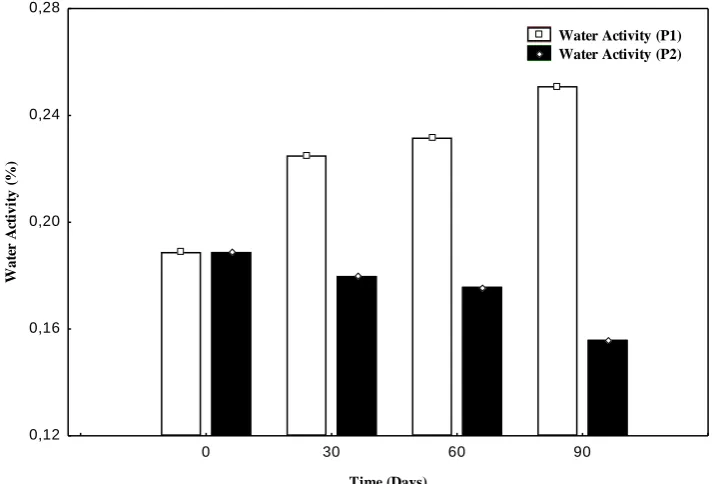
Figure 2, shows the behaviour of the variable water activity in red mombin powder during storage for the packages tested.
Figure 2
There was an increase of 30.60% in water activity during stability for plastic package (P1). In the beginning the water activity was 0.19 and after storage this value went to 0.25. For laminated package (P2), there was a reduction of 15.79% in the values of water activity; in the beginning, it was 0.19 and at the end, 0.15. A similar result was obtained in a mixture of fruit pulp (hog plum, mango and papaya) dehydrated by spray-dryer; the value of 0.34 for water activity was found in a drying temperature of 155°C (Barbosa, 2010).
Microencapsulation of Red Mombin (Spondias Purpurea L.) Pulp Using Spray-Drying
http://www.ijSciences.com
Volume 2 - October 2013 (10)
9
3.4. Analysis of colour parametersColour is one of the most important attributes in food and beverages; it influences the product acceptability by consumers (Burin et al., 2011).
The chromaticity indicates the colour intensity or saturation, and the higher its value, the more intense the powder colour is. Table 2, shows the behaviour of the chromaticity for red mombin powder stored in plastic and laminated packages.
Table 2
Values fluctuated during the chromaticity stability, reaching similar values in both packages.There was a significant effect of time on the values of hue, i.e., the angle h* (Hue) of red mombin pulp powder (Table 2). Increasing storage time causes a decrease in the colour intensity of the powder. The mean values of hue angle ranged from 91.79 to 96.78°, corresponding to regions very close to yellow (90°), which is the colour of the pulp and also of the dehydrated product.
The decrease in hue angle values may be related to degradative reactions of carotenoids, which are the main pigments of the red mombin. Foods are subject to physical and chemical degradation even at low level of water activity. The depreciation of the stability of these materials along with the storage time can be accelerated by heat, moisture or by the packaging permeability to oxygen.
The parameter colour variation L*, which measures the degree of brightness or clarity, is shown in Table 2.
There was an effect of storage time on the brightness of red mombin pulp powder, which showed a slight decrease of its values in both packages. The parameter values for L * decreased stability, compared to baseline, however, keeping the time constants in the two subsequent packages. This behaviour may be related to physical and chemical reactions such as oxidation, resulting in degradation of the pigments responsible for the powder colour and causing a small decrease in the values of L*. Result similar to the present study was found in passion fruit pulp dehydrated by spray dryer: L* was equal to 89.10 (Pedro, 2009). According to this author, the closer to 100 the value of L*, the closer to white the sample is; this can be explained by the addition of additives during dehydration, as in this case the addition of maltodextrin.
4. Conclusion
The packages studied have showed the same pattern of conservation of the constituents in relation to
sugars and color. But differed in moisture and water activity, where the laminated package proved to be more effective as a barrier to water vapor.
5. References
1. Barbosa, S.J., 2010. Qualidade de suco em pó de mistura de frutas obtido por spray drying. 122. Dissertação. (Mestrado em Produção Vegetal no Semiárido) - Universidade Estadual de Montes Claros, Brazil.
2. Burin, V.M., Rossa, P.N., Ferreira-Lima, N.E., Hillmal, M.D.R. Doirdignon-Luiz, M., 2011 .Anthocyanins: optimisation of extraction from Cabernet Sauvignon grapes, microcapsulation and stability in soft drink. Int J Food Sci Tech. 46, 186–193.
3. Campos, J.T., Hasegawa, P.N., Purgatto, E., Lajolo, F., Cornenunsi, R., 2007 .Qualidade pós-colheita de nêsperas submetidas ao armazenamento sob baixa temperatura e atmosfera modificada. Cienc Tecnol Aliment. 27 (2), 401-407.
4. Cano-Chauca, M., Stringheta, P.C., Ramos, A.M., Cal-Vidal, J., 2005 .Effect of the carriers on the microstructure of mango powder obtained by spray drying and its functional characterization. Innov Food Sci Emerg Tech. 6, 420 – 428. 5. Endo, E., Borges, S.V., Daiuto, E.R., Cereda, M.P., Amorim,
E., 2007. Avaliação da vida de prateleira do suco de maracujá (Passiflora edullis f. flavicarpa) desidratado. Cienc Tecnol Aliment. 27 (2), 382-386.
6. Furtado, G.F., Silva, F.S., Portos, A.G., Santos, P., 2010. Secagem de polpa de ceriguela pelo método de camada de espuma. Rev Bras Produt Agro. 12 (1), 9-14.
7. Galdino, P.O., Queiroz, A.J.M., Figueirêdo, R.M.F., Silva, R.N.G., 2003. Avaliação da Estabilidade de polpa de umbu em pó. Rev Bras Produt Agro. 5 (1), 73-80.
8. Gomes, P.M.A., Figueirêdo, R.M.F., Queiroz, A.J.M., 2004. Armazenamento da polpa de acerola em pó a temperatura ambiente. Cienc Tecnol Aliment. 24 (3), 384-389.
9. Ial. Instituto Adolfo Lutz., 2008. Métodos Físico-Químicos para Análise de Alimentos/Ministério da Saúde, Agência Nacional de Vigilância Sanitária. Brasília: Ministério da Saúde. (Série A: Normas Técnicas e Manuais Técnicos). 10. Lima, U.A., 2010. Matérias-Primas dos Alimentos. 1. ed. São
Paulo, Ed. Blucher, 402.
11. Mani, S., Jaya, S., Das, H., 2002. Sticky Issues on Spray Drying of Fruit Juices.The society for engineering in agricultural, food and biological systems, 27-28.
12. Martins, L.P., Silva, S.M., Alves, R.E., Filgueiras, H.A.C., 2003. Desenvolvimento de frutos de Cirigueleira (Spondias purpurea L.). Rev Bras Frutic. 25 (1), 11-14.
13. Melo, E.A., Maciel, M.I.S., Lima, V.L.A.G., Araújo, C.R., 2008. Teor de fenólicos totais e capacidade antioxidante de polpas congeladas de frutas. Alim Nutri. 19 (1), 67-72. 14. Moreira, J.S.A., Souza, M.L., Neto, S.E.A., Silva, R.F., 2011.
Estudo da estabilidade microbiológica e físico-química de polpa de cupuaçu desidratada em estufa.Rev Caat. 24, 26-32. 15. Oliveira, L.F., 2009. Efeito dos Parâmetros do Processo de Desidratação de Jaca (Artocarpus heterophyllus, Lam.) Sobre as Propriedades Químicas, Físico-químicas e Aceitação Sensorial, 121p , Tese. (Doutorado em Ciência e Tecnologia de Alimentos) – Universidade Federal do Rio de Janeiro, Rio de Janeiro, Brazil.
16. Pedro, M.A.M., 2009. Influencia de encapsulantes e do método de secagem nas propriedades físico-químicas e atributos de qualidade da polpa de maracujá (Passiflora edulis f. flavicarpa) em pó, 205, Tese. (Doutorado em Engenharia e Ciência de Alimentos)- UNESP ( Universidade Estadual de São Paulo – Brazil).
17. Pereira, I.E., Queiroz, A.J.M., Figueirêdo, R.M.F., 2006. Características físico-químicas do tomate em pó durante o armazenamento. Rev Biol Cien Terra. 6 (1), 83-90.
Microencapsulation of Red Mombin (Spondias Purpurea L.) Pulp Using Spray-Drying
http://www.ijSciences.com
Volume 2 - October 2013 (10)
10
powders. Chem Engi Process. 46, 386–392.
19. Silva, R.N.G., Figueirêdo, R.M.F., Queiroz, A.J.M., GaldinoA, P.O., 2005. Armazenamento de Umbu-Cajá em pó. Cien Rural.35 (5), 1179-1184.
20. Silva, F.A.S., Azevedo, C.A.V., 2002. Versão do programa computacional Assistat para o sistema operacional Windows. Rev Bras Produt Agro. 4 ,71-78.
21. Tonon, R.V., Brabet, C., Hubinger, M.D., 2009. Influência da temperatura do ar de secagem e da concentração do agente carreador sobre as propriedades físico-químicas do suco de açaí em pó. Cien Tecnol Aliment .29 (2), 444-450.
Table 1 - Mean values of sugars in atomized pulp of red mombin. (n=3)
Time (Days)
Analysis 0 30 60 90
1 Sucrose (mg.mL-1)
P1 130.39 bB ± 0.29 138.82 aA ± 0.89 89.45 cD ±0.14 75.23 dE ± 0.14
P2 110.88 aC ± 0.59 108.22 aC ±0.06 79.39 bE ±0.72 63.35 cF ±0.59
2
Glucose (mg.mL-1)
P1 46.36 bD ± 0.37 62.65 bC ± 0.99 89.28 aA ± 0.0 98.37 aA ± 0.37
P2 46.36 dD ± 0,73 71.13 cB ± 0.0 79.14 bB ± 0.37 88.50 aA ± 0.47
3 Fructose (mg.mL-1)
P1 48.55aE ± 0.0 69.46aD ± 0.53 82.61aA ± 0.35 92.50aA ± 0.53
P2 47.43dE ± 0.18 69.08cD ± 0.0 74.47bC ± 0.53 81.86aB ± 0.42
P1 (Plastic Packaging), P2 (Laminated Packaging), n= number of repetitions.
* Averages followed by the same lowercase letter in the row and the same capitals in the column are not statistically different. The Scott-Knott test at ( p< 0,05) was used.
Table 2 - Parameters for color of powder siriguela pulp ( n=3)
Time (Days)
Analysis 0 30 60 90
Chroma
P1 14.30cC ± 0.19 14.91aA ± 0.09 14.17cC ± 0.01 14.62bB ± 0.01
P2 14.30bC ± 0.19 14.61aB ± 0.01 13.81cD ± 0.01 14.47aB ± 0.02
Hue
P1 96.78aA ±0.19 91.79cD ± 0.01 92.31bC ± 0.04 92.37bC ± 0.03
P2 96.78aA ± 0.19 92.38cC ± 0.09 92.77bB ± 0.02 92.62bB ± 0.05
L*
P1 61.33aA ±0.11 59.94cE ±0.05 60.36bB ±0.005 60.06cD ±0.04
P2 61.33aA ± 0.11 60.27cC ± 0.02 60.44bB ± 0.02 60.23cC ± 0.02
P1 (Plastic Packaging), P2 (Laminated Packaging), n= number of repetitions
Microencapsulation of Red Mombin (Spondias Purpurea L.) Pulp Using Spray-Drying
http://www.ijSciences.com
Volume 2 - October 2013 (10)
11
0 30 60 90
Time (Days)
0,04 0,06 0,08 0,10
M
oi
stu
re
(%)
Moisture (P1) Moisture (P2)
Figure 1- Variation of moisture throughout the storage for two packages studied. (P1) Plastic packaging; (P2) Laminated packaging. Concentrations are expressed as mean ± standard deviation, n = 3. We used the Scott-Knott test at 5% probability.
0 30 60 90
Time (Days) 0,12
0,16 0,20 0,24 0,28
Wat
er
A
ct
ivi
ty
(%)
Water Activity (P1) Water Activity (P2)
Figure 2 - Water activity (aw) during storage in two containers studied. (P1) Plastic packaging; (P2) Laminated