Raji Heyrovska (Correspondence)
[email protected]
Atomic and Ionic Radii of Elements
and Bohr Radii from Ionization
Potentials are Linked Through the
Golden Ratio
Raji Heyrovska
Abstract: In an earlier article, Bohr radius of hydrogen was shown to be the sum of two Golden sections pertaining to the electron and proton. This led to discovering that all bond lengths between same two atoms are sums of two Golden sections representing the radii of the anion and cation, and that the radii of adjacent atoms and or ions in chemical bonds are additive. Subsequently, atomic radii were shown to vary linearly with their Bohr radii obtained from the first ionization potentials. Reported here is a new finding mentioned in the title, for elements of Groups 1A - 8A. The electron is found to occupy a space of its own in the atoms, in support of works on solvated electrons and electrides.
Keywords: Bond lengths, Covalent Radii, Ionic radii, Bohr radii, Golden sections, Main group elements, radii of electrons, Nuclear radii, Golden ratio
1. Introduction
1.1. Golden sections of the ground state Bohr radius of hydrogen
In this introductory section, the present author's work so far on the Golden ratio in atomic and ionic radii is described briefly. She arrived at a new interpretation1 of the ground state Bohr radius, aB of hydrogen (H) atom, by considering the ground state ionization
potential (IH) as the difference between the potentials of the proton (p+) and the electron (e-). This led to the discovery1 that aB, which is the distance between the proton and electron, is divided at the point of electrical neutrality (Pel), the Golden point, into two Golden sections, ae- and ap+ pertaining to the electron and proton, respectively. The latter distances were obtained1 through the relations:
aB = (e/2IH) = ae- + ap+ (1a) (e/2)(1/aB) = IH = (1/2)[(e/ap+) - (e/ae-)] (1b) (ae-/ap+)2 - (ae-/ap+) - 1 = 0, (ae-/ap+) = (1c,d) ap+ = (aB/2) and ae- = (aB/) = ap+ (1e,f)
where e is the charge, is the electrical permittivity of vacuum e/2 = 7.1998 Å.eV. The measured ionization potential is composed of the two components, Ip+ = (e/ap+) and Ie- = (-e/ae-) in equation (1b). On combining equations (1a) and (1b), one obtains the Golden quadratic equation (1c), whose +ve root (see equation 1d) is the Golden ratio, (ae-/ap+) = (1 + 51/2)/2) = = 1.618. This ratio appears in the geometrical features of microscopic as well as macroscopic world and is called2 The Divine Ratio. Thus, it was shown that the Golden ratio arises due to electrostatic reasons right in the core of atoms1,3.
http://www.ijSciences.com Volume 2, Issue Mar 2013
83
lengths of completely or partially covalent and or ionic bonds of about forty hydrides6 and also the lengths of hydrogen bonds7 in many inorganic and biochemical compounds. Golden ratio was also observed in the hydrogen bonds of borates8.
1.2 The Golden ratio based ionic radii of alkali metals and halogens
In the case of the partially ionic bonds in alkali metal hydrides, it was shown1,3 that the difference, d(MH) - d(H+) = d(M+) = d(MM)/2, where d(MM) is the
bond length of between the edge atoms in the metal lattice. On subtracting the above value of d(M+) from the crystal ionic distance, d(M+X-) in the alkali halide, the radius d(X-) of the halogen anion, (X-) = d(XX)/, was obtained. These results showed that d(MM) = d(M+) + d(M-) and d(XX) = d(X+) + d(X -) are sums of two Golden sections representing the anionic and cationic radii. Thus it was found1 that the distances, d(M+X-) in all alkali halides are sums of the Golden ratio based ionic radii as shown,
d(M+) = d(MM)/d(X-) = d(XX)/ and d(MX) = d(M+) + d(X-) (2a-c)
where the inter-metallic bond length, d(MM) = a, the lattice parameter for the bcc lattice of the alkali metals and d(XX) is the bond length in the diatomic halogen molecules.
1.3 Atomic radii and Golden ratio based ionic radii and additivity of radii in chemical bonds
The above led to the general finding1,3,6 that the bond length d(AA) between two
atoms (A) of the same kind is divided at the Golden point into two Golden sections, d(A-) and d(A+), which form the anionic (A-) and cationic (A+) radii of atoms as shown below,
d(AA) = 2d(A) = d(A-) + d(A+) (3a) d(A+) = d(AA)/= (2/)d(A) and d(A-) = d(AA)/ = (2/)d(A) (3b,c)
d(A+) < d(A) < d(A-) = (2/) < 1 < (2/) = 0.764 < 1 < 1.236 (3d)
where the atomic radius, d(A) = d(AA)/2 is defined4 as the covalent radius. The radii increase, as pointed out4 in the order shown in equation (3d).
Soon the general additivity rule of covalent radii and or the Golden ratio based ionic radii was established for bond lengths between two different atoms, d(AB), in many inorganic, organic and biological molecules, see e.g.,9 (a full list of publications is in http://www.jh-inst.cas.cz/~rheyrovs). The Golden ratio was also observed in the sizes of ions and ion-water distances in aqueous solutions10,11.
1.4. More on ionization potentials, correlation with aqueous redox potentials and dependence of various atomic radii on Bohr radii.
Further, linear relations between gaseous ionization potentials and aqueous redox potentials helped to establish the absolute
aqueous redox potentials of elements12,13 and to obtain Golden ratio dependent radii of redox components in solutions14. In another paper15, linear correlations between Bohr radii, aB obtained from the first ionization potentials (I1) of the atoms and various radii of atoms, including the covalent atomic radii, d(A) obtained from lattice constants and bond lengths d(AA), were demonstrated.
2. Present work: atomic and ionic radii of elements related to Bohr radii through the Golden ratio.
Here, another fundamental observation is reported connecting two different properties, namely the atomic radii obtained from lattice parameters and bond lengths with the Bohr radii obtained15 from the first ionization potentials, as in the case of hydrogen, from the equation,
http://www.ijSciences.com Volume 2, Issue Mar 2013
84
The Golden sections of the Bohr radii of atoms are related as follows,
aB = ae- + an+, ae- = aB/ and an+ = aB/ (5a-c) ae- = an+ and aB = ae- = 2an+ (5d,e)
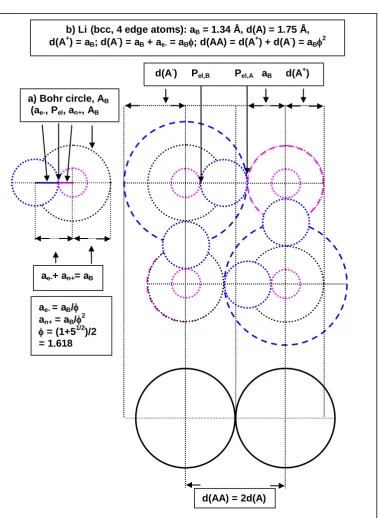
where ae- and an+ are the Golden sections of aB, representing the radius of the electron and of the nucleus An+. These distances are shown as the radii of the corresponding circles in Fig. 1a for Li.
On comparing them with the covalent, anionic and cationic radii, d(A), d(A-) and d(A+) respectively, one finds that the Golden ratio connects them all, as shown in Fig. 1b for Li. It is interesting to note that the nucleus with radius, an+ and electron of radius ae- exactly fit the square with the edge atoms of the bcc lattice of Li. Thus the electron corresponding to the first ionization
potential of the atom (A) is found to have its own space identity in the lattice.
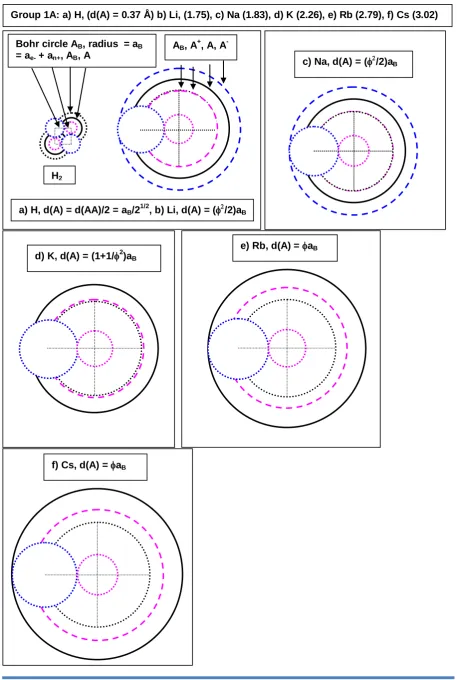
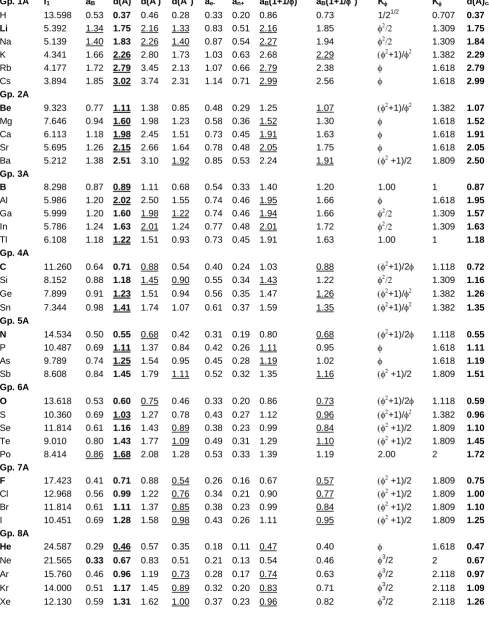
The above finding was found to hold also for other members of the Group 1A elements. The radii d(A) in Table 1 were obtained using bond lengths and lattice parameters from1,16, and the Bohr radii calculated from the data17 on first ionization potentials are also given in Table 1. Figs. 2 show the dependences of the atomic, ionic and Bohr radii (data in Table 1) on the Golden ratio for elements of Group 1A. In all these cases, the atomic radii were found to be directly proportional to their Bohr radii as shown by the simple equation,
d(A) = d(AA)/2 = KaB (6)
where Kis a constant ( see Fig. 2 and Table 1) depending on the Golden ratio.
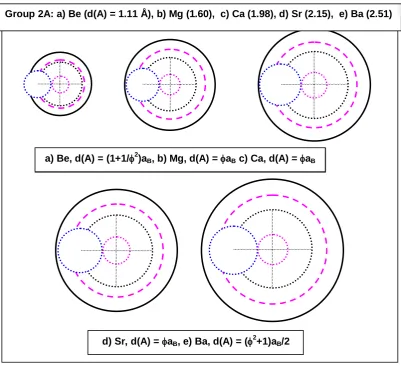
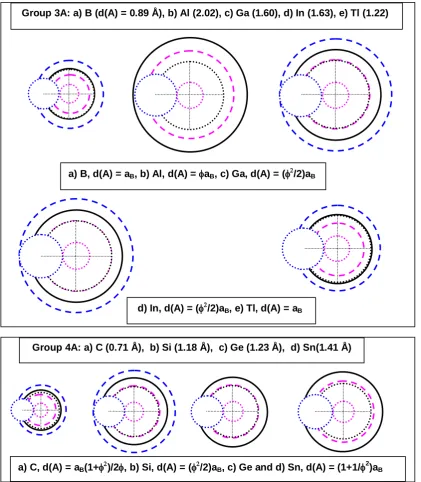
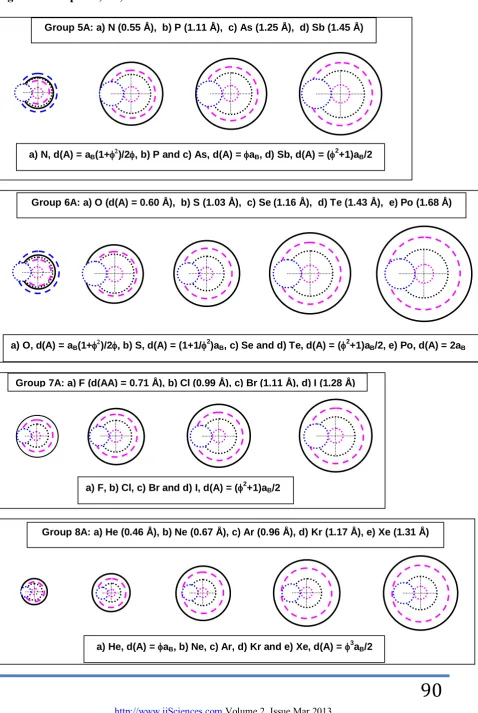
On investigating further the dependence of the atomic and ionic radii of the elements of Groups 2A - 8A, similar results were obtained. Fig. 2 shows the atomic, ionic and Bohr radii for all these elements. Corresponding data are given in Table 1. The values of d(A), d(A-) or d(A+), coincide with aB, aBor other Golden ratio multiples of aB, and these values are underlined in Table 1. It can be seen that in every case Kis a simple
function of the Golden ratio and that each group of elements show some trends. The last column in Table 1 gives the values of d(A)cal calculated as per equation (6). Fig. 3 shows a plot of d(A)cal vs d(A) for the atoms of all the Groups 1A - 8A elements. The least square line shows the good correspondence with equation (6) and thereby it can be seen that the atomic, ionic and Bohr radii are all linked in a
simple way through the Golden ratio. Fig. 4 shows a graph of d(A) vs aB for the various values of K
The observation here that the electron is an entity of its own kind supports similar views in the work on solvated electrons18 and on electrides19. Most notable works on the Golden ratio in molecular structures is the work by Shechtman20 and by Coldea21. The structures of the compounds in the latter work with Golden ratio based ionic radii can be
seen in22.
Thus, it can be concluded that the Golden ratio connects lattice parameters, bond lengths and atomic and ionic radii with the Bohr radii of atoms and is therefore a fundamental geometrical constant in atomic structure and physics.
References
[1] Heyrovska, R. The Golden ratio, ionic and atomic radii and bond lengths. Molecular Physics, 103, 877 - 882 (2005); and the literature therein.
[2] Livio, M. The Golden Ratio: The Story of PHI, the World's Most Astonishing Number, Broadway Books, NY, (2002).
[3] Heyrovska, R. The Golden ratio in the creations of Nature arises in the architecture of atoms and ions. Chapter 12 in Book: Innovations in Chemical Biology, Editor: Bilge Sener, Springer.com, (2009).
[4] Pauling, L. The Nature of the Chemical Bond, Cornell
Univ. Press, NY, (1960).
[5] Bragg, W. L., Philos. Mag., 40, 169 (1920).
[6] Heyrovska, R. a) 2004 International Joint meeting of ECS, USA and Japanese, Korean and Australian Societies, Honolulu, Hawaii, October 2004, Vol. 2004 - 2, Extended. Abs.C2-0551.
http://www.electrochem.org/dl/ma/206/pdfs/0551.pdf ; b) Golden sections of inter-atomic distances as exact ionic radii of atoms.
http://precedings.nature.com/documents/2929/version/1 (See figures, data and the literature therein).
http://www.ijSciences.com Volume 2, Issue Mar 2013
85
hydrogen bond on the covalent and cationic radii of hydrogen, and additivity of bonding distances. Chem. Phys. Letts., 432, 348 - 351 (2006).
[8] Yu, D., Xue, D., Ratajczak, H. Golden ratio and bond-valence parameters of hydrogen bonds of hydrated borates, Journal of Molecular Structure, 783, 210-214 (2006). [9] Heyrovska, R., Narayan, S. Atomic structures of molecules based on additivity of atomic and/or ionic radii. AIP Conference Proceedings, 216, 1119 (2009); Editor(s): Beverly Karplus Hartline, Renee K. Horton, Catherine M. Kaicher.
http://precedings.nature.com/documents/3292/version/1 [10] Heyrovska, R., Dependences of molar volumes in solids, partial molal and hydrated ionic volumes of alkali halides on covalent and ionic radii and the Golden ratio. Chem. Phys. Letts., 436, 287 - 293 (2007).
[11] Heyrovska, R., Dependence of ion-water distances on covalent radii, ionic radii in water and distances of oxygen and hydrogen of water from ion/water boundaries, Chem. Phys. Letts., 429, 600 - 605 (2006).
[12] Heyrovska, R. Absolute Potentials of the Hydrogen Electrode and of Aqueous Redox Couples, Electrochemical
and Solid-State Letters, 12(10), F29-F30 (2009);
http://precedings.nature.com/documents/3395/version/1 [13] Heyrovska, R., Aqueous Redox Potentials Found to be Inversely Proportional to the Bohr Radius, Electrochem.Soc. Trans., 25, 159-163 (2010).
[14] Heyrovska, R., Radii of redox components from absolute redox potentials compared with covalent and aqueous ionic radii, Electroanalysis, 22, 903 - 907 (2010).
[15] Heyrovska, R. a) Direct dependence of covalent, van der Waals and valence shell radii of atoms on their Bohr radii for elements of Groups 1A - 8A. Ohtaki Memorial Lecture, 10th Eurasia Conference on Chemical Sciences, Manila, Philippines, 2008. Philippine J. Sci. 137, 133-139, (2008); b) http://arxiv.org/abs/0708.1108v2
[16] a.
http://www.webelements.com/lithium/crystal_structure.html ; b. http://www.webelements.com/fluorine/atom_sizes.html [17]
http://physics.nist.gov/PhysRefData/IonEnergy/tblNew.html [18] Abel, B., Buck, U., Sobolewskic, A. L. and Domcke, W. On the nature and signatures of the solvated electron in water, Phys. Chem. Chem. Phys., 14, 22–34 (2012). [19] Lee, K., Kim, S. W., Toda, Y., Matsuishi, S., Hosono, H., Dicalcium nitride as a two-dimensional electride with an anionic electron layer, Nature, 494. 336-341 (2013). [20] Shechtman, D., Quasi-Periodic Materials – A Paradigm
Shift in Crystallography.
http://www.nobelprize.org/nobel_prizes/chemistry/laureates/ 2011/shechtman-lecture.html
[21] Coldea, R., et al, Quantum criticality in an Ising chain: experimental evidence for emergent E8 symmetry, Science, 327, 177-180 (2010).
[22] Heyrovska, R., Structures at the atomic level of cobalt, zinc and lead niobates (with an Appendix: Atomic structure of cobalt niobate crystal)
http://precedings.nature.com/documents/6059/version/2
Figure legends
Figure 1. a) The Bohr circle of radius, aB = (e/2
I1) for Li and its Golden sections, ae- and an+ pertaining to the electron and nucleus, respectively, b) the four edge atoms in Li (bcc). Bond length d(AA), and its Golden sections, d(A+), and d(A-) pertaining to the (resonance forms, A+, A- ) cation and anion respectively.Figure 2: Groups 1A - 8A. Comparison of atomic and ionic radii with the Bohr radii for elements. The circles A+ (pink dashes), A (black full line) and A- (blue dashes) have cationic, covalent and anionic radii, d(A+), d(A) and d(A-) respectively. The circles e- (blue dots), AB (black dots) and An+ (pink dots) have radii, ae- = aB/aB (Bohr radius) and an+ = aB/. All are drawn to scale.
Figure 3. Linear correlation of calculated values of atomic radii, d(A)cal with the observed values, d(A) = d(AA)/2.
http://www.ijSciences.com Volume 2, Issue Mar 2013
86
Figure 1
b) Li(bcc, 4 edge atoms): aB = 1.34 Å, d(A) = 1.75 Å,
d(A+) = aB; d(A
-) = aB + ae- = aB; d(AA) = d(A
+
) + d(A-) = aB
2
a) Bohr circle, AB
(ae-, Pel, an+, AB
ae-+ an+= aB
d(AA) = 2d(A)
d(A-) Pel,B Pel,A aB d(A
+
)
ae- = aB/
an+ = aB/
2
= (1+51/2)/2
http://www.ijSciences.com Volume 2, Issue Mar 2013
87
Figure 2 Group 1A
f) Cs, d(A) = aB
e) Rb, d(A) = aB
d) K, d(A) = (1+1/2)aB
c) Na, d(A) = (/2)aB
AB, A
+
, A, A-
Bohr circle AB, radius = aB
= ae- + an+, AB, A
a) H, d(A) = d(AA)/2 = aB/21/2, b) Li, d(A) = (/2)aB
H2
http://www.ijSciences.com Volume 2, Issue Mar 2013
88
Figure 2 Group 2A
d) Sr,d(A) = aB, e) Ba, d(A) = (
2
+1)aB/2
Group 2A: a) Be (d(A) = 1.11 Å), b) Mg (1.60), c) Ca (1.98), d) Sr (2.15), e) Ba (2.51)
http://www.ijSciences.com Volume 2, Issue Mar 2013
89
Figure 2 Groups 3A and 4A
Group 4A: a) C (0.71 Å), b) Si (1.18 Å), c) Ge (1.23 Å), d) Sn(1.41 Å)
a) C, d(A) = aB(1+)/2, b) Si, d(A) = (/2)aB, c) Ge and d) Sn, d(A) = (1+1/
2
)aB
Group 3A: a) B (d(A) = 0.89 Å), b) Al (2.02), c) Ga (1.60), d) In (1.63), e) Tl (1.22)
d) In, d(A) = (/2)aB, e) Tl, d(A) = aB
http://www.ijSciences.com Volume 2, Issue Mar 2013
90
Figure 2 Groups 5A, 6A, 7A and 8A
Group 8A: a) He (0.46 Å), b) Ne (0.67 Å), c) Ar (0.96 Å), d) Kr (1.17 Å), e) Xe (1.31 Å)
a) He, d(A) = aB, b) Ne, c) Ar, d) Kr and e) Xe, d(A) = 3aB/2
Group 7A: a) F (d(AA) = 0.71 Å), b) Cl (0.99 Å), c) Br (1.11 Å), d) I (1.28 Å)
a) F, b) Cl, c) Br and d) I, d(A) = (2+1)aB/2
Group 6A: a) O (d(A) = 0.60 Å), b) S (1.03 Å), c) Se (1.16 Å), d) Te (1.43 Å), e) Po (1.68 Å)
a) O, d(A) = aB(1+)/2, b) S, d(A) = (1+1/
2
)aB, c) Se and d) Te, d(A) = (
2
+1)aB/2, e) Po, d(A) = 2aB
Group 5A: a) N (0.55 Å), b) P (1.11 Å), c) As (1.25 Å), d) Sb (1.45 Å)
a) N, d(A) = aB(1+)/2, b) P and c) As, d(A) = aB, d) Sb, d(A) = (
2
http://www.ijSciences.com Volume 2, Issue Mar 2013
91
Figure 3
y = 0.99x - 0.00 R2
= 1.00
0.0 0.5 1.0 1.5 2.0 2.5 3.0 3.5
0.0 0.5 1.0 1.5 2.0 2.5 3.0 3.5
Atomic radii, d(A) = d(AA)/2 (in Å)
d
(A
)cal
=
K
aB
(
in
Å
)
Gp. 1A Gp. 2A Gp. 3A Gp. 4A Gp. 5A
Gp. 6A Gp. 7A Gp. 8A Gps 1A-8A Lst. sq. line
Figure 4
0.0 0.5 1.0 1.5 2.0 2.5 3.0 3.5
0.0 0.5 1.0 1.5 2.0
Bohr radius, aB (in Å)
A
tom
ic
r
adi
us
,
d(
A
)
(
in
Å
http://www.ijSciences.com Volume 2, Issue Mar 2013
92
Table 1. Covalent radii, d(A) = d(AA)/2 of atoms (A) of elements of Groups 1A - 8A, related to Bohr radii (aB) obtained from 1st ionization potentials, I1, through the Golden ratio, (= 1.618). Ionic radii, d(A-) = d(AA)/ and d(A+) = d(AA)/d(A)cal = KaB. Bohr radius, aB = (e/2 radius ae- = aB/of the electron (e-) and an+ = aB/2 of the nucleus (An+) of A. All radii in Å.
Gp. 1A I1 aB d(A) d(A-) d(A+) ae- an+ aB(1+1/) aB(1+1/2) K K d(A)cal
H 13.598 0.53 0.37 0.46 0.28 0.33 0.20 0.86 0.73 1/21/2 0.707 0.37 Li 5.392 1.34 1.75 2.16 1.33 0.83 0.51 2.16 1.85 1.309 1.75
Na 5.139 1.40 1.83 2.26 1.40 0.87 0.54 2.27 1.94 1.309 1.84
K 4.341 1.66 2.26 2.80 1.73 1.03 0.63 2.68 2.29 +1)/ 1.382 2.29
Rb 4.177 1.72 2.79 3.45 2.13 1.07 0.66 2.79 2.38 1.618 2.79
Cs 3.894 1.85 3.02 3.74 2.31 1.14 0.71 2.99 2.56 1.618 2.99 Gp. 2A
Be 9.323 0.77 1.11 1.38 0.85 0.48 0.29 1.25 1.07 +1)/ 1.382 1.07
Mg 7.646 0.94 1.60 1.98 1.23 0.58 0.36 1.52 1.30 1.618 1.52
Ca 6.113 1.18 1.98 2.45 1.51 0.73 0.45 1.91 1.63 1.618 1.91
Sr 5.695 1.26 2.15 2.66 1.64 0.78 0.48 2.05 1.75 1.618 2.05
Ba 5.212 1.38 2.51 3.10 1.92 0.85 0.53 2.24 1.91 +1)/2 1.809 2.50 Gp. 3A
B 8.298 0.87 0.89 1.11 0.68 0.54 0.33 1.40 1.20 1.00 1 0.87
Al 5.986 1.20 2.02 2.50 1.55 0.74 0.46 1.95 1.66 1.618 1.95
Ga 5.999 1.20 1.60 1.98 1.22 0.74 0.46 1.94 1.66 1.309 1.57
In 5.786 1.24 1.63 2.01 1.24 0.77 0.48 2.01 1.72 1.309 1.63
Tl 6.108 1.18 1.22 1.51 0.93 0.73 0.45 1.91 1.63 1.00 1 1.18 Gp. 4A
C 11.260 0.64 0.71 0.88 0.54 0.40 0.24 1.03 0.88 +1)/2 1.118 0.72
Si 8.152 0.88 1.18 1.45 0.90 0.55 0.34 1.43 1.22 1.309 1.16
Ge 7.899 0.91 1.23 1.51 0.94 0.56 0.35 1.47 1.26 +1)/ 1.382 1.26
Sn 7.344 0.98 1.41 1.74 1.07 0.61 0.37 1.59 1.35 +1)/ 1.382 1.35 Gp. 5A
N 14.534 0.50 0.55 0.68 0.42 0.31 0.19 0.80 0.68 +1)/2 1.118 0.55
P 10.487 0.69 1.11 1.37 0.84 0.42 0.26 1.11 0.95 1.618 1.11
As 9.789 0.74 1.25 1.54 0.95 0.45 0.28 1.19 1.02 1.618 1.19
Sb 8.608 0.84 1.45 1.79 1.11 0.52 0.32 1.35 1.16 +1)/2 1.809 1.51
Gp. 6A
O 13.618 0.53 0.60 0.75 0.46 0.33 0.20 0.86 0.73 +1)/2 1.118 0.59
S 10.360 0.69 1.03 1.27 0.78 0.43 0.27 1.12 0.96 +1)/ 1.382 0.96
Se 11.814 0.61 1.16 1.43 0.89 0.38 0.23 0.99 0.84 +1)/2 1.809 1.10
Te 9.010 0.80 1.43 1.77 1.09 0.49 0.31 1.29 1.10 +1)/2 1.809 1.45
Po 8.414 0.86 1.68 2.08 1.28 0.53 0.33 1.39 1.19 2.00 2 1.72 Gp. 7A
F 17.423 0.41 0.71 0.88 0.54 0.26 0.16 0.67 0.57 +1)/2 1.809 0.75
Cl 12.968 0.56 0.99 1.22 0.76 0.34 0.21 0.90 0.77 +1)/2 1.809 1.00
Br 11.814 0.61 1.11 1.37 0.85 0.38 0.23 0.99 0.84 +1)/2 1.809 1.10
I 10.451 0.69 1.28 1.58 0.98 0.43 0.26 1.11 0.95 +1)/2 1.809 1.25 Gp. 8A
He 24.587 0.29 0.46 0.57 0.35 0.18 0.11 0.47 0.40 1.618 0.47
Ne 21.565 0.33 0.67 0.83 0.51 0.21 0.13 0.54 0.46 3/2 2 0.67
Ar 15.760 0.46 0.96 1.19 0.73 0.28 0.17 0.74 0.63 3/2 2.118 0.97
Kr 14.000 0.51 1.17 1.45 0.89 0.32 0.20 0.83 0.71 3/2 2.118 1.09