The Effect of Salesperson Trust, Preferential Treatment
& Commitment on Customer’s Loyalty
AHSAN AZIM
Faculty of Management Sciences, IIU Islamabad. Email: [email protected]
Tel: +92-3469286319
AKMAL HUSSAIN
Faculty of Management Sciences, IIU Islamabad. Email: [email protected]
Tel: +92-3437147456
MUHAMMAD ASGHAR ALI
Faculty of Management Sciences, IIU Islamabad.Email: [email protected] Tel: +92-3145053830
Abstract
The paper shows the importance and effect of preferential treatment by salespersons & customers-salespersons relationship & trust for store loyalty. Providing preferential treatment and building trust of customers on salespersons can be very helpful for the managers to make their customers loyal. This long term relationship will help the retail store to gain profit and survive in the business world. A questionnaire was used to collect the data. Most of the data was collected from university students by using convenience sampling, but some respondents from different field of life was also included for the generalizability. A sufficient number of females are also included, as needed for the effective results of the study. Both, preferential treatment and trust on salespersons, shows a positive impact on building up the store loyalty. The result also shows that trust on salesperson has more impact on making the customers committed towards the salespersons and hence create them loyal towards the store.
Key Words Customer loyalty, Store loyalty, Commitment to salesperson.
Introduction
Customer loyalty is essential for business survival Reichheld (1993). When the customers getting, something valuable, more than simply the products/services obtained, they are then will consistently uphold a lifelong connection and alliance with that specific retail store, subsequently demonstrates loyalty. ―Loyalty is shown when persons do not undermine others by what they say or do. A person who has undisclosed misgivings, yet still behaves supportively, is seen as loyal‖ East, Gendall, Hammond, and Lomax, (2005).
Building the customers loyalty is not an easy task. Customers‘ views suggest that loyalty is a long term relationship commitment, it must be earned by the retailers and that it can‘t be bought so easily. Sharyn (2006). For enhancing the customers value most of the retailers are very much obliged to continually seek out products, processes and technologies. Morgan and Hunt (1994); Parasuraman, Zeithaml, Berry, (1988); Woodruff (1997). As stated by Woodruff (1997, P.140), ―the issue does not seem to be whether an organization should compete on customer value delivery, but rather how it should do it‖. Many researchers explore the different factors that can build customer loyalty through store brands Kremer and Viot (2012), the presence of other customers in retail store effect customer loyalty Soderlund (2011).
many difficulties to compete for larger ―share of wallet‖Wirtz, Mattila and Lwin, (2007).
Purchase intention is directly related with the trust, commitment and interpersonal relationships of the customers with the salespersons Macintosh and Lockshin (1997). Our study find out the trust factor in personal relationship of customer-salesperson and the benefit got by that relationship to both of them, i-e; customers get what they want, something extra from the products they purchased, from their retailers and retailers got the loyal customers in result.
In the twenty-first century, when many alternatives are available in the market for the customers Trout and Rivkin (2000), the retailers are also now have to develop some long-term relationships with their customers (to make them loyal) to avoid the store switching behavior. In this context, in common distribution systems share, the adoption of comparable prices and follow price promotions of competitors by retailers is often observed, and making an edge by offering good quality service to their customers in term of relationships Berry and Gresham (1986); Davis (1997). So, in the scenario where companies offer similarly high levels of product or service quality, the relationship benefits are now become an important way of gaining the edge over other competitors Berry (1995); Gwinner, Gremler and Bitner (1998); Juttner and Wehrli (1994); Wray, Palmer, and Bejou (1994). The findings of the inquiry will cause the retailers to strategically develop and keep up connections with the clients to make them loyal to that store, prudently.
Literature Review
1. Store Loyalty
A customer shows store loyalty when s/he have intention to buy things from a specific store and want to maintain a long-term relationship with that store due to various reasons, even when s/he have sometime a better or same alternative to that. Repetition of purchase and attitude of a customer towards a specific thing shows the loyalty of the customer Day, (1969); a situation where psychological bond results in the repeat purchase behavior of the customer and repeat purchase intention and behaviors Jarvis and Wilcox (1977); and repeat purchase intentions and behaviors Peter and Olson (1990). Many researches have been done before to identify the importance of store loyalty for retailers. Reichheld (1993) argued that customer loyalty is essential for business survival. The loyalty program is intended to increase the number of loyal customers and to entice loyal customers to increase their shopping frequency and expenditure (basket size) Richard Ho et al (2009). A number of researchers have identified and discuss different factors affecting the store loyalty, e.g. Macintosh and Lockshin (1997); Wulf and Odekerken-Schroder (2003); Wong and Sohal (2006). In this study we will explore the relationship effect of customers-salespersons on store loyalty.
2. Trust in Salespersons
H1: Trust in salespersons is positively related to the commitment to the salespersons.
3. Preferential Treatment by Salespersons
Sheth and Parvatiyar (1995) recognized that ‗‗implicit in the idea of relationship marketing is consumer focus and consumer selectivity—that is, all consumers do not need to be served in the same way‘‘. Consumers perceive this selectivity of customers as a preferential treatment that is not generally delivered to other consumers Bitner (1995); Gwinner, Gremler, and Bitner, (1998). Retailers can make two broad identifiable categories of consumers; loyal and non-loyal consumers. The differentiating between these groups enables a retailer to take the advantage by filling customers need to feel important Peterson, (1995); Ping (1993). Preferential treatment means that something extra is provided to the loyal customers in terms of better service and other extra efforts that is not usually provided to the non-loyal customers. In line with Gwinner, Gremler, and Bitner (1998), we defined preferential treatment as ‗‗a consumer‘s perception of the extent to which a retailer treats and serves loyal consumers better than non-loyal consumers‘‘. This preferential treatment will lead to the commitment to the salespersons and hence contribute in making customer store loyalty.
H2: Preferential treatment by salespersons has a positive effect on customers‘ commitment to the salespersons.
4. Commitment to the Salespersons
Commitment is also considered a key factor in marketing relationships Morgan and Hunt, (1994); Gundlach, Achrol, and Mentzer (1995). Commitment can be defined as one's "enduring desire to maintain a valued relationship" Moorman, Zaltman, and Deshpand (1992). Commitment has been decided into three components Meyer and Allen (1991). Gundlach, Achrol, and Mentzer (1995) define these components as: (1) instrumental, where action of one party demonstrate commitment; (2) attitude, which relate to the intention of a person to maintain relationship; and (3) temporal, showing that commitment refers to something over time. Dick and Basu‘s (1994) definition is much identical with this definition, which were based on repeat patronage and attitude. Therefore it is suggested that commitment can be taken as store loyalty at the store level Sheth and Par-vatiyar (1995) consisting of both positive attitudes and repeat purchase behavior.
H3: A customer’s commitment to a salesperson is related positively to the customers store loyalty.
Figure1 Theoretical Framework of the study
Preferential
treatment by
salespersons
Trust in
salespersons
Commitment
to
salespersons
Store
Loyalty
Questionnaire was distributed to 260 peoples from different field of life, among which 55 percent were male. Most of the data was collected from the universities students (66%). A reasonable percentage of females are also included in the respondents as females are more frequent in shopping. Respondents were asked to consider their favorite store while completing the questionnaire. Whereas, some of the data was collected by filling the questionnaires through the customers on different retail stores. A total of 220 questionnaires were received, among which 209 were usable, hence shows 80 percent of response rate. The sample also shows reasonable age group frequencies, 37 percent are below 25 years, 53 percent between 25 and 35 years, where as 10 % above the 35 years. The summary of demographics is shown in the Table I.
Measures
The scale used to collect the data from different past research studies. Preferential treatment (four items, e.g., This retailer treats regular customers differently than non-regular customers) and Store loyalty (four items, e.g., I feel loyal towards this retailer) Wulf, and Odekerken (2003), trust in salesperson (three items, e.g., This retail salesperson has high integrity) Crosby et al, (1990) and Commitment to salespersons (three items, e.g., I am very committed to maintain my relationship with this retailer‘s salesperson) Morgan and Hunt, (1994). All the variables are measured on 5-point likert scale (1=strongly disagree, 5=strongly agree).
Results
Means, standard deviations, and correlations for the study variables are reflect in the Table II. The Cronbach alpha reliability is also evident from the table II to be significant and shows the reliability of all the items of the variables, used in the scale. The colinearity is found to be less then 10, so it shows that there is no problem of multi-colinearity according to the Neter, Waserman and Katner (1989).
The correlation between each variable is also found to be significant (p < 0.01), hence give support to all our hypotheses.
Table I: Demographics of respondents
f Percentage
Age (n=209)
Under 25 78 37.3
25-35 111 53.1
35-45 15 7.2
Above 45 5 2.4
Sex(n=209)
Male 115 55
Female 94 45
Profession(n=209)
Professional 72 34.4
Student 137 65.6
Table II: Mean, Standard Deviation and Correlation
Variable Mean SD SL PT CTS TOS
1. Store Loyalty 3.703 .799 (.820)
2. Preferential Treatment 3.488 .888 .273** (.848)
3. Commitment to Salesperson 3.542 .799 .543** .257** (.810)
4. Trust on Salesperson 3.810 .882 .322** .217** .313** (.782) **. Correlation is significant at the 0.01 level (2-tailed).
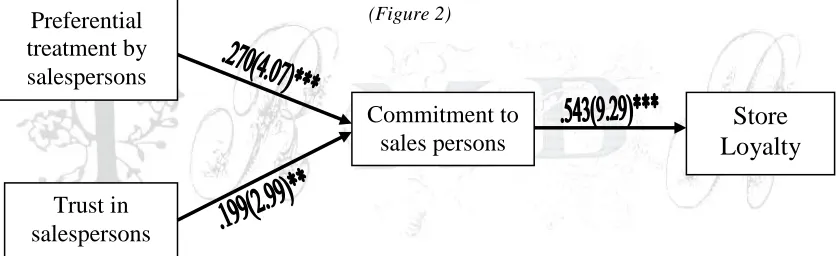
The higher value of the correlation coefficient (0.543) of commitment to salesperson and store loyalty shows that commitment has a ‗strong‘ relationship with store loyalty. From the regression table (Table III) it can be observed that all the hypotheses are found to be accepted. The overall model explained 29 percent of variation in the dependent variable (i-e, adjusted R2 = 0.291). Trust on salesperson effect positively the customers‘ commitment with salespersons (H1=.270, t=4.07, p < 0.001) thus supporting H1. Preferential
treatment of the salespersons increases the customers‘ commitment with salespersons (H2=.199, t=2.99, p <
0.01) thus supporting H2. At the end commitment with salespersons will increase the customers loyalty
towards the store (H3=.543, t=9.29, p < 0.001) hence also support H3. The results of the study are shown in
the Figure 2 are presented in Table III.
(Figure 2)
Note: Numbers in parentheses represent t-values associated with each coefficient and their respective significance is denoted as *p < 0.05, **p < 0.01 and ***p < 0.001. Results based on standardized solutions.
Table III: Parameter estimates for the research model.
Parameter Description ∆R2 Standardized
coefficients(β) t-values P< Hypothesis supported H1 Trust on Salespersons →
Commitment with salespersons
.069 .270 4.07 0.001 Accepted
H2 Preferential treatment → Commitment with salesperson
.066 .199 2.99 0.01 Accepted
H3 Commitment with salespersons
→ Store loyalty .291 .543 9.29 0.001 Accepted
Preferential
treatment by
salespersons
Trust in
salespersons
Commitment to
sales persons
Store
Loyalty
competition. Our findings are aligning with the previous finding of Wong and Sohal (2003), that the service quality that the salespersons provides to their customers, positively affect the customers loyalty. On theoretical point of view, our study add to the existing knowledge the importance of the extra care of the customer by the salespersons in the shape of the preferential treatment, to increase the loyalty of the customers towards a particular store. Trust on salesperson is also found to be the critical in building this customers-salesperson relationship, and in turn store loyalty. When a customer have trust on the salespersons and consider him/her a good adviser in various occasions, while choosing among the different alternatives, will also contribute to bringing that customer again and again and to increase the basket size. Hence, our study proves that this extra benefit, preferential treatment, and the customers trust on the salespersons will enhance the customers‘ commitment with the salespersons in maintaining long term favorable relationship, which is the key to success of any store.
As the ultimate factor that highly influence the customers‘ store loyalty in out study is commitment with the salespersons, but in the comparison of the two variables that have direct impact on customers‘ commitment with salespersons, trust is found to be the most critical one then preferential treatment. Our study evidenced that most of the peoples are interested in maintaining long term relationships with salespersons and that in turn results in the customers store loyalty. The same is urged by Hrebiniak (1974), in sociality point of view trust is an important factor in light of the fact that relationships build on trust are so greatly valued that peoples will want to maintain that relationship for longer time.
Managerial Implications
The results of the study are very much significant for the store managers in practical side. However the implication of result of this study and others, of same kind, as well are not an easy task. A thorough analysis of the results, cultural values and norms, individual‘s preferences and interests is necessary for the successful implication. Overall, the result of the study indicates that salespersons‘ personality, attitude and sociality with others are very much important when store loyalty is concern. The result of the preferential treatment is also found to be significant in this study. So individuals, for whom preferential treatment is also critical in the relationships, are actually showing their ‗esteem‘ level. So managers must have to make policies of training of salespersons, which are more concern in enhancing their attitude towards the customers and train them that how to make a customer committed in relationship.
The implication of the results is never being easy. The sales force have to check the psyche of the different customers, that whether or not they are being motivated with the preferential treatment, and upto what extent they are becoming committed to the salesperson by applying different strategies.
Limitation and Future Research
The study is based on the data that were collected mostly from the university students and very few professionals were included. The sampling is mostly based upon the convenience sampling, so the sample is not representative of the general population, and hence weakens the generalizability of the study. Future research is recommended to include more respondents from almost every field of life that should more representative of the general population.
toward making relationships with the salespersons. The study is done in one single city of Pakistan; future research will give more clear insight about the topic in various regions.
There are some other factors like race, religion and emotions that can also affect the chances of building relationship with the salespersons, which are excluded from this study. By taking into account all these factors, and other as well, that have the impact upon the customers attitude towards building the long term relationship with the salespersons, will also be a great contribution by the researcher(s).
References
Berry, L.L. (1995). Relationship marketing of services – growing interest, emerging perspectives, Journal of the Academy of Marketing Science, 23, 236-45.
Berry, L.L., Gresham, L.G., (1986). Relationship retailing: transforming customers into clients. Business Horizons, 29, 43–47.
Bitner, M.J., (1995). Building service relationships: it‘s all about promises. Journal of the Academy of Marketing Science, 23, 246–251
Crosby, L.A., Evans, K.R., Cowles, D. (1990). Relationship quality in services selling: an interpersonal influence perspective, Journal of Marketing, 54, 68-81.
Davis, J.F., (1997). Maintaining customer relationships through effective database marketing: a perspective for small retailers, Journal of Marketing Theory and Practice 5, 31–42.
Day, G.S., (1969). A two-dimensional concept of brand loyalty. Journal of Advertising Research, 9, 29-35.
Dick, A.S., Basu, K., (1994). Customer loyalty: toward an integrated conceptual framework, Journal of the Academy of Marketing Science, 22, 99–113.
East, R., Gendall, P., Hammond, K. and Lomax, W. (2005). Consumer loyalty: singular, additive or interactive, Australasian Marketing Journal, 13(2), 10-26.
Gandlach, G.T., Achrol, R.S., Mentzer, J.T. (1995). The structure of commitment in exchange, Journal of Marketing, 59, 78-92.
Guenzi, P., Johnson, M.D., Castaldo, S. (2009). A comprehensive model of customer trust in two retail stores, Journal of Service Management, 20, 290 – 316
Gwinner, K.P., Gremler, D.D. and Bitner, M.J. (1998). Relational benefits in services industries: the customer‘s perspective, Journal of the Academy of Marketing Science, 26, 101-14.
Hrebiniak, L.G. (1974). Effects of job level and participation on employee attitudes and perceptions of influence, Academy of Management Journal, 17, 649-662.
Jarvis, L.P. and Wilcox, J.B. (1977). True vendor loyalty or simply repeat purchase behavior? Industrial Marketing Management, 6(1), 9-14
Juttner, U., Wehrli, H.P., (1994). Relationship marketing from a value system perspective, International Journal of Service Industry Management, 5, 54–73.
Meyer, J.P., Allen, N.J. (1991). A three component conceptualization of organizational commitment, Human Resource Management Review, 1, 61-89.
Moorman, C., Zaltman, G., Deshpande, R. (1992). Relationships between providers and users of marketing research: the dynamics of trust with and between organizations, Journal of marketing Research, 29, 314-329.
Morgan, R.M., Hunt, S.D., (1994). The commitment–trust theory of relationship marketing. Journal of Marketing, 58, 20–38.
Neter, J., Wasserman, W., Kutner, M.H. (1989). Applied linear regression models, Homewood, IL: Irwin;
Paolo Guenzi, Michael D. Johnson, Sandro Castaldo, (2009). A comprehensive model of customer trust in two retail stores, Journal of Service Management, 20(3), 290 – 316
Parasuraman, A., Zeithaml, V.A., Berry, L.L. (1988). SERVQUAL: a multiple-item scale for measuring consumer perceptions of service quality. Journal of Retailing, 64, 12–37.
Peter, J.P. and Olson, J.C. (1990). Consumer Behavior and Marketing Strategy, Richard D. Irwin, Homewood, IL
Peterson, R.A., (1995). Relationship marketing and the consumer. Journal of the Academy of Marketing Science, 23, 278–281
Ping, R.A., (1993). The effects of satisfaction and structural constraints on retailer exiting, voice, loyalty, opportunism, and neglect. Journal of Retailing, 69, 320–352
Reichheld, F.F. (1993). Loyalty-based management, Harvard business Review, March/April, 64-73
Richard Ho, Leo Huang, Stanley Huang, Tina Lee, Alexander Rosten, Christopher S. Tang, (2009). An approach to develop effective customer loyalty programs: The VIP program at Tamp;T Supermarkets Inc. , Managing Service Quality, 19(6), 702 – 720
Schurr, P.H., Ozanne, J.L., (1985). Influence on exchange processes: Buyer's preconceptions of a seller's trustworthiness and bargaining toughness. Journal of Consumer Research, 11. 939-953.
Sheth, J.N., Parvatiyar, A., (1995). Relationship marketing in consumer markets: Antecedents and consequences. Journal of the Academy of Marketing Science, 23(4), 255-271
Soderlund, M., (2011). Other customers in the retail environment and their impact on the customer‘s evaluations of the retailer, Journal of Retailing and Consumer Services, 18, 174–182.
Swan, J.E., Nolan, J.J. (1985). Gaining customer trust: A conceptual guide for the salesperson, Journal of personal Selling and Sale Management, 5, 39-48.
Trout, J. and Rivkin, S. (2000), Differentiate or Die: Survival in Our Era of Killer Competition,
Wiley, New York, NY. Wirtz, J., Mattila, A.S. and Lwin, M.O. (2007), How effective are loyalty reward programs in driving share of wallet? Journal of Service Research, 9(4), 327-34.
Wirtz, J., Mattila, A.S., Lwin, M.O. (2007). How effective are loyalty reward programs in driving share of wallet? , Journal of Service Research, 9, 327-341.
Wong, A., Sohal, A. (2003). Assessing customer-salesperson interactions in a retail chain: differences between city and country retail districts, Marketing Intelligence & Planning, 21, 292 – 304.
Woodruff, R.B. (1997). Customer value: the next source for competitive advantage. Journal of the Academy of Marketing Science, 25, 139–153.
Wray, B., Palmer, A., Bejou, D., (1994). Using neural network analysis to evaluate buyer–seller relationships. European Journal of Marketing, 28, 32–48.
Wulfa, K.D., Schroder, G.O. (2003). Assessing the impact of a retailer‘s relationship efforts on consumers‘ attitudes and behavior, Journal of Retailing and Consumer Services, 10, 95–108.