A Deep Dive
i
nto
Pattern-
Recognition
(Facial Features)
Techniques
Surya Govind
,
Student, Dept. of Computer Science and Engineering, Vel Tech Rangarajan Dr. Sagunthala R & D Institute of Science and
Technology. Avadi, Chennai, INDIA.
Abstract—As we have already seen a splendid growth in multimedia and technology, and considerably higher scale of social issues and crimes, face recognition plays a vital role in taking actions regarding all of these. Face as an object consists of variety of features for detection and recognition, therefore, it is still the most challenging research area for students in the field of computer vision and image processing. In this survey paper, I have tried to put in few most endeavouring face features such as, various poses, age, partial occlusion etc. All this information contributes more and more during identification. However the most important is to reject the outliers of facial points. But this task has become more challenging and it becomes tough to recognize faces due to various external and the internal factors such as ageing, variations in poses, emotions variations, uncontrolled environmental conditions etc. There are various techniques which have been developed and used. Each technique has its own characteristics, advantages, disadvantages, performance, representative work etc. This paper also states face detection techniques, approaches, as Eigenface, Artificial Neural Networks (ANN), Support Vector Machines (SVM), Principal Component Analysis (PCA), Independent Component Analysis (ICA), Elastic Bunch Graph Matching etc. However, I just aim to provide a comprehensive review over face recognition along with its applications. And after the deep dive, some major outcomes are given in conclusion.
Keywords— FacialFeatures,SVM,Occlusion,ANN, Challenges, Illumination.
I. INTRODUCTION:
In the last 51 years, the face recognition has gone through a lot of research regarding low cost and systems are reliable in the different fields such as forensic, commercial, health-care, entertainment, government, travelling and immigration etc. Nowadays the Face Recognition System (biometric system) is a big business in the world. The biometrics market grew in the year of 2000 with $400 million and in the year of 2011, biometrics business is $5 billion. Human beings possess natural ability to recognize hundreds of faces by their visual system and cognition. That makes them recognize familiar faces even after a long period of time. Building an intelligent system similar to human perception system is still an active area of research. The researchers have suggested
numerous algorithms and methodologies for
recognizing a face effectively and efficiently. For this purpose, they have focused on detection and recognition of traits and features for individuals such as nose, eyes, mouth, face shape position, size, and beside relationship among traits and features. Furthermore, ongoing research in face recognition tries to develop such systems that could work well in a multitude of real-world applications.
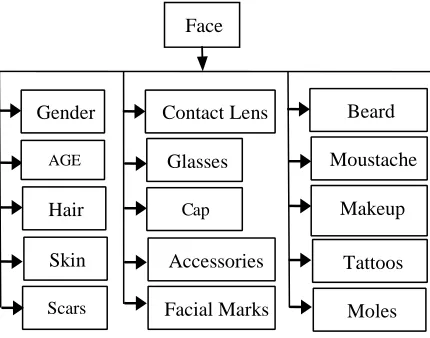
Fig. 1: Auxiliary information from the face Face
Gender
AGE
Hair
Skin
Contact Lens
Cap
Accessories Glasses
Beard
Makeup
Tattoos Moustache
During the past decades, face recognition has received increased attention and has advanced technology. Many commercial systems for still face recognition are now available. Recently, significant research efforts
have been focused on video-based face
modelling/tracking, recognition and system integration. New databases have been created and evaluations of recognition techniques using these databases have been carried out. Now, face recognition has become one of the most active applications of pattern recognition, image analysis and understanding.
II.BACKGROUND:
In 1960 Woody et al. gave the first
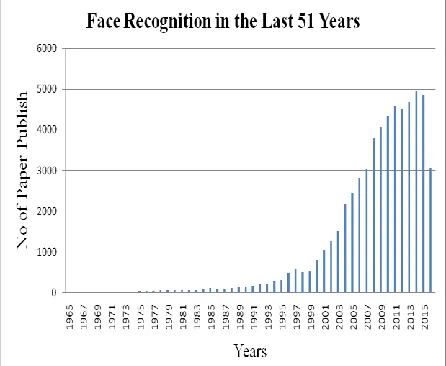
semi-automated facial recognition technique. This technique required some features such as mouth, nose, eyes and nose on the image. After that, face recognition techniques came in the picture. In 2001 onwards this biometric technique increased rapidly according to figure 2. The main goal of this paper is to aware people about constantly increasing scientific interest in face recognition biometric technique. The below analysis has been performed by applying the keyword “face recognition”. The database of face recognition for various types of publications namely, Article, Journals, Review, Book Chapters, Conference Papers and Book as shown in figure 3.Fig. 2: Face Recognition related publications for the past 51 years
History of face recognition the last 15 years have been found to be the most productive years in which maximum papers have been published. This data is very high which means that the research in the field of face recognition experiences its highest evolution so far. The outcomes of this analysis should be translated to more research activities and high prior knowledge
must favour the discovering and developing of the next generation frameworks in face recognition and applications.
Fig. 3: Face related publications for the past 51 years for different Documents
III.CHALLENGING AREAS IN FACE RECOGNITION:
A. Ageing:
Ageing is an inevitable natural process during the lifetime of a person as compared to other facial variations. Ageing effect can be observed under the main three unique characteristics:
1) The ageing is uncontrollable: It cannot be advanced or even delayed and it is slow and irreversible. 2) Personalized ageing Signs: Every human passes through different ageing patterns. And these rely on his or her genes and many other factors, such as health, food, region, and weather conditions.
3) The ageing signs depend on time: The face of a person at an age will affect all older faces, but unaffected in younger age.
B.Partial Occlusion:
Occlusion refers to natural or artificial obstacles in an image. It can be a local region of the face along with different objects such as sunglasses, scarf, hands, and hair. They are generally called partial occlusions. Partial occlusions correspond to any occluding object. And the occlusion less than 50% of the face is considered to be a partial occlusion. The approaches to face recognition with partial occlusion are classified into the following three categories: (1) Part Based Methods.
(2) Feature-based methods and (3) Fractal-Based Methods.
performance of a system when people deceive it either by the use of sunglasses, scarves, veil or by placing mobile phones or hands in front of faces. In some cases, other factors like shadows due to extreme illumination also act as occluding factors. Further, local approaches are used to deal with the problem of partially occluded faces which divide the faces into different parts. However, this problem can be overcome by eliminating some of the features which create trouble while accurate recognition in the image. Mostly local methods are based on feature analysis, in which best possible features are detected and then they are combined. Another approach that can be applied for this purpose is near holistic approach in which occlude features, traits and characters are eradicated and the rest of the face is used as valuable information. Different techniques are being developed by the researchers to cope up with this problem.
C.
Pose Invariance
Pose variance is yet another hurdle in achieving a successful face recognition system. People pose differently every time they take a picture. There is no standardized rule for taking a pose. Therefore, it makes more difficult to distinguish and recognize the faces from images with varying poses. Pose variations degrade the performance of the facial features. Also, many systems work under inflexible imaging conditions and as a result it affects the quality of gallery images. The methods dealing with variation in the pose can be divided into two kinds i.e. multi-view face recognition and face recognition across pose. Multi-view face recognition can be considered as an annexure of frontal face recognition in which the gallery image of every pose is considered. On the other hand, across a pose in face recognition, yield face with a pose which has never been exposed before to a recognition system. There are some other methods and approaches that are being used to tackle the similar problem of face recognition. Furthermore, variance and changes in the pose can be divided into three classes, namely:
(1) General algorithms.
(2) Two-dimensional methods for face recognition and (3) Three-dimensional models.
D. Illuminations:
Illumination is an observable property and effect of light. It may also refer to lightning effect or the use of light sources. Global illuminations are algorithms which have been used in 3D computer graphics. Illumination variation also badly affects the face recognition system. Thus it has been turned an area of attention for many researchers. However, it
becomes the tedious task to recognize one or more persons from still or video images. But it can be quite easy to extract desired information from images when they are taken under a controlled environment along with the uniform background. Also, three methods that can be implemented to deal with illumination problem. They are gradient, grey level and face reflection field estimation techniques. Grey level transformation technique carries out in-depth mapping with a non-linear or linear function. Gradient extraction approaches are used to extract edges of an image in grey level. As illumination is a factor that heavily affects the performance of recognition system obtained via face images or videos. These techniques are developed to suppress the effect of illumination.
IV.METHODS USED IN FACE RECOGNITION:
Face recognition is the sub-area of pattern recognition research and technology. Firstly we take input image from the standard cameras and this image is known as input image. Secondly, pre-processing is performed to improve the image quality and to reduce the noise in the taken images. Next phase is face segmentation where the face part is a cropped from the human body and background of the image. In the next phase, feature extraction is done after segmenting the input image to a very good level and relevant features are identified which can help in distinguishing that person to other people. In the last phase, a template is generated for enrollment and matching purpose. Finally, matching is done at the biometric system for identification of the authenticated person, if there is a match then the output will come in the form of user accepted otherwise user rejected. Face recognition systems can be divided into different categories:
A. Knowledge-based method:
The knowledge-based techniques are based on the geometry of the face and arrangement of the facial features. These knowledge-based methods describe the shape, size and texture. Some methods describe few other characteristics of facial features such as head, eyebrows, eyes, nose and chin. The major problem of these techniques is that they do not perform well because of different types of pose or head orientations as shown in my implementation results of V-J algorithm in figure 4.
Fig 4: Face Segmentation Results obtained on CMU dataset images
B. Feature invariant approaches:
Main aim of these techniques is to find structural features of the human face even with lighting conditions varying. Different types of structural features such as facial local features, skin colour, shape and texture are used. These methods are very sensitive to illumination, occlusion, existence of skin colour regions, and adjacent faces as shown in figure 5.
(a) (b)
(c) (d)
Fig5: (a) Original Image, (b) Skin Color Binary Image, (c) Skin Color Mark Area, (d) Image verified by face length breadth ratio.
C. Template-based methods:
Template-based methods are sensitive to pose, scale and shape variation of the human body. Deformable template methods have been proposed to deal with such variations of pose, scale and shape of the body. Template-based methods using the elastic models include shape parameters as well as intensity information of facial features.
Fig 6: A 14x16 pixel ratio template [8]
D. Appearance-based methods:
The appearance-based methods used for face
detection are Eigenfaces, Linear Discriminant
V. APPROACHES AND TECHNIQUES OF FACE RECOGNITION:
A.Eigen Faces:
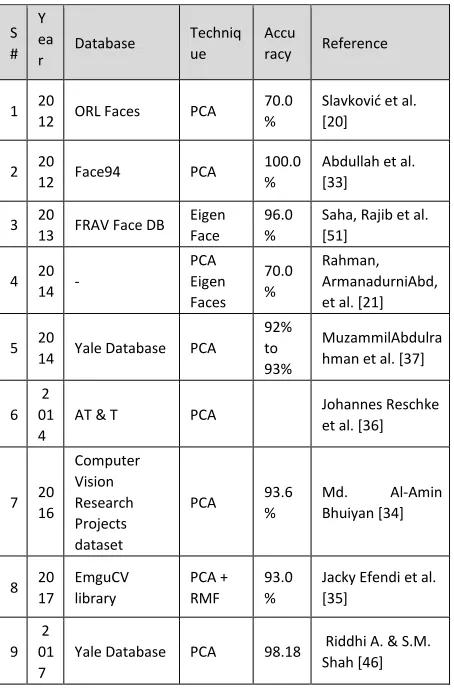
The word eigenface coined by German ―Eigen wert‖ The ―Eigen‖ means ‘characteristic’ and ―wert‖ mean ‘value’. Eigen face is well established algorithms that were used to recognize a feature in a face image. It is based on Principle Component Analysis (PCA). In this method, the fundamental concept is to recognize the face by taking its unique information about the face in question. Then encode it to compare with the decode result of the previously taken image. In eigenface method, decoding is performed with the calculation of eigenvector and then it is represented as a matrix. However, Eigen face-based face recognition systems are only suitable for images having the frontal faces but some researches identify a face with different poses have also been made. Analyzing different results drawn from the researchers the accuracy ratio has been much improved in recent years as compared to previous results. It is expected to have an effective and efficient output in upcoming years.
TABLE I. COMPARATIVE STUDY OF FACE RECOGNITION TECHNIQUES BASED ON PCA :
B.Artificial Neural Networks (ANN):
ANN provides an effective feature recognition technique, and it has been widely used after the emergence of Artificial Intelligence. This consists of a network, where neurons are arranged in the form of layers. Accuracy of face recognition has been boosted with the aid of better deep network architectures and supervisory methods. And recently few remarkable face representation learning techniques are evolved. Using these techniques, deep learning (Fig. 2) has got much closer to human performance. For evaluation, LFW face verification dataset has been used on tightly cropped face images. However, the learned face representation could also add significant intrapersonal variations. One of the most viable features of Neural Networks is it lessens the complexity. It learns from the training samples and then works fine on the images with changes in lighting conditions and increases accuracy. The main drawback of the neural network is a more time is needed for its training. Initially Training is precursor step to get the desired results from the system as user point of view.
After feature extraction, classifiers for face recognition such as the Radial Basis Function and Feed Forward Neural Network (FFNN) are then implemented. Moreover, study reveals that ANNs achieves improvement over face recognition. The following comparative study in Table II shows an accuracy ratio obtained through the use of ANNs.
Fig. 2.Face recognition using neural network.
C.Support Vector Machine (SVM):
SVM is the kind of supervised learning algorithm that uses data for classification and regression analysis. SVM provides advantages of being effective in high dimensions. SVM can be implemented to recognize the faces after facial feature S
# Y ea
r Database
Techniq ue
Accu
racy Reference
1 20 12 ORL Faces PCA 70.0 % Slavković et al. [20]
2 20 12 Face94 PCA 100.0 % Abdullah et al. [33]
3 20 13 FRAV Face DB Eigen Face 96.0 % Saha, Rajib et al. [51]
4 20 14 -
PCA Eigen Faces
70.0 %
Rahman, ArmanadurniAbd, et al. [21]
5 20 14 Yale Database PCA
92% to 93%
MuzammilAbdulra hman et al. [37]
6 2 01
4 AT & T PCA
Johannes Reschke et al. [36]
7 20 16
Computer Vision Research Projects dataset
PCA 93.6 % Md. Bhuiyan [34] Al-Amin
8 20 17 EmguCV library PCA + RMF 93.0 % Jacky Efendi et al. [35]
9 2 01 7
extraction. SVM can yield better outcomes when the large quantity of data set is selected directly with training. However, Least Square Support Vector Machine (LS-SVM) is among the popular one in SVM types that is being successfully utilized for the face recognition task.
The Support Vector Machine (SVM) classifier is the most widely used technique that is being implemented on a wide range of classification problems. SVM is useful in the advent of dealing with very high dimensional data. Researchers worked on SVM for classification of face recognition and got better results as shown in the below Table II.
TABLE II.COMPARATIVE STUDY BASED ON SVM :
S #
Ye ar
Database Technique Accu racy
Reference
1 2009
ORL Face Database
Least Square SVM
96% Xie, Jianhong et al. [25]
2 20 11
ORL Face Database
ICA, SVM 96% Kong, Rui et al. [26]
3 20 11 FERET Database, AT&T Database
2D- Principal Component Analysis, SVM
95.10 %
Le, Thai Hoang et al. [27]
4 20 16
Yale Faces SVM 97.78
%
Bhaskar Anand & Prashant K Shah [24]
D.Gabor Wavelet:
Dennis Gabor in 1946 introduced a tool for signal processing in noise removal and named as Gabor filter. Gabor wavelets technique is being widely used for face tracking and position estimation in face recognition. While an image representation using the Gabor wavelet transform provides both the spatial relations and spatial frequency structure. As shown in Fig. 4, it has a characteristic that allows it to delineate the properties of spatial localization, spatial frequency selectivity, and orientation. Gabor Wavelets works well over-extraction of edge and shape information and it represents the faces in a compact way which is more similar to the feature-based methods.
Fig. 4.Gabor wavelet process of recognition.
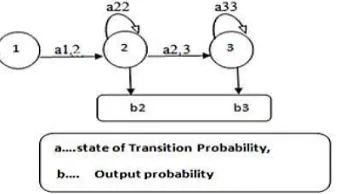
E.Hidden Markov Models:
Hidden Markov Model (HMM) is another statistical modelling technique in which the system undergoes in the Markov process with hidden state. This model was proposed in 1960 and provided a significant contribution towards speech recognition. HMM is a well-established method in reinforcement
learning, temporal pattern recognition, and
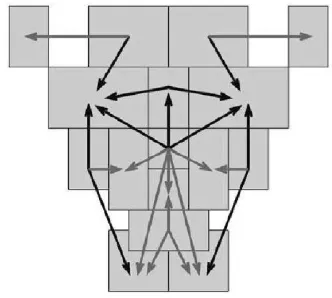
bioinformatics applications. Currently, it is being implemented to recognize facial expressions. Also, it can be applied to the video sequences for face recognition. It needs a sequence of 1D and 2D images for experimental purpose, but firstly these images should be converted into a chronological sequence of 1D or spatial. However, model consists of two processes, in which the first Markov Chain process having a finite number of states is not viewed explicitly. While in other processes each state constitutes a set of probability density function connected with it. Although for research, generally state HMM is designed for face recognition system. 5-state HMM is grouped into five facial features such as eyes, nose, mouth, chin and forehead for frontal view face images. But the number of states can be added or
removed which depends upon the system’s
requirement.
Fig. 6.Hidden Markov Model process of recognition.
VI. APPLICATIONS OF FACE RECOGNITION: Face recognition is used for two primary tasks:
Verification (one-to-one matching) i.e. When
presented with a face image of an unknown individual along with a claim of identity, ascertaining whether the individual is who he/she claims to be. 2. Identification (one-to-many matching): Given an image of an unknown individual, determining that person’s identity by comparing (possibly after encoding) that image with a database of (possibly encoded) images of known individuals. There are numerous application areas in which face recognition can be exploited for these two purposes, a few of which are outlined below.
• Security (access control to buildings,
airports/seaports, ATMs and border checkpoints; computer/ network security; email authentication on multimedia workstations).
• Surveillance (a large number of CCTVs can be monitored to look for known criminals, drug offenders, etc. and authorities can be notified when one is located; for example, this procedure was used at the Super Bowl 2001 game at Tampa, Florida; in another instance, according to a CNN report, two cameras linked to state and national databases of sex offenders, missing children and alleged abductors have been installed recently at Royal Palm Middle School in Phoenix, Arizona).
• General identity verification (electoral registration, banking, electronic commerce, identifying newborns, national IDs, passports, drivers’ licenses, employee IDs).
• Criminal justice systems (mug-shot/booking systems, post-event analysis, forensics).
• Image database investigations (searching image databases of licensed drivers, benefit recipients, missing children, immigrants and police bookings).
• “Smart Card” applications (instead of maintaining a database of facial images, the face-print can be stored in a smart card, bar code or magnetic stripe, authentication of which is performed by matching the live image and the stored template).
• Multi-media environments with adaptive human-computer interfaces (part of ubiquitous or context-aware systems, behaviour monitoring at childcare or old people’s centres, recognizing a customer and assessing his needs).
• Witness face reconstruction. In addition to these applications, the underlying techniques in the current face recognition technology have also been modified and used for related applications such as gender classification, expression recognition and facial feature recognition and tracking; each of these has its utility in various domains: for instance, expression recognition can be utilized in the field of medicine for intensive care monitoring while facial feature recognition and detection can be exploited for tracking a vehicle driver’s eyes and thus monitoring his fatigue, as well as for stress detection. Face recognition is also being used in conjunction with other biometrics such as speech, iris, fingerprint, ear and gait recognition to enhance the recognition performance of these methods.
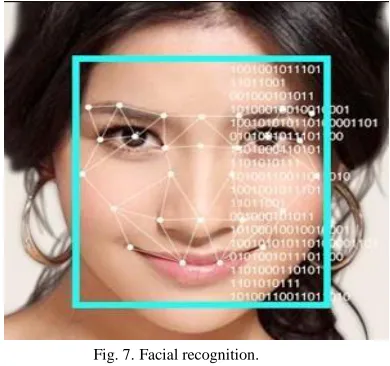
Fig. 7.Facial recognition.
images, whereas eigenfaces image features method work well for frontal face recognition. Among face recognition methods, the most popular are Neural
Networks, Support Vector Machine, Sparse
Representation based Classification (SRC), Linear Regression Classification (LRC), Regularized Robust Coding (RRC) and Nearest Feature Line ((NFL). These methods provide better results when the image dimension is under 150 or more. Furthermore, it is suggested that PCA, SVM, NN and Eigen methods still need to be researched so that more satisfactory results could be achieved for face recognition. Moreover, in this paper we also mentioned state of the art face recognition image database and face technology benefits in various applications. However, main findings of this research are highlighted as under:
• The development trends and achievements in the realm of face recognition show that a lot of researchers have been carried out in the last four decades.
• Currently, the face recognition system has been implemented for many real-time applications, but still it suffers from several challenges that need to be addressed to design a well-established face recognition system.
• Developed face recognition techniques could be analyzed over varying facial expression i.e. under varying lighting conditions and pose. An
evaluation could be performed using
benchmark and latest face databases.
• Similarly to the face image recognition, the video image recognition is more complicated that needs to be researched.
Face recognition is a challenging problem in the field of image analysis and computer vision that has received a great deal of attention over the last few years because of its many applications in various domains. Research has been conducted vigorously in this area for the past four decades or so, and though huge progress has been made, encouraging results have been obtained and current face recognition systems have reached a certain degree of maturity when operating under constrained conditions; however, they are far from achieving the ideal of being able to perform adequately in all the various situations that are commonly encountered by applications utilizing these techniques in practical life.
Further, it is suggested that for recognition of video images, YouTube Faces could
be analyzed for evaluation. Furthermore,
recognition of emotional
human behaviour has emerged recently as a promising research area for scholars that should be exploited in future. Finally, it is concluded that still there remains a gap in terms of study in face recognition system that requires to be filled to improve its accuracy and efficiency.
.
ACKNOWLEDGEMENT:I would like to acknowledge and convey my best regards to Prof. Jenn- Jier- James Lien for guiding me throughout my Learnings at National Cheng Kung University, Taiwan and for providing the positive conditions, guidelines about my desired work.
REFERENCES:
[1] Muhammad Sharif et al. (2017) : Face
Recognition: A Survey‖, Journal of Engineering Science and Technology Review 10 (pp: 166-177).
[2] Lacey et al. (2015): ―A Longitudinal Study of Automatic Face Recognition‖, IEEE ICB, (pp: 1- 8)
[3] Ms. Snehal Houshiram Gorde1, et al.‖ A Review
on Face Recognition Algorithms‖ Volume III, Issue I Issn No.:2350-1146, I.F-2.71
[4] Azeem, Aisha, et al. (2014) "A survey: face recognition techniques under partial occlusion." Int. Arab J. Inf. Technol. 11.1, (pp1-10).
[5] Jin, Yi, and Qiu Qi Ruan.(2012), "Face
recognition using gabor-based improved
supervised locality preserving projections." Computing and Informatics 28.1 (pp: 81-95). [6] Bellakhdhar, Faten, Kais Loukil, and Mohamed
Abid. (2013), "Face recognition approach using Gabor Wavelets, PCA and SVM." IJCSI International Journal of Computer Science Issues 10.2 (pp: 201-206).
[7] Dong Yi, Zhen Lei, Shengcai Liao and Stan Z. Li,( 2015), "Shared Representation Learning for Heterogeneous Face Recognition‖, (pp: 1-15). [8] Bhaskar Anand & Prashant, (2016), “Face
Recognition using SURF Features and SVM Classifier”, ISSN 0975- 6450 Volume 8, Number 1, (pp. 1-8).
[10]Sharif M., Ayub K., Sattar D. and RAZA M., (2012), "Real TimeFace Detection", Sindh Univ. Res. Jour. (Sci. Ser.) Vol. 44(4), (pp: 597- 600).
[11]Zhang, Xiao zheng, and Yong shengGao. (2009),
"Face recognition across pose: A review." Pattern Recognition 42.11 (pp: 2876-2896).
[12]Azeem, Aisha, et al. (2014), "A survey: face recognition techniques under partial occlusion." Int. Arab J. Inf. Technol. 11.1 (pp: 1-10).
[13]Zhao, Wenyi, and Rama Chellappa.
"Illumination-sensitive face recognition using symmetric shape-from-shading."Computer Vision and Pattern Recognition, 2000. Proceedings. IEEE Conference on. Vol. 1. IEEE, 2000. [14]Sharif M., Raza M. and Mohsin S., (2011) , "Face
Recognition Using Edge Information and DCT", Sindh Univ. Res. Jour. (Sci. Ser.) Vol.43 (2) (pp: 209-214).
[15]Sharif M. and Saad A., (2012), "Enhanced SVD Based Face Recognition", Journal of Applied Computer Science & Mathematics, Suceava, Vol. 12(6), (pp: 49-53).
[16]Ming, Yue, Qiuqi Ruan, and Xueqiao Wang. (2012), "Efficient 3dface recognition with Gabor patched spectral regression." Computing and Informatics 31.4), (pp: 779-803).
[17]Liu, Xiaoming, and Tsuhan Chen. "Video-based face recognition using adaptive hidden markov
models." Computer Vision and Pattern
Recognition, 2003. Proceedings. 2003 IEEE Computer Society Conference on. Vol. 1. IEEE along with SVD coefficients." (2008).
[18]Zhang, Xinming, and JianZou. "Face recognition based on sub-image feature extraction and
LS-SVM." Computer Science and Software
Engineering, 2008 International Conference on. Vol. 1. IEEE, 2008.