Vol.5 (2015) No. 4
ISSN: 2088-5334
Study on Circulating Concurrent Flow Dryer for Drying Rapeseed
Le Anh Duc
Nong Lam University, Ho Chi Minh City, Viet Nam E-mail: [email protected]
Abstract— The study was executed to design, manufacture a pilot scale circulating concurrent flow dryer for drying rapeseed with capacity of 200 kg/batch and test to determine the operating parameters of the circulating concurrent flow rapeseed dryer. The effect of initial rapeseed temperature, drying air temperature, drying air flow rate on the rapeseed temperature, exhaust air temperature, exhaust air relative humidity, drying rate, fuel energy consumption and germination ratio were investigated. Temperatures and moisture contents data were collected. For each experiment, rapeseed temperature, exhaust air temperature, exhaust air relative humidity were measured. The germination ratio of rapeseed was tested. The drying rate and fuel energy consumptions were calculated from experiment. The difference between theoretical values and measured values were evaluated by R2 and RMSE. The analytic results shown that the experimental results is in good agreement with theoretical results.
Keywords— rapeseed; concurrent flow; germination ratio; drying rate; fuel energy consumption
I. INTRODUCTION
Rapeseed is an agricultural plant, it was used to product bio-diesel. Rapeseed is normally harvested with moisture content more than 20% (w.b.), which results in high yields, and prevents field loss due to dropping and shattering. However, this moisture content is too high for safe storage and rapeseed must be dried to reach the safe moisture for storage. The commonly used rapeseed dryer is batch-type circulating dryer and fixed bed dryer, the capacity of these dryer is small, it cannot meet the demand of the increasing rapeseed production. In recent years, researches on the moving bed technique have been intensified specially on application in grain dryer. This technique requires a low investment, high drying rate, low energy consumption and causes less mechanical damage to the grain.
Concurrent flow drying is a relatively new grain drying technology. In concurrent flow dryer, the hottest drying air encounters the cold and wet grain at first, therefore drying rate can be increased and grain quality improved.
The study was executed to design, manufacture a pilot scale circulating concurrent flow dryer for drying rapeseed with capacity of 200 kg/batch and test to determine the operating parameters of the circulating concurrent flow rapeseed dryer such as drying temperature, rapeseed temperature, exhaust air relative humidity, exhaust air temperature, air flow rate, drying time, drying rate, germination ratio and fuel energy consumption.
II. MATERIALS AND METHODS
Rapeseed samples were cleaned and stored in refrigerator at a temperature of 4oC [3]. 200 kg of rapeseed with average initial moisture content is 23.0% and 23.2% was used in Test–1 and Test–2, respectively.
Electric balance (A-200, Cass, Korea, accuracy ± 0.01 kg) was use to weigh the mass of Kerosene loss by drying process.
Ambient air relative humidity and exhaust air relative humidity were recorded by hygrometer (MTH4100, Sanyo, UK, 10~99%, ± 1%).
In order to study the influence of different parameters on the performance of the dryer, all parameters may be changed. Airflow rate can be adjusted by the inlet opening of the fan. Temperature of heated air can be adjusted by changing the power of the fuel consumption, to control the burner, temperature sensor (PT-100Ω) was installed at the influx duct and temperature control equipment (HSD-V2, Hansung, Korea) was used. Grain flow velocity was controlled by discharge augers. The rotation of discharge augers were controlled by inverter (S500, Mitsubishi, Japan). Velocity of drying air was measured by anemometer (Velocical-Plus, TSI, USA).
III.RESULTS AND DISCUSSIONS
A. Result of designing and manufacturing
1) Selection of drying principle: There are many different grain dryer designs on the market. Basically, the classical configurations of the moving bed dryers fall into four categories according to the relative directions of seed and air flows: the mixed flow dryer, the cross flow dryer, the concurrent flow dryer, and the countercurrent flow dryer. In a concurrent flow dryer, the both the grain and drying air are moving in the same direction. This type of dryer has the advantage of using very high drying air temperature without affecting grain quality, and do not suffer the variation in grain moisture contents, obtaining of more homogeneous products. Besides, energy efficiency of this type dryer is high. The concurrent flow drying principle was introduced the first time in 1955 by Öholm. Thompson et al. [7] developed simulation models of concurrent-flow dryer for corn drying. Keum et al. [5] studied on circulating concurrent-flow for rice drying with the drying temperature from 98 - 126oC, and air flow rate from 28.5 - 57.1 cmm/m2. The study results shown that drying rate ranged from 1.09 - 2.2 %d.b./h, and energy consumption ranged from 6,224 - 6,992 kJ/kg-water. From these advantages, the use of concurrent-flow drying principle for drying of rapeseed has been recommended owing to:
• Energy saving: energy efficiency of this type dryer is about 30 - 40% better than a cross flow type dryer without heat recovery.
• Can be use high drying temperature (up to 130oC) without rising of grain temperature excessively because grain are exposed to drying air in a short time, leads to high drying rate (1.5 - 2 %w.b./h).
• Grain and drying air flow parallel, leads to more homogeneous moisture content and temperature distributions because all grains are exposed to the same temperatures, therefore guarantee the quality of the dried grains.
Fig. 1. Block diagram of rapeseed concurrent flow dryer.
The principle of the dryer was depicted as Fig. 1. The main structure of the dryer includes grain inlet section, burner, plenum section, drying section, suction centrifugal
The hot air is supplied by kerosene jet-burner, after going through the mixed chamber the drying air will enter the dryer through plenum section. Rapeseed and drying air are moving the same direction until drying air out by forced of suction centrifugal fan, rapeseed is continue to be circulated on the drying chamber for the next cycle drying until its reach to desired final moisture content. Rapeseed flow rate is controlled by two variable speed discharge augers.
The result of designing and calculating determined the operating parameters of dryer as shown in Fig. 2, Fig. 3 and Fig.4.
Drying section
140 110
500 55
Grain inlet
Exhaust air duct
Plenum chamber
250
Fig. 4 View of exhaust air ducts.
The dimension of drying chamber (height × length × width) is 0.5 × 0.7 × 0.5 m. Height of tempering section is 0.5 m. In order to suck the exhaust drying air, suction fan with air flow rate 30 cmm/m2, 1 HP was used. The jet-burner (OL-3, Deawon, Korea) using Kerosene. This jet-burner can be raise drying air temperature up to 140oC.
B. Result of experiment
1) Experimental setup: During experiment the drying air temperature and rapeseed temperature are continuously measured. For measurement temperature of drying air and rapeseed, 16 temperature sensors (Thermocouple T-type, Omega, USA) were installed inside the dryer (Fig. 5). Data from sensors were transferred to Data logger (Datascan 7327, UK) and recorded by two computers.
In plenum section, 3 sensors were installed to measure drying air temperature input. In exhaust air ducts, 4 sensors were installed (2 sensor at upper and 2 sensors at lower ducts) to measure exhaust air temperature. In drying chamber, 6 sensors were installed to measured rapeseed temperature. To measure rapeseed temperature after drying, 2 sensors were installed at above of two discharge augers. And one sensor was installed outside the dryer to measure ambient air temperature (Table 1). Grain flow velocity was set up at 5 m/h, equivalent to the mass of circulated rapeseed is 1000 kg/h. The rotation of discharge augers were 3.5 rpm. Initial rapeseed conditions shown in table 2.
TABLEI
TEMPERATURE SENSORS DISTRIBUTION AND HYGROMETER USED IN EXPERIMENT.
Temperature measurement Notation
Drying air Temperature
inlet 3 No. 1~3
outlet 4 No. 10~13
Rapeseed temperature
drying chamber 6 No. 4~9
discharge 2 No. 14~15
Ambient air temperature 1 No. 16
Relative humidity measurement
Ambient air relative humidity 1 No. 17
Exhaust air relative humidity 1 No. 18
TABLEII
INITIAL RAPESEED CONDITIONS.
Rapeseed Test–1 Test–2
Initial weight (kg) 200 200
Initial moisture content (%,w.b.) 23.0 23.2
Initial rapeseed temperature (oC) 22.8 24.7
Initial germination ratio (%) 98.5 97.7
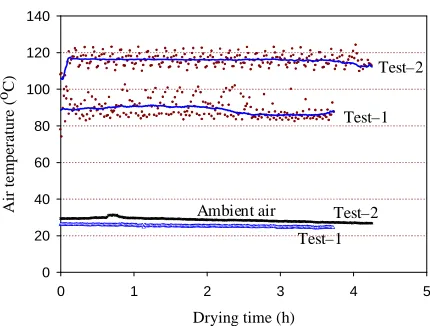
2) Results of experiment : The input data of experiment were executed in accordance with data of calculation. Both Test–1 and Test–2 there are different of drying air temperature in the plenum chamber. The drying air temperature is highest at position of front of plenum, and lowest at back of plenum. In Test–1, the average temperature of drying air in plenum section is 96.9, 84.2 and 83.9oC at front, middle and back of plenum, respectively. In Test–2, the average temperature of drying air in plenum section is 128.1, 111.3 and 106.1oC at front, middle and back of plenum, respectively. The average temperature of drying air in plenum chamber during drying process is 89.4oC and 116.8oC for Test–1 and Test–2, respectively (Fig. 6.).
The temperature of rapeseed during drying at discharge augers (Fig. 7) and the temperature of air at exhaust ducts (Fig. 8) for both Test–1 and Test–2 are fairly uniform. The temperature of rapeseed was analyzed and evaluated to calculating values. The calculated temperature of rapeseed during drying process have good correlative with the experimental data. The R2 and RMSE of rapeseed temperature are 0.904 and 1.15oC in Test–1 and 0.925 and 1.77o in Test–2, respectively. The R2 and RMSE of temperature of discharge rapeseed are 0.940 and 3.56oC in Test–1 and 0.846 and 1.40oC in Test–2, respectively. So, the
very small. The analytical results showed that calculate values have very good fitness to experimental values.
Drying time (h)
0 1 2 3 4 5
Ai r te m p er at u re ( oC ) 0 20 40 60 80 100 120 140 Test–2 Test–1 Test–1 Test–2 Ambient air
Fig. 6 Average variation of drying air temperature during drying.
Drying time (h)
0 1 2 3 4 5
G ra in te m pe ra ture ( oC ) 10 15 20 25 30 35 40
Left discharge auger Right discharge auger
Test–2
Test–1
Fig. 7 Rapeseed temperature during drying at discharge augers.
Drying time (h)
0 1 2 3 4 5
T em p er at u re ( oC ) 10 15 20 25 30 35 40
Upper exhaust air ducts Lower exhaust air ducts
Test–1 Test–2
Fig. 8 Temperature of exhaust air in Test–1 and Test–2.
After experiment was completed, dried rapeseed samples were sealed in double-layer polythene bags for 24 h to reach ambient conditions ([2], [6]). The samples were then tested for germination. The germination tests were conducted according to protocols described for the standard germination test [4]. The average germination percentage of Test–1 and Test–2 are 94.7% and 84.5%, respectively.
TABLEIII
DRYING CONDITIONS FOR DRYING TESTS.
Test No.
Average drying air temperature (oC)
Air flow rate (cmm/m2)
Ambient air temperature (oC)
Ambient relative humidity (%)
Test–1 89.4 30 25.4 (24.2 ~ 26.4) 71.6 (67.1 ~ 75.3)
Test–2 116.8 25 28.6 (26.7 ~ 31.4) 63.4 (60.8 ~ 68.0)
TABLEIV
THE RESULTS OF DRYING RAPESEED IN PILOT-SCALE DRYER
Experimental results Test–1 Test–2
Initial moisture content (%, w.b.) 23.0 23.2
Final moisture content (%, w.b.) 13.8 11.4
Drying time (h) 3.90 4.25
Drying rate (%w.b./h) 2.38 2.80
Germination ratio (%) 94.7 84.5
Fuel energy consumption
(kJ/kg-water) 4915 4831
The difference between calculated value and measured value of fuel energy consumption for drying were 4.62% and 8.57% lower than the experimental values for Test–1 and Test–2, respectively. The differences might be derived by the sequential changes in hot air temperature, ambient temperature, and humidity of the experiment conditions.
In Test–1, the R2 and RMSE of moisture content versus drying time were 0.994 and 0.334 %w.b. In Test–2, the R2 and RMSE of moisture content were 0.997 and 0.506 %w.b., respectively. The analytical results showed the good fitness between calculated moisture content and measured moisture content for both Test–1 and Test–2. The final moisture content in Test–1 is 13.8 %w.b. and Test–2 is 11.4 %w.b. The germination ratio of rapeseed met the standard.
IV.CONCLUSIONS
The combined theoretical and experimental studies were carried out to gain an understanding of the behavior of drying rapeseed by circulating concurrent flow dryer. A pilot scale circulating concurrent flow dryer for drying rapeseed with capacity of 200 kg/batch was designed, manufactured and tested to determine the operating parameters of the dryer. The effect of initial rapeseed temperature, drying air
temperature, drying air flow rate on the rapeseed temperature, exhaust air temperature, exhaust air relative humidity, drying rate, fuel energy consumption and germination ratio were investigated, analyzed and considered.
Two drying experiments were conducted. For each experiment, rapeseed temperature, exhaust air temperature, exhaust air relative humidity were measured. The germination ratio of rapeseed was tested. The drying rate and fuel energy consumptions were calculated from experiment data. The difference between theoretical values and measured values were evaluated by correlation coefficient and root mean square error. The analytic results shown that the experimental results is in good agreement with theoretical results, the circulating concurrent flow dryer is suitable for drying rapeseed.
REFERENCES
[1] Association of Official Seed Analysis, 1993. Rules for testing seeds. Journal of Seed Technology 16: 1 - 113.
[2] ANSI/ASAE S448.1. 2004. Thin-layer drying of agricultural crops. ASAE standards 51st Edition 598 - 600.
[3] Cassells J.A., Caddick L.P., Green J.R. and Reuss R., 2003. Isotherms for Australian canola varieties. Proceedings of the Australian Postharvest Technical Conference, p.59 - 63.
[4] Duc L.A., Han J.W., 2009. The effects of drying conditions on the germination properties of rapeseed. Journal of Biosystems Engineering. The Korean Society for Agricultural Machinery. Vol. 34 No.1, p.30 - 36.
[5] Keum D.H., Han J.G., Kang S.R., Kim O.W., Kim H., Han J.W. and Hong S.J., 2005. Development of rice circulating concurrent-flow dryer (I) - Performance test of pilot scale dryer. Journal of Biosystems Engineering 10(2): 97 - 106.
[6] Sokhansanj S., Zhijie W., Yajas D. and Kameoka T., 1986. Equilibrium relative humidity-moisture content of rapeseed (canola) from 5oC to 25oC. Transactions of the ASAE 29(3): 837 - 839. [7] Thompson T.L., Peart R.M. and Foster G.H., 1968. Mathematical