*Corresponding author:Niharika Maran ISSN: 0976-3031
Research Article
ENHANCING NETWORK PERFORMANCE USING RANDOM EARLY
DETECTION IN VIRTUAL QUEUE
Niharika Maran and Shubha Dubey
Department of Computer Science and Engineering, RITS, Bhopal
DOI: http://dx.doi.org/10.24327/ijrsr.2017.0810.1066
ARTICLE INFO ABSTRACT
The sender host is sends data to destination host through intermediate nodes or directly sometime in wired network. It is rarely possible the sender and receiver are directly connected in same network. The role of route is to collected data from the different hosts and according to route of destination data packets are delivering to destination router. The problem of congestion is occurring in network due to not handling load properly. The Traditional congestion control schemes help improve the performance after congestion has occurred. Throughout congestion data packets are drop in network and network throughput may also degrades and the end to end delay may become very high. Congestion control technique facilitates the network to recuperate from the congestion situation. In this paper we proposed the congestion control multipath virtual queue management technique with RED protocol in wired network. In this technique the congestion is handled by properly by applying RED mechanism with AVQ in multipath network. The multipath path routing is provides the alternative path that’s why it is better than the unipath routing protocol. The throughput is improve and delay is minimizes that enhance network performance. The proposed scheme performance is compare with the protocol performance of Droptail, Unipath, RED Unipath and AVQ in wired network. The performance all protocol are measured through performance metrics and the proposed performance is showing the better results and better data enhancing in wired network. The proposed mechanism is not completely removes the congestion but handle it properly that shows reduction in packet dropping.
INTRODUCTION
Active Queue Management (AQM)[1-3] is the most widely used research areas in the field of networking for congestion detection and avoidance. The idea used in AQM is to detect early congestion by dropping or marking packets before queue overflow. Router where congestion occurs provides a prior congestion indication to sources to avoid the large queuing delay and reduce packet losses by adjusting their packet transmission rate timely. Active Queue Management (AQM)[2][3] is an algorithm that detects and reacts to incipient congestion to avoid queue from overflows. There are in general two ways to detect congestion: first it can give congestion signal to traffic sources explicitly by setting Explicit Congestion Notification (ECN) bits, second it can be congestion signal to traffic sources implicitly by dropping packets.
The new mechanism is called Adaptive Virtual Queue (AVQ) algorithm maintains two queues a virtual queue and an actual
queue. Virtual queue capacity (called virtual capacity) is less than the capacity of the actual queue. When a packet arrives in the real queue, the virtual queue is also updated by inserting a fictitious packet to reflect the new arrival. When the congestion occurs and packet is dropped if packet transmission rate is higher than the packet handling capacity of node/link. Packet drop is treated as congestion by the source thus source reduce packet transmission rate to eliminate congestion. Packets in the real queue are marked/dropped when the virtual buffer overflows.
Related work
In this section describe about the existing work those provide AQM and virtual queue mechanism for congestion free communication against wired network.
Srisankar S. Kunniyur[4] et al proposed a mechanism called Adaptive virtual queue in 2004. The basic idea of developing the AVQ algorithm is to design an AQM scheme that results in a low-loss, low-delay and high utilization operation at the link.
Recent Scientific
Research
International Journal of Recent Scientific Research
Vol. 8, Issue, 11, pp. 21399-21404, November, 2017
Copyright © Niharika Maran and Shubha Dubey, 2017, this is an open-access article distributed under the terms of the Creative Commons Attribution License, which permits unrestricted use, distribution and reproduction in any medium, provided the original work is properly cited.
DOI: 10.24327/IJRSR CODEN: IJRSFP (USA)
Article History:
Received 05th August, 2017 Received in revised form 08th September, 2017
Accepted 10th October, 2017
Published online 28st November, 2017
Key Words:
Detection In Virtual Queue
From authors point of view the AVQ mechanism out performs a number of other well-known AQM schemes in terms of losses, utilization and average queue length. In particular, this mechanism is able to maintain a small average queue length at high utilizations with minimal loss at the routers.
Anand Rao [5] et al presented a mechanism Compound TCP (C-TCP) is presently the default transport layer protocol in the Windows operating system. In which study a non-linear fluid model of Compound TCP along with Virtual Queue (VQ) management schemes in network routers. Objective of this mechanism is to driving the link utilization to a desired level. Analysis of the AVQ policy shows that the system is liable to losing local stability with higher feedback delays, high link capacities, and with variations in the AVQ damping factor.
K.Chitra [6] et al presented a mechanism called FAVQCHOKe. In this title, arrival rate at the network link is maintained as a principal measure of congestion to improve the transient performances of the system and ensures the entire utilization of link capacity. This characteristic is particularly beneficial to real-time multimedia applications. Further, FAVQCHOKe achieves the above while maintaining high link utilization and low packet loss.
Mr. A.Chandra [7]et al presented a mechanism called Adaptive Virtual Queue with Choke Packets (AVQCP). In this mechanism choke packets are sent to the source when the virtual buffer overflows. Then source reduces its traffic sent to a particular destination by some percentage when it receives a choke packet. Sources ignore repeating choke packet for a fixed interval of time. If no further choke packets arrive after a certain time, the source will again increase the traffic. This mechanism gives better throughput than other AQM scheme.
Chin-Ling Chen[8] et al presented a mechanism called Proportional Rate based Control (PRC), is proposed to maintain the queue length as the level 1 by adjusting maximum desired rate if arrival rate exceeding the maximum desired rate by dropping the; at level 2 virtual queue to control packet transmission if arrival rate above minimum desired rate. The performance of PRC is compared with several well-known AQM, the proposed scheme is more effective which stabilize the queue and has lesser loss rate.
Qian Yanping et al presented a rate-based stable enhanced adaptive virtual queue (EAVQ) algorithm [9]. The concepts of this algorithm are measures of congestion, as well as desired link utilization ratio. Arrival rate at network was maintained as a principal measure of congestion. the specified link utilization magnitude relation was used as a subordinate measure and a rate-based adaptive mechanism that resolve the issues, like hardness of parameters setting, poor ability of anti-disturbance, and a little link capability loss. EAVQ improved the transient performances of the system and ensured the complete utilization of link capability.
Hao Wang et al propose effective AQM algorithm, named adaptive real queue control (ARQC) [10]. In which an explicit congestion indicator, virtual regulating time, is meant to detect network congestion. This title provides the tuning rules for the control parameters support the discrete model of TCP dynamics. Simulation results demonstrate that ARQC
outperforms the other AQM schemes in terms of stability, responsiveness and robustness in dynamic networks.
Prasant Kumar et al [11] explore the impact of buffer size and round trip time (RTT) on AQM router where TCP Reno is used as transport protocol in single bottleneck dumbbell topology. Among several AQM techniques, this title considered random early detection (RED), random exponential marking (REM), proportional integral (PI) and adaptive virtual queue (AVQ). Simulation results shows that the RED and AVQ obtain better stability than REM and PI by regulating queue length around its expected value. However RED and AVQ techniques drop more packets than REM and PI.
Manoj Kumar Prajapati, Divakar Singh[12] “Verifying Queue Length Scheme in Wired Communication for Congestion Control” in this title they discuss with the continuous increasing demand of internet applications. Network`s are expressing a serious congestion problem. In very large networks with heavy load traffic, Internet routers play an important role during congestion. All the internet routers have some buffers at input and output port which holds the packets in the time of congestion. Many queue management algorithms have been proposed but they mainly focus on fixed queue limit. Recognizing the fact that drop tail algorithm has fix maximum queue limit ,they direct our attention to variable Length queue limit for Combined Input and Output queued (CIOQ) switches. They propose a simple modification to the drop tail algorithm in which a generic queue management controls methodology in TCP/IP networks, that case they dynamic change queue length in our wired network.
Proposed Work
management (AQM) techniques [4][5]. RED prevents global synchronization deadlocks, and bias against massive flows to overcome limitation of Drop Tail queue. RED technique detects incipient congestion by using two important parameters i.e. minimum threshold (minth) and maximum threshold
(maxth). The average queue size (avgq) is calculated for every
packet arrived at the router. Then it compares the avgq with two
defined threshold value minth and maxth. If avgq is less than
minth then no packets are dropped or marked. If avgq is in
between minth and maxth arriving packet is marked with
probability Pa, where Pa is function of avgq. if avgq is greater
than maxth then it drops all incoming packets to lower the
queuing delay. If packet drop/mark is occurred in queue source reduce packet transmission rate to reduce packet loss and improve packet delivery ratio. So out of which random early detection (based on adaptive queue management) efficient in contrast of reliability as well as usability, from random early detection queue we proposed a mechanism and to enhanced RED through Adaptive Virtual Queue (EAVQ).
Proposed Adaptive Virtual Queue (EAVQ) implemented in every router whose provide connectivity to multi user environment, every router create individual RED queue for different senders and all the queue size initially equals, while the multiple sender sends the data to the routers than queue utilization are diverse for different users that depends on sender data rate. So in our proposal, based on queue utilization of the router, for set of s sender fetch the data to set of n queue in the router, and some situation queues like n1 and n2 utilization are
differ because sender s1 data rate higher than the sender s2 it
means n1 utilization greater than n2. Those queue utilization
create the wastage memory requirement because one sender demand extra queue and another under load utilization condition, so resolve this condition through threshold based queue detection, if the n1 queue greater than the threshold
utilization and n2 queue less than the threshold than ∂ queue
size share by the n1 from n2 queue. That done virtually so it’s
provides better utilization of queue and provides reliable, less congested communication as compare to existing methodology to the wired network.
AVQ-RED performance is better than the AVQ-Drop tail mechanism in terms of better queue utilization, higher throughput and low packet loss rate. Thus proposed mechanism EAVQ will utilize the queue better and gives the higher performance than existing AVQ.
Proposed Algorithm
Random early detection (RED) is a adaptive queue management mechanism are used, so that RED provide adaptability of queue according to data sends by sender and minimized the data drop from the network. In this section we enhanced RED queue using proposed adaptive virtual queue sharing algorithm, that algorithm describe in three parts input parameter, output and steps uses for execution. In the input parameter initialized all the required constraint for network design i.e. router, sender, receiver, queue, data rate etc. and execution steps those input needed algorithm runs. In our proposed algorithm distance vector multipath routing are uses that search the route from source to end server and sends data through multiple paths. Multipath routing balance the network load based on channel capacity and sends data, in the data
transmission while two sender share the common routers than independently queue are created in the router, those queue are share by both senders based on data within the queue, i.e. q1 utilization larger than the q2 and utilization threshold than q1 increases by ∂ and q2 decrease by ∂ that virtually adopted for both senders and minimized data drop as compare to RED technique and gives better output respect of network performance.
Algorithm: Random Early Detection with Adaptive Virtual Queue
Input
W: wired nodes R: routers S: Sender nodes E: end server
q: {q1, q2... qn} set of queue
qu: {qu1, qu2... qun}
qth: queue threshold
∂: queue change dr: initial data rate
λ: data rate change
I,O: input/output link capacity Red, Drop Tail: queue type DM: Distance vector multipath
Output: data drop, pdr, throughput, end-to-end delay, data send, data receives analysis
Steps: Initiate route-search (DM, S, E) If R in network than
Rtable generate routing table
Rf forward packet to next R or E
If E found by DM than
E receives routing packet by different path E Send Ack to S by reverse multipath path Send (data, S, E)
Else
E receives routing packet E Send Ack to S by reverse path End if
Else
E not found or R not exist End if
Send (data, S, E)
Identifies link capacity from s to R i1 store for s1 to R
i2 store for s2 to R
Identifies link capacity from R to E o1 store for R to E
o2 store for R to E
If i1 >o1 && i2 >o2 than
Router R create respective q for respective s q1 assign to s1
q2 assign to s2
qtype RED/Drop tail
End if
s1, s2 send data to E
For path 1 to n do
While dr1 > dr2 && qu1 > qth && qu2 < qthdo
q1 q1 + ∂
Detection In Virtual Queue
dr1 dr1 - λ
dr2 dr2 + λ
End while End for
Proposed Functional Architecture
In this section describe about the functional architecture of our proposed work, that architecture divided into four parts these are queue implementation, router configuration, design wired communication and analysis of network. In this architecture adaptive virtual queue share the queue based on utilization of queues and share the virtual space from other queue whose utilization less than the threshold utilization of queue. The connectivity is described in the diagram.
Figure 1 Proposed Functional Architecture for AVQ-Red Method
Simulation Parameters
The simulation parameters are considered for simulation of wired network is mentioned in table 1. In this wired network the number of devices for communication is considered 20 in network. The router is taking routing decision connected with duplex link in network.
Table 1 Network Simulation Parameters
Parameters Type
Network Type Wired
Nodes/Devices 20
Physical Medium Wired
Number of Router 8
End Server 2
Queue Type Red, Drop Tail, AVQ-Drop Tail, AVQ-Red
Simulation Time 100 seconds
Link Type Duplex Link
MAC Layer 802.3
Routing Protocol DV (Uni-path), DM (multipath)
Link Capacity 5MB (from node to Route),
Route-Router (50Kb to 5Mb)
Traffic Type CBR
Agent Type TCP/UDP
The performance of four protocols is measures on the basis of these performance metrics and the performance of proposed virtual queue method of handling congestion is better in network. These parameters are common in all scenarios for exact measurement of performance in network.
Simulation analysis
In this section describe about simulation analysis result through various parameters, for those analysis apply the network simulator-2 and generate network depended analysis etc.
Packet Delivery Ratio Analysis
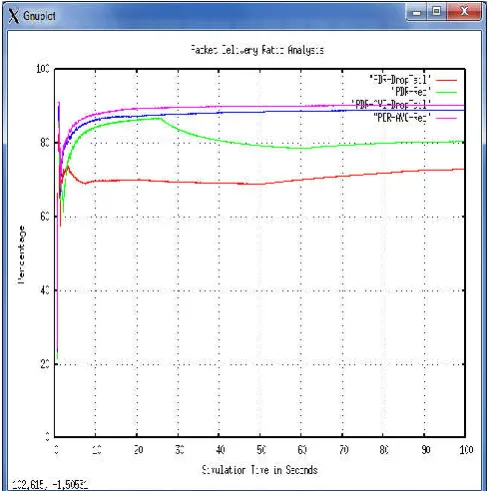
The measurement of packets receiving on the respect of sending in percentage ratio is calculating through PDR performance metrics. In this graph the PDR performance of four protocols like Drop tail Uni-path, RED Uni-path, AVQ with Drop tail Multipath and proposed AVQ with RED Multipath is measured and recognized that the performance of proposed scheme is provides better performance due to handle congestion problem efficiently. The better packet receiving provides efficient data delivery in network. The PDR performance w.r.t is mentioned in given graph of all existing protocols in wired network. The PDR performance of proposed AVQ with RED in Multipath is provides better results as compared to AVQ with Droptail in multipath packet receiving up to end of simulation time. The proposed performance has shows better results as compare to all existing three of them shown in figure 2.
Figure 2 PDR Analysis during simulation
Average e-e Delay (ms)
proposed protocol performance is shows minimum delay because of better data receiving shown in table 2.
Throughput analysis
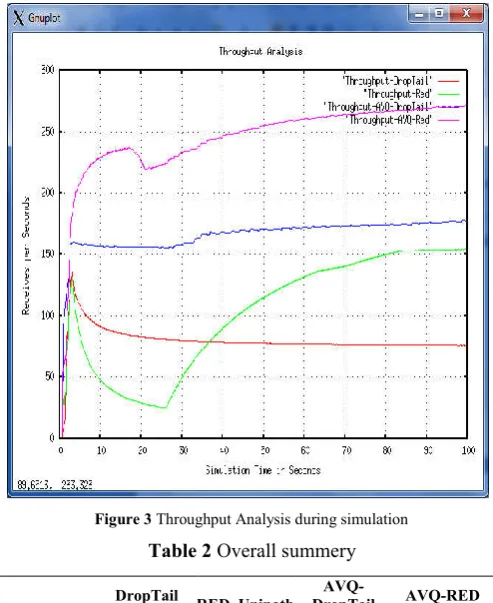
The number of sender and receiver in wired network are connected through routers and these routers are decided the route according to destination availability in network. The function of router is to routed data packets in between sender to receiver. In this graph throughput performance of all protocols including existing and proposed is evaluated and scrutinize that the performance of proposed scheme is give better results because of handle load in wired network efficiently. The proposed protocol throughput is about 260 packets/seconds in network and rest of them performance is very poor as compare to proposed shown in figure 6.
Figure 3 Throughput Analysis during simulation
CONCLUSION AND FUTURE WORK
The congestion is the major problem in network and their anticipation and avoidance is only possible if identified the congestion is occur in network. The number of senders is sending data according to available bandwidth and nodes processing capability. In wired network the link is reliable because directly connection to another node that is nearest to destination or router that is forwarded data to destination host area. In this research we proposed the congestion control scheme to handle the extra load in network properly. The proposed mechanism is work is limited bandwidth that is considered in all scenario with limited processing capability of sender and receiver host. The multipath routing is always
provides better result than unipath routing but it is also possible to improves multipath routing performance. The Unipath Droptail and Unipath RED performance is performing unipath routing in wired network. The multipath routing is the advance routing mechanism of unipath routing and in this multipath the concept of AVQ is showing better network performance. But the proposed protocol is enhance the performance by applying AVQ with RED in multipath routing and their performance is showing best result as compare to rest of three protocols considered in this research. The load in network is detected by RED that’s why it is better with AVQ. The proposed protocol is minimizes the delay and packet dropping and due to that the packet receiving, throughput and PDR is provides better results shown in Table 2. The proposed protocol handles the congestion state more efficiently and provides better communication in between sender and receiver.
The multipath routing is able to handle congestion with AVQ and RED mechanism in wired network. In future we proposed the congestion control scheme based the route selection having minimum load in network. It means just predict the load on the route on the basis of their historical information in wired network. And also possible if lightly loaded route is not available then to maintain synchronization in between sender and receiver before data sending in network.
References
1. Bhaskar Reddy, T.B. and Ali, A. “Performance Comparison of Active Queue Management Techniques”, India Journal of Computer Science, Vol. 4, pp 1020-1023. 2008.
2. V. Firoiu and M. Borden, “A study of active queue management for congestion control”, In Proceedings of the IEEE Infocom, pages 1435-1444, Tel Aviv, Mar 2000.
3. S. Athuraliya, V. H. Li, S. H. Low, and Q. Yin, “Rem: Active queue management, IEEE Network, Vol. 15, pp. 48-53, 2001.
4. Srisankar S. Kunniyur, R. Srikant, “An Adaptive Virtual Queue (AVQ) Algorithm for Active Queue Management” IEEE/ACM TRANSACTIONS ON NETWORKING, VOL. 12, NO. 2, APRIL 2004. 5. Anand Rao, Amit Warrier, Gaurav Raina, “Stability
analysis of Compound TCP with Adaptive Virtual Queues”, India-UK Advanced Technology Centre of Excellence in Next Generation Networks. 2013 IEEE 6. K.Chitra, Dr..G Padmavathi, “Favqchoke: To Allocate
Fair Buffer To A Dynamically Varying Traffic In An Ip Network”, International Journal of Distributed and Parallel Systems (IJDPS) Vol.2, No.1, January 2011. 7. Mr. A. Chandra, Ms. T. Kavitha, “Adaptive Virtual
Queue with Choke Packets for Congestion Control in MANETs”, IRACST-International Journal of Computer Networks and Wireless Communications (IJCNWC), ISSN: 2250-350 Vol.4, No2, April 2014.
8. Chin-Ling Chen, Chia-Chun Yu, “Performance Evaluation of Active Queue Management Using a Hybrid Approach” Journal Of Computers, VOL. 7, NO. 5, MAY 2012.
9. Qian Yanping, Li Qi, Lin Xiangze, Ji Wei.”A Stable Enhanced Adaptive Virtual Queue Management Table 2 Overall summery
DropTail
Unipath RED Unipath
AVQ-DropTail Multipath
AVQ-RED Multipath
PDF 71.61 70.25 88.75 89
Average e-e
delay(ms) 1963.9 697.95 1826.35 1006.31
No. of dropped
Detection In Virtual Queue
Algorithm for TCP Networks”, IEEE International Conference on Control and Automation, 2007 IEEE. 10. Hao Wang, Ou Li, Chenda Liao, Zuohua Tian. “Design
of Adaptive Real Queue Control Algorithm Supporting TCP Flows”, 35th Annual IEEE Conference on Local Computer Networks, 2010 IEEE.
11. Prasant Kumar Dash, Sukant Kishoro Bisoy,” Analysis of AQM Router of Network Supporting Multiple TCP Flows”, IEEE International Conference on Computational Intelligence and Computing Research 2014 IEEE.
12. Manoj Kumar Prajapati, Divakar Singh “Verifying Queue Length Scheme in Wired Communication for Congestion Control” Scholars Research Library. European Journal of Applied Engineering and Scientific Research, 2012, 1 PP.91-98.
*******
How to cite this article: