OPTIMIZATION OF ARRAY FACTOR IN
LINEAR ARRAYS USING MODIFIED
GENETIC ALGORITHM
Ali Varahram
Department of Industrial Engineering, Sharif University of Technology Tehran, Iran, [email protected] – [email protected]
Jalil Rashed Mohassel
Center of Excellence on Applied Electromagnetic Systems, ECE Department Faculty of Engineering, Tehran University, Tehran, Iran, [email protected]
K. Mafinezhad
Department of Electrical Engineering, Ferdowsi University of Mashhad Mashhad, Iran, [email protected]
(Received: December 24, 2003 – Accepted in Revised Form: )
Abstract The array factor (sidelobe level, SLL) of a linear array is optimized using modified continuous genetic algorithms in this work. The amplitudes and phases of the currents as well as the separation of the antennas are all taken as variables to be controlled. The results of the design using modified GA versions are compared with other methods. Two design problems were studied using several continuous modified GA versions and the results are presented as several plots. As a final example, the design specifications for an array with 200 elements are given. The effectiveness and advantages of the proposed modified GA versions are outlined.
Key Words Linear Arrays, Array Factor (AF), Sidelobe Level (SLL) Genetic Algorithm (GA), Optimization
ﻩﺪﻴﮑﭼ
ﻪﻟﺎﻘﻣ ﻦﻳﺍ ﺭﺩ ﯼﺭﺎﻨﮐ ﮒﺮﺒﻠﮔ ﺢﻄﺳ
)
SLL
( ﯽﺘﺛﺍﺭﻭ ﻢﺘﻳﺭﻮﮕﻟﺍ ﺯﺍ ﻩﺩﺎﻔﺘﺳﺍ ﺎﺑ ﻪﺘﺳﻮﻴﭘ
ﻩﺪﺷ ﻪﻨﻴﻬﺑ ﻩﺪﺷ ﺡﻼﺻﺍ
ﺖﺳﺍ . ﺖﺳﺍ ﻩﺪﺷ ﻪﺘﻓﺮﮔ ﺮﻈﻧ ﺭﺩ ﻩﺪﻨﻨﮐ ﻝﺮﺘﻨﮐ ﯼﺎﻫﺮﻴﻐﺘﻣ ﻥﺍﻮﻨﻋ ﻪﺑ ﯽﮕﻤﻫ ﺎﻫ ﻦﺘﻧﺁ ﻪﻠﺻﺎﻓ ﺰﻴﻧ ﻭ ﺯﺍﺮﻓ ،ﻪﻨﻣﺍﺩ .
ﻪﺠﻴﺘﻧ
ﺖﺳﺍ ﻩﺪﻳﺩﺮﮔ ﻪﺴﻳﺎﻘﻣ ﺮﮕﻳﺩ ﯼﺎﻫ ﺵﻭﺭ ﺎﺑ ﯽﺣﺍﺮﻃ .
ﯽﺣﺍﺮﻃ ﻪﻧﻮﻤﻧ ﻭﺩ ﻪﺘﻓﺎﻳ ﺀﺎﻘﺗﺭﺍ ﻪﺘﺳﻮﻴﭘ ﻢﺘﻳﺭﻮﮕﻟﺍ ﻪﻧﻮﻤﻧ ﻦﻳﺪﻨﭼ ﺎﺑ
ﺖﺳﺍ ﻩﺪﻳﺩﺮﮔ ﻪﺋﺍﺭﺍ ﺩﺪﻌﺘﻣ ﯼﺎﻫ ﯽﻨﺤﻨﻣ ﺕﺭﻮﺻ ﻪﺑ ﺞﻳﺎﺘﻧ ﻭ ﺪﻧﺍ ﻩﺪﺷ ﯽﺳﺭﺮﺑ .
،ﻲﻳﺎﻬﻧ ﻝﺎﺜﻣ ﮏﻳ ﻥﺍﻮﻨﻋ ﻪﺑ
ﮒﺭﺰﺑ ﻪﻳﺍﺭﺁ ﮏﻳ ﯼﺎﻫ ﻪﺼﺨﺸﻣ ۲۰۰
ﯼﺎﻫ ﺵﻭﺭ ﻥﺩﻮﺑ ﺮﺛﻮﻣ ﻭ ﺎﻳﺍﺰﻣ ﻭ ﻩﺪﻣﺁ ﺖﺳﺩ ﻪﺑ ﯼﺮﺼﻨﻋ
GA
ﺭﺩ ﻩﺪﺷ ﻪﺋﺍﺭﺍ
ﻩﺪﺷ ﺢﻳﺮﺸﺗ ﻞﻳﺎﺴﻣ ﻪﻧﻮﮔ ﻦﻳﺍ ﺭﺩ ﻪﻟﺎﻘﻣ ﺖﺳﺍ
.
1. INTRODUCTION
The application of Genetic Algorithm (GA) is now common in complicated EM problems [1]. In designing arrays with many elements (more than 50), GA is referred to as one of efficient methods [2] which is capable of handling complex problems with many independent variables. Suitable design methods based on conventional procedures have been presented for arrays with fewer elements [3]. In the design of linear and planar arrays, in
presented.
2. PRELIMINARIES
When the positions and the excitations of the elements in an array are known, the array factor, AF (θ,φ), can be obtained for different specific geometries [4]. Ordinarily in analysis and design procedures one of the two factors, position or excitation, is used as a variable to optimize the array factor. However in optimization using GA, there is no limitation on selection of variables. Therefore, the amplitudes and phases of the excitations as well as positions of the elements can be used as independent variables in the optimization process.
Normally, phases of excitations, in the elements of an array are multiples of a fixed value which is determined by the number of binary bits of the binary phase shifter. Therefore, all the angles can not be swept practically, by these phase shifters. For example, to realize a precision of 0.5 degrees, a ten bit phase shifter (210=1024) should be employed. Therefore to find the desired accuracy in phases of the elements, delay lines are used. A combination of phase shifter and delay lines can provide an excitation with an arbitrary phase. In many conventional design techniques, the amplitude of excitation is obtained for elements with equal separations and the far field pattern of the array is controlled by the amplitude of excitation. In some other methods positions of the elements is controlled with an assumed current distribution. The purpose of optimization is reducing the main lobe beamwidth, sidelobe level (SLL) or null position control of the pattern. In this work, the reduction of sidelobe level by controlling amplitudes, phases, and the positions of the elements is performed. The effectiveness of the proposed continuous GA versions in such a complex problem with many variables is studied.
3. GENETIC ALGORITHM
Foundations for GA are well known [5]. In the past decade GA has been used in antenna arrays and
antenna pattern design [6]. Sidelobe level reduction for linear and planar arrays has shown that reduction of sidelobe level (SLL, in dB's) is linearly related to the logarithm of the reduction in half-power beam width [7]. In these methods, with an assumption that the positions of all elements of the array are specified, the excitation current is determined using GA. Results show that SLL reduction is readily possible using the presented modified GA methods with significant improvement over conventional genetic algorithm[8].
4. CONTINUOUS GENETIC ALGORITHM
Solving problems in the continuous space, using discrete GA requires in each step of evolution, two mappings; from discrete space to the continuous space and vice versa. Therefore the computational time in this case is much more than that of the continuous GA. In this paper we have used modified continuous GA for arrays with high numbers of elements.
and the continuous GA (real coded) routine are in the following processes:
(a) transformation from the chromosome space to
the variable space and the inverse transformation; (b) the method of mutation of genes; and
(c) the structure of genes (chromosomes). TABLE 1. Design Specifications for Problems #1, #2, and #3 in the Continuous GA.
The Initial Population Distribution is Uniform.
Description of the Array
Problem # 1 Problem # 2
Problem # 3
No. Elements
128
48
200
No. Variables (dimensions)
192
72
300
No. Population
128
128
512
No. Evolution Stages
200
200
288
Minimum of No. Evolution Stages
λ/2 λ/4 λ/2Maximum of No. Evolution Stages
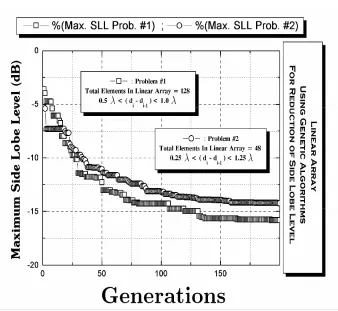
λ 5λ/4 3λ/2Figure 2. Maximum SLL (dB) of the linear array versus stages of evolution in modified continuous GA (C2).
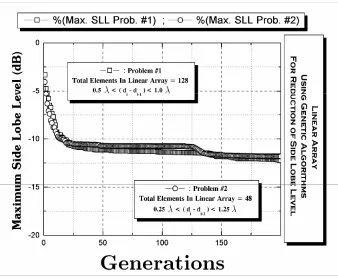
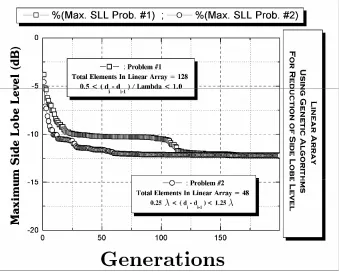
Other modified GA versions used in the analysis are as follows:
Continuous GA with adaptive mutation rate (C2) Fast continuous GA with adaptive mutation rate (C3)
Continuous GA with adaptive mutation rate and high mortality (C4)
Fast continuous GA independent of genes “intervals” (C5).
C2: In continuous GA with adaptive mutation rate
(C2), we control the mutation factor. The direction of mutation rate is selected opposite to the evolution error. If in two consecutive generations, the evolution error increases, we reduce the mutation rate and vice versa. In all versions, however, the best chromosome is not altered. Normally, the rate of increase (or decrease) in
mutation is preserved.
chromosomes can be taken to be five percent.
C4: If the matched individuals are assumed as a closed loop chain and the replacement of population is done by repetition and combining the loop with itself, then this method is similar to the conventional continuous GA (C1) in which the number of individuals to be eliminated is high in comparison to the total population. In addition, the mutation rate is also adaptive. We refer to this version as: continuous GA with adaptive mutation rate and high mortality (C4).
C5: The last modified version of the GA method is
continuous GA independent of genes separations
(C5). Generally, evolution is due to two factors; i.e. mutation and mating. In the continuous space, mutation by many states will provide all the possible values of the variables. In mating, we can either increase the number of crossover points or the position of crossover. In a chromosome model,
similar to a DNA, genes are like a chain while in this process a chromosome makes a loop where genes are located around this loop. When mating, a loop has not a beginning or an end and hence crossover becomes independent of the position of the event and the two loops can interchange each part of their periphery. In nature however, according to the experiments, there is a direct relation between the distance of genes and the probability of occurrence of a crossover. With an increase in genes separations, the probability of the occurrence of a crossover is increased and vice versa [9] but in the above technique an independency in the genes separation is achieved. In Figure 6 the array factor of problem #2 in
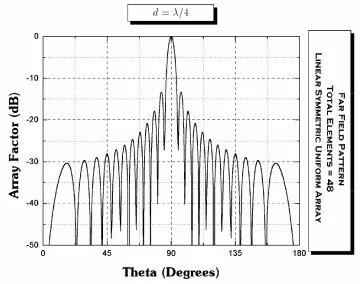
Figure 6. Array factor (AF) of problem #2 versus θ (in degrees) in modified GA (C2) after 200 stages.
of Figure 6 and Figure 7 shows several dB improvement in the SLL using modified version (C2). Even more improvement can be achieved using other versions.
5. DESIGN RESULTS USING MODIFIED ALGORITHMS
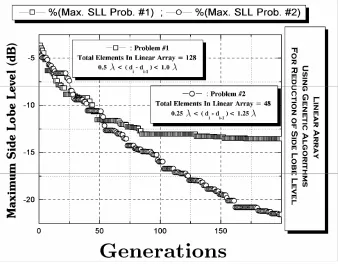
As a design example using modified GA versions, we select a complicated case (problem #3). The proposed data is given in Table 1. We have used version (C5) in the design procedure. The elements of the array are symmetric around center of the array. There are 200 elements in the array and therefore, considering symmetry of the problem we have 300 independent variables which are phase, amplitude and the position of each element. The results of SLL and relative processing time of the algorithm (flops) versus stages of evolution is
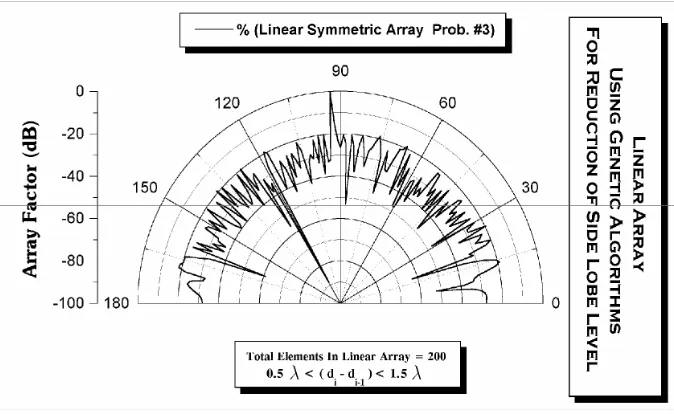
plotted in Figure 8 and Figure 9 respectively. Figure 10 shows the radiation pattern of the array in the φ=90 plane using (C5) and after 288 evolution steps. It is observed that a SLL of approximately -20dB is achieved for the linear array. This shows the effectiveness of the design with an improvement of more than 6.5dB over the best possible SLL for a uniform linear array which is well known to be -13.5 dB's.
As a sample, Table 2 shows the results of the design in problem #3. The position (relative to the center of the array) in terms of wavelengths, amplitude and phase (in degrees) of each element of the linear array in problem #3 is presented in Table 2.
6. CONCLUSION
To improve the radiation pattern and the array
Figure 9. Execution time versus stages of evolution in the modified continuous GA (C5).
TABLE 2.Positions of Elements from the Center of the Array (in Wavelengths), Relative Amplitudes and Phases for Problem #3.
No. Position
Amplitude
Phase
No. Position
Amplitude
Phase
1 0.833 0.5742 105.8 51 50.6 0.8887 264.4
2 1.962 0.9904 173.8 52 51.95 0.5955 241.7
3 3.257 0.7943 232.1 53 52.71 0.1169 271.8
4 4.157 0.2715 267.4 54 53.96 0.5743 317.5
5 5.07 0.9405 241.8 55 55.03 0.8535 296.1
6 6.077 0.9153 236.7 56 55.56 0.0412 232.4
7 6.864 0.5936 273.6 57 56.58 0.6835 333.6
8 7.549 0.2928 216.1 58 57.97 0.02812 224
9 8.368 0.7989 219.1 59 58.54 0.7085 359.1
10 9.564 0.878 230.7 60 59.36 0.439 352.6 11 10.92 0.5115 297.6 61 60.14 0.3052 17.02 12 12.25 0.9551 296.9 62 60.95 0.8499 341.6 13 12.82 0.02764 353.7 63 61.64 0.4154 358.9 14 13.96 0.7791 298.4 64 62.89 0.8658 25.1 15 15.19 0.8446 317 65 64.11 0.6956 10.96 16 16.12 0.3918 298.5 66 64.67 0.1315 305.6 17 16.94 0.9108 14.06 67 65.26 0.4182 99.7 18 18.04 0.2225 335 68 66.47 0.8399 35.37 19 19.22 0.9637 9.1 69 67.87 0.9815 67.04 20 20.25 0.5685 45.13 70 69.22 0.9858 59.57
21 21 0.8842 307.9 71 70.14 0.4902 101.5
22 21.87 0.8766 22.08 72 71.16 0.2882 99.91 23 23.07 0.829 27.99 73 71.86 0.216 128.4 24 24.47 0.9895 35.68 74 73.03 0.3237 85.74 25 25.42 0.8268 110.5 75 74.13 0.1976 166.2
26 26.2 0.02656 280.6 76 75 0.3819 111.1
27 26.8 0.9525 69.18 77 76.07 0.8542 120.2
28 27.88 0.8221 129.4 78 77.29 0.7726 179 29 28.51 0.7664 47.65 79 78.71 0.5502 154.2 30 29.55 0.6424 100.7 80 80.14 0.2991 172.5 31 30.25 0.5463 28.89 81 81.17 0.1071 255 32 31.17 0.7808 81.41 82 82.12 0.5199 207.8 33 32.41 0.9887 126.7 83 82.96 0.03923 305.3 34 33.57 0.6375 134.2 84 83.76 0.8816 174.5 35 34.78 0.1638 163 85 84.88 0.3496 280.8 36 36.24 0.9275 163.2 86 85.49 0.2936 39.32
37 37.5 0.9966 150.5 87 86.5 0.1564 318.7
38 38.56 0.03113 175.4 88 87.38 0.2567 259.7 39 39.12 0.471 149.8 89 88.38 0.2931 263.85 40 39.74 0.2277 203.5 90 89.35 0.152 21.87 41 40.43 0.5353 81.44 91 90.08 0.9536 230.7 42 41.44 0.9417 179.1 92 91.08 0.2066 8.721 43 42.72 0.9182 202.8 93 91.7 0.6377 278
44 43.8 0.4626 196.7 94 92.77 0.8995 288.2
factor, a combination of array variables (positions, amplitudes and phases) was controlled in such a way that an increase in the dimension of the problem, and independent of the continuous GA method, the convergence of the problem is still possible. In continuous GA, the required processing time increases linearly with an increase in the dimension of the problem while the convergence time for the response increases logarithmically [10]. Two problems with dimensions 72 and 192 were analyzed using several proposed modified GA algorithms and the results as well as the convergence rate is presented as several plots. The effectiveness of the proposed modified versions were studied and compared. With the selection of a complicated problem having a dimension of 300, the results, convergence time, and the variation of convergence versus evolution stages were obtained and were given in several plots. With an increase in the dimension of the problem and without a drastic increase in the computational time modified continuous GA versions make it possible to find an optimized solution fairly close to a global optimum.
7. ACKNOWLEGMENT
The support of Vice chancellor for research, Tehran University in preparing this work is gratefully acknowledged.
8. REFERENCES
1. Haupt Randy, L., “An Introduction to Genetic Algorithms for Electromagnetism,” IEEE Antennas and
Propagation Magazine, Vol. 37, No 2, (April 1995),
7-15.
2. Haupt Randy, L., “Thinned Arrays Using Genetic Algorithms”, IEEE Transactions on Antennas
and Propagation, Vol. 42, No 7, (July 1994),
993-999.
3. Kumar, B. P. and Branner, G. R., “Design of Unequally Spaced Arrays for Performance Improvement”, IEEE
Transactions on Antennas and Propagation, Vol. 47,
No 3, (March 1999), 511-523.
4. Balanis, C. A., “Antenna Theory Analysis and Design”, John Wiley and Sons, (1997).
5. Goldberg, D. E., “Genetic Algorithms in Search, Optimization and Machine Learning”, Addison-Wesley, (1989).
6. Buckly, M. J., “Linear Array Synthesis Using a Hybrid Genetic Algorithm”, Proc. IEEE Antennas
Propagat. Soc. Int. Symp., Baltimore, MD, (July 1996),
584-587.
7. Weile, D. S. and Michielssen, E., “Integer Coded Pareto Genetic Algorithm Design of Constrained Antenna Arrays”, IEE Electronic Letters, Vol. 32, No 19, (September 12, 1996), 1744-1745.
8. Yan, K. K. and Lu, Y., “Sidelobe Reduction in Array-Pattern Synthesis Using Genetic Algorithm”, IEEE
Transactions on Antennas and Propagation, Vol. 45,
No 7, (July 1997), 1117-1121.
9. Mueller, R. F., Young, I. D. and Emery, A. E. H., “Emery's Elements of Medical Genetics”, 10th Edition, Churchill Livingstone, (1998).
10. Ares-Pena, F. J., Rodriguez-Gonzalez, J. A., Villanueva, L. E. and Rengarajan, S. R., “Genetic Algorithms in the Design and Optimization of Antenna Array Patterns”, IEEE Transactions on Antennas and
Propagation, Vol. 47, No 3, (March 1999),