A Monthly Double-Blind Peer Reviewed (Refereed/Juried) Open Access International e-Journal - Included in the International Serial Directories Indexed & Listed at:
VOLUME NO.3(2013),ISSUE NO.10(OCTOBER) ISSN2231-5756
INTERNATIONAL JOURNAL OF RESEARCH IN COMMERCE, IT & MANAGEMENT
CONTENTS
CONTENTS
CONTENTS
CONTENTS
Sr.
No.
TITLE & NAME OF THE AUTHOR (S)
Page No.
1. MACHINE USAGE BASED ON PRODUCT MIX IN MANUFACTURING CLASSIFICATIONS DR. SURESH TULSHIRAM SALUNKE & SHWETA SURESH TULSHIRAM SALUNKE
1
2. A STUDY ON THE CHALLENGES FACED BY TIRUPUR GARMENT EXPORTERS DR. S. SARANANAN & S. MOHANRAJ
5
3. HEALTHCARE AND MEDICAL TOURISM: RETROSPECT AND PROSPECT R. VEERAPPAN, J. SASIGANTH, FR. ANGELO JOSEPH & A. JOE ROBINSON
8
4. TRADE BETWEEN INDIA AND ASEAN COUNTRIES FOR AGRICULTURAL AND MINERAL PRODUCTS: EXPLORING COMPATIBILITY THROUGH REVEALED COMPARATIVE ADVANTAGE
DR. B. P. SARATH CHANDRAN
11
5. RELEVANCE OF ISLAMIC BANKING TO INDIAN ECONOMY S. NAYAMATH BASHA & DR. BADIUDDIN AHMED
17
6. AXIOMATIZATION OF THE PREFERENCE CORE IN MULTICRITERIA COOPERATIVE GAMES A. SUGUMARAN & P. VISHNU PRAKASH
21
7. CORPORATE GOVERNANCE & INFORMATION SECURITY: AN ANALYTICAL STUDY DR. BADIUDDIN AHMED, SYED HAMID MOHIUDDIN QUADRI & IRFANUDDIN
25
8. RUPEE FALLING: DOLLAR IS ON HORSE RIDE M. RAMU, M. S. K. VARMA & S.SUDHEER
28
9. AN ANALYSIS OF INDIAN AUTOMOBILE INDUSTRY: SLOWDOWN AS AN OPPORTUNITY FOR NEW DEVELOPMENT DR. ANKUR KUMAR RASTOGI & NITIN GOPAL GUPTA
36
10. A PROPOSED THEORY OF NEURAL NETWORKS IN KNOWLEDGE MANAGEMENT FOR AN EXPERT SYSTEM V. SUMALATHA
41
11. THE INFORMATION MANAGEMENT PRACTICES OF BHIRDAR UNIVERSITY DR. MATEBE TAFERE
45
12. VEBLENIAN SOCIO-PSYCHOLOGICAL MODEL: AN ETHNOGRAPHIC STUDY DR. K. ABRAHAM & DR. M. RAJASEKHAR
51
13. INNOVATIVE TEACHING AND LEARNING TO ENHANCE CRITICAL THINKING AND REFLECTIVE PRACTICE, FOR QUALITY AND RELEVANCE OF HEALTH EDUCATION
DR. BIRHANU MOGES ALEMU
56
14. A STATISTICAL ANALYSIS OF PHYSICALLY DISABLED POPULATION: DEVELOPMENT IN REHABILITATION SCHEMES DR. CHINNA ASHAPPA
68
15. USE OF E-JOURNALS IN THE DISCIPLINES OF LIFE SCIENCE IN K.U.K: AN ANALYTICAL STUDY ANIL KUMAR
72
16. ISLAMIC MICROFINANCE-FINANCING THE POOREST OF THE POOR DILAWAR AHMAD BHAT
79
17. USE OF CLOUD COMPUTING IN MANUFACTURING COMPANIES SHEETAL MAHENDHER & SUBASHREE
83
18. CLIMATE CHANGE AND VECTOR BORNE DISEASES: THE ROLE OF GIS & REMOTE SENSING DIVYA GEORGE & DR. R. RAJKUMAR
88
19. FEASIBILITY STUDY FOR IMPLEMENTATION OF AN ACTIVITY- BASED COSTING SYSTEM (ABCS) IN ALLOY STEEL INDUSTRIES (ASI) MAJID NILI AHMADABADI & ALI SOLEIMANI
96
20. AN IMPACT OF SERVICE QUALITY ON LOYAL CUSTOMER AND ITS SATISFACTION: A STUDY OF PRIVATE BANKS IN KANPUR CITY (INDIA) RAVINDRA KUMAR KUSHWAHA, GURPREET SINGH, NEERAJ JOSHI & NEHA PUSHPAK
101
21. A STUDY ON EMPLOYEE PERFORMANCE APPRAISAL IN CEMENT INDUSTRY IN TAMILNADU DR. M. RAGURAMAN, R. VEERAPPAN, S. ALBERT, M. SUGANYA & S. HEMAVATHY
107
22. DETERMINANTS OF MOBILE BANKING TECHNOLOGY ADOPTION OF COMMERCIAL BANKS IN ETHIOPIA ZEMENU AYNADIS, TESFAYE ABATE & ABEBE TILAHUN
110
23. EVALUATION OF LIC’S EFFICIENCY IN GENERATING CAPITAL FUNDS UNDER ULIP’S SCHEMES MANJUSHREE S
117
24. EVALUATION OF COST MANAGEMENT TOOLS: A STUDY ON MULTINATIONAL PHARMACEUTICAL COMPANIES OF BANGLADESH TAHMINA AHMED
120
25. AN EVALUATION OF NEW ZEALAND’S EXPORT COMPETITIVENESS USING SHIFT-SHARE ANALYSIS DR. SATYA GONUGUNTLA
126
26. INCREASING INTERNATIONAL COLLABORATIONS IN SCIENCE AND TECHNOLOGY AROUND THE WORLD, AND ITS PATTERNS IN INDIA WITH SPECIAL REFERENCE TO INDO-GERMAN COLLABORATION
MUNEEB HUSSAIN GATTOO & MUJEEB HUSSAIN GATTOO
131
27. A STUDY ON THE ETHICAL INVESTMENT DECISION MAKING IN INDIAN RELIGIOUS ORGANISATIONS BINCY BABURAJ KALUVILLA
135
28. GREEN MARKETING MIX: A STRATEGY FOR SUSTAINABLE DEVELOPMENT L. NANDA GOPAL
138
29. CONSIDERING RELATIONSHIP BETWEEN CASH WITH CAPITAL COST AND FINANCIAL FLEXIBILITY AHMAD GHASEMI & DR. ROYA DARABI
140
30. UNDERSTANDING THE GREEKS AND THEIR USE TO MEASURE RISK SANJANA JUNEJA
146
CHIEF PATRON
CHIEF PATRON
CHIEF PATRON
CHIEF PATRON
PROF. K. K. AGGARWAL
Chairman, Malaviya National Institute of Technology, Jaipur
(An institute of National Importance & fully funded by Ministry of Human Resource Development, Government of India)
Chancellor, K. R. Mangalam University, Gurgaon
Chancellor, Lingaya’s University, Faridabad
Founder Vice-Chancellor (1998-2008), Guru Gobind Singh Indraprastha University, Delhi
Ex. Pro Vice-Chancellor, Guru Jambheshwar University, Hisar
FOUNDER
FOUNDER
FOUNDER
FOUNDER PATRON
PATRON
PATRON
PATRON
LATE SH. RAM BHAJAN AGGARWAL
Former State Minister for Home & Tourism, Government of Haryana
Former Vice-President, Dadri Education Society, Charkhi Dadri
Former President, Chinar Syntex Ltd. (Textile Mills), Bhiwani
CO
CO
CO
CO----ORDINATOR
ORDINATOR
ORDINATOR
ORDINATOR
AMITA
Faculty, Government M. S., Mohali
ADVISORS
ADVISORS
ADVISORS
ADVISORS
DR. PRIYA RANJAN TRIVEDI
Chancellor, The Global Open University, Nagaland
PROF. M. S. SENAM RAJU
Director A. C. D., School of Management Studies, I.G.N.O.U., New Delhi
PROF. M. N. SHARMA
Chairman, M.B.A., Haryana College of Technology & Management, Kaithal
PROF. S. L. MAHANDRU
Principal (Retd.), Maharaja Agrasen College, Jagadhri
EDITOR
EDITOR
EDITOR
EDITOR
PROF. R. K. SHARMA
Professor, Bharti Vidyapeeth University Institute of Management & Research, New Delhi
CO
CO
CO
CO----EDITOR
EDITOR
EDITOR
EDITOR
DR. BHAVET
Faculty, Shree Ram Institute of Business & Management, Urjani
EDITORIAL ADVISORY BOARD
EDITORIAL ADVISORY BOARD
EDITORIAL ADVISORY BOARD
EDITORIAL ADVISORY BOARD
DR. RAJESH MODI
Faculty, Yanbu Industrial College, Kingdom of Saudi Arabia
PROF. SANJIV MITTAL
University School of Management Studies, Guru Gobind Singh I. P. University, Delhi
PROF. ANIL K. SAINI
VOLUME NO.3(2013),ISSUE NO.10(OCTOBER) ISSN2231-5756
INTERNATIONAL JOURNAL OF RESEARCH IN COMMERCE, IT & MANAGEMENT
DR. SAMBHAVNA
Faculty, I.I.T.M., Delhi
DR. MOHENDER KUMAR GUPTA
Associate Professor, P. J. L. N. Government College, Faridabad
DR. SHIVAKUMAR DEENE
Asst. Professor, Dept. of Commerce, School of Business Studies, Central University of Karnataka, Gulbarga
ASSOCIATE EDITORS
ASSOCIATE EDITORS
ASSOCIATE EDITORS
ASSOCIATE EDITORS
PROF. NAWAB ALI KHAN
Department of Commerce, Aligarh Muslim University, Aligarh, U.P.
PROF. ABHAY BANSAL
Head, Department of Information Technology, Amity School of Engineering & Technology, Amity
University, Noida
PROF. A. SURYANARAYANA
Department of Business Management, Osmania University, Hyderabad
DR. SAMBHAV GARG
Faculty, Shree Ram Institute of Business & Management, Urjani
PROF. V. SELVAM
SSL, VIT University, Vellore
DR. PARDEEP AHLAWAT
Associate Professor, Institute of Management Studies & Research, Maharshi Dayanand University, Rohtak
DR. S. TABASSUM SULTANA
Associate Professor, Department of Business Management, Matrusri Institute of P.G. Studies, Hyderabad
SURJEET SINGH
Asst. Professor, Department of Computer Science, G. M. N. (P.G.) College, Ambala Cantt.
TECHNICAL ADVISOR
TECHNICAL ADVISOR
TECHNICAL ADVISOR
TECHNICAL ADVISOR
AMITA
Faculty, Government M. S., Mohali
FINANCIAL ADVISORS
FINANCIAL ADVISORS
FINANCIAL ADVISORS
FINANCIAL ADVISORS
DICKIN GOYAL
Advocate & Tax Adviser, Panchkula
NEENA
Investment Consultant, Chambaghat, Solan, Himachal Pradesh
LEGAL ADVISORS
LEGAL ADVISORS
LEGAL ADVISORS
LEGAL ADVISORS
JITENDER S. CHAHAL
Advocate, Punjab & Haryana High Court, Chandigarh U.T.
CHANDER BHUSHAN SHARMA
Advocate & Consultant, District Courts, Yamunanagar at Jagadhri
SUPERINTENDENT
SUPERINTENDENT
SUPERINTENDENT
SUPERINTENDENT
CALL FOR MANUSCRIPTS
CALL FOR MANUSCRIPTS
CALL FOR MANUSCRIPTS
CALL FOR MANUSCRIPTS
We invite unpublished novel, original, empirical and high quality research work pertaining to recent developments & practices in the areas of Computer Science & Applications; Commerce; Business; Finance; Marketing; Human Resource Management; General Management; Banking; Economics; Tourism Administration & Management; Education; Law; Library & Information Science; Defence & Strategic Studies; Electronic Science; Corporate Governance; Industrial Relations; and emerging paradigms in allied subjects like Accounting; Accounting Information Systems; Accounting Theory & Practice; Auditing; Behavioral Accounting; Behavioral Economics; Corporate Finance; Cost Accounting; Econometrics; Economic Development; Economic History; Financial Institutions & Markets; Financial Services; Fiscal Policy; Government & Non Profit Accounting; Industrial Organization; International Economics & Trade; International Finance; Macro Economics; Micro Economics; Rural Economics; Co-operation; Demography: Development Planning; Development Studies; Applied Economics; Development Economics; Business Economics; Monetary Policy; Public Policy Economics; Real Estate; Regional Economics; Political Science; Continuing Education; Labour Welfare; Philosophy; Psychology; Sociology; Tax Accounting; Advertising & Promotion Management; Management Information Systems (MIS); Business Law; Public Responsibility & Ethics; Communication; Direct Marketing; E-Commerce; Global Business; Health Care Administration; Labour Relations & Human Resource Management; Marketing Research; Marketing Theory & Applications; Non-Profit Organizations; Office Administration/Management; Operations Research/Statistics; Organizational Behavior & Theory; Organizational Development; Production/Operations; International Relations; Human Rights & Duties; Public Administration; Population Studies; Purchasing/Materials Management; Retailing; Sales/Selling; Services; Small Business Entrepreneurship; Strategic Management Policy; Technology/Innovation; Tourism & Hospitality; Transportation Distribution; Algorithms; Artificial Intelligence; Compilers & Translation; Computer Aided Design (CAD); Computer Aided Manufacturing; Computer Graphics; Computer Organization & Architecture; Database Structures & Systems; Discrete Structures; Internet; Management Information Systems; Modeling & Simulation; Neural Systems/Neural Networks; Numerical Analysis/Scientific Computing; Object Oriented Programming; Operating Systems; Programming Languages; Robotics; Symbolic & Formal Logic; Web Design and emerging paradigms in allied subjects.
Anybody can submit the soft copy of unpublished novel; original; empirical and high quality research work/manuscriptanytime in M.S. Word format after preparing the same as per our GUIDELINES FOR SUBMISSION; at our email address i.e. [email protected] or online by clicking the link online submission as given on our website (FOR ONLINE SUBMISSION, CLICK HERE).
GUIDELINES FOR SUBMISSION OF MANUSCRIPT
GUIDELINES FOR SUBMISSION OF MANUSCRIPT
GUIDELINES FOR SUBMISSION OF MANUSCRIPT
GUIDELINES FOR SUBMISSION OF MANUSCRIPT
1. COVERING LETTER FOR SUBMISSION:
DATED: _____________
THE EDITOR
IJRCM
Subject: SUBMISSION OF MANUSCRIPT IN THE AREA OF.
(e.g. Finance/Marketing/HRM/General Management/Economics/Psychology/Law/Computer/IT/Engineering/Mathematics/other, please specify)
DEAR SIR/MADAM
Please find my submission of manuscript entitled ‘___________________________________________’ for possible publication in your journals.
I hereby affirm that the contents of this manuscript are original. Furthermore, it has neither been published elsewhere in any language fully or partly, nor is it under review for publication elsewhere.
I affirm that all the author (s) have seen and agreed to the submitted version of the manuscript and their inclusion of name (s) as co-author (s).
Also, if my/our manuscript is accepted, I/We agree to comply with the formalities as given on the website of the journal & you are free to publish our contribution in any of your journals.
NAME OF CORRESPONDING AUTHOR: Designation:
Affiliation with full address, contact numbers & Pin Code: Residential address with Pin Code:
Mobile Number (s): Landline Number (s): E-mail Address: Alternate E-mail Address:
NOTES:
a) The whole manuscript is required to be in ONE MS WORD FILE only (pdf. version is liable to be rejected without any consideration), which will start from the covering letter, inside the manuscript.
b) The sender is required to mentionthe following in the SUBJECT COLUMN of the mail:
New Manuscript for Review in the area of (Finance/Marketing/HRM/General Management/Economics/Psychology/Law/Computer/IT/ Engineering/Mathematics/other, please specify)
c) There is no need to give any text in the body of mail, except the cases where the author wishes to give any specific message w.r.t. to the manuscript. d) The total size of the file containing the manuscript is required to be below 500 KB.
e) Abstract alone will not be considered for review, and the author is required to submit the complete manuscript in the first instance.
f) The journal gives acknowledgement w.r.t. the receipt of every email and in case of non-receipt of acknowledgment from the journal, w.r.t. the submission of manuscript, within two days of submission, the corresponding author is required to demand for the same by sending separate mail to the journal. 2. MANUSCRIPT TITLE: The title of the paper should be in a 12 point Calibri Font. It should be bold typed, centered and fully capitalised.
3. AUTHOR NAME (S) & AFFILIATIONS: The author (s) full name, designation, affiliation (s), address, mobile/landline numbers, and email/alternate email address should be in italic & 11-point Calibri Font. It must be centered underneath the title.
VOLUME NO.3(2013),ISSUE NO.10(OCTOBER) ISSN2231-5756
INTERNATIONAL JOURNAL OF RESEARCH IN COMMERCE, IT & MANAGEMENT
5. KEYWORDS: Abstract must be followed by a list of keywords, subject to the maximum of five. These should be arranged in alphabetic order separated by commas and full stops at the end.
6. MANUSCRIPT: Manuscript must be in BRITISH ENGLISH prepared on a standard A4 size PORTRAIT SETTING PAPER. It must be prepared on a single space and single column with 1” margin set for top, bottom, left and right. It should be typed in 8 point Calibri Font with page numbers at the bottom and centre of every page. It should be free from grammatical, spelling and punctuation errors and must be thoroughly edited.
7. HEADINGS: All the headings should be in a 10 point Calibri Font. These must be bold-faced, aligned left and fully capitalised. Leave a blank line before each heading.
8. SUB-HEADINGS: All the sub-headings should be in a 8 point Calibri Font. These must be bold-faced, aligned left and fully capitalised. 9. MAIN TEXT: The main text should follow the following sequence:
INTRODUCTION
REVIEW OF LITERATURE
NEED/IMPORTANCE OF THE STUDY
STATEMENT OF THE PROBLEM
OBJECTIVES
HYPOTHESES
RESEARCH METHODOLOGY
RESULTS & DISCUSSION
FINDINGS
RECOMMENDATIONS/SUGGESTIONS
CONCLUSIONS
SCOPE FOR FURTHER RESEARCH
ACKNOWLEDGMENTS
REFERENCES
APPENDIX/ANNEXURE
It should be in a 8 point Calibri Font, single spaced and justified. The manuscript should preferably not exceed 5000 WORDS.
10. FIGURES &TABLES: These should be simple, crystal clear, centered, separately numbered & self explained, and titles must be above the table/figure. Sources of data should be mentioned below the table/figure. It should be ensured that the tables/figures are referred to from the main text.
11. EQUATIONS:These should be consecutively numbered in parentheses, horizontally centered with equation number placed at the right.
12. REFERENCES: The list of all references should be alphabetically arranged. The author (s) should mention only the actually utilised references in the preparation of manuscript and they are supposed to follow Harvard Style of Referencing. The author (s) are supposed to follow the references as per the following:
•
All works cited in the text (including sources for tables and figures) should be listed alphabetically.•
Use (ed.) for one editor, and (ed.s) for multiple editors.•
When listing two or more works by one author, use --- (20xx), such as after Kohl (1997), use --- (2001), etc, in chronologically ascending order.•
Indicate (opening and closing) page numbers for articles in journals and for chapters in books.•
The title of books and journals should be in italics. Double quotation marks are used for titles of journal articles, book chapters, dissertations, reports, working papers, unpublished material, etc.•
For titles in a language other than English, provide an English translation in parentheses.•
The location of endnotes within the text should be indicated by superscript numbers.PLEASE USE THE FOLLOWING FOR STYLE AND PUNCTUATION IN REFERENCES: BOOKS
•
Bowersox, Donald J., Closs, David J., (1996), "Logistical Management." Tata McGraw, Hill, New Delhi.•
Hunker, H.L. and A.J. Wright (1963), "Factors of Industrial Location in Ohio" Ohio State University, Nigeria.CONTRIBUTIONS TO BOOKS
•
Sharma T., Kwatra, G. (2008) Effectiveness of Social Advertising: A Study of Selected Campaigns, Corporate Social Responsibility, Edited by David Crowther & Nicholas Capaldi, Ashgate Research Companion to Corporate Social Responsibility, Chapter 15, pp 287-303.JOURNAL AND OTHER ARTICLES
•
Schemenner, R.W., Huber, J.C. and Cook, R.L. (1987), "Geographic Differences and the Location of New Manufacturing Facilities," Journal of Urban Economics, Vol. 21, No. 1, pp. 83-104.CONFERENCE PAPERS
•
Garg, Sambhav (2011): "Business Ethics" Paper presented at the Annual International Conference for the All India Management Association, New Delhi, India, 19–22 June.UNPUBLISHED DISSERTATIONS AND THESES
•
Kumar S. (2011): "Customer Value: A Comparative Study of Rural and Urban Customers," Thesis, Kurukshetra University, Kurukshetra.ONLINE RESOURCES
•
Always indicate the date that the source was accessed, as online resources are frequently updated or removed.WEBSITES
MACHINE USAGE BASED ON PRODUCT MIX IN MANUFACTURING CLASSIFICATIONS
DR. SURESH TULSHIRAM SALUNKE
VICE PRESIDENT
ENGINEERING & BUSINESS DEVELOPMENT
UNIVERSITY OF MUMBAI
MUMBAI
SHWETA SURESH TULSHIRAM SALUNKE
M. TECH. (EM) STUDENT
MANIPAL INSTITUTE OF TECHNOLOGY
MANIPAL UNIVERSITY
UDPI
ABSTRACT
This research elucidates an algorithm for the calculation of optimal product mix and machine utilization for a manufacturing process employing trainee engineers. A study of the important parameters influencing the system performance has also been conducted.
KEYWORDS
Product Mix, Capacity, Time reduction.
INTRODUCTION
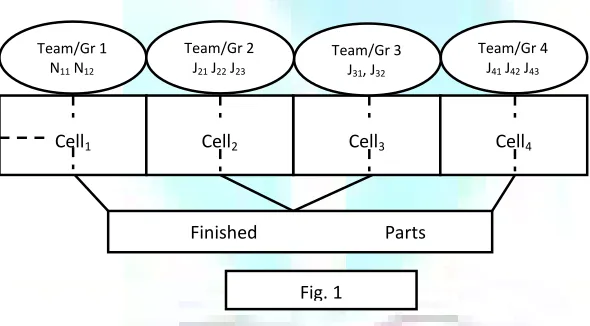
he product and process for mass production are characterized by high non-productive time, unavoidable delays and occasional inspections as stated by Hitomi(n.d). Application of group technology consist [trainee engineers] along with process experts environment has been known to offer the advantages of mass production and result into cost reduction. In order to derive maximum benefit of group manufacture it is essential to allocate the technical team based part facilities, to different machines in an optimal manner. Each part family may visit a number of machines but not necessarily all the machines in the system. However, for this situation the amount of effort needed to work out an optimal schedule, for a real life problem, would be quite large. By adopting simpler manufacturing business strategy would comprise of a number of cells with each cell being provided with different number of machines of varied types. One cell would process a particular group of part. A system of this type is shown in Fig. 1:
For the manufacturing system in Fig. 1, the machine loading and product mix decisions are major problems. These problems have been investigated analytically with mathematical programming techniques by Hanssman (1999). From trainee engineer stand point, the production scheduling problem has been investigated by Hitomi and Ham (1978) whereas, Petrov (1977) has dealt with flow type group production planning. PERA (1950) has considered the loading and scheduling of work in a trainee engineers cell. Hitomi (n.d) and Ham (1978) have also developed optimizing algorithm for machine capacity planning and product mix in a single machine and multi stage production systems.
In this paper the authors have presented an efficient computer algorithm for the determination of optimum product-mix and machine-load, in a manufacturing system of the type shown a manufacturing system of the type shown in Fig. 1. for three different conditions.
MODEL FORMULATION
The cells in Fig. 1 comprise of a number of machines of varied types grouped in accordance with the operations necessary for a part family. Each group consists of two or more parts and is processed fully in a single cell. The present work is based on the model of Hitomi et al. (1982) however, the solution methodology and the computer algorithm developed by the authors are more accurate and less tedious to use.
MACHINE LOADING AND PRODUCT-MIX ANALYSIS
The assumptions:
1. The case of a single machine is treated and the total time available on the machine is‘d’.
2. Parts to be processed are classified into M groups. The group index is denoted by I (= 1, 2, …… M). In group Gi, Ni parts are included where the part index denoted by J (= 1, 2, … Ni).
3. The group production time consists of group set up time, and sum of job production times for each group. 4. Job-production time is equal to job set-up time, and unit production time multiplied by lot size.
5. All the parts are cylindrical in shape and produced by turning.
T
Fig. 1
Cell
1Cell
2Cell
3Cell
4Team/Gr 1 N11 N12
Team/Gr 2 J21 J22 J23
Team/Gr 3 J31, J32
Team/Gr 4 J41 J42 J43
VOLUME NO.3(2013),ISSUE NO.10(OCTOBER) ISSN2231-5756
INTERNATIONAL JOURNAL OF RESEARCH IN COMMERCE, IT & MANAGEMENT
It is required to determine the optimal numbers of the kinds of parts to be produced within a limited time available as well as to decide the optimum machining speed for all products so as to maximize the production rate.(A) Part Manufacturing Time :
The manufacturing time of jth part is ith group is given by eqn.1. The part is machined in a single pass at a constant feed and cost factor, tool life, set time etc. are all deterministic. It is assumed that the Taylors tool life relationship (VTn = C) holds true.
= + + 1/ 1 − 1
(for j = 1, 2 … N1 and i = 1, 2, … M)
Unit production time from above equation when plotted against the cutting speed provides a typical bell shaped curve for which optimal cutting speed is obtained as:
= − 1
When processing Jij in a lot of size Jij the total manufacturing time is given by :
= +
(for j = 1, 2, … Ni and I = 1, 2, … M)
(B) Manufacturing Cost
The cost of a part can be expressed as a function of machining speed (Vij) (c)
. This cost is given by below equations :
= + + ! + + " 1/
For j=1,2….Nij and i=1,2…M
Optimal product mix decision is to be based on the fact that optimal amount of part has to be produced within the prescribed delivery period.
ANALYSIS FOR SOLUTION
The solution of eqns. 6-8 has been attempted for three cases Case I : (Q = d)
For this case all Xij’s are 1 and the objective function assumes the form
# $ % = &
'
(
& lij
,
(
The optimal solution is:
- = . = 0
(For j=1,2….Ni and j=1,2….M) Case II : When Q > d
The problem is now replaced by the following 0-1 type linear program. The machining speed is initially set corresponding to maximum production rate. The objective function of CASE 1 i.e. maximized subject to Pij = Pij
(t)
. A heuristic takes into account the selection and rejection criterion. The part with maximum production time including the set up has been considered as a candidate for rejection.
Case III : When Q < d
The unique feasible speed values for machining all the parts are based on the minimization of the total cost with the slack time. Based on this criterion the problem assumes a non-linear nature as below:
Minimize,
0 = &
'
(
[ αSi + & αζSij + LijQij Vij ζ]
,
(
The optimal solution, Vij, to this non-linear problem is solved using KUHN-TUCKER conditions . This function is termed ‘Efficiency sensitive function’. Properties of this function can be derived with following consideration. At the minimal points, the machining speed for minimum production cost is derived from the conditions.
9:
9; Vij t = 0 and
@ABC @ABD = 0
Exponent, nij varies between O<nij < 1 due to which (1/nij -1
) > 0. Also, since (Vij (c)
< Vij (t)
therefore, from rij – bij, ij > 0
and in the speed range Eij obtained as :
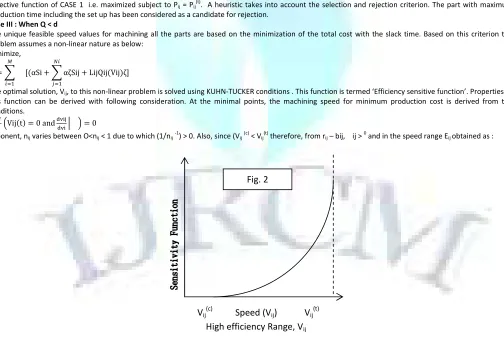
The relationship between sensitivity function and speed is shown in Fig. 2.
RESULTS
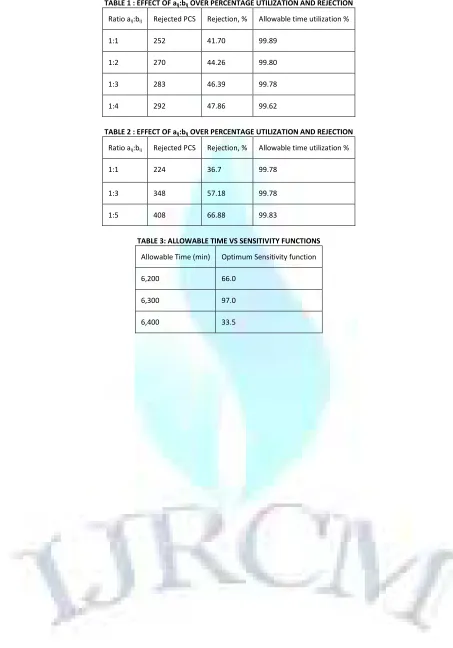
The programme has been tested for the data of Hitomi & Ham and the following conclusions have been derived : 1. Proposed procedure is computationally simpler than the branch and bound algorithm of Hitomi & Ham (1978).
2. It is noted (Table 1) that for aji remaining constant, as bij increases the rejection increases slowly. The percentage utilization is almost same, nearly 100%.
Fig. 2
V
ij(c)
Speed (V
ij) V
ij(t)
3. Effect of variation of ratio of tool replacement time and preparation time is given in Table 2. 4. For Q<d, the sensitivity function drops faster with marginal increase in allowable time (Table 3).
CONCLUSIONS
The approach developed to compute the optimal product mix in a GT manufacturing cell is efficient, simpler and takes less computational time. This also offers high machine utilization. It has been observed that the preparation time has maximum influence on the production rate. There is a significant relationship between the optimum value of sensitivity function and allowable time.
REFERENCES
1. Abe, Masahiro and Takeo Hoshi. “Corporate Finance and Human Resource Management.” June 2004. 2. F. & S.W.Hess, Management Technology, Vol. 1, No.1, 1960 m p. 349.
3. Hanssman, F. & S.W.Hess, Management Technology, Vol. 1, No.1, 1999 m p. 349.
4. Hanssman, Keizai Koho Center, Japan 2005: An International Comparison. Tokyo: Keizai Koho Center, 2005. 5. Hitomi, K & I. Ham, Journ. Engg. & Ind. ASME, Vol. 100, 1978, pp 370-374.
6. Hitomi, K. & Ham, Trans. ASME, Aug. 77 p. 759.
7. Hitomi, K. & I. Ham, Journ. Engg. & Ind. ASME, Vol. 1982, pp 363-368.
8. Kuhn, H.W. & A.W.Tucker, proc. II Berkley Symposium on Mathematical Statistics and Probability, 1950, pp 481-492. 9. Lomnicki, Z.A., Opr. Res. Q 16, 1965, p. 89.
10. North, Douglass C. Understanding the Process of Economic Change. Princeton, NJ: Princeton University Press, 2005.
11. Threadgold, David and Yuki Allyson Honjo, “Japanese Regional Banks: Suburban Values.” Tokyo: Fox-Pitt, Kelton Swiss Re Capital Markets (Japan), 6 May 2005.
12. Tisley, R. F.A. Lewis & D.F.Gallway, Anni. CIRP, 1977, pp 269-271.
13. Tsuru, Shigeto. Japan’s Capitalism. Cambridge: Cambridge University Press, 1993.
14. Vietor, Richard H.K. “Japan: Deficits, Demography and Deflation.” Boston MA: Harvard Business School case Study 9-706-004, Rev. 22 Sept. 2005.
15. Yasuaki, Chijiwara. “Insights Into Japan-U.S. Relations On the Eve of the Iraq War: Dilemmas over ‘Showing the Flag.’” Asian Survey, Vol. 45, No. 6 (Nov/Dec. 2005), pp. 843-664.
NOMENCLATURE
Aij Preparation time for part j of group i, min/pc
Bij Tool-replacement time for part j of group i.
Cij 1 min tool life machining speed for part j of group i.
Nij Slope constant of the Taylor’s tool life equation for part j of group i
Pij Maximum production rate per unit production time for part j of group i.
Sij Job set up time for part j of group I, min/lot.
ββββIj Machining over head for part j of group i.
λλλλIj Machining over head for part j of group i.
1ij No. of pieces in the lot Jij
Gij Speed dependent unit production cost (Rs./min)
Si Group set up time for the group G1 (min/group0
Vij Machining speed for the lot Jij (m/min)
Xij 0-1 variable for G1
∝ ∝∝
VOLUME NO.3(2013),ISSUE NO.10(OCTOBER) ISSN2231-5756
INTERNATIONAL JOURNAL OF RESEARCH IN COMMERCE, IT & MANAGEMENT
TABLE 1 : EFFECT OF aij:bij OVER PERCENTAGE UTILIZATION AND REJECTIONRatio aij:bij Rejected PCS Rejection, % Allowable time utilization %
1:1 252 41.70 99.89
1:2 270 44.26 99.80
1:3 283 46.39 99.78
1:4 292 47.86 99.62
TABLE 2 : EFFECT OF aij:bij OVER PERCENTAGE UTILIZATION AND REJECTION
Ratio aij:bij Rejected PCS Rejection, % Allowable time utilization %
1:1 224 36.7 99.78
1:3 348 57.18 99.78
1:5 408 66.88 99.83
TABLE 3: ALLOWABLE TIME VS SENSITIVITY FUNCTIONS
Allowable Time (min) Optimum Sensitivity function
6,200 66.0
6,300 97.0
REQUEST FOR FEEDBACK
Dear Readers
At the very outset, International Journal of Research in Commerce, IT and Management (IJRCM)
acknowledges & appreciates your efforts in showing interest in our present issue under your kind perusal.
I would like to request you to supply your critical comments and suggestions about the material published
in this issue as well as on the journal as a whole, on our E-mail i.e.
for further
improvements in the interest of research.
If you have any queries please feel free to contact us on our E-mail
.
I am sure that your feedback and deliberations would make future issues better – a result of our joint
effort.
Looking forward an appropriate consideration.
With sincere regards
Thanking you profoundly
Academically yours
Sd/-
VOLUME NO.3(2013),ISSUE NO.10(OCTOBER) ISSN2231-5756