*Corresponding author: Jasmine Sarah Alexander ISSN: 0976-3031
RESEARCH ARTICLE
A COMPETENCY BASED FRAMEWORK FOR SOCIAL WORK EDUCATION IN INDIA
Jasmine Sarah Alexander
Guest Lecturer, Loyola College of Social Sciences, Thiruvananthapuram
DOI: http://dx.doi.org/10.24327/ijrsr.2017.0809.0775ARTICLE INFO ABSTRACT
The demand for a new model of social work education has been in existence since the 1940s. Amidst the recognition that social work education in India has made modest strides, academicians have vehemently criticized the present model of social work education and the profession over the years. The current article attempts to introduce a competency based framework to social work education in India. This framework adopts a Competency Based Education (CBE) approach by drawing directly from social work practice in India. The framework purports to address the shortcomings of the present model by being more relevant to Indian social realities, creating a strong link between theory and practice, and fostering greater commitment to the profession. It also hopes to be useful, to both social work schools and social welfare institutions, in setting standards of training for social work students and practitioners.
INTRODUCTION
Social Work continues to be strongly impacted by the universal phenomenon of globalization (Dominelli, 2010). One negative consequence of the universal exchange in Social Work was the export model or the unselective imposition and borrowing of western models of education and practice by developing countries (Healy, 2012: 13). Such western models are deemed to be incongruent with indigenous practice realities, and this has led to the failure of social work profession to develop and deliver effective, acceptable and culturally appropriate services in these countries (Gray, Coates & Bird, 2008: 1, 3, 7). This trend was especially true for India where post-independence, exchanges between American and Indian social workers, led to the adoption of a predominantly American model of social work education and training in the first school of social work in the country (Mandal, 1989). The pervasive effect of the American influence was also seen in the syllabi, followed by the large number of subsequent schools of social work, which do not seem to show any significant variation, especially with regard to course structure and core content (Nanavatty, 1967: 58; Mehta, 1981: 256; Gokarn, 1994: 68, 69; R.K.Singh 2005: 100; Pathare, 2015: 54, 63, 64). Over the years, even though Indian social work education developed a model of its own (Mathew, 1981; Kulkarni, 1993; Palattiyil & Sidhva, 2012), the dominant view is that American influence persists (Pawar, 1999: 567; Singh, Gumz & Crawley, 2011: 863; Kamaraj &
Selvamani, 2012: 76; Bodhi, 2014: 78, 79; Pathare, 2015: 58). The Indian social work academia have long been clamouring to break away from western models of education for various reasons, which include its unsuitability to Indian social work practice and the consequent stagnation of professional development (Pathak, 1975: 178; A.Desai, 1975: 21; Gore & Gore, 1977; Nagpaul, 1993; Srivastava, 1999: 122; Mohan, 2002; Sharma, 2005: 147). The need to look into the facts and requirements of indigenous practice to make Indian social work education more relevant, and the need to evaluate social work education to set standards of training has also been registered time and again (UGC, 1965, 1980, 1990, 2001; Siddiqui, 2015: 15).
Different approaches to indigenization have been suggested to make social work in developing countries more relevant to the local contexts (Gray & Coates, 2008: 13-30). In India, only few studies have systematically explored the status of Indian social work practice (Ramachandran & Padmanabhan, 1969; Ramachandran, Barah & Vasudevan, 1977; Nair, 1983; Pathak, 1983) and only one study has attempted to link practice information to education (Ramachandran, 1988). In the reports by the UGC, the standards of National Assessment and Accreditation Council (NAAC, 2004), and the writings by eminent academicians (Gore, 1973; Dasgupta, 1976; Ramachandran, 1988; Siddiqui, 2001; Gangrade, 2005a; Bodhi, 2014), various suggestions have been made to render Indian social work education relevant to Indian social realities. In
International Journal of
Recent Scientific
Research
International Journal of Recent Scientific Research
Vol. 8, Issue, 9, pp. 19860-19866, September, 2017
Copyright © Jasmine Sarah Alexander, 2017, this is an open-access article distributed under the terms of the Creative Commons Attribution License, which permits unrestricted use, distribution and reproduction in any medium, provided the original work is properly cited.
DOI: 10.24327/IJRSR
CODEN: IJRSFP (USA)
Article History: Received 05thJune, 2017 Received in revised form 08th July, 2017
Accepted 10thAugust, 2017
Published online 28stSeptember, 2017
Key Words:
most of these works, with regard to curriculum development, even though there is significant change in perspective towards the social development approach, there seem to be, in
Ramachandran’s words, a preoccupation with “perpetuating the
system, with a commitment to retaining the existing form of training system and institution, subject only to some redistribution of teaching courses and loads, and some
modification of content” (A.Desai, 1984; Ramachandran, 1989, as cited in Mandal, 1995: 362), rather than a revamping of the whole framework. Also, there is a lack of studies which contribute to social work education by systematically analyzing the forms of local practice and the training needs of practitioners (Siddique, 1987, 2001, 2015).
The problem and research gap identified above indicates the need for an alternative model of social work education. According toSiddiqui(1997), the demand for a new model of social work education has been in existence since the 1940s. Also, as early as 1987, Siddiqui had suggested that social work education in India move towards a competency based approach. The current article, which is based on the doctoral study of the author, envisages an educational framework which adopts a Competency Based Education (CBE) approach and draws directly from social work practice in India. This competency-based educational framework purports to address the shortcomings of the present model by being more relevant to Indian social realities, creating a strong link between theory and practice, and fostering greater commitment to the profession. It also hopes to be useful, to both social work schools and social welfare institutions, in setting standards of training for social work students and practitioners.
METHODOLOGY
Goal and Specific Objectives1. To enhance standardization and professionalization in Indian Social Work by designing a competency based framework for social work education in India.
To discover the Core Competencies, i.e. the Core Intervention Areas, Core Knowledge, Core Values and Core Skills, required for social work practice in India.
To discover the Core Intervention areas (CIA) of Indian social work practice by analyzing the interventions of social work organizations functioning in 15 fields of social work.
To discover the Core knowledge for Indian social work practice by analyzing the knowledge requirements of social workers practicing across 15 fields of social work. 1.3:
To discover the Core Values of Indian social work practice by analyzing the value requirements of social workers practicing across 15 fields of social work.
To discover the Core Skills for Indian social work practice by analyzing the skill requirements of social workers practicing across 15 fields of social work.
To design a Competency based framework for social work education in India by synthesizing the findings on core competencies.
Theoretical Preposition
The objectives of the study aim at discovering core competencies across 15 fields of social work practice, and seek
to place such information on the Core competencies as central to the designing of a competency based education framework. This implies that the study stands for the designing of an educational model which is (1) generalist in principle and (2) based on competencies for practice. Thus the study puts forward the following theoretical proposition: irrespective of the specialized field of practice, there is a core of competencies in which all students and practitioners of social work should demonstrate proficiency.
Defining Concepts
Few of the major concepts of the study are operationally
defined here. ‘Education’ is restricted to the realm of formal
education in the discipline of social work. Social work education is offered by schools/departments of social work and refers to endeavours which aim at inculcating knowledge, skills and values to social work students. ‘Social work practice’
refers to the interventions carried out by social workers. In India, the social worker may or may not possess a professional degree and social work practice primarily happens in government or non-governmental organizations. Private social work practice is not common in India. Social work organizations or social service agencies deliver direct services to individuals, families and communities. These services can be provided in public agencies at the federal, state and local level or in private, non-profit settings (NASW, 2011: 1). Generalist practice refers to social work practice in which the social worker is trained to use wide range of information and skills across different fields of practice. When social work practice is restricted to specific fields of social work, specialized practice takes place. The specific area of functioning/practice of the social worker, which brings together clients with more or less similar experiences and characteristics, can be referred to as the social work practice field. The fields of social work in which a social worker is employed, may cater to (1) a specific target population (like children, youth, aged, women, trafficked persons, HIV/AIDS victims, mentally ill, differentially abled etc.) or (2) an area of interest or a social issue (Human Rights, environment, family, disaster management, destitution, community development etc.) or (3) a specific institution (hospice, hospital, industry, prison, school or other educational institutes etc.). In this particular study 15 social work practice fields have been selected. They are: 1) Community Development (urban and rural), 2) Child and Family Welfare; 3) Social Work with Youth; 4) School Social Work; 5) Medical Social Work, 6) Psychiatric Social Work, 7) Deaddiction, 8) Geriatric Social Work, 9) Physically Challenged, 10) Mentally Challenged, 11) Corporate Social Work, 12) Correctional Social Work; 13) Social Work with Refugees; 14) Disaster Management; and 15) Anti-Trafficking.
A ‘competency’ is defined as “more than just knowledge and
skills; it involves the ability to meet complex demands by drawing on and mobilizing psychosocial resources (including
skills and attitudes) in a particular context” (Definition and
competencies- knowledge, values, skills and interventions-required for social work practice. This framework can be used for education and training purposes. It has four components: (1) Knowledge: The informational requirements necessary to practice effectively and efficiently in a particular field of social work; (2) Values:The social worker’s lasting beliefs, ideals or
attitudes regarding an issue, client, colleague, agency or the profession which influences his/her thoughts words and actions. (3) Skills: A set of abilities, techniques, procedures, therapies etc. that are employed by a social worker to accomplish a professional task effectively and efficiently. (4) Interventions: Aids and assistances, activities, programmes and projects etc. undertaken by social workers and the social work organization for the attainment of the goals and objectives which have been set for particular field or for a specific target population.‘Core Competencies’are a description of the core or common knowledge, values, skills and intervention areas required for generalist practice across different fields of social work practice. Hence Core Competencies have four components- Core Knowledge, Core Values, Core Skills and Core Intervention Areas- which needs to be mastered by all social workers.
Research Design
The present study adopts the Multiple Case study design,
following Yin’s principles of Case studies (Yin, 2014). The main units of analysis or the cases in the current study are social work organizations that function in each of the 15 fields of social work practice as defined above. The qualitative nature of case study research entails the use of non-probability sampling methods. Judgment sampling was the choice non-probability sampling methods used by the researcher. The number of cases selected depended on how representative a particular case was of a particular field of practice, i.e. the saturation logic was employed in deciding the number of cases. The number of social workers in each case organization varied according to nomination and availability. The number of organizations was 21 and social workers were 92.
Data collection and analysis are developed together in an iterative process in a case study (Cassell & Symon, 2004: 329). The main data collection techniques used by the study are interviews with social work practitioners working in the social work organizations, and documents produced by the social work organizations. Brief observation visits were also made to the organizations. Secondary data is used where primary data seemed incomplete.
Data analysis consists of examining, categorising, tabulating, testing or otherwise recombining both quantitative and qualitative evidence to address the initial propositions of a study (Yin, 2009: 126). The present study has two objectives. For the first objective, data is collected from 21 social work organizations in 15 social work fields on 4 competency components- interventions, knowledge, values and skills. This data on field-wise competencies is then analyzed to discover core competencies- i.e. core interventions, core knowledge, core values and core skills. For the second objective the information on core competencies is used to design a competency-based framework for social work education in India. For the purpose of designing the framework a logic model called the DACUM is utilized. DACUM, which is the
abbreviation for ‘Developing A Curriculum’ is a quick yet highly valid job analysis technique. The DACUM process is used to determine the competencies that should be addressed in a training curriculum for a specific occupation. The DACUM checklist, a tool used in curriculum planning, is adopted by the current study in designing the educational framework (Norton 1997: 296).
Findings and Recommendations
Findings
The Findings were organized into four parts: Preliminary Details, Core Competencies, Propositions and Competency based education (CBE) framework.
Preliminary Details sheds light on the profile of the respondent organizations and respondent social workers. 15 social work fields, 21 sub fields, 21 organizations and 92 respondents were covered. Of the 21 organizations, 16 (76%) were directly visited for interviews, online interviews were conducted for 2 (10%) and content analysis of reports were made for 3 (14%). Of the 92 respondents interviewed 61 possessed professional Social Work Degrees, while 31did not possess a professional social work degree. Of the 92 respondents interviewed, 67 (73%) had above 5 years experience, 23(25%) had experience between 1-5 years and 2 (2%) had experience below 1 year. Both of the respondents with below one year experience were those with professional social work degrees. Of those with experience between1-5 years, 16 had social work degrees and 7 did not. Of those above 5 years experience, 43 had social work degrees and 24 did not. Of the 21 organizations, 7(33%) had over 50 years experience, 9(43%) had over 25 years experience, 4(19%) had over 10 years experience and 1(5%) had below 10 years experience. 9 cities were visited: Delhi, Mumbai, Kolkata, Udaipur, Jamshedpur, Bangalore, Hyderabad, Chennai and Trivandrum.
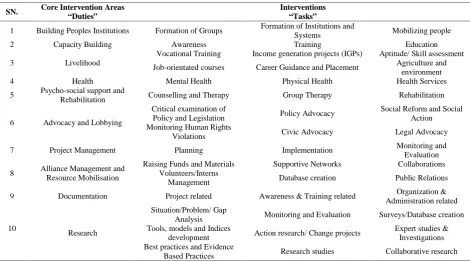
Core Competencies is defined by the researchers to include 4 components: Core Knowledge, Core Values, Core Skills and Core Interventions. There is close inter-relation between the 4 components; nevertheless the 4 components are assumed to be indispensible to Social work training and practice. All the Competence components have been described based on responses of respondent social workers under the current study, and cross-reference to secondary data generated by researcher. Core Intervention Areas are the intervention groups that are practiced commonly across different fields of social work. The data on the interventions of 21 cases were subject to qualitative analysis using the nVivo software to discover 10 core intervention areas across 15 fields. A significant finding is that the analysis does not indicate any intervention which can be placed outside these 10 areas. The Core Intervention Areas
are: Building people’s organizations, Capacity Building,
usually the outcome of a DACUM process, which identifies the training needs of an industry (Norton, 1993, Norton, 1997). A number of studies (Ramachandran & Padmanabhan, 1969, Ramachandran, Barah & Vasudevan, 1977, Nair, 1983, Pathak, 1983, Ramachandran 1988) and academicians (UGC, 1980, Gore, 1981) provide a number of classifications of social work functions. Siddiqui (2015) notes that a review of social work practice is long overdue. The current study updates the functional classification by analyzing practice.
Core Skills are defined as the skills that are required for practice across different fields of Social Work. There were 353 Skill responses which were categorized into 74 sub-categories and 9 Main categories. These 9 main categories were organized based on the Core Intervention Areas. Hence, only 1 additional
skill areas surface, ‘Others’, because the other 8 are part of the CIA. ‘Others’ refers additional skills like knowledge of foreign
and other local languages, computer proficiency, driving etc. The 9 Core Skills areas are: 1) Building people’s
Organizations; (2) Capacity Building; (3) Psychosocial support and Rehabilitation; (4) Alliance Management and Resource Mobilization; (5) Advocacy and Lobbying; (6) Project Management; (7) Documentation; (8) Research; (9) Other Skills. Other skills can be equated to “21stcentury” skills. The
core skills have also been featured in Figure 1.
Core Values can be defined as the values that are held commonly by social workers practicing across different fields. There were 290 Value Responses, which were categorized into 79 sub-categories and 9 main categories. The 9 main categories were further divided into three heads to represent the Core
Values. The heads of these categories was based on a ‘code of ethics’ framework, which was derived from a review of
literature on the codes of ethics of different countries. The three main heads and 9 sub-categories are: 1) Belief in Human dignity: (1) Respect for the inherent worth and dignity of the individual; (2) Openness to diversity and tolerance towards differences; (3) Faith in the strengths of the client.; 2) Belief in
Humanity: (4) A heart of service, (5) Empathy; 3) Belief in Professional Integrity: (6) Commitment and Passion for the Profession, (7) Personal Integrity, (8) Professional Responsibilities, (9) Personal and Professional Development (Figure 5.2). The TISS 1997 "Declaration of Ethics for
Professional Social Workers” and the 2002 Code of ethics by
Bombay Association of Trained Social Workers reflect similar categories and values (Gunavathy, 2003).
Core Knowledge is defined as knowledge requirements for social workers which are common across different social work practice fields. There were 357 knowledge responses, which were categorized into 98 sub-categories and 4 main categories. Figure 2 indicates the 4 Core Knowledge Areas and its sub-components Thus Core knowledge has 4 sub-components: (1) knowledge related to social work profession (T1), (2) knowledge related to fields of social work practice (T2-4), (3) knowledge related to social work values (T5) and, (4) knowledge related to social work practice skills (T6-16). Knowledge related to the fields of practice was further categorized into knowledge related social problems (T2), social welfare policies and legislations (T3) and social work interventions.
In the framework, the researcher has suggested the need for integration of supportive and interdisciplinary content. Dasgupta (1976) has stressed the importance of integrated theory, i.e. a theory for practice. He suggests the adoption of trans-disciplinary content and a number of new areas of knowledge which will be beneficial for the post-modern social worker.
Theoretical Proposition: The study had put forward the proposition that there is a core of competencies across all fields of practice. The findings of the study support this proposition by identifying the core intervention areas, the core knowledge, Figure 1 DACUM Chart- the ten CIA and component interventions
SN. Core Intervention Areas “Duties”
Interventions “Tasks”
1 Building Peoples Institutions Formation of Groups Formation of Institutions andSystems Mobilizing people
2 Capacity Building Awareness Training Education
3 Livelihood
Vocational Training Income generation projects (IGPs) Aptitude/ Skill assessment
Job-orientated courses Career Guidance and Placement Agriculture and
environment
4 Health Mental Health Physical Health Health Services
5 Psycho-social support and
Rehabilitation Counselling and Therapy Group Therapy Rehabilitation
6 Advocacy and Lobbying
Critical examination of
Policy and Legislation Policy Advocacy
Social Reform and Social Action Monitoring Human Rights
Violations Civic Advocacy Legal Advocacy
7 Project Management Planning Implementation Monitoring and
Evaluation
8 Alliance Management and
Resource Mobilisation
Raising Funds and Materials Supportive Networks Collaborations
Volunteers/Interns
Management Database creation Public Relations
9 Documentation Project related Awareness & Training related Organization &
Administration related
10
Research
Situation/Problem/ Gap
Analysis Monitoring and Evaluation Surveys/Database creation
Tools, models and Indices
development Action research/ Change projects
Expert studies & Investigations Best practices and Evidence
core values and core skills. Based on this primary proposition, the study suggests that all schools of social work should provide mandatory training in the 10 core intervention areas (CIA). The study also suggests that specialization based training is not relevant to Indian social work education, because the nature of practice interventions and skills are similar across all fields, only background knowledge differs. This finding of the study regarding specializations is supported by a number of studies which have been summarized by M.Desai (1991). However, if at all specializations are offered it shall not cover more than 1-2 papers.
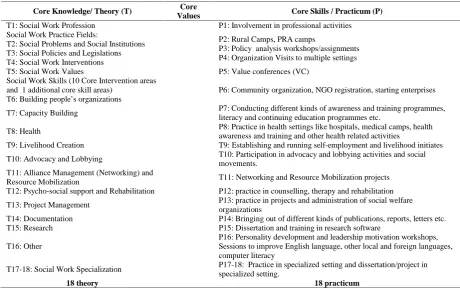
A competency based framework was designed integrating the findings on Core Knowledge, Core Values, Core Skills and Core Intervention Areas, within a framework following certain principles: competency-focus (a clear listing of intervention/skills), link between theory and practicum (i.e. for every theory paper there should be a practicum), Competency-based instruction and assessment, learner-centeredness, the use of modules, periodic review and faith in a generic model. The framework is outlined in Figure 2.
Recommendations
There is much to do to improve the effectiveness of social work education. However, the suggestions stated in this chapter relate directly to the findings of the current study and to the scope of a competency based educational model. Based on the findings of the study, the following suggestions are made:
1. A competency/intervention based classification of social work skills, as derived by the current study, is more relevant to Indian practice.
2. A generic course with only limited and condensed specializations is more applicable to Indian social work practice.
3. It is crucial that schools of social work adopt an unofficial CBE curriculum to fill the existing gap in skill training.
4. Curriculum reviewers should attempt to foster clear link between theory and practicum, as demonstrated in the CBE framework.
5. Schools should attempt to create indigenous training modules and teaching materials, and especially in relation to the Core competencies.
6. Assessment and Evaluation tools which assess demonstrated skill need to be developed.
7. Mandatory skill training should be provided to all social work students in the 10 CIA
CONCLUSION
An important point that needs discussion is “what changes need
to be made to the present curriculum to transform it in to a
CBE curriculum?” The process of transforming to a CBE
model, which is learner and skill-centered, requires faith and commitment to the model, more than resources.
The researcher believes that the existing model of social work education in India has sufficient scope for incorporating the CBE model. What will change is the framework of the curriculum and the theory-practicum link. There is likely to be no need for additional subjects or additional practicum hours; this statement is based on the assumption that most premiere schools of social work have acknowledged the significance of the UGC model curriculum 2001, which offers a comprehensive list of papers and practicum to be covered by social work programmes. However, the existing practicum should be diversified and reorganized, so that each theory paper has a practicum component. Thus, the theory and practicum should be reorganized and integrated within the CBE Figure 2 The competency based framework for social work education
Core Knowledge/ Theory (T) Core
Values Core Skills / Practicum (P)
T1: Social Work Profession P1: Involvement in professional activities
Social Work Practice Fields:
T2: Social Problems and Social Institutions T3: Social Policies and Legislations T4: Social Work Interventions
P2: Rural Camps, PRA camps
P3: Policy analysis workshops/assignments P4: Organization Visits to multiple settings
T5: Social Work Values P5: Value conferences (VC)
Social Work Skills (10 Core Intervention areas and 1 additional core skill areas)
T6: Building people’s organizations
P6: Community organization, NGO registration, starting enterprises
T7: Capacity Building P7: Conducting different kinds of awareness and training programmes,
literacy and continuing education programmes etc.
T8: Health P8: Practice in health settings like hospitals, medical camps, health
awareness and training and other health related activities
T9: Livelihood Creation T9: Establishing and running self-employment and livelihood initiates
T10: Advocacy and Lobbying T10: Participation in advocacy and lobbying activities and social
movements. T11: Alliance Management (Networking) and
Resource Mobilization T11: Networking and Resource Mobilization projects
T12: Psycho-social support and Rehabilitation P12: practice in counselling, therapy and rehabilitation
T13: Project Management P13: practice in projects and administration of social welfare
organizations
T14: Documentation P14: Bringing out of different kinds of publications, reports, letters etc.
T15: Research P15: Dissertation and training in research software
T16: Other
P16: Personality development and leadership motivation workshops, Sessions to improve English language, other local and foreign languages, computer literacy
T17-18: Social Work Specialization P17-18: Practice in specialized setting and dissertation/project in
specialized setting.
framework, to form an “integrated theory of practice” rather than following the traditional framework of ‘core, interdisciplinary and supportive’ domains. UGC (1960) had
suggested integration of subjects. Perhaps the most time-consuming and intellectually and physically taxing part of the transformation into a CBE programme is the creation of modules and assessment tools, which are essential components of a CBE curriculum.
The CBE model promises to nurture competent performance by achieving a judicious combination of knowledge, value and skill development. It adopts a learner-centred approach which is based on the philosophy that all students can win. The CBE
model is also based on ‘social work interventions’ based
practice as it happens in India and is hence more relevant than
western practice models, like the ‘methods’, ‘systems’ and the ‘integrated’ approaches. This model promises to be the long
lost link between theory and practice. It is a straight-forward and simple model to which students, practitioners and social work agencies can readily relate. Distance education and training of other social work personnel can also employ the CBE framework effectively.
Siddiqui (2001:549), after discussing a number of issues regarding the functions of social workers and the social work
curricular reviews, notes “the only thing that can truly guide us
in a meaningful way is professional expertise, which is needed and valued by people and organizations, and for which they are willing to pay for...A social worker is one who can carry out
his/her job effectively.” The researcher strongly supports the
wisdom in these statements and believes that Competency-based education is the sure answer to enhancing professional expertise. A Competency-based framework promises to be a panacea to many of the grave problems being faced by the profession of social work in India. More than anything else, the competency based framework is committed to producing competent social workers who can make a difference in the society.
References
Bodhi, S. (2014a). On the Politics of Social Work Curriculum and Pedagogy: Reflections of a Social Work Educator. Indian Journal of Dalit and Tribal Social Work, 2 (2),
71-83. Retrieved October 7, 2016 from
http://www.daltrijournals.org/
IJDTSW/Volume/v2issue2/V2I2no6.php
Bodhi, S. (2014b). Towards a Theory of Tribal Social Work: Some Reflections on its Methodological Foundation. The Journal of Development Practice, 1, 10-16.
Cassell, C., & Symon, G. (2004). Essential Guide to Qualitative Methods in Organizational Research. London: Sage Publications Ltd. Retrieved on September 18, 2016, from http:// books.google.co.in
Council on Social Work Education (CSWE). (2015). Educational Policy and Accreditation Standards. Alexandria, VA: Author. Retrieved on September 16, 2016, from http://www.cswe.org/file.aspx?id=81660 Dasgupta, S. (1976). Social work education: A critique of the
classical model. Journal of Higher Education, 1 (3), 358-366.
Definition and Selection of Competencies (DeSeCo). (2005). The definition and selection of key competencies. Paris: OECD. Retrieved on September 16, 2016, from https://www.oecd.org/pisa/35070367.pdf
Desai, A. (1975). Social Work Education in India. In S. Gokhale (Ed.), Social Welfare Legend and Legacy (pp. 204-219). Bombay: Popular
Desai, A. (1984). Social Action and the Social work Curriculum. In H. Siddiqui (Ed.), Social Work and Social Action (pp.65-85). New Delhi: Harnam Publications. Dominelli, L. (2010). Globalization, contemporary challenges
and social work practice. International Social Work, 53 (5), 599-612. Retrieved on October, 7, 2016 from Doi: 10.1177/0020872810371201
Gangrade, K. (2005a). Gandhian approach to development and social work. New Delhi: Concept Publishing Company. Gokran. N. (1994). Patterns and trends in Curricula. In K.
Jacob (Ed.), Social Work Education in India: Retrospect and prospect (pp.65-76). Udaipur: Himanshu Publications. Gore, M. (1973). Some Aspects of Social Development.
Mumbai: TISS.
Gore, M. (1981). The Scope of Social Work Practice. In T. Nair (Ed.), Social Work Education and Social Work practice in India (pp.1-13). Chennai: Association of Schools of Social Work in India.
Gore, P., & Gore, M. (1977). Social Work Education in India. In Ganguli, B.N. (Ed.), Social Development (pp. 260-90). New Delhi: Sterling Pub Pvt. Ltd.
Gray, M., & Coates, J. (2008). From indigenization to cultural relevance. In M. Gray, J. Coates, & M. Bird (Eds.), Indigenous Social Work around the world- Towards culturally relevant education and Practice. Hampshire, England: Ashgate.
Gray, M., Coates, J., & Bird, M. (2008). Introduction. In M. Gray, J. Coates & M. Bird (Eds.). Indigenous social work around the world: Towards culturally relevant education and practice. Hampshire, England: Ashgate.
Gunavathy, J. (2003). Evolving a Code of Ethics for the Social Work Profession in India. Perspectives in Social Work, 18 (3), 34-42.
Healy, L. (2012). Defining International Social Work. In L. Healy & R. Link (Eds.), Handbook of International Social Work: Human rights, development and the global profession. New York, USA: Oxford University Press. Retrieved on October 7, 2016 from http://books. google.co.in/
Kamaraj, J., & Selvamani, P. (2012). Best Practices and innovation in Social Work Profession. In I. Ponnuswami & A. Francis (Eds.), Professional Social Work Education: Emerging Perspectives (pp.71-81). New Delhi: Author Press
Kulkarni, P. (1993). The indigenous base of social work profession in India. The Indian Journal of Social Work, 54 (4), 556-565.
Mandal, K. (1989). American influence on social work education in India and its impact. International Social Work, 32, 303-309
Mehta, V. (1981). Four decades of teaching methods and teaching materials in social work. In T. Nair (Ed.), Social Work Education and Social Work practice in India (pp.253-305). Chennai: Association of Schools of Social Work in India.
Mohan, B. (2002). Universalization of Knowledge: Social Practice beyond east and west. In P. Viswesvaran (Ed.), Social Work Today: Present Realities and Future Prospects (pp. 149-159). Chennai: Madras School of Social Work
Nagpaul, H. (1993). Analysis of social work teaching material in India: the need for indigenous foundations. International Social Work, 36 (3), 207–220.
Nair, T. (1983). Study of Social Welfare Manpower in Tamil Nadu. New Delhi: Concept.
Nanavatty, M. (1967). Growth and problems of the profession of Social Work. The Indian Journal of Social Work, 27 (1), 55-62.
National Assessment and Accreditation Council (NAAC). (2004). Draft Manual for Assessment and Accreditation of Social Work Education Programme. New Delhi: Author. National Association of Social Workers (NASW). (2011).
Social workers in Social Service Agencies: occupational profile. Washington DC: NASW. Retrieved on September
16, 2016, from
http://workforce.socialworkers.org/studies/profiles/Social %20Services.pdf
Norton, R. (1993). SCID: Model for Effective Instructional Development. Bloomington, MN: Paper presented at the Mid-America Competency-Based Education Conference.
Retrieved October 6, 2016 from
http://files.eric.ed.gov/fulltext/ED359338.pdf
Norton, R. (1997). DACUM Handbook. Columbus: Centre on Education and Training for Employment, Ohio State
University. Retrieved October 6, 2016 from
http://files.eric.ed.gov/fulltext/ED401483.pdf
Palattiyil, G., & Sidhva, D. (2012). Guest Editorial – Social Work in India. Practice, 24 (2), 75-78, Retrieved on July
3, 2016 from
http://dx.doi.org/10.1080/09503153.2012.671004
Pathak, S. (1975). A quarter Century of Professional Social Work in India. In S. Gokhale (Ed.), Social Welfare Legend and Legacy (pp.170-192). Bombay: Popular.
Pathak, S. (1983). Social Welfare Manpower: A regional study. Delhi: Summan Publications.
Pathare, S. (2015). Social work education in India: Transition from westernization to indigenization. In S. Bhatt & S. Pathare (Eds.), Social work education and practice engagement (pp.52-65). New Delhi: Shipra Publications Pawar, M. (1999). Professional Social Work in India: Some
Issues and strategies. The Indian Journal of Social Work, 60 (4), 566-586
Ramachandran, P. (1988). Perspectives for Social Work-Beyond 2000. The Indian Journal of Social Work, 49 (1), 11-20.
Ramachandran, P. (1989). Perspectives for Social Work- 2000 AD. Mumbai: TISS. Cited in Mandal, K. (1995). India. In T. Watts, D. Elliott & N. Mayadas, International Handbook on Social Work Education. Westport, USA: Greenwood Press. Retrieved on October 7, 2016 from https://books.google.co.in/
Ramachandran, P., & Padmanabhan, A. (1969). Professional Social workers in India. Bombay: United Asia Publications.
Ramachandran, P., Barah, B., & Vasudevan, P. (1977). Social welfare Manpower in Greater Bombay. Bombay: Soimaya Sharma, R. (2005). Challenges before social work education. In
S. Singh & S. Srivastava (Eds.), Teaching and practice of social work in India: Realities and responses (pp.144-149). Lucknow: New Royal Book Company
Siddique, H. (1987). Towards a competency based education for social work. The Indian Journal of Social Work, 48 (1), 23-32.
Siddiqui, H. (1997). Analysis of literature on Social Action. The Indian Journal of Social Work, 58 (1), 212-232. Siddiqui, H. (2001). Social Work Education: Some unresolved
curriculum issues. The Indian Journal of Social Work, 62 (4), 535-553.
Siddiqui, H. (2015). Social Work in India. In S. Bhatt & S. Pathare (Eds.), Social work education and practice engagement (pp.3-21). New Delhi: Shipra Publications. Singh, R.K. (2005). Professional status of social work in India:
an overview. In S. Singh & S. Srivastava (Eds.), Teaching and practice of social work in India: Realities and responses (pp.98-126). Lucknow: New Royal Book Company.
Singh, S., Gumz, E., & Crawley, B. (2011). Predicting India's Future: Does it Justify the Exportation of US Social Work Education?. Social Work Education, 30 (7), 861-873.
Retrieved July, 3, 2016 from
http://dx.doi.org/10.1080/02615479.2010.515303
Srivastava, S. (1999). Addressing the future of Social Work in India. The Indian Journal of Social Work, 60 (1), 118-139 University Grants Commission. (1965). Social Work Education
in Indian Universities. New Delhi: Author.
University Grants Commission. (1980). Review of Social Work Education in India- Retrospect and Prospect-Report of the Second Review Committee. New Delhi: Author.
University Grants Commission. (1990). Report of UGC Curriculum development centre on Social work education. Delhi: Author.
University Grants Commission. (2001). UGC model curriculum: Social Work Education. New Delhi: Author.
Retrieved November 15, 2014, from
http://www.ugc.ac.in/oldpdf/modelcurriculum/social_work _education.pdf
Verma, R. (1994). Strengthening curricular inputs. In K. Jacob (Ed.), Social Work Education in India: Retrospect and prospect (pp.89-100). Udaipur: Himanshu Publications. Yin, R. (2009). Case Study Research: Designs and Methods
(4th Ed.: pp.98-125). Thousand Oaks, California: Sage Publication. Retrieved on September 18, 2016, from
http://cemusstudent.se/wp-content/uploads/2012/02/YIN_K_ROBERT-2.pdf