Using operational research to ensure that
immunisation benefits are enjoyed by all
David N. Durrheim
Hunter Medical Research InstituteEmail: [email protected]
In Australia, having government-funded vaccines with established efficacy against infectious diseases is a neces-sary measure to ensure that everyone enjoys the protection these vaccines offer. In addition mechanisms for effectively delivering these vaccines to hard-to-reach groups and those at greatest risk must also be identified, tested, refined and expanded appropriately. Locally generated evidence can inform immunisation strategies, both local and global, to ensure that children who need to be immunised will get
vaccinated, and vaccinated on time.1
The operational research model – the systematic search for knowledge on interventions, tools or strategies that enhance program effectiveness – is increasingly recognised as the most appropriate method for addressing perplexing
questions within public health programs.2Even though the
focus of operational research is usually a particular setting (e.g. closely assessing the quality of and access to local services, identifying ways in which they can be improved and evaluating the feasibility of local approaches or inter-ventions), the findings can be of global relevance, depend-ing on the quality of research design and methods, and the
generalisability of the findings.3
The operational research agenda may explore innovative approaches to program delivery or it may introduce and test relatively small refinements to improve the quality of existing service provision. For ‘operational research’ the need for review by an ethics committee should always be considered and if in any doubt, full ethics review should occur.
Strengths of the operational research approach include: high local relevance, ability to convince local decision-makers, relatively short lag times before findings are implemented,
and cost-effectiveness.4 This is patent in the three local
operational research papers published in this edition of the
Bulletin. It is encouraging to have contributions from three of the eight former area health services addressing priority immunisation issues that have important application beyond their local area. The timely identification and immunisation of Aboriginal infants; improved coverage with all antigens, including varicella, before school entry; and understanding the serotype replacement consequences of pneumococcal vaccination locally, are contributions that demonstrate the inherent value of the operational research approach. These three papers also demonstrate what can be achieved through investing in building the capacity for health program staff to apply appropriate research methods.
The remaining two papers in this special issue of theBulletin
can also be viewed broadly as operational research. The paper from the state’s three largest paediatric centres describing the children’s hospitals influenza vaccine initia-tive by Wood and Cashman demonstrates the value of effective collaboration to enable the timely investigation into an unexpected adverse event. Ongoing pertussis out-breaks pose questions about the appropriateness of current pertussis-vaccine containing schedules. The paper by Quinn and co-workers introduces the potential of pertussis sero-surveillance as a relatively new tool to better understand perplexing pertussis epidemiology in Australia. This under-standing will assist in decisions about optimal timing of vaccine doses.
The full benefits of operational immunisation research accrue when research findings are integrated into the immu-nisation program. Global public health bodies are strongly
encouraging this ‘follow-through’ phase.5 This phase is
Vol. 22(11–12) November–December 2011 ISSN 1034 7674
NSW PUBLIC HEALTH
BULLETIN
completed when dissemination of results has led to docu-mented policy and/or guideline changes that are being monitored. The operational research philosophy is fully embraced when program staff continually consider ways of improving their program and test these ideas through further operational research.
References
1. Mhatre SL, Schryer-Roy AM. The fallacy of coverage: uncovering disparities to improve immunization rates through evidence. Results from the Canadian International Immuni-zation Initiative Phase 2 – Operational Research Grants.
BMC Int Health Hum Rights2009; 9(Suppl 1): S1. doi:10.1186/ 1472-698X-9-S1-S1
2. Zachariah R, Harries AD, Ishikawa N, Rieder HL, Bissell K, Laserson K et al. Operational research in low-income countries: what, why and how?Lancet Infect Dis2009; 9(11): 711–7. doi:10.1016/S1473-3099(09)70229-4
3. Lienhardt C, Cobelens FG. Operational research for improved tuberculosis control: the scope, the needs and the way forward.
Int J Tuberc Lung Dis2011; 15(1): 6–13.
4. Durrheim DN, Speare R, Harries AD. Research that influences policy and practice – characteristics of operational research to improve malaria control in Mpumalanga Province, South Africa.
Malar J2002; 1: 9. doi:10.1186/1475-2875-1-9
5. Global Fund to fight AIDS, tuberculosis and malaria. Frame-work for operations and implementation research in health and disease control Programs. 2010. Available from: http://www. theglobalfund.org/documents/me/FrameworkForOperations Research.pdf (Cited 6 June 2011).
Invasive pneumococcal disease
in western Sydney, 2002
–
2010
Kristina L. Flego
A,C, George Truman
A,
Vicky Sheppeard
Aand Robin E. Gilmour
B ACentre for Population Health, Clinical Support Division Western B
Communicable Diseases Branch, NSW Department of Health C
Corresponding author. Email: [email protected]. nsw.gov.au
In January 2005 the 7-valent pneumococcal conjugate vaccine (7vPCV) was funded on the National Immunisa-tion Program for all children as a three-dose regimen given at 2, 4 and 6 months of age with a catch-up program for children up to 3 years of age. In the same year, the 23-valent pneumococcal polysaccharide vaccine (23vPPV) was funded for all Australians aged 65 years and over. A 23vPPV nationally funded program for Indigenous Australians aged 50 years and over, as well as those aged 15–50 years with specified underlying medical risk factors,
has been in place since 1999.1
We review the burden of invasive pneumococcal disease (IPD) in the former Sydney West Area Health Service (SWAHS) during the period 2002–2010 with particular attention to the proportion of IPD due to serotypes covered or not covered by the vaccines (Box 1).
Methods
IPD (defined by the isolation ofStreptococcus pneumoniae
from a normally sterile site such as blood or cerebrospinal fluid) has been a notifiable condition under the NSW
Public Health Act 1991since January 2001. All New South Wales (NSW) laboratories are required to report positive culture results to their local public health unit (PHU). All serotyping was performed at the Institute for Clinical Pathology and Medical Research, Westmead, one of three
reference laboratories for this purpose in Australia. PHU staff enter this information, including serotyping results if
available, into a statewide database.2
The population investigated was that of the former SWAHS (estimated 2010 population of 1 168 076). To demonstrate vaccine impact on disease burden the popu-lation was divided into three age categories for analysis: 0–4 years, 5–64 years and 65 years and over. Non-Aboriginal people aged 5–64 years are not routinely vaccinated. Annual age-specific rates and Poisson confi-dence intervals were calculated from January 2002 to
December 2010 in Microsoft ExcelÒ using notification
data and Australian Bureau of Statistics population estimates from a population health database held by the NSW Department of Health (Health Outcomes and Information Statistical Toolkit). The average annual age-adjusted rates for each of the three age categories for the period 2002–2004 (baseline) were compared to the 2006– 2010 post-vaccination implementation period. The serotype incidence percentage was calculated by summing the total cases caused by that serotype divided by the total notified cases for that time period.
Results
Changing incidence of IPD over time by age category All three age categories showed a reduction in the age-specific IPD incidence over time with the greatest reduction in the 0–4-year age group (Figure 1).
Comparison of average annual IPD notification rates for the two time periods also shows that the greatest reduction in IPD incidence has been in the 0–4-year age group (72.8% reduction) (Table 1). The 5–64-year age group had a 39.4% decrease which is greater than that seen in the
Table 1. Average annual age-specific invasive pneumococcal disease counts and incidence, Sydney West Area Health Service, 2006]2010 compared with 2002]2004
Age group (years)
Average annual count Average annual rate/100 000 Relative
reduction (%) (95% CI)
2002]2004 2006]2010 2002]2004 2006]2010
0–4 54 16 69 19 72.8 (66.1–78.5)
5–64 56 36 6 4 39.4 (29.9–47.9)
65 and over 36 27 35 24 31.4 (18.9–42.4)
65 years and over age group (31.4%), despite this popula-tion being targeted for 23vPPV.
Comparison of serotype incidence
The proportion of IPD cases due to serotypes contained in the 7vPCV was reduced in 2006–2010 compared with 2002–2004. Serotype 19A demonstrated the biggest increase, followed by serotype 3. Twelve of the 15 non-vaccine serotypes found in this population were relatively more common during 2006–2010. Non-vaccine serotypes caused 6% of all notified cases in 2002–2004 and 16% of all notified cases in 2006–2010.
Discussion
A significant reduction in the overall incidence of IPD occurred in the SWAHS population since the National Immunisation Program pneumococcal vaccines were introduced. The greatest reduction was in children aged less than 5 years, although significant reductions were noted across all age groups. These results are similar to those from
other settings where unvaccinated cohorts enjoyed a reduced
incidence of IPD due to a herd immunity effect.3–5
Serotype epidemiology has also changed since the pre-vaccination period. All 7vPCV-containing serotypes have reduced in relative frequency across the entire population. Serotype 19A, a component of the 23vPPV, is now the dominant serotype. Factors in the emergence of 19A may include: poor 23vPPV coverage rates in the 65 years and
over age group (54%);6 inferior efficacy of the
poly-saccharide vaccine in elderly persons compared to that of 7vPCV in infants; and pressure from antibiotic use, as 19A
is frequently resistant to penicillin and erythromycin.7–10
Conclusion
The introduction of the 7vPCV into the National Immu-nisation Program has significantly reduced the incidence of IPD across all ages but particularly in 0–4-year olds. Non-7vPCV serotypes now predominate, particularly serotype 19A. A 13-valent pneumococcal conjugate vac-cine 13vPCV (which includes serotypes 19A and 3) will replace 7vPCV from July 2011 (Box 1). This is expected to reduce the incidence of IPD in the 0–4-year age group and potentially the remainder of the population through a herd immunity effect.
References
1. Department of Health and Ageing. Vaccine Preventable Diseases in Australia, 2005–2007.Commun Dis Intell2010; 34(Suppl.).
2. Health NSW. Response Protocol for NSW Public Health Units. Pneumococcal Disease (Invasive). September 2004. Available 0
10 20 30 40 50 60 70 80 90
2002 2003 2004 2005 2006 2007 2008 2009 2010
Year of onset
Age-standardised rate/100
000: 0–4 years
and 65 years and over
0 1 2 3 4 5 6 7 8
A
g
e-standardised rate/100
000: 5–64
y
ears
0–4 years 65 years and over 5–64 years
Figure 1. Age-specific incidence rates, invasive pneumococcal disease, Sydney West Area Health Service, 2002–2010
Source: NSW Notifiable Conditions Information Management System.
Box 1. Serotypes covered by the three pneumococcal vaccines provided in NSW, 2004–2011
7-valent pneumococcal conjugate vaccine (7vPCV): 4, 6B, 9V, 14, 18C, 19F, 23F
13-valent pneumococcal conjugate vaccine (13vPCV): all 7vPCV serotypes plus 1, 3, 5, 6A, 7F, 19A
23-valent pneumococcal conjugate vaccine (23vPPV): all 7vPCV serotypes plus 1, 2, 3, 5, 7F, 8, 9N, 10A, 11A, 12F, 15B, 17F, 19A, 20, 22F, 33F
from: http://www.health.nsw.gov.au/factsheets/guideline/ pneumo.html (Cited 27 May 2011.)
3. Isaacman DJ, Fletcher MA, Fritzell B, Ciuryla V, Shranz J. Indirect effects associated with widespread vaccination of infants with heptavalent pneumococcal conjugate vaccine (PCV7;Prevenar).Vaccine2007; 25(13): 2420–7. doi:10.1016/J.VACCINE.2006.09.011
4. Metlay JP, Fishman NO, Joffe M, Edelstein PH. Impact of pediatric vaccination with pneumococcal conjugate vaccine on the risk of bacteremic pneumococcal pneumonia in adults.
Vaccine2006; 24(4): 468–75. doi:10.1016/J.VACCINE. 2005.07.095
5. Kellner JD, Vanderkooi OG, MacDonald J, Church DL, Tyrrell GJ, Scheifele DW. Changing epidemiology of invasive pneumococcal disease in Canada, 1998–2007: update from the Calgary-area Streptococcus pneumoniae research (CASPER) study.Clin Infect Dis2009; 49(2): 205–12. doi:10.1086/599827
6. Sydney West Immunisation Strategy 2010–13. Parramatta: Centre for Population Health; 2010.
7. Dias R, Canic¸a M. Invasive pneumococcal disease in Portugal prior to and after the introduction of pneumococcal heptavalent conjugate vaccine.FEMS Immunol Med Microbiol2007; 51(1): 35–42. doi:10.1111/J.1574-695X.2007.00283.X
8. Lynch JP, Zhanel GG. Streptococcus pneumoniae: epidemio-logy and risk factors, evolution of antimicrobial resistance, and impact of vaccines.Curr Opin Pulm Med2010; 16(3): 217–25.
9. Harboe ZB, Benfield TL, Valentiner-Branth P, Hjuler T, Lambersten L, Kaltoft M. et al. Temporal trends in invasive pneumococcal disease and pneumococcal serotypes over 7 decades.Clin Infect Dis2010; 50(3): 329–37. doi:10.1086/ 649872
10. Lin˜ares J, Ardanuy C, Pallares R, Fenoll A. Changes in anit-microbial resistance, serotypes and genotypes in Streptococcus pneumoniae over a 30-year period.Clin Microbiol Infect2010; 16(5): 402–10. doi:10.1111/J.1469-0691.2010.03182.X
Aboriginal identification in Hunter
New England infants
Natalie Allan
Aand Patrick M. Cashman
A,B AHunter New England Population HealthB
Corresponding author. Email: [email protected]. gov.au
The delayed immunisation of Indigenous children in the
first year of life is an important issue in Australia.1 The
proportion of Aboriginal infants not fully immunised at 12 months of age (15%) is over double that of non-Aboriginal children (7%) in the Hunter New England Local Health District (HNELHD).
In the past when Hunter New England Population Health received Australian Childhood Immunisation Register lists of children overdue for vaccination, Aboriginal children were identified in partnership with local Aboriginal health workers and followed up in an attempt to facilitate more timely future doses of vaccine. However, this meant that children were already overdue at an age when they were most vulnerable to many vaccine-preventable diseases. This ‘lesson from the field’ describes a new approach to improve both Aboriginal immunisation rates and the recording by health staff of mothers’ identification of their baby’s Aboriginal status.
The Hunter New England Aboriginal Health Partnership requested that action be taken to close the gap in Aborigi-nal infant immunisation. The Partnership is an executive steering group with membership consisting of the Chief Executive Officer of the HNELHD and the chairperson or
elected representative of each of the nine Aboriginal Community Controlled Health Services in the district. The Partnership aims to improve the health of Aboriginal people in the Hunter New England region by providing leadership, ongoing advice on general health policy, strategic planning, service issues and equity of allocation of resources. The Partnership provides a forum and a process for sharing information and is committed to the practical application of the principles of Aboriginal peo-ples’ self-determination, a partnership approach and inter-sectoral collaboration. To facilitate immunisation, the Partnership supported the use of newborn data from all routine health service records for the purposes of contact-ing the child’s parents.
Through a new approach to improve the timeliness of Aboriginal infant vaccination the parents of newborn Aboriginal infants are contacted soon after birth by an Aboriginal immunisation officer in the Population Health Unit. The officer facilitates the early linking of mothers with providers of immunisation. The approach also empha-sises the importance of the accurate recording by health staff of mothers’ identification of their baby’s Aboriginal status.
records held by the Community Health Information Man-agement Enterprise (CHIME), the principal inpatient database, were often inaccurate and did not reflect community knowledge. Consequently, this prompted the systematic comparison of recorded Aboriginal
identifica-tion in two datasets, CHIME andObstetriX.2
Methods
The recorded identification of Aboriginal infants in two health service datasets was compared over a 3-month period, August–October 2010. Data from the NSW Health
ObstetriXdatabase were compared to the birth notification data available from the CHIME.
TheObstetriXdatabase is completed in HNELHD mater-nity units. During the post-natal interview, midwives ask all mothers to nominate whether their baby will identify as Aboriginal and this information is then recorded in the
ObstetriX database. Aboriginal births recorded in this database are supplied monthly to the Population Health Unit by the 15 maternity midwifery unit managers in HNELHD to permit follow up by the Aboriginal immuni-sation officer of these babies’ mothers.
CHIME is the principal inpatient database in HNELHD and contains detailed patient demographic information collected during any presentation within the HNELHD. The CHIME data are automated and are available to the Population Health Unit within a few days of birth. However, Aboriginal identification of infants is not veri-fied and defaults to the mother’s recorded identity. This system populates all the HNELHD clinical records.
Results
Less than half (46%; 72/158) of newborns were recorded as Aboriginal in both data sets. Fifty-three percent of
newborn Aboriginal children (84/158) were only recorded inObstetriXand 1% (2/158) only in CHIME.
Discussion
Accurate recording by health staff of mothers’ identifica-tion of their baby’s Aboriginal status in medical informa-tion systems is essential to the success of the initiative linking Aboriginal infants and immunisation service providers. Strategies which allow Aboriginal people to identify themselves assist in the provision of services that
can close the gap in health experience.3
The discordance between the ObstetriX and CHIME
datasets identified by this study resulted in the HNELHD embarking on a program to encourage staff to support more complete identification by Aboriginal clients of the service. A training package for clerical staff who record demographic data was developed. Database managers now routinely compare Aboriginal identification data across databases, a quality measure initiated by this study.
References
1. Hull BP, Mahajan D, Dey A, Menzies RI, McIntyre PB. Immunisation coverage annual report, 2008.Commun Dis Intell
2010; 34: 241–58.
2. ObstetriXdatabase. NSW Perinatal Data Collection (HOIST). Centre for Epidemiology and Research, NSW Department of Health.
3. Kelaher M, Parry A, Day S, Paradies Y, Lawlor J, Solomon L. Improving the identification of Aboriginal and Torres Strait Islander People in mainstream general practice. August 2010. Lowitja Institute. Available from: http://www. lowitja.org.au/improving-identification-aboriginal-and-torres-strait-islander-people-mainstream-general-practice-0 (Cited 2 June 2011.)
Why are children on the NSW North Coast
not being vaccinated against chickenpox?
Marianne Trent
North Coast Public Health Unit
Email: [email protected]
In November 2005, varicella (chickenpox) vaccination administered at 18 months of age was included in the government funded National Immunisation Program for
all children born after 1 May 2004.1Each month the former
North Coast Public Health Unit received a report on
children recorded as overdue to receive the vaccination according to the Australian Childhood Immunisation Reg-ister (ACIR). It appeared that a disproportionate number of children aged 20–60 months were recorded as overdue for varicella vaccine.
This study explored why 907 children living in northern New South Wales (NSW) and aged 20–60 months as at April 2010 had received, according to the ACIR, all their other due vaccinations but not varicella vaccination.
Methods
The parents of children aged less than 5 years and identified as being vaccinated with all other scheduled vaccines except varicella were sent: a copy of their child’s vaccination record; a chickenpox factsheet; a questionnaire; and a letter explaining that their child was overdue for varicella vacci-nation and highlighting the importance of the vaccivacci-nation. As this study formed part of routine follow-up of children identified by the ACIR as being overdue for vaccination it did not require ethics approval. This is in accordance with
NSW Health Policy Directive PD2005_098.2
The questionnaire included questions asking whether their child had been vaccinated and whether the child had also had chickenpox. See Box 1 for questions.
The ACIR records for all children were checked 12 months after the initial contact.
Results
A total of 406 questionnaires (45%) were returned to the Public Health Unit. More than a quarter of respondents
(n¼111, 27.3%) indicated that their child had been
vaccinated. This was verified by contacting their providers and updating the ACIR. Fifty respondents (12.3%) indi-cated that their child had experienced varicella infection and was therefore not vaccinated. Twenty-six of these children were reported to have had the infection before the age of 18 months.
The letter prompted 155 respondents (38.2%) to seek vaccination from their immunisation provider. Three
per-cent of parents (n¼12) indicated that they had not been
offered the vaccine by their vaccine provider, while
approximately 6% (n¼26) indicated that they would
rather their child got ‘‘natural disease’’. Other reasons for not vaccinating included wanting to wait until the child
was older (n¼2), wanting to wait until the vaccine had
been around for longer (n¼2) and medical
contraindica-tions (not registered with the ACIR) (n¼4). Some
parents said that they had forgotten (n¼7).
Twelve months after the intervention, according to the ACIR 501 children (55%) remained unvaccinated and 42 parents (4.6%) had completed a conscientious objector form indicating they did not wish their child to receive the vaccine.
Discussion
Based on the returned questionnaires and verification with the immunisation provider, many children who had no varicella vaccine recorded on the ACIR had been vacci-nated or had experienced self-reported varicella disease. The simple intervention of a letter indicating their child’s status, describing the potential complications of chicken-pox and encouraging vaccination, prompted almost 40% of the respondents to have their overdue children vaccinated against chickenpox.
Globally, many families and countries cannot afford to protect their children against varicella and it is not a public health priority in settings where vaccine-preventable pneu-monia (pneumococcus), diarrhoea (rotavirus) and measles are common and must remain the focus of immunisation
programs.3 However, in Australia, where the vaccine is
available free to children, greater effort should be made to encourage parents and providers to optimally protect their children.
References
1. Australian Government Department of Health and Ageing. Immunise Australia Program. Available from: http://immunise. health.gov.au/internet/immunise/publishing.nsf/Content/nips2 (Cited 3 June 2011.)
2. Health NSW. PD2005_098 Children Overdue for Immunisation (Guidelines for the Active Follow-Up of). Available from: http://www.health.nsw.gov.au/policies/PD/2005/PD2005_098. html (Cited 5 September 2011.)
3. Durrheim DN. Varicella vaccine: local convenience or global equity?Lancet2006; 368(9554): 2208–9. doi:10.1016/S0140-6736(06)69889-9
Box 1. Questions asked of parents as part of the study to determine why children aged 20–60 months living on the NSW North Coast were not vaccinated against varicella
• Has your child been vaccinated against chickenpox? If yes, give details of provider, date and batch
num-ber (from Baby Health Record)
If no, why not?
• Has your child had chickenpox (the disease)? If yes, at what age did they have chickenpox?
The seroepidemiology of pertussis in NSW:
fluctuating immunity profiles related
to changes in vaccination schedules
Helen E. Quinn
A,E, Deepika Mahajan
A,
Linda Hueston
B, Patricia Campbell
C,D,
Robert I. Menzies
A, Gwendolyn L. Gilbert
Band Peter B. McIntyre
AA
National Centre for Immunisation Research and Surveillance, The Children’s Hospital at Westmead
B
Centre for Infectious Diseases and Microbiology – Public Health, Institute for Clinical Pathology and Medical Research,
Westmead Hospital
CVaccine and Immunisation Research Group, Murdoch Children’s Research Institute
D
Melbourne School of Population Health, The University of Melbourne
E
Corresponding author. Email: [email protected]
Abstract: The pertussis epidemic experienced in NSW in 2008–2009 was likely to be in part due to changes in diagnostic practice since 2007, which amplified disease notifications. We used population-based seroepidemiology as a less biased means of interpreting age-specific pertussis infection pat-terns in NSW from three serosurveys undertaken in 1997–98 (during an epidemic), 2002 (post-epidemic) and 2007 (inter-epidemic), using a standardised pertussis toxin IgG enzyme-linked immunosorbent assay (ELISA). There was a decrease in the
propor-tion of high anti-pertussis toxin IgG titres (.62.5
ELISA Units/mL) across all age groups in the 2007 serosurvey compared to the previous two serosur-veys. In the 2007 serosurvey, the proportion of
undetectable (,5 ELISA Units/mL) anti-pertussis
toxin IgG titres increased in many age groups. The seroepidemiological profiles of the three serosur-veys demonstrate fluctuating immunity profiles related to changes in vaccination schedules.
Despite longstanding immunisation programs in developed countries such as Australia and the United States, periodic epidemics of pertussis continue at intervals of 3–4 years
on a background of endemic circulation. In 2008–2009, New South Wales (NSW) experienced a sustained
pertus-sis epidemic which was unusually large in magnitude.1
However, interpretation of notification data from the current pertussis epidemic is confounded by changes in diagnostic practice since 2007. The shift to widespread use of polymerase chain reaction for pertussis diagnosis in all age groups is likely to have amplified the number of cases notified during the epidemic, particularly in children.
Population-based, cross-sectional seroepidemiology offers a less biased means of comparison of age-specific patterns of pertussis compared to other disease surveillance meth-ods, but requires acceptable standardisation and reproduc-ibility of serologic tests and the ability to extrapolate these results to estimates of symptomatic cases. The European Sero-Epidemiology Network (ESEN) standardised the use of a serologic criterion for recent infection, measured in IgG-pertussis toxin (PT) using enzyme-linked
immunosor-bent assay (ELISA) Units2 (EU) between participating
laboratories using different serologic methods. This
devel-opment allowed meaningful comparison of Bordetella
pertussis seroepidemiology in six European countries.3,4 This standardised methodology has previously been applied to Australian sera collected in 1997–98 and 2002
to describe national pertussis trends by age and over time.5,6
Since then, several important changes in pertussis vaccine schedules have occurred in all states and territories, includ-ing NSW. First, the 18-month booster dose of diphtheria-tetanus-acellular pertussis vaccine (DTPa) was removed from the National Immunisation Program schedule in 2003. Second, an adult formulation acellular pertussis-containing vaccine (dTpa) was added to the schedule for adolescents,
with school-based vaccination commencing in May 2004.7
Earlier schedule changes are outlined in Table 1.
This study compares NSW data from three cross-sectional serosurveys, undertaken in 1997–98 (during an epidemic), 2002 (post-epidemic) and 2007 (inter-epidemic). The aim was to evaluate age-specific patterns of presumptive recent pertussis infection in the context of changes to the vaccine schedule and pertussis notifications.
Methods
Population and study design
The 2007 sera used in this study were selected from a bank of approximately 7200 sera collected opportunistically
from a geographically representative group of 29 diag-nostic laboratories receiving samples from hospitalised and ambulant persons throughout Australia as part of a national
serosurveillance program,8 but was restricted to NSW
laboratories for this study. The sera in the opportunistic sample were residual from specimens submitted for diag-nostic testing and would otherwise have been discarded. Residual sera were from subjects who: were immunosup-pressed; had received multiple or recent (within 3 months) blood transfusions; or were known to have HIV infection, were excluded by staff at the diagnostic laboratory. Sera were identified by a medical record number, sex, age, state/ territory of origin and a unique identifier, to ensure that only one sample from any subject was tested. Approval for the serosurvey was obtained from the Western Sydney Area Health Service Human Research Ethics Committee.
In all relevant age groups the required sample size was
calculated to achieve a 95% probability of precision7%
around a point estimate based on the expected level of seroprevalence. There were equal numbers of males and females within each age group.
The population and study design for the 1997–98 and 2002
serosurveys have been described previously.5,6Across the
three serosurveys the proportion of samples from outer regional and remote locations remained similar. In con-trast, the proportion of samples from a metropolitan area decreased (85% in 1997–98 to 70% in 2007) and the proportion from an inner regional area increased (10% in 1997–98 to 25% in 2007).
Testing and serologic criteria for recent pertussis infection For the 2007 serosurvey a total of 1152 sera randomly selected from those available in each age group were tested using an established ELISA method adapted from
Giammanco et al9and previously described in full.5,6The
1997–98 serosurvey was conducted at the ESEN reference laboratory at the University of Palermo, Italy and both the 2002 and 2007 analyses were performed at the Centre for Infectious Diseases and Microbiology, Sydney, Australia. The method used in our laboratory was validated against a panel of sera from the ESEN reference laboratory. In 2007 the assay was again validated, using a panel of samples from the 2002 serosurvey.
The minimum level of detection of the assay, defined as the minimum amount of antibody that must be present for the serum to have at least one optical density (OD) value within the linear range of the reference serum response curve, was estimated to be 2 EU/mL. Anti-PT IgG levels were divided into four categories, previously described by the ESEN study group as suggestive of pertussis exposure
within certain time periods:4 ,5 EU/mL (undetectable),
5,62.5 EU/mL (exposure more than 12 months
previ-ously), 62.5,125 EU/mL (exposure within 12 months)
and $125 EU/mL (exposure within 6 months). Exposure
implies ‘significant’ exposure, with antibody response and is inclusive of infection and immunisation. These categories were originally derived by de Melker and colleagues from a longitudinal cohort study of Dutch patients with clinically confirmed pertussis infection, and demonstrated that high anti-PT IgG levels can be a sensitive and specific indicator of recent infection. These levels fell below the nominated threshold levels in almost all patients within 12 months of
infection.2
Statistical analysis
Proportions and 95% confidence intervals were calculated for sera in each of the categories described above, by age group. A chi-square test was used to compare
propor-tions by age group and serosurvey, withpvalues ,0.05
Table 1. Significant pertussis vaccine schedule changes in NSW, 1975]2003
Year Vaccine type Event
1975 DTPw Diphtheria-tetanus-whole cell pertussis (DTPw) national vaccination schedule recommended for infants aged 3, 4 and 5 months
DTPw Booster dose for infants aged 15–18 months introduced 1978 DTPw Booster dose removed from schedule
1982 DTPw National vaccination schedule changed to a primary series at 2, 4 and 6 months of age 1985 DTPw Booster dose re-introduced at 18 months of age due to an increase in pertussis incidence
in children aged 4–5 years
1994 DTPw Booster dose at 4–5 years of age added to the recommend vaccination schedule 1997 DTPa Diphtheria-tetanus-acellular pertussis (DTPa) recommended for the booster doses
of vaccination
1999 DTPa All five scheduled doses of DTPw replaced with DTPa
2000 DTPa Second booster dose recommended at 4 years instead of 4–5 years 2003 DTPa Booster dose at 18 months of age removed from schedule
dTpa Adult formulated diphtheria-tetanus-acellular pertussis (dTpa) recommended as a booster dose at 15–17 years of age
considered significant. Analyses were performed using Microsoft Excel and SAS (version 9.2, SAS Institute, Cary, NC, USA).
Results
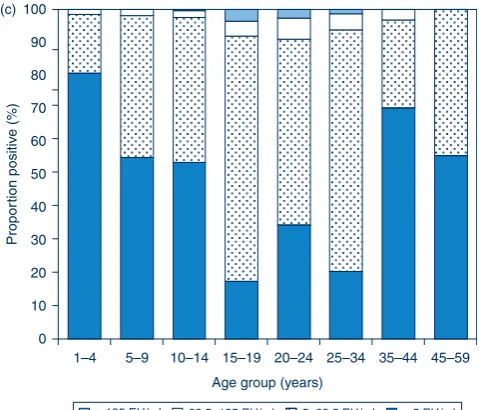
The distribution of titres in each of the three serosurveys is provided in Figure 1(a,b,c). In 1997–98, the highest
proportion of anti-PT IgG levels$62.5 EU/mL was seen
in the 5–9 and 15–19-year age groups. In contrast, in 2002
the highest proportion of anti-PT IgG levels$62.5 EU/mL
was seen in the 20–24, 25–34 and 35–44-year age groups.
The proportion with anti-PT IgG levels$62.5 EU/mL was
reduced across the population in 2007 compared to the previous collections.
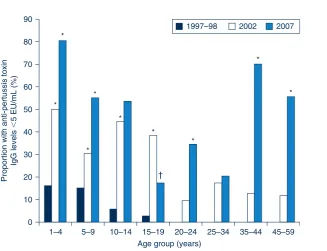
To further highlight these differences, the proportion of
sera with anti-PT IgG levels$62.5 EU/mL across the three
collections are presented in Figure 2. When comparing the 2002 serosurvey to the 1997–98 serosurvey, significant decreases were seen in the 5–9 and 15–19-year age groups. When comparing the 2007 serosurvey to the 2002 sero-survey, significant decreases were seen in the 5–9 and 10–14-year age groups and in all age groups for those aged 20 years and over.
If the population proportions with anti-PT IgG levels
,5 EU/mL (undetectable) over the period of the three
collections are compared, many age groups experienced a significant increase in undetectable levels (Figure 3).
In particular, the proportion of 1–4-year olds increased from 16% in 1997–98 to 81% by 2007 and the proportion of 35–44-year olds increased from 0% in 1997–98 to 70% by 2007. The only age group for which a significant decrease was observed between the 2002 and 2007 collections was 15–19-year olds.
0 10 20 30 40 50 60 70 80 90 100 (a)
1–4 5–9 10–14 15–19 20–24 25–34 35–44 45–59
Propor
tion positiv
e (%)
Age group (years)
ⱖ125 EU/mL 62.5–<125 EU/mL 5–<62.5 EU/mL ⬍5 EU/mL
Figure 1a. Cross-sectional distribution of anti-pertussis toxin IgG levels in the NSW population in eight age groups (1–4 through to 45–59 years) in 1997–98.
ⱖ125 EU/mL 62.5–<125 EU/mL 5–<62.5 EU/mL ⬍5 EU/mL
0 10 20 30 40 50 60 70 80 90 100 (b)
1–4 5–9 10–14 15–19 20–24 25–34 35–44 45–59
Propor
tion positiv
e (%)
Age group (years)
Figure 1b. Cross-sectional distribution of anti-pertussis toxin IgG levels in the NSW population in eight age groups (1–4 through to 45–59 years) in 2002.
0 10 20 30 40 50 60 70 80 90 100 (c)
Propor
tion positiv
e (%)
1–4 5–9 10–14 15–19 20–24 25–34 35–44 45–59
Age group (years)
ⱖ125 EU/mL 62.5–125 EU/mL 5–62.5 EU/mL ⬍5 EU/mL
Figure 1c. Cross-sectional distribution of anti-pertussis toxin IgG levels in the NSW population in eight age groups (1–4 through to 45–59 years) in 2007.
Sources: 1997–98, 2002 and 2007 serosurveys.
Discussion
This study compares patterns of anti-PT IgG by age, between three time periods. The use of seroepidemiologi-cal data for this purpose avoids problems associated with traditional disease surveillance data, such as changes in
diagnostic testing practices and physician awareness.10,11
Overall, in the 2007 serosurvey there was a decrease in the
proportion of high anti-PT IgG levels ($62.5 EU/mL)
across all age groups, compared with earlier serosurveys, which was significant for many age groups. This was in keeping with the relatively low levels of pertussis notifica-tions in this year, which immediately preceded epidemic 0
5 10 15 20 25 30 35 40 45
Proportion with anti-pertussis toxin
IgG levels
ⱖ
62.5 EU/mL (%)
* *
* *
* *
*
*
1–4 5–9 10–14 15–19 20–24 25–34 35–44 45–59
Age group (years)
1997–98 2002 2007
Figure 2. Cross-sectional proportion of anti-pertussis toxin IgG levels ($62.5 EU/mL) in the NSW population in eight age groups (1–4 years through to 45–59 years) in 1997–98, 2002 and 2007.
*Significant decreases compared to the previous collection.
Sources: 1997–98, 2002 and 2007 serosurveys.
0 10 20 30 40 50 60 70 80 90
Proportion with anti-pertussis toxin
IgG levels
⬍
5 EU/mL (%)
1997–98 2002 2007
*
* *
* *
*
† *
*
*
1–4 5–9 10–14 15–19 20–24 25–34 35–44 45–59
Age group (years)
Figure 3. Cross-sectional proportion of undetectable anti-pertussis toxin IgG levels (,5 EU/mL) in the NSW population in eight age groups (1–4 years through to 45–59 years) in 1997–98, 2002 and 2007.
ySignificant decreases compared to the previous collection. *Significant increases compared to the previous collection.
Sources: 1997–98, 2002 and 2007 serosurveys.
notifications in NSW.1 Another unusual finding was the increase in the proportion of undetectable anti-PT IgG levels
(,5 EU/mL), which again was significant in several age
groups.
Of particular note is the significant decrease in high anti-PT IgG levels in the 1–4-year age group, from 16% in 1997–98 to 2% in 2007, despite this age group being eligible for recent vaccination, which is thought to be a contributor to high anti-PT IgG levels in serological
surveys.2 The lower proportion of high anti-PT IgG
levels in the 2007 serosurvey in sera from children aged less than 10 years is also reflected in notification data showing low level reporting for this age group in the period
2002–2007.12,13 The 1–4-year age group in the 2007
serosurvey were not eligible for an 18-month booster dose of DTPa after it was removed from the schedule in
September 2003.7This may have contributed to the
signif-icant increase in the proportion of undetectable anti-PT IgG levels in this age group, and is consistent with signifi-cant waning of immunity after the primary series of DTPa in the absence of a later booster.
In the 1997–98 serosurvey, adolescents aged 10–14 years (not eligible for a pre-school booster) and 15–19 years (eligible for three-dose primary DTPw vaccination only) had high proportions of high anti-PT IgG levels, which again reflected high notification rates in the 10–19-year age
group at this time.14In the 2002 serosurvey, high anti-PT
IgG levels continued to be observed for the cohort eligible for a primary series of DTPw only, who were now young adults aged 20–24 years. The relatively high rate of notifica-tions in the 10–19-year age group also continued, reaching a
peak in 2001 of 132 notifications per 100 000 population.14
This rate fell to 62 per 100 000 population in 2002, and mirrored the 2002 serosurvey finding of a significantly lower proportion of high anti-PT IgG levels for both the 10–14 and 15–19-year age groups compared to the 1997–98 serosur-vey. The decline in anti-PT IgG levels in the 10–14-year age group may be attributable to children who had received the
scheduled pre-school booster dose moving into this cohort.15
Despite the availability of booster doses during childhood for the now adolescent cohort, coverage was poor, in part
due to concerns about the safety of DTPw.10,16When an
adult formulated acellular pertussis-containing vaccine (dTpa) became available, it was added to the schedule as
a booster dose for adolescents aged 15–17 years.7The dose
would target the cohort with sub-optimal childhood booster coverage, who continued to be conspicuous in pertussis
notifications17and it was hoped that in the future would
prevent an increase in cases due to waning of childhood vaccinations. In 2004, NSW Health delivered this vaccine through a school-based program to those aged 12–19 years and followed this with delivery to Year 7 students (aged 12–13 years) in 2005. The majority of those targeted in this program were aged 15–19 years at the time of the 2007
serosurvey. This was one of the few age groups to not show a significant decrease in the proportion of anti-PT IgG levels between the 2002 and 2007 serosurveys (Figure 2). Also, in contrast to all other age groups, the 15–19-year age group had a significant decrease in the proportion of undetectable anti-PT IgG levels in 2007, compared to the 2002 serosurvey (Figure 3). This may largely be attributed to the vaccination program, as disease activity between
2002 and 2007 was low.12,13
The large increase in undetectable anti-PT IgG levels in the 35–44-year age group is of concern, as this may indicate an increased susceptibility to infection at an age when people are likely to be parents of young infants. Young infants are most at risk from severe disease and death due to
pertussis,13,18 and parents are an important source of
infection.19,20 At the present time a ‘cocooning strategy’
(vaccinating close contacts of infants) is the recommended method of protecting infants too young to be immunised
for pertussis.21In March 2009, in response to the epidemic,
NSW Health commenced funding of a cocooning dose of dTpa for parents, grandparents and other close contacts
of infants less than 12 months of age.22The success of this
strategy is currently being investigated.
There were several limitations to this study. The sera used in this study were opportunistically collected rather than randomly sampled. We tried to minimise any biases by obtaining sera that were submitted for a range of diagnostic tests (excluding HIV) to major laboratories throughout NSW that serviced mainly ambulatory populations. We cannot exclude the possibility of selection bias toward a more sick population. No information regarding the clini-cal status of individuals whose sera were used here was collected and we did not exclude sera that were submitted for the diagnosis of pertussis. However, the method used here has been validated for measles against a prospective, cluster-sampling method and was found to be
representa-tive.23The immunisation status of subjects was unknown.
While it is possible to estimate immunisation coverage for the childhood population in this study, it is largely unknown for the older age groups.
Conclusion
The seroepidemiological profiles of the three serosurveys demonstrate fluctuating immunity profiles related to dis-ease patterns and changes in vaccination schedules. The unique seroepidemiological profile from the 2007 serosur-vey is interesting and requires further analysis. The small proportion of high anti-PT IgG levels indicative of recent infection, coupled with an increased proportion of very low anti-PT IgG levels, is likely to have set the stage for a large, sustained epidemic. Testing and analysis of serological profiles using a collection from the time of the epidemic would be a valuable means to elucidate the role of population immunity in pertussis epidemic cycles.
Acknowledgments
The National Centre for Immunisation Research and Surveillance (NCIRS) is supported by The Australian Government Department of Health and Ageing, the NSW Department of Health and The Chil-dren’s Hospital at Westmead. Serosurveys conducted by the Centre for Infectious Diseases and Microbiology–Public Health are funded by NCIRS. We wish to acknowledge the staff of the laboratories that provided the sera, Katherine Tudo (Institute of Clinical Pathology and Medical Research) for assistance in the processing and testing of sera and Dr Jodie McVernon (The University of Melbourne) for assistance with the analysis. GlaxoSmithKline provided antigen for the assay. All testing and analysis were conducted at the Centre for Infectious Diseases and Microbiology–Public Health and NCIRS.
References
1. Spokes PJ, Quinn HE, McAnulty JM. Review of the 2008–2009 pertussis epidemic in NSW: notifications and hospitalisations.
N S W Public Health Bull2010; 21(7–8): 167–73. doi:10.1071/ NB10031
2. de Melker HE, Versteegh FG, Conyn-Van Spaendonck MA, Elvers LH, Berbers GA, van Der Zee A et al. Specificity and sensitivity of high levels of immunoglobulin G antibodies against pertussis toxin in a single serum sample for diagnosis of infection with Bordetella pertussis.J Clin Microbiol2000; 38(2): 800–6.
3. Giammanco A, Chiarini A, Maple PA, Andrews N, Pebody R, Gay N et al. European Sero-Epidemiology Network: standard-isation of the assay results for pertussis.Vaccine2003; 22(1): 112–20. doi:10.1016/S0264-410X(03)00514-0
4. Pebody RG, Gay NJ, Giammanco A, Baron S, Schellekens J, Tischer A et al. The seroepidemiology ofBordetella pertussis
infection in Western Europe.Epidemiol Infect2005; 133(1): 159–71. doi:10.1017/S0950268804003012
5. Cagney M, MacIntyre CR, McIntyre P, Puech M, Giammanco A. The seroepidemiology of pertussis in Australia during an epidemic period.Epidemiol Infect2006; 134(6): 1208–16. doi:10.1017/S095026880600625X
6. Quinn HE, McIntyre PB, Backhouse JL, Gidding HF, Brotherton J, Gilbert GL. The utility of seroepidemiology for tracking trends in pertussis infection.Epidemiol Infect2010; 138(3): 426–33. doi:10.1017/S0950268809990707
7. National Health and Medical Research Council. The Australian immunisation handbook. Canberra: Australian Government Department of Health and Ageing; 2003.
8. Gidding H. Australia’s national serosurveillance program.N S W Public Health Bull2003; 14(4–5): 90–3. doi:10.1071/NB03027
9. Giammanco A, Taormina S, Chiarini A, Dardanoni G, Stefanelli P, Salmaso S et al. Analogous IgG subclass response to pertussis toxin in vaccinated children, healthy or affected by whooping cough.Vaccine2003; 21(17–18): 1924–31. doi:10.1016/S0264-410X(02)00823-X
10. Horby P, MacIntyre CR, McIntyre PB, Gilbert GL, Staff M, Hanlon M et al. A boarding school outbreak of pertussis in adolescents: value of laboratory diagnostic methods.Epidemiol Infect2005; 133(2): 229–36. doi:10.1017/S0950268804003401
11. McIntyre P. Lessons from surveillance: solving the pertussis puzzle.N S W Public Health Bull2003; 14(4–5): 69–71. doi:10.1071/NB03022
12. Brotherton J, Wang H, Schaffer A, Quinn H, Menzies R, Hull B et al. Vaccine preventable diseases and vaccination coverage in Australia, 2003 to 2005.Commun Dis Intell2007; 31(Suppl): S1–152.
13. Chiu C, Dey A, Wang H, Menzies R, Deeks S, Mahajan D et al. Vaccine preventable diseases in Australia, 2005 to 2007.
Commun Dis Intell2010; 34(Suppl): S1–167.
14. Quinn HE, McIntyre PB. Pertussis epidemiology in Australia over the decade 1995–2005 – trends by region and age group.
Commun Dis Intell2007; 31(2): 205–15.
15. Torvaldsen S, McIntyre PB. Effect of the preschool pertussis booster on national notifications of disease in Australia.Pediatr Infect Dis J2003; 22(11): 956–9. doi:10.1097/01.
inf.0000095198.75170.b6
16. McLennan W. Children’s immunisation, Australia. April 1995. ABS Cat. No. 4352.0. Canberra: Australian Bureau of Statistics; 1996.
17. Brotherton J, McAnulty J. A pertussis epidemic in NSW: how epidemiology reflects vaccination policy.N S W Public Health Bull2003; 14(4–5): 77–81. doi:10.1071/NB03024
18. Cortese MM, Baughman AL, Zhang R, Srivastava PU, Wallace GS. Pertussis hospitalizations among infants in the United States, 1993 to 2004.Pediatrics2008; 121(3): 484–92. doi:10.1542/peds.2007-1393
19. de Greeff SC, Mooi FR, Westerhof A, Verbakel JM, Peeters JF, Heuvelman CJ et al. Pertussis disease burden in the household: how to protect young infants.Clin Infect Dis2010; 50(10): 1339–45. doi:10.1086/652281
20. Wendelboe AM, Njamkepo E, Bourillon A, Floret DD, Gaudelus J, Gerber M et al. Transmission of Bordetella pertussis to young infants.Pediatr Infect Dis J2007; 26(4): 293–9. doi:10.1097/ 01.inf.0000258699.64164.6d
21. National Health and Medical Research Council. The Australian immunisation handbook. 9th ed. Canberra: Australian Government Department of Health and Ageing; 2008.
22. Della Bosca J. Media release: Whooping cough vaccine not just for kids: 2009. Available from: www.health.nsw.gov.au/news/ 2009/pdf/20090313_02.pdf (Cited 20 May 2011.)
23. Kelly H, Riddell MA, Gidding HF, Nolan T, Gilbert GL. A random cluster survey and a convenience sample give comparable estimates of immunity to vaccine preventable diseases in children of school age in Victoria, Australia.Vaccine
Influenza immunisation program at three
tertiary paediatric hospitals in NSW in 2010
Nicholas J. Wood
A,Band Patrick M. Cashman
C,D ANational Centre for Immunisation Research and Surveillance of Vaccine-Preventable Diseases B
The Children’s Hospital at Westmead C
Population Health, Hunter New England Local Health District DCorresponding author. Email: patrick.cashman@hnehealth.
nsw.gov.au
Abstract:This is a report of an innovative influ-enza immunisation program in three tertiary paediatric hospitals in NSW. A targeted once-off program of influenza immunisation funded by NSW Health was offered during 2010 at the
Children’s Hospital at Westmead, Sydney
Children’s Hospital and the John Hunter Chil-dren’s Hospital. Authorised immunisers offered influenza immunisation to paediatric patients, out-patients and relatives of children with chronic illnesses. Influenza immunisation was adminis-tered to 3458 people, 1251 (36%) of whom were children with chronic conditions. In 2009 before the program, 420 influenza vaccines were pre-scribed for children in two of these hospitals. This number increased to 949 in 2010, the year of the program. Dedicated vaccination clinics at tertiary paediatric hospitals provide additional opportu-nities to ensure that children at high risk of severe influenza disease and its complications are vaccinated. The information obtained from the hospital vaccination program contributed to the national investigation of febrile convulsions following influenza vaccines in children in 2010.
Young children and infants have a high incidence of influenza infection, and hospitalisation for the treatment of influenza and its complications is most common in
children less than 2 years of age.1–3 The Australian
Immunisation Handbook recommends influenza immuni-sation for children over 6 months of age, and strongly recommends influenza immunisation for children over 6 months of age with medical conditions predisposing to
severe influenza.4
Many children with moderate-to-severe chronic medical conditions attend outpatient care at one of the three major paediatric hospitals in New South Wales (NSW), the Children’s Hospital at Westmead, Sydney Children’s Hos-pital and the John Hunter Children’s HosHos-pital. Over 400 000 children are seen each year in the outpatient
departments at the three hospitals; approximately
290 000 children are treated at the Children’s Hospital at Westmead, 100 000 at Sydney Children’s Hospital and
20 000 at the John Hunter Children’s Hospital.5 The
Sydney Children’s Hospitals Network, including Sydney Children’s Hospital and the Children’s Hospital at West-mead, has over 44 500 inpatient admissions annually, making it the largest Australian and New Zealand chil-dren’s health service.
In 2010 NSW Health provided funding to conduct influenza vaccination at these three hospitals through a targeted once-off program. The program funding was for a 6-month period and was principally used to employ nurse immunisers with the aim of offering influenza immunisation to protect paediatric inpatients and outpatients and decrease the numbers of preventable influenza hospitalisations.
Siblings and parents of children with medical conditions attending outpatient clinics were also offered influenza vaccination to reduce opportunities of influenza exposure thereby cocooning the medically at-risk children.
This paper describes the program delivery of influenza vaccine to children with chronic medical conditions and their families at the three major paediatric hospitals in NSW in 2010.
Methods
The clinics at each hospital varied in location, timing and staffing. Individual details including unique hospital identifier, age, sex, presence of chronic medical condition, influenza vaccine received and contact details were recorded at the time of vaccination. All clinics commenced
offering the monovalent H1N1 2009 vaccine, PanvaxÒ
(CSL Biotherapies, Australia), in February 2010 and changed to seasonal trivalent inactivated influenza virus (TIV) vaccine in March 2010 when it became available.
The John Hunter Children’s Hospital used only InfluvacÒ
(Solvay Biologicals, 0.5 mL) as the seasonal influenza vaccine, as it was the only vaccine obtained by the hospital, while Sydney Children’s Hospital and The
Children’s Hospital at Westmead used either FluvaxÒ
(CSL Biotherapies, 0.5 mL), FluvaxÒ junior (CSL
Biotherapies, 0.25 mL) or InfluvacÒ(Solvay Biologicals,
0.5 mL).
The clinics were advertised by posters around the hospital, through presentations at medical team meetings, during grand rounds and by individual approaches from the nurse immuniser to parents of patients attending the hospital. At the Children’s Hospital at Westmead, nurse immunisers from the Sydney West Area Health Service (SWAHS) public health unit were seconded for the duration of the influenza vaccine program.
As this was a new approach in NSW, participating hospi-tals and their associated public health unit met monthly by teleconference to implement, coordinate and manage the program. These groups have continued to meet during the 2011 influenza season to coordinate and promote influenza immunisation and monitor vaccine safety.
We evaluated clinic outcomes using the following indica-tors: the number of children and members of their families immunised; a comparison of current vaccine administra-tion against previous attempts to increase influenza vaccine coverage at the paediatric hospitals.
National adverse events signal
On Friday 23 April 2010, following the advice of the Chief Medical Officer of Australia, seasonal influenza vaccine administration to children aged 5 years and under was suspended due to an adverse events signal of possible increased fever reactions and febrile convulsions follow-ing influenza immunisation in young children. This signif-icantly affected the influenza vaccine program in the three paediatric tertiary hospitals but clinic records provided a unique cohort of children to rapidly provide additional data to inform the national investigation.
From 27 April 2010, research nurses and clinic staff from the Children’s Hospital at Westmead and the National Centre for Immunisation Research and Surveillance (NCIRS) used a scripted telephone interview to ask parents
of children 6 months to 5 years old, who had received influenza vaccines in the three hospitals since the initiation of the program, about reactions following the receipt of the influenza vaccine. Parental reports were collated for each child who was vaccinated, and analysed by type of influenza vaccine received, age of the child, and the presence of chronic co-existing medical conditions (including gastroenterological, respiratory, oncological, cardiac and neurological conditions).
We therefore also evaluated the utility of the clinic in responding to and understanding a national adverse events signal.
Results
The combined number of influenza-containing vaccines (monovalent H1N1 or seasonal trivalent) given to children presenting with medical conditions and their families at the three hospitals was 3458 vaccines (Table 1). Children with
chronic medical conditions accounted for 36% (n¼1251)
of vaccines administered.
The immunisation nurses reported that the offer to immu-nise family members to assist in the protection of their unwell child against influenza was popular and over 2000 family members were immunised.
The 2010 influenza program at the paediatric tertiary hospitals administered more influenza vaccinations to outpatients than in previous years (as measured by the influenza vaccines dispensed from the two hospital phar-macies that had provided ad hoc vaccination to paediatric outpatients previously) (Figure 1).
National adverse events signal
Commencing on 27 April 2010, parents of children
6 months to 5 years old (n¼333), who had received
influenza vaccines in the three hospitals since the initiation of the program, were contacted. Overall nearly 20%
(n¼66) of parents reported that their child had a fever
within 48 hours of vaccination. There was a statistically Table 1. Numbers of influenza vaccines administered at three NSW paediatric hospitals to children with chronic medical conditions and their families, 2010
Monovalent H1N1 (Panvax)
n
Children with chronic medical conditions given monovalent H1N1 (Panvax)
n(%)
Seasonal Influenza vaccine
n
Children with chronic medical conditions given seasonal influenza vaccine
n(%)
Total administered
vaccine N
CHW 543 174 (32) 1427 413 (29) 1970
SCH 232 108 (47) 297 194 (65) 529
JHCH 391 166 (42) 568 196 (35) 959
Total 1166 448 (38) 2292 803 (35) 3458
CHW: The Children’s Hospital at Westmead. SCH: Sydney Children’s Hospital.
JHCH: John Hunter Children’s Hospital.
significant higher parental fever report for CSL FluvaxÒ
compared with InfluvacÒ (RR 6.5, 95% CI 3.1 to13.9,
p,0.0001), or CSL PanvaxÒ(RR 2.9, 95% CI 1.8 to 4.3,
p#0.0001).6There were no reports of febrile convulsions
in any children.
Discussion
The dedicated paediatric hospital influenza vaccine program in 2010 immunised higher numbers of high medical at-risk children compared to previous years. Cocooning protection was offered through vaccination of family members. Having a database of the cohort of vaccinees allowed the hospitals to rapidly investigate an important safety alert and contribute to the national investigation of febrile convulsions following influenza vaccines in children in 2010.
The Royal Children’s Hospital, Melbourne, Victoria has had a dedicated immunisation service for many years,
delivering vaccinations including annual influenza
vaccine, providing immunisation advice and managing adverse events. Parents and siblings of patients are able to purchase influenza vaccine from the hospital pharmacy. This service delivered approximately 2000 doses of
influ-enza vaccine to patients, parents and siblings in 2009.7
Additional benefits of these hospital-based programs in-clude the opportunity for specialists to seek advice regard-ing immunisation for their patients with complex medical
conditions, the development of common vaccination protocols for use in complex medical cases, the capacity to investigate safety concerns quickly, and a training opportunity for hospital nursing staff with vaccines which are usually administered in primary care settings.
As the Australian Immunisation Handbook notes: ‘it is vital that healthcare professionals take every available
opportunity to vaccinate children and adults’.4 It is
particularly important that children with chronic medical conditions who are most at risk of severe vaccine-preventable diseases are vaccinated in a timely way.
Conclusion
Dedicated vaccination clinics at tertiary paediatric hospitals provide a valuable method of ensuring that children at high risk of severe influenza disease and its complications are vaccinated. The clinics can provide these vulnerable children with additional protection by vaccinating their family members (cocooning), while at the same time facilitate important clinical, surveillance and education activities.
Acknowledgments
NSW Health provided funding for the program in each of the paediatric hospitals. We thank the staff at each clinic site for their contribution.
References
1. Izurieta HS, Thompson WW, Kramarz P, Shay DK, Davis RL, DeStefano F et al. Influenza and the rates of hospitalisation for respiratory disease among infants and young children.N Engl J Med2000; 342: 232–9. doi:10.1056/NEJM200001273420402
2. Neuzil KM, Mellen BG, Wright PF, Mitchel EF, Jr, Griffin MR. Effect of influenza on hospitalization, outpatient visits and courses of antibiotics in children.N Engl J Med2000; 342: 225–31. doi:10.1056/NEJM200001273420401
3. Isaacs D. Should all Australian children be vaccinated against influenza?Med J Aust2005; 182: 553–4.
4. National Health and Medical Research Council. The Australian immunisation handbook 9th edition, 2008. Canberra: Australian Government Publishing Service; 2008.
5. Australian Institute of Health and Welfare. Information on hospitals throughout Australia and how they compare against national and state and territory data. [http://www.aihw.gov.au/ australias-hospitals-at-a-glance-2009-10/] Available at: www.myhospitals.gov.au (Cited 15 September 2011).
6. Wood N, Sheppeard V, Cashman P, Palasanthiran P, Casacelli M, Cannings K et al. Influenza vaccine safety in children less than 5 years old. The 2010 and 2011 experience in Australia.Ped Inf Dis J.2011 Nov 16. [Epub ahead of print]. doi:10.1097/ INF.0B013E31823D5303
7. 2010 Victorian public healthcare awards: A hospital based immunisation service. Available at: http://www.rch. org.au/emplibrary/rch_awards/VPHA2010_Final_ immunisationaward.pdf (Cited 15 September 2011).
134 369 379
587
50 41
362
0 200 400 600 800 1000
2007 2008 2009 2010
Chidren’s Hospital Westmead John Hunter Children’s Hospital
Figure 1. Influenza vaccines dispensed at two NSW paediatric hospitals: comparison of program year 2010 with previous years, 2007–2009.
Source: Hospital pharmacy records at The Children’s Hospital at Westmead and the John Hunter Children’s Hospital.
List of reviewers in 2010
–
2011
The NSW Public Health Bulletin is a peer-reviewed journal. Thanks are extended to the following reviewers
for their support of theBulletinin 2010–2011.
Allsop, S
National Drug Research Institute, Curtin University Armstrong, B
Sydney School of Public Health, The University of Sydney Banks, E
Australian National University and The Sax Institute Baxter, D
Australian Federation of AIDS Organisations Beard, F
Queensland Health Bowen, S
Victorian Department of Health Boyle, M
Hunter New England Area Health Service Brotherton, J
Victorian Cytology Service Brown, G
Curtin University Brown, N
Poche Centre for Indigenous Health, The University of Sydney
Browne, K
Hunter New England Area Health Service Butler, C
National Centre for Epidemiology and Public Health, The Australian National University
Cameron, ID
Sydney Medical School, The University of Sydney and Royal Rehabilitation Centre Sydney Carey, M
Monash Sustainability Institute, Monash University Charlesworth, K
NSW Department of Health Clemson, L
Ageing, Work & Health Research Unit, Faculty of Health Sciences, The University of Sydney
Conaty, S
Sydney South West Area Health Service Corben, P
North Coast Area Health Service Correll, P
NSW Department of Health Crofts, N
Melbourne School of Population Health, The University of Melbourne
Cumming, RG
Sydney Medical School, The University of Sydney Dax, E
ConsultingLIZ
Delbaere, K
Neuroscience Research Australia, The University of New South Wales
Durrheim, D
Hunter Medical Research Institute Elliott, E
Paediatrics and Child Health, The University of Sydney and The Children’s Hospital at Westmead
Ferson, M
South Eastern Sydney Illawarra Area Health Service French, M
School of Pathology and Laboratory Medicine, The University of Western Australia Garsia, R
Department of Immunology, Royal Prince Alfred Hospital
Gilbert, L
Centre for Infectious Diseases and Microbiology, Westmead Hospital
Gold, M
Discipline of Paediatrics, The University of Adelaide
Grulich, A
The Kirby Institute (formerly the National Centre in HIV Epidemiology and Clinical Research, The University of New South Wales
Haire, B
Centre for Values, Ethics and the Law in Medicine, The University of Sydney
Hall, R
School of Public Health and Preventive Medicine, Monash University
Hall, W
UQ Centre for Clinical Research, The University of Queensland
Harris, E
Centre for Health Equity Training Research and Evaluation, The University of New South Wales Hawkshaw, B
Sydney West Area Health Service Hayen, A
School of Public Health, The University of Sydney Jalaludin, B
Sydney South West Area Health Service Jones, T
Greater Western Area Health Service Korner, H
National Centre in HIV Social Research, The University of New South Wales
Langely, A
Leask, J
National Centre for Immunisation Research and Surveillance, The Children’s Hospital at Westmead
Lewis, M
Menzies School of Health Policy, The University of Sydney
Lewis, P
Northern Sydney Central Coast Area Health Service Lord, S
Neuroscience Research Australia, The University of New South Wales
Lovitt, L
Clinical Excellence Commission Lowbridge, C
NSW Department of Health Lujic, S
School of Medicine, The University of Western Sydney Lyle, D
Broken Hill University Department of Rural Health, The University of Sydney
McAnulty, J
NSW Department of Health McCallum, L
SA Department of Health McCoombe, S
National Centre for Farmer Health, School of Medicine, Deakin University
McCue, P
Premier’s Council for Active Living NSW McGeechan, K
School of Public Health, The University of Sydney McIntyre, P
National Centre for Immunisation Research and Surveillance, The Children’s Hospital at Westmead Marks, G
Woolcock Institute of Medical Research Menzies, R
National Centre for Immunisation Research and Surveillance, The Children’s Hospital at Westmead
Merritt, T
Hunter New England Population Health Milat, A
The Sax Institute Mitchell, R
Department of Aviation, The University of New South Wales
Monger, C
NSW Department of Health Morgan, G
University Centre for Rural Health – North Coast, The University of Sydney and Northern NSW Local Health District
Newell, M
National Centre for Farmer Health, School of Medicine, Deakin University
O’Connor, C
Sydney Local Health District and South West Sydney Local Health District
O’Donnell, D
NSW Department of Health
Palasanthiran, P
Department of Immunology and Infectious Diseases, Sydney Children’s Hospital and The University of New South Wales
Parkhill, N ACON Peterson, K
Queensland Health Reynolds, C
Flinders University Law School Robertson, C
Dunedin School of Medicine, University of Otago, NZ Robertson, P
South Eastern Area Laboratory Services Ryan, L
NSW Department of Health Sainsbury, P
Population Health, NSW Health Sanson-Fisher, R
School of Medicine and Public Health, The University of Newcastle
Scuffham, P
School of Medicine, Griffith University Seale, H
School of Public Health and Community Medicine, The University of New South Wales
Selvey, L Greenpeace Sheppeard, V
Sydney West Area Health Service Skull, S
Menzies School of Health Research Spencer, AJ
School of Dentistry, The University of Adelaide Staff, M
Northern Sydney Central Coast Area Health Service Stewart, K
NSW Department of Health Stickney, B
NSW Department of Health Sullivan, J
Children’s Cancer Institute Australia Taylor, L
NSW Department of Health Thackway, S
NSW Department of Health Tobin, S
NSW Department of Health Torvaldsen, S
School of Public Health and Community Medicine, The University of New South Wales
Vance, E
Neuroscience Research Australia Wade, V
Sydney South West Area Health Service Watson, D
Bureau of Health Information Watson, W
Transport and Road Safety (TARS) Research (formerly NSW Injury Risk Management Research Centre), The University of New South Wales
Weber, D
Sydney South West Area Health Service Weisberg, E
Sydney Centre for Reproductive Health Research, Family Planning NSW
Wise, M
Centre for Health Equity Training Research and Evaluation, The University of New South Wales Wright, C
Centre for Oral Health Strategy, NSW Health
Wright, T
Department of Primary Industries Yeatman, H
School of Health Sciences, The University of Wollongong Zuo, Y
National Centre for Immunisation Research and Surveillance, The Children’s Hospital at Westmead Zwar, N
School of Public Health and Community Medicine, The University of New South Wales
Pertussis in NSW and its prevention
in infants and children
Aaron W. Cashmore
A, Ruiting Lan
Band Kristine K. Macartney
CA
NSW Public Health Officer Training Program, NSW Department of Health
B
School of Biotechnology and Biomolecular Sciences, The University of New South Wales
C
National Centre for Immunisation Research and Surveillance, The Children’s Hospital at Westmead
Pertussis is an acute respiratory tract illness caused by
infection with the bacteriumBordetella pertussis.
![Table 1.Average annual age-specific invasive pneumococcal disease counts and incidence, Sydney West Area Health Service,2006]2010 compared with 2002]2004](https://thumb-us.123doks.com/thumbv2/123dok_us/58837.2007528/3.595.60.553.677.765/average-specific-invasive-pneumococcal-incidence-health-service-compared.webp)

![Table 1.Significant pertussis vaccine schedule changes in NSW, 1975]2003](https://thumb-us.123doks.com/thumbv2/123dok_us/58837.2007528/9.595.56.555.98.325/table-significant-pertussis-vaccine-schedule-changes-nsw.webp)