relationship skills program in marital commitment
of couples
Bahareh Chitsazzadeh Alaf1, Kianoush Zahrakar1, Bagher Sanai1
Abstract
Nowadays, due to the increasing rate of divorce and betrayals, the marital commitment has been concerned in marriage and family studies. The research aimed to evaluate the effect of Practical Application of Intimate Relationship Skills (PAIRS) program in marital commitment of couples. The method was quasi-experimental and the design was pretest-posttest with a control group. The convenience sampling method was employed to choose 16 couples whose marital commitment score was below the mean in Isfahan, Iran. These couples were randomly assigned to the experimental and control groups (N=8 in each group). Data gathering was carried out using Adams and Jones dimensions of commitment inventory (DCI) that was filled out by the members of both groups in the pretest stage. Then, the experimental group received the PAIRS training program in thirteen 90-minute sessions. 35 percent of the total variance belongs to the group membership due to the effectiveness of this educational program. This educational program attempts to make couples aware of themselves and their spouses, enhance, intimacy and empathy and develop effective relationship skills and problem-solving skills. The results demonstrated that the PAIRS program showed a positive effect on marital commitment. Hence, the PAIRS program can be employed to prevent divorce by increasing marital commitment in couples.
Keywords: Conflict, Education, Marriage Journal of Research & Health
Social Development & Health Promotion Research Center
Vol. 7, No. 1, Jan & Feb 2017 Pages: 653- 662. DOI: 10.18869/acadpub.jrh.7.1.653
Original Article
1. Department of Counseling, Faculty of Psychology and Educational Sciences, Kharazmi University, Tehran, Iran Correspondence to: Bahareh Chitsazzadeh Alaf, Department of Counseling, Faculty of Psychology and Educational Sciences, Kharazmi University, Tehran, Iran Email: [email protected]
Received: 28 Feb 2014 Accepted: 21 Apr 2014
How to cite this article: Chitsazzadeh Alaf B, Zahrakar K, Sanai B. Effect of practical
application of intimate relationship skills program in marital commitment of couples. J Research & Health2017; 7(1): 653- 662.
Introduction
Family is the smallest unit of the society. This social unit is the origin of human emotions and the core of the most intimate interpersonal relationships and interactions. Its importance is to the point that the health and development of any societies depends on the health and development of families in that society [1]. Marriage as the most important and highest social practice has always been in the center
of attention to meet the emotional needs of individuals [2].
partners wish to be the first and last love in the life of each other and to be committed to each other. The marital relations become superficial and impermanent without commitment [3]. Reynolds and Mansfield reported that after the factor of love and pleasure in marriage, commitment is the second most important factor guaranteeing the marriage [4].
Amato asserts that marital commitment means how much value and worth is placed on marital relationships and how much couples have motivation to stay in the marriage [5]. In general, commitment in a relationship means the agreement and intention of partners to have a committed and long-life relationship and refers to the stable conditions that keep the couples together and in fact, the stability is the main principle of commitment [6]. Adams and Jones define commitment as the couples’ tendency to keep the marital relationship regardless of the fluctuating rate of satisfaction [7]. Johnson has presented a comprehensive model for marital commitment in which, marital commitment is divided into three different dimensions of personal commitment, moral commitment, and structural commitment.
Personal commitment means the individual’s desire and interest to be involved in the marital relationship. Moral commitment indicates the individual’s moral loyalty towards the marriage and structural commitment refers to have external constraints and barriers in leaving the relationship or the fear of possible consequences resulted from getting divorced and feelings of obligation and compulsion to remain in the marriage [8]. In general, the consequences of commitment are divided into two categories: 1) the effect on the relationship’s performance; lack of commitment endangers the maintenance and continuance of marriage. 2) The effect on the stability of relationship; commitment can be considered as glue for a relationship. According to Laure, commitment leads to the maintenance of a relationship despite problems and difficult situations; whereas, lack of commitment can be considered as the most significant risk factor for divorce [9]. In recent years, the rate of divorce has been increased
than several years ago. Divorce makes knotty problems and threatens the mental health of individuals in both industrialized and developing nations. One of the main reasons of divorce, specifically in Iran, is the lack of familiarity and adequate skills of marital life. Couples on the verge of marriage take steps in a challenging pathway from falling in love to giving commitment and they need to learn skills in this passage [10].
Various programs have been introduced for marriage making interventions in marriage and marital issues such as couple’s pre-marriage preparation programs [11], post-marriage enrichment programs [12], and counseling for maladaptive spouses [13]. One of the empowerment programs for intervention in couples’ relationship in order to prevent the marital dissatisfaction and increase the intimacy and marital commitment is Practical Application of Intimate Relationship Skills (PAIRS) program. PAIRS is an educational training program which was first introduced by Gordon. It aims to train the skills required for making an intimate relationship. PAIRS has been derived from the works of Fermo, Bowen, Perlz, and borden which are the most famous humanistic treatments in the second half of the twentieth century [14].
literacy, and emotional empowerment, 3) effective change in dysfunctional behaviors through training the enhance intimacy skills and behaviors [16].
The PAIRS program presents a comprehensive system to enhance the self-knowledge and develop the ability to sustain pleasurable intimate relationships [17]. This program claims to make couples aware of interactions that are destructive to intimate relationships. When the inappropriate behaviors are identified, the couples learn how to decrease and replace maladaptive behaviors with healthy behaviors. This issue will promote effective behavior, generosity, goodwill, and sincerity and all these are essential sources of pleasure for intimate relationships [15]. Emotional literacy training, shared skills training to couples to create and sustain intimacy, providing information and useful strategies and approaches to keep family life alive, and creating dynamics in the marriage are the main objectives of the PAIRS program [18].
One of the basic principles of this program is sustainable intimacy. When the intimacy decreases, the basis of marriage becomes undermined and the problem-solving ability decreases. Therapy experiences have shown that when couples learn to create, reconstruct, and maintain the intimacy, important issues such as commitment, cooperation, loyalty, and creative management in personal differences are more quickly organized [19]. The PAIRS program provides a plan for couples to be able to assess their successes and failures [20]. In this educational program, the therapist tries to distinguish weaknesses in marital relationships and provide the necessary advices. Identifying and tackling these weaknesses help couples to reconstruct their relationships, and thus, increase their empathy, attachment, and emotional literacy [17].
Researches on the field of Practical Application of Intimate Relationship Skills program have demonstrated its effect in marital context. Durana assessed the effect of the program and concluded that this educational program can increase marital satisfaction [21].
Gordon and Durana employed the PAIRS program to increase the awareness and develop the ability of couples to sustain intimate relationships. The findings indicated that this program leads to the decreased anxiety and increased adjustment, satisfaction, and intimacy [22].
Turner's research aimed to evaluate the effect of PAIRS program on marital discord. In this study, both experimental and control groups were matched in terms of demographic characteristics such as gender, age, education, and duration of marriage. The results of the pretest stage and follow-up stage after 6 months showed that the experimental group improved significantly marital discord [23]. The results of a research entitled the effect of intimate relationship skills training in couples’ attachment styles and emotional intelligence showed that the PAIRS program can significantly adjust and reform attachment styles and improve the emotional intelligence in couples [24]. Khodadadi in a study entitled the effect of PAIRS program in the quality of life and perceived social support of couples expecting child concluded that this educational program can improve the quality of life and couples’ perceived social support [25].
program, which its effect has been proven in various studies. Secondly, no research has shed light onto the effect of this program on the variable of marital commitment and the lack of clinical and controlled studies is felt in this area.
Method
The present research employed a quasi-experimental method with pretest, posttest design and a control group. The research population included all the couples who attended a training course on the improvement of marital relationship and increase of life satisfaction in response to the researchers’ public announcement in the counseling and psychological services clinics of Isfahan, the center of Iran, in 2013. The sample was selected through one-stage, random cluster sampling method. First, four counseling centers were selected and then, 40 couples were chosen using convenience sampling among the couples referred to these centers. Adams and Jones marital commitment questionnaire was then administered on the participants. Based on the obtained results, 16 couples scored below the mean on the marital commitment questionnaire and they were included in the final sample. In the next step, these couples were randomly assigned to the experimental and control groups (N=8 in each group).
The experimental and control groups filled out Marital Commitment Questionnaire in the pretest. The experimental group was exposed to thirteen 90-minute per week sessions of Intimate relationship skills training according to the group and step-by-step procedures, whereas the control group received no intervention and the members were placed on the waiting list. The educational protocol of sessions used in this research was designed based on a book on marital therapy written by Bita Hosseini [19]. Subsequent to the end of the educational sessions, the posttest was administered on both groups. It is worth mentioning that a one-day workshop was also held for the control group in accordance
to the ethical principles and in order to appreciate their cooperation in the research. No drop-out was observed throughout the sessions.
The headlines of sessions of Practical Application of Intimate Relationship Skills program have been presented in Table 1. Marital commitment questionnaire: This questionnaire measures the loyalty amount and dimensions in individuals to their spouse and marriage. This questionnaire was designed by Adams and Jones and measures three dimensions of marital commitment. These dimensions include personal commitment: commitment toward the spouse based on the attractiveness of the spouse. Moral commitment: commitment toward the marriage based on the sanctity and dignity of marital relationship. Structural commitment: commitment toward the spouse and marriage based on the feeling of coercion to stay in the marriage or fear of consequences of getting divorced [26]. Each item is scored on a 5-point Likert scale from strongly disagree (1) to strongly agree (5). The majority of the questions are directly scored, except for the items of 11, 12, 16, 23, 28, 29, 30, 32, 34, 35, 36 and 38 that are reversely scored. The total scores ranges from 1 to 172 and the maximum score shows the couples’ high commitment [26].
Table 1 The structure of the sessions of practical application of intimate relationship skills program
Number of sessions Sessions
1st session stating the objectives, Introduction, registering and welcoming the members, introducing the leader and members, rules and norms of the group such as confidentiality, mutual respect, regular attendance and so on, administration of the pre-test
2nd session
Training the definition of marital commitment, different types of marital commitment, the influencing factors in marital commitment, the dimensions of marital commitment, the influence of commitment on the self, children, and social relationships, academic and occupational performance
and relationship with partner.
3rd session Training the appropriate and basic strategies for primary feedback (strategies such as talking in the manner of PAIRS, love groups, if you loved me, you would know that…)
4th session Evaluating the backgrounds of commitment and intimacy with members
5th session Training the dialogue, clarification, and asking for opinion on the issues
6th session Training the clarification of assumptions
7th session Training the history and the unique self
8th session Training the emotional relearning, emotional literacy, and creating the attachment fields
9th session Training the acquisition of mood skills and maintaining intimacy in relationships
10th session Training how to enjoy each other, sexiness, and sexuality
11th session Training the attitude and strategies to establish long-lasting and successful relationships
12th session Making a contract, stating and clarifying expectations
13th session Reviewing the group process from the beginning to the endand administration of the posttest and finally, conclusion, termination
In this research, below instruments were used to collect data.
present research, the internal consistency of the questionnaire was equal to 0.82.
Subsequent to data gathering, the descriptive
(mean and standard deviation) and inferential (covariance) statistics were employed to analyze the data in the SPSS-18 software.
Results
The mean age of males and females participated in this study was 36.41 ± 5.1 and 30.8 ± 5.6, respectively. The educational level of subjects was as following: third grade of junior high school (15%), diploma degree (37.5%),
bachelor's degree (35.5%) and Master's degree (12 %).
Table 2 shows the descriptive indices of the experimental and control groups in the pretest and posttest.
Table 2 Mean and standard deviation of scores of marital commitment in the experimental and control groups
Variable Group Pretest Posttest
Mean DeviationStandard Mean DeviationStandard
Marital Commitment Experimental 103.75 8.52 126.44 6.67
As observed in Table 2, the mean score of the experimental group on marital commitment is higher than the control group.
In order to employ the covariance analysis, the statistical assumptions were first used to analyze the normality of distribution of scores,
homogeneity of variances, homogeneity of regression’s slope and the linear relationship between control and dependent variables. In order to assess the normality of distribution of scores, Shapiro-Wilk test was used and the results have been presented in Table 3. Table 3 The results of Shapiro-Wilk test: the normality of the scores distribution of marital
ment in the experiential and control groups
Level of significance Statistics
Degree of freedom Groups
0.473 0.949
16 Experimental Group
0.311 0.937
16 Control Group
As observed in Table 3, the null hypothesis is based on the normality of the scores distribution of marital commitment in the remaining two groups. That is to say that, the sample scores are normal and homogenous with the society and the kurtosis and skewness
are accidental (all significant levels are above 0.05).
In order to assess the pre-assumption of the homogeneity of variances, Levene’s test was used and the results have been presented in Table 4.
Table 4 The results of Levene’s test: the homogeneity of variances of marital commitment scores in the experimental and control groups
F df1
df2 Level of
significance (P) Variable
0.381 1
30 0.542
Marital commitment
The presented values in Table 4 indicate that Levene’s test in the variables of marital commitment is not significant (p=0.542, F=0.381). Therefore, the variances of the experimental and control groups are not significantly different and the homogeneity assumption of variances is not confirmed. In order to investigate the lack of interaction between the groups and the scores of pretest, the assumption of regression slope’s equality was investigated and confirmed with respect
to the results (F1.28=1.05 and p>0.05). Therefore, it can be concluded that there is no interaction between the groups and pretest. Moreover, it can be concluded that there is a linear relationship between the control variable and independent variable of marital commitment, because the regression slope’s lines of dependent variable is parallel to its pretest. All the pre-assumptions were confirmed and hence, the employment of covariance analysis is permitted.
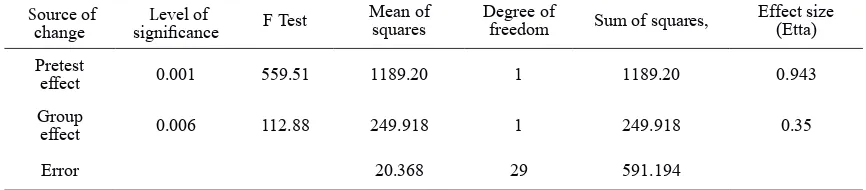
Table 5 Outcomes of unilateral covariance for analysis of experiment effects on the marital commitment variable Effect size
(Etta) Sum of squares,
Degree of freedom Mean of
squares F Test
Level of significance
Source of change
0.943 1189.20
1 1189.20
559.51 0.001
Pretest effect
0.35 249.918
1 249.918
112.88 0.006
Group effect
591.194 29
The results of table 5 indicate that there is a significant relationship between mean scores of marital commitment in the experimental and control groups in the posttest stage subsequent to the control of pretest scores (p=0.01). Therefore, the research hypothesis is confirmed. That is to say that, Practical Application of Intimate Relationship Skills (PAIRS) program has increased the marital commitment among the couples. The effect size of this educational program on marital commitment was equal to 0.35 in the posttest. That is to say that, 35 percent of the total variance belongs to the group membership due to the effectiveness of this educational program.
Discussion
The present research aimed to investigate the effect of Practical Application of Intimate Relationship Skills (PAIRS) program in marital commitment of couples. Results indicated that the PAIRS program significantly increased marital commitment in couples. The results of this research are in line with the results obtained by Durana who investigated the effect of this program in couples’ intimacy and showed the positive effect of this program on couple’s intimacy [29]. Gordon and Durana showed in their research that the PAIRS program can lead to the couples’ less anxiety and more adjustment, satisfaction, and intimacy [22]. Peluso , Eisenberg , and Schindler showed in their research that the PAIRS program is effective in coping with interpersonal problems and improving social performance of couples [17]. Ebrahimi investigated the effect of the PAIRS program in increasing marital satisfaction and adjusting attachment dimensions among daughters of martyr families. Results indicated that such programs can increase marital satisfaction of those individuals.
Turner stated in his research that the PAIRS program has decreased couple’s marital discord [23]. Moreover, our results are in line with the results obtained by Durana [21], Esmaeeli Niya [24], and Khodadadi [25].
In the explanation of the obtained results, it can be concluded that Practical Application of Intimate Relationship Skills (PAIRS) program is a multi-dimensional model that integrates the concepts, values, and skills related to love, intimacy, and marriage [15]. Intimacy in couples is an important basis for the establishment of commitment to the spouse and marriage. We cannot make a healthy marital life, unless the commitment to the partner and marriage is seriously taken into account [30]. When the intimacy as a deep emotional experience in affective relationships is undermined, the strong pillars of marriage becomes unstable and the enthusiasm the ability to solve problems, overcom the barriers, fears, and doubts gets worse [19].
According to the previous researches, marital commitment is the second most influencing factor in marriage stability and the lack of commitment is the most significant factor in getting divorced [31]. Swensen and Trahaug reported that marriages with high levels of intimacy have higher marital commitment, more expressed love, and less observed conflict [32]. Meeting basic needs such as love, kindness, belongingness, and commitment are taken into account in the PAIRS program. Factors that are important in long-lasting healthy relationships in this approach are negotiation to solve problems, and perceiving the partner viewpoints. Marital quality is also a multi-dimensional concept that includes different dimensions of marital relationship such as adjustment, satisfaction, happiness, cohesion, and commitment [33]. The bottom line in the PAIRS program is that, the requirement for establishing long-lasting intimacy is the maintenance of long-lasting marriage.
and impeded and premature burnout occurs. The PAIRS program stresses the necessity of intimacy and makes couples aware of the importance of establishing intimate relationships. Couples learn to establish intimacy in their relationships and become aware of pre-and-post marriage requirements such as commitment, cooperation, loyalty, and creative management of differences. During the training sessions of the PAIRS program, the couples learn that the intimacy is the main pillar of long-lasting marital life. Couples feelings of satisfaction and intimacy act as the driving force and persuades them to stay in the relationship. In the educational sessions and during trainings to couples, the emotional bonds are strengthened and the couples become more satisfied with their interpersonal and sexual relationships and hence, they are more likely to keep the relationship and reinforce the commitment to the partner. In this therapeutic approach, in addition to strong intimacy and close relationships, the couples learn to develop empathy toward each other and bring about peace to their relationships which finally leads to the higher levels of commitment and loyalty. In the PAIRS program, the couples are trained to pay attention to their important responsibilities in making intimacy and learning effective skills of marital relationship. When a spouse feels responsible, S/he tries to fulfill the responsibilities to make the partner satisfied. As marital satisfaction is enhanced, the intimacy is established and by improved intimacy, perceived commitment is strengthened.
Conclusion
This study aimed to investigate the effect of PAIRS program in marital commitment of couples. The results indicated that this educational program is effective in increasing couples’ marital commitment. The getting married and making warm and intimate family in which the husband and wife are the main pillars should be on the basis of commitment. Lack of commitment in the family is like
the lack of qualified materials in a building that cannot guarantee the structures. Commitment is the state of loyalty in either sad or happy times. Commitment is one of the most important components of a successful marriage. Without commitment, the marital relationship is superficial and aimless and the couples cannot experience a deep love and intimacy imposed on commitment and loyalty. The PAIRS program is one of the preventive educational programs that aim to improve the couples’ relationship. This educational program attempts to make couples aware of themselves and their partner, enhance intimacy and empathy, and develop effective skills and problem-solving skills in the peer relationship. Couples confront with various problems and issues in the passage of marital life. Sometimes these problems make distresses in marital relationships and adversely affect the couples’ relationship due to the lack of appropriate management. Therefore, employing some interventions are quite necessary for the couples to improve the marital relationship and increase the intimacy and satisfaction.
Every research has its own limitation. This research was conducted in the city of Isfahan. Therefore, the generalization to other populations and areas should be cautiously. The present research was carried out on the 16 couples. The limited sample size also makes low levels of generalizability. The lack of research carried out in Iran on the effect of PAIRS program was another limitation to this research. The follow-up stage was not long enough to prove the long-term effects of this program in couples. Using a self-report tool was another limitation.
results, it is recommended that counselors and family therapists use this educational program in counseling centers, psychological services clinics, and family education groups to improve the quality of marital relationships and increase marital satisfaction.
Acknowledgements
Hereby it is honorable to thank all the couples whose participation was efficacious for the research.
Contribution
Study design: BCH, KZ, BS Data collection and analysis: BCH Manuscript preparation: BCH, KZ, BS
Conflict of Interest
"The authors declare that they have no competing interests."
Funding
The author (s) received no financial support forthe research, authorship and/or publication of this article.
References
1- Satir V. People making in family psychology.
Translated by Birashk. Tehran: Roshd; 2009.
2- Bernstain FH, Bernstain MT. Marital therapy. Translated by Sohrabi. Tehran: Rasa; 2003. pp: 124- 5. 3- Ebrahimi S. The effectiveness of practical application
of intimate relationship skills (PAIRS) program on increasing marital satisfaction and adjusting attachment dimensions. [dissertation]. Faculty of psychology and
educational sciences. University of Mashhad 2008; pp:
159.
4- Reynolds J, Mansfield P. The effect of changing attitudes to marriage on its stability’, in Simons J (ed.) High Divorce Rates: The state of evidence on
reasons and reviews of evidence on the causes of marital breakdown and the effectiveness of policies and services intended to reduce its incidence, research
series. London: Lord Chancellor’s Department; 1999.
5- Amoto PR. Studying marital interaction and commitment with survey data. J Marriage Fam2010; 23: 53-70.
6- Impett EA, Beals KP, Peplau LA. Testing the
investment model of relationship commitment and stability in a longitudinal study of married couples.
7- Adams JM, Jones WH. The conceptualization of marital commitment: An integrative analysis. J Pers Soc Psychol1997; 72(5): 1177–96.
8- Johnson MP, Caughlin JP, Huston TL. The tripartite nature of marital commitment: Personal, moral
and structural reasons to stay married. J Marriage Fam1999; 61(1): 160-77.
9- Rhoades GK, Stanley SM, Markman HJ. Should
I stay or should I go? Predicting dating relationship stability from four aspects of commitment. J Fam Psychol2010; 24(5): 543-50.
10- Najar Pourian S, Bahrami F, Etemadi O. The
effect of premarital training program on improvement of commitment in female students at Islamic Azad University of Fasa. Journal of Family Research2008; 4(13): 77-86.
11- Fowers BJ ,Olson DH. Enrich marital satisfaction
scale: A reliability and validity Study. J Fam
Psychol1993; 7: 176-85.
12- Accordino MP, Guerney BG. Relationship
enhancement couples and family outcome research
of the last 20 years. The Family Journal2003; 11(2): 162-6.
13- Simon FB, Stierlin H, Wynne LC. The language of family therapy. A systemic vocabulary and source
book. New York: Family Process press; 1985. 14- DeMaria R, Hannah MT. Building intimate relationships: Bridging treatment, education and enrichment. New York: Brunner/Mazel; 2003. 15- Beckman BM. Evaluation of the practical
application of intimate relationship skills (PAIRS)
program using the brief symptom inventory (ESI). [dissertation]. Cincinnati, Ohio: Xavier University 2005.
16- Harway M. Handbook of couples therapy. New York: John Wiley & Sons; 2005.
17- Peluso P ,Eisenberg SD, Schindler RA. The healthy marriage initiative evaluation: Relationship education impact report, Program Evaluation. New York: Fireside; 2011.
18- Gordon L. Passage to intimacy. New York: Fireside; 2000.
19- Hoseini B. Base of couple therapy. Tehran: Jangal press; 2010.
20- Gordon L, DeMaria R, Haggerty V, Hayes E. PAIRS SHM facilitator’s guide and curriculum for
managers, facilitators, and family support staff.
Weston, FL: PAIRS Foundation; 2007.
21- Durana C. Bonding and emotional re-education of couples in the PAIRS. Training: Part II. Am J Fam Ther1996; 24(4): 315-28.
1999. pp: 217- 36.
23- Turner L. The impact of a psych educational group
intervention on marital discord, adult interaction style,
projective identification, and projective identification.
Unpublished. [dissertation]. Submitted to the faculty of the National Catholic School of Social Services.
Washington, D.C.: Catholic University of America
1998.
24- Esmaeilnia A. The investigation of teaching
practical application of intimate relationship skills (PAIRS) on the attachment style and the emotional intelligence of couples. [dissertation]. Faculty of psychology and educational sciences. Presented for
the degree of masters of family counseling. Mashhad: University of Mashhad 2011.
25- Khodadadi M. The practical application of
intimate relationship skills (PAIRS) program and its effectiveness on quality of life and perceived social support in couples expecting a child. [dissertation]. Faculty of psychology and educational sciences. Presented for the degree of masters of family
counseling.Mashhad: University of Mashhad 2011. 26- Abbasi Molid H. The effect of teaching reality
therapy on marital commitment in couples of Khomeinishahr preprovience. [dissertation]. Faculty of psychology and educational sciences. Presented for
the degree of masters of family counseling. Isfahan: Isfahan University 2009.
27- Rezai J. The effect of teaching Islamic life style
upon marital commitment and intimacy, regarding family system. [dissertation]. Faculty of psychology and educational sciences. Presented for the degree of
masters of family counseling. Isfahan: University of Isfahan 2010.
28- Shariati M. The effectiveness of teaching marital
enrichment on commitment and resiliency of married woman in Najaf Abad pre-province. [dissertation]. Faculty of psychology and educational sciences. Presented for the degree of masters of family
counseling. Isfahan: Isfahan University 2011.
29- Durana C. Enhancing marital intimacy through
psych education: The PAIRS. Program. The Family
Journal1997; 5(3): 204-15.
30- Klark V. Seeking love in life. Translated by
Gharache Daghi. Tehran: Ohadi; 2009.
31- Cohan CL, Kleinbaum S. Toward a greater
understanding of the cohabitation effect: Premarital cohabitation and marital communication. J Marriage Fam 2002; 64:180-192.
32- Swensen CH, Trahaug G. Commitment and
the long–term marriage relationship. J Marriage
Fam1985; 47: 939-45
33- Isa nejad O. The effectiveness relationships
in Isfahan. [dissertation]. Faculty of psychology and educational sciences. Presented for the degree
of masters of family counseling. Isfahan: Isfahan University 2008.