University of Bolton
UBIR: University of Bolton Institutional Repository
Educational Cybernetics: Journal Articles
(Peer-Reviewed) Institute for Educational Cybernetics
2008
Patterns of personal learning environments.
Scott Wilson
University of Bolton, [email protected]
This Article is brought to you for free and open access by the Institute for Educational Cybernetics at UBIR: University of Bolton Institutional Repository. It has been accepted for inclusion in Educational Cybernetics: Journal Articles (Peer-Reviewed) by an authorized administrator of UBIR: University of Bolton Institutional Repository. For more information, please [email protected].
Digital Commons Citation
Wilson, Scott. "Patterns of personal learning environments.." (2008).Educational Cybernetics: Journal Articles (Peer-Reviewed).Paper 4.
Patterns of personal learning environments
Scott Wilson
Institute of Educational Cybernetics, University of Bolton, Bolton, UK
The use of design patterns is now well established as an approach within the field of software systems as well as within the field of architecture. An initial effort was made to harness patterns as a tool for elaborating the design of the elements of personal learning environments as part of the University of Bolton’s Personal Learning Environment project; however, this earlier effort had a number of limitations that prompted a revisit to the pattern language documented here. In particular, the initial patterns, while functionally useful, lacked some of the moral and generative qualities that are the essential qualities of an effective pattern language. This paper presents a revised pattern language focussed around two primary categories, learning networks, and personal learning tools.
Keywords: personal learning environments, pattern languages, learning networks
Introduction
The University of Bolton undertook the Personal Learning Environments Reference Model Project in 2006 as part of a series of projects funded by JISC to provide a framework for understanding specific areas of technology application in education1. The project used a number of techniques for elaborating the area of “Personal Learning Environments” (PLEs), including developing a pattern language, which is documented in the final report of the project (Johnson, et. al., 2007).
As a methodological approach, the emerging of patterns through observation of phenomena is a common technique in social science research having its roots in phenomenology, and with methods like Glaser and Strauss’s Grounded Theory (Glaser and Strauss, 1967) as a popular technique in educational research. However, unlike pure phenomenology, where the observer’s prior knowledge is bracketed-out, the approach taken by the Bolton was to capture the authentic situated experience of technology users. In this there is a fundamentally ethnographic dimension to the work that was conducted. This construction of patterns of technology use out of the reports of individual experience therefore is resolutely pragmatic: its purpose is to establish with greater clarity than we can do through looking at discursive themes, the nature of individual experience with the emerging tools and technologies which are associated with the Personal Learning Environment. These patterns can then be reflected back as guiding practices when developing tools or constructing an environment.
However this is only one way of perceiving patterns and pattern languages; another is to view them as a very personal perspective, laden with many kinds of social and ethical values, that attempts to find useful and “life-sustaining” patterns in artificial structures. Using patterns, if we build at large scales – whether in architecture or in software – we can hopefully do so in a way that still enables the environment to develop in a living manner. In the built environment there is a clear distinction between “architecture” and “environment”; that is, the plans and constructed shells of buildings, and the pattern of life and habitation. In software there is
1
typically less freedom for systems to take on a life of their own; software applications are typically unable to “learn” at the hands of their users, in a similar way to that which Brand (1995) describes for the adaptation of buildings.
However, a PLE is not a piece of software. It’s an environment where people and tools and communities and resources interact in a very loose kind of way. Hence, patterns are a reasonable means to identify useful means of constructing small parts of that environment; the generativity (as Alexander uses the term, see Alexander, 1996) comes from how people construct the environment for themselves: the tools they choose, the communities they start and join, the resources they assemble, the things they write. We hope that, if these patterns we’ve identified are useful, then an environment where the tools and services use the patterns, then such networks will have a “living” quality, unlike the rather dry atmosphere that may characterize a typical Learning Management System.
Even taking a pragmatic approach to patterns, key issues still needed to be addressed. First of all, if we are to establish such common patterns, how do we define the domain we observe? Secondly, in the establishment of emerged categories and mechanisms, how can we ensure that the categories are in a form that is useful to a general understanding of technology?
In answer to the first point, the PLE project applied the pattern methodology to a set of tools that seemed to fit within the area of personal tools that were used in learning activities, such as the management of time, communications and media, and the interaction of users and communities. These formed the evidence base for surfacing a range of patterns relating to how these various tools offer a solution to the common problems users face in managing their activity.
The project identified 77 patterns based on a wide range of tools:
Chat and messaging tools: iChat, MSN Messenger, AOL Instant Messenger Groupware and community tools: Groove, ELGG, Colloquia
Calendaring, scheduling and time management tools: iCal, Sunbird, TaDaList BaseCamp News aggregation tools: NetNewsWire, Shrook
Weblogging and personal publishing tools: Drupal, Wordpress, Blogger, XJournal, Flock Social software: 43Things, Flickr, LiveJournal, del.icio.us, Furl, Technorati
Authoring and collaboration tools: SubEthaEdit, Writely, WriteBoard, SynchroEdit, OpenOffice, office
Integration tools: NetVibes, EyeOS, SuprGlu
Since the publication of the initial report, a much broader discourse on PLEs has developed, with new insights. One of these subsequent developments has been the practice of explaining the users own PLE; users have started writing down the set of tools and services that they use in their own learning to share with others (see, for example, Sims (2007), and Martin (2007)). This is interesting for comparison with the base evidence set of the PLE project; while there is significant overlap, the diversity of individuals’ PLEs is such that a comprehensive pattern analysis would be impractical.
“[…] PLE's are power tools. They empower the powerless to break out of their boxes. PLE's invites self-directed learning. PLE's become a source of discrepancy and deviation from the "party line". It becomes possible to think for oneself and disagree with the groupthink. Learning from a PLE makes it possible to see
patterns of abuse, exploitation and neglect in the workplace. PLE's undermine the imposed, top-down, command & control kind of power. PLE's put distributed and democratized power in the hands of the individual. It counteracts the conformity pressures without confrontations or insurrections. PLE's are politically radical and perfectly natural.”
This is important in the shaping of a pattern language; Alexander’s own work explicitly recognises a political agenda, for example in A Pattern Language he cites the deschooling ideas of Ivan Illich as the basis for several patterns relating to educational buildings and districts (Alexander, 1977). Just as Alexander’s pattern language was aimed at creating a humanistic transformation of the built environment, a PLE pattern language aims to create a user-centric transformation of educational technology.
Revisiting the pattern language developed in the PLE project, a number of issues emerge:
The patterns are exclusively concerned with functionality without reference to social and political aspects or context
The patterns are based on a relatively small evidence base
The patterns are at a very small granular level, for example of individual controls within applications The patterns are mostly concerned with the properties of the personal tools rather than the ecology of
tools and networks that constitutes the PLE
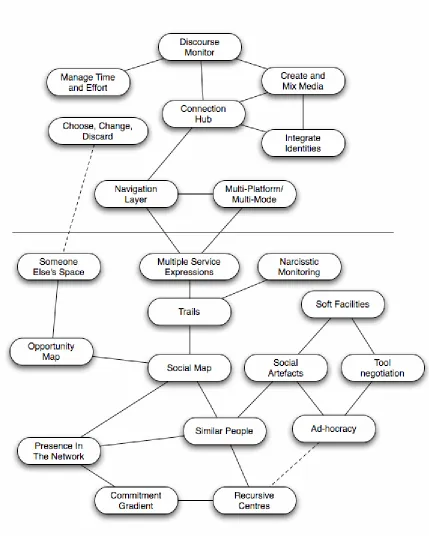
For this paper the patterns were revisited, and, in the light of emerging discourse, recast into a much smaller set of more general patterns that it is hoped are more useful in capturing some of the essential characteristics of a PLE, both as it is experienced and as it is imagined. The original patterns, as described in the PLE Report, will hopefully remain a useful resource for developers and designers wishing to construct new tools; these new patterns it is hoped will stimulate discussion and assist in understanding the PLE concept, and ideally should be of value for those engaged in the design and planning of new learning opportunities and environments.
Framework
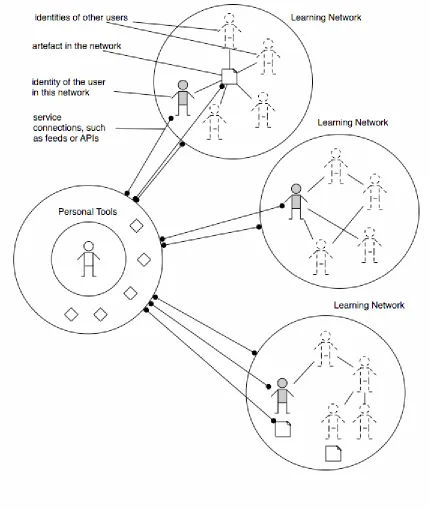
Figure 1. The personal tools of a user enable them to interact with their identities and the identities of related users and artefacts in multiple networks via a number of service points.
Personal tools
personal learning environment. Personal tools may form an integrated, possibly loose-coupled single environment, or may be a collection of quite distinct tools each performing a single function.
Learning networks
Learning networks are the services that connect people and resources, such as social networks and social content networks. While there are many definitions emerging around the concept of learning networks (see, for example, Koper (2004), and Downes (2006)), a learning network as defined here, is not a community (or community of practice), but is rather the infrastructure and collection of services within which communities can emerge or be created. A community of practice has a ‘centre of gravity’ that holds it together – its common domain of practice. Learning networks support multiple domains with overlapping memberships. In the case of informal learning, a learning network differs from a generic social network primarily in terms of its context or intent from the perspective of particular users or collections of users. However, we also use learning network to characterise the collection of online services offered by formal educational institutions in their interactions with personal learning tools, and these types of learning network have some specific patterns that we explore in this paper.
While the patterns described here are intended to be specifically useful in the case of learning networks, they may in some cases also apply to general social networks.
Patterns
Patterns of personal learning tools
Discourse monitor
Problem: Users need to be able to monitor the state of the discourses in which they are engaged, to identify new opportunities for exploration, new developments in the subject, or simply new arguments or comments in ongoing conversations. This monitoring has to also be manageable; rather than be overwhelmed with
information the user has to be able to be selective in what they attend to, and to be able to scan a wide range of potential items of interest.
Solution: Provide a monitor that displays a summary of items from multiple inputs. The inputs should be capable of being filtered using tags, ratings and other parameters set by the user, and the proportion of items displayed from the different input sources may be varied using a virtual mixing desk or some other
mechanism. The monitor needs to offer a means to flag an item to draw greater attention to it.
Micro-Patterns: A Discourse Monitor would typically involve the implementation of a number of smaller design patterns, as described in the PLE Report, including:
Tags Star Rating Attention Flag
Sortable Column View Channel Guide
Filter Rule Resource Feed Resource Preview Shuffle Control Unread Count Unread Flag
Links to other patterns: An item in the Discourse Monitor may be used to initiate Create and Mix Media, or to create a task or event in Manage Time and Effort.
Example: Newsreaders (RSS feed aggregators) are the basic prototype of a discourse monitor, and personal portals such as Netvibes offer similar capabilities. Yahoo Pipes provides a model for the underlying
information processing for discourse monitoring tools. As time goes on we expect a greater range of discourse monitoring tools to become available.
Connection hub
Problem: People participate in many different networks and with different levels of commitment; each of these networks knows a particular fragment of the user’s context and its connections in that network.
However, there are also connections between networks, and conversations across networks, which cannot be represented within any network in particular.
Solution: Use personal learning tools that are agnostic of specific learning networks, but enable free
Links to other patterns: Select tools that Create and Mix Media using media from multiple networks. Use a
Discourse Monitor that listens on many channels from different networks. Integrate Identities that have a presence in different networks. Use a Navigation Layer to show the connections of multiple networks within a single context. Acting as a connection hub is one of the primary purposes of a personal learning toolkit.
Examples: The Explode2 service provides users with the ability to search and form connections across multiple social networks.
Create and mix media
Problem: Students, teachers and researchers need to be able to create and mix a wide range of media for various audiences, including for personal reflection or experimentation.
Solution: Include tools in the personal learning toolkit for authoring media, mixing it, and publishing it to a range of networks. Connect these tools to the Discourse Monitor to enable new media or mixes to be created in relation to an ongoing conversation or emerging knowledge construct. Support blogging, podcasting, photostreaming, vodcasting, and open archive deposition as publishing models. Connect to mobile devices as sources of media. Connect to social media collections (e.g. Flickr, YouTube) as sources of raw media for remixing.
Links to other patterns: Creation could be initiated from an item in a Discourse Monitor. Where media is published, this relies on the toolkit Integrating Identities.
Examples: Blog editors offer some of these kinds of features. Yahoo Pipes provides an engine for remixing media from multiple sources.
Integrate identities
Problem: Different learning networks and publishing channels are suited to different identities, either because they offer different identity management technologies, or because the user would want to appear differently there than elsewhere
Solution: Include identity management capability within the personal learning toolkit. Use a keychain to securely manage a range of different account credentials for different networks. Use a profile manager to manage a range of different sets of public attributes for different purposes (e.g. nickname, email address).
Links to other patterns: Integrating Identities is necessary wherever the toolkit needs to talk to external services, for example when Creating and Mixing Media and Connection Hub.
Examples: Microsoft CardSpace and Apple Keychain are examples of personal identity management technologies. OpenID providers such as MyOpenID offer profile management services.
Manage time and effort
Problem: Users are active; they need to accomplish tasks related to their learning, such as reply to a post about a topic of interest, to write a paper, or to investigate a concept. They also have schedules they need to
2
work with, such as attendance at events. At a more advanced level users may need to manage complex personal projects.
Solution: Include a personal task management tool and a calendar tool within the personal learning toolkit. The task management may simply be a “to do list” feature within another tool, such as a calendar or email application, or a dedicated application with advanced features, for example a tool that implements a task methodology such as Getting Things Done.
Links to other patterns: Tasks and calendar events should be able to be created from the Discourse Monitor.
Micro-patterns: There are many smaller patterns related to the management of time and tasks; for example, within the original PLE pattern language described in the PLE report there is:
Calendar DueDate
ScheduledAlarm ToDoList
Examples: There are many good examples of personal productivity software that fulfil this requirement, such as Microsoft Outlook and Mozilla Thunderbird, as well as some specialized tools such as iGTD or the online service BaseCamp.
Navigation Layer
Problem: The functions needed to achieve a goal are spread across different tools and services, making it harder to navigate and to achieve a desired goal.
Solution: Use a simple navigation layer that unites some of the basic features of various tools within a shared environment. Rather than attempt to force all the features of the tools into a smaller space, select only key functions and construct “Widgets” that support the most common actions in smaller, more reusable form factor. Bring the Widgets together within a “web desktop” or a dashboard.
Links to other patterns: A Navigation Layer helps make sense of a Connection Hub and can assist in supporting Multi-Platform/Multi-Mode.
Examples: Mac OS X Dashboard, Windows Vista SideBar, NetVibes, and PageFlakes
Multi-platform/Multi-mode
Problem: Depending on context, users may need access to toolkit functions using shared computers, their own laptop or desktop computer, or on a mobile phone.
Solution: Select tools capable of operating on multiple platforms and modes of interaction, or have different specialized versions available for various platforms and modes. True multi-mode operation also requires synchronisation between devices and the web: for example, to enable access from non-personal devices such as cyber café or lab PCs.
Examples: The use of open APIs and web services has unlinked many applications from their initial forms. For example, in addition to its web interface, tools for desktop operating systems and mobile phones are also available for Flickr.
Choose, change, discard
Problem: Users need their personal toolkit to support their current objectives as they see them, often spanning the concerns of several networks. This places them in potential conflict with instructional design
requirements.
Solution: Let users be able to add, remove, reconfigure and reorganize the tools of the personal learning toolkit. Do not design tools that support external reconfiguration or organisation without the user’s consent. Do not offer services or content that forces a particular navigation or presentation pattern. Where a strong instructional design is needed, use the Someone Else’s Space pattern for learning networks.
Patterns of learning networks
Recursive centres
Problem: If a network is too diffuse and homogenous it feels empty and lifeless. How can a network have a feeling of being a lively place, how can it encourage density?
Solution: Encourage the development of a centre, a place of life around which other centres orbit, at different scales but similar density. These centres, recursively present within the network, need to be sufficiently dense to develop a strong identity for those visiting them or belonging to them. Encourage density by discouraging duplication of communities. Have the ‘gardeners’ of the network, or the system itself, suggest ways of incorporating a new concept into an existing group rather than create a new one, if this would result in a loss of centre. Think of the network as a city with a lively downtown area at the centre, surrounded by a cluster of neighbourhoods that have their own character and mini-downtown areas within them.
According to Mayfield, the nature of interconnection alters at various scales of a network (Mayfield, 2003). At around 150 members, a “social” community has a Gaussian pattern of interconnection; at around 12 members, a “creative” community has a flat pattern of interconnection (everyone talks to everyone). At larger scales, interconnection follows a power law. This “n > 150 > 12” ratio may be appropriate for a learning network. If a network develops organically via self-organisation, then it may naturally develop a structure that has the desired properties at a given scale. If the structure of the network is a reflection of a formal education provider then it may not have this kind of structure and may need to be reworked; for example, organised on the basis of topics rather than course registrations.
The notion of centres, and of centres within centres, is mentioned by Alexander (1996) as one of the critical underpinning principles of living design.
Presence in the network
Problem: Users sometimes need to know whether other users are present in the network, either to coordinate conversation or simply to gain a sense of the context of their friends or colleagues. For unknown users, a way of quickly getting a sense of who they are without reading a detailed profile is useful in browsing.
Solution: Use graphical avatars (sometimes known as “gravatars”) for user profiles, and connect these to presence indicators where information is available. Display a buddy list of avatar pictures for each user. Allow users to attach additional presence information (such as a “mood message”) to convey a richer picture of their current context, level of engagement, or affective character. Allow users to add a “tagline” to their profile; displayed along with the graphical avatar, this offers a simple way for users to express their identity and facilitates finding Similar People.
Micro-patterns:
Gravatar: a small image used to represent a user, such as a portrait or other representative graphic, or an image that is not necessarily representative that they use to characterize themselves
Presence Indicator: a visual indication of someone’s presence, such as a ‘light’ or icon Buddy List: a visual collection of presence indicators and mood messages
Tagline: a short personal statement that helps characterize a user.
Mood Message: a short message associated with presence that indicates their disposition or context.
Example: Explode provides a simple buddy list that offers a panel of graphical avatars for a users friends across multiple social networks.
Similar people
Problem: Users obtain value from social networks through discovering and making connections with other users and initiating collaboration. How can the network facilitate this?
Solution: Provide mechanisms for collecting and making searchable user’s profiles. The network may obtain a profile from a user directly, through a profile form or by aggregating an existing profile supplied from a personal tool (see Integrate Identities). It may also obtain a profile indirectly through inferring characteristics based on activities within the network. The user profile needs to capture the essential characteristics that support matching within the network, these would include not only professional and academic interests and goals, but also more general social characteristics such as likes and dislikes.
The network should offer a peer-matching service that enables users to find those with similar interests or goals, and provide an efficient means of rendezvous, through selective disclosure of contact information or offering initial contact spaces. The service should also allow “friending” of people to take place, essentially “bookmarking” another person.
Such a service, it may be noted, when taken together with the Ad-hocracy pattern, would form one of the “Four Networks” as described by Illich (1971).
Links to other patterns: A natural progression from enabling Similar People would be to support Ad-hocracy.
Ad-hocracy
Problem: Users encounter people with whom they may have similar goals and interests and want to create a place, such as a study group or project, where they can discuss how to work together; or they might want to create a centre that those kinds of people might visit. How can the network help?
Solution: Allow ad-hoc creation of groups and spaces without restriction and with very little work. Let groups form and disband naturally. Allow groups to have their own character, with many possible customizations under the control of their members; following the principle of recursive centres, each community is a small mirror of the whole network.
Enable a smooth transition from “friending” to “community formation”. Allow each ad-hoc to set its own boundaries, for example whether public or private, and whether invite-only or request-based. Ad-hocracy enables groups to form quickly, and establish ways of working through Tool Negotiation.
The term “Ad-hocracy”, incidentally, is taken from a novel by Cory Doctorow (Doctorow, 2003), where it used to describe a largely self-organising society coordinated using reputation currency.
Micro-Patterns: Buddy List Invitation Bell Guest
Presence indicator Friend
Links to other patterns: There is a natural dynamic in a network between the need for Recursive Centres and
Ad-hocracy; on the one hand the mechanisms to promote sufficient density, and on the other mechanisms for unconstrained fragmentation. Similar People offers a natural progression to Ad-hocracy.
Social artefacts
Problem: People sometimes are able to associate purely on the basis of shared interests; in other cases though, the rendezvous is mediated by an interest in a common artefact, which leads to increased sociality. This approach to looking at social networks, called object-centred sociality (Engeström, 2005, after Knorr Cetina, 2001) implies that without shared artefacts, the number and strength of the connections within the network may not reach a desirable level.
Solution: Provide clear forms of shared artefacts that users can use to initiate conversations and assess each other’s respective viewpoints. The artefacts may be digital representations such as photos, songs, or videos, or they may be more abstract such as goals or tags. In the case of formal learning, the primary materials of study may form the initial shared artefacts.
Links to other patterns: Social artefacts can assist in finding Similar People and offer a focus for Ad-hocracy.
Commitment gradient
Problem: Users of learning networks have variable levels of commitment, to communities within the network and to the network itself. How can the network best ensure its viability recognizing these different levels of commitment?
Context: Alexander et. al. (1977) created the Intimacy Gradient pattern to describe the gradual unfolding of public and private spaces in buildings, from the public entry porch and hallway, through social spaces like the lounge and bedroom, through to private spaces like bedrooms. This pattern has been discussed in great depth in relation to the operation of social networks, from the entry points and lounges into areas with greater specialization and social density (e.g. Levin, 2004, and Charman, 2004). In learning networks a better concept to use is commitment rather than intimacy; we are concerned with the health of the network rather than the privacy of its sponsors, its vibrancy and cohesion. However, the viability of the network is only of concern to a small proportion of its constituents; following Nielsen’s analysis (Nielsen, 2006), of the members of a network 90% will have a low level of commitment (e.g. ‘lurkers’), 9% will have a medium level of commitment (e.g. contributors), and only 1% will have a high level of commitment (e.g. the ‘wizards’, or ‘members of good standing’ (Shirky, 2003).
Links to other patterns: Commitment gradients are a potential mechanism for maintaining Recursive Centres. Public levels of commitment can be offered as part of Presence in the Network.
Solution: Provide mechanisms that help recognize commitment, and offer capabilities commensurate with that commitment. Enable users to become ‘gardeners’ that help cultivate the network and keep it healthy, with corresponding rights. Enable a community for meta-conversations about the network itself and its viability. Provide services and tools that assist gardeners in their cultivation.
Examples: Wikipedia, SocialText “gardening tool”.
Multiple service expressions
Problem: Users are accessing services offered by learning networks using potentially very different personal learning tools.
Solution: For each service offered by the learning network, offer multiple service expressions suitable for a different mode or platform. For example, the same type of functionality may be offered as:
A feed
An API for developers A desktop Widget
A web Widget that can be added to blogs, other social network sites, or widget engines
It is increasingly simple to develop a wide range of potential interfaces to core functionality and content, enabling a much higher degree of diversity to be manageable. Networks should not be selfish about their services, but allow their users to build upon them in ways that suit their personal environment. Multiple service expressions enable integration of a service into a Navigation Layer, and supports Multi-Platform/Multi-Mode operation.
Social maps
Problem: In a diverse network, it’s easy for users to feel lost or disoriented. How can the network make sense of itself to users?
Solution: Offer ways of constructing maps that show users in relation both to each other and to the features of the network. Offer visualizations, or expose relationships in an API, which tools can use, applying different mapping metaphors. Users may be able to construct pathways through the maps, and share these with others, or add annotations that help understand the meaning of the network’s structure. Maps should help users from feeling lost and confused in the network, and help generate a sense of togetherness and coherence; but they should reflect a structure, not impose it. The map is not the territory.
Micro Patterns:
Radar Map Presence Map Tag Cloud
Links to other patterns: A social map is one way of exposing Presence in the Network and for finding Similar People.
Example: the Flickr Graph3 service visualizes social relations between users of Flickr. The company TouchGraph4 offers a number of social mapping products for networks such as LiveJournal and MySpace.
Narcissistic monitoring
Problem: Users have a strong concern with their own identity within a network, and in particular how others relate to them. How can the network help users see themselves?
Solution: Offer a range of tools to support self-monitoring. Provide feeds that contain all activity in the network that directly relates to the user, such as friend requests, entries, and comments.
Links to other patterns: This is an example of Trails Leading In Many Directions.
Example: 43 Things offers a feed for “activity related to you” that includes all comments or replies, “cheers”, and other user activities that relate to the user.
Tool negotiation
Problem: Users have potentially very different sets of personal tools; when they identify people they want to collaborate with, and the activity pattern they want to engage in, how do they actually start collaborating?
Solution: Provide mechanisms where users can undertake tool negotiation. This could be as simple as a chat or discussion area in user communities, or could use a sophisticated set of heuristics to suggest good common tools for a given activity. For example, if the activity pattern is to “write a document together” and some of the community has familiarity with Google Docs, then the network might suggest this as a starting point. Networks should try to facilitate users decisions on the tools they want to use, rather than assume that the tools offered by the network itself are the right ones.
3
http://www.marumushi.com/apps/flickrgraph/
4
Links to other patterns: Tool Negotiation is one of the key activities of Ad-hocracy.
Opportunity map
Problem: Sometimes users may want to start a completely new community within the network, but often they prefer to attach themselves to existing communities, including those that are representations of formal
learning opportunities. How can the network help users locate existing communities?
Solution: Offer an Opportunity Map that shows the various opportunities within the network.
Links to other patterns: This may augment or filter a Social Map of the network.
Examples: Currently few systems of formal learning expose a feed of courses, however the adoption of the XCRI course aggregation specification5 may change this. XCRI offers a specification for how a provider can offer descriptions of its opportunities, rather like an RSS feed offers descriptions of resources, such that other networks and services can aggregate them and present them to users.
Someone else’s space
Problem: Users sometimes need to provide a consistently designed space to afford particular activities, or to set a tone for participation, and which is the same for all participants. This can be because of the structure of a learning design, or simply be a result of a desire to create a particular kind of interaction within a shared space. This requirement contradicts the typical operation of a personal learning toolkit that is entirely personally configured.
Solution: Provide spaces designed and owned by specific users, but ensure they have clearly marked doorways both in and out. Someone Else’s Space is the ‘default’ behaviour of many existing educational systems; in the PLE it is only one among many other patterns.
Links to other patterns: Make the transition into Someone Else’s Space available from the personal learning toolkit via the Opportunity Map.
Examples: A sequence created using a learning design system, such as LAMS6, is an example of Someone Else’s Space when linked to a less structured network platform, such as Elgg.
Trails leading in many directions
Problem: A network can be a large place, and not all obvious paths lead to interesting directions. How can the network help users navigate in a flexible manner?
Solution: Create “trails” that lead from each node of the network in various directions. Use backlinks (links that head back to nodes that link here), sidelinks (nodes mediated by other nodes, such as “people who read this book also read…”), linkrolls (the collections the node appears in), and other techniques that offer a rich variety of paths to follow. These need not be based on sophisticated rules; they may simply be provocations for serendipitous discovery.
5
See http://www.xcri.org
6
Links to other patterns: Trails may be incorporated into a Social Map; they may also complement Multiple Service Expressions.
Soft facilities
Problem: As well as the “soft” space of the network, sometimes there is also a relationship to the objects of the physical world, such as buildings, rooms, and equipment. How can the network aid users in the physical world?
Solution: Offer a “soft” version of each “hard” object such as an artefact such as a painting or a book, a piece of equipment such as a tool or instrument, or infrastructure such as rooms and buildings. Use sensors, maps, RFID, QR-Codes and GPS to allow the item to be found, to locate itself, and to tell users where to find it. Design the objects to allow them to be requested, booked, or assigned by users. Connect the metadata and sensors of the object to the network; allow the object to describe itself. As technology evolves, more sophisticated forms of meshing of physical and virtual space may emerge (see Sterling, 2005).
This is another one of the Four Networks as described by Illich (1971); the network of access to educational objects.
Links to other patterns: Soft facilities are possible forms of Social Artefacts. They can also be the subjects of
Tool Negotiation.
Conclusions
The pattern-based approach is an attractive one for a topic with such diverse and individual perspectives as the Personal Learning Environment; it offers a way to capture a diverse range of characteristics at a technical and a social level in a way that can be understood by designers as well as developers. The patterns described here it is hoped will be a useful resource for those engaged in the design of new environments, opportunities, tools, and networks.
However, as with all attempts at identifying commonality there are the issues of “granularity” and of degree of variation permitted within the patterns. In Alexander’s work (1977) there is considerable variation, from patterns concerned with the construction process through to political and ethical patterns at the level of cities. The “if it seems useful, put it in” approach, regardless of any governing ontology, seems entirely appropriate for a technique whose main objective is to inspire the generation of a “living world”. However, unlike architecture, the PLE is a new concept and the idea of what may be deemed a “useful” pattern will take time to emerge. Alexander in his more recent work has experimented with techniques for validating the “living quality” of designed artefacts (Alexander, 2004) that may be a useful approach as more examples of personal tools and learning networks emerge. Alternatively, we may simply wait and see which patterns stimulate ideas and designs.
new constructions. Ultimately, the patterns in this paper will have to be judged on the designs they are used to produce.
References
Alexander, C., Ishikawa, S., Silverstein, M., Jacobson, M., Fiksdahl-King, I., & Angel,
S., (1977). A Pattern Language: Towns, Buildings, Construction. Oxford: Oxford University Press.
Alexander, C., (1996). The Origins of Pattern Theory, the Future of the Theory, And The Generation of a Living World. Keynote address to the eleventh annual conference on Object-oriented programming systems, languages, and applications. October 6 - 10, 1996, San Jose, CA USA. Retrieved on 28th June, 2007 from http://www.patternlanguage.com/archive/ieee/ieeetext.htm
Alexander, C., (2004). The Nature of Order: The Phenomenon of Life. Berkeley: Center for Environmental Structure. ISBN 0972652914.
Brand, S., (1995). How Buildings Learn: What Happens After They're Built. New York: Penguin, ISBN 978-0140139969
Charman, S. (2004). Intimacy gradients online. Retrieved on 27th June, 2007 from http://www.headshift.com/archives/002107.cfm
Doctorow, C., (2003), Down and out in the magic kingdom. New York: Tor, ISBN 076530953X
Downes, S. (2006). Learning Networks and Connective Knowledge. Retrieved on 14th August, 2007, from http://it.coe.uga.edu/itforum/paper92/paper92.html
Engeström, J., (2005). Why some social network services work and others don't — Or: the case for object-centered sociality. Retrieved on 28th June, 2007 from
http://www.zengestrom.com/blog/2005/04/why_some_social.html
Glaser, B.,and Strauss, A., (1967). The Discovery of Grounded Theory: Strategies for Qualitative Research.
New Jersey:Aldine Transaction. ISBN: 0202302601.
Haskins, T. (2007). PLEs are power tools. Retrieved on 13th August, 2007 from http://growchangelearn.blogspot.com/2007/06/ples-are-power-tools.html
Illich, I., (1971). Deschooling Society. New York: Harper and Row. ISBN: 0060121394
Johnson, M., Liber, O., Wilson, S., Beauvoir, P., Sharples, P., Milligan, C. (2007). PLE Report. Retrieved on 28th June, 2007 from http://wiki.cetis.ac.uk/Ple/Report
Knorr Cetina, K., (2001). Objectual Practice. In Schatzki, T. R., Knorr Cetina, K. and von Savigny, E. (Eds.)
The practice turn in contemporary theory. London: Routledge.
2004 (6). Special Issue on the Educational Semantic Web.
Levin, A. (2004). More on Intimacy Gradient. Retrieved on 27th June, 2007 from http://alevin.com/weblog/archives/001473.html
Martin, M. (2007). My Personal Learning Environment. Retrieved on 14th August, 2007, from http://michelemartin.typepad.com/thebambooprojectblog/2007/04/my_personal_lea.html
Mayfield, R. (2003). Distribution of choice. Retrieved on 28th June, 2007 from http://radio.weblogs.com/0114726/2003/02/10.html#a281
Neilsen, J. (2006). Participation Inequality: Encouraging More Users to Contribute. Retrieved on 28th June, 2007 from http://www.useit.com/alertbox/participation_inequality.html
Shirky, C. (2003). A Group Is Its Own Worst Enemy. Retrieved on 27th June, 2007 from http://www.shirky.com/writings/group_enemy.html
Sims, R. (2007). Ray’s Personal Learning Environment. Retrieved on 14th August, 2007 from http://simslearningconnections.com/ple/ray_ple.html
Sterling, B., (2005). Shaping Things. Cambridge: MIT Press. ISBN: 0-262-69326-7