A Monthly Double-Blind Peer Reviewed Refereed Open Access International e-Journal - Included in the International Serial Directories
Indexed & Listed at:
VOLUME NO.2(2012),ISSUE NO.8(AUGUST) ISSN2231-5756
INTERNATIONAL JOURNAL OF RESEARCH IN COMMERCE, IT & MANAGEMENT
CONTENTS
CONTENTS
CONTENTS
CONTENTS
Sr.
No.
TITLE & NAME OF THE AUTHOR (S)
Page No.
1. ANALYSIS OF IPOS UNDERPRICING: EVIDENCE FROM BOMBAY STOCK EXCHANGE
ROHIT BANSAL & DR. ASHU KHANNA
1 2. BANKRUPTCY PREDICTION OF FIRMS USING THE DATA MINING METHOD
ATIYE ASLANI KTULI & MANSOUR GARKAZ
8 3. THE EFFECT OF BASEL III REQUIREMENTS ON IMPROVING RISK-MANAGEMENT CAPABILITIES IN JORDANIAN BANKS
DR. MOHAMMED FAWZI ABU EL HAIJA
12 4. CAPITAL STRUCTURE DETERMINANTS: CRITICAL REVIEW FOR SELECTED INDIAN COMPANIES
DR. AVANISH KUMAR SHUKLA
18 5. IMPACT OF INFLATION ON BANK LENDING RATE IN BANGLADESH
EMON KALYAN CHOWDHURY
23 6. THE PERCEPTION OF BANK EMPLOYEES TOWARDS COST OF ADOPTION, RISK OF INNOVATION, AND STAFF TRAINING’S INFLUENCE ON THE
ADOPTION OF INFORMATION AND COMMUNICATION TECHNOLOGY (ICT) IN THE RWANDAN COMMERCIAL BANKS
MACHOGU MORONGE ABIUD & LYNET OKIKO
27
7. ICT, ELECTION AND DEVELOPMENT IN AFRICA
NDUONOFIT, LARRY-LOVE EFFIONG & ONWUKWE, VIVIAN CHIZOMA
32 8. MODERATING ROLE OF EMOTIONAL INTELLIGENCE TOWARDS STRESS AND EMPLOYEE PERFORMANCE IN THE INDIAN BANKING SECTOR
BEULAH VIJI CHRISTIANA.M & DR. V. MAHALAKSHMI
35 9. FACTORS INFLUENCING CUSTOMER LOYALTY IN MOBILE PHONE SERVICE - A STUDY WITH REFERENCE TO COIMBATORE CITY
DR. V.T.R .VIJAYAKUMAR & B.SUBHA
39 10. A STUDY ON OCCUPATIONAL STRESS AMONG GRADE I POLICE CONSTABLES
M.SHUNMUGA SUNDARAM & DR. M. JAYA KUMARAN
44 11. A STUDY ON THE IMPACT OF SPIRITUALITY ON ORGANISATIONAL PERFORMANCE WITH SPECIAL REFERENCE TO ORGANIISATIONS IN
SALEM CITY
DR. M. G.SARAVANA RAJ & R. FLORENCE BHARATHI
49
12. A COMPARATIVE STUDY OF SELF- EFFICACY AND SUBJECTIVE WELL- BEING AMONG EMPLOYED WOMEN AND UNEMPLOYED WOMEN
DR. K. JAYASHANKAR REDDY
54 13. NETWORK SECURITY THREATS AND SOLUTIONS IN A VIRTUAL MARKETPLACE
DR. PANKAJ KUMAR GUPTA & DR. AJAY KUMAR TIWARI
58 14. A STUDY OF SUPPLIERS CERTIFICATION AT DIFFERENT LAYERS AND ITS IMPACT ON QUALITY IN AUTO COMPONENT INDUSTRY
DR.DATTATRY RAMCHANDRA MANE
61 15. GLOBAL LIFE INSURANCE PENETRATION AND DENSITY
DR. GUDALA SYAMALA RAO
69 16. AN ENHANCE SECURITY OF PLAYFAIR CIPHER SUBSTITUTION USING A SIMPLE COLUMNAR TRANSPOSITION TECHNIQUE WITH MULTIPLE
ROUNDS (SCTTMR)
GAURAV SHRIVASTAVA, MANOJ DHAWAN & MANOJ CHOUHAN
75
17. CONSUMERS PERCEPTIONS OF CORPORATE SOCIAL RESPONSIBILITY: EMPIRICAL EVIDENCE
AMIT B. PATEL, DR. VIMAL K. BHATT & JATIN K. MODI
79 18. A STUDY ON FINANCIAL HEALTH OF KINGFISHER AIRLINES LTD: (Z- SCORE APPROACH)
JIGNESH. B. TOGADIYA & UTKARSH. H. TRIVEDI
84 19. STRATEGIES OF CUSTOMER RELATION MANAGEMENT IN MODERN MARKETING
DR. T. PALANISAMY & K. AMUTHA
88 20. CORPORATE GOVERNANCE IN OIL & GAS SECTOR: AN EMPIRICAL INVESTIGATION
RASHESH PATEL & SWATI PATEL
92 21. KNOWLEDGE MANAGEMENT & MOBILIZING KNOWLEDGE IN EDUCATION BY FOLLOWING CASE STUDY OF YU;GI-OH WORLD
SMITA.S.JAPE
101 22. STUDY OF CRM THROUGH SOCIAL NETWORKING SITE: A FACEBOOK PERSPECTIVE
TEENA BAGGA & APARAJITA BANERJEE
107 23. ORDINARY LEAST SQUARES METHOD AND ITS VARIANTS
R. SINGH
114 24. I T INFRASTRUCTURE IN CREATING POTENTIAL MARKETING OPPORTUNITIES IN INDUSTRIES: AN EMPIRICAL STUDY OF SELECT INDUSTRIES
IN KARNATAKA
MANJUNATH K R & RAJENDRA M
120
25. THE IMPACT OF KNOWLEDGE MANAGEMENT ON BUSINESS ORGANIZATION
SUNITA S. PADMANNAVAR & SMITA B. HANJE
126 26. LOCUS OF CONTROL AMONG HIGH SCHOOL TEACHERS
DEEPA MARINA RASQUINHA
129 27. KNOWLEDGE MANAGEMENT: A CONCEPTUAL UNDERSTANDING
AINARY ARUN KUMAR
135 28. A STUDY ON EFFECTIVENESS OF ORGANIZATIONAL HEALTH IN SMALL SCALE INDUSTRIES
DR. J. S. V. GOPALA SARMA
142 29. JOB SATISFACTION DURING RECESSION PERIOD: A CASE STUDY OF PUBLIC & PRIVATE INSURANCE IN PUNJAB
HARDEEP KAUR
149 30. BANKING SECTOR REFORMS IN INDIA
DR. SANDEEP KAUR
156
CHIEF PATRON
CHIEF PATRON
CHIEF PATRON
CHIEF PATRON
PROF. K. K. AGGARWAL
Chancellor, Lingaya’s University, Delhi
Founder Vice-Chancellor, Guru Gobind Singh Indraprastha University, Delhi
Ex. Pro Vice-Chancellor, Guru Jambheshwar University, Hisar
PATRON
PATRON
PATRON
PATRON
SH. RAM BHAJAN AGGARWAL
Ex. State Minister for Home & Tourism, Government of Haryana
Vice-President, Dadri Education Society, Charkhi Dadri
President, Chinar Syntex Ltd. (Textile Mills), Bhiwani
CO
CO
CO
CO----ORDINATOR
ORDINATOR
ORDINATOR
ORDINATOR
AMITA
Faculty, Government M. S., Mohali
ADVISORS
ADVISORS
ADVISORS
ADVISORS
DR. PRIYA RANJAN TRIVEDI
Chancellor, The Global Open University, Nagaland
PROF. M. S. SENAM RAJU
Director A. C. D., School of Management Studies, I.G.N.O.U., New Delhi
PROF. M. N. SHARMA
Chairman, M.B.A., Haryana College of Technology & Management, Kaithal
PROF. S. L. MAHANDRU
Principal (Retd.), Maharaja Agrasen College, Jagadhri
EDITOR
EDITOR
EDITOR
EDITOR
PROF. R. K. SHARMA
Professor, Bharti Vidyapeeth University Institute of Management & Research, New Delhi
CO
CO
CO
CO----EDITOR
EDITOR
EDITOR
EDITOR
DR. BHAVET
Faculty, M. M. Institute of Management, Maharishi Markandeshwar University, Mullana, Ambala, Haryana
EDITORIAL ADVISORY BOARD
EDITORIAL ADVISORY BOARD
EDITORIAL ADVISORY BOARD
EDITORIAL ADVISORY BOARD
DR. RAJESH MODI
Faculty, Yanbu Industrial College, Kingdom of Saudi Arabia
PROF. SANJIV MITTAL
University School of Management Studies, Guru Gobind Singh I. P. University, Delhi
PROF. ANIL K. SAINI
Chairperson (CRC), Guru Gobind Singh I. P. University, Delhi
DR. SAMBHAVNA
Faculty, I.I.T.M., Delhi
DR. MOHENDER KUMAR GUPTA
VOLUME NO.2(2012),ISSUE NO.8(AUGUST) ISSN2231-5756
INTERNATIONAL JOURNAL OF RESEARCH IN COMMERCE, IT & MANAGEMENT
DR. SHIVAKUMAR DEENE
Asst. Professor, Dept. of Commerce, School of Business Studies, Central University of Karnataka, Gulbarga
MOHITA
Faculty, Yamuna Institute of Engineering & Technology, Village Gadholi, P. O. Gadhola, Yamunanagar
ASSOCIATE EDITORS
ASSOCIATE EDITORS
ASSOCIATE EDITORS
ASSOCIATE EDITORS
PROF. NAWAB ALI KHAN
Department of Commerce, Aligarh Muslim University, Aligarh, U.P.
PROF. ABHAY BANSAL
Head, Department of Information Technology, Amity School of Engineering & Technology, Amity University, Noida
PROF. A. SURYANARAYANA
Department of Business Management, Osmania University, Hyderabad
DR. SAMBHAV GARG
Faculty, M. M. Institute of Management, Maharishi Markandeshwar University, Mullana, Ambala, Haryana
PROF. V. SELVAM
SSL, VIT University, Vellore
DR. PARDEEP AHLAWAT
Associate Professor, Institute of Management Studies & Research, Maharshi Dayanand University, Rohtak
DR. S. TABASSUM SULTANA
Associate Professor, Department of Business Management, Matrusri Institute of P.G. Studies, Hyderabad
SURJEET SINGH
Asst. Professor, Department of Computer Science, G. M. N. (P.G.) College, Ambala Cantt.
TECHNICAL ADVISOR
TECHNICAL ADVISOR
TECHNICAL ADVISOR
TECHNICAL ADVISOR
AMITA
Faculty, Government H. S., Mohali
MOHITA
Faculty, Yamuna Institute of Engineering & Technology, Village Gadholi, P. O. Gadhola, Yamunanagar
FINANCIAL ADVISORS
FINANCIAL ADVISORS
FINANCIAL ADVISORS
FINANCIAL ADVISORS
DICKIN GOYAL
Advocate & Tax Adviser, Panchkula
NEENA
Investment Consultant, Chambaghat, Solan, Himachal Pradesh
LEGAL ADVISORS
LEGAL ADVISORS
LEGAL ADVISORS
LEGAL ADVISORS
JITENDER S. CHAHAL
Advocate, Punjab & Haryana High Court, Chandigarh U.T.
CHANDER BHUSHAN SHARMA
Advocate & Consultant, District Courts, Yamunanagar at Jagadhri
SUPERINTENDENT
SUPERINTENDENT
SUPERINTENDENT
SUPERINTENDENT
SURENDER KUMAR POONIA
CALL FOR MANUSCRIPTS
CALL FOR MANUSCRIPTS
CALL FOR MANUSCRIPTS
CALL FOR MANUSCRIPTS
Weinvite unpublished novel, original, empirical and high quality research work pertaining to recent developments & practices in the area of Computer, Business, Finance, Marketing, Human Resource Management, General Management, Banking, Insurance, Corporate Governance and emerging paradigms in allied subjects like Accounting Education; Accounting Information Systems; Accounting Theory & Practice; Auditing; Behavioral Accounting; Behavioral Economics; Corporate Finance; Cost Accounting; Econometrics; Economic Development; Economic History; Financial Institutions & Markets; Financial Services; Fiscal Policy; Government & Non Profit Accounting; Industrial Organization; International Economics & Trade; International Finance; Macro Economics; Micro Economics; Monetary Policy; Portfolio & Security Analysis; Public Policy Economics; Real Estate; Regional Economics; Tax Accounting; Advertising & Promotion Management; Business Education; Management Information Systems (MIS); Business Law, Public Responsibility & Ethics; Communication; Direct Marketing; E-Commerce; Global Business; Health Care Administration; Labor Relations & Human Resource Management; Marketing Research; Marketing Theory & Applications; Non-Profit Organizations; Office Administration/Management; Operations Research/Statistics; Organizational Behavior & Theory; Organizational Development; Production/Operations; Public Administration; Purchasing/Materials Management; Retailing; Sales/Selling; Services; Small Business Entrepreneurship; Strategic Management Policy; Technology/Innovation; Tourism, Hospitality & Leisure; Transportation/Physical Distribution; Algorithms; Artificial Intelligence; Compilers & Translation; Computer Aided Design (CAD); Computer Aided Manufacturing; Computer Graphics; Computer Organization & Architecture; Database Structures & Systems; Digital Logic; Discrete Structures; Internet; Management Information Systems; Modeling & Simulation; Multimedia; Neural Systems/Neural Networks; Numerical Analysis/Scientific Computing; Object Oriented Programming; Operating Systems; Programming Languages; Robotics; Symbolic & Formal Logic and Web Design. The above mentioned tracks are only indicative, and not exhaustive.
Anybody can submit the soft copy of his/her manuscript anytime in M.S. Word format after preparing the same as per our submission guidelines duly available on our website under the heading guidelines for submission, at the email address: [email protected].
GUIDELINES FOR SUBMISSION OF MANUSCRIPT
GUIDELINES FOR SUBMISSION OF MANUSCRIPT
GUIDELINES FOR SUBMISSION OF MANUSCRIPT
GUIDELINES FOR SUBMISSION OF MANUSCRIPT
1. COVERING LETTER FOR SUBMISSION:
DATED: _____________ THE EDITOR
IJRCM
Subject: SUBMISSION OF MANUSCRIPT IN THE AREA OF .
(e.g. Finance/Marketing/HRM/General Management/Economics/Psychology/Law/Computer/IT/Engineering/Mathematics/other, please specify)
DEAR SIR/MADAM
Please find my submission of manuscript entitled ‘___________________________________________’ for possible publication in your journals.
I hereby affirm that the contents of this manuscript are original. Furthermore, it has neither been published elsewhere in any language fully or partly, nor is it under review for publication elsewhere.
I affirm that all the author (s) have seen and agreed to the submitted version of the manuscript and their inclusion of name (s) as co-author (s).
Also, if my/our manuscript is accepted, I/We agree to comply with the formalities as given on the website of the journal & you are free to publish our contribution in any of your journals.
NAME OF CORRESPONDING AUTHOR:
Designation:
Affiliation with full address, contact numbers & Pin Code: Residential address with Pin Code:
Mobile Number (s): Landline Number (s): E-mail Address: Alternate E-mail Address:
NOTES:
a) The whole manuscript is required to be in ONE MS WORD FILE only (pdf. version is liable to be rejected without any consideration), which will start from the covering letter, inside the manuscript.
b) The sender is required to mention the following in the SUBJECT COLUMN of the mail:
New Manuscript for Review in the area of (Finance/Marketing/HRM/General Management/Economics/Psychology/Law/Computer/IT/
Engineering/Mathematics/other, please specify)
c) There is no need to give any text in the body of mail, except the cases where the author wishes to give any specific message w.r.t. to the manuscript. d) The total size of the file containing the manuscript is required to be below 500 KB.
e) Abstract alone will not be considered for review, and the author is required to submit the complete manuscript in the first instance.
f) The journal gives acknowledgement w.r.t. the receipt of every email and in case of non-receipt of acknowledgment from the journal, w.r.t. the submission of manuscript, within two days of submission, the corresponding author is required to demand for the same by sending separate mail to the journal.
2. MANUSCRIPT TITLE: The title of the paper should be in a 12 point Calibri Font. It should be bold typed, centered and fully capitalised.
3. AUTHOR NAME (S) & AFFILIATIONS: The author (s) full name, designation, affiliation (s), address, mobile/landline numbers, and email/alternate email address should be in italic & 11-point Calibri Font. It must be centered underneath the title.
4. ABSTRACT: Abstract should be in fully italicized text, not exceeding 250 words. The abstract must be informative and explain the background, aims, methods,
VOLUME NO.2(2012),ISSUE NO.8(AUGUST) ISSN2231-5756
INTERNATIONAL JOURNAL OF RESEARCH IN COMMERCE, IT & MANAGEMENT
5. KEYWORDS: Abstract must be followed by a list of keywords, subject to the maximum of five. These should be arranged in alphabetic order separated by commas and full stops at the end.
6. MANUSCRIPT: Manuscript must be in BRITISH ENGLISH prepared on a standard A4 size PORTRAIT SETTING PAPER. It must be prepared on a single space and
single column with 1” margin set for top, bottom, left and right. It should be typed in 8 point Calibri Font with page numbers at the bottom and centre of every page. It should be free from grammatical, spelling and punctuation errors and must be thoroughly edited.
7. HEADINGS: All the headings should be in a 10 point Calibri Font. These must be bold-faced, aligned left and fully capitalised. Leave a blank line before each
heading.
8. SUB-HEADINGS: All the sub-headings should be in a 8 point Calibri Font. These must be bold-faced, aligned left and fully capitalised.
9. MAIN TEXT: The main text should follow the following sequence:
INTRODUCTION
REVIEW OF LITERATURE
NEED/IMPORTANCE OF THE STUDY
STATEMENT OF THE PROBLEM
OBJECTIVES
HYPOTHESES
RESEARCH METHODOLOGY
RESULTS & DISCUSSION
FINDINGS
RECOMMENDATIONS/SUGGESTIONS
CONCLUSIONS
SCOPE FOR FURTHER RESEARCH
ACKNOWLEDGMENTS
REFERENCES
APPENDIX/ANNEXURE
It should be in a 8 point Calibri Font, single spaced and justified. The manuscript should preferably not exceed 5000 WORDS.
10. FIGURES &TABLES: These should be simple, crystal clear, centered, separately numbered & self explained, and titles must be above the table/figure. Sources of data should be mentioned below the table/figure. It should be ensured that the tables/figures are referred to from the main text.
11. EQUATIONS: These should be consecutively numbered in parentheses, horizontally centered with equation number placed at the right.
12. REFERENCES: The list of all references should be alphabetically arranged. The author (s) should mention only the actually utilised references in the preparation
of manuscript and they are supposed to follow Harvard Style of Referencing. The author (s) are supposed to follow the references as per the following:
•
All works cited in the text (including sources for tables and figures) should be listed alphabetically.•
Use (ed.) for one editor, and (ed.s) for multiple editors.•
When listing two or more works by one author, use --- (20xx), such as after Kohl (1997), use --- (2001), etc, in chronologically ascending order.•
Indicate (opening and closing) page numbers for articles in journals and for chapters in books.•
The title of books and journals should be in italics. Double quotation marks are used for titles of journal articles, book chapters, dissertations, reports, working papers, unpublished material, etc.•
For titles in a language other than English, provide an English translation in parentheses.•
The location of endnotes within the text should be indicated by superscript numbers.PLEASE USE THE FOLLOWING FOR STYLE AND PUNCTUATION IN REFERENCES: BOOKS
•
Bowersox, Donald J., Closs, David J., (1996), "Logistical Management." Tata McGraw, Hill, New Delhi.•
Hunker, H.L. and A.J. Wright (1963), "Factors of Industrial Location in Ohio" Ohio State University, Nigeria.CONTRIBUTIONS TO BOOKS
•
Sharma T., Kwatra, G. (2008) Effectiveness of Social Advertising: A Study of Selected Campaigns, Corporate Social Responsibility, Edited by David Crowther & Nicholas Capaldi, Ashgate Research Companion to Corporate Social Responsibility, Chapter 15, pp 287-303.JOURNAL AND OTHER ARTICLES
•
Schemenner, R.W., Huber, J.C. and Cook, R.L. (1987), "Geographic Differences and the Location of New Manufacturing Facilities," Journal of Urban Economics, Vol. 21, No. 1, pp. 83-104.CONFERENCE PAPERS
•
Garg, Sambhav (2011): "Business Ethics" Paper presented at the Annual International Conference for the All India Management Association, New Delhi, India, 19–22 June.UNPUBLISHED DISSERTATIONS AND THESES
•
Kumar S. (2011): "Customer Value: A Comparative Study of Rural and Urban Customers," Thesis, Kurukshetra University, Kurukshetra.ONLINE RESOURCES
•
Always indicate the date that the source was accessed, as online resources are frequently updated or removed.WEBSITES
A STUDY ON EFFECTIVENESS OF ORGANIZATIONAL HEALTH IN SMALL SCALE INDUSTRIES
DR. J. S. V. GOPALA SARMA
RESEARCH SCHOLAR
DEPARTMENT OF COMMERCE & MANAGEMENT STUDIES
ANDHRA UNIVERSITY
VISAKHAPATNAM
ABSTRACT
Efficient management of human resources is a crucial factor in determining the growth and prosperity of business enterprises. This is particularly true in the case of small industry where the owners are forced to have a close and more personal association with their employees. In order to build up loyal, efficient and committed work force, small scale organizations should pay adequate attention to hiring, training and employee development activities and undertake systematic human resource practices on a long term basis. Healthy organizations have conditions which satisfy individual as well as organizational goals. Organizational health can be understood through certain indicatorssuch as absenteeism, labour turnover and grievances. This paper explains three major areas from my research study. The first one is absenteeism of employees in small scale industries, the second one is labour turnover of human resource and third one is in grievances of employees in small scale industries.This paper describes that how the Organization Health is influenced on the efficiency and commitment of the employees in small scale industries. The main source of information, however, is primary data collected through the questionnaires* meant for employees and employers. In view of the large number of small scale units in Visakhapatnam, it has been decided to go for a sampling method.
KEYWORDS
Absenteeism, Labour turnover, Grievances.
INTRODUCTION
uman beings are very complex in their psychological makeup and hence, managers cannot influence employees’ inner states directly. They can, however, create work environments that encourage quality performance. Physical working conditions and reward systems should therefore be designed carefully and used effectively to encourage individuals to reach organizational goals. In the present chapter, an attempt has been made to examine. Healthy organizations have conditions which satisfy individual as well as organizational goals. Healthy organizations have conditions which satisfy individual as well as organizational goals. Organizational health can be understood through certain indicatorssuch as absenteeism, labour turnover, grievances etc. When ignored, these may lead to crisis situations and may force the organization to draw the shelters. The focus of the present chapter is on the selected indicators of organizational health.
REVIEW OF LITERATURE
The literature relating to small scale industries is plenty. Most of the studies relate to structure and organization, entrepreneurship, financial aspects and marketing aspects of small scale industries. The studies covering HR aspects of small scale industries are relatively less. A review of some of the studies has been attempted below:
Raghurama A(2004has stated that in Kerala especially after globalization there has been a decelerating trend in the number of small scale units registered, investment made and employment generated, despite the fact that the state is gifted with abundant natural resources and favorable industrial climate. Small scale industries must be promoted on a larger scale considering the fall in investment and increase in unemployment in the state. This requires initiative on the part of the entrepreneurs, change in the attitude of entrepreneurs and motivation and incentive from the government. For the actual development of small scale industries commitment, dedication and hard work are required on the part of the entrepreneurs. The small scale industries must be competitive in the context of globalization for their survival and growth. Otherwise they will perish resulting in colossal waste of resources and unemployment.
Inder Jeet Dagar (2005) studied on Electronics Industry located in NCR Delhi, to analysis labour turnover and steps to bring the turnover to the minimum extent , which is a vital part of manpower management, though certain degree of employee turnover is healthy and inevitable, excessive turnover is a set back both to the employees and the organization. The present study is based on the collection of data from 50 Small Scale Electronic Industries. It is concluded that, either excessive
turnover is among recent starters or among trained and experienced employees, reduce turnover among recent new starters by paying particular attention to recruitment, induction and training.
Murali Krishna S(2006) had studied about different socio-economic factors such as age, education, parental occupation, caste system, inter-alia, influence the entrepreneurial behavior. Majority of the entrepreneurs started their ventures at a relatively early age and were still continuing as entrepreneurs. The level of technical education as well as previous job experience in the same line of activity prompted many respondents to start up an industry. Most of the entrepreneurs, finding it difficult to secure their livelihood in their native place, migrated to places where they can find better business opportunities.
David Amirtha Rajan S. & Gnana Soundari P(2007)have found that well qualified married male dominates the small business in Madurai. They are mostly above 30 years, and also well experienced in their fields. The spouses are also qualified and good earners. It is a self-motivated business. Their properties are not inherited from their forefathers. They feel that they gained a new culture from their business with the qualities of “self confident and optimistic”, “take initiative”, “responsive to criticisms and suggestions”, “Create need to achieve” and “good memory”. Therefore, these qualities helped them survive in their fields successfully for a long period.
D.Nagayya and B.Sobha Rani (2007) have studied about Credit flow for small enterprises had a chequered career, particularly during the fiscal years 2000-2004. From 2005 onwards, the picture is distinctly better. It is important to bring about change in the mindsety of banks and financial institutions to strengthen the hands of SMEs through a liberal approach for SME credit by looking at the sector as one with very high potential, deeserving encouragement.
VOLUME NO.2(2012),ISSUE NO.8(AUGUST) ISSN2231-5756
INTERNATIONAL JOURNAL OF RESEARCH IN COMMERCE, IT & MANAGEMENT
majority of the entrepreneurs. The final result makes clear the impact and importance of non-monetary support for the organizational growth. It is also concluded that non-monetary support enhances the performance and operating efficiency of the firm.
V.N. Prasad (2008)had stated that it has been recognized world over that MSMEs provide the most jobs and many of them are in service activities. It has already been noted elsewhere above how important the segment is in generation of employment in the country. Ignoring the welfare of MSMSEs can prove counter-productive to the success of various poverty alleviation and employment generation programmes. Unable to face challenges several of them may pull down their shutters; and the public funds spent on them would eventually go waste. Such enterprises, therefore, need support of stakeholders to become viable business entities, able to survive in the end. The long-term survival of these enterprises largely hinges on the availability of targeted support in specific areas such as indicated above.
NEED OR IMPORTANCE OF THE STUDY
The study has been conducted in Visakhapatnam – an emerging industrial city in the state of Andhra Pradesh. Visakhapatnam is the second biggest urban complex in the State, next to the capital city of Hyderabad. Visakhapatnam city, popularly called “The City of Destiny’ has been witnessing phenomenal growth in terms of industrial development and infrastructure facilities. Visakhapatnam, the rising steel city, throbbing with maritime activity, is fast developing into one of the premier industrial centers in the world. Besides, the first ever port based Steel Plant, it also houses some of the major private and public sector units viz., Hindustan Shipyard, Bharat Heavy Plate and Vessels Limited, Hindustan Zinc Limited, Hindustan Polymers, Coromandel Fertilizers and Hindustan Petroleum Corporation Limited. The city’s location as strategic port endowed it with all the requisites for the establishment of Naval Project and Eastern Naval Command. Progress in respect of small industry has been no less impressive, the first Industrial Estate was established in the city way back in 1957, developing an area of about 50 acres with an investment of Rs. 29.71 lakhs near Anantagiri Road and all the 33 units constructed at the time were allotted to industrialists who had come forward to set up units. To meet the increased need of the infrastructure to develop new industries in Visakhapatnam, an area of 15.95 acres has been acquired in the year 1958 to create Marripalem Estate that was developed into 54 plots, and allotted to various industrialists. The Andhra Pradesh Industrial Infrastructural Corporation (APIIC) has developed 182 plots in an area of 39.90 acres around the same time for various industries in Autonagar in order to accommodate industrialists and entrepreneurs from various parts of the state. In response to increased Government support and assistance, the small scale industry has grown by leaps and bounds in several parts of the country, and Visakhapatnam is no exception to this general trend. A number of small scale units have come up in Visakhapatnam As on 31st March 2008 there are 14,290 SSI units in Visakhapatnam with an investment of Rs. 12,488 lakhs providing employment to more than one lakh people. Visakhapatnam not only occupies a unique place in the industrial map of Andhra Pradesh but also offers brighter prospects for further industrial development.
Keeping the strategic role of small scale units in our country and the contribution this sector is making to the growth of the economy, it is considered important to make them more competitive and effective through well designed and appropriate HR policies and practices. But unfortunately HR element in small scale industries has not received the attention it deserved by the researchers. The review of literature suggests that there is preponderance of studies focusing on marketing, finance and entrepreneurship aspects of small scale industries. Comprehensive studies covering the important HR practices in small scale industries are few and far between. A modest attempt, therefore, is made in the present study to fill this research gap to some extent. The scope of the study is confined to small scale industries located in the industrial city of Visakhapatnam. While there are plenty of HR studies made in relation to various large scale organizations, no comprehensive study has yet been carried out covering the human element in small scale units that have grown enormously in this growing city in recent years.
OBJECTIVES OF THE STUDY
The present study has been carried out with the following specific objectives:
i) To diagnose the organizational health of the units with the help of select indicators like absenteeism, labour turnover, grievance redressal and ii) To offer suggestions for creating a good HR culture in small scale units by practicing sound and effective HR practices
METHODOLOGY AND SAMPLING
In view of the large number of small scale units in Visakhapatnam, it has been decided to go for a sampling method.
SELECTION OF SAMPLE EMPLOYERS
For the purpose of administering the questionnaire among the Employers, we have taken as many employers as there are sample units. Since 54 units are taken as sample units from the five dominant industrial groups, 54 employers are taken to represent their respective units and the questionnaire has been administered among them. All the employers responded to the questionnaires.
Selection of Sample Employees There are 624 employees totally working in the 54 sample units covered in the study. The number of employees working in each category of the industrial groups is shown in the Table1.1.
TABLE 1.1: SAMPLE SIZE OF RESPONDENT EMPLOYEES
Industry Groups Sample Units No. of Employees 5 0% Sample Size of Employees Actual No. of Employees Responded
Agro based 7 78 39 32*
Food 7 114 57 57
Chemical & Engineering 20 230 115 115
Electrical 14 142 71 51*
Electronics 6 60 30 30
Total 54 624 312 285*
*A few employees not responded to the questionnaire
Source: Records of DIC, Visakhapatnam.
TABLE 1.2: SAMPLE SIZE OF SMALL SCALE UNITS
Industry Groups Small Units in the Universe Sample Units of 10 percent
Agro based 65 7
Food 70 7
Chemical & Engineering 200 20
Electrical 140 14
Electronics 60 6
Total 540 54
Source: Records of DIC, Visakhapatnam.
First the workers were classified on the basis of their skill into skilled, semi-skilled and unskilled categories. Following stratified sampling method, the respondent employees were selected from all the categories to ensure representation of all employees.
TOOLS OF ANALYSIS
For analyzing and interpreting the data so collected from different sources, simple statistical techniques like averages and percentages are used.
ORGANISATIONAL HEALTH
Healthy organizations have conditions which satisfy individual as well as organizational goals. Organizational health can be understood through certain indicators such as absenteeism, labour turnover, grievances etc. When ignored, these may lead to crisis situations and may force the organization to draw the shelters. The focus of the present chapter is on the selected indicators of organizational health.
1. ABSENTEEISM
Absenteeism is one of the important human problems in industry which results in loss of production, increased labour cost and reduced operational efficiency. Very few enterprises in India have been able to handle this problem in a systematic and effective manner due to lack of awareness and proper appreciation of its ill-effects. A far inadequate attention is paid to this problem in the small scale sector. Apart from passing observations on absenteeism in small industry, no systematic effort has been made to bring out the nature, extent and effects of absenteeism in small scale sector. In view of this, the problem of absenteeism has been examined at length in relation to selected units in the following pages.
REASONS FOR ABSENTEEISM – EMPLOYERS’ VIEW
In view of the high magnitude of absenteeism in small scale industries under study, it is important to examine the reasons thereof in order to be able to consider measures for grappling with the problem. In this regard, an attempt is made to elicit the reasons for absenteeism both from employers as well as employees. In Table 1.3 the reasons offered by employers are shown.
TABLE 1.3: REASONS FOR ABSENTEEISM – EMPLOYERS’ VIEW
Reasons Agro based Food Chemical & Engg Electrical Electronics Total
Agricultural operations/Visits to native place 2 (33.33) 2 (33.33) 9 (52.94) 5 (50.00) 2 (50.00) 20 (46.51)
Sickness __ 1
(16.67) 2 (11.77) 1 (10.00) 1 (25.00) 5 (11.63)
Social Festivals/ Functions 1
(16.67) 2 (33.33) 3 (17.64) 2 (20.00) 1 (25.00) 9 (20.93) Advance pay/next day of payday/ Gambling, Alcohol 2
( 33.33) 1 (16.67) 2 (11.77) 1 (10.00)
__ 6
(13.95)
Availability of lucrative jobs outside 1
(16.67)
__ 1
(5.88)
1 (10.00)
__ 3
(6.98)
Total 6
(100) 6 (100) 17 (100) 10 (100) 4 (100) 43 (100.00) Note: Figures in parentheses indicate percentages to totals.
We can understand from the Table that ‘Agricultural operations / Visits to native places’ was the most important reason cited by 46.51 per cent of employers in all small scale industries. However, ‘Social festivals and functions’ was another important reason cited by 20.93 per cent of employers while, ‘Advance pay’ was the next important reason for absenteeism cited by 13.95 per cent of employers. ‘‘Sickness ‘was another reason for absenteeism of employers cited by 11.63 per cent of employers. ‘Availability of lucrative jobs outside’ was offered by 6.98 per cent of employers.
Against this is the overall position, industry wise differences could be noticed. It may be seen that majority of (52.94 per cent) the employers in Chemical & Engineering industry, half of employers in Electrical industry as well as Electronics industry felt that “Agricultural operations” at their native villages was the main reason for absenteeism of employees. “Sickness” was another important reason for absenteeism as cited by one-fourth of the employers in Electronics industry. This is followed by Food industry (16.67 per cent), Chemical & Engineering industry (11.77 per cent) and Electronics industry (10.00). It is also observed that “Social Festivals and Functions” was relatively a more important reason for the absenteeism as stated by 21.21 per cent of employers in Electronics industry followed by Food industry (20.34 per cent) and Electrical industry (19.61 per cent). One–third of the employers in Agro-based industry stated that Advance pay/ next day of pay day/ gambling, Alcohol is another important reason for absenteeism of employees in small scale industries.
From the above analysis, we can sum up that the major factors contributing for employee absenteeism are the frequent visits to the native places for attending agricultural operations, social functions and festivals, advance pay/ gambling & alcohol, sickness and availability of lucrative jobs outside. Across the industry groups also, the dominant reasons are the employee visits to their native places for attending agricultural operations, the social festivals / functions and sickness they are often falling a prey to.
REASONS FOR ABSENTEEISM – EMPLOYEES’ VIEW
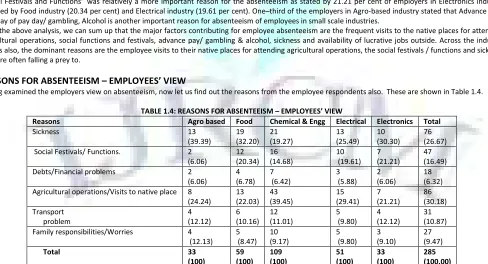
Having examined the employers view on absenteeism, now let us find out the reasons from the employee respondents also. These are shown in Table 1.4.
TABLE 1.4: REASONS FOR ABSENTEEISM – EMPLOYEES’ VIEW
Reasons Agro based Food Chemical & Engg Electrical Electronics Total
Sickness 13
(39.39) 19 (32.20) 21 (19.27) 13 (25.49) 10 (30.30) 76 (26.67)
Social Festivals/ Functions. 2
(6.06) 12 (20.34) 16 (14.68) 10 (19.61) 7 (21.21) 47 (16.49)
Debts/Financial problems 2
(6.06) 4 (6.78) 7 (6.42) 3 (5.88) 2 (6.06) 18 (6.32) Agricultural operations/Visits to native place 8
(24.24) 13 (22.03) 43 (39.45) 15 (29.41) 7 (21.21) 86 (30.18) Transport problem 4 (12.12) 6 (10.16) 12 (11.01) 5 (9.80) 4 (12.12) 31 (10.87)
Family responsibilities/Worries 4
(12.13) 5 (8.47) 10 (9.17) 5 (9.80) 3 (9.10) 27 (9.47)
Total 33
(100) 59 (100) 109 (100) 51 (100) 33 (100) 285 (100.00) Note: Figures in parentheses indicate percentages to totals.
VOLUME NO.2(2012),ISSUE NO.8(AUGUST) ISSN2231-5756
INTERNATIONAL JOURNAL OF RESEARCH IN COMMERCE, IT & MANAGEMENT
as another reason by 10.87 per cent of the employees. “Family responsibilities/Worries” was cited by 9.47 per cent of the employees and “Financial problems” was shown as a reason by 6.32 per cent of the employees.
Among the different industry groups, it may be seen that 39.45 per cent of the employees in Chemical & Engineering and 29.41 per cent in Electrical industries expressed that “Agricultural operations” was the main reason for absenteeism of employees. “Sickness” was the most important reason cited by 39.39 per cent of the employees in Agro-based industry followed by Food industry (32.20 per cent) and Electronics industry (30.30 per cent). It is also observed that “Social Festivals and Functions” was relatively a more important reason for the absenteeism of employees in Electronics industry (21.21 per cent) followed by Food industry (20.34 per cent) and Electrical industry (19.61 per cent).
It may finally be concluded that the major factors contributing for employee absenteeism are the frequent visits to the native places for attending agricultural operations, sickness, social functions and festivals, transport problems and family responsibilities. However, between the two groups of respondents viz., the employers and employees, we can observe a few differences of opinion. For example, according to employer’s perception, ’Social festivals & functions’ is the second dominating factor whereas according to employees’ perception, the second dominating factor is ‘Sickness’. Further, employers pointed out that absenteeism is there on the days following the pay day, and also due to alcoholism and gambling on the part of employees which was not mentioned by any of the employees. Similarly, some of the reasons offered by employees like transport problems, family responsibilities/worries and financial difficulties for absenteeism were not mentioned by any of the employers. Irrespective of these differences, the fact remains that the small scale industries are very much in the grip of the problem of absenteeism. Hence it is necessary on the part of employers to study the reasons carefully as perceived by them as well as the employees and accordingly take appropriate steps to contain this problem of absenteeism.
LABOUR TURNOVER
Labour turnover is the rate of change in the working staff of a concern during a definite period. It is a measure of the extent to which old employees leave and new employees enter the service of a concern in a given period. In a constantly changing work force, there can be little co-operation among the workers themselves or between the workers and the supervisory and managerial personnel. Further, when the employees in an undertaking are always in search of opportunies available out side, they are not likely to have any interest in their work. The constant change in personnel entails a certain amount of cost to the employer. The time, energy, and resources invested on a new employee in engaging and training him on a job and making him. Adjusted to a new work situation will all have been wasted if he is not going to stick on to the job for a reasonable length of time. In every way, labour turnover is a double edged malady. While the employer suffers the heavy monetary loss owing to an excessive rate of resignations, the employees incur the loss in the form of sacrificing the benefits of continued employment.
CAUSES OF LABOUR TURNOVER – EMPLOYERS’ VIEW
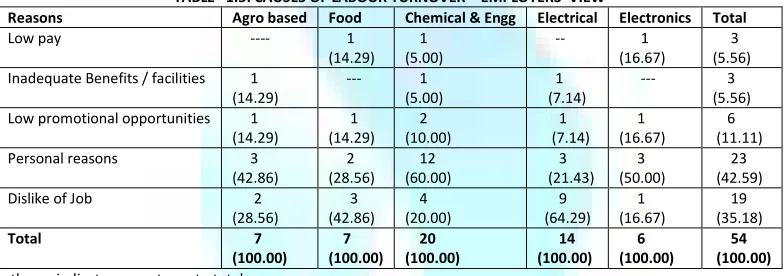
Having examined the extent of labour turnover, now an attempt is made to look into the causes of labour turnover as opined by the employers. Table 1.5 shows the opinions of the employers.
TABLE 1.5: CAUSES OF LABOUR TURNOVER – EMPLOYERS’ VIEW
Reasons Agro based Food Chemical & Engg Electrical Electronics Total
Low pay ---- 1
(14.29) 1 (5.00)
-- 1 (16.67)
3 (5.56) Inadequate Benefits / facilities 1
(14.29)
--- 1 (5.00)
1 (7.14)
--- 3 (5.56) Low promotional opportunities 1
(14.29)
1 (14.29)
2 (10.00)
1 (7.14)
1 (16.67)
6 (11.11)
Personal reasons 3
(42.86)
2 (28.56)
12 (60.00)
3 (21.43)
3 (50.00)
23 (42.59)
Dislike of Job 2
(28.56)
3 (42.86)
4 (20.00)
9 (64.29)
1 (16.67)
19 (35.18)
Total 7
(100.00) 7 (100.00)
20 (100.00)
14 (100.00)
6 (100.00)
54 (100.00) Note: Figures in parentheses indicate percentages to totals.
It can be observed from the above Table 1.5 that a large segment of the employers (42.59 per cent) expressed that ‘personal reasons’ of employees is one of the most important causes for labour turnover. ‘Dislike of job’ is another important cause for labour turnover as felt by more than one-third of the respondents (35.18 percent). At the next level of importance ‘Low promotional opportunities’ is cited by about one-tenth (11.11 per cent) of the employers under study. A few employers also pointed out that labour turnover is taking place on account of ‘Low pay’ (5.56 per cent) and ‘Inadequate benefits/facilities (5.56 percent) in their units.While this is the overall position, notable differences can be seen across the industry groups. It may be observed from the Table thatin Chemical & Engineering industry group 60.00 per cent of employers trotted out ‘Personal reasons’ as the important cause of labour turnover whereas in Electrical industry group, as many as 64.29 percent of the employers mentioned ‘Dislike of the job’ as the important cause of turnover. Similarly, in Electronics industry (50.00 per cent) and Agro-based industry (42.86 per cent) ‘Personal reasons’ is the cause of turnover in the opinion of employers whereas ‘dislike of job’ is the cause of labour turnover as opined by sizeable number of employers in Food industry (42.86 per cent) and Agro-based industry (28.56 per cent).
On the whole, we can conclude that in the opinion of employers it is not the dissatisfaction of employees with pay or benefits or promotional avenues that is responsible for the turnover. Their main contention is that it is largely because of the employees’ dislike of the job and due to their personal reasons, the employees are leaving the organisations.
CAUSES OF LABOUR TURNOVER – EMPLOYEES’ VIEW
Now let us turn our attention to examine the views of employees regarding the causes of labour turnover which are shown in Table 1.6.
TABLE 1.6: CAUSES OF LABOUR TURNOVER – EMPLOYEES’ VIEW
Reasons Agro based Food Chemical & Engg Electrical Electronics Total
Low pay 20
(60.61) 30 (50.85) 79 (72.48) 10 (19.61) 7 (21.21) 146 (51.23) Inadequate benefits/
facilities 3 (9.09) 9 (15.25) 18 (16.51) 21 (41.18) 3 (9.09) 54 (18.95) Low promotional opportunities 4 (12.12) 6 (10.17) 3 (2.75) 5 (9.80) 6 (18.18) 24 (8.42)
Employer’s Rude
Behaviour / harassment 1 (3.03) 4 (6.78) 3 (2.75) 7 (13.73) 4 (12.12) 19 (6.67)
Personal reasons 3
(9.09) 7 (11.86) 4 (3.67) 5 (9.80) 10 (30.31) 29 (10.18))
Dislike of Job 2
(6.06) 3 (5.09) 2 (1.84) 3 (5.88) 3 (9.09) 13 (4.56)
Total 33
(100.00) 59 (100.00) 109 (100.00) 51 (100.00) 33 (100.00) 285 (100.00) Note: Figures in parentheses indicate percentages to totals.
While this is the overall position, industry-wise we can find that majority of employees in Chemical and Engineering (72.48 percent) Agro-based industry (60.61 percent) and Food industry (50.85 percent) felt that ‘inadequate pay’ is the reason for turnover whereas in Electrical industry a large chunk of employees (41.18 percent) held the view that ‘inadequate benefits/facilities’ is the reason. What is more interesting here is a few employees, constituting a small percentage (6.67) though, are of the opinion that ‘rude behaviour of employers or their harassment’ is a reason for turnover of employees.
After analyzing the reasons offered by employers as well as employees, we can notice marked differences in their perceptions about the causes of labour turnover. While employees attribute labour turnover largely to reasons like low pay and inadequate facilities and benefits, employers argue that it is largely due to personal reasons of employees and their dislike of the job. It is to their own benefit, the employers should understand the reasons given by employees for turnover.
EFFECTS OF LABOUR TURNOVER – EMPLOYERS’ VIEW
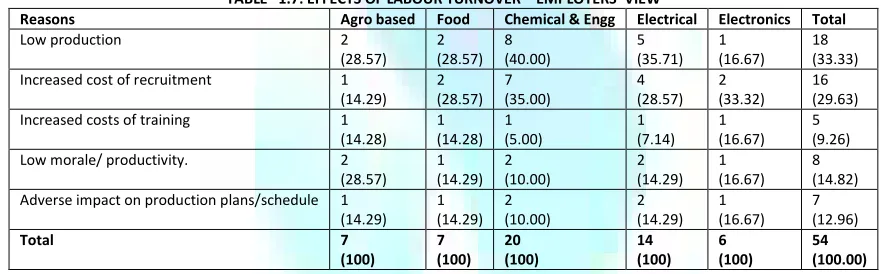
Having examined the extent and causes of labour turnover, now an attempt is made to analyse the effects of labour turnover as opined by the employers in the first instance. Table 1.7 shows the opinions of the employers.
TABLE 1.7: EFFECTS OF LABOUR TURNOVER – EMPLOYERS’ VIEW
Reasons Agro based Food Chemical & Engg Electrical Electronics Total
Low production 2
(28.57) 2 (28.57) 8 (40.00) 5 (35.71) 1 (16.67) 18 (33.33)
Increased cost of recruitment 1
(14.29) 2 (28.57) 7 (35.00) 4 (28.57) 2 (33.32) 16 (29.63)
Increased costs of training 1
(14.28) 1 (14.28) 1 (5.00) 1 (7.14) 1 (16.67) 5 (9.26)
Low morale/ productivity. 2
(28.57) 1 (14.29) 2 (10.00) 2 (14.29) 1 (16.67) 8 (14.82) Adverse impact on production plans/schedule 1
(14.29) 1 (14.29) 2 (10.00) 2 (14.29) 1 (16.67) 7 (12.96)
Total 7
(100) 7 (100) 20 (100) 14 (100) 6 (100) 54 (100.00) Note: Figures in parentheses indicate percentages.
We can observe that one-third of employers in all the units expressed that labour turnover would lead to ‘low production’. Almost the same number of respondents felt that it will lead to ‘increased cost of recruitment’. ‘Low morale / productivity’ is cited as another important effect of labour turnover by 14.82 per cent of the employers. The other consequences of labour turnover are ‘adverse impact on production plans/schedules’ (9.26 per cent) and ‘increased costs of training’ (9.26 per cent) as expressed by a few employers. If we look at this industry-wise, we may observe that low production was the problem expressed by a sizeable section of respondents in Chemical & Engineering industry and Electrical industry. It may also be seen that increased cost of recruitment is the result of labour turnover as felt by a large section of employers not only in Chemical & Engineering industry (35.00 per cent) but also in Electronics industry.
It can be concluded from the above analysis that there are serious consequences of labour turnover in terms of low production, increased cost of recruitment and training, reduced morale/ productivity, impacting production plans and schedules adversely. Among these effects, the first two consequences viz., low production and increased costs of recruitment are reported by a large number of employers.
EFFECTS OF LABOUR TURNOVER – EMPLOYEES’ VIEW
Now let us turn our attention to the views of employees regarding the effects of labour turnover which are shown in Table 1.8.
VOLUME NO.2(2012),ISSUE NO.8(AUGUST) ISSN2231-5756
INTERNATIONAL JOURNAL OF RESEARCH IN COMMERCE, IT & MANAGEMENT
TABLE 1.8: EFFECTS OF LABOUR TURNOVER – EMPLOYEES’ VIEWReasons Agro based Food Chemical & Engg Electrical Electronics Total
Low production 20
(60.61) 38 (64.41) 76 (69.73) 19 (37.25) 22 (66.67) 175 (61.40)
Increased cost of recruitment 2
(6.06) 4 (6.78) 7 (6.42) 6 (11.77) 1 (3.03) 20 (7.02)
Increased costs of training 6
(18.18) 12 (20.33) 14 (12.84) 20 (39.22) 6 (18.18) 58 (20.35)
Low morale/productivity 4
(12.12) 3 (5.09) 9 (8.26) 4 (7.84) 3 (9.09) 23 (8.07) Adverse impact on production plans/ schedules 1
(3.03) 2 (3.39) 3 (2.75) 2 (3.92) 1 (3.03) 9 (3.16)
Total 33
(100.00) 59 (100.00) 109 (100.00) 51 (100.00) 33 (100.00) 285 (100.00) Note: Figures in parentheses indicate percentages to totals.
It is interesting to note that the opinions of employers and employees over the effects of labour turnover appear to be more or less similar. Therefore, it is necessary that appropriate measures should be taken to deal with the problem of labour turnover, so that these small units can ward off the ill effects like low production, increased costs of recruitment and training, low level of employee morale and productivity and adverse impact on the plans and schedules.
GRIEVANCES
The term ‘grievance’ implies any dissatisfaction or feeling of injustice in connection with one’s employment situation that is brought to the attention of management. Generally speaking, grievances are manifestations of employee dissatisfaction that affect organizational health and performance. As indicators of organizational health, grievances are very important for the small business owner as well because they can be aware of employee frustrations, problems and expectations through this medium. A detailed study of the grievances, therefore, has been attempted in the following pages.
i) Nature of Grievances
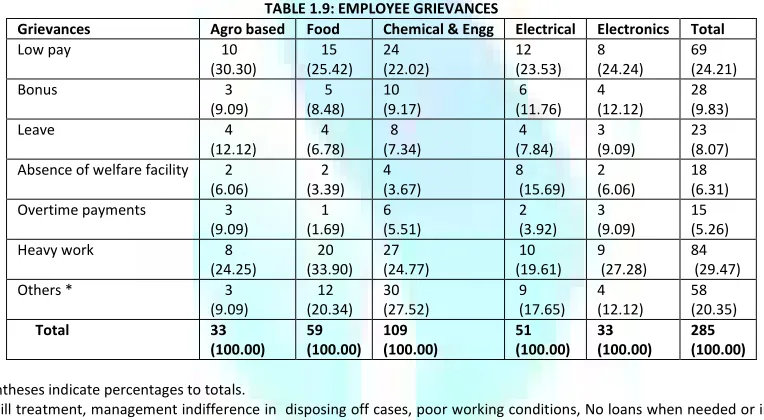
The nature of grievances of employees was enquired into. The responses of employees are shown in Table 1.9.
TABLE 1.9: EMPLOYEE GRIEVANCES
Grievances Agro based Food Chemical & Engg Electrical Electronics Total
Low pay 10
(30.30) 15 (25.42) 24 (22.02) 12 (23.53) 8 (24.24) 69 (24.21)
Bonus 3
(9.09) 5 (8.48) 10 (9.17) 6 (11.76) 4 (12.12) 28 (9.83)
Leave 4
(12.12) 4 (6.78) 8 (7.34) 4 (7.84) 3 (9.09) 23 (8.07) Absence of welfare facility 2
(6.06) 2 (3.39) 4 (3.67) 8 (15.69) 2 (6.06) 18 (6.31)
Overtime payments 3
(9.09) 1 (1.69) 6 (5.51) 2 (3.92) 3 (9.09) 15 (5.26)
Heavy work 8
(24.25) 20 (33.90) 27 (24.77) 10 (19.61) 9 (27.28) 84 (29.47)
Others * 3
(9.09) 12 (20.34) 30 (27.52) 9 (17.65) 4 (12.12) 58 (20.35)
Total 33
(100.00) 59 (100.00) 109 (100.00) 51 (100.00) 33 (100.00) 285 (100.00) Multiple Responses
Note: Figures in parentheses indicate percentages to totals.
*Include: supervisors ill treatment, management indifference in disposing off cases, poor working conditions, No loans when needed or irregular increments, ‘ No medical attention’.
The above Table shows the grievances as expressed by employees in small scale units. We can observe that 29.47 per cent of employees in small scale units cited ‘Heavy work’ as an important grievance. 24.21 per cent of employees voiced concern over their ‘low wages’. It may be noticed that ‘Absence of bonus’ was cited as another grievance by 9.83 per cent of employees. ‘Absence of Leave’ was the next grievance ventilated by 8.07 per cent of employees. While ‘Absence of welfare facilities’ was cited by 6.31 per cent of the employees, 5.26 per cent of employees in small scale units cited ‘No O.T payments’ as their grievance. Apart from these, a few ‘other’ grievances were also nurtured by some employees (20.35 per cent). They include grievances such as ‘supervisors ill-treatment, management’s indifference in disposing of the cases, poor working conditions, not giving loans when needed, irregular increments, no medical attention etc. If we analyze industry-wise, we can observe that 33.90 per cent of employees in Food industry cited ‘Heavy work’ as a very important grievance followed by Electronics industry (27.28 per cent), Chemical & Engineering industry (24.77 per cent), Agro-based industry (24.25 per cent) and Electrical industry (19.61 per cent). It may also be noticed from the study that 30.30 per cent of employees in Agro-based industries voiced concern over their ‘low pay’. This is followed by Food industry (25.42 per cent), Electronics industry (24.24 per cent), Electrical industry (23.53 per cent) and Chemical & Engineering industry (22.02 per cent). We can observe from the study that ‘absence of bonus is cited as another grievance by 12.12 per cent of employees in Electronics industry followed by Electrical industry (11.76 per cent), Chemical & Engineering (9.17 per cent), Agro-based industry (9.09 per cent) and Food industry (8.48 per cent).
It may be concluded that a large per cent of the employees in Agro-based (30.30 per cent) and Electrical (23.53 per cent) industries voiced their concern over their low wages. A large section of the employees in Food (33.90 per cent) and Electronics industries (27.28 per cent) cited heavy work as an important grievance. A few employees in Agro-based (6.06 per cent), Chemical & Engineering (3.69 per cent) and Electronics (6.06 per cent) industries cited lack of welfare facilities as an their grievance. Therefore, we can understand that employees in the small scale units are aggrieved in respect of several matters that have to be paid attention by management.
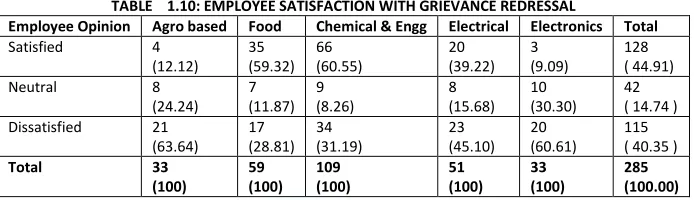
ii) Employee Satisfaction with Grievance Redressal
TABLE 1.10: EMPLOYEE SATISFACTION WITH GRIEVANCE REDRESSAL
Employee Opinion Agro based Food Chemical & Engg Electrical Electronics Total
Satisfied 4
(12.12) 35 (59.32)
66 (60.55)
20 (39.22)
3 (9.09)
128 ( 44.91)
Neutral 8
(24.24) 7 (11.87)
9 (8.26)
8 (15.68)
10 (30.30)
42 ( 14.74 )
Dissatisfied 21
(63.64) 17 (28.81)
34 (31.19)
23 (45.10)
20 (60.61)
115 ( 40.35 )
Total 33
(100)
59 (100)
109 (100)
51 (100)
33 (100)
285 (100.00) Note: Figures in parentheses indicate percentages to totals.
We can observe from the above Table 1.10 that nearly forty five percent of employees expressed satisfaction with the functioning of the grievance redressal mechanism in their organizations. About two-fifth of employees (40.35 per cent), however, are dissatisfied. A small percent (14.74 per cent) of employees preferred to take a middle position i.e., neutral. While this is the overall position in the small scale units, industry-wise, it may be noticed that majority of employees (63.64 per cent) in Agro-based industry are dissatisfied with the functioning of the grievance procedures in their organizations. This is followed by Electronics industry (60.61 per cent), Electrical industry (45.10 per cent), Chemical & Engineering industry (31.19 per cent) and Food industry (28.81 per cent). We can further observe that majority of the employees (60.55 per cent) in Chemical & Engineering and Food industries (59.32 per cent) are satisfied with the functioning of the grievance procedures in their organizations. However, maximum per cent of employees in Chemical & Engineering and Food industries found the functioning of grievance procedures to be satisfactory. Thus, institution of formal grievance procedures does not automatically guarantee employee satisfaction.
CONCLUSION (MAJOR OBSERVATIONS)
In view of the high percentage of employees remaining dissatisfied, much attention needs to be paid for the adoption of right grievance procedures in the respective organizations. Informal discussions with employees had revealed that management took nearly a week to redress their grievances. Though management claimed that the procedure adopted was formal and systematic, employees felt that the procedures adopted were not uniform always. A certain amount of informality crept into the way of redressal. Prompt redressal of grievances through a formal grievance procedure is one of the essential requirements for good labour–management relations. If grievances are allowed to accumulate, they create a sense of frustration, disloyalty and non-cooperation among employees who may lose interest in work and produce far below their capacities. Further, if grievance is handled in a haphazard fashion, without employing a formal procedure, it may become a bone of contention between labour and management leading to serious consequences. In the absence of a formal mechanism through which workers can freely ventilate their grievances from time to time, workers tend to keep their problems bottled up inside themselves, and when they go unattended for a long time, these issues culminate in the form of violent demonstrations and strikes causing incalculable harm to organizational performance. Absence of a formal grievance redressal mechanism, thus, in every way brings in untold hardships for the management. But many small business employers tend to discount the value of a formal grievance procedure, as the foregoing analysis showed believing that problems of a serious nature do not arise there in. Management therefore, should go for instituting formal, uniform and transparent grievance redressal mechanisms. There is ample evidence available to make an inference that employees in the small scale industries are not very much committed. In the face of competition from large industry for skilled and talented employees, the task of employers in small industry is more challenging. They should be able to carve out a niche market of their own within which they should be able to lure and retain employees. Absenteeism was found to be a serious malady existing in several small scale industries. Two-thirds of the employers in all the sample units stated that employees were absent to a large extent. In view of the high magnitude of absenteeism in small scale industries, it is important to examine the reasons thereof in order to be able to consider measures for grappling with the problem. Coupled with the problem of absenteeism is the problem of labour turnover. Majority of employers expressed that the labour turnover in their units was high. A large segment of the employers attributed this to personal reasons of employees, dislike of job, lack of promotional opportunities and low wages. Majority of employers in small scale units reported lack of a formal grievance procedure in their units. Broadly speaking, formal grievance procedures were not instituted in majority of the units. A high percentage of employees also expressed their unhappiness. Much attention needs to be paid for the adoption of right grievance procedures in the respective organizations.
REFERENCES
2. Alok S. Bhattacharya,”Interdependence of Evaluation and Analysis in Training Quality Systems”, IJTD, Vol.XXXVI, No.1, Jan-Mar, 2006, pp.4-7.
3. Buddar Datt & Sundaram K.P.M: “Indian Economy,” 2003, p.640.Chowdary Mukthar Singh ‘Cottage and small scale industries’ Read Book Publications, Hyderabad, 2007.
4. David Amirtha Rajan S. & Gnana Soundari P,”Entrepreneurial Culture among Proprietors of Small Business in Madurai” SEDME, Vol.34, No.3, September, 2007, pp.21-26.
5. Dinesh P.T. & Jayasheela & Basil Hans.V ‘‘Micro, Small and Medium Enterprises in India: Trernds and Challenges”, SEDME, Vol.35, No.2, June, 2008, pp.37-46.
6. Geetika& Dri. Tripti Singh,” Strategic Human Resource Management and Competitive Advantage”, IJTD, Vol. XXXVII, No.4, Oct-December, 2007, pp.9-10. 7. Hyderabad R.L. & Praveen Korbu ‘‘Determinants of Capacity Utilisation in SSI Sector: A Case Study: SEDME, Vol.35, No.2, June, 2008, pp.37-46.. 8. Inder Jeet Dagar, “Labour Turnover in Small Scale Industry”, The Indian Journal of Commerce, Vol.58, No.2, April-June 2005, pp.41-49.
9. Jeya Kumar M. & Swamikannan.D,” Determinants of Bootstrap Finance used by Textile based Small Scale Units in Madurai District”, SEDME, Vol.34, No.3, September, 2007, pp.79-86.
10. Krishnamurthi R,” Training Adults: Challenges and Choices”, IJTD, Vol.XXXVI, No.4, October-December, 2006, pp.56-61. 11. Lavanya latha K,”Small Scale Sector: A Nursery of Economic Development”, SEDME, Vol.32, No.2, June2005, pp. 19-24.
12. Manonmani, M & Geeta K.T,”Efficiency in Agro- Based Consumer Goods Industries of Tamil Nadu”, IJIR, Vol. 44, No. 3, Jan.2009, pp.486-499. 13. Neelam Jain, “Small Scale Industries in the New Millenium” SEDME, March, 2004, pp.63-72.
14. Prasad, V.N, “Small Service Enterprises NeedGovernment’sInterventions”, SEDMI, Vol.35, No.3, September 2008, pp.10.
15. Rajyalakshmi,” Role of Productivity in the Development of the Small Scale Industryu in the Visakhapatnam District of Andhrapradesh”, Gitam Journal of Management Vol. 2, No,. 1, Jan-June, 2004, pp.166-170.
16. Rudra Saibaba and Renuka Sagar, “Management of Small Enterprises”, Kalyani Publishers, New Delhi, 2007.
17. Raghurama M,”Small Scale Industries in Kerala-Competitiveness and Challen ges under Globalisation”, SEDME,Vol.31, No. 2, June 2004, pp.7-17.
18. Ramanand Yadav”Integrating Continuous Improvement Practices as an Innovative Strategy: An application model for Total Quality Managed Small and Medium Enterprises” SEDME, Vol.34, No.3, September, 2007, pp.87-93.
VOLUME NO.2(2012),ISSUE NO.8(AUGUST) ISSN2231-5756
INTERNATIONAL JOURNAL OF RESEARCH IN COMMERCE, IT & MANAGEMENT
REQUEST FOR FEEDBACK
Dear Readers
At the very outset, International Journal of Research in Commerce, IT and Management (IJRCM)
acknowledges & appreciates your efforts in showing interest in our present issue under your kind perusal.
I would like to request you to supply your critical comments and suggestions about the material published
in this issue as well as on the journal as a whole, on our E-mail i.e.
for further
improvements in the interest of research.
If you have any queries please feel free to contact us on our E-mail
.
I am sure that your feedback and deliberations would make future issues better – a result of our joint
effort.
Looking forward an appropriate consideration.
With sincere regards
Thanking you profoundly
Academically yours
Sd/-