Jazdończyk Paulina. The impact of physical vascular therapy on biological renewal after endurance exercise within selected blood parameters. A case study. Journal of Education, Health and Sport. 2018;8(9):1726-1736. eISNN 2391-8306. DOI
http://dx.doi.org/10.5281/zenodo.1439294
http://ojs.ukw.edu.pl/index.php/johs/article/view/6143
The journal has had 7 points in Ministry of Science and Higher Education parametric evaluation. Part B item 1223 (26/01/2017). 1223 Journal of Education, Health and Sport eISSN 2391-8306 7
© The Authors 2018;
This article is published with open access at Licensee Open Journal Systems of Kazimierz Wielki University in Bydgoszcz, Poland
Open Access. This article is distributed under the terms of the Creative Commons Attribution Noncommercial License which permits any noncommercial use, distribution, and reproduction in any medium, provided the original author (s) and source are credited. This is an open access article licensed under the terms of the Creative Commons Attribution Non commercial license Share alike.
(http://creativecommons.org/licenses/by-nc-sa/4.0/) which permits unrestricted, non commercial use, distribution and reproduction in any medium, provided the work is properly cited. The authors declare that there is no conflict of interests regarding the publication of this paper.
Received: 04.09.2018. Revised: 20.09.2018. Accepted: 20.09.2018.
The impact of physical vascular therapy on biological renewal after endurance exercise within selected blood parameters. A case study
1Paulina Jazdończyk
1Kręg-Clinic, 192 Strzeszyńska Str., Poznań, Poland
Key words: physical vascular therapy, blood parameters, biological renewal, endurance exercise
Abstract
Introduction. Microcirculation functionally comprises the most important part of the human circulatory system taking place in the branched network of the smallest blood vessels. At this stage, microcirculation is responsible for transportation functions which are essential for life, namely, it carries oxygen and nutrients to tissues and removes metabolic waste products. The main objective of this study was to evaluate the effectiveness of the physical vascular therapy in the process of biological renewal after endurance exercise.
Findings 1. Physical vascular therapy applied to improve microcirculation had different effects on blood levels of sodium, potassium, calcium and magnesium in the woman and man. 2. The application of the BEMER therapy in biological renewal after endurance exercise in the woman at her sixth decade of life may be justified also as a preparation for endurance exercise.
Introduction
exclusion of the region of capillaries and blood circulation. Microcirculation is functionally the most essential part of the human circulation system taking place in the branched network of the smallest blood vessels. This is where it fulfils the transport function, which is so important for life, namely, microcirculation delivers oxygen and nutrients to tissues and removes metabolic waste products. Limitations or dysfunctions of microcirculation may lead to premature aging process of cells and be the reason of many disorders [2]. Vasomotion (vasomotor action, angiokinesis), first observed by Jones in 1852, is the reduction of the vessel lumen caused by the contraction or relaxation of smooth muscles in arterial endothelium or pericytes on the external venous membrane independent of the heart rate or respiration. A healthy blood circulation system normally causes ca. 30 x 10 mins, whereas with abnormal blood circulation there is only 1 x 10 minutes. The efficiency of microcirculation can be affected by age, environmental degradation and pursued lifestyle [3]. The results of reduced angiokinetic efficiency include, among other things, impaired performance of the immune system, protection against free radicals, circulation system efficiency, and extended recovery process of the liver.
Physical vascular therapy in biological renewal has been studied by Kowalska, Mrozkowiak, Posłuszny, Sokołowski and Żukowska [4-9]. Based on the analysis of obtained blood parameters, they showed that the applied methods and signal profile, by increasing the lumen of micro vessels, had a different influence on the value of selected blood parameters and the use of emitted stimulation in biological renewal after exercise in males in the 5th or 6th decade of life could be well justified and treated as preparing for endurance exercise. It should be pointed out that the author does not prejudge a positive or negative impact of physical vascular therapy on the process of resuscitation. She only believes that this therapy can be applied and may bring a positive effect as a preparation for endurance exercise.
The main objective of this study was to evaluate the effectiveness of the physical vascular therapy in the process of biological renewal after endurance exercise.
Research material
The study was conducted on a woman aged 61 years, weight – 82.1 kg and height – 69.8 cm, leading an active lifestyle. Measurements were conducted by means of a typical medical scale. Before starting endurance exercise, all blood parameters of the subject were within reference ranges and the woman obtained a physician’s consent to carry out level 3 of the intensity exercise.
Methodology and subject of research
fatigue and restitution process, the following were selected: Na, K, Ca and Mg. The research methodology assumed that this would be the only element of biological renewal and in case of the methods of physical vascular therapy, there were used the producer’s recommendations and available publications which specified the real time of achieving therapy results for 12-16 hours [10-12]. An assumption was made, according to Mrozkowiak, that in the second research edition, Bemer therapy would be applied 7 days before physical exercise every day from 6 a.m. to 06.08. a.m., from 4 p. m. to 04.08 p.m. in the daily cycle and from 10 p.m. to 05.30 a.m. in the night cycle. Signal parameters in the daily cycle for 8 minutes were: at 6 a.m. the stimulus intensity was 10 (35 microtesla), at 04.00 p.m. – 6 (21 microtesla). In the night cycle S2 from 10 p.m. to 05.30 a.m. the impact was 10 microtesla. The signal impact covered the entire surface of the body while lying on the back and on the left or right side. Blood sampling and measurements were conducted in line with applicable rules within this scope and included: atmospheric pressure, pulse, systolic blood pressure and diastolic blood pressure, body temperature and selected blood parameters. Physical work of high intensity was also considered to be standard physical exercise.
An assumption of Ulatowski was made [13] that the procedure should cause systolic blood pressure to range between 130 and 180 mm Hg and Brown index should be over 50. The endurance exercise lasted 66 minutes and consisted of two subsequent cycles. One cycle included the following loads: 2 mins: 20 W, 4 mins: 40 W, 2 mins: 20 W, 4 mins: 60 W, 2 mins 20 W, 5 mins: 80 W, 2 mins: 20 W, 4 mins: 60 W, 2 mins: 20 W, 4 mins: 40 W and 2 mins: 20 W. The quantity of turns was measured using the bicycle ergometer and it ranged from 60 to 70 turns per minute. During the final 15 secs of the second cycle, the subject stayed on the bicycle ergometer and was recommended to do any work without load which was supposed to prevent hypersensitivity. Electrodes of the patient monitor and the blood pressure cuff were applied in the last minute of performed standard load. The analytical material was sampled on the test day and for the consecutive five days in accordance with the following pattern:
1. Before exercise at 10.30: blood (measurement 1), measurement of peripheral pulse, systolic and diastolic blood pressure, body weight and height
a. blood at 11.36 a.m. (measurement 2), 01.30 p.m. (measurement 3), 03.30 p.m. (measurement 4), for consecutive 5 days at 08.00 (measurement 5-9).
b. SO2 from the end of exercise until 10.51 with reading of the level every 15 sec.
c. measurement of peripheral pulse from the end of exercise until 10.51 with reading of the level every 15 sec.
d. systolic and diastolic blood pressure from the end of exercise until 10.50 with reading of the level every 10 sec.
Statistical analysis
Statistical methods used in the research included calculating of: the mean systolic and diastolic blood pressure as well as differences between results achieved during the first and second edition of the studies concerning blood parameters analysed in the study.
Results
Atmospheric pressure oscillated from 735.8 to 742.5 mmHg during the first edition and from 749.7 to 758.3 mmHg during the second one. The woman’s body temperature always ranged from 36.5 to 36.80 C. In the first edition of the study, systolic blood pressure was between 129 and 132 mmHg before physical effort and dropped from 149 to 119 mmHg after exercise. Diastolic blood pressure ranged from 81 to 84 mmHg and from 125 to 89 mmHg respectively. During the second edition before physical effort it oscillated respectively from 121 to 120 mmHg and decreased from 135 to 117 after exercise. Average pressure was respectively from 77 to 79 mmHg and from 99 to 79 mmHg. Mean values of systolic and diastolic blood pressure ranged from 137 to 101 mmHg during the first edition and from 120 to 97 mmHg during the second one. Oxygen saturation in the first edition before exercise was about 98 %, and after standard load ranged from 96 to 95%. During the second edition it was respectively – from 96% to 97% and from 95% to 99%. Heart rate during the first edition before physical effort was 69 beats per minute (bpm) and after standard load it reduced from 111 to 79 bpm. In the second edition it decreased respectively from 109 to 68 bpm.
Blood potassium level (K – blue colour) slightly varied during the second test. Only between the first and third hour the level was increased and between 5 and 86.5 hours later it was slightly lower. Blood calcium level (Ca – red colour) five hours later was the same on both tests and from 62.5 h it was higher and then went down again. Blood magnesium level (Mg – green colour) revealed insignificant differences during the course of both tests, Fig. 2.
Discourse
While subjecting the woman to physical effort and the impact of physical vascular therapy during the second session, the distribution of potassium levels was similar during biological renewal to the results of tests conducted on the male subject. It should be highlighted though that the values in both sessions were lower in the female subject and deviated less from the levels of this parameter obtained in the first session than in the case of the studies conducted by Mrozkowiak [7]. Based on the distribution of calcium levels in the woman and man, the differences were only minor. However, the calcium level distribution in both sessions differed significantly in the woman and in the case of the male subject during the final phase of biological renewal supported with physical vascular therapy there was observed a significant growth of calcium level in the second session. As regards blood magnesium levels, they did not differ significantly in the woman in both sessions as opposed to the man’s levels.
Conclusions
1. Physical vascular therapy applied to improve microcirculation had different effects on blood levels of sodium, potassium, calcium and magnesium in the woman and man.
2. The use of BEMER therapy in biological renewal after endurance exercise in the woman at her sixth decade of life may be justified also as a preparation for endurance exercise.
Literature
1. Klopp R., Mikrozurkulation, im Fokus der Forschung, 1 Auf. 2008 Mediquant Verlag AG in Schliessa 19b FL-Triesen.
3. Instructions BEMER-SET Classic/Pro, User Manual, BEMER Group, August 2013 the Freudenstadt ZAEN Congress 04.01.2011
4. Mrozkowiak M., Effect of BEMER therapy on selected blood indicators during biological renewal after endurance exercise. Case study. Journal of Education, Health and Sport. 2015;5(4):278-298.
5. Mrozkowiak M., Mrozkowiak Magdalena. An attempt to evaluate the effectiveness of BEMER therapy in biological renewal after endurance exercise and selected cognitive functions. Case study. Journal of Education, Health and Sport. 2015;5(9):11-62.
6. Mrozkowiak M., Kowalska D., The use of physical vascular therapy in chronic venous insufficiency, Practical physiotherapy and rehabilitation, 2016, 70, p. 31-34.
7. Mrozkowiak M., Die Beurteilung der Wirksamkeit der BEMER-Therapie bei der körperlichen Regeneration nach dem Ausdauertraining. Case study = The evaluation of the efficacy of BEMER therapy in physical recovery after endurance training. Case study. Journal of Education, Health and Sport. 2016;6(4):399-428.
8. Mrozkowiak Mirosław, Mrozkowiak Magdalena, Żukowska Hanna, Sokołowski Marek. Effect of BEMER signal on biological restitution and cognitive processes after endurance exercise. A case study. Journal of Education, Health and Sport. 2016;6(10):175-196.
9. Mrozkowiak M., Posłuszny M. The effect of BEMER therapy on selected blood indicators in the process of biological restitution after exercise endurance. A case study. Journal of Education, Health and Sport. 2017;7(7):703-722.
10 . Piruet-Gottwald M., Multiple Sklerose: Wie Sie Ihen Korper starkę, Naturlich Heilen– Gesund Leben, Deutschland, Ausland inkl. Ubersee, 2014, no. 2, p. 10-12.
11. Ziemssen T., Piatkowski J., Haase R., Long-term effects of bio-electromagnetic-energy. Regulation therapy on fatigue in patients with multiple sclerosis, Altern Ther Health. Med. 2011, Nov - Dec, 17 (6), 22-28.
12. Piatkowski J., Kern S., Ziemssen T., Effect of BEMER magnetic field therapy on the level of fatigue in patients with multiple sclerosis: a randomized, double-blind controlled trial, J. Altern Komplement Med., 2009, May, 15 (5), 507-11, DOI 10.1089/ACM, 2008.0501.
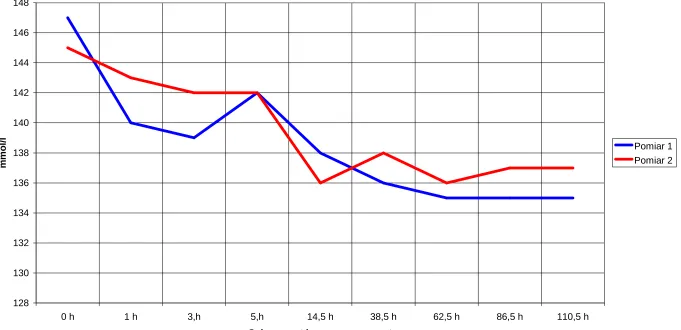
Fig. 1. Blood sodium level before and after endurance effort in the first and second test (n) 1
128 130 132 134 136 138 140 142 144 146 148
0 h 1 h 3,h 5,h 14,5 h 38,5 h 62,5 h 86,5 h 110,5 h
Subsequent hours measurment
m
m
o
l/l Pomiar 1
Fig. 2 Blood potassium, sodium and magnesium levels before and after endurance effort in the first and second test (n) 1
Subsequent hours of measurement
0 1 2 3 4 5 6
m
m
o
l/l
, m
g
/d
l Pomiar 1