• work with maps and grids • explore slides, turns,
and flips
• explore lines of symmetry
U N I T
Motion Geometry
274
Key Words
grid
slide, translation
vertical
horizontal
turn, rotation
turn centre
quarter turn
half turn
three-quarter turn
clockwise
counterclockwise
flip, reflection
reflection line
image
line of symmetry
Look at the map of the amusement park.
• What rides do you see?
• How do people move on each ride?
L E S S O N
276 LESSON FOCUS Describe how to move from one place to another on a grid.
Grids and Maps
David Howell plays chess. At 8 years old, he was the youngest person to beat a grand master.
One chess piece is the knight. The knight can move these ways.
1 right, 2 up or 2 down 1 left, 2 up or 2 down 2 right, 1 up or 1 down 2 left, 1 up or 1 down
The chessboard is a grid.
There is a grid in the playground. Children stand on the grid.
They move right or left and up or down .
Choose two people on the grid. How does one person move to get to the other? Write how many squares in each direction.
Repeat for several pairs of people.
S h o w
and
S h a re
Share your moves with a classmate.
A map is drawn on a grid.
To go from the car to the school, you move: 5 squares right and 4 squares up
or 4 squares up and 5 squares right
Here is another map.
On this map, every building is at an intersection.
To go from the town hall to the grocery store, you move:
4 squares right and 3 squares down or 3 squares down and 4 squares right
Right Left Up
Down
Do not count the square where you start.
Do count the square where
you finish.
Number Strategies
Start at 42. Count on: • by 2s to 68 • by 5s to 92 • by 10s to 132
Numbers Every Day
278 ASSESSMENT FOCUS Question 3
1. How do you move to go from: a) the bus station to school? b) the department store to the
bus station?
c) the toy store to the post office? d) the gas station to the bank?
2. Suppose you start at the gas station. You go 2 squares right, 3 squares up, 1 square left, and 2 squares down. Where do you end up?
How do you know?
3. You are at the train station. To get there, you went
2 squares down and 4 squares right. Where did you start?
How do you know?
Math
Link
Social Studies
The grids and maps in this lesson are like the maps you made of the place you live.
How do you move on your maps to get from one place to another?
279
4. You can move right, left, up, or down on the grid below.
Play the game with a classmate. You choose two number facts.
Your friend tells you how to move from one number to the other.
5. Here is a pattern of squares on a grid.
What is the rule to move from one red square to the next?
6. On a 1-cm grid,
draw a different pattern of squares. Write the rule for your pattern.
Mark two points, A and B, on grid paper.
Explain how to get from A to B, and from B to A. You are on: How do you get to:
a) 4 4 5 7?
b) 3 5 2 2?
c) 6 2 3 3?
d) 7 7 4 5?
L E S S O N
280 LESSON FOCUS Identify slides (translations) using Pattern Blocks and pictures.
Looking at Slides
As people ride the moving walkway, they stay still while their position changes.
How does this picture show a slide?
Find pairs of blocks that show a slide. Which pairs of blocks do not show a slide? Record what you found out.
S h o w
and
S h a re
Show your partner how you know that 2 blocks show a slide. Have you found all possible slides? How do you know?
Describe each slide.
How do you know that 2 blocks do not show a slide?
A B C D E
F
281
A slide moves an object along a line. The object does not turn.
That means, the way it faces does not change.
This picture shows a slide. This picture does not show a slide.
Slides can be in different directions.
A slide is sometimes called a translation.
The way the child faces
does not change.
A vertical slide moves a figure up or down.
A horizontal slide moves a figure left or right.
A diagonal slide moves a figure on a slant.
Number Strategies
You say 5. I say 11. You say 10. I say 21. You say 15. I say 31. You say 30. I say 61. Guess my rule.
You say 35.
What will I say? I say 101. What did
you say?
Numbers Every Day
The child does not move along
282
1. Which pictures show a slide? How do you know?
Which pictures do not show a slide? How do you know?
a) b)
c) d)
e) f)
2. Describe the movement in each picture.
ASSESSMENT FOCUS Question 4
3. Look around your classroom. a) Describe 3 things that slide.
b) Describe 3 things that move but do not slide.
4. In this board game, Jill may slide her counter up, down, right, or left.
Jill’s counter is on the red square. It took 2 slides to get there.
On the first slide,
Jill moved the counter 3 squares.
On the second slide, Jill moved it 2 squares.
On which square could Jill have started? Could Jill have started somewhere else? How do you know?
Imagine that a classmate missed this lesson. Use words and
pictures to explain to her what a slide is.
Name 3 things that slide. Name 3 things that move but do notslide.
1 2 3 4 5 6
7 8 9 10 11 12
13 14 15 16 17 18
19 20 21 22 23 24
25 26 27 28 29 30
31 32 33 34 35 36
optional cartoony art—a classroom scene
The hare and the tortoise had a race.
The race was 5 times around the running track. The hare ran 4 times around in 1 hour,
then stopped for a rest. The tortoise did not stop. She took 1 hour to go once around the track. The hare woke up after 4 hours.
Who won the race?
S h o w
and
S h a re
Explain how you solved the problem.
A snail is at the bottom of a well. It climbs 2 m every day, but it slides back 1 m at night.
The well is 6 m deep. How many days does it take the snail to get out of the well?
What do you know?
• Each day, the snail climbs 2 m up the well.
• Each night, the snail slides back 1 m. • The snail has to climb 6 m to get out.
Think of a strategy to help you solve the problem.
• You can draw a picture.
• Show where the snail is each day.
L E S S O N
Strate
gies
• Make a table. • Use a model. • Draw a picture. • Solve a simpler
problem. • Work backward. • Guess and check. • Make an organized
list.
• Use a pattern.
How does drawing a picture help you to solve a problem? Use grid paper to record how far
the snail moves.
Use a different colour for each day. Count the days when the snail reaches the top of the well. When does the snail get out of the well?
Write a similar problem. Have a classmate solve your problem.
Choose one of the
1. Shannon is shorter than Bruce.
Olivia is shorter than Alex but taller than Bruce. Who is the tallest? Shortest?
2. Hannah and Liam are using a compass.
They move 30 m north, then 30 m west, and then 30 m south.
What direction do they go to get back to where they started?
How far must they go?
Strate
gies
285
day 1
W E
N
286 LESSON FOCUS Identify and perform turns (rotations) using cutouts and Pattern Blocks.
What Is a Turn?
From 2 o’clock to 3 o’clock, the minute hand moves 1 turn.
The centre of the clock is the turn centre.
You will make a pinwheel to show different turns.
You need 2 pieces of grid paper and glue.
➤ On one piece of grid paper, draw 4 congruent figures.
These are the arms of your pinwheel. Make them long and thin.
➤ Colour the arms, then cut them out.
➤ Paste the arms on the second piece of grid paper to show how a pinwheel’s arms turn around a centre.
S h o w
and
S h a re
Show your pinwheel to a classmate.
Describe the turn from one arm to the next. Write the words you use.
287
After 1 turn, a figure is back to where it started.
When the minute hand moves from 12 to 3, it moves a quarter turn.
This is a clockwise turn.
When the minute hand moves from 12 to 6, it moves a half turn.
When the minute hand moves from 12 to 9, it moves a three-quarter turn.
When the turn is the opposite way, it is a
counterclockwise turn.
A turn is sometimes called a rotation.
1. Which picture shows a turn? How do you know? Does any picture show a slide? How do you know?
a) b)
Calculator Skills
Multiply.
189, 289, 389, 4 89 What pattern do you see
in the products?
Use the pattern to find: 589, 689, 789,
889
When does the pattern stop?
Numbers Every Day
quarter turn
Start
Turn centre
three-quarter turn
288
2. Which pictures show a turn? How do you know? Which pictures do not show a turn? Explain.
a) b)
c) d)
3. Explain how this picture shows a turn. Try to do this in 2 ways.
4. a) It is 3:00 a.m.
The hour hand makes a quarter turn. What time is it then? How do you know? b) It is 6:30 p.m.
The hour hand makes a half turn.
What time is it then? How do you know? c) It is 9:45 a.m.
The hour hand makes a three-quarter turn. What time is it then? How do you know?
Unlocking a door Spinning a top
Playing checkers Tossing a coin
Start
289
ASSESSMENT FOCUS Question 7
Think of 3 things you have turned since you woke up this morning.
Use words, pictures, or numbers to describe each turn. 5. Work with a partner.
Draw 2 congruent figures on grid paper. Cut out one of them.
Place this figure on top of the other.
Move the top figure to show a quarter, half, or three-quarter turn.
Ask your partner to:
• Point to the turn centre.
• Say what fraction of a turn the figures show. • Say the direction of the turn.
6. Janetha started to brush her dog at 9 o’clock. When she finished, the minute hand
had made a quarter turn.
How long was Janetha brushing her dog?
7. Rick turns the minute hand of this clock a three-quarter turn counterclockwise.
He then turns the minute hand a quarter turn clockwise.
What time does the clock show?
How do you know?
290 LESSON FOCUS Identify reflections (flips) using Pattern Blocks and pictures.
Exploring Reflections
L E S S O NYou will need Pattern Blocks, grid paper, and a Mira.
➤ Draw a line on grid paper. Use this as a mirror line.
➤ Place a Pattern Block on one side of the mirror line.
➤ Have your partner place a
congruent Pattern Block on the other side of the mirror line so that it is the image of your block.
Use a Mira to check the image.
➤ Take turns to place other congruent blocks to make matching designs on both sides of the mirror line.
This is Kan Shu.
Each figure and its image show a reflection.
This is the reflection line or mirror line.
A figure and its image face opposite ways.
A reflection is sometimes called a flip.
S h o w
and
S h a re
Copy your designs onto grid paper. How are the designs the same? How are they different?
Mental Math
Find each answer in 2 different ways.
Tell how you did it. 45 + 17 = 77 – 58 = 120 – 65 =
Numbers Every Day
292
1. Which pictures show a reflection? How do you know?
Where is the mirror line?
a) b)
c) d)
e) f)
2. In question 1, does any picture show a slide? A turn? How do you know?
Math
Link
Your World
293
ASSESSMENT FOCUS Question 4
3. Which pictures show a reflection? How do you know?
a)
4. Look at this picture.
It is the image of a figure in a mirror. Draw the figure.
Place 2 congruent Pattern Blocks on grid paper. How can you tell if they show a slide, a turn, or a reflection? Use words and pictures to explain.
b)
c)
294 LESSON FOCUS Identify and find lines of symmetry by folding paper and using a transparent mirror.
Lines of Symmetry
L E S S O NA G
B EE D
H
L
F
C K
I J
Each picture has a
line of symmetry.
How can you show that each line is a line of symmetry?
You need a copy of these figures.
Find all the lines of symmetry for each figure. Share the work.
S h o w
and
S h a re
Show your group the lines of symmetry you found. Sort the figures.
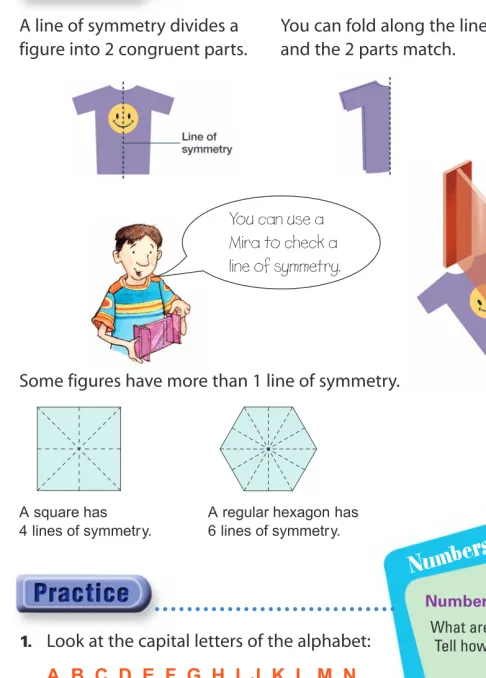
A line of symmetry divides a figure into 2 congruent parts.
You can fold along the line and the 2 parts match.
Some figures have more than 1 line of symmetry.
A square has 4 lines of symmetry.
A regular hexagon has 6 lines of symmetry.
1. Look at the capital letters of the alphabet:
A B C D E F G H I J K L M N O P Q R S T U V W X Y Z
a) Which letters have 1 line of symmetry? 2 lines of symmetry? More than 2?
b) Which letters have no lines of symmetry? How do you know?
Number Strategies
What are the missing digits? Tell how you know.
4 3 2 6 7 3 + 8 – 2 8
9 1 7 7
Numbers Every Day
You can use aMira to check a line of symmetry.
296 ASSESSMENT FOCUS Question 4
2. Write your name in capital letters.
How many letters have 1 line of symmetry?
Are these letters more than one-half of your name? Less than one-half?
3. Which flags below have each symmetry? How do you know?
• a vertical line of symmetry • a horizontal line of symmetry • more than 1 line of symmetry • no lines of symmetry
a) Canada b) The United States c) Japan of America
d) France e) China f) New Zealand
4. On dot paper, draw a picture that has 2 lines of symmetry.
Tell how you know it has 2 lines of symmetry.
Find a picture in a magazine that has 1 line of symmetry. Cut it out. Paste it in your notebook.
Show
W
ha
t
You
K
n
o
w
1. In the grid below, how do you move to go from
a) A to B? b) B to D? c) F to C?
2. In the grid above, which pairs of blocks show
a) a slide? b) a turn? c) a reflection? How do you know?
3. Use a copy of these figures.
Find the lines of symmetry in each figure.
a) Name each figure above.
b) How many lines of symmetry are there in each figure?
c) How many sides are there in each figure?
d) What patterns do you see in your answers?
Learning Goals
U N I T
✓
✓
✓
work with maps and grids explore slides, turns, and flips
explore lines of symmetry
297 1 2 4 5 6 L E S S O N
A B C D
Design a ride for an amusement park. The ride must move people
in at least 2 different ways.
Turns counterclockwise.
299 Moves up and down.
Think about how you will present your ride to the class.
Will you
– make a drawing? – make a model? – write about it? – talk about it?
How does your ride move people in at least 2 different ways?
What did you learn about how figures can move? Use words and pictures to explain.
Your work should show how you designed a ride a clear presentation of your ride
an explanation of how the ride moves
how you used geometric language to describe your work
✓
✓
✓
✓
300 FOCUS Cross Strand Performance Assessment
Are You a Square or a Rectangle?
Part 1
You will need a measuring tape.
➤ Measure your partner’s height with her shoes off.
➤ Measure her arm span.
➤ Record these measurements in a table.
➤ Have your partner take the same measurements from you.
Is your height greater than, less than, or equal to your arm span?
• If your height is greater than your arm span,
you are a tall rectangle.
• If your height is less than your arm span, you are a
short rectangle.
• If your height and arm span are within 2 cm, you are a square.
Which best describes you:
tall rectangle, short rectangle, or square?
Catch: Fig G3_3CS.2– table showing Height above the left column and Arm Span above the right column; child’s handwriting
301
Take It Further
Find the shapes of friends and family members.
How do their shapes compare with your classmates’ shapes? Write what you find out.
Tall rectangle Short rectangle Square
Part 2
You will need grid paper.
➤ Conduct a survey of your classmates. Have each student record his shape on a tally chart.
Look at your survey results.
• Which shape is most common? Least common?
• Are more boys than girls square? • Are more girls than boys square?
➤ Graph the data.
Compare your graph with those of other classmates. How are the graphs similar? Different?
➤ Write your own question about the graph. Answer your question.
Tell what you found out about the different shapes of your classmates.