2
Model Fitting
2.1 Introduction
The model fitting process described in this book involves four steps:
1. Model specification – a model is specified in two parts: an equation linking the response and explanatory variables and the probability distribution of the response variable.
2. Estimation of the parameters of the model.
3. Checking the adequacy of the model – how well it fits or summarizes the data.
4. Inference – calculating confidence intervals and testing hypotheses about the parameters in the model and interpreting the results.
In this chapter these steps are first illustrated using two small examples. Then some general principles are discussed. Finally there are sections about notation and coding of explanatory variables which are needed in subsequent chapters.
2.2 Examples
2.2.1 Chronic medical conditions
Data from the Australian Longitudinal Study on Women’s Health (Brown et al., 1996) show that women who live in country areas tend to have fewer consultations with general practitioners (family physicians) than women who live near a wider range of health services. It is not clear whether this is because they are healthier or because structural factors, such as shortage of doctors, higher costs of visits and longer distances to travel, act as barriers to the use of general practitioner (GP) services. Table 2.1shows the numbers of chronic medical conditions (for example, high blood pressure or arthritis) reported by samples of women living in large country towns (town group) or in more rural areas (country group) in New South Wales, Australia. All the women were aged 70-75 years, had the same socio-economic status and had three or fewer GP visits during 1996. The question of interest is: do women who have similar levels of use of GP services in the two groups have the same need as indicated by their number of chronic medical conditions?
Table 2.1 Numbers of chronic medical conditions of 26 town women and 23 country women with similar use of general practitioner services.
Town
0 1 1 0 2 3 0 1 1 1 1 2 0 1 3 0 1 2
1 3 3 4 1 3 2 0
n = 26, mean = 1.423, standard deviation = 1.172, variance = 1.374
Country
2 0 3 0 0 1 1 1 1 0 0 2 2 0 1 2 0 0
1 1 1 0 2
n = 23, mean = 0.913, standard deviation = 0.900, variance = 0.810
Suppose theYjk’s are all independent and have the Poisson distribution with parameter θj representing the expected number of conditions.
The question of interest can be formulated as a test of the null hypothesis H0 : θ1= θ2 =θ against the alternative hypothesis H1 :θ1 =θ2.The model fitting approach to testing H0 is to fit two models, one assuming H0 is true, that is
E(Yjk) =θ; Yjk ∼P oisson(θ) (2.1)
and the other assuming it is not, so that
E(Yjk) =θj; Yjk ∼P oisson(θj), (2.2)
wherej= 1 or 2. Testing H0 against H1 involves comparing how well models (2.1) and (2.2) fit the data. If they are about equally good then there is little reason for rejecting H0.However if model (2.2) is clearly better, then H0would be rejected in favor of H1.
If H0 is true, then the log-likelihood function of theYjk’s is
l0=l(θ;y) =
J
j=1 Kj
k=1
(yjklogθ−θ−logyjk!), (2.3)
where J = 2 in this case. The maximum likelihood estimate, which can be obtained as shown in the example in Section 1.6.2, is
θ= yjk/N,
whereN =jKj. For these data the estimate isθ= 1.184 and the maximum
If H1is true, then the log-likelihood function is
l1 = l(θ1, θ2;y) =
K1
k=1
(y1klogθ1−θ1−logy1k!)
+
K2
k=1
(y2klogθ2−θ2−logy2k!). (2.4)
(The subscripts on l0 and l1 in (2.3) and (2.4) are used to emphasize the connections with the hypotheses H0 and H1, respectively). From (2.4) the maximum likelihood estimates areθj =kyjk/Kjforj = 1 or 2. In this case
θ1= 1.423,θ2= 0.913 and the maximum value of the log-likelihood function, obtained by substituting these values and the data into (2.4), isl1=−67.0230. The maximum value of the log-likelihood functionl1 will always be greater than or equal to that of l0 because one more parameter has been fitted. To decide whether the difference is statistically significant we need to know the sampling distribution of the log-likelihood function. This is discussed in Chap-ter 4.
If Y ∼ Poisson(θ) then E(Y) = var(Y) = θ. The estimate θ of E(Y) is called the fitted valueofY. The difference Y −θ is called aresidual (other definitions of residuals are also possible, see Section 2.3.4). Residuals form the basis of many methods for examining the adequacy of a model. A residual is usually standardized by dividing by its standard error. For the Poisson distribution an approximate standardized residual is
r= Y−θ θ .
The standardized residuals for models (2.1) and (2.2) are shown in Table 2.2 and Figure 2.1. Examination of individual residuals is useful for assessing certain features of a model such as the appropriateness of the probability distribution used for the responses or the inclusion of specific explanatory variables. For example, the residuals inTable 2.2and Figure 2.1exhibit some skewness, as might be expected for the Poisson distribution.
The residuals can also be aggregated to produce summary statistics measur-ing the overall adequacy of the model. For example, for Poisson data denoted by independent random variables Yi, provided that the expected valuesθiare
not too small, the standardized residuals ri = (Yi−θi)/
θi approximately have the standard Normal distributionN(0,1), although they are not usually independent. An intuitive argument is that, approximately, ri ∼ N(0,1) so
r2
i ∼χ2(1) and hence
r2 i =
(Yi−θi)2
θi ∼χ
2(m). (2.5)
Table 2.2 Observed values and standardized residuals for the data on chronic medical conditions (Table 2.1), with estimates obtained from models (2.1) and (2.2).
Value Frequency Standardized residuals Standardized residuals
of Y from (2.1); from (2.2);
θ= 1.184 θ1 = 1.423 andθ2= 0.913
Town
0 6 -1.088 -1.193
1 10 -0.169 -0.355
2 4 0.750 0.484
3 5 1.669 1.322
4 1 2.589 2.160
Country
0 9 -1.088 -0.956
1 8 -0.169 0.091
2 5 0.750 1.138
3 1 1.669 2.184
Residuals for model (2.1)
Residuals for model (2.2)
2 1
0 -1
country town
country town
estimated in order to calculate to fitted values θi (for example, see Agresti, 1990, page 479). Expression (2.5) is, in fact, the usual chi-squared goodness of fit statistic for count data which is often written as
X2 =(oi−ei)2
ei ∼χ2(m)
where oi denotes the observed frequency and ei denotes the corresponding expected frequency. In this case oi=Yi ,ei=θi andri2=X2.
For the data on chronic medical conditions, for model (2.1)
r2
i = 6×(−1.088)2+ 10×(−0.169)2+. . .+ 1×1.6692= 46.759.
This value is consistent with ri2 being an observation from the central chi-squared distribution with m= 23 + 26−1 = 48 degrees of freedom. (Recall from Section 1.4.2, that if X2 ∼χ2(m) then E(X2) =mand notice that the calculated value X2 =ri2= 46.759 is near the expected value of 48.)
Similarly, for model (2.2)
r2
i = 6×(−1.193)2+. . .+ 1×2.1842= 43.659
which is consistent with the central chi-squared distribution withm= 49−2 = 47 degrees of freedom. The difference between the values ofri2from models (2.1) and (2.2) is small: 46.759−43.659 = 3.10. This suggests that model (2.2) with two parameters, may not describe the data much better than the simpler model (2.1). If this is so, then the data provide evidence supporting the null hypothesis H0:θ1=θ2.More formal testing of the hypothesis is discussed in Chapter 4.
The next example illustrates steps of the model fitting process with contin-uous data.
2.2.2 Birthweight and gestational age
The data in Table 2.3 are the birthweights (in grams) and estimated gesta-tional ages (in weeks) of 12 male and female babies born in a certain hospital. The mean ages are almost the same for both sexes but the mean birthweight for boys is higher than the mean birthweight for girls. The data are shown in the scatter plot inFigure 2.2. There is a linear trend of birthweight increasing with gestational age and the girls tend to weigh less than the boys of the same gestational age. The question of interest is whether the rate of increase of birthweight with gestational age is the same for boys and girls.
Let Yjk be a random variable representing the birthweight of the kth baby in groupjwherej= 1 for boys andj = 2 for girls andk= 1, . . . ,12. Suppose that the Yjk’s are all independent and are Normally distributed with means
μjk = E(Yjk), which may differ among babies, and variance σ2 which is the same for all of them.
A fairly general model relating birthweight to gestational age is
Table 2.3 Birthweight and gestational age for boys and girls.
Boys Girls
Age Birthweight Age Birthweight
40 2968 40 3317
38 2795 36 2729
40 3163 40 2935
35 2925 38 2754
36 2625 42 3210
37 2847 39 2817
41 3292 40 3126
40 3473 37 2539
37 2628 36 2412
38 3176 38 2991
40 3421 39 2875
38 2975 40 3231
Means 38.33 3024.00 38.75 2911.33
42 40
38 36
34 3500
3000
2500
Gestational age Birth weight
where xjk is the gestational age of the kth baby in group j. The intercept parameters α1 and α2 are likely to differ because, on average, the boys were heavier than the girls. The slope parameters β1 andβ2 represent the average increases in birthweight for each additional week of gestational age. The ques-tion of interest can be formulated in terms of testing the null hypothesis H0:
β1=β2 =β (that is, the growth rates are equal and so the lines are parallel), against the alternative hypothesis H1:β1=β2.
We can test H0 against H1 by fitting two models
E(Yjk) =μjk =αj+βxjk; Yjk ∼N(μjk, σ2), (2.6)
E(Yjk) =μjk =αj+βjxjk; Yjk ∼N(μjk, σ2). (2.7)
The probability density function for Yjk is
f(yjk;μjk) = √ 1
2πσ2 exp[− 1
2σ2(yjk−μjk)
2].
We begin by fitting the more general model (2.7). The log-likelihood func-tion is
l1(α1, α2, β1, β2;y) =
J
j=1 K
k=1
[−1
2log(2πσ
2)− 1
2σ2(yjk −μjk)
2]
= −1
2JKlog(2πσ
2)− 1
2σ2
J
j=1 K
k=1
(yjk−αj−βjxjk)2
where J = 2 and K = 12 in this case. When obtaining maximum likelihood estimates ofα1, α2, β1andβ2 we treat the parameterσ2 as a known constant, or nuisance parameter, and we do not estimate it.
The maximum likelihood estimates are the solutions of the simultaneous equations
∂l1 ∂αj =
1
σ2
k
(yjk−αj−βjxjk) = 0,
∂l1 ∂βj =
1
σ2
k
xjk(yjk−αj−βjxjk) = 0, (2.8)
where j = 1 or 2.
An alternative to maximum likelihood estimation is least squares estima-tion. For model (2.7), this involves minimizing the expression
S1=
J
j=1 K
k=1
(yjk−μjk)2 =
J
j=1 K
k=1
The least squares estimates are the solutions of the equations
∂S1
∂αj = −2 K
k=1
(yjk−αj−βjxjk) = 0,
∂S1
∂βj = −2 K
k=1
xjk(yjk−αj−βjxjk) = 0. (2.10)
The equations to be solved in (2.8) and (2.10) are the same and so maximizing
l1 is equivalent to minimizing S1. For the remainder of this example we will use the least squares approach.
The estimating equations (2.10) can be simplified to
K
k=1
yjk −Kαj−βj K
k=1
xjk = 0,
K
k=1
xjkyjk −Kαj K
k=1
xjk−βj K
k=1 x2
jk = 0
forj = 1 or 2. These are called the normal equations. The solution is
bj = K
kxjkyjk−(
kxjk)(
kyjk) Kkx2
jk−(
kxjk)2 ,
aj = yj−bjxj,
whereaj is the estimate of αj and bj is the estimate of βj,for j= 1 or 2. By considering the second derivatives of (2.9) it can be verified that the solution of equations (2.10) does correspond to the minimum of S1. The numerical value for the minimum value forS1 for a particular data set can be obtained by substituting the estimates forαj and βj and the data values for yjk and
xjk into (2.9).
To test H0 : β1 = β2 = β against the more general alternative hypothesis H1, the estimation procedure described above for model (2.7) is repeated but with the expression in (2.6) used for μjk. In this case there are three parameters, α1, α2 and β, instead of four to be estimated. The least squares expression to be minimized is
S0 =
J j=1 K k=1
(yjk−αj−βxjk)2. (2.11)
From (2.11) the least squares estimates are given by the solution of the simultaneous equations
∂S0
∂αj = −2 K
k=1
(yjk−αj−βxjk) = 0,
∂S0
∂β = −2 J j=1 K k=1
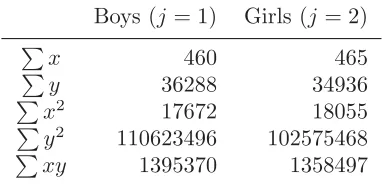
Table 2.4 Summary of data on birthweight and gestational age in Table 2.3 (sum-mation is over k=1,...,K where K=12).
Boys (j= 1) Girls (j= 2)
x
460 465
y
36288 34936
x2
17672 18055
y2
110623496 102575468
xy
1395370 1358497
for j = 1 and 2. The solution is
b = K
jkxjkyjk−j(kxjkkyjk) Kjkx2
jk−
j(
kxjk)2 ,
aj = yj−bxj.
These estimates and the minimum value for S0 can be calculated from the data.
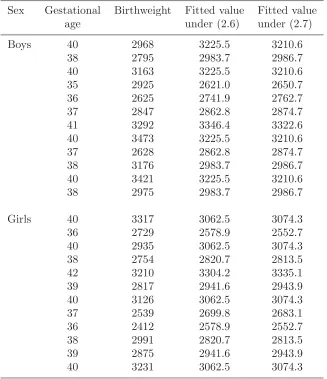
For the example on birthweight and gestational age, the data are summa-rized inTable 2.4 and the least squares estimates and minimum values forS0 andS1are given inTable 2.5. The fitted valuesyjk are shown inTable 2.6. For model (2.6), yjk =aj+bxjk is calculated from the estimates in the top part ofTable 2.5. For model (2.7),yjk =aj+bjxjk is calculated using estimates in the bottom part of Table 2.5. The residual for each observation isyjk−yjk. The standard deviationsof the residuals can be calculated and used to obtain approximate standardized residuals (yjk−yjk)/s.Figures 2.3and2.4show for models (2.6) and (2.7), respectively: the standardized residuals plotted against the fitted values; the standardized residuals plotted against gestational age; and Normal probability plots. These types of plots are discussed in Section 2.3.4. The Figures show that:
1. Standardized residuals show no systematic patterns in relation to either the fitted values or the explanatory variable, gestational age.
2. Standardized residuals are approximately Normally distributed (as the points are near the solid lines in the bottom graphs).
3. Very little difference exists between the two models.
The apparent lack of difference between the models can be examined by testing the null hypothesis H0 (corresponding to model (2.6)) against the alternative hypothesis H1(corresponding to model (2.7)). If H0is correct, then the minimum valuesS1andS0should be nearly equal. If the data support this hypothesis, we would feel justified in using the simpler model (2.6) to describe the data. On the other hand, if the more general hypothesis H1 is true then
Table 2.5 Analysis of data on birthweight and gestational age inTable 2.3.
Model Slopes Intercepts Minimum sum of squares
(2.6) b= 120.894 a1 =−1610.283 S0= 658770.8
a2 =−1773.322
(2.7) b1 = 111.983 a1 =−1268.672 S1= 652424.5
b2 = 130.400 a2 =−2141.667
Table 2.6 Observed values and fitted values under model (2.6) and model (2.7) for data inTable 2.3.
Sex Gestational Birthweight Fitted value Fitted value
age under (2.6) under (2.7)
Boys 40 2968 3225.5 3210.6
38 2795 2983.7 2986.7
40 3163 3225.5 3210.6
35 2925 2621.0 2650.7
36 2625 2741.9 2762.7
37 2847 2862.8 2874.7
41 3292 3346.4 3322.6
40 3473 3225.5 3210.6
37 2628 2862.8 2874.7
38 3176 2983.7 2986.7
40 3421 3225.5 3210.6
38 2975 2983.7 2986.7
Girls 40 3317 3062.5 3074.3
36 2729 2578.9 2552.7
40 2935 3062.5 3074.3
38 2754 2820.7 2813.5
42 3210 3304.2 3335.1
39 2817 2941.6 2943.9
40 3126 3062.5 3074.3
37 2539 2699.8 2683.1
36 2412 2578.9 2552.7
38 2991 2820.7 2813.5
39 2875 2941.6 2943.9
34 36 38 40 42 -1
0 1 2
Gestational age
R
esidu
als
Model (2.6)
2600 2800 3000 3200 3400 -1
0 1 2
Fitted values
Re
si
du
al
s
Model (2.6)
2 1
0 -1
-2 99
90
50
10
1
Residuals
Per
ce
n
t
Model (2.6)
34 36 38 40 42 -1
0 1 2
Gestational age
Re
si
d
u
al
s
Model (2.7)
2 1
0 -1
-2 99
90
50
10
1
Residuals
Per
ce
n
t
Model (2.7)
2600 2800 3000 3200 3400
-1 0 1 2
Fittted values
Re
si
d
u
al
s
Model (2.7)
sampling distributions of the corresponding random variables
S1=
J
j=1 K
k=1
(Yjk−aj−bjxjk)2
and
S0=
J
j=1 K
k=1
(Yjk−aj−bxjk)2.
It can be shown (see Exercise 2.3) that
S1 =
J
j=1 K
k=1
[Yjk−(αj+βjxjk)]2−K
J
j=1
(Yj−αj−βjxj)2
− J
j=1
(bj−βj)2(
K
k=1 x2
jk −Kx2j)
and that the random variables Yjk, Yj and bj are all independent and have the following distributions:
Yjk ∼ N(αj+βjxjk, σ2),
Yj ∼ N(αj+βjxj, σ2/K),
bj ∼ N(βj, σ2/(
K
k=1 x2
jk−Kx2j)).
ThereforeS1/σ2 is a linear combination of sums of squares of random vari-ables with Normal distributions. In general, there are JK random variables (Yjk −αj −βjxjk)2/σ2, J random variables (Yj −αj −βjxj)2K/σ2 and J random variables (bj −βj)2(kx2jk −Kx2j)/σ2. They are all independent and each has the χ2(1) distribution. From the properties of the chi-squared distribution in Section 1.5, it follows that S1/σ2 ∼ χ2(JK −2J). Similarly, if H0 is correct then S0/σ2 ∼ χ2[JK −(J + 1)]. In this example J = 2 so
S1/σ2 ∼ χ2(2K −4) and S
0/σ2 ∼ χ2(2K −3). In each case the value for
the degrees of freedom is the number of observations minus the number of parameters estimated.
If β1 and β2 are not equal (corresponding to H1), then S0/σ2 will have a non-central chi-squared distribution with JK −(J + 1) degrees of freedom. On the other hand, provided that model (2.7) describes the data well, S1/σ2 will have a central chi-squared distribution withJK−2J degrees of freedom. The statistic S0−S1 represents the improvement in fit of (2.7) compared to (2.6). If H0 is correct, then
1
σ2(S0−S1)∼χ2(J −1).
distribu-N o n -c e n tra l F C e n tra l F
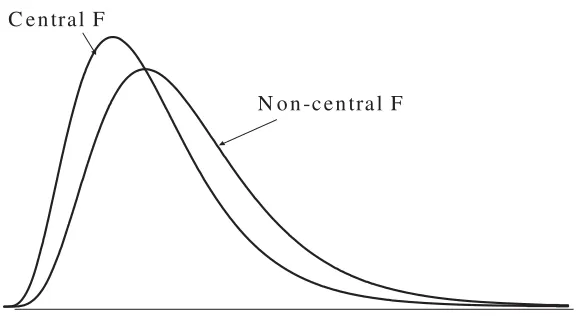
Figure 2.5 Central and non-central F distributions.
tion. However, as σ2 is unknown, we cannot compare (S0−S1)/σ2 directly with the χ2(J −1) distribution. Instead we eliminate σ2 by using the ratio of (S0−S1)/σ2 and the random variable S1/σ2 with a central chi-squared distribution, each divided by the relevant degrees of freedom,
F = (S0−S1)/σ
2
(J−1) / S1/σ2
(JK−2J) =
(S0−S1)/(J−1)
S1/(JK−2J) .
If H0 is correct, from Section 1.4.4, F has the central distribution F(J − 1, JK −2J). If H0 is not correct, F has a non-central F-distribution and the calculated value of F will be larger than expected from the central F -distribution (see Figure 2.5).
For the example on birthweight and gestational age, the value of F is
(658770.8−652424.5)/1
652424.5/20 = 0.19
This value is certainly not statistically significant when compared with the
F(1,20) distribution. Thus the data do not provide evidence against the hy-pothesis H0 : β0 = β1, and on the grounds of simplicity model (2.6), which specifies the same slopes but different intercepts, is preferable.
These two examples illustrate the main ideas and methods of statistical modelling which are now discussed more generally.
2.3 Some principles of statistical modelling
2.3.1 Exploratory data analysis
Any analysis of data should begin with a consideration of each variable sepa-rately, both to check on data quality (for example, are the values plausible?) and to help with model formulation.
is categorical how many categories does it have and are they nominal or ordinal?
2. What is the shape of the distribution? This can be examined using fre-quency tables, dot plots, histograms and other graphical methods.
3. How is it associated with other variables? Cross tabulations for categorical variables, scatter plots for continuous variables, side-by-side box plots for continuous scale measurements grouped according to the factor levels of a categorical variable, and other such summaries can help to identify pat-terns of association. For example, do the points on a scatter plot suggest linear or non-linear relationships? Do the group means increase or decrease consistently with an ordinal variable defining the groups?
2.3.2 Model formulation
The models described in this book involve a single response variable Y and usually several explanatory variables. Knowledge of the context in which the data were obtained, including the substantive questions of interest, theoret-ical relationships among the variables, the study design and results of the exploratory data analysis can all be used to help formulate a model. The model has two components:
1. Probability distribution ofY, for example,Y ∼N(μ, σ2).
2. Equation linking the expected value of Y with a linear combination of the explanatory variables, for example, E(Y) = α+βx or ln[E(Y)] =
β0+β1sin(αx).
For generalized linear models the probability distributions all belong to the exponential family of distributions, which includes the Normal, binomial, Poisson and many other distributions. This family of distributions is discussed in Chapter 3. The equation in the second part of the model has the general form
g[E(Y)] =β0+β1x1+. . .+βmxm
where the part β0+β1x1+. . .+βmxm is called the linear component. Notation for the linear component is discussed in Section 2.4.
2.3.3 Parameter estimation
2.3.4 Residuals and model checking
Firstly, consider residuals for a model involving the Normal distribution. Sup-pose that the response variable Yi is modelled by
E(Yi) =μi; Yi∼N(μi, σ2).
The fitted values are the estimatesμi.Residuals can be defined asyi−μi and the approximate standardized residuals as
ri= (yi−μi)/σ,
whereσis an estimate of the unknown parameterσ. These standardized resid-uals are slightly correlated because they all depend on the estimates μi and
σthat were calculated from the observations. Also they are not exactly Nor-mally distributed becauseσ has been estimated by σ. Nevertheless, they are approximately Normally distributed and the adequacy of the approximation can be checked using appropriate graphical methods (see below).
The parameters μi are functions of the explanatory variables. If the model is a good description of the relationship between the response and the ex-planatory variables, this should be well ‘captured’ or ‘explained’ by theμi’s. Therefore there should be little remaining information in the residualsyi−μi. This too can be checked graphically (see below). Additionally, the sum of squared residuals (yi−μi)2 provides an overall statistic for assessing the adequacy of the model; in fact, it is the component of the log-likelihood func-tion or least squares expression which is optimized in the estimafunc-tion process. Secondly, consider residuals from a Poisson model. Recall the model for chronic medical conditions
E(Yi) =θi; Yi ∼P oisson(θi).
In this case approximate standardized residuals are of the form
ri= yi−θi θi
.
These can be regarded as signed square roots of contributions to the Pearson goodness-of-fit statistic
i
(oi−ei)2
ei ,
whereoi is the observed value yi and ei is the fitted valueθi ‘expected’ from the model.
Cox and Snell, 1968; Prigibon, 1981; and Pierce and Shafer, 1986). Many of these residuals are discussed in more detail in McCullagh and Nelder (1989) or Krzanowski (1998).
Residuals are important tools for checking the assumptions made in formu-lating a model. This is because they should usually be independent and have a distribution which is approximately Normal with a mean of zero and constant variance. They should also be unrelated to the explanatory variables. There-fore, the standardized residuals can be compared to the Normal distribution to assess the adequacy of the distributional assumptions and to identify any unusual values. This can be done by inspecting their frequency distribution and looking for values beyond the likely range; for example, no more than 5% should be less than−1.96 or greater than +1.96 and no more than 1% should be beyond ±2.58.
A more sensitive method for assessing Normality, however, is to use a Nor-mal probability plot. This involves plotting the residuals against their ex-pected values, defined according to their rank order, if they were Normally distributed. These values are called the Normal order statistics and they depend on the number of observations. Normal probability plots are available in all good statistical software (and analogous probability plots for other dis-tributions are also commonly available). In the plot the points should lie on or near a straight line representing Normality and systematic deviations or outlying observations indicate a departure from this distribution.
The standardized residuals should also be plotted against each of the ex-planatory variables that are included in the model. If the model adequately describes the effect of the variable, there should be no apparent pattern in the plot. If it is inadequate, the points may display curvature or some other sys-tematic pattern which would suggest that additional or alternative terms may need to be included in the model. The residuals should also be plotted against other potential explanatory variables that are not in the model. If there is any systematic pattern, this suggests that additional variables should be included. Several different residual plots for detecting non-linearity in generalized linear models have been compared by Cai and Tsai (1999).
In addition, the standardized residuals should be plotted against the fitted values yi, especially to detect changes in variance. For example, an increase in the spread of the residuals towards the end of the range of fitted values would indicate a departure from the assumption of constant variance (sometimes termed homoscedasticity).
2.3.5 Inference and interpretation
It is sometimes useful to think of scientific data as measurements composed of a message, orsignal, that is distorted bynoise.For instance, in the example about birthweight the ‘signal’ is the usual growth rate of babies and the ‘noise’ comes from all the genetic and environmental factors that lead to individual variation. A goal of statistical modelling is to extract as much information as possible about the signal. In practice, this has to be balanced against other criteria such as simplicity. The Oxford Dictionary describes thelaw of parsimony (otherwise known as Occam’s Razor) as the principle that no more causes should be assumed than will account for the effect. Accordingly a simpler or more parsimonious model that describes the data adequately is preferable to a more complicated one which leaves little of the variability ‘unexplained’. To determine a parsimonious model consistent with the data, we test hypotheses about the parameters.
Hypothesis testing is performed in the context of model fitting by defin-ing a series of nested models corresponddefin-ing to different hypotheses. Then the question about whether the data support a particular hypothesis can be for-mulated in terms of the adequacy of fit of the corresponding model relative to other more complicated models. This logic is illustrated in the examples earlier in this chapter. Chapter 5 provides a more detailed explanation of the concepts and methods used, including the sampling distributions for the statistics used to describe ‘goodness of fit’.
While hypothesis testing is useful for identifying a good model, it is much less useful for interpreting it. Wherever possible, the parameters in a model should have some natural interpretation; for example, the rate of growth of babies, the relative risk of acquiring a disease or the mean difference in profit from two marketing strategies. The estimated magnitude of the parameter and the reliability of the estimate as indicated by its standard error or a confidence interval are far more informative than significance levels or p-values. They make it possible to answer questions such as: is the effect estimated with sufficient precision to be useful, or is the effect large enough to be of practical, social or biological significance?
2.3.6 Further reading
2.4 Notation and coding for explanatory variables
For the models in this book the equation linking each response variableY and a set of explanatory variables x1, x2, . . . xm has the form
g[E(Y)] =β0+β1x1+. . .+βmxm.
For responses Y1, ..., YN, this can be written in matrix notation as
g[E(y)] =Xβ (2.13)
where
y= ⎡ ⎢ ⎢ ⎢ ⎢ ⎣
Y1 . . . YN
⎤ ⎥ ⎥ ⎥ ⎥
⎦ is a vector of responses,
g[E(y)] = ⎡ ⎢ ⎢ ⎢ ⎢ ⎣
g[E(Y1)]
. . . g[E(YN)]
⎤ ⎥ ⎥ ⎥ ⎥ ⎦
denotes a vector of functions of the terms E(Yi) (with the same g for every element),
β= ⎡ ⎢ ⎢ ⎢ ⎢ ⎣
β1 . . . βp
⎤ ⎥ ⎥ ⎥ ⎥
⎦ is a vector of parameters,
and X is a matrix whose elements are constants representing levels of cat-egorical explanatory variables or measured values of continuous explanatory variables.
For a continuous explanatory variable x (such as gestational age in the example on birthweight) the model contains a term βx where the parameter
β represents the change in the response corresponding to a change of one unit in x.
For categorical explanatory variables there are parameters for the different levels of a factor. The corresponding elements of X are chosen to exclude or include the appropriate parameters for each observation; they are called dummy variables. If they are only zeros and ones, the term indictor vari-ableis used.
If there are p parameters in the model and N observations, then y is a
2.4.1 Example: Means for two groups
For the data on chronic medical conditions the equation in the model
E(Yjk) =θj; Yjk ∼P oisson(θj), j = 1,2
can be written in the form of (2.13) with g as the identity function, (i.e.,
g(θj) =θj),
y= ⎡ ⎢ ⎢ ⎢ ⎢ ⎢ ⎢ ⎢ ⎢ ⎢ ⎢ ⎣ Y1,1 Y1,2 .. . Y1,26 Y2,1 .. . Y2,23 ⎤ ⎥ ⎥ ⎥ ⎥ ⎥ ⎥ ⎥ ⎥ ⎥ ⎥ ⎦
, β =
θ
1 θ2
and X=
⎡ ⎢ ⎢ ⎢ ⎢ ⎢ ⎢ ⎢ ⎢ ⎢ ⎢ ⎣ 1 0 1 0 .. . ... 1 0 0 1 .. . ... 0 1 ⎤ ⎥ ⎥ ⎥ ⎥ ⎥ ⎥ ⎥ ⎥ ⎥ ⎥ ⎦
The top part of Xpicks out the terms θ1 corresponding to E(Y1k) and the bottom part picks out θ2 for E(Y2k). With this model the group means θ1 andθ2 can be estimated and compared.
2.4.2 Example: Simple linear regression for two groups
The more general model for the data on birthweight and gestational age is
E(Yjk) =μjk =αj+βjxjk; Yjk ∼N(μjk, σ2).
This can be written in the form of (2.13) if g is the identity function,
y = ⎡ ⎢ ⎢ ⎢ ⎢ ⎢ ⎢ ⎢ ⎢ ⎢ ⎢ ⎣ Y11 Y12 .. . Y1K Y21 .. . Y2K ⎤ ⎥ ⎥ ⎥ ⎥ ⎥ ⎥ ⎥ ⎥ ⎥ ⎥ ⎦
, β=
⎡ ⎢ ⎢ ⎣ α1 α2 β1 β2 ⎤ ⎥ ⎥
⎦ and X=
⎡ ⎢ ⎢ ⎢ ⎢ ⎢ ⎢ ⎢ ⎢ ⎢ ⎢ ⎣
1 0 x11 0
1 0 x12 0
..
. ... ... ...
1 0 x1K 0
0 1 0 x21
..
. ... ... ...
0 1 0 x2K
⎤ ⎥ ⎥ ⎥ ⎥ ⎥ ⎥ ⎥ ⎥ ⎥ ⎥ ⎦
2.4.3 Example: Alternative formulations for comparing the means of two groups
There are several alternative ways of formulating the linear components for comparing means of two groups: Y11, ..., Y1K1and Y21, ..., Y2K2.
(a) E(Y1k) =β1,and E(Y2k) =β2.
This is the version used in Example 2.4.1 above. In this case β=
β1 β2
and the rows of Xare as follows
Group 1 : 1 0
Group 2 : 0 1 .
(b) E(Y1k) =μ+α1, and E(Y2k) =μ+α2.
In this version μrepresents the overall mean and α1 and α2 are the group
differences from μ. In this caseβ= ⎡ ⎣ αμ1
α2 ⎤
⎦and the rows of Xare
Group 1 : 1 1 0
Group 2 : 1 0 1 .
This formulation, however, has too many parameters as only two param-eters can be estimated from the two sets of observations. Therefore some modification or constraint is needed.
(c) E(Y1k) =μand E(Y2k) =μ+α.
Here Group 1 is treated as the reference group and α represents the
ad-ditional effect of Group 2. For this version β =
μ α
and the rows of X
are
Group 1 : 1 0
Group 2 : 1 1 .
This is an example of corner point parameterization in which group effects are defined as differences from a reference category called the ‘corner point’.
(d) E(Y1k) =μ+α, and E(Y2k) =μ−α.
This version treats the two groups symmetrically; μ is the overall average effect and α represents the group differences. This is an example of a sum-to-zero constraint because
[E(Y1k)−μ] + [E(Y2k)−μ] =α+ (−α) = 0.
In this case β=
μ
α
and the rows ofX are
Group 1 : 1 1
Group 2 : 1 −1 .
2.4.4 Example: Ordinal explanatory variables
defining the model using
E(Y1k) = μ
E(Y2k) = μ+α1
E(Y3k) = μ+α1+α2
and henceβ= ⎡ ⎣ αμ1
α2 ⎤
⎦ and the rows of Xare
Group 1 : 1 0 0
Group 2 : 1 1 0
Group 3 : 1 1 1 .
Thus α1 represents the effect of Group 2 relative to Group 1 and α2 repre-sents the effect of Group 3 relative to Group 2.
2.5 Exercises
2.1 Genetically similar seeds are randomly assigned to be raised in either a nu-tritionally enriched environment (treatment group) or standard conditions (control group) using a completely randomized experimental design. After a predetermined time all plants are harvested, dried and weighed. The results, expressed in grams, for 20 plants in each group are shown inTable 2.7.
Table 2.7 Dried weight of plants grown under two conditions.
Treatment group Control group
4.81 5.36 4.17 4.66
4.17 3.48 3.05 5.58
4.41 4.69 5.18 3.66
3.59 4.44 4.01 4.50
5.87 4.89 6.11 3.90
3.83 4.71 4.10 4.61
6.03 5.48 5.17 5.62
4.98 4.32 3.57 4.53
4.90 5.15 5.33 6.05
5.75 6.34 5.59 5.14
We want to test whether there is any difference in yield between the two groups. Let Yjk denote the kth observation in the jth group wherej = 1 for the treatment group, j = 2 for the control group and k = 1, ...,20 for both groups. Assume that theYjk’s are independent random variables with
(a) Conduct an exploratory analysis of the data looking at the distributions for each group (e.g., using dot plots, stem and leaf plots or Normal prob-ability plots) and calculating summary statistics (e.g., means, medians, standard derivations, maxima and minima). What can you infer from these investigations?
(b) Perform an unpaired t-test on these data and calculate a 95% confidence interval for the difference between the group means. Interpret these results.
(c) The following models can be used to test the null hypothesis H0against the alternative hypothesis H1,where
H0: E(Yjk) =μ; Yjk ∼N(μ, σ2), H1: E(Yjk) =μj; Yjk ∼N(μj, σ2),
for j = 1,2 and k = 1, ...,20. Find the maximum likelihood and least squares estimates of the parametersμ, μ1andμ2, assumingσ2is a known constant.
(d) Show that the minimum values of the least squares criteria are:
for H0, S0 = (Yjk −Y)2 where Y =
K
k=1 K
k=1
Yjk/40,
for H1, S1 = (Yjk −Yj)2 whereYj=
K
k=1
Yjk/20
forj = 1,2.
(e) Using the results of Exercise 1.4 show that
1
σ2S1=
1
σ2 20
k=1 20
k=1
(Yjk−μj)2− 20
σ2 2
k=1
(Yj−μj)2
and deduce that if H1 is true 1
σ2S1 ∼χ2(38).
Similarly show that
1
σ2S0=
1
σ2 2
j=1 20
k=1
(Yjk−μ)2− 40
σ2 2
j=1
(Y −μ)2
and if H0 is true then
1
σ2S0 ∼χ2(39).
(f) Use an argument similar to the one in Example 2.2.2 and the results from (e) to deduce that the statistic
has the central F-distribution F(1, 38) if H0 is true and a non-central distribution if H0 is not true.
(g) Calculate theF-statistic from (f) and use it to test H0against H1. What do you conclude?
(h) Compare the value of F-statistic from (g) with the t-statistic from (b), recalling the relationship between the t-distribution and the F -distribution (see Section 1.4.4) Also compare the conclusions from (b) and (g).
(i) Calculate residuals from the model for H0 and use them to explore the distributional assumptions.
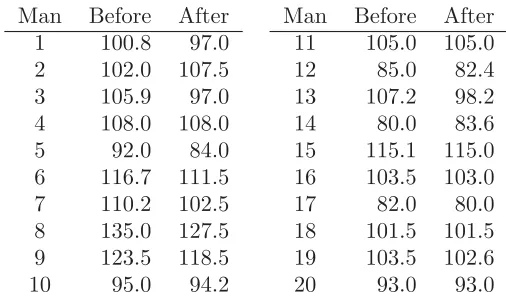
2.2 The weights, in kilograms, of twenty men before and after participation in a ‘waist loss’ program are shown in Table 2.8. (Egger et al., 1999) We want to know if, on average, they retain a weight loss twelve months after the program.
Table 2.8 Weights of twenty men before and after participation in a ‘waist loss’ program.
Man Before After Man Before After
1 100.8 97.0 11 105.0 105.0
2 102.0 107.5 12 85.0 82.4
3 105.9 97.0 13 107.2 98.2
4 108.0 108.0 14 80.0 83.6
5 92.0 84.0 15 115.1 115.0
6 116.7 111.5 16 103.5 103.0
7 110.2 102.5 17 82.0 80.0
8 135.0 127.5 18 101.5 101.5
9 123.5 118.5 19 103.5 102.6
10 95.0 94.2 20 93.0 93.0
Let Yjk denote the weight of the kth man at the jth time where j = 1 before the program and j = 2 twelve months later. Assume the Yjk’s are independent random variables with Yjk ∼ N(μj, σ2) for j = 1,2 and
k= 1, ...,20.
(a) Use an unpaired t-test to test the hypothesis
H0:μ1=μ2 versus H1:μ1=μ2.
(b) Let Dk = Y1k−Y2k, fork = 1, ...,20. Formulate models for testing H0 against H1 using the Dk’s. Using analogous methods to Exercise 2.1 above, assumingσ2 is a known constant, test H0 against H1.
(d) List the assumptions made for (a) and (b). Which analysis is more appropriate for these data?
2.3 For model (2.7) for the data on birthweight and gestational age, using methods similar to those for Exercise 1.4, show
S1 =
J
j=1 K
k=1
(Yjk−aj−bjxjk)2
=
J
j=1 K
k=1
[(Yjk−(αj+βjxjk)]2−K
J
j=1
(Yj−αj−βjxj)2
− J
j=1
(bj−βj)2(
K
k=1 x2
jk−Kx2j)
and that the random variablesYjk,Yj andbj are all independent and have the following distributions
Yjk ∼ N(αj+βjxjk, σ2),
Yj ∼ N(αj+βjxj, σ2/K),
bj ∼ N(βj, σ2/(
K
k=1 x2
jk−Kx2j)).
2.4 Suppose you have the following data
x: 1.0 1.2 1.4 1.6 1.8 2.0
y: 3.15 4.85 6.50 7.20 8.25 16.50
and you want to fit a model with
E(Y) = ln(β0+β1x+β2x2).
Write this model in the form of (2.13) specifying the vectorsy and β and the matrixX.
2.5 The model for two-factor analysis of variance with two levels of one factor, three levels of the other and no replication is
E(Yjk) =μjk =μ+αj+βk; Yjk ∼N(μjk, σ2)
wherej = 1,2;k= 1,2,3 and, using the sum-to-zero constraints,α1+α2 = 0, β1+β2+β3 = 0.Also the Yjk’s are assumed to be independent. Write the equation for E(Yjk) in matrix notation. (Hint: let α2 = −α1, and