172 | J . H u m . I n s . 2 0 1 8 ; 2 ( 4 ) : 1 7 2 - 1 7 8
Journal of Humanities Insights 2(4): 172-178, 2018
Research Paper
The Effects of Private Education Institutes in
Providing Modern Financial Knowledge in Developing
Countries
Sara Kashisaz1, Emran Mobarak
Department of Management, University of Karachi, Pakistan
Received: 28 August 2018 Accepted: 20 September 2018 Published: 01 December 2018
Abstract
The main objectiveof this study is to reveal the contribution of the private higher education institutions in providing majors and programs relevant to knowledge economy, and to show to which extent these institutions presented qualitative and competitive education in Saudi Arabia during the period 2005-2016. Adescriptive analytical method was used to analyze data and to test the hypothesis. Findings of the study indicated to; suitability of specialties of programs offered by private universities and colleges to what are required in the labor market in the era of knowledge economy; the proportion of private higher education graduates to the total graduates of higher education in KSA is low; quality and competitive education experienced in these institutions is limited. The study recommended that more incentives have to be provided to encourage private sector to invest in higher education, and to improve level of quality practiced in the private universities and colleges.
Keywords
: Private Higher Education; Knowledge Economy; Compatible; Competitiveness
How to cite the article:S. Kashisaz, E. Mobarak, The Effects of Private Education Institutes in Providing Modern Financial Knowledge in Developing Countries, J. Hum. Ins. 2018; 2(4): 172-178, DOI: 10.22034/JHI.2018.80887
©2018 The Authors. This is an open access article under the CC By license
1.Introduction
The private sector is considered the main partner of the governmental sector in driving the cycle of development in most of the Arab countries. Higher education is one of the important sectors which witnessed extensive investments of the private sector [1]. The expansion of the higher education in KSA was mainly led by the government, but there was an explicit contribution of the private sector which represented in establishment of universities and colleges which award higher education degrees in various specialties. The quality of education offered by most of these private higher education institutions might have played a distinguish role in enhancing and improving the higher education output in the manner of specialties and skills of the graduates [2-3]. Regarding the requirements of the knowledge economy which led to transition in nature of graduates’ skills and specialties demanded by the labor market, the private higher
1 Corresponding Author email: [email protected]
education may contribute significantly in providing these requirements. This study tries to shade light over the role played by the Private higher education institutions in providing competitive education appropriate to the requirements of the knowledge economy and fulfilling Kingdom of Saudi Arabia (KSA) goal in its (2030 Vision) to give the private sector greaterrole in achieving the development plans of the kingdom [4-6].
1.1 Objectives of the study
1. To reveal types of specialties of graduate and undergraduate programs offered by the private higher education institutions in KSA.
2. To demonstrate the proportion of the private higher education institutions of the total graduates in KSA during the period 2005-2016. 3. To show the quality standards of the
J . H u m . I n s . 2 0 1 8 ; 2 ( 4 ) : 1 7 2 - 1 7 8 |173 1.2 Problem of the study
The main question of the study: Doprivate higher education institutions in KSA provide pattern of education with appropriate specialties and quality standards required by knowledge economy? [7]. This question can be branched into the following sub- questions:
What are the specialties of the programs offered by these private institutions and their relevancy to knowledge economy requirements?
What are the proportions of the private higher education graduates of the total higher education graduates in KSA during the period 2005-2016?
Are private higher education institutions offer a sort of education fulfill the quality standards? 1.3 Structure of the study
The study consists of five parts, the first part includes the abstract and introduction. The second part shows the analytical framework and literature Review. Third part illustrates the methodology used to perform the study and tools used to test the hypothesis. The fourth part demonstrates the results and discussion, finally, conclusion and recommendations.
2.Analytical framework and Literature Review Increasing the participation rates of the private sector in the economy through investments and contribution to the development process, became one of the main goals for most of the developing economies. Depending on governments to be the main stream for providing the economic commodities and services in the developing countries, caused great burden and deficits in the public expenditures and balance of payments of these countries, and had explicit negative impact on the economic performance. One of the main policies which had been implemented by the developing countries, is encouraging the private sector to expand and get a leading role in driving the development process which requires investments in various sectors. Education sector is one of the services sectors which witnessed intensive investments of the private sector worldwide and particularly in developing countries. Investment of the private sector in higher education through establishment of universities and colleges and providing educational programs in majors highly demanded by the labor market. This investment had a significant effect on the education process and contribution to human development in most of the developing countries including Arab world countries. which have more than 200 private university constituting about 40% of the total universities in the region (Arab Knowledge Report, 2014).
Simultaneously, prevailing of knowledge economy concepts and desire of Arab countries to get advanced ranking in knowledge economy indicators internationally and locally, led these countries to adapt economic and social policies which could help in attaining the requirements to achieve knowledge economy. Abdulrahim showed that knowledge economy is based on the production and use of information and knowledge derived partly by possibilities opened up through technological changes through their effect on production methods, consumption patterns and the structure of economies [8]. Study of Organization for Economic Cooperation and Development (OECD) 2001, indicated that the high levels of education and literacy are the key principals competencies demanded in the knowledge economy. Basic general education provides workers with the core academic and cognitive competences required to participate most effectively. These core competencies provide the base to facilitate further training and further upgrading of those specific technical skills required for knowledge workers1.Schwerdtstated that education is the key
determinant of human capital in terms of economic theory, formal education is the main source of general human capital with the basic proposition that investment in education results in high human capital and productivity [9-11]. Endogenous growth models suggest that human capital may generate economic growth in the long run. Diewerd (2009), mentioned to human capital as a measure of the economic value of an employee’s skill set. Education, experience and abilities of an employee have an economic value for employers and for the economy as a whole [12-13].
174 | J . H u m . I n s . 2 0 1 8 ; 2 ( 4 ) : 1 7 2 - 1 7 8 growth through investment in human capital. Particular important are new technology, its dissemination through education and related externalities.
Tazeen (2008), argued that employment is the basic labor market outcome of education for individuals, and that contemporary conceptions of employability are distinctive in their generic nature: that there is a range of attributes that can aid graduates in the gaining and maintaining of a wide range of different forms of employment rather than a specific profession or trade [12-14].
Therefore, creating high skilled and educated labor-force is the basic task of higher education institutions for effective contribution to knowledge economy. Abdulrahim (2016), showed that demand for high skilled labor increased while that for low skilled labor decreased. Some professions became highly required such as information technology, engineering, health, technical and business administration, while demand for many humanitarian professions kept constant or declined. As it was stated in the OECD report (2001), knowledge based industries which include the main producing manufacturing and the main users of technology (namely knowledge intensive services such as finance, insurance, business, communication and community, social and personal services, accounted for more than half (OECD) GDP and continued to grow rapidly.
Tristan (2015), revealed that changing labor market in which with the possible exceptions of well-established progressions such as medicine and engineering, generic skills have become as important to graduate recruiters and subject-specific knowledge. As stated in Dwring (1997) report, “to survive in the labor market of the future, workers will need new sets of skills to work across conventional boundaries and see connections between process, functions and disciplines and in particular to manage the learning which will support their careers”.
So, we can conclude that our focus should not be on whether universities should prepare students for work, but on the ways in which they do so. This can be achieved by enhancement of quality of education provided by the high education institutions, as it was stated by Tristan (2015), through distinction between the development of technological rather than merely technical knowledge, enabling graduates to reflect critically on and shape their work environment, involving not just the ability to apply theoretical knowledge for a particular purpose but the capacity to contribute to the theoretical component of that applicable knowledge.
Therefore, great role is expected to be played by higher education institutions to contribute effectively in presenting skilled graduates compatible to knowledge economy requirements.
Public high education institutions can’t achieve this task alone, considering the constrained financial budgets and the increasing enrolment rates of students in education system. Here, the contribution of the private sector to higher education become a must, through establishment of universities and colleges and providing quality education. This could help in delivering skilled graduates in majors and specialties appropriate to professions required by the labor market in the era of knowledge economy.
2.2 Previous studies Jamjoom, Yssra 2012
A PhD published study was presented by Jamjoom, Yussra, University of London 2012 titled “Understanding Private higher education in Saudi Arabia- Emergence, Development and Perceptions”. Jamjoomcarried a field study investigating the opinion of stakeholders about quality of education provided by private higher education institutions compared to that of public higher education institutions. The study concerned aspects related to teaching, student’s learning, assessment and extracurricular activities. Results and conclusion of her study will be discussed in the following analytical part of this study about private higher education sector in Saudi Arabia.
Abdulrahim, Hiyam 2016
Abdulrahimpublished scientific paper titled “Compatibility of Higher Education Specializations with the Employment in Economic Activities in Saudi Arabia in the Era of Knowledge Economy for the period (2010-2015). The study discussed the employment compatibility of higher education graduates in some economic activities related to knowledge economy, with the relevant specializations of higher education graduates in Saudi Arabia during the period (2010-2015). Correlation and paired sample T-test were the statistical methods used to describe data and test the hypothesis. Main findings of the study are; there are no significant differences between the annual average growth rates of employment of higher education graduates in most of the studied economic activities and the annual average growth rates of higher education graduates in the relevant specializations. The study recommended expanding healthy and engineering specializations, controlling growth rate of diploma degree for social and humanities fields, and encouraging employment of higher education graduates in the general administration, professional, scientific and technical fields.
3.Methodology
The hypotheses of the study are:
J . H u m . I n s . 2 0 1 8 ; 2 ( 4 ) : 1 7 2 - 1 7 8 |175 appropriate to the specialties required in the
labor market in the era of knowledge economy.
Proportion of private higher education institutions graduates to the total graduates of higher education in KSA is little.
Private higher education institutions deliver quality education which develop the graduate's competencies required in knowledge economy. To test the first and second hypotheses Primary data collected from the Ministry of higher education reports and Authority of Public Statistics and Information will be used to get summations and ratios and will be presented in descriptive tables and diagrams. Testing the third hypothesis will be carried by revising ranking of private higher education institutions in the international and regional classification of Universities, Academic accreditation and university ranking are indicators for the level of quality prevailing in the private higher education institutions. Results presented by Jamjoom’s (2012) study which concerns quality of education provided by the private higher education institution in KSA will be analyzed.
4.Results and Discussion
4.1 Private Higher education in Saudi Arabia Private Higher education in Saudi Arabia had started recently when Prince Sultan University was established in 1999, compared to the private investments in higher education in other Arab countries such as Sudan and Egypt. Establishment of private higher education institutions continued until it reached 9 universities and 36 colleges in 2016. The increase in the number of higher education institutions reveals the Kingdom’s commitment to the vital sector and its full awareness of the importance of such institutions in creating and building up the human capital in Saudi Arabia (Indicators and International Comparisons Report, 2010). KSA Vision (2030), encourages the private sector to invest and enhance innovation and competiveness in order to play an important role in the development process. Hence, the current contribution of the private sector in GDP in KSA is less than 40%. The growth rate of private sector in 2014 was (5.4%) decreased to (3.4%) in 2015 (Althemariy, 2016). It was no longer feasible for government to be fully responsible for the rising cost of higher education, in time with macro-level fiscal policies designed to restrain government expenditures and increase private involvement in the provision of social services, a process of liberalization. Another factor for necessity of involvement of the private sector in higher education is the high enrollment of students in secondary schools which increased the demand for higher education in various specialties (Jamgooms, 2012).
The Private Higher Education Report KSA, (2015) indicated that The General Directorate for Private Higher Education, endeavors to enable the private sector in KSA to offer higher education in accordance with international standards of quality and academic accreditation in a manner which realizes the kingdom’s higher education policy. In order to encourage the private sector to invest in higher education, Ministry of Education provides privileges for the private sector such as:
Coordinate with the Ministry of Finance to arrange loans for private higher education institutions.
Coordinate with the Ministry of Municipalities and rural affairs to grant lands to private higher education institution or rent to them at nominal cost.
Offer advice and assistance in the area of development and problem solving for private universities and colleges.
Payment of fees for 50% of students in private colleges and universities in the specializations of their choice if they have not been accommodated in government universities. 4.2 Quality Assurance
Ministry of Education monitors the performance of private higher education institutions through academic, financial and administrative reports. To ensure advanced levels of quality, Ministry of Education carries periodic visits through specialized committees to private colleges and universities to assess their progress of the educational process and ascertain the quality of their output ( Private Higher Education Report KSA, 2015).The National Commission for Academic Accreditation& Assessment (NCAAA) has been established in KSA with responsibility for determining standards and criteria for academic accreditation and assessment and for accrediting postsecondary institutions and the programs they offer. The standards to be applied in judgment about accreditation are based on broad practices which are summarized in eleven standards. These standards are applied for both intuitions and programs accreditation. They presented in the following five groups:
Institutional context
1. Mission and Objectives
2. Government and Administration
3. Management of Quality Assurance and
Improvement
Quality of learning and teaching
1. Learning and teaching
Support for student learning
1. Student administration and support
services
2. Learning resources
176 | J . H u m . I n s . 2 0 1 8 ; 2 ( 4 ) : 1 7 2 - 1 7 8
1. Facilities and equipment
2. Financial planning & management
3. Employment process
Community contributions
1. Research
2. Institutional relationships with the
community (Handbook for Quality Assurance,2012)
The above mentioned standards are applied for private higher education institutions same as for public institutions to be awarded the institution and program academic accreditation.
4.3 Testing the Hypotheses 4.3.1 First Hypothesis
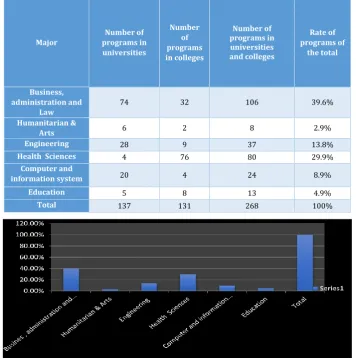
To test the first hypothesis which is “Majors and specialties provided by the private higher education institutions in KSA are appropriate to the specialties required in the labor market in the era of knowledge economy” the following table is used.
Data of table no. 1 shows that there is consistency between majors and specializations required in knowledge economy and those of private universities and colleges in KSA. Business and Administration represents the highest majors for about 40%, followed by Health Sciences, Engineering and Computer and Information Sciences for 29.9%, 13.8%, and 8.9% consequently. These majors are considered the most required specializations in the labor market in most of the economies which experience knowledge economy circumstances. The Humanitarian & Arts, and Education come at the tail of majors in private higher education institutions. There are some other specialties which are not established in private higher institutions such as agriculture and social services. Most probably the reason behind the suitability of majors provided by private higher education institution with what is required in knowledge era, is the profitability. The private sector seeks profit so it provides the specialties highly required in the labor market.
Table 1. Majors and programs of private universities and collegesin Saudi Arabia,2016
Major
Number of programs in universities
Number of programs in colleges
Number of programs in universities and colleges
Rate of programs of
the total
Business, administration and
Law
74 32 106 39.6%
Humanitarian &
Arts 6 2 8 2.9%
Engineering 28 9 37 13.8%
Health Sciences 4 76 80 29.9%
Computer and
information system 20 4 24 8.9%
Education 5 8 13 4.9%
Total 137 131 268 100%
The result of this analysis is appropriate with the
findings of the study carried by Abdulrahim, (2016), which showed that health, engineering and computer specializations are the most majors
J . H u m . I n s . 2 0 1 8 ; 2 ( 4 ) : 1 7 2 - 1 7 8 |177 education institutions in KSA are appropriate to the
specialties required in the labor market in the era of knowledge economy.” is true.
4.3.2 The second hypothesis
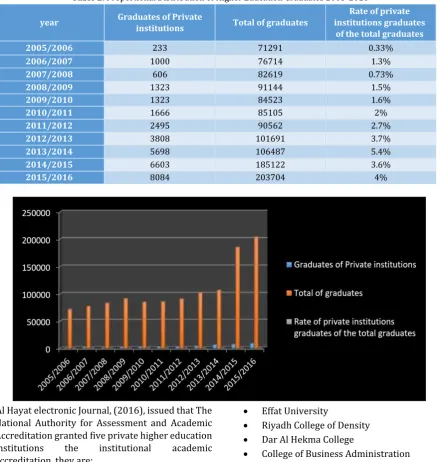
The second hypothesis is “Proportion of private higher education institutions to the total graduates of higher education in KSA is little”. The following table shows the distribution of graduates of private universities and colleges compared to total graduates of Saudi higher education institutions.
Table no. 2 shows that the proportion of private higher education graduates of the total graduates is very low, it doesn’t reach 6% throughout the period 2005-2016. But it is noticed that there is increasing trend of the growth rate of private higher education graduates in all years understudy with the
exception of the year 2007/2008. Regarding the recent involvement of the private sector in the higher education, these ratios are reasonable and indicate that the private sector will expand in the field of higher education if it continued its increasing trend in the near future. According to this analysis, the second hypothesis of the study “Proportion of private higher education institutions graduates to the total graduates of higher education in KSA is little “is true.
4.3.3The third hypothesis
The third hypothesis of this study is “Private higher education institutions deliver quality education which develop the graduates competencies required in knowledge economy.
Table 2. Proportional Distribution of Higher Education Graduates 2005-2016
year Graduates of Private institutions Total of graduates
Rate of private institutions graduates
of the total graduates
2005/2006 233 71291 0.33%
2006/2007 1000 76714 1.3%
2007/2008 606 82619 0.73%
2008/2009 1323 91144 1.5%
2009/2010 1323 84523 1.6%
2010/2011 1666 85105 2%
2011/2012 2495 90562 2.7%
2012/2013 3808 101691 3.7%
2013/2014 5698 106487 5.4%
2014/2015 6603 185122 3.6%
2015/2016 8084 203704 4%
Al Hayat electronic Journal, (2016), issued that The National Authority for Assessment and Academic Accreditation granted five private higher education institutions the institutional academic accreditation, they are:
Princess Sultan University
Effat University
Riyadh College of Density
Dar Al Hekma College
178 | J . H u m . I n s . 2 0 1 8 ; 2 ( 4 ) : 1 7 2 - 1 7 8 (Accreditation Board for Engineering and Technology), for six of its programs B.Sc. in (2009 &2012), four of them are Engineering programs and two computer programs.
King Faisal University and Princess Sultan University are the only two private universities which included in the classification of the best fifty Arab Universities ranking the positions 42 &43 consequently in the year 2014/2015. (Sabaq Electronic Journal, Riyadh ,7/12/2014).
For some extent, considering the relatively recent establishment of private higher education institutions, two out of nine universities and three colleges out of thirty-nine colleges to get the academic accreditation is limited for private higher education in Saudi Arabia.
One of the important indicators for quality performance of the private sector denoted in the results of (Jamgoom’s, 2012) study, was the usage of English language which perceived to contribute to the quality of education delivered in private higher education. It gives access to up-to-date books and learning resources not available in public universities. On other hand, (Jamgooms,2012) showed that stakeholders perceive significant differences in quality between private and public sectors in terms of quality of teaching class size, and emphasis on extracurricular activities. Students –teacher ratios are lower in the private institutions which enables greater personal attention for students. Regarding the previous qualitative analysis about the quality of education delivered by private higher education institutions, we can’t judge that the level of quality experienced in private higher education institutions is reasonable. The indicators of accreditation and teaching methods and English language may give relative significance of quality assurance in these Private institutions. Therefore, the hypothesis which states “Private higher education institutions deliver quality education which develop the graduates competencies required in knowledge economy.” could be accepted with limited level. 5.Findings and Recommendations
5.1 Findings
1. Saudi government provides incentives and privileges to encourage the private sector to invest in the higher education sector.
2. Continuous assessment and monitoring are carried by Ministry of Education for the performance of private higher education institutions for quality assurance.
3. Testing the hypothesis showed that Majors and specialties provided by the private higher education institutions in KSA are appropriate to the specialties required in the labor market in the era of knowledge economy.
4. Analysis revealed that the Proportion of private higher education institutions graduates to the
total graduates of higher education in KSA is little during the period 2005-2016.
5. Academic accreditation, local and regional ranking of Universities, methods of teaching and usage of English language provided limited evidence that Private higher education presents good quality of education consistent with development trends and quality standards. 5.2 Recommendations
1. Provision of more privileges to encourage the private sector to establish universities and colleges and introduce knowledge required majors and specialties.
2. Enhancement of secondary schools’ students to involve in private higher education institutions 3. Continuous monitoring and evaluating the
performance of the private universities and colleges to achieve quality of their output. References
1. Hiyam, A. 2016. Compatibility of Higher Education Specializations with the Employment in Economic Activities in Saudi Arabia in the Era of Knowledge Economy for the period (2010-2015), Journal of Business Management & Social Sciences Research Vol. 5 No. 9.
2. Althemaery, I. 2016. Saudi Economic, analytical view, King Saud University.
3. Diewerd, E. 2009. OECD workshops on productivity analysis and measurement, conclusion and future directions in productivity measurement and analysis, University of British Columbia. 4. Jamgoom, Y. 2012. Understanding private higher education in Saudi Arabia-Emergence, Development and perception, Institute of Education, University of London.
5. Mccowan, T. 2015. Should Universities promote employability? U.K, volume 13(33), SAQE.
6. Schwrdt, G. and J. Turunem. 2009. Changes in Human Capital implication for productivity growth in the Euro Area, OECD.
7. Tazeen, F. 2008. Linking Education Policy to labor market outcomes, World Bank publications. 8. Al-Hayat electronic Journal, 1/9/2016, www.alhayat.com.
9. Ministry of Education, The private Higher Education Report 2015, Saudi Arabia.
10. National Commission for Academic Accreditation &Assessment (NCAAA). 2013. Handbook for quality assurance and Accreditation in Saudi Arabia.
11. Organization of Economic Cooperation and Development (OECD), Competencies for knowledge Economy, chapter 4,2001.
12. Sabaq Electronic Journal, Riyadh, 7/12/2014 13. UNDP, Arab Knowledge Report, Youth and Localization of Knowledge. 2014
14. World Bank, World Development Indicators 2016, ED stats database.