PERFORMANCE EVALUATION OF A CLOUD-BASED PICTURE
ARCHIVING AND COMMUNICATION SYSTEM (PACS)
1
Jinmisayo Adigun Awokola,
1Justice Ono Emuoyibofarhe,
2Christoph Meinel,
1Funmilola Alaba Ajala
1 Department of Computer Science and Engineering, Ladoke Akintola University of Technology,
Ogbomoso, Oyo State, Nigeria
2 Internet Technology and Systems Chair, Hasso Plattner Institut, University of Potsdam, Potsdam,
Germany
Corresponding Author: Jinmisayo A. Awokola, [email protected]
ABSTRACT: In the field of medical informatics, there
has been a paradigm shift from the adoption of the conventional Picture Archiving and Communication System (PACS) to cloud-based PACS because of the cost-effectiveness and storage computational efficiency. However, cloud-plugged technologies are subject to security and network performance issues because of the internetworking and interoperability over the internet. Hence, this work focused on the development and evaluation of a secured cloud-based PACS framework so as to assess the usability of the technology in developing countries of the World through a case study approach. KEYWORDS: PACS, Cloud, DICOM, Modalities.
1. INTRODUCTION
Picture Archiving and Communication Systems (PACS) are continually useful in medical informatics because of the affinity to successfully store, retrieve, transmit, manage and visualize medically observed data from the radiologists ([TLT17]). However, there are challenges of adopting PACS in developing countries of the World because of the challenge of the cost of acquiring high-performance and grid-based hardware and software systems to successfully run a PACS-based technology for big-data driven medical applications ([GMK14]). Hence, cloud computing provides a feasible solution to this challenge by the provisioning of a cost-effective storage management facility.
Cloud computing is the internet-provisioning of storage and application resources for specific clients based on their specified requirements and needs ([S+18b]). Also, cloud-based computing aim to achieve ubiquitous computing ([K+16]). Hence, this led to the advancement and innovation of Mobile Cloud-based computing technology ([R+14]). However, the invisible integration of the Internet of Things (IoT) and cloud computing technologies poses a number of security and network performance issues to the potential clients ([C+18]).
Usability (adoption) of a technology is continually inhibited by the aforementioned technical (performance) issues ([AFG18]). However, cloud-PACS integrated technology is not an exception because the limitation of PACS that was bridged by the cloud technology gave rise to the security and network performance constraints. Hence, cloud-PACS (integrated) technology is an open-ended research issue. Therefore, recent research in cloud-PACS has focused on bridging the security and network performance issues to enhance the usability and wide adoption of the technology in medical informatics. However, this work focused on bridging the gap through deployment of the technology in a developing country context using a case study approach.
Security in Information-based applications generally focus on satisfying the anonymity, non-repudiation, authentication, confidentiality and authorization requirements ([CL18]). The cloud-plugged application is not an exception as the aforementioned requirements must be fully and successfully satisfied to ensure client's confidence in the cloud service. Different frameworks and models have been proposed to enhance the security of cloud-based computing technology ([L+18]; [T+18]; [S+18a]). However, these frameworks and models are often generic with less specificity to a particular application domain. Also, the network performance issues as a result of the security overhead inherent in these Cloud-PACS frameworks and models were often compromised because this is not a challenge in developed countries of the World. These regions enjoy a stable, high throughput, and high bandwidth internet connectivity.
Cloud-PACS frameworks that will provide security via the cloud and ensure fast retrieval and access to cloud-based storage resources are essential to facilitate and enhance medical diagnosis. Also, this will enhance the quick and faster treatment of successfully examined patients in the long run. Hence, this innovation will be successful in developing countries if it satisfied both security and network performance requirements.
2. REVIEW OF RELATED WORKS
Kuriakose ([Kur13]) proposed a conventional PACS implementation framework for medical imaging useful for diagnosis. It proposed an application network gateway for communicating, transmitting and archival of the medical imaging data. However, the major components of this framework are the imaging modalities (X-ray, CT scan, ultrasound and
MRI), PACS operational tools (PACS database server, PACS database and PACS controller) and users (radiologists). Figure 1 shows the proposed conventional PACS implementation framework through a Local Area Network (LAN) service provisioning.
Balasingam and Sivalingam ([BS17]) proposed the implementation of a Cloud-PACS framework for tele-echocardiology. In developing countries of the World, it is intended to facilitate expert inputs from cardiologists and physicians for better diagnosis and treatment since medical expertise in the field is not widely distributed across all the continental zones. However, this application domain is freight with a number of research issues ranging majorly from component-based standardization to security (confidentiality). Hence, the need for a robust cloud-PACS framework will aim to circumvent the aforementioned issues.
Figure 1: Conventional LAN-PACS Framework ([Kur13])
Parikh and Mehta ([PM15]) proposed a logically web-enabled framework for the deployment of PACS technology for medical imaging. This enhances the usability of the technology based on the cost-effectiveness advantage that the web offers over the conventional PACS framework. However, security is compromised for cost-effectiveness since the web is fraught with vulnerabilities which are exploitable by hackers. Hence, the need to integrate security frameworks into the web-based PACS can patch the vulnerabilities and holes.
Vuppala et al. ([V+17]) proposed a framework that hybridized cloud computing and big data technologies for the analysis of medical image data across different institutional domains to primarily support disease diagnosis. Security was achieved in
policy settings were appropriately configured. Obfuscation was the major security employed in this framework. Hence, the integrated technology was scalable across different platforms.
3. METHODOLOGY
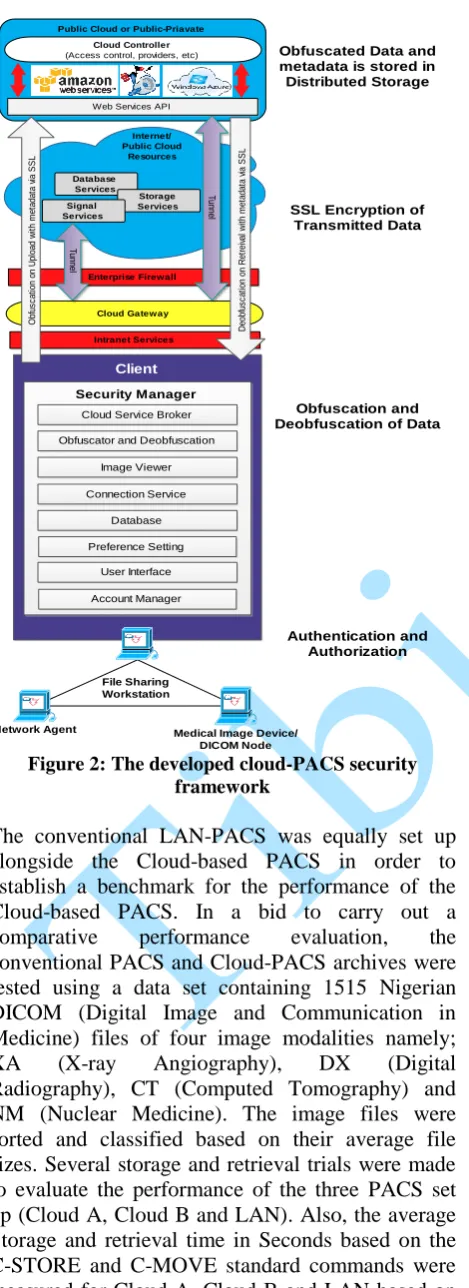
In this work, a security framework for cloud-PACS was developed. The framework successfully satisfied the confidentiality, authorization and authentication requirements majorly through the security components (obfuscator, cloud service broker, firewall, gateway, account and preference manager). The security components inter-network and inter-operate with the client, network and cloud layered components in order to successfully achieve
Local Area Network
Hospital Information Systems Radiologist A
Radioogist B
. . .
Radiologist n PACS
Database PACS Database
Server
PACS Controller X-ray
CT Scan
Ultrasound
framework. The cloud storage facility employed, are the Amazon Simple Storage Service (Cloud A) and Microsoft Azure (Cloud B). Figure 2 shows the Cloud-PACS security framework.
Figure 2: The developed cloud-PACS security framework
The conventional LAN-PACS was equally set up alongside the Cloud-based PACS in order to establish a benchmark for the performance of the Cloud-based PACS. In a bid to carry out a comparative performance evaluation, the conventional PACS and Cloud-PACS archives were tested using a data set containing 1515 Nigerian DICOM (Digital Image and Communication in Medicine) files of four image modalities namely; XA (X-ray Angiography), DX (Digital Radiography), CT (Computed Tomography) and NM (Nuclear Medicine). The image files were sorted and classified based on their average file sizes. Several storage and retrieval trials were made to evaluate the performance of the three PACS set up (Cloud A, Cloud B and LAN). Also, the average Storage and retrieval time in Seconds based on the C-STORE and C-MOVE standard commands were measured for Cloud A, Cloud B and LAN based on
uploads and downloads. All upload and retrieval experiments were carried out using the Internet LAN Service within the Ladoke Akintola University of Technology (LAUTECH), Ogbomoso, Nigeria Campus. This network represents a typical developing country scenario.
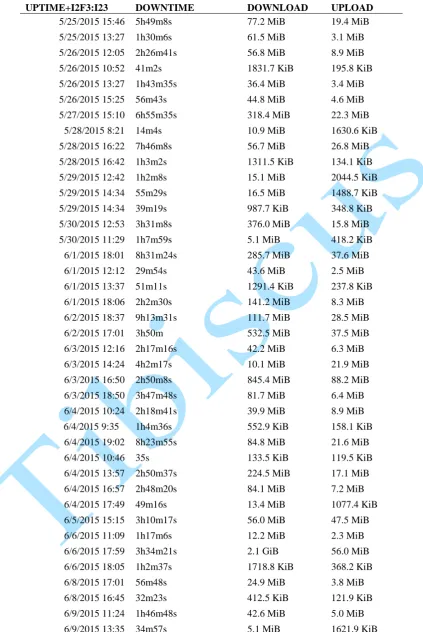
The profile of the internet network used for the experimentation is shown in Table 1.
4. RESULTS AND DISCUSSION
Several upload and retrieval trials were made on the DICOM Image dataset based on the standard C-STORE and C-MOVE commands. The average time to obtain results with trials is shown in form of tables. Tables 2 to 5 display the results for the storage process based on C-STORE for each modality while Tables 6 to 9 captures that of the download process based on C-MOVE.
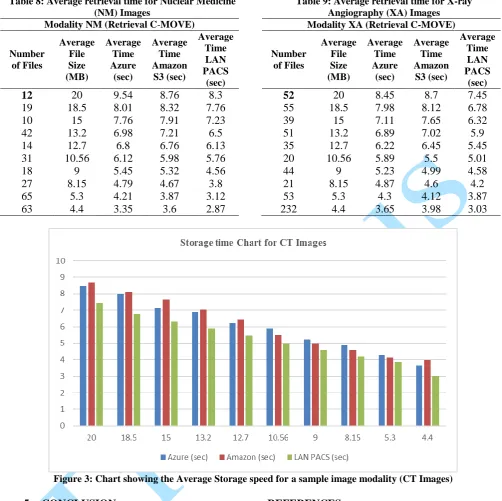
Figure 3 shows the sample graphical representation of one of the tables. As expected, the conventional PACS archive image storage, based on DICOM C-STORE command, is faster due to its simplicity and local operations. It is unquestionable that Cloud storage will always be slower than similar operations executed over the conventional LAN PACS. However, the important thing is to analyze the solution’s feasibility in a real world environment. The Cloud storage time presented in Tables 2 to 5 are acceptable for a typical DICOM institution, because archiving medical image studies is executed just once and without impacting on the end-user interface.
The analysis of image retrieval time is much more critical to validate the PACS cloud solution because the image data can be accessed (and downloaded) several times in the same procedure and the physician is in front of a work station waiting for the download to be completed. However, the conventional PACS image retrieval, based on DICOM C-MOVE command is faster than the Cloud solution.
The LAN PACS retrieval delays are similar to storage times because the process time associated with the retrieve command (C-MOVE) is residual compared to the effective network data transfer (C-STORE). However, a good observation is that the retrieval time differences from Cloud to LAN are much lower than in the storage process. In general, the trials showed that the solution is robust and that it was possible to store and retrieve all the desired studies without any problem or service interruptions. Web Services API
Enterprise Firewall
Intranet Services Cloud Gateway Cloud Controller (Access control, providers, etc) Public Cloud or Public-Priavate
Database Services Storage Services Signal Services Internet/ Public Cloud Resources T u n n e l T u n n e l Security Manager
Obfuscator and Deobfuscation
Preference Setting Account Manager O b fu s c a ti o n o n U p lo a d w it h m e ta d a ta v ia S S L D e o b fu s c a ti o n o n R e tr e iv a l w it h m e ta d a ta v ia S S L
Medical Image Device/ DICOM Node Network Agent
Client
File Sharing Workstation
Cloud Service Broker
Image Viewer
Connection Service
Database
User Interface
Obfuscated Data and metadata is stored in Distributed Storage
SSL Encryption of Transmitted Data
Table 1: The profile of the Nigerian internet network used for the cloud-PACS implementation UPTIME+I2F3:I23 DOWNTIME DOWNLOAD UPLOAD
5/25/2015 15:46 5h49m8s 77.2 MiB 19.4 MiB
5/25/2015 13:27 1h30m6s 61.5 MiB 3.1 MiB
5/26/2015 12:05 2h26m41s 56.8 MiB 8.9 MiB
5/26/2015 10:52 41m2s 1831.7 KiB 195.8 KiB
5/26/2015 13:27 1h43m35s 36.4 MiB 3.4 MiB
5/26/2015 15:25 56m43s 44.8 MiB 4.6 MiB
5/27/2015 15:10 6h55m35s 318.4 MiB 22.3 MiB
5/28/2015 8:21 14m4s 10.9 MiB 1630.6 KiB
5/28/2015 16:22 7h46m8s 56.7 MiB 26.8 MiB
5/28/2015 16:42 1h3m2s 1311.5 KiB 134.1 KiB
5/29/2015 12:42 1h2m8s 15.1 MiB 2044.5 KiB
5/29/2015 14:34 55m29s 16.5 MiB 1488.7 KiB
5/29/2015 14:34 39m19s 987.7 KiB 348.8 KiB
5/30/2015 12:53 3h31m8s 376.0 MiB 15.8 MiB
5/30/2015 11:29 1h7m59s 5.1 MiB 418.2 KiB
6/1/2015 18:01 8h31m24s 285.7 MiB 37.6 MiB
6/1/2015 12:12 29m54s 43.6 MiB 2.5 MiB
6/1/2015 13:37 51m11s 1291.4 KiB 237.8 KiB
6/1/2015 18:06 2h2m30s 141.2 MiB 8.3 MiB
6/2/2015 18:37 9h13m31s 111.7 MiB 28.5 MiB
6/2/2015 17:01 3h50m 532.5 MiB 37.5 MiB
6/3/2015 12:16 2h17m16s 42.2 MiB 6.3 MiB
6/3/2015 14:24 4h2m17s 10.1 MiB 21.9 MiB
6/3/2015 16:50 2h50m8s 845.4 MiB 88.2 MiB
6/3/2015 18:50 3h47m48s 81.7 MiB 6.4 MiB
6/4/2015 10:24 2h18m41s 39.9 MiB 8.9 MiB
6/4/2015 9:35 1h4m36s 552.9 KiB 158.1 KiB
6/4/2015 19:02 8h23m55s 84.8 MiB 21.6 MiB
6/4/2015 10:46 35s 133.5 KiB 119.5 KiB
6/4/2015 13:57 2h50m37s 224.5 MiB 17.1 MiB
6/4/2015 16:57 2h48m20s 84.1 MiB 7.2 MiB
6/4/2015 17:49 49m16s 13.4 MiB 1077.4 KiB
6/5/2015 15:15 3h10m17s 56.0 MiB 47.5 MiB
6/6/2015 11:09 1h17m6s 12.2 MiB 2.3 MiB
6/6/2015 17:59 3h34m21s 2.1 GiB 56.0 MiB
6/6/2015 18:05 1h2m37s 1718.8 KiB 368.2 KiB
6/8/2015 17:01 56m48s 24.9 MiB 3.8 MiB
6/8/2015 16:45 32m23s 412.5 KiB 121.9 KiB
6/9/2015 11:24 1h46m48s 42.6 MiB 5.0 MiB
Table 2: Average storage time for Computed Tomography (CT) Images
Modality CT (Storage C-STORE)
Number of Files Average File Size (MB) Average Time Azure (sec) Average Time Amazon S3 (sec) Average Time LAN PACS (sec)
15 20 10.55 10.81 6.23
41 18.5 10.40 10.09 5.91
38 15 9.75 9.6 5.33
20 13.2 9.12 9.35 3.98
11 12.7 8.68 8.81 4.34
49 10.56 8.39 8.23 4.9
43 9 7.86 8.02 2.45
41 8.15 7.32 7.75 3.72
38 5.3 6.78 6.56 2.12
100 4.4 5.87 5.71 5.01
Table 3: Average storage time for Digital Radiography (DX) Images
Modality DX (Storage C-STORE)
Number of Files Average File Size (MB) Average Time Azure (sec) Average Time Amazon S3 (sec) Average Time LAN PACS (sec)
15 20 10.56 10.12 7.34
41 18.5 9.23 8.98 5.32
38 15 8.35 8.75 4.99
20 13.2 7.45 7.79 3.01
11 12.7 7.01 6.87 3.23
49 10.56 6.23 6.56 4.19
43 9 6.19 6.05 2.03
41 8.15 5.45 5.59 4.96
38 5.3 4.78 4.65 4.21
100 4.4 3.73 3.86 3.13
Table 4: Average storage time for Nuclear Medicine (NM) Images
Modality NM (Storage C-STORE)
Number of Files Average File Size (MB) Average Time Azure (sec) Average Time Amazon S3 (sec) Average Time LAN PACS (sec)
12 20 9.82 9.76 9.32
19 18.5 9.23 8.95 8.65
10 15 8.73 8.43 8.01
42 13.2 7.45 7.78 6.84
14 12.7 7.05 7.23 6.58
31 10.56 6.77 6.4 5.8
18 9 6.13 5.76 5.15
27 8.15 5.45 5.65 4.35
65 5.3 5.55 5.13 4.85
63 4.4 4.91 4.87 4.12
Table 5: Average storage time for X-ray Angiography (XA) Images
Modality XA (Storage C-STORE)
Number of Files Average File Size (MB) Average Time Azure (sec) Average Time Amazon S3 (sec) Average Time LAN PACS (sec)
52 20 9.65 9.76 5.01
55 18.5 9.34 9.13 4.84
39 15 8.97 8.67 4.43
51 13.2 8.01 8.23 4.9
35 12.7 7.72 7.81 3.34
20 10.56 7.13 7.34 3.78
44 9 6.87 6.76 3.37
21 8.15 6.12 6.23 2.89
53 5.3 5.76 5.9 2.23
232 4.4 4.91 5.17 1.35
Table 6: Average retrieval time for Computed Tomography (CT) Images
Modality CT (Retrieval C-MOVE)
Number of Files Average File Size (MB) Average Time Azure (sec) Average Time Amazon S3 (sec) Average Time LAN PACS (sec)
12 20 6.55 5.12 4.22
24 18.5 5.78 6.23 5.2
23 15 3.94 4.32 3.2
31 13.2 5.08 5.29 4.6
11 12.7 6.43 5.26 4.08
23 10.56 5.19 4.65 3.89
11 9 4.18 5.24 3.55
17 8.15 3.97 3.32 2.56
22 5.3 4.8 3.87 2.79
42 4.4 6.91 5.64 3.06
Table 7: Average retrieval time for Digital Radiography (DX) Images Modality DX (Retrieval C-MOVE)
Number of Files Average File Size (MB) Average Time Azure (sec) Average Time Amazon S3 (sec) Average Time LAN PACS (sec)
15 20 9.76 8.51 7.43
41 18.5 8.7 9.23 7.39
38 15 8.43 8.21 7.17
20 13.2 7.65 8.09 6.87
11 12.7 7.21 7.43 6.31
49 10.56 6.87 6.98 6.01
43 9 6.32 5.91 5.21
41 8.15 5.54 5.24 4.82
38 5.3 5.02 4.86 4.13
Table 8: Average retrieval time for Nuclear Medicine (NM) Images
Modality NM (Retrieval C-MOVE)
Number of Files
Average File Size (MB)
Average Time Azure
(sec)
Average Time Amazon
S3 (sec)
Average Time LAN PACS
(sec)
12 20 9.54 8.76 8.3
19 18.5 8.01 8.32 7.76
10 15 7.76 7.91 7.23
42 13.2 6.98 7.21 6.5
14 12.7 6.8 6.76 6.13
31 10.56 6.12 5.98 5.76
18 9 5.45 5.32 4.56
27 8.15 4.79 4.67 3.8
65 5.3 4.21 3.87 3.12
63 4.4 3.35 3.6 2.87
Table 9: Average retrieval time for X-ray Angiography (XA) Images Modality XA (Retrieval C-MOVE)
Number of Files
Average File Size (MB)
Average Time Azure
(sec)
Average Time Amazon
S3 (sec)
Average Time LAN PACS
(sec)
52 20 8.45 8.7 7.45
55 18.5 7.98 8.12 6.78
39 15 7.11 7.65 6.32
51 13.2 6.89 7.02 5.9
35 12.7 6.22 6.45 5.45
20 10.56 5.89 5.5 5.01
44 9 5.23 4.99 4.58
21 8.15 4.87 4.6 4.2
53 5.3 4.3 4.12 3.87
232 4.4 3.65 3.98 3.03
Figure 3: Chart showing the Average Storage speed for a sample image modality (CT Images)
5. CONCLUSION
This work successfully carried out a comparative performance analysis and evaluation of cloud-PACS integrated technology and the conventional LAN-PACS so as to ascertain the usability quotient for developing countries of the World through a Nigerian case study and experimentation. However, trade-off between security and performance was minimized to a reasonable level based on the results obtained. Hence, this work recommends the implementation and adoption of a secured Cloud-PACS framework for developing countries so as to enhance medical imaging. Consequently, this will enhance the quality of medical services and customer's (patient) satisfaction on the long run.
REFERENCES
[AFG18] Atzeni A., Faily S., Galloni R. -
Usable Security. Encyclopaedia of Information Science and Technology (4th Edition), 2018.
[BS17] Balasingam M., Sivalingan B. -
Future of Tele-echocardiology. Journal of Nursing and Health Care 3(1), 12-15, 2017.
[C+18] Conti M., Dehghantanha A., Franke K., Watson S. - Internet of Things Security and Forensics: Challenges and Opportunities, Future Generation Computer Systems 78(2), 544-546
[GMK14] Grace R. K., Manimegalai R., Kumar S. - Medical Image Retrieval System in
Grid using Hadoop Framework,
International Conference on Computational Science and Computational Intelligence, Las Vegas, USA, 2-5, 2014.
[K+16] Kryftis Y., Mastorakis G., Mavromoustakis C. X., Batallaa J. M., Pallas E., Kormentzas G. -
Efficient Entertainment Services
Provision over a novel network
architecture. IEEE Wireless
Communication, 23(1), 14-21, 2016.
[Kur13] Kuriakose K. - Infrastructure for Secure Medical Image Sharing between Distributed PACS and DI-r systems
(Masters). University of Ontario Institute of Technology, Oshawa, Ontario, 2013.
[L+18] Liu L., Liu L., Xiadong F., Huang Q., Zhang X., Zhang Y. - A Cloud-based Framework for Larger scale traditional Chinese Medical Record Retrieval, Journal of Biomedical Informatics, 77(1), 21-33, 2018.
[PM15] Parikh A., Mehta V. - PACS and Imaging Informatics: Next Generation and Innovations, Proceedings of the SPIE Medical Imaging, Orlando, USA, 2015.
[R+14] Rahimi R. M., Ren J., Lin C. H., Vasilakos A. V., Venkatasubramanian N. - Mobile Cloud Computing: A Survey, State of Art and Future Directions. Mobile Networks and Applications 19(2), 133-143, 2014.
[S+18a] Sohol A. S., Sandthu R., Sood S. K., Chang V. - A Cybersecurity Framework to identify malicious edge devices in fog computing and cloud-of-things environments. Computers and Security 74 (1), 340-345,
[S+18b] Stergiou C., Psannis K. E., Kim B., Gupta B. - Secure Integration of IoT
and Cloud Computing, Future
Generation Computer Systems 5(2), 25-28, 2018.
[TLT17] Tabatabaei M. S., Langarizadeh M., Tavakol K. - An Evaluation Protocol
for Picture Archiving and
Communication System: A Systematic Review, Acta Informatica Medica 25(4), 250-253, 2017.
[T+18] Tao M., Zuo J., Liu Z., Castiglione A., Palmieri F. - A Multi-layer Cloud Architecture Model and Ontology-based Security Service Framework for
IoT-based smart homes, Future
Generation Computer Systems 78(3), 1040-1042, 2018.
[VGS18] Verma P., Gupta A., Sambyal R. S. -
Security Issues and Challenges in
Cloud Computing: A Review,
International Journal of Scientific Research in Computer Science, Engineering and Information Technology 4(1), 1-4, 2018.
[V+17] Vuppala S. K., Dinesh M. S., Viswanathan S., Ramachandran G., Bussa N., Geetha M. - Cloud Based Big Data Platform for Image Analytics,
![Figure 1: Conventional LAN-PACS Framework ([Kur13])](https://thumb-us.123doks.com/thumbv2/123dok_us/8958822.1868190/2.595.66.534.289.576/figure-conventional-lan-pacs-framework-kur.webp)