97
IJMGE
Int. J. Min. & Geo-Eng.Vol.50, No.1, June 2016, pp.97-110.
Effects of Weak Layer Angle and Thickness on the Stability of Rock Slopes
Garmondyu E. Crusoe Jr
*1, Cai Qing-xiang
1, 2, Shu Ji-sen
1, 2, Han Liu
1, 2, Yamah J. Barvor
11- School of Mines, China University of Mining &Technology, Xuzhou, Jiangsu 221116, China
2- State Key Laboratory of Resources and Mine Safety, China University of Mining &Technology, Xuzhou, Jiangsu 221116, China
Received 13 Aug 2015; received in revised form 07 May 2016; accepted 07 May 2016 *Corresponding author: [email protected]
Abstract
This paper investigates two key factors (angle and thickness) of a weak layer in relation to their influencing mechanism on slope stability. It puts forward the sliding surface angle and morphological model criteria for the control of rock slopes and realization of its failure mechanism. By comparing the Failure Modes and Safety Factors (Fs) obtained from numerical analysis, the influence pattern for the weak layer angle and the thickness on the stability of rock slopes is established. The result shows that the weak layer angle influences the slope by validating the existence of the “interlocking” situation. It also illustrates that as the angle of the weak layer increases, the Fs unceasingly decreases with an Fs transformation angle. The transformation interval of the Fs demonstrates the law of diminishing of a quadratic function. Analysis of the weak layer thickness on the influence pattern of slope stability reveals three decrease stages in the Fs values. The result also shows that the increase in the thickness of the weak layer increases the failure zone and influences the mode of failure. Given the theoretical and numerical analysis of a weak layer effects on the stability of rock slopes, this work provides a guiding role in understanding the influence of a weak layer on the failure modes and safety factors of rock slopes.
Keywords:Slope Stability, Safety Factors, Failure Modes, Weak Layer
1. Introduction
Slope Instability is the downward movement of soil or rock mass in response to gravitational stresses. The investigation of slopes has become very important in the field of civil and mining engineering in order to find the potential failure mechanism for safe design of open pits, highways and dams in terms of safety, reliability, and economically profitability. There are several ways of carrying out slope stability analysis; two of the most common methods used these days are the traditional Limit Equilibrium method and the
Strength Reduction method. The Limit
Crusoe Jr et al./ Int. J. Min. & Geo-Eng., Vol.50, No.1, June 2016
98
23, 24]. In rock mechanics, discontinuities such as joints, weak bedding planes, faults, and weak zones significantly influences the response of rock masses to loadings and surface excavations [3, 7]. Several researchers have attributed the failure of rock masses to the presence of weak layer. For example, the catastrophic rockslide-debris flow which occurred at the crest of the Jiweishan Mountain in Wulong, Chongqing, China, was studied and it was deduced that approximately five million cubic meters of the limestone blocks slid along a weak interlayer of bituminous and
carbonaceous shale [26]. The Abbotsford
landslide of 1979, which occurred in the urban area of Dunedin, New Zealand, was studied and through a commission of inquiry it was established that unfavorable geology due to a weak clay layer in the 7°- dip slope was the underlying cause of the landslide [15]. The failed dip slope of the 2004 Niigata-ken Chuetsu Earthquake in Japan was investigated and the researchers established that the slope failed along a deeply weathered weak thin layer of sandy tuff [11]. Several cases of instability of cut slopes along major highways in Jordan were studied with the aim of establishing a wider database of case-studies and all possible mechanisms and factors influencing stability. The study shows that major cut slope failures were caused by the presence of weak cohesive layers (mainly clayey marl) inter bedded within mostly stronger formations [1]. Using the two-dimensional UDEC (3.1) software, the effect of two single lithological structures on the height of a collapsing roof was studied and it was found that the major controlling factors affecting the height of the collapsing roof to be the weak lithological structure of the surrounding rocks [20]. Also, the effect of weak interlayer on the failure pattern of rock mass around tunnel by using physical model test and numerical analysis was studied and it was deduced that the weak interlayer affected the stability of the tunnel by
increasing the failure zone and causing
asymmetric stress distribution [16]. In relation to the influence of the geo-mechanical properties of the weak layer, most of the previous studies focused on the shear strength of the weak layer on which failure is likely to occur or has occurred [12, 13]. For example, retrieved undisturbed samples from the 2004 Niigata-ken Chuetsu Earthquake were collected and the strength properties of the weak layer which formed part of the main sliding body was analyzed using both simple shear and tri-axial compression tests [10]. However, very few studies have focused on the role of parameters such as orientation, location,
and thickness of a weak layer on slope stability. The impact of a weak horizon on kinematics and internal deformation of failure mass by using discrete element method was carried out [21] and the study shows that the presence and geometry of a weak horizon change the mode and kinematic of mass movement and govern the location of the failure surface. The failure mode and formation of shear zones in clay slopes with horizontal montmorillonite weak layers under rainfall conditions was investigated [25] and the results show that the weak and permeable layer caused rainfall to infiltrate deeper into the slope, inducing additional displacement. The issue of validating the concept of weak layer role on the stability of rock slopes has not been adequately discussed in literature. Therefore, further work is needed to establish a more systematic methodology for studying the role of weak layer on deformability of rock slopes, which is the main aim of this research. Of the various numerical methods used for analyzing slope stability, it is well known that the families of Discrete Element Method and Discontinuous Deformation Analysis are well suited to problems influenced by planes of weaknesses. It has been demonstrated that the Finite Element Method (FEM) with explicit representation of discontinuities with joint elements is a credible alternative [5, 17, 18, 14, 27]. In this study, a systematic investigation of the weak layer influence was conducted using a control variate methodology along with the use of numerical simulations.
2. Theoretical background
2.1 A Weak layer dip angle and its influence on stability of rock slopes
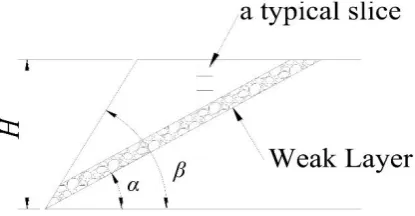
A Weak Layer is a key factor that controls the stability of surface mines slopes. Figure 1(a) shows a weak layer control slope where sliding is likely to occur. As shown in Figure 1b, the mechanical model of the upper sliding mass is presented and the mode of failure is dictated by the plane. From Figure 1: H is the height of the slope, N is the normal component, β the slope face angle and α, the dip angle of the weak layer.
99
(b) Mechanical model
Fig. 1 Mechanical model of Slope Failure control by Weak Layer
Based on the mechanical analysis of Figure 1 above, the sliding mass stability is determined, whether or not the magnitude of the relationship between the sliding force (Fx) and the resisting force (Fk) is larger or smaller. The sliding force
(Fx) is defined by the equation:
(1) While the resisting force (Fk) is defined as:
(2) where G is defined as the weight of the sliding mass, kN, and (°) the internal friction angle of the weak layer. By equation (1) and (2), the stability of the sliding mass can be determined based on the following conditions:
(3)
When , the slope is stable
and the condition is further reduced to , that is, the slope is in a steady state condition where the weak layer angle α is less than its internal friction angle . From the conditions specified, when α= , the slope is in a limiting equilibrium state and when α< , the slope is in a state of instability. Hence, the angle of the weak layer influences the stability of the slope. According to the above theoretical model combined with the monitoring data of the weak layer angle and internal friction angle, the influence of the weak layer angle on the slope stability can be accurately determined.
2.2 A Weak layer thickness and its influence on
stability of rock slopes
The presence of a weak layer within a slope does not only influence the slope stability, but also the mode of failure. When the weak layer thickness is comparatively small, sliding often occurs on the weak layer. However, with increase in the weak layer thickness, the sliding body structure and morphology are no longer controlled by the weak layer angle, but rather the mechanical parameters and specific thickness of the weak layer. Figure 2 below, shows a slope model with a thick weak layer that controls the stability of a rock slope.
Fig. 2 Control Slope model by weak layer thickness
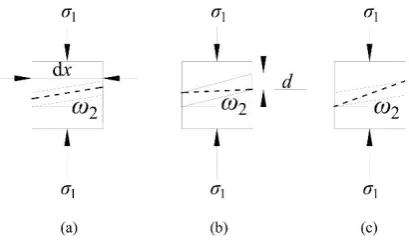
Adopting the fundamental basis of the slice method, the sliding mass is divided into slices and the rock mass strength is used to determine the weakest structural plane as shown in Figure 3. For the original rock mass under the effect of the principal stress , the maximum shear stress plane and the horizontal plane angle is defined by:
(4)
Fig. 3 Rock mass stress model
When the maximum shear stress surface occurs within the region of the weak layer as shown in
x
sin
F
G
k cos tan '
F G
'
cos tan ' sin
cos tan ' sin
cos tan ' sin
G G
G G
G G
cos tan ' sin
G G
tan ' tan
'
'
'
1
1
o 1 45
2
Crusoe Jr et al./ Int. J. Min. & Geo-Eng., Vol.50, No.1, June 2016
100
Figure 3d, the plane of rupture and the horizontal surface angle is defined as:
(5)
However, when the maximum shear stress occurs within different rock masses and passes through the rock mass structural plane, the entire failure structure is not a straight shearing surface as seen in Figure 3c. Hence, the presence of the weak layer within the slope does not only give rise to the slope deformation, but also influences the sliding surface geometry. A critical factor that affects the stability of slope and its failure mode in addition to the weak layer angle α, is the weak layer thickness d, which can be determined based on the following conditions:
(6)
From the criterion above, wher ,
the most critical sliding surface is parallel to the weak layer extensional direction; hence, failure occurs along the plane of the weak layer. For the
criterion when as demonstrated
in Figure 4(b), the condition of the sliding surface angle which follows the condition of the weak layer most critical sliding surface angle is satisfied
completely, such that,
. When Δ>0, the slice base which is the sliding surface, lies completely within the weak layer and stability of the slope depends on the shear strength of the weak layer. Also, when Δ=0, the slice base is the most critical sliding surface and failure occurs from the right side of the model (Figure 4b) to the left top side. However, when Δ<0, the most critical sliding surface and the rock mass interface intersect and the failure surface is determined by both the rock mass strength and the strength of the weak layer (Figure 3c). Thus, in a typical slice, the sliding surface may not be a complete planar failure surface.
Fig. 4 Weak Layer control sliding surface angle decisive model
For the final criterion in (6) where
, the sliding surface occurs at
the slice base satisfying the condition
. From the condition, it is seen that if Δ>0,the sliding surface exist completely within the weak layer and when Δ=0, the slice base becomes the most critical sliding surface. However, when Δ < 0,the critical sliding surface develops from the right top side to the bottom left side, where failure occurs both in the rock mass and the weak layer.
3 Method and Model Setup 3.1 Flac / Slope
FLAC/Slope is the computer code used for this research. It is a powerful numerical tool based on the Finite Difference Method that has the capability of simulating advanced geotechnical analysis. It is designed specifically to perform factor of safety calculations for slope stability. It operates directly from the two-dimensional FLAC graphical interface (the GIIC) which provides for rapid creation of models for soil and rock slopes along with their stability conditions [17].
3.2 Model Setup
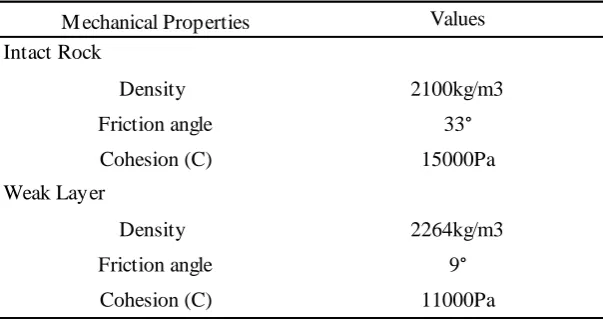
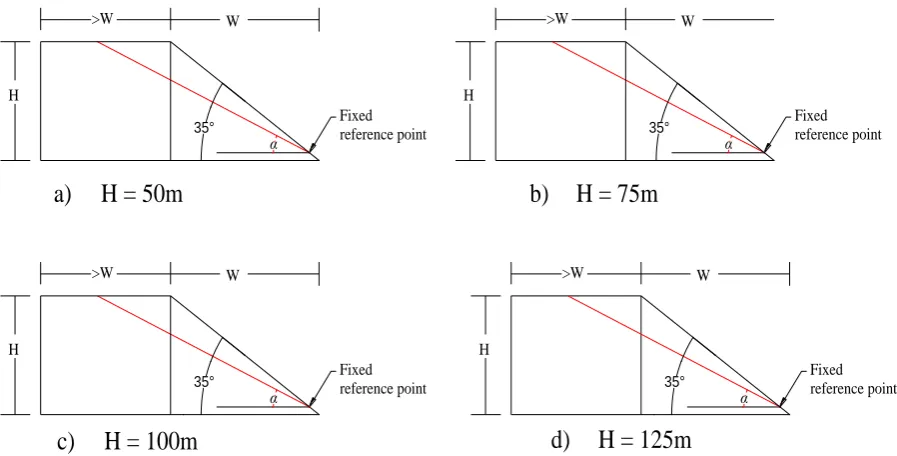
In order to investigate the effect of a weak layer on the Fs and Failure Mode of slope, two critical factors of the weak layer were studied. The slope models were set up at four different heights, namely; 50m, 75m, 100m and 125m, respectively, as shown in Figure 5. The material parameters of the rock and weak layer used in the numerical analysis are shown in Table 1. The initial models as illustrated in Figure 5(a-d) were done without the inclusion of a weak layer, while, for all subsequent models, the weak layer dip angle and thickness were varied as the factor of safety was calculated. The numerical simulations were done keeping the weak layer angle at a constant value (e.g. 5°); the weak layer thickness is varied from w 3
45
2
w 2 w 2 w 2> 45 2
= 45
2 45 2 w 2
= 45
2
w 2
> 45 2
2
= -(d tan -d tand x
x
) w 2 45 2 2
= -(d tand x
-d tan )x
101
0.1m to 2.5m. The above procedure was done for all weak layer angles within the four different.
slopes model Figure 5(a-d). From Figure 5, H is the height and w is the width of the slope
Materials are represented by quadrilateral elements within the model, which form a mesh or grid that is shaped as the object to be modeled. Elements and grid points are numbered in a row-and-column fashion rather than in a sequential manner. The program uses two dimensional arrays (I, J) and (i,j) to define the elements and nodes respectively, within its discrete mesh. An uppercase “I” and a lowercase “i” specify the location of an element and a node, column-wise from left to right, starting at column one. On the other hand, an uppercase “J” and a lowercase “j” specify the location of an element and a node, row-wise from bottom to top, starting at row one. The grid elements within the mesh behave according to a prescribed linear or non-linear stress / strain behavior in response to the applied forces or boundary restraints. The material can yield and flow, and the mesh can deform and move with the material that is represented. The accuracy of a finite element analysis depends on the type of element used, fineness of mesh, mesh layout, the geometry of the problem, and the constitutive model used to simulate the
stress-strain behavior of the soils. Different
discretization schemes used in finite element analysis of slopes during the last three decades show great variability in the size and shape of the elements used. To analyze the rock slope stability, the slope model is first divided into rock blocks that are then internally discretized into finite difference square elements. The discrete finite difference mesh used in the analysis for the 75m high slope is as shown in Figure 6. The most important factors in the stability analysis of a rock
slope using the finite difference method are the unit weight of soil γ, the shear strength parameters c′ and φ′, and the geometry of the problem. Although a number of failure criteria have been suggested for modeling the strength of soil, Mohr Coulomb criterion remains the most widely used in geotechnical practice and has been used throughout this paper. The behavior of the weak layer is defined by the coulomb slip criterion which limits the shear force. In addition, the weak layer may dilate at the onset of slip. Dilation is governed in the coulomb model by a specified dilation angle ψ [17]. The dilation angle ψ affects
the volume change of the soil during yielding. As a frictional material, it will exhibit high dilation near the peak leading eventually to a residual state under a constant volume condition (ψ = 0) [6]. Slope stability analysis is relatively unconstrained, so the selection of soil dilation angle is less important [13]. As the main objective of the study was the prediction of the factor of safety, a compromise value of ψ = 0 during yield has been used in this paper. This value of ψ enables the model predict reliable factor of safety and a reasonable indication of the location and shape of the potential failure surfaces [6, 13]. The numerical modeling work presented in this
research was carried out providing the
assumptions presented in Table 2. These assumptions are necessary for a generic study, as our aim is to establish a numerical platform for predicting the influence of a weak layer on the stability of rock slopes.
Cohesion (C)
Values
2100kg/m3
33°
15000Pa
2264kg/m3
9°
11000Pa M echanical Properties
Intact Rock
Density
Friction angle
Cohesion (C)
Weak Layer
Density
Table 1. Material Properties of intact rock and weak layer
102
Fig. 5 Slope models and locations of artificial far field boundaries
Fig. 6 Model geometry with domain discretization (Finite difference mesh)
No. Conditons
1
The thin weak layer was created in FLAC/Slope by adjusting two layer boundaries to match the locations of the weak layer. The weak layer boundaries were positioned in the Layers tool by locating the handle points along the boundaries at the specified x- and y-coordinate positions [17].
2
According to the mechanical process in rock excavation and slope stability analyses, the right and left boundaries of the mesh were fixed only in the horizontal direction, while the base was fixed in both the horizontal and vertical directions. The angle of the weak layer was interchange d from 5° to 25° at an interval of 5°.The weak layer thickness used in the numerical model were interchanged from 0.1m to 2.5m at an interval of 0.2m. The weak layer dip on the face of the slope, 6.5m above the slope toe in all model with weak layer.
3 The strength properties of the weak layer and intact rock were kept constant in all model. The mechanical parameters
used in all analysis were provided by [9].
4
Several authors have discussed in depth the influence of the finite difference mesh on the stability of slope [17, 23]. However a detailed mesh modelling is beyond the scope of this study and for the purpose of consistency a finer mesh in Flac/slope is used to simulate all the models.
Table 2. General Assumptions
>W H
α
H
α
W
35°
W
35°
Fixed reference point
Fixed reference point >W
a)
H = 50m
WFixed reference point 35°
H
d)
H = 125m
Wα
c)
H = 100m
35° >WH
b)
H = 75m
>W
Fixed reference point
103
4. The effect of weak layer angle and thickness on rock slope stability4.1 Influence pattern of a Weak Layer angle on stability
Based on the analyses for different weak layer
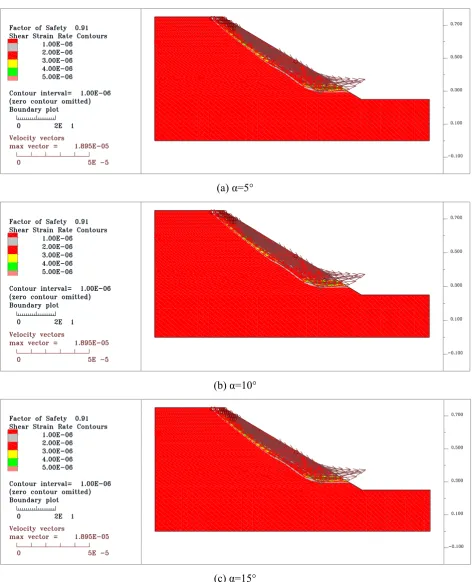
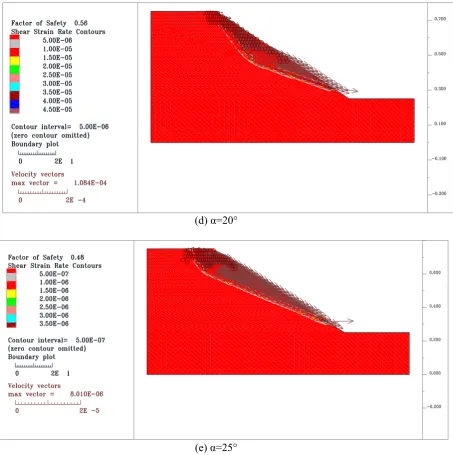
angles, given the slope height is 50m and weak layer thickness is 0.9m; the corresponding influence on the slope stability by the angles of the weak layer are shown in Figure 7(a-e), while, Figure 8 shows the Fs change rule for the 0.9m thick weak layer.
(a) α=5°
(b) α=10°
Crusoe Jr et al./ Int. J. Min. & Geo-Eng., Vol.50, No.1, June 2016
104
(d) α=20°
(e) α=25°
Fig. 7 Weak Layer angles influence on the slope stability
Fig. 8 Fs change rule for the weak layer angle
0 0.2 0.4 0.6 0.8 1
0 5 10 15 20 25
FS
105
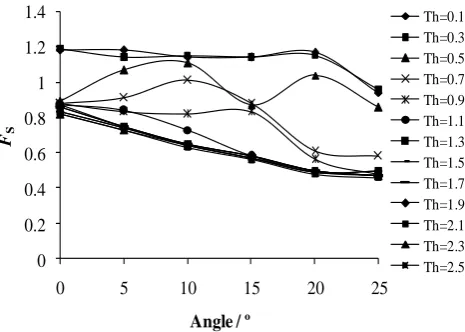
As it can be seen in Figure 8, as the weak layer angle increases, the safety factors take an overall decreasing trend and at an angle greater than 15°, the Fs appear in an accelerated decline. For different weak layer thickness at a continuous variable process, their Fs value and corresponding weak layer angles are shown in Figure 9.
Fig. 9 Fs values for Weak Layer thicknesses at different weak layer angles
As shown in Figure 9, with the increase of the weak layer angles, the weak layer thickness equally gives rise to the decrease in the Fs values at a certain degree. However, all curves do not completely conform to the kind of change rule as shown in Figure 8. It is observed that, for a certain weak layer thickness (e.g. 0.5m), a medium mesh in Flac/Slope may suitably produce results that would generate similar curve to that shown in Figure 8. However as the weak layer thickness varies (e.g. 0.3m or 0.7m), a medium mesh may no longer be suitable, but rather a finer mesh would be ideal for simulation. As shown in Figure 9, the result shows abnormal values, which are primarily the effect of the finite difference mesh. Removing d=0.5m, that is omitting the abnormal data, when the weak layer thickness is atd<0.9m, the Fs exerts a comparatively similar change rule. The results show that there exists a break point angle which causes an accelerated decrease in the value of the Fs as the weak layer thickness gradually increases. Having d=0.1m and d=0.3m, the break point angle is 20°, while, when d=0.7m and d=0.9m, the break point angle is 15°. When the weak layer thickness is greater than 1.1m, the slope Fs and the increase of the weak layer angle shows a progressive decreased quadratic function as the rate of decline reduces.
4.2 Influence pattern of a Weak Layer thickness on stability
By studying the weak layer angle and Fs influence pattern, it appears that there exist an influence relationship between the weak layer thickness and the safety factor. The result shows that at the same angle, different thickness of a weak layer corresponds to different safety factors, as shown in Figure 10.
Fig. 10 Relationship between Fs value and weak layer thickness at different weak layer angles
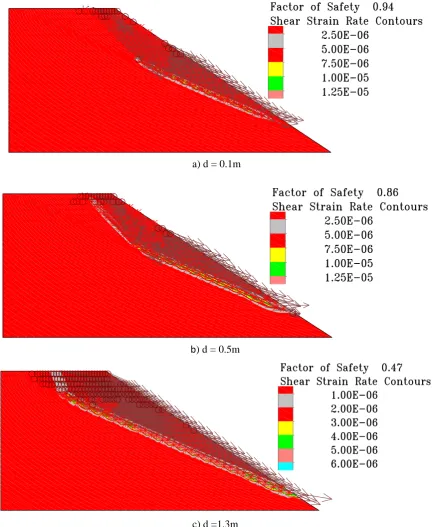
From Figure 10, the factor of safety and the weak layer thickness increment exert an identical change rule. When d<0.25m, the decrease in the rate of stability is slow. However, when 0.25m<d<1.1m, the overall Fs shows a larger rate of decrease. In addition, when d>1.25m, the Fs basically remains unchanged. These phenomena show that when the weak layer thickness increases to a certain extent, the weak layer becomes the controlling factor of stability since the Fs and failure mode depend on the strength of the weak layer. The thickness of the weak layer does not only influence the Fs value, but also the mode of failure. Given a slope height of 50m when the angle of the weak layer is 25°, the effect of the change in the weak layer thickness on the sliding surface is shown in Figure 11. As discussed in section 2.2, as the weak layer thickness increases, the mode of failure is influenced by the strength of the weak layer and its corresponding thickness. The result also shows that at a 0.1m thickness, failure takes place on the weak layer indicating plane failure. However, as the weak layer thickness is increased from 0.1m to 0.5m, the failure zone increases and failure occurs in both the rock mass above the weak layer and on the weak plane, thus, forming a non-planar surface. As the weak layer thickness is further increased from 0.5m to 1.3m, the mode of failure further changes to completely another form.
0 0.2 0.4 0.6 0.8 1 1.2 1.4
0 5 10 15 20 25
FS
Angle / º
Th=0.1 Th=0.3 Th=0.5 Th=0.7 Th=0.9 Th=1.1 Th=1.3 Th=1.5 Th=1.7 Th=1.9 Th=2.1 Th=2.3 Th=2.5 0 0.2 0.4 0.6 0.8 1 1.2 1.4
0 0.25 0.5 0.75 1 1.25 1.5 1.75 2 2.25 2.5
Fs
Thickness / m
5° 10°
15° 20°
Crusoe Jr et al./ Int. J. Min. & Geo-Eng., Vol.50, No.1, June 2016
106
a) d = 0.1mb) d = 0.5m
c) d =1.3m
Fig. 11 Effect of weak layer thickness on the mode of failure
4.3 Influence of weak layer on different slope
height
(1) Weak Layer dip angle
Considering the results obtained from the study done at a slope height of 50m, the importance of understanding the influence of a weak layer on
107
(a)H=75m (b)H=100m
(c)H=125m
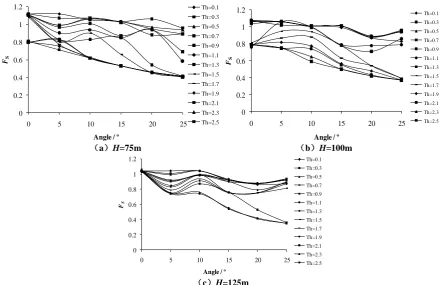
Fig. 12 Influence of Weak Layer angle on different slopes height
Given the results of the Fs value as shown in Figure 12(a-c), it can be inferred that the higher the overall slope height, the smaller the Fs values. With the increase of the weak layer angles, there is a range within the factor of safety which shows a negative rise. For instance, when H=75m and the weak layer thickness ranges between 0.5m<d<1.5m, the angle of the weak layer increases from 5° to 10° with the factor of safety increasing. This indicates that the presence of a weak layer affects the relationship between the inclination angle and the critical sliding surface. For the slope with H=100m, the weak layer angle
increases from 0° to 5° with the Fs increasing in that region, while for the slope with H=125m, the weak layer angle increases at an interval [5˚, 10˚] with the Fs increasing in that region. These rules exist to fully explain the relationship between the angles of the slope, the sliding surface, and the angle of the weak layer when reaching “locking” condition as the Fs enhances.
(2) Weak Layer thickness
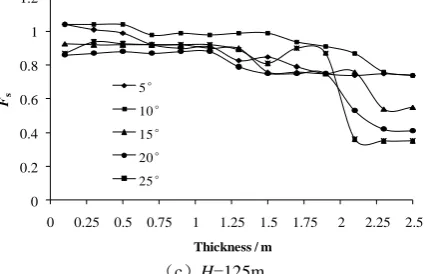
Figure 13 shows the statistical condition of different slopes height with different weak layer thicknesses.
(a)H=75m (b)H=100m
0 0.2 0.4 0.6 0.8 1 1.2
0 5 10 15 20 25
FS
Angle / º
Th=0.1 Th=0.3 Th=0.5 Th=0.7 Th=0.9 Th=1.1 Th=1.3 Th=1.5 Th=1.7 Th=1.9 Th=2.1 Th=2.3 Th=2.5 0 0.2 0.4 0.6 0.8 1 1.2
0 5 10 15 20 25
FS
Angle / º
Th=0.1 Th=0.3 Th=0.5 Th=0.7 Th=0.9 Th=1.1 Th=1.3 Th=1.5 Th=1.7 Th=1.9 Th=2.1 Th=2.3 Th=2.5 0 0.2 0.4 0.6 0.8 1 1.2
0 5 10 15 20 25
FS
Angle / º
Th=0.1 Th=0.3 Th=0.5 Th=0.7 Th=0.9 Th=1.1 Th=1.3 Th=1.5 Th=1.7 Th=1.9 Th=2.1 Th=2.3 Th=2.5 0 0.2 0.4 0.6 0.8 1 1.2
0 0.25 0.5 0.75 1 1.25 1.5 1.75 2 2.25 2.5
Fs
Thickness / m
5° 10° 15° 20° 25° 0 0.2 0.4 0.6 0.8 1 1.2
0 0.25 0.5 0.75 1 1.25 1.5 1.75 2 2.25 2.5
Fs
Thickness / m
5°
10°
15°
20°
Crusoe Jr et al./ Int. J. Min. & Geo-Eng., Vol.50, No.1, June 2016
108
(c)H=125m
Fig. 13 Influence of weak layer thickness on different slope height
From Figure 13, it can be seen that as the weak layer thickness increases, the Fs values follow a consistent change pattern from a slow decline to an accelerated decline and then a gentle decline. The change pattern of the weak layer thickness to the FS value from a slow decline to an accelerated decline and then a slow decline occurs mainly due to the change in weak layer thickness at specific ranges in relation to the overburden material and the magnitude of the weak layer at different thicknesses. It can be seen that as the weak layer thickness increases from a very small value to some medium values, failure takes place along the weak layer. However as the weak layer thickness increases beyond this medium value, the role of the weak layer in controlling stability increases and as such failure occurs partly within the weak layer leading to an accelerated decrease in the Fs value. As seen in Figure 13, after the accelerated decline a slow trend in the Fs value occurs. From this point the thickness of the weak layer is relatively large and the entire slide surface exist within the weak layer and stability is completely dictated by the weak layer. For the different slope heights, the Fs accelerated decline occurs at different locations. Given the slope height; H=50m, the Fs accelerated decline exists between 0.25m<d<1.0m, while for H=75m, the Fs
accelerated decline exists between
0.50m<d<1.25m. When the slope height is; H=100m, the Fs accelerated decline exists at an interval [1.0m, 1.75m] and for H=125m, the Fs accelerated decline moves to [1.5m, 2.25m]. From these change patterns, it is deduced that the extent of the weak layer thickness on the Fs accelerated decline is 0.75m. The result shows that the higher the height of the slope, the larger the weak layer thickness Fs accelerated decline.
5. Conclusions
This paper establishes the concept of weak layer thickness and its angle influence on slope stability and deduces that both parameters are important factors that influence stability. Based on the research work, the following conclusions are deduced:
(1) According to the principle of limiting equilibrium analysis, the influence of the weak layer angle on the Fs can be obtained. Additionally, the method of slice can be used to deduce the failure mode and the influence of the weak layer thickness on the stability of rock slopes. The results provide the discriminant condition for the most critical sliding surface.
(2) For any given increment in the weak layer angle, the Fs constantly decreases as there exists a weak layer angle which causes the rate of decrease to mutate. After the mutation zone, the Fs and the weak layer angle form a law of diminishing quadratic function as the rate of decrease gradually changes.
(3) As the weak layer thickness increases from a lower value to a higher one, the safety factors occur in a variation process from a low decline to an accelerated decline and back to a slow decline. It can be further deduced that the interval location of the accelerated decline gradually increases with the increase in slope height.
(4) When the weak layer thickness increases to a certain extent (mutation zone), the weak layer becomes the controlling factor of the slope stability. Additionally, the pattern of the sliding surface changes as the weak layer thickness is varied from a higher value to lower value.
0 0.2 0.4 0.6 0.8 1 1.2
0 0.25 0.5 0.75 1 1.25 1.5 1.75 2 2.25 2.5
Fs
Thickness / m
5°
10°
15°
20°
109
AcknowledgmentsThe research is supported by the National Natural Science Foundation of China (Grant No. 51034005) and the National High Technology Research and Development program of China (863 Program)(Grant No. 2012AA062004). These
supports are gratefully acknowledged.
Furthermore, we would like to extend our sincere gratitude to the two anonymous reviewers for their constructive suggestions, which helped to improve this manuscript.
Reference
[1] Al-Homoud, A. S., & Tubeileh, T. K. (1998).
Analysis and remedies of landslides of cut slopes due to the presence of weak cohesive layers within stronger formations. Environmental Geology, 33(4), 299-311.
[2] Bois, T., Bouissou, S., & Jaboyedoff, M. (2012).
Influence of structural heterogeneities and of large scale topography on imbricate gravitational rock slope failures: New insights from 3-D physical modeling and geomorphological analysis. Tectonophysics, 526,
147-156.doi:10.1016/j.tecto.2011.08.001
[3] Barton, N. (1978). Suggested methods for the
quantitative description of discontinuities in rock
masses. ISRM, International Journal of Rock
Mechanics and Mining Sciences & Geomechanics Abstracts, 15(6).
[4] Cala, M., & Flisiak, J. (2001, October). Slope
stability analysis with FLAC and limit equilibrium methods. In FLAC and Numerical Modeling in
Geomechanics—2001 (Proceedings of the 2nd
International FLAC Symposium on Numerical
Modeling in Geomechanics, Ecully-Lyon, France, October 2001) (pp. 113-114).
[5] Cala, M., & Flisiak, J. (2003). Complex geology
slope stability analysis by shear strength
reduction. Brummer, Andrieux, Detournay & Hart
(eds.) FLAC and Numerical Modelling in
Geomechanics. AA Balkema Publishers, 99-102.
[6] Chang, Y. L., & Huang, T. K. (2005). Slope
stability analysis using strength reduction
technique. Journal of the Chinese Institute of Engineers, 28(2), 231-240.
[7] Dalgıç, S. (2000). The influence of weak rocks on
excavation and support of the Beykoz Tunnel, Turkey. Engineering geology, 58(2), 137-148.
[8] Dawson, E. M., Roth, W. H., & Drescher, A.
(1999). Slope stability analysis by strength
reduction. Geotechnique, 49(6), 835-840.
http://dx.doi.org/10.1680/geot.1999.49.6.835
[9] Datang. (2014), Geotechnical Engineering Investigation Manual [R], Datang No. 2 East Surface Coal Mines, Inner Mongolia, China
[10] Deng, J., Kameya, H., Tsutsumi, Y., Koseki, J., & Kuwano, J., (2010). Simple shear tests on unsaturated undisturbed specimens containing a weak layer” In: Alonso, E., Gens, A. (Eds.), Proceedings of the Fifth International Conference Unsaturated Soils, Barcelona, Spain, pp. 235–240.
[11] Deng, J., Kameya, H., Miyashita, Y., Kuwano, J., Kuwano, R., & Koseki, J. (2011). Study on a failed dip slope with a thin sandy layer in 2004 Niigata-ken Chuetsu Earthquake. Engineering Geology, 123(4), 302-314.
[12] Fredlund, D. G., & Krahn, J. (1977). Comparison of slope stability methods of analysis. Canadian Geotechnical Journal, 14(3), 429-439.
[13] Griffiths, D. V., & Lane, P. A. (1999). Slope
stability analysis by finite
elements. Geotechnique, 49(3), 387-403.
[14] Hammah, R. E., Yacoub, T., Corkum, B., & Curran, J. H. (2008, January). The practical modelling of discontinuous rock masses with finite element analysis. In The 42nd US Rock Mechanics Symposium (USRMS). American Rock Mechanics Association.
[15] Hancox, G. T. (2008). The 1979 Abbotsford Landslide, Dunedin, New Zealand: a retrospective look at its nature and causes. Landslides, 5(2), 177-188.
[16] Huang, F., Zhu, H., Xu, Q., Cai, Y., & Zhuang, X. (2013). The effect of weak interlayer on the failure pattern of rock mass around tunnel–Scaled model tests and numerical analysis. Tunnelling and Underground Space Technology, 35, 207-218.
[17] Itasca, F. L. A. C. (2002). Fast Lagrangian analysis of continua. Itasca Consulting Group Inc., Minneapolis, Minn.
[18] Itasca, F. L. A. C. (2001). Fast Lagrangian analysis of continua. Itasca Consulting Group Inc., Minneapolis, Minn.
[19] Jinzhong, S., Xiaofu, T., Xudong, G., Yonggui, Y., & Xiusheng, Y. (2008). Stability analysis for loosened rock slope of Jinyang Grand Buddha in Taiyuan, China. Earth Science Frontiers, 15(4), 227-238.
[20] Jun, G., Guofeng, L., Zhang, G., Shibo, Y., Chong, M., & Fengbin, S. (2010). Effect of a single weak lithological structure on the height of a collapsing roof in a deep soft rock roadway. Mining Science and Technology (China), 20(6), 820-824.
[21] Liu, Z., & Koyi, H. A. (2013). The impact of a weak horizon on kinematics and internal deformation of a failure mass using discrete element method.
Tectonophysics, 586, 95-111.
http://dx.doi.org/10.1016/j.tecto.2012.11.009
Crusoe Jr et al./ Int. J. Min. & Geo-Eng., Vol.50, No.1, June 2016
110
[23] Naghadehi, M. Z., Jimenez, R., KhaloKakaie, R., & Jalali, S. M. E. (2011). A probabilistic systems methodology to analyze the importance of factors affecting the stability of rock slopes. Engineering Geology, 118(3), 82-92.
[24] Saintot, A., Henderson, I. H. C., & Derron, M. H. (2011). Inheritance of ductile and brittle structures in the development of large rock slope instabilities: examples from western Norway. Geological Society, London, Special Publications, 351(1), 27-78.
[25] Wang, R., Zhang, G., & Zhang, J. M. (2010).
Centrifuge modelling of clay slope with
montmorillonite weak layer under rainfall
conditions. Applied Clay Science, 50(3), 386-394.
[26] Xu, Q., Fan, X., Huang, R., Yin, Y., Hou, S., Dong, X., & Tang, M. (2010). A catastrophic rockslide-debris flow in Wulong, Chongqing, China in
2009: background, characterization, and
causes. Landslides, 7(1), 75-87.