Http://www.ijetmr.com©International Journal of Engineering Technologies and Management Research [9-14]
Assistant Professor, Department of Physics, Rewa Engineering College, Rewa (M.P.), INDIA 2
Assistant Professor, Department of Electrical Engineering, Rewa Engineering College, Rewa (M.P.), INDIA
Abstract:
This paper represents the study of different types of single phase AC to DC step down converter. Performances and outputs have analyzed depending on the equations. Different parameters such as voltage gain, harmonic contents in input current, and parameters of changing output voltage are compared different type of single phase AC to DC converters. AC to DC converter is defined as rectifier. The main power supply system is alternating in nature. Rectification action is required to obtain DC supply from the main power supply which is sinusoidal.
Keywords:
Rectifier, Half-wave rectification, Rectifier output smoothing.
Cite This Article: Dr. S. K. Mahobia, and Prof. G. R. Kumrey, “STUDY AND PERFORMANCE OF SINGLE-PHASE RECTIFIERS WITH VARIOUS TYPE OF PARAMETER” International Journal of Engineering Technologies and Management Research, Vol. 3, No. 1(2016): 9-14.
INTRODUCTION 1.
A rectifier is an electrical device that converts alternating current (AC), which periodically reverses direction, to direct current (DC), which flows in only one direction. The process is known as rectification. Physically, rectifiers take a number of forms, including vacuum tube diodes, copper and selenium oxide rectifiers, semiconductor diodes and other silicon-based semiconductor switches. Historically, even synchronous electromechanical switches and motors have been used. Early radio receivers, called crystal radios, used a "cat's whisker" of fine wire pressing on a crystal of galena (lead sulfide) to serve as a point-contact rectifier or "crystal detector". Rectifiers have many uses, but are often found serving as components of DC power supplies and high-voltage direct current power transmission systems.
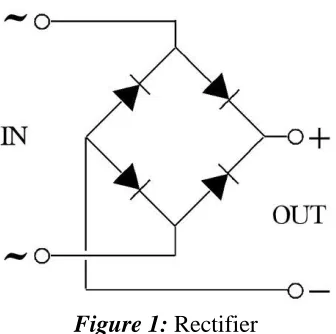
Http://www.ijetmr.com©International Journal of Engineering Technologies and Management Research [9-14] Figure 1: Rectifier
Because of the alternating nature of the input AC sine wave, the process of rectification alone produces a DC current that, though unidirectional, consists of pulses of current. Many applications of rectifiers, such as power supplies for radio, television and computer equipment, require a steady constant DC current (as would be produced by a battery). In these applications the output of the rectifier is smoothed by an electronic filter (usually a capacitor) to produce a steady current.
2. RECTIFIER DEVICES
The development of silicon semiconductor rectifiers, vacuum tube thermionic diodes and copper oxide- or selenium-based metal rectifier stacks were used. With the introduction of semiconductor electronics, vacuum tube rectifiers became obsolete, except for some enthusiasts of vacuum tube audio equipment. For power rectification from very low to very high current, semiconductor diodes of various types (junction diodes, schottky diodes etc.) are widely used. Other devices that have control electrodes as well as acting as unidirectional current valves are used where more than simple rectification is required e.g., where variable output voltage is needed. High-power rectifiers, such as those used in high-voltage direct current power transmission, employ silicon semiconductor devices of various types.
3. RECTIFIER CIRCUITS
Rectifier circuits may be single-phase or multi-phase (three being the most common number of phases). Most low power rectifiers for domestic equipment are single-phase, but three-phase rectification is very important for industrial applications and for the transmission of energy as DC (HVDC).
4. SINGLE-PHASE RECTIFIERS
HALF-WAVE RECTIFICATION
Http://www.ijetmr.com©International Journal of Engineering Technologies and Management Research [9-14] Figure 2: Half-wave rectifier
The no-load output DC voltage of an ideal half wave rectifier for a sinusoidal input voltage is: Where:
Vdc, Vav – the DC or average output voltage, Vpeak, the peak value of the phase input voltages, Vrms, the root-mean-square value of output voltage.
FULL-WAVE RECTIFICATION
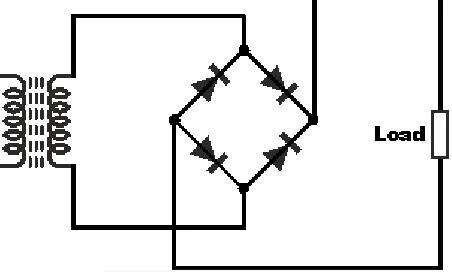
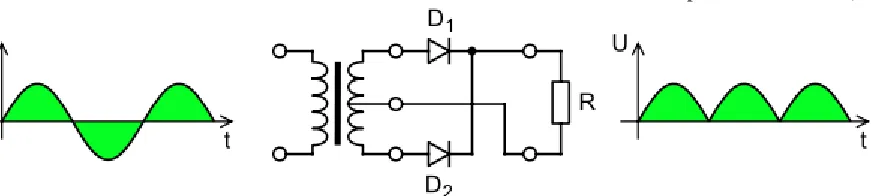
A full-wave rectifier converts the whole of the input waveform to one of constant polarity (positive or negative) at its output. Full-wave rectification converts both polarities of the input waveform to pulsating DC (direct current), and yields a higher average output voltage. Two diodes and a center tapped transformer, or four diodes in a bridge configuration any AC source (including a transformer without center tap), are needed. Single semiconductor diodes, double diodes with common cathode or common anode, and four-diode bridges, are manufactured as single components.
Figure 3: Full-wave rectifier using 4 diodes.
Http://www.ijetmr.com©International Journal of Engineering Technologies and Management Research [9-14] Figure 4: Full-wave rectifier using a center tap transformer and 2 diodes.
5. RECTIFIER EFFICIENCY
Rectifier efficiency (η) is defined as the ratio of DC output power to the input power from the AC supply. Even with ideal rectifiers with no losses, the efficiency is less than 100% because some of the output power is AC power rather than DC which manifests as ripple superimposed on the DC waveform. For a half-wave rectifier efficiency is very poor, (the divisors are 2 rather than √2 because no power is delivered on the negative half-cycle). Efficiency is reduced by losses in transformer windings and power dissipation in the rectifier element itself. Efficiency can be improved with the use of smoothing circuits which reduce the ripple and hence reduce the AC content of the output.
6. RECTIFIER LOSSES
A real rectifier characteristically drops part of the input voltage (a voltage drop, for silicon devices, of typically 0.7 volts plus an equivalent resistance, in general non-linear)—and at high frequencies, distorts waveforms in other ways. Unlike an ideal rectifier, it dissipates some power. Half-wave rectification and full-wave rectification using a center-tapped secondary produces a peak voltage loss of one diode drop. Bridge rectification has a loss of two diode drops. This reduces output voltage, and limits the available output voltage if a very low alternating voltage must be rectified. As the diodes do not conduct below this voltage, the circuit only passes current through for a portion of each half-cycle, causing short segments of zero voltage (where instantaneous input voltage is below one or two diode drops) to appear between each "hump". Peak loss is very important for low voltage rectifiers (for example, 12 V or less) but is insignificant in high-voltage applications such as HVDC.
7. RECTIFIER OUTPUT SMOOTHING
Producing steady DC from a rectified AC supply requires a smoothing circuit or filter. In its simplest form this can be just a reservoir capacitor or smoothing capacitor, placed at the DC output of the rectifier. There is still an AC ripple voltage component at the power supply frequency for a half-wave rectifier, twice that for full-wave, where the voltage is not completely smoothed.
Http://www.ijetmr.com©International Journal of Engineering Technologies and Management Research [9-14]
Higher numbers of peaks can be achieved by using transformer networks placed before the rectifier to convert to a higher phase order.
A more usual alternative to a filter, and essential if the DC load requires very low ripple voltage, is to follow the reservoir capacitor with an active voltage regulator circuit. The reservoir capacitor must be large enough to prevent the troughs of the ripple dropping below the minimum voltage required by the regulator to produce the required output voltage. The regulator serves both to significantly reduce the ripple and to deal with variations in supply and load characteristics. It would be possible to use a smaller reservoir capacitor (these can be large on high-current power supplies) and then apply some filtering as well as the regulator, but this is not a common strategy. The extreme of this approach is to dispense with the reservoir capacitor altogether and put the rectified waveform straight into a choke-input filter. The advantage of this circuit is that the current waveform is smoother and consequently the rectifier no longer has to deal with the current as a large current pulse, but instead the current delivery is spread over the entire cycle. The disadvantage, apart from extra size and weight, is that the voltage output is much lower – approximately the average of an AC half-cycle rather than the peak.
8. TRANSFORMERS WORK
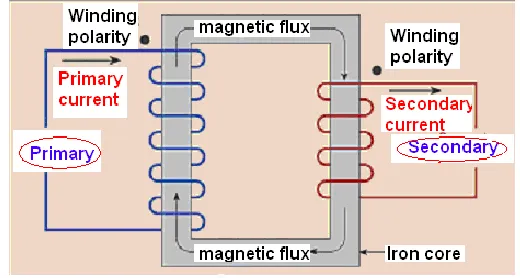
A basic transformer consists of two sets of coils or windings. Each set of windings is simply an inductor. AC voltage is applied to one of the windings, called the primary winding. The other winding, called the secondary winding, is positioned in close proximity to the primary winding, but is electrically isolated from it.
The alternating current that flows through the primary winding establishes a time-varying magnetic flux, some of which links to the secondary winding and induces a voltage across it. The magnitude of this voltage is proportional to the ratio of the number of turns on the primary winding to the number of turns on the secondary winding. This is known as the “turns ratio.”
Http://www.ijetmr.com©International Journal of Engineering Technologies and Management Research [9-14]
9. REFERENCES
[1] Mehran Mirjafari, Robert S. Balog, Multi-objective design optimization of renewable energy
system inverters using a Descriptive language for the components, Applied Power Electronics Conference and Exposition (APEC), 2011 Twenty-Sixth Annual IEEE, pp.1838 – 1845.
[2] F. Blaabjerg, F. Iov, T. Kerekes, R. Teodorescu, ,Trends in power electronics and control of
renewable energy systems, Power Electronics and Motion Control Conference (EPE/PEMC), 2010, pp. K-1 - K-19.
[3] Maria IMECS, Csaba SZABO, Ioan Iov INCZE, Modeling and simulation of controlled
bi-directional power electronic converters in a DC energy distribution line with AC grid- and motor-side active filtering, Power Electronics and Applications, 2007 ,pp.1–10.
[4] R.S. Ramshaw, Power Electronics Semiconductor Switches (Chapman & Hall, London,
1993).
[5] P.C. Sen, Power Electronics (Tata McGraw-Hill, 1988).
[6] J. Schaefer, Rectifier Circuits: Theory and Design (Wiley, 1965).
[7] G.J. Wakileh, Power Systems Harmonics (Springer, 2001).
[8] M.H. Rashid (ed.), Power Electronics Handbook (Academic Press, 2001)
[9] A.W. Kelley and W.F. Yadusky, Phase-controlled rectifier linecurrent harmonics and power
factor as a function of firing angle and output filter inductance, Proc. APEC’90.
[10] Eupec, Rectifier diode D 2601N, BIP AC / SM PB, 2002-05-31, Eupec Data Sheet.
[11] Eupec, Phase control thyristor T 2871N, BIP AM / SM PB, 2002-04- 07, Eupec Data Sheet.