VISIBLE BOYS, INVISIBLE GIRLS: THE REPRESENTATION OF GENDER
IN
LEARN ENGLISH WITH TITO
(A Critical Discourse Analysis of English Language Textbooks for Primary School)
Nadia Tiara Antik Sari1
The Language Center, Indonesia University of Education
Abstract:This study, entitled “Visible Boys, Invisible Girls: The Representation of Gender in Learn English with Tito (A Critical Discourse Analysis of English Language Textbooks for Primary School)”, is aimed at revealing the representation of gender in a series of Indonesian primary school English textbooks published by PT. Mutiara Permata Bangsa, Yogyakarta in 2007. The study is also aimed at gaining information about the editor’s perspective upon the issue and investigating the underlying ideology behind the representation. This research employs the framework of Critical Discourse Analysis (CDA). The main data are six textbooks for primary school. This study also conducts an inteview with the book editor. The text analysis utilizes transitivity system of Halliday which focuses on investigating Participants, Processes, and Circumstances of a clause. It is supported by lexical choice analysis of the text and a qualitative analysis of the interview. The findings show that the books favor males over females. Male characters are more visible in that they are more frequently occurred and they appear to hold more important roles of Participant. In terms of Gender stereotyping, males are perpetually associated with a more well-paid jobs i.e. ‘doctor’ and ‘pilot’ and ‘teacher’ for females. Meanwhile, females are more likely valued by their physical appearance and personality i.e. ‘slim’, ‘fair-skinned’, ‘beautiful’, ‘kind’, and diligent’. At the end of the research, the editor of the book admitted the lack of concern on the issue of gender in composing her textbooks. These seem to indicate male domination as the underlying ideology behind the representation.
Keywords:Gender, gender bias, gender representation, textbook evaluation.
Abstrak:Studi ini, berjudul “visible boys, invisible girls”: representasi gender pada buku Learn English with Tito (Sebuah Analisis Wacana Kritis pada Buku Bahasa Inggris Sekolah Dasar), ditujukan untuk mengetahui representasi gender sebuah seri Buku Bahasa Inggris Sekolah Dasar yang diterbitkan oleh PT. Mutiara Permata Bangsa, Yogyakarta pada tahun 2007. Studi ini juga ditujukan untuk mendapatkan sudut pandang editor dan mengidentifikasi ideologi yang mendasari representasi tersebut. Studi ini menggunakan kerangka Analisis Wacana Kritis. Data utamanya adalah enam buku Sekolah Dasar. Studi ini juga melaksanakan wawancara pada editor buku. Analisis teks menggunakan sistem transitivitas yang dikembangkan oleh Halliday yang menitikberatkan investigasi pada participants, processes, dan circumstances dari sebuah klausa. Hal ini juga didukung oleh analisis pemilihan
1
leksikal pada teks dan sebuah analisis kualitatif pada wawancara. Hasil yang didapatkan menunjukkan bahwa buku tersebut lebih menitikberatkan pada laki-laki dibandingkan perempuan. Karakter laki-laki lebih terlihat karena lebih sering muncul dan memegang peranan penting seorang participant. Dalam hal stereotip gender, laki-laki lebih diasosiasikan dengan derajat pekerjaan yang lebih tinggi dibandingkan dengan perempuan, sebagai contoh; ‘dokter’ dan pilot untuk laki-laki dan ‘guru’ untuk perempuan. Dilain hal, perempuan lebih diasosiasikan dengan penampilan fisik dan kepribadiannya, seperti ‘langsing’, ‘berkulit putih’, ‘cantik’, ‘baik’, dan ‘rajin’. Diakhir studi, editor buku tersebut mengakui kurangnya perhatian pada masalah gender dalam penyusunan Buku tersebut. Hal ini mengindikasikan dominasi laki-laki sebagai ideologi dibelakang representasi Buku tersebut.
Kata kunci: Gender, bias gender, representasi gender, evaluasi buku ajar.
Textbooks hold a very important role in the teaching and learning process as they are the main references for teachers to conduct the instruction activities in classroom. Pinter (2006) states that textbook is the most important teaching and learning material that guides teacher’s and learner’s activities in many classrooms. Many teachers follow every contents and exercises provided in the textbooks they use. Sheldon (1988) and Hutchinson (1994) (as quoted by Wang, 1998) confirm that ELT (English Language Teaching) program really depends on what is served by the textbooks.
That vital role of textbooks creates a huge demand on textbooks evaluation to optimize the learning activities (Wang, 1998). Many experts have formulated the aspects of textbook evaluation. For example, Madjid (2002) from many sources synthesized 10 aspects of textbook evaluation: soundness of theory underpinning the learning principles, cultural and gender bias relevancy, acceptability, authenticity, skills integration, meaningful activity, authentic language use, cognitive development, grammatical and other linguistics explanation –inductive or deductive, and contextual and situational vocabulary presentation.
Focusing on the second point, cultural and gender bias, Nunan (1991, in Madjid, 2002) points out that it is very possible to evaluate learning materials for their sexism and racism contents. In fact, there have been so many studies which are completed which investigate the representation of gender in school textbooks. For instance, Hellinger (1980) in Germany and Gaff (1982) in U.K. who conduct a research on ELT textbooks in their countries and discovered an obvious sexist language patterns which are tied in the textbooks. In Middle East and Eastern countries, Ansary and Babii (2003) in Iran and also Otlowski (2003) in Japan report that ELT textbooks still portray women in a stereotyped portrayal of mothers and homemakers.
Horgan (1995) points out that the imbalance treatment to male and female students has created a low self-esteem and low future-achievements of female students. Hence, since textbooks have become teachers’ main reference which support and influence the whole learning activities (especially for young learners) the imbalance portrayal of gender in school textbooks should be improved.
METHODOLOGY
This study has three main aims: to reveal the representation of gender in the English school textbooks entitled Learn English with Tito published by PT. Mutiara Permata Bangsa, Yogyakarta; to gain information about aspects mostly considered by the editor in composing the textbooks; and to reveal the ideology underlying the representation of gender in the textbooks. To fulfil the aims, two kinds of data are used i.e. texts and interview results. The main data to reveal the representation of gender in the textbooks are derived from the analysis of the texts. Learn English with Tito depicts the same animation characters from the book of grade 1 until grade 6 such as “Tito” (male), his cat, “Popo”, (sometime is gendered as ‘male’, and some other as ‘female’, and some other is ‘neutral’), and their friends, “Cindy” (female) and “Wandi” (male), etc.
The first step undertaken in data collection is the identification of ‘linguistic-gendered” clauses in all series of the textbook (grade one until grade six). Linguistic-gendered-texts/clauses are texts about people or people-like (Sunderland 2000, cited in Damayanti 2006) which focuses on the ‘linguistic’ aspect of the textbooks (i.e. reading passages, exercises and dialogues) neglecting the ‘pictorial’ texts of illustrations accompanying the ‘linguistic’ text. These ‘linguistic-gendered-texts’ should involve at least one of the genders, i.e. male or female. In the analysis, male characters are signed “(M)” while female characters are signed “(F)”. The gender roles are determined according to the justification provided in the texts (i.e. pronouns following; ‘he/him/his’ or ‘she/her’, etc.) or illustrations accompanying the texts. For example in a sentence in grade 1 book page 9, “I am Wandi.” The word “I” is categorized as “(M)” which refers to ‘male’ since Wandi is typically a male in Indonesian naming system. Furthermore, the picture also sows that it is a boy who say the statement, “I am Wandi,” in a bubble speech. Another example in grade 4 book page 84, “What does Popo do on her birth day?” the character Popo (the cat) is classified as ‘(F)’ which refers to ‘female’ because there is the pronoun “her” which explains that Popo is a female.
The second step is to conduct transitivity analysis to reveal the representation of gender in the textbooks. This analysis utilizes Hallidayan approach (see Halliday, 1994; Halliday&Matthiessen, 2004) which categorizes the gendered-clauses into their types of Process, Participant, and Circumstance. Table 1 shows the types of process and their main roles of participant:
Table 1: Types of Process and Main Participant
Processes Main Roles of Participant
Type Meaning
Material Happening, Doing Actor, Goal, Recipient, Client
Mental Seeing, Feeling,
Thinking
Relational Attributing, Identifying Carrier, Attribute Identified, Identifier Possessor, Possessed
Verbal Saying Sayer, Receiver
Existential Existing Existent
Behavioural Behaving Behaver
Meanwhile, Table 2 shows the types of Circumstance which might be associated with the male or female characters. There are nine types of Circumstance in which some of them are subcategorized further as follow:
Table 2 Types and Subtypes of Circumstance
Type Subtype WH Questions
Extent Distance
Duration Frequency
How far?
How long? How many? How many times?
Location Place
Time
Where? When?
Manner Means
Quality Comparison
How? What with? How? How -ly? How? What like?
Cause Reason
Purpose Behalf
Why? How? What for? Who for? Contingency Condition
Concession Default
In what case/event? Inspite /Despite what?
In the absence of/in default of what? Accompaniment Comitation
Addition
Who/What with/What else? And who/What else?
Role Guise
Product
What ‘as’? What into?
Matter What about?
Angle Who Says?
underlying the representation in the textbooks, second data are needed. It is derived from the ‘standardized’ interview with the editor of the books, Itje Chodidjah.
FINDINGS AND DISCUSSION
This section is a compact explanation of analysis, findings, and discussion. It will be divided into three parts based on the analysis tools; transitivity, lexical and interview.
Transitivity Analysis
Transitivity analysis is one of the central approaches to reveal representational meanings in texts. Principally, the clause analysis focuses on three main categories of transitivity i.e. Processes, Participants, and Circumstances (Halliday, 1994; Halliday&Matthiessen, 2004).
There are six main processes; Material, Relational, Mental, Behavioural, Verbal, and Existential Processes. Each of the processes consists of its own Participant(s). They have their own characteristics and represent different meanings. Butt et al. (2003) explains that the types of Process are usually realized by verbal groups. Sometimes, the core of the verb (called the ‘Event’) is also preceded by auxiliary verb(s). In the other hand, Participants are more likely realized by nominal groups. Meanwhile, Circumstances are typically realized by adverbial groups or prepositional phrases. There are three main processes i.e. Material, Mental, and Relational Processes. The first process, Material is the process of ‘doing’ and ‘happening’ which reflects a shift of events “through some input of energy” (Halliday&Matthiessen, 2004: 179). In the whole textbooks, Material process is very prominent especially in the middle to the upper class of grades 3, 4, 5, and 6. Typically, the process explains the type of activity which is done by male or female characters as can be seen in the following examples:
[3a]
[3b]
(Learn English with Tito grade 3, Unit 4, Listen. Say p.78)
In those examples, [3a] and [3b], ‘Tito’s mother’ (a female) is portrayed as doing something very concrete, i.e. ‘cook’. In the second clause, Cindy (introduced as one of the main female characters in the textbooks) ‘is helping’ her. The verb ‘is helping’ refers to the previous ‘cook’. Hence, both clauses share the same type of process. ‘Cook’ is categorized as Material process because there is a shift of events in a sense that we could see a physical movement of both Tito’s mother and Cindy doing the cooking. Outer body experience which is realized by physical movement is one of the basic characteristics of a ‘concrete’ Material process.
The main Participants in this process are Actor and Goal. Halliday&Matthiessen (2004: 179) explains that Actor is “the one that does the deed ― that is, the one that brings about the
Tito’s mother
is cooking in the kitchen
Actor (F) Process: Material
Circ: Location; Place
Cindy is helping her
Actor (F)
Process: Material
change.” In [3a] and [3b], both of the Actors are female. ‘Tito’s mother’ and ‘Cindy’ are the ones who ‘is cooking’ and ‘is helping (to cook)’, hence they are labeled as the Actor. Moreover in [3b] there is another participant which is called the Goal. The noun ‘her’ in [3b] which refers to ‘Tito’s mother’ is a Goal because it is affected by the action of the Actor (‘Cindy’). ‘Her’ is the “one to which the process is extended” (Halliday&Matthiessen, 2004: 181). In [3b], ‘Cindy’ is doing a process of ‘helping (to cook)’ to ‘her’. Hence, ‘her’ is a Goal which happened to be a female.
In terms of Circumstances, Material process is pretty much flexible to be extended by one or more circumstantial figure(s). In [3a], there is a Circumstance of ‘Location’ which refers to ‘Place’, explaining the place setting of the process and answering the question ‘Where’.
The second process, Mental, is the process of ‘sensing’ which concerns with the experience in our own consciousness. It usually describes a phenomenon or our states of mind (Halliday&Matthiessen, 2004; Bloor&Bloor, 2004). Halliday divided the process into four ‘sensing’ categories which are ‘perceptive’, ‘cognitive’, ‘desiderative’, and ‘emotive’. Mental process can be observed in the following examples:
[3c]
(Learn English with Tito grade 1, Unit 3, Story p.62)
[3d]
(Learn English with Tito grade 3, Unit 1, Listen. Say p.11)
In the examples, [3c] and [3d], both of male and female characters are portrayed to ‘love’ and ‘like’ something. The verbs ‘love’ and ‘like’ reflect “a flow of events taking place in our own consciousness” (Halliday&Matthiessen, 2004, p. 197). They reflect an emotion happen inside their (Tito’s and Nisa’s) consciousness which could not be observed directly by someone. Hence, they are ‘emotive’ Mental process.
The participants in this process are Senser and Phenomenon. Senser must have a consciousness because it is “the one that ‘senses’ ― feels, thinks, wants or perceives” (Halliday&Matthiessen, 2004: 201). In [3c], the Senser is ‘I’ which refers to ‘Tito’ (the main male character in the textbooks, and ‘Nisa’ (a female, shown by the illustration and is also typically a female’s name in Indonesia naming system). In other hand, what “is felt, thought, wanted, or perceived” is called Phenomenon (Halliday&Matthiessen, 2004, p. 203). In [3c], the Phenomenon is a human (‘my teacher’, which refers to ‘Miss Hana’, a female) who is loved by ‘I’ or ‘Tito’. Meanwhile in [3d], the Phenomenon is an action of ‘reading’ which is enjoyed by ‘Nisa’. Phenomenon can be a thing, a fact, or an act (Halliday&Matthiessen, 2004).
The third process, Relational, is the process of ‘attributing’ and ‘identifying’. It follows that the clause categorized in this process attempts to ascribe a characteristic to something or to make an identification of something (Halliday&Matthiessen, 2004). Therefore, Relational process is mostly found in the lower level of books grade 1 and 2 in which the curriculum
I (Tito) love my teacher
Senser (M) Process: Mental Phenomenon (F)
Nisa likes reading
Senser (F)
materials have just started to introduce many new vocabularies to the students. Some of the examples are:
[3e]
[3f]
(Learn English with Tito grade 1, Unit 1, Conversation P.16)
[3g]
[3h]
(Learn English with Tito grade 2, Unit 6, Look. Say P.127)
In the first two examples, [3e] and [3f], there are Identifying Relational processes. These clauses attempt to explain the ‘I’. Since there is only one ‘I’ for everyone, then in [3e], ‘I’ is ‘Merita’, and in [3f], ‘I’ is ‘Aji’. In other word, ‘Merita’ (a female in Indonesian naming system which is also shown by the illustration) is the ‘I’ explained in the first clause and ‘Aji’(a male in Indonesian naming system which is also shown by the illustration) is the ‘I’ explained in the second clause. The ability to substitute each other is the fundamental characteristic of Identifying Relational process. The Participants of this process are Identified and Identifier. Both of the subjects in [3e] and [3f], the ‘I’, are labeled as Identified, “that which is to be identified”, and ‘Merita’ and ‘Aji’ as Identifier, “that which serves as identity” (Halliday&Matthiessen, 2004, p.227).
In the second two clauses, [3g] and [3h], Attributing Relational process occurs. In this process, characteristics of male and female are usually provided. For example in these two clauses, age characteristic of the subjects (the ‘I’s) are attached. The Participants of this process are Carrier and Attribute. The Attribute as a “class ascribed or attributed to” something (Halliday&Matthiessen, 2004, p.219) usually contains gender characteristics regarding physical appearance, occupations, personality, etc. The nominal groups ‘8 years old’ and ‘6 years old’ are both Attribute with both the ‘I’s as Carrier which are attached with the entity of the Attribute (Halliday&Matthiessen, 2004).
I am Merita
Identified (F) Process: Relational
Identifier
I am Aji
Identified (M)
Process: Relational
Identifier
I ‘m 8 years
old Carrier (M) Process:
Relational
Attribute
I ‘m 6 years
old Carrier (F) Process:
Relational
In addition, in Attributive Relational process, there is a subtype of Possessive Relational process with Possessor and Possessed as the Participants. It can be observed in the following clause:
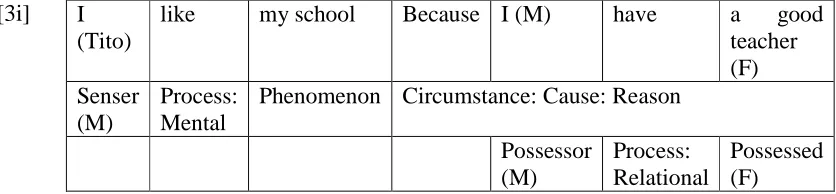
[3i]
(Learn English with Tito grade 3, Unit 1, Read.. Say P.24)
There are two clauses in the example [3i]. In the first clause, there is a Mental process which explains that the Senser (‘I’ which refers to ‘Tito’) feels ‘like’ to his school (the Phenomenon). This statement is followed by the reason of his feeling which is realized in the Circumstance of Cause of Reason, “because I have a good teacher.” This circumstantial element is constructed by a Possessive Relational process which reflects that an entity is possessed by another entity (Halliday, 1994; Halliday&Matthiessen, 2004). There are two Participants in this process, i.e. Possessor and Possessed. In this possessive structure, the entity who has something is called ‘Possessor’ (the ‘I’) and the entity which is owned is called ‘Possessed’ (which happens to be a female, Miss Hana, as also shown by the illustration) (Halliday, 1994). Hence, the second clause implies that a male is ascribed with his possessive relationship of a female.
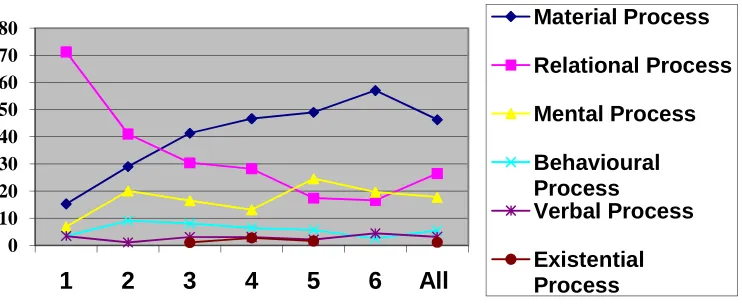
In all of the textbooks, even though Relational process became the most frequent process in grade one and two, Material process is prominent in the whole textbooks. Table 3.1 shows the total of every process that occurred in Learn English with Tito grade 1 to 6. The next most frequent processes in these textbooks are Relational, Mental, Behavioural, Verbal, and Existential processes. Material stands out with 563 occurrences (46.26%). In the second place is Relational with 322 occurrences (26.46%). In the third place is Mental with 215 occurrences (17.67%). In the fourth place is Behavioural with 66 occurrences (5.42%). In the fifth place is Verbal with 38 occurrences (3.12%). The last is Existential with 13 occurrences (1.07%).
Table 3.1 Frequency of Processes occurred in Learn English with Tito Grade 1-6
No .
Learn English with Tito Grade 1-6 Process
Types
Grades
Total %
1 2 3 4 5 6
1. Material 9 29 83 139 96 207 563 46.26
2. Relational 42 41 61 84 34 60 322 26.46
3. Mental 4 20 33 39 48 71 215 17.67
4. Behavioural 2 9 16 19 11 9 66 5.42
5. Verbal 2 1 6 9 4 16 38 3.12
6. Existential - - 2 8 3 - 13 1.07
Total 1,217 100
I (Tito)
like my school Because I (M) have a good
teacher (F) Senser
(M)
Process: Mental
Phenomenon Circumstance: Cause: Reason
Possessor (M)
Process: Relational
Material and Relational processes are dominant most likely because the textbooks consist of many narrative texts despite the fact that the books are not developed based on the ‘genre-based approach’ (GBA). The data are also presented in line graph in figure 3.1. The x-axis shows the book’s grade while the y-x-axis shows the percentage of processes’ occurence as follow:
Figure 3.1 The Graph of Processes distributions in Learn English with Tito Grade 1-6
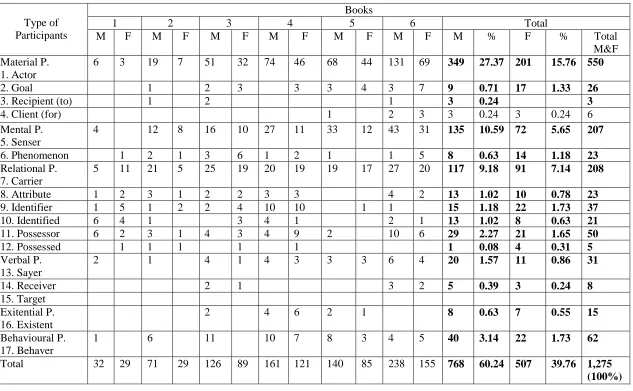
Furthermore, Table 3.2 presents the occurrences of Participant in all of the books. In Learn English with Tito grade 1 to 6, there are 1,275 Participants. Male characters dominate with 768 occurrences (60.24%) versus 507 occurrences of females (41.4%). Compared to female characters, males are more likely portrayed as Actor, Recipient, Senser, Carrier, Attribute, Identified, Possessor, Sayer, Receiver, Existent, and Behaver. Meanwhile, females are more likely portrayed as Goal, Phenomenon, Identifier, and Possessed. In addition, both males and females are in the same number as Client.
In detail, the most frequent occurring Participant in Material process is Actor with 550 occurrences (43.13%). They consist of 349 males (27.37%) and 201 females (15.76%). There are 26 Goals (2.04%) in which 9 of them are males (0.71%) and 17 of them are females (1.33%). There are 3 Recipients (0.24%) in which all of them are males (0.24%). In addition, there are 6 Clients (0.48%) in which half of them are males and the other half are females; each with 3 occurrences (0.24%). In Relational process, there are 344 Participants (26.99%). Firstly, there are 208 Carriers (16.32%) in which 117 of them are males (9.18%) and 91 of them are females (7.14%). Secondly, there are 23 Attributes (1.8%) in which 13 of them are males (1.02%) and 10 of them are females (0.78%). Thirdly, there are 37 Identifiers (2.91%) in which 15 of them are males (1.18%) and 22 of them are females (1.73%). Fourthly, there are 21 Identifieds (1.65%) in which 13 of them are males (1.02%) and 8 of them are females (0.63%). Fifthly, there are also 50 Possessors (3.92%) in which 29 of them are males (2.27%) and 21 of them are females (1.65%). Lastly, there are 5 Possesseds (0.39%) in which 1 of them is male (0.08%) and 4 of them are females (0.31%). In Mental process, there are 230 Participants
0 10 20 30 40 50 60 70 80
1 2 3 4 5 6 All
Material Process
Relational Process
Mental Process
Behavioural Process
Verbal Process
(18.05%). There are 207 Sensers (16.24%) in which 135 of them are males (10.59%) and 72 of them are females (5.65%). There are 23 Phenomenons (1.81%) in which 8 of them are males (0.63%) and 14 of them are females (1.18%). In Behavioural process, there are 62 Participants (4.87%) in which 40 of them are males (3.14%) and 22 of them are females (1.73%). In Verbal process, there are 40 Participants (3.06%). There are 31 Participants as Sayer (2.43%) in which 20 of them are males (1.57%) and 11 of them are females (0.86%). There are also 8 Participants of Receiver (0.63%) in which 5 of them are males (0.39%) and 3 of them are females (0.24%). In Existential process, there are 15 Participants as Existent (1.18%) in which 8 of them are males (0.63%) and 7 of them are females (0.55%). In short, in the whole books, males are more visible than females. The visibility is judged in terms of the number of occurrences of roles and the type of roles. In terms of number of occurrences, males are more visible in that they are dominant with 768 occurrences of roles referring to them (60.24%). Meanwhile, females are less visible with only 507 (39.76%) of roles associated with them.
Table 3.2 Types of Participant of Male(s) and Female(s) Characters in Learn English with Tito Grade 1-6
Type of Participants
Books
1 2 3 4 5 6 Total
M F M F M F M F M F M F M % F % Total
M&F Material P.
1. Actor
6 3 19 7 51 32 74 46 68 44 131 69 349 27.37 201 15.76 550
2. Goal 1 2 3 3 3 4 3 7 9 0.71 17 1.33 26
3. Recipient (to) 1 2 1 3 0.24 3
4. Client (for) 1 2 3 3 0.24 3 0.24 6
Mental P. 5. Senser
4 12 8 16 10 27 11 33 12 43 31 135 10.59 72 5.65 207
6. Phenomenon 1 2 1 3 6 1 2 1 1 5 8 0.63 14 1.18 23
Relational P. 7. Carrier
5 11 21 5 25 19 20 19 19 17 27 20 117 9.18 91 7.14 208
8. Attribute 1 2 3 1 2 2 3 3 4 2 13 1.02 10 0.78 23
9. Identifier 1 5 1 2 2 4 10 10 1 1 15 1.18 22 1.73 37
10. Identified 6 4 1 3 4 1 2 1 13 1.02 8 0.63 21
11. Possessor 6 2 3 1 4 3 4 9 2 10 6 29 2.27 21 1.65 50
12. Possessed 1 1 1 1 1 1 0.08 4 0.31 5
Verbal P. 13. Sayer
2 1 4 1 4 3 3 3 6 4 20 1.57 11 0.86 31
14. Receiver 2 1 3 2 5 0.39 3 0.24 8
15. Target Exitential P. 16. Existent
2 4 6 2 1 8 0.63 7 0.55 15
Behavioural P. 17. Behaver
1 6 11 10 7 8 3 4 5 40 3.14 22 1.73 62
Total 32 29 71 29 126 89 161 121 140 85 238 155 768 60.24 507 39.76 1,275
Circumstances in Learn English with Tito Grade 1-6
In terms of Circumstances, Table 3.3 presents the occurrences of Circumstances in all of the textbooks. There are 465 circumstantial elements. Most of them are Circumstance of Location (77.20%) which attempts to explain the setting of time and place of an action. There are 209 occurrences which refer to Place (44.95%) and 150 occurrences which refer to Time (32.26%). In Circumstance of Place, 134 of them (28.82%) are associated with male characters while 75 of them (16.13%) are associated with females. Circumstance of Time, there are 93 occurrences (20%) which are associated with males while 57 occurrences (12.26%) with females. In the third most frequent Circumstances is Circumstance of Manner of Quality with 38 occurrences (8.17%) in which 28 of them are associated with males (6.02%) and 10 of them with females (2.15%). In the fourth place, there is Circumstance of Cause of Purpose with 23 occurrences (4.95%) in which 20 of them are associated with males (4.3%) and 3 of them with females (0.65%). In the fifth place is Circumstance of Accompaniment of Comitation with 17 occurrences (3.66%) in which 13 of them are associated with males (2.8%) and 4 of them with females (0.86%).
In the sixth place, there is Circumstance of Manner of Means with 12 occurrences (2.58%) in which 8 of them are associated with males (1.72%) and 4 of them with females (0.86%). In the seventh place, there is Circumstance of Extent of Frequency with 5 occurrences (1.08%) in which 4 of them are associated with males (0.86%) and 1 of them with female (0.22%). In the eighth place, there is Circumstance of Extent of Duration with 4 occurrences which all are exclusively associated with male characters (0.86%). In the ninth place, there are two types of circumstantial elements, i.e. Circumstance of Cause of Reason and of Behalf with 3 occurrences (0.65%). In Circumstance of Cause of Reason, all of them are exclusively associated with male characters (0.65%). Meanwhile in Circumstance of Cause of Behalf, 1 of them is associated with male (0.22%) and 2 of them with females (0.43%). In the last place, there is Circumstance of Extent of Duration with 1 occurrence which is associated with female (0.22%).
Table 3.3 Types of Circumstance Associated with Male(s) and Female(s) Characters in Learn English with Tito Grade 1-6
Types of Circumstances
Subtype
Books
1 2 3 4 5 6 Total Total M&F
M F M F M F M F M F M F M % F %
Extent Distance 1 1 0.22 1
Duration 1 2 1 4 0.86 4
Frequency 1 3 1 4 0.86 1 0.22 5
Location Place 3 1 6 1 21 15 18 16 35 15 51 27 134 28.82 75 16.13 209 Time 1 3 8 4 4 1 24 13 10 13 46 23 93 20 57 12.26 150
Manner Means 1 3 1 4 3 8 1.72 4 0.86 12
Quality 1 3 2 1 22 9 28 6.02 10 2.15 38
Comparison
Cause Reason 1 1 1 3 0.65 3
Purpose 1 2 3 2 8 1 4 2 20 4.3 3 0.65 23
Behalf 1 1 1 1 0.22 2 0.43 3
Contingency Condition Concession Default Accompanimen
t
Comitation 4 1 5 4 3 13 2.8 4 0.86 17
Addition Role Guise
Product Matter
Angle
Lexical Choice
In order to reveal the gender representation more comprehensively, lexical choice analysis was conducted to examine some lexical preferences to be set in a particular gender of male or female. Two important areas of gender representation are to observe how both genders are portrayed in terms of physical appearance and personal traits and in terms of the occupational roles they hold (Florent et al., 1994; Carroll&Kowitz, 1994). Both of them are elaborated further in sections 3.2.1 and 3.2.2.
Types of Physical Appearance and Personal Trait
In these books, there are two ways to depict physical appearance and personal trait characteristics of a male or female character. They are as a Participant and as an Epithet. As a Participant, the characteristics mostly occurred in Relational process especially in the attributive mode which attempts to ascribe a quality to an entity (Halliday&Matthiessen, 2004). Some of them can be observed in the following clauses where Tito describes his parents:
[3j]
[3k]
(Learn English with Tito, Grade 4 Unit 4, Listen. Say P.24)
Clauses [3j] and [3k] set the characteristics of physical appearance of Tito’s parents as the Attribute. In the former clause, [3j], ‘he’ which refers to Tito’s father is ascribed with the quality of being ‘tall’. Meanwhile in the latter clause, [3k], ‘she’ which refers to Tito’s mother is ascribed with the quality of being ‘beautiful’. In addition, the quality also could be explained as a possession as can be observed in the following clause when Tito describes his sister, Lisa:
[3l]
(Learn English with Tito, Grade 4 Unit 4, Listen. Say P.24)
The clause shows another way to ascribe a physical appearance characteristic of someone which is by placing the characteristics as a possession. In this clause, [3l], ‘she’ which refers to Lisa (Tito’s sister) acts as a Possessor who owns a characteristic of having a ‘long hair’.
Secondly, as an Ephitet, the characteristic is placed differently in existential clause [3m] as follow:
[3m]
(Learn English with Tito grade 5, Unit 1, Story P.18)
He (M) Is tall
Carrier (M) Process: Relational Attribute
She (F) is beautiful Carrier
(F)
Process: Relational
Attribute
She (F) Has long hair Possessor (F) Process:
Relational
Possessed
Once upon a time
in a castle far away from Jakarta,
there was a handsome prince (M).
Circ: Location; Time
Circ: Location; Place
Process: Existential
In the clause, [3m], the Participant which contains a characteristic of physical appearance is the Existent, ‘a handsome prince’. Hence, the quality of ‘handsome’ is not a Participant. It is called an Epithet, a premodification which clarifies the quality of an entity, ‘prince’ (Butt et al., 2003).
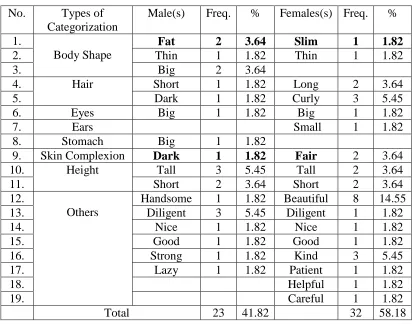
Further physical appearance and personal trait characteristics of male and female characters in the textbooks are shown in table 3.4 The table can be classified into three main categories: ‘parts of body’, ‘height’, and ‘others’. ‘Parts of body’ covers body shape, hair types, eye shape, ear size, stomach, and skin complexion. ‘Height’ explains type of portrayal of male and female characters’ height as they are depicted in the textbooks which is subcategorized into ‘tall’ and ‘short’, and ‘other’ explains the personal traits in which some still describe the physical appearance characteristic.
Table 3.4 Physical Appearance of Male and Female Characters
No. Types of Categorization
Male(s) Freq. % Females(s) Freq. %
1.
Body Shape
Fat 2 3.64 Slim 1 1.82
2. Thin 1 1.82 Thin 1 1.82
3. Big 2 3.64
4. Hair Short 1 1.82 Long 2 3.64
5. Dark 1 1.82 Curly 3 5.45
6. Eyes Big 1 1.82 Big 1 1.82
7. Ears Small 1 1.82
8. Stomach Big 1 1.82
9. Skin Complexion Dark 1 1.82 Fair 2 3.64 10. Height Tall 3 5.45 Tall 2 3.64
11. Short 2 3.64 Short 2 3.64
12.
Others
Handsome 1 1.82 Beautiful 8 14.55 13. Diligent 3 5.45 Diligent 1 1.82
14. Nice 1 1.82 Nice 1 1.82
15. Good 1 1.82 Good 1 1.82
16. Strong 1 1.82 Kind 3 5.45
17. Lazy 1 1.82 Patient 1 1.82
18. Helpful 1 1.82
19. Careful 1 1.82
Total 23 41.82 32 58.18
While in the investigation of transitivity analysis it could be observed that male characters dominate the roles of Participant, the findings of lexical choices analysis regarding physical and personal traits show different evidence. It could be concluded that compared to males, females are more likely valued by their physical appearance and personal traits. This is shown in the total occurrences of the traits associated with males and females and the type of traits associated with them.
completed with many accessories of how a female is expected to behave: ‘diligent’, ‘nice’, ‘good’, ‘patient’, ‘helpful’, ‘careful’ (each with 1 occurrences, 1.82%) and ‘kind’ (3 occurrences, 5.45%).
Meanwhile, male is only once described as someone “handsome” (1.82%). In addition to the traits ‘diligent’ (3 occurrences, 3,45%), ‘nice’, and good’ (each with 1 occurrence, 1.82%), males are also described as ‘big’ (2 occurrences, 3.64%) and ‘strong’ (1 occurrence, 1.82%). ‘Big’ and ‘strong’ are two traits that never found to be collocated with females. In addition, males are also more likely described by some traits with negative impression, i.e. ‘fat’ (2 occurrences, 3.64%) with ‘big stomach’ and ‘lazy’ (each with 1 occurrence, 1.82%).
Expectation concerning physical appearance and personal traits of males and females are two big issues in gender equity. In terms of personal trait, masculinity is always related to muscle which lead to a notion that a man should be strong and aggressive. Meanwhile, femininity is always interconnected with nurturing behavior (Wood, 1994). The textbooks obviously convey this traditional expectation.
Reinforcing the stereotype of women as ‘beautiful’ creatures who are emphasized on being ‘slim’ and ‘fair-skinned’ could send negative impact to young girls. It could lead the girls to the idea that the only way to be a beautiful woman is by being slim and fair-skinned. Textbooks should present more variation of male and female appearances in order to make students accept their own uniqueness. It is through this way that young boys and girls gain confidence which help them to perform better at school (Horgan, 1995).
Types of Economic Role
It is also important to investigate the occupational roles of male and female participants in these textbooks. With the same characters maintained from grade one until grade six, there are several characters who are described to have economic roles. They are Wandi’s father as a doctor, Cindy’s father as a pilot, Cindy’s mother as a reporter/journalist, Miss Hana as Tito’s English Teacher, and Tito’s mother as a Teacher. Their economic roles are pointed out as a Participant with premodification by a Deictic which functions “to point to, or some way select, the noun functioning as Thing” (Butt et al., 2003: 67).
There are two types of Deictic found to point out the economic roles in the textbooks, i.e. Possessives and Article. Economic role which is mentioned with a premodification by a Possessive can be observed in the following example:
[3n]
(Learn English with Tito Grade 3, Look. Read. Match P.17)
In [3n], there is an economic role of being a ‘school cleaning boy’. This role is placed as a Participant, an Actor. However, it does not stand independently. This role is premodified by a Deictic of Possessives, ‘our’.
In other hand, economic role which is premodified by an Article can be observed in the following example:
Our school cleaning boy (M)
is cleaning the toilet
[3o]
(Learn English with Tito Grade 6, Look. Say P.36)
In relational clause [30], ‘She’ is ascribed with her economic role classification which is ‘teacher’. This economic role is permodified by the Arcticle ‘a’ to specify it.
Damayanti (2006) found out that if female characters in the textbooks are portrayed to have economic roles, they are frequently associated with teaching activity at school. Hence, table 3.5 is presented to show types of economic roles which are hold by male and female characters which is classified in two categories, i.e. economic roles which are related with ‘school’, and ‘others’.
Table 3.5 Occupational Roles of Male and Female Characters in Learn English with Tito grade 1-6
No. Economic Roles Related with...
Male(s) Freq. % Female(s) Freq. %
1. School Teacher 1 5 Teacher 8 40
2. School
Cleaning Boy
1 5 Head Teacher 2 10
3. Others Pilot 3 15 Journalist/Reporter 3 15
4. Doctor 2 10
Total 7 35 13 65
It could be observed that the textbooks portrayed females with more occupational roles (13 occurrences, 65%) than males (7 occurrences, 35%). However, most of them are associated with ‘school’ as a place they are working. There are 8 occurrences that females are mentioned as ‘teacher’ (40%) while male is only mentioned once (5%). In addition, there are 2 occurrences of females mentioned as a ‘head teacher’ which sign an empowering role of females as a leader. The other occupational role of females is as ‘journalist/reporter’ (classified in the same class because it refers to the same character, Cindy’s mother) with 3 occurrences (15%). Meanwhile, most of the economic roles of males are in the categorization of ‘others’. They are mentioned as ‘pilot’ with 3 occurrences (15%) and ‘doctor’ with 2 occurrences (10%). In addition, there is also 1 occurrences of being ‘school cleaning boy’ (5%).
Based on the findings, it can be said that in these textbooks, both characters are shown to have various occupations. In previous study (Damayanti, 2006), male characters are more often portrayed to be ambitious and have carriers which enabling them to earn high salaries than females. In other hand, females are mostly portrayed to have carrier at school. The findings in this present research showed that males are not only portrayed as Doctor and Pilot (two jobs which are usually associated with high salary), but also an
She (F) Is a teacher
Carrier (F)
ordinary ‘school cleaning boy’ (a job which never associated with high salary). Female characters, even though still mostly portrayed to have carrier at school, are also portrayed as a dynamic woman as a journalist and reporter. Furthermore, an important step has been made by portraying females with leadership ability as a “head teacher”, avoiding the generic term “head master”.
The Concerns of the Editor of Learn English with Tito
At the end of the research, an interview with the editor of Learn English with Tito, Itje Chodidjah, was carried out to complete the understanding about the reasons underlying the representation of gender in the textbooks. The interview was conducted via e-mail considering that she lives out of town and has a very full schedule. The questions asked are 13 questions which cover; her slight profile, her duties as the editor of Learn English with Tito and her attempts as the editor to deal with the issue of gender representation in primary school English textbooks.
The first four questions are asked to know her profile and duty as the editor of Learn English with Tito. Ibu Itje explained that she was graduated from Universitas Malang (formerly IKIP Malang) in 1994 for her undergraduate study. After that, she continued her post graduate education in Warwick University, England majoring English for Young Learners in 1993-1994. Furthermore, she is actively taking part in many short courses regarding Young Learners, Teacher Training, and Trainer Training. She stated that it is her first experience to be a textbook editor. As an editor she comprehends her task is to direct and share concepts and ideas with the writers about what and how to create the book as well as to give advice for the whole production of it.
In agreement with the statements of Sheldon (1988), Hutchinson (1994) (as both cited in Wang, 1998) and Pinter (2006), Ibu Itje stated that textbooks in English Language Teaching (ELT) particularly in Indonesia hold a crucial role. She argued that the reasons why many teachers follow every bit and pieces in the textbook are because they have limited time and there has been lack of ‘practical in service teacher training’ in university to meet the need of teachers in the actual classroom. “For example the credit for teaching methodology is very limited and tend to be theoretical,” she added. She also explained that the textbooks need to be accompanied by teachers’ manual to guide teachers’ different interpretation of the materials in the textbooks. In fact, she believes that textbooks which are accompanied by teachers’ manual would be a good teacher training which guide the teachers to handle the classroom. It was the reason why Learn English with Tito is accompanied with Teachers Books.
Ibu Itje firmly answered that she put the children's cognitive and language development as the most concerned aspect in Tito. As a matter of fact, the consistent characters from grade one until six such as Tito (male), Cindy (female), Wandi (male), and Popo (cat) are intended to fulfill the children’s cognitive development. She also added that she had consulted the material in Tito with the curriculum, adapted the number of students in the class, and provided interesting pictures, contextuality, stories, and communicative activities. They are all done based on the theory of children to learn a new language.
When she was asked about the issue of sexist language or gender representation in school textbooks, she was not really certain about it. She only stated that this issue would not be detrimental as long as the textbooks provide a balance role of female and male without explaining further about kind of roles she mentioned. However, she admitted that actually she and her team are dealing with the issue at the moment. She explained that they are trying to change the title of “Learn English with Tito” to become “Learn English with Tito and Cindy”. At first, she made the name “Tito” as the title of the book simply because it is easy to be said and can be accepted by people in any regions in Indonesia. Furthermore, she also pointed out that at the moment they are still considering whether or not Popo (the cat) will be represented with the pronoun ‘it’ instead of ‘he’.
The evidence that the editor is not familiar with the issue of gender representation in school textbooks has proven the lack of attention upon the case in Indonesia. Indonesian textbooks’ authors, editors, and publishers need to start to pay more attention as well as to start to eliminate the sexist language which they consciously and or unconsciously provided in their textbooks.
The Ideology Underlying the Representation
Fairclough (2003, p. 9) describes ideology as a “representation of aspects of the world which can be shown to contribute to establishing, maintaining, and changing social relations of power, domination and exploitation.” He also added that every kind of text has an ideological effect in which a perspective about the world is transferred. In this research, the findings of transitivity and lexical choice analyses which are also confirmed by the editor have shown a strong indication of male domination as the ideology underlying the representation of reality in the textbooks.
Furthermore, it is shown that as a female, the editor failed to capture the demand of providing a balanced gender representation in her textbooks. When she answered that children’s cognitive development is one of the main concerns in editing the textbooks, she neglected the development of children’s gender awareness as a part of the cognitive development itself (See Peterson & Lach, 1990).
The idea of representing a more balanced gender representation in school textbooks (as well as other kind of texts) is aimed at opening more opportunity for females to be independent and actively involved in the nation’s development. However, adapting textbooks to promote a more balanced gender representation is only one of many steps to cope with sexist attitude. ‘Free-sexist’ textbooks could not guarantee ‘free-sexist’ classroom instruction. The effort of empowering women will be more successful if it is followed up with teacher trainings which could be an eye-opener for the importance of gender equality.
CONCLUSION
the editor towards the issue, and the underlying ideology behind the representation. Based on the analysis and findings, it is shown that the textbooks favor males than females. In addition, the editor does not really concern about the issue of gender. These indicate that male domination appears to be the ideology underlying the representation.
In the investigation of representation, male characters are favored in that they are more visible than females in terms of the high frequency of their occurrences and the significance roles of Participant they hold. In terms of occupational roles, males are perpetually associated with more well paid jobs than females. Meanwhile, females are more valued by their physical appearance and personal traits, not by their capability. The editor admitted that free-sexist language and balanced-gender representation are not well accommodated in the textbooks. Feedbacks to create a more balanced-gender representation in school textbooks will be very welcomed. In addition, all of the evidences show male’s domination as the underlying ideology of the representation in the textbooks.
Based on the findings, it can be said that awareness of an underlying ideology is important to build a more balanced attitude in all aspects of life, such as gender. Reconstruction of meaning through CDA is proven to be a useful strategy to explore ideologies behind the texts. It is also proven that Systemic Functional Linguistics (SFL) is a useful resource for CDA.
For further research, the examination could also be deepened to the other unit of analysis such as the speech act, passivisation and nominalization, and the analysis of visual grammar. In addition, similar studies could also be conducted to analyze gender representation in another level of school textbooks from varies publishers, children’s story books, or even novels, news paper and magazine articles, etc. Hopefully, further studies could show a significant improvement of a more balanced-gender representation.
REFERENCES
Ansary, H. and Babii, E. (2003). Subliminal Sexism in Current ESL/EFL Textbooks in
Asian-EFL Journal[Online]. Available on-line at:
http:// www.asian-efl-jornal.com/march03.sub1.htm [August 8, 2008]
Bloor, T. and Bloor, M. (2004). The Functional Analysis of English: A Hallidayan Approach.New York: Oxford University Press.
Butt, D.et al.(2003). Using Functional Grammar. An explorer’s Guide. National Center for English Language Teaching and Research. Sydney: Macquarie University. Carroll, D. and Kowitz, J. (1994). Using Concordancing Techniques to Study Gender
Stereotyping in ELT Textbooks in J. Sunderland (ed.): pp. 73-82.Exploring Gender: Questions and Implications for English Language Education. Hertfordshire: Prentice Hall International.
Damayanti, I.L. (2006). Fathers at Work, Mothers at Home: Gender Representations in English Language Textbooks for Primary Students in Indonesia. University of Warwick: Unpublished.
Florent, J, Fuller, K., Pugsley, J. Walter, C. and Young, A. (1994). On Balance: Guidelines for The Representation of Women and Men in English Language Teaching Materials in J. Sunderland (ed.): 112-120. Exploring Gender: Questions and Implications for English Language Education. Hertfordshire: Prentice Hall International.
Gaff, R. (1982). Sex-stereotyping in Modern Language Teaching─an aspect of the hidden curriculumin British Journal of Language Teachingxx (2), pp. 71-78
Halliday, M. A. K. (1994). An Introduction to Functional Grammar. Second Edition. London: Edward Arnold.
Halliday, M.A.K. and Matthiessen., C. (2004). An Introduction to Functional Grammar. Third Edition. London: Arnold.
Hellinger, M. (1980). ‘For Men Must Work and Women Must Weep’: Sexism in English Language Textbooks used in German Schools” in Women’s Studies International Quarterly3, pp. 267-275.
Horgan, D. D. (1995).Achieving Gender Equity in Classroom. Boston: Allyn and Bacon. Madjid, A. (2002). EFL Textbook Evaluation: A Study of Senior High School English
Textbooks by State and Non-State Run Publishers. UPI: Unpublished.
Otlowski, M. (2003). Ethnic Diversity and Gender Bias in EFL Textbooks in Asian EFL Journal.[Online].Availabe online at:
http:// www.asian-efljournal.com/june 2003 mo.php [August 17, 2008]
Peterson, S. B. & Lach, M. A. (1990). Gender Stereotypes in Children’s Book: their prevalence and influence on cognitive and affective development in Gender and Education, 2 (2), pp. 185-197
Pinter, A.. (2006).Teaching Young Language Learners. Oxford: Oxford University Press. Wang, J. (1998).Evaluating an EFL Textbook—A New English Course [online]. Available
online at: http://www.ling.lancs.ac.uk/groups/crile/docs/crile31wang.pdf [September 8, 2008]