Journal of Applied Linguistics and Language Research Volume 4, Issue 3, 2017, pp. 65-93
Available online at www.jallr.com ISSN: 2376-760X
* Correspondence: Maria Tsintavi, Email: mariatsintavi gmail.com © 2017 Journal of Applied Linguistics and Language Research
Students’ Attitudes and Perceptions towards
Computer-Assisted Language Learning
Maria Tsintavi *
University of the Aegean Greece, University of Reading UK Alumna
Abstract
Research in the field of CALL has provided evidence for the benefits of using computer-based learning activities in the language classroom (Selfe & Hilligoss, 1994; Pennington, 1996; Beauvois, 1997). Furthermore other researchers assert that computers create a better learning environment (Frisch, 1995), can help students improve their skills (Joiner, 1997 and Martinez-Lage, 1997) and learn foreign languages easier (Bush, 1997) and can make students like their lessons more and take less time to learn something (Bush, 2000). Therefore studying students’ attitudes and perceptions towards computers in the classroom can help us see if there are positive perspectives on implementing and using this promising medium in the classroom. A total of 90 high school students (N=90), 48 boys and 42 girls, 13-15 years old (M=14.00, SD=0.821) participated in the study. All students were asked to complete a questionnaire. By analyzing the data it is evident that students enjoy using such a medium as a part of their lesson and as they state computers offer them more motivation to learn English. All in all, the study generally reveals positive views on behalf of the students and lets us conclude that there are positive prospects for using computers in the classroom in the future.
Keywords: computer-assisted language learning, students’ attitudes, technology
INTRODUCTION
material is beneficial and somehow essential to learning, the computer as a machine which doesn’t get bored with presenting the same material and can offer immediate and non-judgmental feedback is ideal for use in repeated drills and finally the computer can offer material on an individualized basis, giving the students the chance to work at their own pace (Warschauer, 1996). Based on these notions, a number of tutoring systems were developed at that time among which was the PLATO system, which ran on its own special hardware consisting of a central computer and terminals. The PLATO system included vocabulary drills, grammatical explanations and translation tests (Ahmad et al, 1985). In the late 1970s and the early 1980s the particular phase of CALL was undermined by two factors. Firstly, behaviorist approaches to language learning were being rejected at both theoretical and pedagogical levels and secondly, the microcomputer which was just introduced offered a wide range of new possibilities. As a result, the stage was set for CALL to enter a new phase.
as listening, speaking, reading and writing but also in integrating technology into the language learning process more.
Integrative approaches to CALL are primarily based on two technological developments of the last decade, multimedia computers and the Internet (Warschauer, 1996). Both technological developments are going to be discussed further in the next sections. In integrative approaches, the student learns to make use of different technological tools ‘as an ongoing process of language learning and use’ (Warschauer & Healey, 1998, p. 58), rather than to visit a computer lab once a week for isolated exercises. As Warschauer and Healey (1998) conclude if the technology of behavioristic CALL is the mainframe, and the technology of communicative CALL is the PC, then the multimedia networked computer can be said to be the technology of integrative CALL. The multimedia networked computer not only offers possibilities for integrated use of technology, but also the imperative for such a use, as learning to write, read and communicate through the computer has nowadays become a distinct feature of life in the modern world (Warschauer & Healey, 1998). It should also be mentioned, that the role of the teacher inevitably changes with the times, as to meet the needs and follow the changes of the specific era. Various theorists (Van Dijk & Kintsch, 1983; Dole et al., 1991) underline that cognitive theories assume that students interpret and organize the information provided by their teachers, combining it with prior knowledge. Consequently, the teacher has the role of the facilitator of learning, who is responsible to find, select and provide information to the students, based on their individual needs. The teacher, as a facilitator should be able to use a wide variety of materials, so as to improve the students’ language skills. It is essential for them to teach learners how to use materials effectively and to able to meet the needs that the students have. Therefore teacher training is an essential process for teachers, so as to be able to use multimedia and other resources in this new type of language classroom, which is the flexible language classroom.
RESEARCH INTO THE BENEFITS OF CALL
students. They provide ‘an excellent theoretical basis for teaching receptive skills using technology’ (Richmond, 2001, p. 21), which appears to be useful to them. Bush (2000) explains how researchers conducting meta-analyses of computer-aided instruction (CAI) concluded that students like their lessons more and take less time to learn something, when they are learning with CAI. In his previous study (1997) in the United States he had concluded that technology can help students learn a foreign language and students like using technology in English for Specific Purposes (ESP) courses. He asserts that it is ‘possible to resolve technical and practical issues related to implementing technology’ (299). In his study students don’t only appear to like using technology for language learning, but also appear to benefit from such integration in their classroom. Various researchers (Cononelos & Oliva, 1993; Kern, 1995; Beauvois & Elledge; 1996) acknowledge the benefits for students using computer- mediated communication (CMC) in classroom contexts. In their studies, they conclude that students like to work in computer- network environments and that student-to-student interaction is also increased when working in such environments. The above mentioned researchers argue that computer networks provide a rich communicative environment.
RESEARCH IN STUDENTS’ ATTITUDES TOWARDS CALL
Pratt et al (2002) presented a study on secondary students’ attitudes towards using computers as learning tools. The study took place in a secondary school in Otago, New Zealand. Responses from 235 students were gathered regarding their perceptions about the role computers play in learning, as well as the students’ preferred medium of learning. The method used for data collection was that of questionnaires. The students’ answers were categorized into three subgroups: perceived levels of enjoyment, importance and anxiety levels when using computers. The researchers asserted that students generally expressed very positive attitudes regarding the enjoyment factor of computers. More specifically, students indicated a high level of enjoyment, as well as high levels of comfort, when working on a computer. Regarding the importance of computers to learning and their future lives, students expressed neutral to very positive attitudes. Students appeared not to be scared at all by using computers and on the contrary appeared to feel comfortable when using them. The specific study reveals generally positive attitudes on behalf of the students questioned, regarding use of computers. They stated overall that they enjoy using them; they feel they are important tools and that they don’t feel anxious about them. Other findings of the particular study reveal that students enjoy learning by using computers and that they feel they learn more when using them (Pratt et al, 2002).
and expanded their horizon of knowledge acquisition’ (Liou, 1997, p. 47) and argue that they would use the World Wide Web as a source of information in the future. They also firmly asserted that to be aware of global issues prepared themselves better for the world in the future. Students held in this study generally positive attitudes towards the use and potential of the Web. They regarded the application of the Web in their classroom as fruitful and useful for foreign language learning.
they agree or strongly agree that laptops make the schoolwork easier. In interviews conducted, students reported accessing Internet resources, writing easier and more convenient and being able to organize their document were the ways that they believed laptops were helping them more with their work. The majority of the Middle class students (81% and 75% respectively) also stated that they prefer using computers rather than pen and paper, mainly because in this way their work is more interesting and fun (Hill et al, 2003). Upper school students indicated in a percentage of 57% (9th grade) and 46% (10th grade) that they believe that laptops improve the quality of their work. They also agree or strongly agree that laptops make the schoolwork easier, with 71% and 55% reporting this result. They stated that editing and revising documents, locating resources and creating presentations were the most important ways in which computers were helpful. The majority stated again here that they prefer using computers than pen and paper (Hill et al, 2003). As shown above research regarding students’ attitudes towards computers in their classrooms has been conducted worldwide. Nevertheless the specific topic has not been under investigation in Greece. This study aims to fill this gap.
RATIONALE FOR THE STUDY
The field of CALL has attracted a lot of attention in the last years worldwide and more and more schools are trying to incorporate computers and technology in general in their programs. Similarly, in Greece there has been growing interest regarding uses of CALL, so as to enrich language learning settings. More specifically the numerous possibilities that the Internet is offering nowadays, as well as the multiple capabilities of multimedia applications have increased the teachers’ and the headmasters’ interest regarding the potential of using computers to teach languages .By looking at what research in the field of CALL conducted so far has indicated, I became interested in looking at attitudes towards the integration of technology in language classrooms. Students’ attitudes and perceptions towards computers in their classroom was the primary interest in my case, basically because their beliefs will certainly affect whether or not integration in the classroom will be successfully accomplished. By examining other studies regarding students’ perceptions, I reached the conclusion that in the majority of cases students are generally positive towards such integration. In the specific study, I will attempt to answer the following question: ‘What are the attitudes and perceptions of Greek high school students towards computers in general and computers as part of their English language class?’
RESEARCH METHOD
study took place in three high school classes. All three classes had computers as part of their English language lesson.
A total of 90 high school students (N=90), 48 boys and 42 girls, 13-15 years old (M=14.00, SD=0.821) participated in the study. All students were asked to complete a questionnaire. The survey method by means of questionnaires was my chosen method of collecting data from the students. The questionnaire was designed so as to obtain information regarding the frequency and purposes of using computers, as well as their views and attitudes towards computers in the English language classroom.
RESULTS
Students (N=90) Age
N Valid 90 Missing 0
Mean 14,00 Median 14,00 Std. Deviation ,821
Variance ,674 Skewness ,000 Std. Error of
Skewness ,254 Kurtosis -1,517 Std. Error of
Kurtosis ,503 Minimum 13 Maximum 15
Figure1. gender and age Crosstabulation
gender * age Crosstabulation Count
age
Total
13 14 15
male 20 17 11 48
female 10 13 19 42
Question 1:
1. How often do you usually use computers? question1
Frequency Percent Valid Percent Cumulative Percent
Valid
More than 3 hours/day 2 2,2 2,2 2,2 Every day 1-3 hours 47 52,2 52,2 54,4
2-3 times/week 29 32,2 32,2 86,7 Less than 2-3
times/week 12 13,3 13,3 100,0
Total 90 100,0 100,0
As we observe 2 of the students questioned (2.2%) use computers more than 3 hours a day, while 47 (52.2%) use them every day for 1-3 hours. Also, 29 students (32.2%) use them 2-3 times a week and 12 students (13.3%) less than 2-3 times a week. The graph of the answers follows.
Figure 2. The amount of time students usually use computers
Question 2:
2. What do you usually use a computer for?
question2
Frequency Percent Valid Percent Cumulative Percent
Valid
Send emails 29 32,2 32,2 32,2 Talk through chat
groups 19 21,1 21,1 53,3
Search information on
the Internet 40 44,4 44,4 97,8
Play games 2 2,2 2,2 100,0
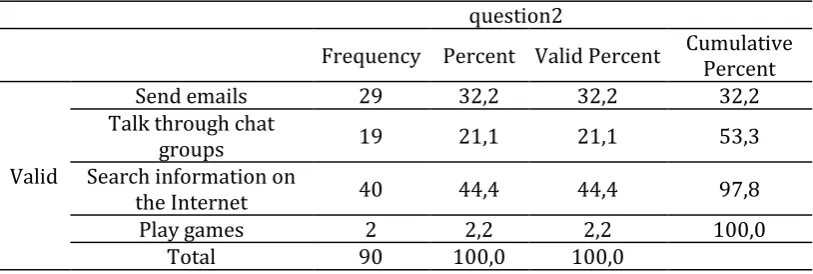
As we observe 29 students (32.2%) use computers to send e-mails, 19 students (21.1%) use them to talk through chat groups, 40 (44.4%) to search information on the Internet and 2 of them (2.2%) to play games. The graph of the answers follows.
Figure 3. Reasons students use a computer for.
Question 3:
3. Do you use the Internet in general?
question3
Frequency Percent Valid Percent Cumulative Percent
Valid
Yes 88 97,8 98,9 98,9
No 1 1,1 1,1 100,0
Total 89 98,9 100,0 Missing System 1 1,1
Total 90 100,0
Regarding the Internet use, 88 students (98.9%) use the Internet, whereas 1 student (1.1%) doesn’t use it.
Question 4:
4. Do you feel that there is an advantage in searching for information on the Internet than in books?
question4
Frequency Percent Valid Percent Cumulative Percent
Valid
Yes 79 87,8 87,8 87,8
No 11 12,2 12,2 100,0
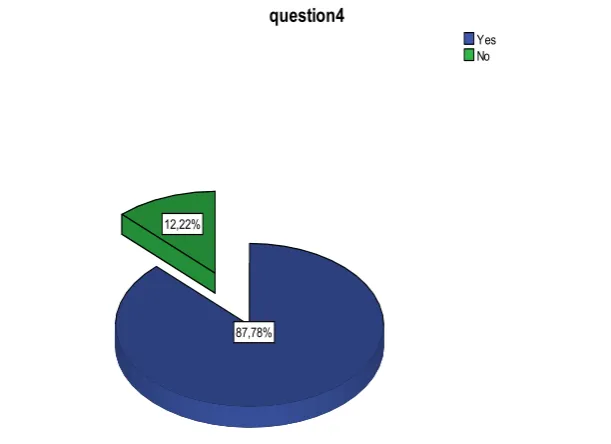
As we can observe, 79 students (87.8%) feel that there is an advantage in searching for information on the Internet than in books, while 11 students (12.2%) don’t feel there is an advantage. The graph of the answers follows.
Figure 4. Students opinions onadvantage in searching for information on the Internet than in books
Question 5:
5. Do you prefer using online dictionaries and encyclopedias rather than using dictionaries and encyclopedias in the library?
question5
Frequency Percent Valid Percent Cumulative Percent
Valid
Online 58 64,4 65,2 65,2
In the
library 31 34,4 34,8 100,0
Total 89 98,9 100,0 Missing System 1 1,1
Total 90 100,0
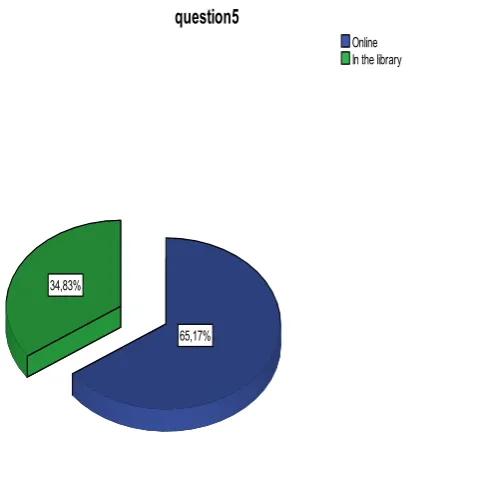
Figure 5. Preference toward finding sources online or in library
Question 6:
6. How do you feel about computers being part of your English language lesson? question6
Frequency Percent Valid Percent Cumulative Percent
Valid
Like 87 96,7 97,8 97,8
Don't like 2 2,2 2,2 100,0
Total 89 98,9 100,0 Missing System 1 1,1
Total 90 100,0
As we observe, 87 students (97.8%) like computers to be part of their English language lesson, while 2 (2.2%) don’t like it.
Question 7:
7. Do you feel that the use of the computer motivates you more to learn English than the traditional lesson?
question7
Frequency Percent Valid Percent Cumulative Percent
Valid
Yes 65 72,2 72,2 72,2
No 25 27,8 27,8 100,0
Total 90 100,0 100,0
Figure 6. Motivation to use computerto learn English
Question 8:
8. Would you prefer doing the computer activities at school or at home? question8a
Frequency Percent Valid Percent Cumulative Percent
Valid
At school 65 72,2 72,2 72,2
At home 25 27,8 27,8 100,0
Total 90 100,0 100,0
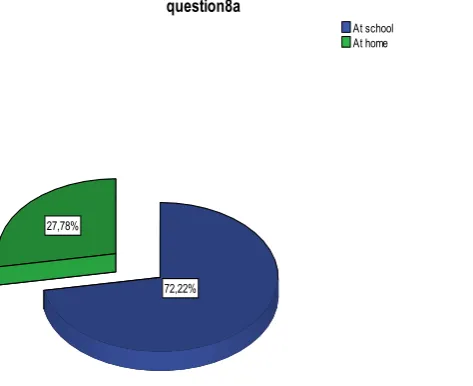
As we observe, 65 students (72.2%) prefer doing the computer activities at school, while 25 students (27.8%) prefer doing them at home. The graph of the answers follows.
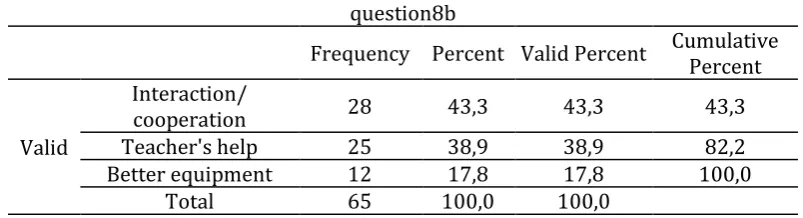
If you prefer doing them at school, what do you feel is the most important advantage? question8b
Frequency Percent Valid Percent Cumulative Percent
Valid
Interaction/
cooperation 28 43,3 43,3 43,3 Teacher's help 25 38,9 38,9 82,2 Better equipment 12 17,8 17,8 100,0
Total 65 100,0 100,0
Among the 65 students who prefer doing the activities at school, 28 of them(43.3%) feel that the interaction and cooperation with their classmates is the most important advantage, while 25 (38.9%) the fact that the teacher can help them and 12 students(17.8%) claim that the school equipment is better. The graph follows.
Figure 8. the most important advantage of doing the computer activities at school
Question 9:
9. Would you like to have computers incorporated in other classes as well (e.g. History, biology class)?
question9
Frequency Percent Valid Percent Cumulative Percent
Valid
Yes 85 94,4 94,4 94,4
No 5 5,6 5,6 100,0
Total 90 100,0 100,0
As we can see, 85 students (94.4%) would you like to have computers incorporated in other classes as well, while 5 (5.6%) wouldn’t like that.
10. What do you enjoy most and what least when using computers in your English language lesson?
a. I enjoy most:
question10a
Frequency Percent Valid Percent Cumulative Percent
Valid
Interaction with
classmates 63 70,0 70,0 70,0
Lesson becomes fun 7 7,8 7,8 77,8 Preparing projects 20 22,2 22,2 100,0
Total 90 100,0 100,0
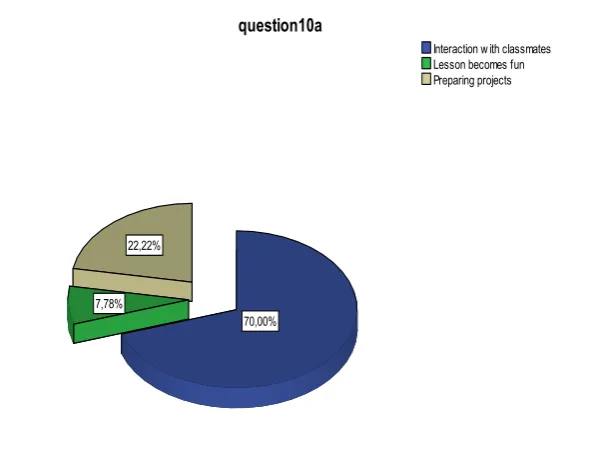
Regarding what the students enjoy most, 63 of them (70.0%) enjoy the interaction they have with their classmates, while 7 (7.8%) believe that the lesson becomes more fun this way and 20 (22.2%) enjoy preparing projects in the computer. The graph of the answers follows.
Figure 9. Activities that cause more enjoymentwhen using computers in your English language lesson
b. I enjoy least:
question10b
Frequency Percent Valid Percent Cumulative Percent
Valid
Pressure of time 48 53,3 53,3 53,3 Sessions sometimes
cancelled 3 3,3 3,3 56,7
There is nothing I don’t
like 39 43,3 43,3 100,0
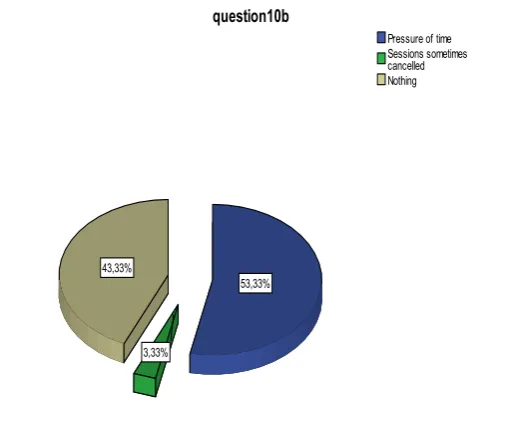
They enjoy least that there is pressure of time (53.3%) and that computer sessions are sometimes cancelled (3.3%). Also, 39 students (43.3%) feel there is nothing they don’t like.
Figure 10. Activities that cause less enjoyment when using computers in your English language lesson
Gender differences in the students’ answers
Question 1:
gender * question1 Crosstabulation Count
question1
Total More than 3
hours/day
Every day 1-3 hours
2-3 times/week
Less than 2-3 times/week
gender male 2 41 5 0 48
female 0 6 24 12 42
Total 2 47 29 12 90
Chi-Square Tests
Value df Asymp. Sig. (2-sided) Pearson Chi-Square 52,345a 3 ,000
Likelihood Ratio 61,804 3 ,000 Linear-by-Linear
Association 46,445 1 ,000 N of Valid Cases 90
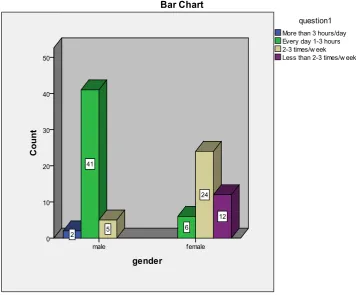
The differences between the two sexes as far as the hours of computer usage is concerned, were found to be statistically significant (p-value=0.000 < 0.01, CI 99%). The bar chart of the sex differences follows.
Figure 11. The differences between the two sexes regarding the hours of computer usage
Question 5:
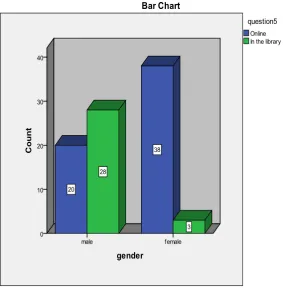
gender * question5 Crosstabulation Count
question5
Total Online In the
library
gender male 20 28 48
female 38 3 41
Total 58 31 89
Chi-Square Tests
Value df Asymp. Sig. (2-sided)
Exact Sig. (2-sided)
Exact Sig. (1-sided) Pearson Chi-Square 25,354a 1 ,000
Continuity Correctionb 23,156 1 ,000 Likelihood Ratio 28,391 1 ,000
Fisher's Exact Test ,000 ,000
Linear-by-Linear
a. 0 cells (,0%) have expected count less than 5. The minimum expected count is 14,28. b. Computed only for a 2x2 table
The differences between the two sexes as far as searching for information online or in the library concerned, were found to be statistically significant (p-value=0.000 < 0.01, CI 99%).The bar chart of the sex differences follows.
Figure 12. The differences between the two sexes regarding searching for information online or in the library
Question 6:
gender * question6 Crosstabulation Count
question6
Total Like Don't like
gender male 46 2 48
female 41 0 41
Total 87 2 89
Chi-Square Tests
Value df Asymp. Sig. (2-sided)
Exact Sig. (2-sided)
Exact Sig. (1-sided) Pearson Chi-Square 25,354a 1 ,000
Continuity Correctionb 23,156 1 ,000 Likelihood Ratio 28,391 1 ,000
Fisher's Exact Test ,000 ,000
Association
N of Valid Cases 89
a. 0 cells (,0%) have expected count less than 5. The minimum expected count is 14,28. b. Computed only for a 2x2 table
The differences between the two sexes on whether they like computers to be part of their lesson, were found to be statistically significant (p-value=0.000 < 0.01, CI 99%). The bar chart of the sex differences follows.
Figure 13. The differences between the two sexes on whether they like computers to be part of their lesson
Question 7:
gender * question7 Crosstabulation Count
question7
Total Yes No
gender male 25 23 48
female 40 2 42
Total 65 25 90
Chi-Square Tests
Value df Asymp. Sig. (2-sided)
Exact Sig. (2-sided)
Exact Sig. (1-sided) Pearson Chi-Square 20,794a 1 ,000
Continuity Correctionb 18,698 1 ,000 Likelihood Ratio 23,812 1 ,000
Fisher's Exact Test ,000 ,000
Linear-by-Linear
Association 20,563 1 ,000 N of Valid Cases 90
The differences between the two sexes regarding motivation to learn English, were found to be statistically significant (p-value=0.000 < 0.01, CI 99%). The bar chart of the sex differences follows.
Figure 14. The differences between the two sexes regarding motivation to learn English
Question 8:
gender * question8a Crosstabulation Count
question8a
Total At school At home
gender male 25 23 48
female 40 2 42
Total 65 25 90
Chi-Square Tests
Value df Asymp. Sig. (2-sided) Exact Sig. (2-sided) Exact Sig. (1-sided)
Pearson Chi-Square 20,794a 1 ,000 Continuity Correctionb 18,698 1 ,000 Likelihood Ratio 23,812 1 ,000
Fisher's Exact Test ,000 ,000
Linear-by-Linear
Association 20,563 1 ,000 N of Valid Cases 90
The differences between the two sexes on whether they prefer doing the activities at school or at home, were found to be statistically significant (p-value=0.000 < 0.01, CI 99%). The bar chart of the sex differences follows.
Figure
15. The differences between the two sexes on whether they prefer doing the activities at school or at home
Question 10:
gender * question10a Crosstabulation Count
question10a
Total Interaction
with classmates
Lesson becomes fun
Preparing projects
gender male 41 7 0 48
female 22 0 20 42
Total 63 7 20 90
Chi-Square Tests
Value df Asymp. Sig. (2-sided)
Pearson Chi-Square 32,474a 2 ,000 Likelihood Ratio 42,850 2 ,000 Linear-by-Linear
Association 20,765 1 ,000 N of Valid Cases 90
The differences between the two sexes on what they enjoy most, were found to be statistically significant (p-value=0.000 < 0.01, CI 99%). The bar chart of the sex differences follows.
Fig
ure 16. The differences between the two sexes on what they enjoy most
gender * question10b Crosstabulation Count
question10b
Total Pressure of
time
Sessions sometimes
cancelled
Nothing
gender male 40 3 5 48
female 8 0 34 42
Total 48 3 39 90
Chi-Square Tests
Value df Asymp. Sig. (2-sided) Pearson Chi-Square 45,701a 2 ,000
Likelihood Ratio 51,241 2 ,000 Linear-by-Linear Association 42,087 1 ,000
N of Valid Cases 90
The differences between the two sexes on what they enjoy least, were found to be statistically significant (p-value=0.000 < 0.01, CI 99%). The bar chart of the sex differences follows.
Figure 17. The differences between the two sexes on what they enjoy least
DISCUSSION
learning. He concluded that ‘computer games constitute a good example of material that satisfies the criterion of language needs relevant to learners of that language, and, at the same time, promotes vocabulary learning’ (Palmberg, 1988, p. 251) Therefore the evidence of enjoying using the computer for such a purpose that the students’ provide can be exploited by language teachers to assist vocabulary learning in a second or foreign language context. Sending e-mails is reported from many students as a feature that they particularly like doing when using a computer. This fact can be further exploited by the language teacher as this form of asynchronous communication can enrich language learning when used in a meaningful context. Students can therefore be asked to use e-mails, which they particularly enjoy using and communicate with other native or non-native speakers of English in the school and perhaps in other schools abroad. The Internet overall plays without any doubt a significant role in computer usage. Almost all the students questioned stated that they are using the Internet in general. As far as possible advantages of searching for information on the Internet rather than in books in the library, the students surveyed basically reported the advantages of finding information quickly and easily which support the view that the Internet seen as a flexible medium (Warschauer et al, 2000).
reported for example by some of the learners of his study as the major reason why they didn’t want to use it more often. In addition to the fact that the learners surveyed state that they like using computers in their English language lesson and that computers motivate them to learn English they state that they would like to have computers incorporated in some other classes as well. This statement reinforces the view that the specific learners hold very positive attitudes towards the implementation of computers in their classes. Interaction and cooperation with their classmates are again reported by the vast majority of the learners in their answers of the last question as the feature that they enjoy most when working on the computer and the computer activities. The enjoyment factor underlined in the study of Pratt et al (2002) is here seen as important as well; as many students respond that the lesson becomes more fun this way. Time pressure is reported as the fact that the students don’t like that much.
All in all, students indicate very positive attitudes towards computers used in their classroom context. They overall perceive the computer to be a tool that through quick and easy access and use provides opportunities for flexible and pleasant language learning, as well as additional motivation to learn English. The fun element, basically accomplished through playing games on the computer and sending e-mails is of importance to the students, as well as the fact that through the computer activities they are able to interact and co-operate with their classmate. As Crompton (1989, p. 18) argues, the introduction of a computer in a classroom can overall ‘enhance the education process for both teachers and children’. The main responsibility of what is happening in a classroom falls of course in the hands of the teachers. They need to become familiar with the various and multiple uses of computers, as well as to carefully select and design the material to be used each time. Students’ and teachers’ attitudes and perceptions towards computers and technological developments in general, used for teaching and learning purposes seem to open the road for further and fruitful exploration and exploitation of the potentials of technology.
REFERENCES
Ahmad, K., Corbett, G., Rogers, M., & Sussex, R. (1985). Computers, language learning and
language teaching. Cambridge: Cambridge University Press. Atkinson,T.(1998). WWW: The Internet.London: CILT.
Barson, J., Frommer, J., & Schwartz, M. (1993). Foreign language learning using e-mail in a task-oriented perspective: interuniversity experiments in communication and collaboration. Journal of Science Education and Technology, 2, 565-584.
Beauvois, M. (1997). Computer-mediated communication (CMC): Technology for improving speaking and writing'. In M. Bush (Ed.), Technology-Enhanced
Language Learning (pp. 165-184). Lincolnwood: National Textbook Company. Beauvois, M.H., & Elledge, J. (1996). Personality types and megabytes. Student attitudes
toward computer mediated communication (CMC) in the language classroom.
CALICO Journal, 13 (2/3), 27-45.
Bush, M.D. (2000). Digital Versatile Disc (DVD) the new medium for interactive video.
CALICO Journal 17(3). 453-474.
Chun, D. (1994). Using computer networking to facilitate the acquisition of interactive competence. System, 22(1), 17-31.
Collins, J.., Hammond , M. & Wellington, J. (1997). Teaching and Learning with
Multimedia. London. Routledge.
Cononelos, T. & Oliva. M. (1993). Using computer networks to enhance foreign language/ culture education. Foreign Language Annals 26: 141-152.
Cummings, C. A. (1998). Teacher Attitudes and Effective Computer Integration. Unpublished Master's Thesis, University of Virginia.
Cuthell, J. P. (2002). Virtual Learning. The Impactof ICT on the Way that Young People
Work and Learn. Aldershot: Ashgate Publishing Limited.
Dole, J. A., Duffy, G.G., Roehler, L.R., & Pearson, P.D. (1991). Moving from the old to the new: research on reading comprehension instruction. Review of Educational
Research, 61, 239-264.
Eastment, D. (1999). The Internet and ELT. Oxford, The British Council: Summertown Publishing.
Feldman, M. (1995). Import/export e-mail business simulation. In M. Warschauer (Ed.),
Virtual connections: online activities and projects for networking language learners
(pp. 216-217). Honolulu, Hawai'i: University of Hawai'i Second Language Teaching and Curriculum Center.
Garrett, N., (1998). Computers in foreign Language Education: Teaching, Learning and Language Acquisition research. ADFL Bulletin (19)3, 6-12.
Higgins, J & Johns, T. (1984). Computers in Language Learning. London. Collins Educational.
Hong, K. S Ridzuan, A.A & Kuek , M.-K. (2003). Students attitudes toward the use of the Internet for learning. A study at a university in Malaysia. Educational Technology
and Society, 6 (2), 45-49.
Joiner, E.G. (1997). Teaching listening. How technology can helr. In Bush, M.D & R.M Terry (eds) Technology Enhanced Language Learning. Illinois, USA National Textbook Company, 77-120.
Jones, C., & Fortescue, S. (1987). Using computers in the language classroom. London: Longman.
Kelm, O. (1995). E-mail discussion groups in foreign language education: Grammar follow-up. In M. Warschauer (Ed.), Telecollaboration in foreign language learning:
Proceedings of the Hawai'i symposium , Honolulu, HI: University of Hawai'i, Second Language Teaching and Curriculum Center.
Kenning, M.-M., & Kenning, M. J. (1990). Computers and language learning: current
theory and practice. New York: Ellis Horwood.
Kern, R. & M. Warschauer (Eds.). (2000). Network-based language teaching: Concepts
and practice. Cambridge: Cambridge University Press.
Kramsch, C.(1993).Context and Culture in Language Teaching. Oxford: OUP.
Little, D., S. Devitt& D. Singleton. (1988). Authentic Texts in Foreign Language Teaching:
Theory and Practice. Dublin: Authentik.
Liou, H. C. (1997). The impact of WWW texts on EFL learning. Computer Assisted
Language Learning, 10 (5), 455-478.
Liu, M. (1992). The effect of hypermedia-assisted instruction on second language learning: a semantic-network-based approach. Dissertation Abstracts
International, A: The Humanities and Social Sciences, 53, 1134-A.
Lixl-Purcell, A. (1995). German area studies on the net. In M. Warschauer (Ed.), Virtual
connections: online activities and projects for networking language learners , 292-294. Honolulu, Hawai'i: University of Hawai'i, Second Language Teaching and Curriculum Center.
Loucky, J. P. (2005). Combining the benefits of electronic and online dictionarieswith CALL Web sites to produce effective and enjoyable vocabulary and language learning lessons. Computer Assisted Language Learning 18(5),389-416.
Maddison, J. (1983). Education in the Microelectronics Era. Milton Keynes: Open University.
Martinez-Lage, A. (1997). Hypermedia technology for teaching reading. In M. Bush & R. Terry (Eds.), Technology-enhanced language learning (pp. 185-213). Lincolnwood, IL: National Textbook Co.
Masterman, L. (1985). Teaching the Media. Comedia Publ.
McDonald, H. & Ingvarson, L. (1995). Free at Last? Teachers, Computers and Independent Learning. Paper presented at the annual meeting of the American
Educational research Association, San Francisco, CA, April 18-22.
McQuail, D. (1983). Mass Communication Theory: an Introduction. London: Sage.
Medcalf-Davenport,.A. (1998). Historical and Current Attitudes Toward and Uses of
Educational Technology: A Work in Progress.U.S. Texas.
Mitra, A., & Steffensmeier, T. (2000). Changes in student attitudes and students computer use in a computer-enriched environment. Journal of Research on
Technology in Education, 32(3), 417-433.
Morris, F. (2005). Child-to-child interaction and corrective feedback in a computer mediated L2 class. Language Learning& Technology, 9, 29-45.
Palmberg, R. (1988). Computer games and foreign-language learning. ELT Journal 42, 4, 247-251.
Pennington, M. C. (1996). The Power of the Computer in Language Education. In Pennington, M. C. (ed). The Power of CAL (pp.1-15). Athelstan Publications.
Phillips, M. (1987). Communicative language learning and the microcomputer. London: British Council.
Pratt, N. (2002). Using or making use of ICT. Ways of Knowing Journal, 2(2), 40-47. Pusack, J. P., & Otto, S. K. (1990). Applying Instructional technologies. Foreign Language
Richmond, A. (2001). What is the state of CALL and IT use in ELT in the UK? An
assessment of attitudes, skills, knowledge and use in private English language schools. Unpublished MA Thesis, University of Reading.
Rosen, L. (1995). City net: travel the world from your desktop. In M. Warschauer (Ed.),
Virtual connections: Online activities and projects for networking language learners
(pp. 308-309). Honolulu, HI: University of Hawai'i, Second Language Teaching and Curriculum Center.
Rüschoff, B. (1993). Language learning and information technology: State of the art.
CALICO Journal, 10(3), 5-17.
Selfe, C. L., & Hilligoss, S. (1994). Literacy and computers: The complications of teaching
and learning with technology. New York: Modern Language Association of America. Slater P. & Varney-Burch, S. (2001). Multimedia in language learning. London: CILT. Soh, B.L. & Soon, Y.P. (1991).English by e-mail: Creating global classroom via the
medium of computer technology. ELT Journal 45, 287-292.
Stevens, Vance. (1991). A study of student attitudes toward CALL in a self-access student resource centre. System, 19(3)289-299.
Sullivan, N., & Pratt, E. (1996). A comparative study of two ESL writing environments: A computer-assisted classroom and a traditional oral classroom. System, 24(4), 491-501.
Teeler, D. &Gray, P. (2000). How to Use the Internetin ELT. Harlow: Pearson Education. Underwood, J. (1984). Linguistics, computers, and the language teacher: a communicative
approach. Rowley, MA: Newbury House.
Underwood, J. (1989). On the edge: intelligent CALL in the 1990s. Computers and the
Humanities, 23 (1), 71-84.
Van Dijk, T.A. & Kintsch, W. (1983). Strategies of discourse comprehension. Orlando, FL: Academic Press.
Vockell, E.L. & Schwartz, E. (1992). The Computer in the Classroom. New York: McGraw-Hill.
Wang, Y. M. (1993). E-mail dialogue journaling in an ESL reading and writing classroom. Unpublished Ph.D. dissertation, University of Oregon at Eugene.
Warschauer, M. (1996a). Comparing face-to-face and electronic communication in the second language classroom. CALICO Journal, 13(2), 7-26.
Warschauer, M. (1996b). Computer-assisted language learning: an introduction. In S. Fotos (Ed.), Multimedia Language Teaching (pp. 3-20). Tokyo: Logos.
Warschauer, M., & Healey, D. (1998). Computers and language learning: An overview.
Language Teaching, 31, 57 – 71.
APPENDIX
QUESTIONNAIRE FOR THE STUDENTS
This questionnaire has been designed, in order to investigate students’ attitudes and perceptions towards the use of computers as part of the English Language lesson. Your cooperation will be greatly appreciated.
By completing and returning this questionnaire I understand that I am giving consent for my responses to be used for the purposes of this research.
Gender M/F Age………
Please tick:
1. How often do you usually use computers?
More than 3 hours a day… Every day 1-3 hours…. 2-3 times a week…
Less than 2-3 times a week… I never use computers…
2. What do you usually use a computer for?
To send emails…
To talk through chat groups…
To search for information on the Internet… To play games…
Other… (please name……….)
3. Do you use the Internet in general?
Yes… No…
4. Do you feel that there is an advantage in searching for information on the Internet than in books?
Yes… No…
5. Do you prefer using online dictionaries and encyclopedias rather than using dictionaries and encyclopedias in the library?
I prefer online dictionaries/ encyclopedias…
I prefer dictionaries/ encyclopedias in the library…
6. How do you feel about computers being part of your English language lesson? I like the computer to be part of the lesson…
I don’t like the computer to be part of the lesson.. Other… (please name….)
7. Do you feel that the use of the computer motivates you more to learn English than the traditional lesson?
Yes… No…
8. Would you prefer doing the computer activities at school or at home? At school…
8b. If you prefer doing them at school, what do you feel is the most important advantage? Interaction/ cooperation with classmates…
The teacher can help me if I need something…
The equipment is better at school… Other… (please name….)
9. Would you like to have computers incorporated in other classes as well (e.g. History, biology class)?
Yes… No…
10.What do you enjoy most and what least when using computers in your English language lesson?
10a. I enjoy most:
Interaction with classmates… The lesson becomes more fun… Preparing projects in the computer… 10b. I enjoy least:
There is pressure of time to complete handouts… The computer sessions are sometimes cancelled …