ISSN 2324-805X E-ISSN 2324-8068 Published by Redfame Publishing URL: http://jets.redfame.com
Effect of 5E Learning Model on Academic Achievement, Attitude and
Science Process Skills: Meta-analysis Study
Nevin Kozcu CakırCorrespondence: Nevin Kozcu Cakır, Research Assistant Doctor, Mugla Sitki Kocman University, Faculty of Education, Department of Mathematics and Science, Mugla, Turkey.
Received: September 12, 2017 Accepted: October 11, 2017 Online Published: October 30, 2017 doi:10.11114/jets.v5i11.2649 URL: https://doi.org/10.11114/jets.v5i11.2649
Abstract
Today, with the development of science and technology and its rapid progress, the importance attached to science education has increased. This increase in interest has led to the development of the methods, techniques, and approaches that enable the students to be active, question and construct knowledge. The 5E learning model is one of them, and many studies have been conducted in literature related to this model. These independent studies have been carried out in different study areas, with different study groups, and different results have been achieved. In order to evaluate these results in general, it is necessary to make use of as many studies as possible. Meta-analysis was considered to work to reveal how each work has impacted the situation and make a generalization. From this point of view, a meta-analysis study was planned in this study to evaluate the effect of the 5E learning model on academic achievement, retention and scientific process skills. For this purpose, all the Master's, doctoral theses and articles in Turkish and English languages which were carried out in Turkey between 2006 and 2016 and which are suitable for the research problem have been scanned and included in the scope of the study. In order to limit studies and conduct meta-analysis in this context, studies had to be planned with semi-experimental design with experiment and control groups; there had to be quantitative data such as mean, standard deviation, and sample size and they had to be applied only in science courses. The data obtained from the articles and theses were meta-analyzed and it was determined that the 5E learning model had an effect on the students' academic achievement, attitude towards science and science process skills. In this context, studies should be conducted in order to limit the studies and to perform the meta-analysis, in which semi-experimental design with experimental and control groups is planned, t-test is applied only in science courses. By analyzing the data obtained from the articles and theses, a general evaluation was made about the effect of the 5E learning model on academic achievement, attitude toward science and science process skills. As a result of the study, the effect of the method applied for each dependent variable was found to favor the experimental group.
Keywords: 5E learning model, meta-analysis 1. Introduction
Today, it has become more difficult for individuals to follow fast and continuous information exchange around the world. Individuals realized that they need to learn the ways to attain information rather than knowing it so that they can overcome this difficulty, facilitate their daily life and work in developing and changing work environments. It was also thought that education should teach individuals how to construct information. For this reason, many countries took science education programs into consideration and they began new structuring. To examine some of these programs; Science_A Process Approach: S_APA I was developed by Gagne and this program aims to ensure that students learn by practicing during their education and that they obtain and improve science process skills by doing experiments (Padilla, Okey & Garrard, 1984; Kaptan, 1999). It was later revised and changed to S_APA II (Science_A Process Approach II). This program differed from the previous one in that students did not have books and were involved in the learning process by participating directly in the activities (Kaptan, 1999).
Journal of Education and Training Studies Vol. 5, No. 11; November 2017
The Science Curriculum Improvement Study (SCIS) program aims to help children achieve science process skills and become scientifically literate individuals. Piaget's developmental periods were taken into consideration in the construction of the program. The main aim of the program is to enable students to discover, search for and find scientific knowledge in classrooms (Kratochvil & Crawford, 1971, Kaptan, 1999, Kaptan, Yetisir & Demir, 2007). Learning cycle defined by JMyran Atkin and Robert Karplus (1962) was used in this program (Bybee, 2006). Learning cycle is based on research and constructivist approach.
If we look at the basics of all of these programs, it is noteworthy that students are active and construct the knowledge themselves in these programs.
These recently developed programs, science education standards published by the National Research Council (NRC) in 1995 and rapidly changing science and technology have made it necessary to restructure the science course program in our country in order to train qualified individuals. In light of these developments, Ministry of National Education restructured the Science Lesson in 2004 and changed its name to Science and Technology Lesson (MoNE, 2005). A structured approach was adopted in the new program and the program was designed with a spiral structure. Later revisions were made to the program (MoNE, 2005; MoNE, 2013) and finally, draft program was developed in 2017. However, the basis of the program is the constructivist approach (MoNE, 2017). The main aim of the program is to educate science-literate individuals. The main feature of science literate individuals is they construct information themselves. Many methods, techniques, and models have been developed to reveal the constructivist approach in the program. One of these models is 5E learning model. The model can be used in science courses to increase the quality of practices and to design science courses based on structural approach and cognitive psychology (Bybee, 1997). Furthermore, Bybee (1997) argues that the use of this approach helps students redefine, organize, examine, and change the ideas they already have through interacting with their peers and environment. According to Duran (2004), the 5E learning model helps and serves teachers in that it provides an example of the application of the structuralist approach in course processing and provides good reform-based instruction. He also stated that the model could help to develop the curriculum. Senan (2013) reported that the technology-enriched 5E learning model is a good tool for students to acquire 21st-century skills as well as for teachers to teach a specific concept. In his study on the 5E learning model, Prokes (2009) observed that the students in this model were more active and motivated than the students in lecture-based classrooms and that these students could find opportunities to share their knowledge and experiences. According to the 5E learning model, students' prior knowledge is identified and a research question is put forth about the concept or event to be learned, the first-hand experience and information are reached in the solution of the existing question through teacher’s guidance and the concept or event is transferred to a different field and evaluated. When its steps are examined in general;
Introduction: the purpose of this step is to capture the attention and interest of students. A problem, situation or event is given for the ability and concept intended to be constructed in the students. It is aimed that the students focus on this situation. The most prominent feature of this step is that a short demonstration, problem situation or event is given in order to evaluate and reveal the preliminary knowledge of students. The teacher gets students’ attention to the question or event at the beginning of the lesson.
Discovery: At this stage, students experience firsthand the experience they need to solve the question put forth in the introduction stage.
Description: Students are allowed to explain and organize the lacking part in their preliminary knowledge in a clear and understandable manner with the information they just acquired.
Expanding: It includes the ability to transfer the concepts or situations students learn to new situations.
Assessment: Students receive adequate feedback on the concepts, explanations, and skills they acquire. Teachers have to evaluate learning outcomes at this stage (Bybee, 2006, Campbell, 2006).
Acıslı & Turgut, 2010; Aktas, 2013b, Aydın & Yılmaz, 2010; Bıyıklı & Yagcı, 2015; Guzel, 2016; Hırca, Calık & Seven, 2011; Ozbudak & Ozkan, 2014) and science process skills (Acıslı, 2014; Acıslı, Turgut, Yalcın & Gurbuz, 2009; Acıslı & Turgut, 2011; Altun Yalcın, Acıslı & Turgut, 2010; Bıyıklı, 2013; Ozturk Geren & Dokme, 2015;) of students. These studies in science have been realized at many levels from primary education (first (primary) and second (secondary) levels) to university. However, no research has been carried out that indicates a clear result showing how effective this model is on attitude, achievement and science process skills when compared with traditional teaching methods in the field of science. These independent studies were carried out in different study areas and with different study groups and different results were achieved. In order to evaluate these results in general, it is necessary to make use of as many studies as possible. Meta-analysis has been conducted in the study in order to monitor how each study has affected the situation and to make a generalization. This study aims to determine the effect of the 5E learning model on academic achievement, attitude towards lesson and science process skills compared to the traditional teaching method. To this end, answers to the following questions were sought:
1. What is the effect of the 5E learning model on the academic achievement of students? 2. What is the effect of the 5E learning model on students' attitude towards lesson? 3. What is the effect of the 5E learning model on students' science process skills?
2. Method
2.1Research Model
In the study, meta-analysis was used to determine the effect of the 5E learning model on students' academic achievement, attitudes toward science, and science process skills. Although meta-analysis is described as reviewing in health sciences and research in social sciences, it is basically a quantitative technique which aims to combine the results of several published and complete individual studies in terms of various variables and make a general evaluation. It is a literature search technique in scientific research and helps to reach a general judgment by compiling quantitative research results (Bailar, 1995, Christensen, Johnson & Turner, 2015; Finley, 1995; Hunter & Schmidt, 2004).
2.2 Data Collection
The sources from which the research data was obtained are articles and master's and doctoral dissertations published and unpublished about the "5E learning" model in Turkey between 2006 and 2016, designed with quantitative design and published in refereed journals with essential statistical data.
When scanning;
The website of YOK (Council of Higher Education) National Dissertation Center has been used for thesis. When scanning, keywords including both Turkish and English "5E learning model", "Structural approach", "5E" were typed in the study title and both the Turkish and English theses were reached. A total of 74 dissertations were reached, but the number of theses reached from the dissertation center and from the researchers is 21. 11 of these theses are master's degree and 10 of them are doctorate theses. Only theses written for science courses were included in the study. 10 theses were excluded from the study because of the use of a single group pattern or the use of more than one teaching method in some theses, or because some theses did not have some values required for analysis or because some of them had been published in journals. The articles of the theses published have been included in the study. 10 theses on the effect of the 5E learning model on the academic achievement of students, 6 theses on the students' attitude towards lesson and 1 thesis on the science process skills of students have been included in the meta-analysis study.
EBSCO, Google Scholar, Ulakbim, and other prestigious scientific refereed journals were scanned in order to reach the articles published in Turkey. All the Turkish and English publications whose sampling was Turkey have been scanned. Some articles have not been included in the study because they had more than one teaching method used together and they did not indicate some values required for analysis. As regards to the articles included, 23 articles on the effect of the 5E learning model on the academic achievement of students, 16 articles on the students' attitude towards lesson and 5 articles on the science process skills of students have been included in the meta-analysis study.
As there were several studies on attitudes and academic achievement in some theses and articles, these were considered as separate studies. Furthermore, the reports on the 5E learning model were difficult to reach, so they have not been included in the study.
Criteria for Being Included In the Study
The following criteria were taken into account when determining the studies to be included in the meta-analysis study:
Journal of Education and Training Studies Vol. 5, No. 11; November 2017
• The articles should be published in master and doctoral theses and in refereed journals written in English and Turkish,
• Studies should include experimental and control groups and pre-test post-test experimental study;
• Studies should be applied in the field of science and technology,
• In the studies, the traditional teaching approach should be applied to the control group while the 5E learning model to the experimental group.
• In the studies, there should be arithmetic mean and standard deviation values of study groups related to academic achievement, attitude towards lesson and science process skills.
• In the studies, the sample sizes of the study groups should be included.
2.3 Data Code
The coding has been done so that the meta-analysis of the scanned and obtained works can be done. The coding process has been done to include the contents and the publication information of the study. Codes consist of the author, type and publication year of the study, the level of education of the student group to which the study was applied, the type of the course the study was applied to, the statistical data and dependent variables in the study. The statistical data used in the study are the sample size, arithmetic mean and standard deviation values of the study. The dependent variables, on the other hand, are the effect size of the academic achievement, attitude towards the course and science process skills. The effect size is a standard value used in the analysis of each study (Bernard et al., 2004; quoted by: Aktamıs, Higde & Ozden, 2016).
2.4 Data Analysis
Meta-analysis method has been used in the study. In addition, descriptive analyses have been made as to by whom, in what year and in which publication type the studies were performed. Comprehensive Meta-Analysis (CMA) program has been used for meta-analysis. Cohen (1977) defined the Cohen's d shown in the meta-analysis as the difference between the averages of the two groups as the resulting value from dividing the two groups into a common standard deviation combined (quoted by: Cohen, 1980). There is also Hedge's g in meta-analysis studies and the same formula is utilized here too and Cohen assumes that the variances here are not equal to the difference (Dincer, 2014). Thanks to the d and g values calculated here, the results of more than one independent study are translated into a common measuring system, which helps us to make a right comparison (Dincer, 2014, Ustun, Eryılmaz, 2014).
Cohen (1988) used a classification for interpreting the effect sizes and overall effect size obtained from the meta-analysis. According to this;
• -0.15≤ d ≤ 0.15 was interpreted as insignificant level;
• 0.15 ≤ d ≤ 0.40, minor level;
• 0.40 ≤ d ≤ 0.75, medium level;
• 0.75 ≤ d ≤ 1.10, broad level;
• 1.10 ≤ d ≤ 1.45, very broad-level;
• 1.45 ≤ d perfect level.
Before calculating the effect sizes in the meta-analysis, it is necessary to perform a homogeneity test to measure the effect sizes and the homogeneity of the population sample in the study. Thus, the model to be applied is determined according to the study. There are 2 models; one is the fixed effects model and the other is the random effects model. The fixed effect model states that all studies have only one effect size and that the resulting differences are due to sampling error. The random effects model, on the other hand, implies that the actual effect size may vary from work to work due to variables such as age, education of participants and sampling size. Thus, it tells the effect size is distributed around some averages (Ustun & Eryılmaz, 2014). The model is determined according to whether or not the Q value exceeds the critical value and whether the p values are less or more than 0.05. If the Q value exceeds X2 value for a specific df value and if p<0.05, there
is heterogeneity and the random effects model is used. If the Q value does not exceed X2 value for a specific df value and
if p>0.05, there is homogeneity and the fixed effects model is used. The effect size is calculated according to these models (Borenstein, Hedges, Higgins & Rothstein, 2009; Dincer, 2014).
3. Results
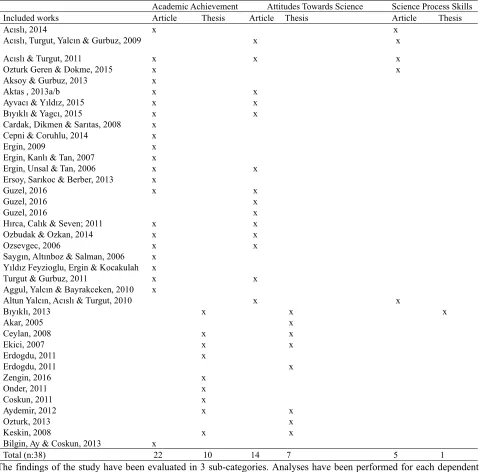
skill have been included in the study. In the studies about the dependent variable of academic achievement, a total of 1202 students in the experimental group and 1054 students in the control group; in the studies about the dependent variable of attitude towards lesson, a total of 725 students in the experimental group and 722 students in the control group and in the studies about the dependent variable of science process skills, a total of 177 students in the experimental group and 169 students in the control group have been analyzed.
Table 1. Meta-Analysis included works
Academic Achievement Attitudes Towards Science Science Process Skills
Included works Article Thesis Article Thesis Article Thesis
Acıslı, 2014 x x
Acıslı, Turgut, Yalcın & Gurbuz, 2009 x x
Acıslı & Turgut, 2011 x x x
Ozturk Geren & Dokme, 2015 x x
Aksoy & Gurbuz, 2013 x
Aktas , 2013a/b x x
Ayvacı & Yıldız, 2015 x x
Bıyıklı & Yagcı, 2015 x x
Cardak, Dikmen & Sarıtas, 2008 x Cepni & Coruhlu, 2014 x
Ergin, 2009 x
Ergin, Kanlı & Tan, 2007 x
Ergin, Unsal & Tan, 2006 x x
Ersoy, Sarıkoc & Berber, 2013 x
Guzel, 2016 x x
Guzel, 2016 x
Guzel, 2016 x
Hırca, Calık & Seven; 2011 x x
Ozbudak & Ozkan, 2014 x x
Ozsevgec, 2006 x x
Saygın, Altınboz & Salman, 2006 x Yıldız Feyzioglu, Ergin & Kocakulah x
Turgut & Gurbuz, 2011 x x
Aggul, Yalcın & Bayrakceken, 2010 x
Altun Yalcın, Acıslı & Turgut, 2010 x x
Bıyıklı, 2013 x x x
Akar, 2005 x
Ceylan, 2008 x x
Ekici, 2007 x x
Erdogdu, 2011 x
Erdogdu, 2011 x
Zengin, 2016 x
Onder, 2011 x
Coskun, 2011 x
Aydemir, 2012 x x
Ozturk, 2013 x
Keskin, 2008 x x
Bilgin, Ay & Coskun, 2013 x
Total (n:38) 22 10 14 7 5 1
The findings of the study have been evaluated in 3 sub-categories. Analyses have been performed for each dependent variable and the findings were listed respectively.
3.1 Findings Related to the Effect of 5E Learning Model on Academic Achievement of Students
Journal of Education and Training Studies Vol. 5, No. 11; November 2017
Table 2.Findings Related to Homogeneity and General Effect Size
Model ES df Q X2 SE ES (%95 CI)
Min. Max.
SEM 1.189 30 215.652 43.77 0.047 1.098 1.280
REM 1.268 30 215.652 43.77 0.128 1.017 1.518
When the Table 2 above is examined, the Q value according to the homogeneity test is calculated as 215.652. In the X2
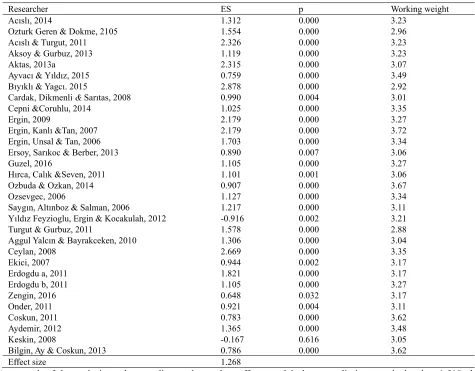
table, the critical value was found to be 43.77 with 30 degrees of freedom at 95% significance level. According to these results, it can be said that the distribution of effect sizes is heterogeneous because Q value (215.652) is larger than the critical value of 43.77 and p-value (p <0.05) is small. According to the test results, the analysis was performed by the random effects model. Accordingly, the combined effect sizes, variance and working weights of the studies included in the study are shown in Table 3.
Table 3. Effect Size Findings of Studies Included in the Research
Researcher ES p Working weight
Acıslı, 2014 1.312 0.000 3.23
Ozturk Geren & Dokme, 2105 1.554 0.000 2.96
Acıslı & Turgut, 2011 2.326 0.000 3.23
Aksoy & Gurbuz, 2013 1.119 0.000 3.23
Aktas, 2013a 2.315 0.000 3.07
Ayvacı & Yıldız, 2015 0.759 0.000 3.49
Bıyıklı & Yagcı. 2015 2.878 0.000 2.92
Cardak, Dikmenli & Sarıtas, 2008 0.990 0.004 3.01
Cepni &Coruhlu, 2014 1.025 0.000 3.35
Ergin, 2009 2.179 0.000 3.27
Ergin, Kanlı &Tan, 2007 2.179 0.000 3.72
Ergin, Unsal & Tan, 2006 1.703 0.000 3.34
Ersoy, Sarıkoc & Berber, 2013 0.890 0.007 3.06
Guzel, 2016 1.105 0.000 3.27
Hırca, Calık &Seven, 2011 1.101 0.001 3.06
Ozbuda & Ozkan, 2014 0.907 0.000 3.67
Ozsevgec, 2006 1.127 0.000 3.34
Saygın, Altınboz & Salman, 2006 1.217 0.000 3.11
Yıldız Feyzioglu, Ergin & Kocakulah, 2012 -0.916 0.002 3.21
Turgut & Gurbuz, 2011 1.578 0.000 2.88
Aggul Yalcın & Bayrakceken, 2010 1.306 0.000 3.04
Ceylan, 2008 2.669 0.000 3.35
Ekici, 2007 0.944 0.002 3.17
Erdogdu a, 2011 1.821 0.000 3.17
Erdogdu b, 2011 1.105 0.000 3.27
Zengin, 2016 0.648 0.032 3.17
Onder, 2011 0.921 0.004 3.11
Coskun, 2011 0.783 0.000 3.62
Aydemir, 2012 1.365 0.000 3.48
Keskin, 2008 -0.167 0.616 3.05
Bilgin, Ay & Coskun, 2013 0.786 0.000 3.62
Effect size 1.268
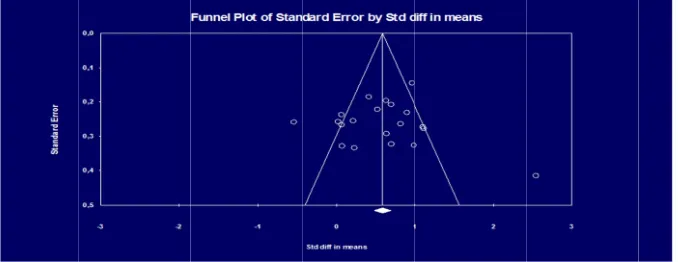
Figure 1. Effect Size Funnel Plot
It will be seen that in the event of publication bias in the funnel plot, the effect sizes will be distributed asymmetrically and vice versa. When Figure 1 is examined, it is seen that it is distributed in a structure close to the symmetric structure. This shows that the publication bias is not high. The value obtained as a result of the Rosenthal method is 13.270 and if the value is more than 1, it shows that there is resistance against publication bias.
3.2 Findings Related to the Effect of 5E Learning Model on Students' Attitudes towards the Lesson
The findings of the homogeneity test and the findings as to which model is to be used are given in Table 2 below in order to determine the effect of the 5E learning model on students' attitudes towards the lesson when compared with the traditional teaching model.
Table 4. Findings Related to Homogeneity and General Effect Size
Model ES df Q X2 SE ES (%95 CI)
Min. Max.
SEM 0.584 19 79.697 30.14 0.054 0.477 0.691
REM 0.583 19 79.697 30.14 0.115 0.358 0.808
As indicated in Table 4 above, the Q value according to the homogeneity test was calculated as 79.697. In the X2 table,
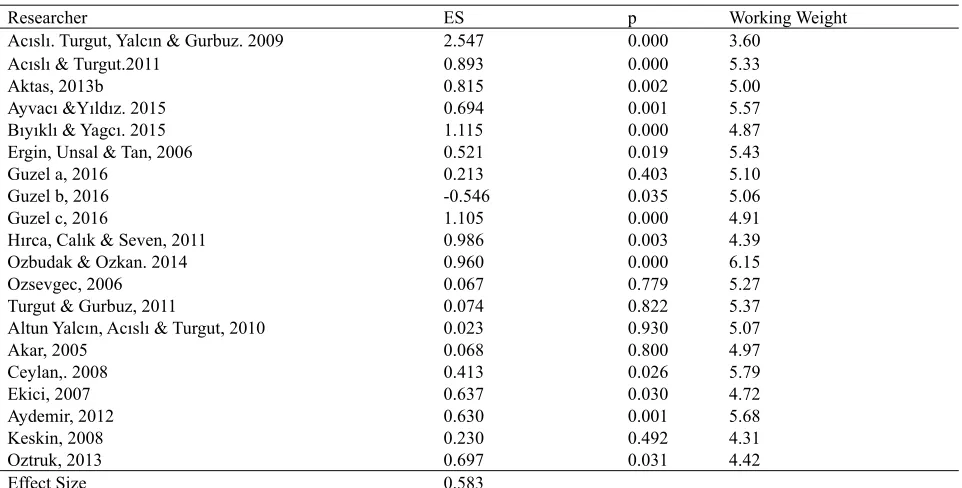
the critical value was found to be 30.14 with 19 degrees of freedom at 95% significance level. These results show that the distribution of effect sizes is heterogeneous because Q value (215.652) is larger than the critical value of 30.14 and p-value (p <0.05) is less. Furthermore, the test results indicate that the analysis was performed by the random effects model. Accordingly, the combined effect sizes, variance and working weights of the studies included in the study are shown in Table 5.
Table 5. Effect Size Findings of Studies Included in the Research
Researcher ES p Working Weight
Acıslı. Turgut, Yalcın & Gurbuz. 2009 2.547 0.000 3.60
Acıslı & Turgut.2011 0.893 0.000 5.33
Aktas, 2013b 0.815 0.002 5.00
Ayvacı &Yıldız. 2015 0.694 0.001 5.57
Bıyıklı & Yagcı. 2015 1.115 0.000 4.87
Ergin, Unsal & Tan, 2006 0.521 0.019 5.43
Guzel a, 2016 0.213 0.403 5.10
Guzel b, 2016 -0.546 0.035 5.06
Guzel c, 2016 1.105 0.000 4.91
Hırca, Calık & Seven, 2011 0.986 0.003 4.39
Ozbudak & Ozkan. 2014 0.960 0.000 6.15
Ozsevgec, 2006 0.067 0.779 5.27
Turgut & Gurbuz, 2011 0.074 0.822 5.37
Altun Yalcın, Acıslı & Turgut, 2010 0.023 0.930 5.07
Akar, 2005 0.068 0.800 4.97
Ceylan,. 2008 0.413 0.026 5.79
Ekici, 2007 0.637 0.030 4.72
Aydemir, 2012 0.630 0.001 5.68
Keskin, 2008 0.230 0.492 4.31
Oztruk, 2013 0.697 0.031 4.42
Effect Size 0.583
The analysis performed according to the random effects model indicate that the upper limit was calculated as 0.808, the
-3 -2 -1 0 1 2 3
0,0
0,1
0,2
0,3
0,4
S
ta
nda
rd
E
rr
or
Std diff in means
Journal of Educ
lower limit w When statistic according to t effect of the a Cohen (1988) had negative e The Funnel P Rosenthal met
It will be seen and vice versa publication bi than 1, it show
3.3 Findings R
The findings below in orde with the tradit Table 6. Findi
Model
SEM REM As indicated i the critical va the distributio p-value (p <0 model. Accor shown in Tabl Table 7. Effec Researcher Acıslı, 2014 Acıslı, Turgu Ozturk Geren Acıslı & Tur Altun Yalcın Bıyıklı, 2013 Effect Size As a result of lower limit w When statistic according to t
cation and Train
was 0.358 and cal significanc the results obt applied method ) classification effects, and the Plot was used
thod.
n that in the ev a. Figure 2 pro ias is not high. ws that it is res
Related to the E
of the homog er to determine
tional teaching ings Related to
ES
1.586 1.669 in Table 6 abo alue was found on of effect siz 0.05) is less. F rdingly, the com
le 7.
ct Size Finding
ut, Yalcın & Gur n & Dokme; 20 rgut, 2011 n, Acıslı & Turgu
3
the analysis pe was 1.124 and
cal significanc the results obta
ning Studies
the effect size ce was exami tained. In addi d is in favor o n. The effect si e smallest effe to determine i
vent of publica oves that it was The value obt sistant against p
Effect of 5E Le
geneity test an e the influence g model. o Homogeneity
df
5 5 ve, the Q valu d to be 11.70 w
es was heterog urthermore, th mbined effect
gs of Studies In
rbuz, 2009 15 ut. 2010
erformed acco the effect size ce was exami ained. In additi
e was 0.583 fo ined, Z = 5.08 ition, the fact of the experim izes of the stud
ct size was cal if there was a
Figure 2. Ef ation bias in th s distributed in tained as a res publication bia
earning Model
d the findings e of the 5E lea
y and General Q
23.797 23.797 ue according to
with 5 degrees geneous becau he test results sizes, varianc
ncluded in The ES 1.472 0.927 1.892 1.643 1.13 3.134 1.669 ording to the ra
e was 1.669 fo ined, Z = 6.00 ion, the fact th
for a standard 88 and p = 0 that the mean ental group an dies point out lculated as -0.5 a publication b
ffect Size Funn he funnel plot, n a structure clo sult of the Rose
as.
l on Students' S
s as to which arning model o
Effect Size X2
11.07 11.07 o the homogen s of freedom a use Q value (23
indicate that t ce and workin
e Research 2 7 2 3 1 4 9
andom effects m for a standard
02 and p = 0 hat the mean ef
error of 0.115 0.000 were fou n effect size w nd has a mediu 19 studies had 546 and the hig bias, and calcu
nel Plot the effect size ose to the sym enthal method
Science Proce
model is to b on students' sc
SE
0.126 0.278 neity test was c at 95% signific 3.797) is large the analysis w g weights of t
p 0.000 0.004 0.000 0.000 0.000 0.000 0.000 model, the upp
error of 0.278 0.000 were fou ffect size is po
Vol. 5,
5 and a confid und. This is s was positive (+ um range of e d positive effe ghest effect siz ulations were m
es will be distr mmetric structu d was 12.583 a
ess Skills
be used are de cience process
ES (%95 C Min. 1.340 1.124 calculated as 2 cance level. Th er than the criti was performed the studies inc
Working Weig 17.30 16.53 15.35 18.09 17.59 15.14 per limit was c 8 and a confid und. This is s ositive (+1.669
No. 11; Novem
dence interval statistically sig +0.583) shows
ffects accordin ects while only
ze as 2.547. made accordin
ributed asymm ure. This shows and if the value
emonstrated in skills when c
CI) Max. 1.832 2.214 23.887. In the
hese results pr ical value of 1
by the random cluded in the s
ght
calculated as 2 dence interval statistically sig 9) shows that t
mber 2017
of 95%. gnificant that the ng to the y 1 study
ng to the
metrically s that the e is more
Table 6 ompared
X2 table,
rove that 1.70 and m effects study are
of the applied method is in favor of the experimental group and has a perfect range of effects according to the Cohen (1988) classification. When the effect sizes of the studies are examined, it is seen that all studies have positive effects, the smallest effect size was calculated as 0,927 and the highest effect size was 3.134.
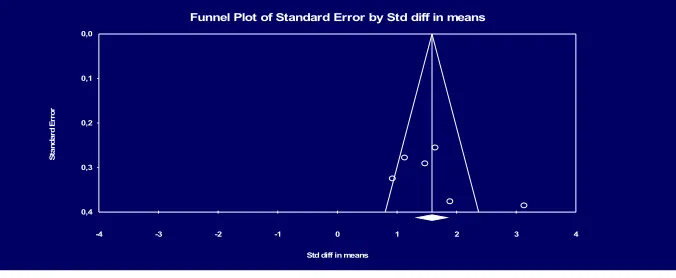
The Funnel Plot was used to determine if there was a publication bias, and calculations were made according to the Rosenthal method.
Figure 3. Effect Size Funnel Plot
It will be seen that in the event of publication bias in the funnel plot, the effect sizes will be distributed asymmetrically and vice versa. Figure 3 shows that it is distributed in a structure close to the symmetric structure. This shows that the publication bias is not high. The value obtained as a result of the Rosenthal method is 8.65 and if the value is more than 1, it shows that it is resistant against publication bias.
4. Discussion
On the effect of 5E learning model on the academic achievement compared with the traditional teaching method, a total of 31 studies which were published or unpublished nationally or internationally between 2006 and 2016, which were applied in science lessons, designed in experimental design, with quantitative data (arithmetic average, sample size and average) have been combined. The total number of samples in the studies used to determine its effect on academic achievement was 2256. According to random effects model, it has been determined that the overall effect size of the studies was found to be 1,017 and ES=1,268 (%95 CI, SE=0,128) at a confidence interval of 1,518 and that it has a very broad level of effect according to Cohen (1988) classification. According to this finding, it can be said that the 5E learning model is very effective on academic achievement compared with the traditional teaching method. Besides this, studies showing that it has negative effects have also been found (Keskin, 2008; Yıldız Feyzioglu, Ergin & Kocakulah, 2012). The negative consequences of these studies may be due to small sample groups and physics topics that are difficult to understand. This result of the study shows a parallelism with the studies conducted in parallel with the studies carried out between 2003 and 2014 but researched the effect of constructivist approach on academic achievement (including studies involving the 5E learning model) and with no specific field application limit (Ayaz & Sekerci, 2015) and the studies with no specific field application limit that researched the effect of 5E learning model on the academic achievement between 2008 and 2014 (Anıl & Batdı, 2015).
On the effect of 5E learning model on students' attitude towards the lesson compared with the traditional teaching method, a total of 20 studies which were published or unpublished nationally or internationally between 2006 and 2016, applied in science lessons, designed in experimental design with quantitative data (arithmetic average, sample size and average) have been combined. The total number of samples in the studies used in determining its effect on attitudes towards the lesson is 1447. According to random effects model, it has been determined that the overall effect size of the studies was found to be 0,358 and ES=0,583 (%95 CI, SE=0,115) at a confidence interval of 0,808 and that it has a very broad level of effect according to Cohen (1988) classification. This finding reveals that the 5E learning model is moderately effective on the attitude towards the lesson compared with the traditional teaching method. Besides this, 1 study showing that it has negative effects was found (Guzel, 2016). The reason for the negative outcome of these studies has not been determined. This result of the study shows a parallelism with the studies conducted in parallel with the study between 2003 and 2014 but researched the effect of constructivist approach on students' attitude towards lesson (including the studies involving the 5E learning model) and with no specific field application limit (Ayaz & Sekerci, 2015) and the studies with no specific field application limit that researched the effect of 5E learning model on students' attitude towards lesson (Anıl & Batdı, 2015) and the studies that researched the effect of 5E learning model on students' attitude towards lesson and that covered the years between 2004 and 2014 and with no specific field application limit (Ayaz, 2015).
-4 -3 -2 -1 0 1 2 3 4
0,0
0,1
0,2
0,3
0,4
S
ta
nda
rd
E
rr
or
Std diff in means
Journal of Education and Training Studies Vol. 5, No. 11; November 2017
On the effect of 5E learning model on the science process skills compared with the traditional teaching method, a total of 6 studies which were published or unpublished nationally or internationally between 2006 and 2016, applied in science lessons, designed in experimental design with quantitative data (arithmetic average, sample size and average) have been combined. The total number of samples in the studies used in determining the effect on science process skills is 346. According to random effects model, it has been determined that the overall effect size of the studies was found to be 1,124 and ES=1,559 (%95 CI, SE=0,278) at a confidence interval of 2,214 and that it has a perfect level of effect according to Cohen (1988) classification. According to this finding, it can be said that the 5E learning model is effective at a perfect level on the attitude towards the lesson compared with the traditional teaching method. Besides this, no studies showing negative effects have been identified.
In general, it can be said that the 5E learning model is more effective on students' academic achievement, attitude towards lesson and science process skills than the traditional teaching method.
The following suggestions can be given in line with the study.
• It has been determined that the 5E learning model has a moderate effect on the attitudes of the students. In other studies, Ayaz (2015) determined a small scale of effect; Anıl and Batdi (2015) a medium scale of effect, Saraç (2017) a medium scale of effect, Ural and Bumen (2016) a medium scale of effect and Ayaz and Sekerci (2015) a medium scale of effect. These results indicate that it can be investigated what needs to be done in order to increase this effect.
• The 5E learning model has been found to have a broad effect on the academic achievement of students. In other studies; Anıl and Batdi (2015) determined a very broad scale of effect, Saraç (2017) a very broad scale of effect, Ural and Bumen (2016) a very broad scale of effect and Ayaz and Sekerci (2015) a very broad scale of effect. Teachers can be encouraged to apply the 5E learning model in lessons, and the necessary in-service practices can be given to eliminate the application difficulties.
• Since this teaching model is efficient, it can be emphasized more in the curriculum.
• Meta-analysis studies that investigate with which course content and at which level of learning the applications prepared according to the 5E learning model are more effective can be performed.
References
*Acıslı, S., & Turgut, U. (2011). The examination of the influence of the materials generated in compliance with 5e learning model on physics laboratory applications. International Online Journal of Educational Sciences, 3(2), 562-593.
*Acıslı, S., Turgut, U., Altun, Y. S., & Gurbuz, F. (2009). The influence of teaching based on 5e learning model on undergraduates’ skills of scientific process and their attitudes towards physic laboratory in the electric topics.
Bayburt University Journal of Education Faculty, 4(I-II), 80-92.
*Aggul, Y. F., & Bayrakceken, S. (2010). The effect of 5e learning model on pre-service science teachers’ achievement of acid-bases subject. International Online Journal of Educational Sciences, 2(2), 508-531.
*Akar, E. (2005). Effectiveness of 5e learning cycle model on students’ understanding of acid-base concepts.
Unpublised Masters Thesis, Orta Dogu Teknik University, Institute of Science and Technology, Ankara.
*Aksoy, G., & Gurbuz, F. (2013). An example for the effect of 5e model on the academic achievement of students: in the unit of “force and motion”. Inonu University Journal of the Faculty of Education, 14(2), 1-16.
*Aktas, M. (2013a). Researching pf the 5E learning model and cooperative learning method on academic achievement in biology lesson. Ahi Evran University Journal of Kırsehir Education Faculty, 14(3), 37-58.
*Aktas, M. (2013b). The effect of the 5E learning model and cooperative learning method on attitude toward biology lesson. Gazi University Journal of Gazi Education Faculty, 33(1), 109-128.
*Altun, Y. S., Acıslı, S., & Turgut, U. (2010). The effect of five e instructional model on pre-service science teachers’ attitudes towards physics laboratory and development of scientific process skills. Journal of Kastamonu Education
Faculty, 18(1), 147-158.
*Aydemir, N. (2012). Effectiveness of 5e learning cycle model on high school students’ understanding of solubility
equilibrium concept. Unpublised Doctor Thesis, Orta Dogu Teknik University, Institute of Science and Technology,
Ankara.
*Ayvacı, H. S., & Yıldız, M. (2015). An evaluation of the instruction carried out with printed laboratory materials designed in accordance with 5e model: reflection of light and image on a plane mirror. Eurasia Journal of
*Bilgin, İ., Ay, Y., & Coskun, H. (2013). The effect of 5E model on the 4th grade students’ success about substance and
their opinions on the model. Journal of Kastamonu Education Faculty, 21(4), 1449-1470.
*Bıyıklı, C. (2013). The effect of 5E learning model designed according to learning experiences on the science process
skill, level of learning and attitude. Unpublised Doctor Thesis, Hacettepe University, Institute of Social Sciences,
Ankara.
*Bıyıklı, C., & Yagcı, E. (2015). The effect of learning experiences designed according to 5e learning model on level of learning an attitude. Abant İzzet Baysal University Journal of Education Faculty, 15(1), 302-325.
*Cardak, O., Dikmenli, M., & Sarıtas, O. (2008). Effect of 5e instructional model in student success in primary school 6th year circulatory system topic. Asia-Pasific Forum on Science Learning and Teaching, 9(2).
*Cepni, S., & Senel, C. T. (2014). Investigation the effects of learning environment enriched with 5E model on students’ achievement. Uludag University Journal of Education Faculty, 27(2), 343-369.
*Ceylan, E. (2008). Effect of 5e learning cycle model on understanding of state of matter and solubility concepts. Unpublished Doctor Thesis, Orta Dogu Teknik University, Institute of Science and Technology, Ankara.
*Coskun, H. (2011). The effect of 5E learning model on achievement, attitude, critical thinking and intellectual
structure of 4th grade students in the “let’s learn about substance” unit. Unpublised Masters Thesis, Mustafa
Kemal University, Institute of Social Sciences, Hatay.
*Ekici, F. (2007). The effect of instructional material designed according to 5E learning cycle which is based on constructivist approach on 11 the grade students understanding of redox reaction and electrochemisrty.
Unpublised Masters Thesis, Gazi University, Institute of Educational Sciences, Ankara.
*Erdogdu, S. (2011). The effect of teaching electricity subjects according to 5E model on students success and attitudes.
Unpublised Masters Thesis, Selcuk University, Institute of Educational Sciences, Konya.
*Ergin, İ, Unsal, Y., & Tan, M. (2006). An example for the 5e model on the academic success and attitude of students: “projectile motion”. Ahi Evran University Journal of Kırsehir Education Faculty, 7(2), 1-15.
*Ergin, İ. (2009). An example for the 5e model on the academic success and recognition level of students: “projectile motion”. Journal of Mehmet Akif Ersoy Education Faculty, 18, 11-26.
*Ergin, İ., Kanlı, U., & Tan, M. (2007). To examine the effects of 5E model on the students’ academic success in physics education. Gazi University Journal of Gazi Education Faculty, 27(2), 191-209.
*Ersoy, İ., Sarıkoc, A., & Berber, N. C. (2013). Effectiveness od materials prepared on electric magnetism subject considering elaboration stage of 5E model. Journal of Buca Education Faculty, 35, 144-154.
*Guzel, H. (2016). The effect of brightness of lamps teaching based on the 5e model on students’ academic achievement and attitudes. Educational Research and Reviews, 11(17), 1670-1678. https://doi.org/10.5897/ERR2016.2915 *Hırca, N., Calık, M., & Seven, S. (2011). Effects of guide materials based on 5e model on students’ conceptual change
and their attitudes towards physics: a case for “work, power and energy” unit. Turkish Science Education, 8(1), 153-158.
*Keskin, V. (2008). Effectiveness of constructivist 5E learning cycle model on high school students’ learning of simple
pendulum concepts and attitudes. Unpublised Masters Thesis, Marmara University, Institute of Educational
Sciences, İstanbul.
*Onder, E. (2011). The effect of constructivist 5E learning strategy used in the unit “reproduction, growth and
development in living beings” in science and technology course on the success of 6th grade students. Unpublised
Masters Thesis, Selcuk Univesity, Institute of Educational Sciences, Konya.
*Ozbudak, Z., & Ozkan, M. (2014). The impact of instruction of phenotypic specialties of the human to academic success, attitude and the persistence. Uludag University Journal of Education Faculty, 27(1), 185-206.
*Ozsevgec, T. (2006). Determining effectiveness of student guiding material based on the 5E model in “Force and Motion” unit. Journal of Turkish Science Education, 3(2), 36-48.
*Ozturk, G. N., & Dokme, İ. (2015). The effect of 5e learning model-based activities on students’ scientific process skills and academic achievement. Mersin University Journal of Education Faculty, 11(1), 76-95.
*Ozturk, N. (2013). The effect of activities based on 5E learning model in the unit titled, light and sound at the sixth
grade science and technology lesson on learning outcomes. Unpublised Doctor Thesis, Gazi University, Institute
Journal of Education and Training Studies Vol. 5, No. 11; November 2017
*Saygın, O., Altınboz, N. G., & Salman, S. (2006). The effect of the constructivist teaching approach on the success of learning biology lessons: the basic unit of life is the cell. Gazi University Journal of Gazi Education Faculty, 26(1), 51-64.
*Turgut, U., & Gurbuz, F. (2011). Effect of teaching with 5e model on students’ behaviors and their conceptual changes about the subject of heat and temperature. International Online Journal of Educational Sciences, 3(2), 679-706. *Zengin, E. (2016). Effect of 5e learning model on student achievement in the teaching of cell division in 8th grade.
Unpublised Masters Thesis, Ataturk University, Institute of Educational Sciences, Erzurum.
Acıslı, S. (2014). The examination of the effect of the materials developed according to the 5e learning model on the students’ scientific process skills and academic achievement in general physic laboratory application. Ondokuz
Mayıs University Journal of Education Faculty, 33(2), 628-641.
Aktamıs, H., Higde, E., & Ozden, B. (2016). Effect of the inquiry-based learning method on students’ achievement, science process skills and attitudes towards science: a meta-analysis science. Turkish Science Education, 13(4), 248-261.
Anıl, V., & Batdi, V. (2015). A comparative meta-analysis of 5e and traditional approaches in turkey. Journal of
Education and Training Studies. 3(6), 212-219. https://doi.org/10.11114/jets.v3i6.1038
Ayas, A. (1998). New approaches in science education. Anadolu University, Open Enrollment Faculties Graduation Completion Program, Science Teaching. Eskisehir: Anadolu University Publication.
Ayaz, M. F. (2015). The effect of 5E learning model on the attitudes of the students: a study of meta-analysis. Electronic
Journal of Education Sciences, 7(4), 29-50.
Ayaz, M. F., & Sekerci, H. (2015). The effect of constructivist approach to academic achievement and attitude: a meta-analysis study. Journal of Hasan Ali Yucel Education Faculty, 24(12-2), 27-44.
Aydın, N., & Yılmaz, A. (2010). The effect of constructivist approach in chemistry education on students’ higher order cognitive skills. Hacettepe University Journal of Education Faculty, 39, 57-68.
Bailar III, J. C. (1995). The practice of meta-analysis. Journal of Clinical Epidemiology, 48(1), 149-157. https://doi.org/10.1016/0895-4356(94)00149-K
Bronstein, M., Hedges, L. V., Higgins, J. P. T., & Rothstein, H. R. (2009). Introduction to meta-analysis. United Kingdom: John Wiley and Sons, Ltd. Publication. https://doi.org/10.1002/9780470743386
Bybee, R. W. (1997). Achieving scientific literacy: From purposes to practices. Postmouth, NH: Heineman Publication. Bybee, R. W., Taylor, J. A., Gardner A., Scotter, P. V., Powell, J. C., Westbrook, A., & Landes, N. (2006). The basic 5e
instructional model: origins and effectiveness. Office of Science Education National Institutes Of Health. 1-80. Campbell, M. A. (2006). The effect of the 5E learning cycle model on students’ understanding of force and motion
concepts. Unpublished Master’s Thesis. Central Florida University, Orlando, Florida.
Cepni, S., & Sahin, C. (2012). Effect of different teaching methods and techniques embedded in the 5e instructional model on students’ learning about buoyancy force. Eurasian Journal Physic & Chemistry Education, 4(2), 97-127. Cepni, S., Sahin, C., & İpek, H. (2010). Teaching floating an dinking concepts with different methods and techniques
based on the 5e instructional model. Asia-Pasific Forum on Science Learning and Teaching, 11(2).
Cepni, S., San, H. M., Gokdere, M., & Kucuk, M. (2001). Developing example activity to 7e model that is suitable for
theory of structuring mind in science learning. Symposium of Science Education in Turkey in the beginning of the
New Millennium, ss. 83-92. Maltepe University Education Faculty, İstanbul.
Cetin, D. A. (2012). The effect of 5e learning cycle model on eleventh grade students’ conceptual understanding of acid
and bases concepts and motivation to learn chemistry. Unpublised Doctor Thesis, Orta Dogu Teknik University,
Institute of Science and Technology, Ankara.
Ceylan, E., & Geban, O. (2009). Facilitating conceptual change in understanding state of matter and solubility concepts by using 5E learning cycle model. Hacettepe University Journal of Education Faculty, 36, 41-50.
Christensen, L. B., Johnson, R. B., & Turner, L. A. (2015). Research methods, design and analysis (12 nd. Ed.).
England: Perason Education Limited.
Cohen, P. A. (1980). Effectiveness of student-rating feedback for improving college instruction: a meta-analysis of findings. Research in Higher Education, 13(4), 321-341. https://doi.org/10.1007/BF00976252
Dasdemir, İ. (2016). The effect of the 5e instructional model enriched with cooperative learning and animations on seventh-grade students’ academic achievement and scientific attitudes. International Electronic Journal of
Elementary Education, 9(1), 21-38.
Devecioglu, K. Y. (2016). Embedding analogical reasoning into 5e learning model: a study of the solar system. Eurasia
Journal of Mathematics, Science & Technology Education, 12(4), 881-911.
Dikici, A., Turker, H. H., & Ozdemir, G. (2010). Examination of the effect of 5E learning cycle on meaningful learning.
Cukurova University Journal of Education Faculty, 39(3), 100-128.
Dincer, S. (2014). Applied meta-analysis in educational sciences. Ankara: Pegem A.
Duran, B. L., & Duran, E. (2004). The 5E instructional model : A learning cycle approach for inquiry-based science teaching. The Science Education Revies, 3(2), 49-58.
Er Nas, S., Coruhlu, T. S., & Cepni, S. (2010). An assessment on the effectiveness of the material developed for the elaborate stage of the 5E model. Ondokuz Mayıs University Journal of Education Faculty, 29(1), 17-36.
Finley, D. J. (1995). A statistician looks at meta-analysis. Journal of Clinical Epidemiology, 48(1), 87-103. https://doi.org/10.1016/0895-4356(94)00096-9
Hunter, J. E., & Schmidt, F. L. (2004). Methods of meta-analysis: correcting error and bias in research findings (2nd.
Ed.). Thousand Oaks, CA: Sage. https://doi.org/10.4135/9781412985031
Kaptan, F. (1999). Science teaching. İstanbul: Ministry of National Education Publications.
Kaptan, F., Yetisir, M. İ., & Demir, M. (2007). Examination of different viewpoints of scientific process skills. Journal
of Contemporary Education Academic, 338, 15-23.
Kratochvil, D. W., & Crawford, J. J. (1971). Science curriculum improvement study developed by the science
curriculum improvement study project. Access on: 25.07.2017 http://files.eric.ed.gov/fulltext/ED058102.pdf .
Lai, A. F., Lai, H. Y., Chuang, W. H., & Wu, Z. H. (2015). Developing a mobile learning management system for
outdoors nature science activities based on 5e learning cycle. Paper presented at the International Association for
Development of the Information Society (IADIS) International Conference on e-Learning , Spain.
M.E.B. (2005). National education ministry training and education board presidential science and technology course
program. Ankara: 2005.
M.E.B. (2013). National education ministry training and education board presidential science and technology course
program. Ankara: 2013.
M.E.B. (2017). National education ministry training and education board presidential science and technology course
program. Ankara: 2017.
National Research Council (NRC). (1997). National Science Education Standards. Washington, DC: National Academy Press.
Ozsevgec, T., Cepni, S., & Bayri, N. (2007). The effectiveness of the 5E model retentive conceptual learning. Yeditepe
University Journal of Education Faculty (EDU7), 2(2).
Pabuccu, A., & Geban, O. (2015). Effect of 5E learning cycle instruction on misconceptions on acid-base concept.
Abant İzzet Baysal University Journal of Education Faculty, 15(1), 191-206.
Padilla, M. J., Okey, J. R., & Garrard, K. (1984). The effect of instruction on integrated science process skill achievement. Journal of Research in Science Teaching, 21(3), 277-287. https://doi.org/10.1002/tea.3660210305 Prokes, C. (2009). Inquiry based planning and teaching for the 21st century: Impacts of the 5E model in social studies.
Ohio Social Studies Review, 45(1), 15-21.
Sahin, C., & Cepni, S. (2012). Effectiveness of instruction based on the 5E teaching model on students’ conceptual understanding about gas pressure. Journal of Necatibey Education Faculty Electronic Science and Mathematics
Education, 6(1), 220-264.
Saka, A. (2006). The Effect of 5E Model on Removing Science Student Teachers Misconceptions About Genetics.
Unpublised Doctoral Thesis, Karadeniz Teknik University, Institute of Science and Technology, Trabzon.
Saraç, H. (2017). The effect of 5E learning model usage on students’ learning outcomes: meta-analysis study. The
Journal of Limitless Education and Research, 2(2), 16-49.
Senan, D. C. (2013). Infusing BSCS 5e instructional model with multimedia: A promising approach to develop 21st
Journal of Education and Training Studies Vol. 5, No. 11; November 2017
Temel, S., Dincol, O. S., & Yılmaz, A. (2012). The effect of learning cycle model on preservice chemistry teachers’ understanding of oxidation reduction topic and thinking skills. Journal of Necatibey Education Faculty Electronic
Science and Mathematics Education, 6(1), 287-305.
Tiryaki, S. (2009). The 5e learning model based on the constructivist approach and the success and the holding
influence on the processing of the 8th grade "voice" unit of the collaborative learning method. Unpublised Masters
Thesis, Ataturk University, Institute of Science and Technology, Erzurum.
Ural, G., & Bumen, N. (2016). A meta-analysis on instructional applications of constructivism in science and technology teaching: a sample of Turkey. Education and Science, 41(185). https://doi.org/10.15390/EB.2016.4289 Ustun, U., & Eryılmaz, A. (2014). A research method for effective research synthesis: Meta-analysis.Education and
Science, 39(174), 1-32.
Yıldız, F. E., Ergin, O., & Kocakulah, M. S. (2012). The effect of 5e learning model instruction on seventh grade students’ conceptual understanding of force and motion. International Online Journal of Educational Sciences, 4(3), 691-705.
Notes
Note 1. The items used in the study are marked with “*”
Note2. This article presented as a video presentation at International Conference on New Horizons in Education. But this article is not printed in full text.
Copyrights
Copyright for this article is retained by the author(s), with first publication rights granted to the journal.