High-Performance Thin Layer
Chromatography Method for Identification
and Quantification of Oleanolic Acid in the
Roots of
Achyranthes aspera
Linn.
Aparna A. Saraf, Aruna C. Samant
Department of Botany, The Institute of Science, Mumbai, Maharashtra, IndiaAbstract
Aim: A correlation exists between biological activities and presence of secondary metabolites in plants. The present research work is carried out to develop and validate a chromatographic method using HPTLC for identification and quantification of Oleanolic Acid from the roots of Achyranthes aspera Linn. Method: The External Standard Method is used for quantification analysis in present study. It assures accuracy and precision in quantitative analysis and is especially suited for HPTLC studies. Chromatography was performed on aluminium-backed silica gel 60F254 HPTLC plates of 250 μm thickness with solvents toluene: ethyl acetate: methanol: acetone 14:4:1:1 (v/v/v/v) as the mobile phase. Derivatisation was carried out with Anisaldehyde sulphuric acid, scanned, and quantified at 540 nm. Results: The concentration of Oleanolic Acid in roots of the plant is found to be 1.277ng/ µg. The statistical analysis proved that the developed method is suitable and specific. Conclusion: This is a sensitive, specific and reproducible HPTLC method for the quantification of Oleanolic Acid from roots of Achyranthes aspera Linn.
Key words: Achyranthes aspera Linn., quantification, oleanolic acid
Address for correspondence:
Dr. Aparna A. Saraf, The Institute of Science, 15 Madame Cama Road, Fort - 400 032, Mumbai, India. Phone: +91-9869357636. E-mail: [email protected] Received: 06-09-2015
Revised: 02-10-2015 Accepted: 10-12-2015
INTRODUCTION
H
erbal medicines have a strong traditional or conceptual base and the potential to be useful as drugs in terms of safety and effectiveness in treating different diseases. The World Health Organization has made an attempt to identify all medicinal plants used globally and listed more than 20,000 species. A correlation exists between biological activities and the presence of secondary metabolites in plants. Many secondary metabolites have been isolated from plants, and their pharmacological activity has been established. Oleanolic acid is one such secondary metabolite, with established medicinal properties, reported from medicinally important plant Achyranthes aspera Linn.A. aspera Linn. is found on road sides, field boundaries, and waste places as a weed throughout India up to an altitude of 2100 m and in the South Andaman Islands.[1,2] Although it has many medicinal properties, it is particularly used spermicidal,[3] antipyretic[4]
and as a cardiovascular agent.[5] It is used by traditional healers for the treatment of fever, dysentery, and diabetes.[6] Traditionally for snake bites, the ground root of A. aspera Linn. is given with water until the patient vomits and regains consciousness.[7] Fresh piece of the root of is used as tooth brush. A paste of the roots in water is used in ophthalmic and opacities of the cornea.[8] Roots are used as astringents to wounds, in abdominal tumor and stomach pain.[9]
Oleanolic acid is found in roots of A. aspera Linn. and can be used as biomarker to establish the authenticity of the plant. Oleanolic acid (3β-hydroxyolean-12-en-28-oic acid) is a pentacyclic triterpenoid compound possessing broad range of biological activities. Oleanolic acid and its derivatives
ORIGINAL
AR
possess several promising pharmacological activities, such as hepatoprotective effects, and anti-inflammatory, antioxidant, or anticancer activities.[10] Oleanolic acid is reported in A. aspera Linn. and present study is aimed at identification and quantification of oleanolic acid from roots of the plant under study. Such natural products can be employed as biomarkers and effectively used for the purpose of authentication of plant material [Figure 1].
Oleanolic Acid
Synonyms: (3β)-3-hydroxyolean-12-en-28-oic acid; (+)-oleanolic acid; 3β-Hydroxyolean-12-en-28-oic acid; astrantiagenin C; caryophyllin; giganteumgenin C; gledigenin 1; NSC 114945; oleonolic acid; virgaureagenin B;
Molecular formula: C30H48O3 Molecular weight: 456.70
Chemical class/group: Terpenes (Subclass: Triterpenes, pentacyclic trirerpenes)
MATERIALS AND METHODS
In the present research work, an attempt has been made to develop a high-performance thin layer chromatography (HPTLC) method for quantitative determination of oleanolic acid from root powder of A. aspera Linn. The External Standard Method is generally used for quantification analysis in TLC studies as assures accuracy and precision in the quantitative analysis. A chromatogram was developed using standard oleanolic acid with different concentration and root extract with same concentration, plotted separately on HPTLC plate. A calibration curve was obtained by plotting standard peak area against concentration as per the ICH guidelines.[11,12]
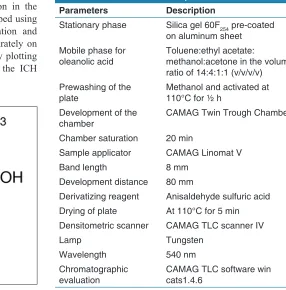
Methanolic extracts of root powder was used for the experimental work. Separation was performed on an aluminum-backed silica gel 60F254 HPTLC plates, with 250 μm thickness; E. Merck, Darmstadt, Germany, using toluene:ethyl acetate:methanol:acetone in the volume ratio of 14:4:1:1 (v/v/v/v) as mobile phase for oleanolic acid. After development, the plate was derivatized with anisaldehyde sulfuric acid reagent. Detection and quantification were performed by densitometry at λ = 540 nm in visible mode. Evaluation was performed by comparing peak areas with linear regression. Oleanolic acid was not detectable in UV light or fluorescence therefore it has been transformed in detectable substances to evaluate the TLC separation. Derivatization of the HPTLC plate was done by dipping the plate in anisaldehyde sulfuric acid reagent for <5 s. After removing the plate from the solution, it was air dried first and then CAMAG plate heater II, at 110-120°C for 4-5 min. The plate was scanned at 540 nm using tungsten lamp by CAMAG Scanner IV and Wincat software version 1.4.6 for β-sitosterol. The chromatographic conditions are given in Table 1.
Instrument
Camag Linomat V sample applicator, Camag Twin trough glass chamber and Camag TLC Scanner IV equipped with Cats 1.4.6 version software.
Figure 1: Structure of oleanolic acid
Table 1: Optimized chromatographic conditions for identification and quantification of oleanolic acid in
roots of A. aspera Linn
Parameters Description
Stationary phase Silica gel 60F254 pre‑coated on aluminum sheet
Mobile phase for
oleanolic acid Toluene:ethyl acetate: methanol:acetone in the volume ratio of 14:4:1:1 (v/v/v/v) Prewashing of the
plate Methanol and activated at 110°C for ½ h Development of the
chamber CAMAG Twin Trough Chamber Chamber saturation 20 min
Sample applicator CAMAG Linomat V
Band length 8 mm
Development distance 80 mm
Derivatizing reagent Anisaldehyde sulfuric acid Drying of plate At 110°C for 5 min Densitometric scanner CAMAG TLC scanner IV
Lamp Tungsten
Wavelength 540 nm
Chromatographic
evaluation CAMAG TLC software win cats1.4.6
Reagents
Toluene, Ethyl acetate, methanol and acetone were of analytical reagent grade with 99.8% purity. They were obtained from SD Fine chemicals.
Standards
Standard oleanolic acid was procured from Sigma-Aldrich.
Glassware
Standard volumetric flasks and pipettes of class A grade were used throughout the determination.
Plant Material
Whole plants of A. aspera Linn. were collected in the month of August and September 2013 from natural habitats in Vasai region of Thane district. The plants were authenticated at Blatter’s herbarium; St. Xavier’s College, Mumbai and the specimens voucher were deposited in the St. Xavier’s College Herbarium for further reference. The accession number for A. aspera L. is 62490.
Preparation of Standard Solutions for Oleanolic Acid
Preparation of stock (A) solution of oleanolic acid (1 µg/µl)
Stock (A) solutions of oleanolic acid (1 µg/µl) were prepared in methanol. 10.0 mg of standard oleanolic acid was accurately weighed and transferred to a 10.0 ml standard volumetric flask. The contents of the flask were initially dissolved in 5.0 ml of methanol, followed by sonication and then diluted up to the mark with methanol.
Preparation of stock (B) solution for oleanolic acid (0.1 µg/µl)
From the standard stock (A) solution, 0.1 ml is transferred to a 10.0 ml standard volumetric flask. The contents of the flask were initially dissolved in 5.0 ml of methanol, followed by sonication and then diluted up to the mark with methanol. Thus, a working stock solution of oleanolic acid of 0.1 µg/µl was prepared in methanol.
Preparation of Mobile Phase
The mobile phase comprising toluene:ethyl acetate:methanol:acetone in the volume ratio of 14:4:1:1 (v/v/v/v) was prepared. Twin trough chromatographic chamber was saturated for 20 min with Whatmann paper No.1.
Preparation of Sample Solution
Oleanolic acid is soluble in methanol, and hence methanol was used for extraction from plant powder during method development and validation for the plant. Root extracts of the concentration 50 µg/µl were prepared. During the process, 500 mg of root powder of A. aspera Linn. was extracted with 10.0 ml of methanol. The mixture was sonicated for 30 min and it was kept overnight for extraction. It was filtered through Whatmann filter paper No. 41 and filtrate obtained was subjected to HPTLC for quantification of oleanolic acid. 10 µl of the sample solution was applied along with standard solution for quantification.
Preparation of Chromatogram
The quantification studies were carried out in accordance to External Standard Method by applying different concentrations of standard oleanolic acid (0.1 μg/μl) and same concentration of sample solution (50 µg/µl) on HPTLC plate [Table 2].
RESULTS AND DISCUSSION
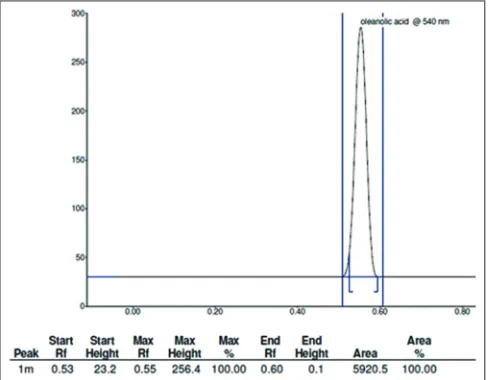
IdentificationThe identity of the band of oleanolic acid in root extract was confirmed by comparing Rf value of root extracts with that of standard solutions [Figures 2 and 3].
Quantification
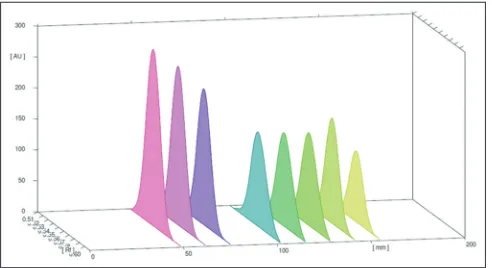
The HPTLC densitogram [Figure 5] and HPTLC profile [Plate 1] are obtained using standard HPTLC procedure [Table 1]. Chromatogram of standard oleanolic acid solution with volume ranging from 4 µl to 2 µl yielded better results
and hence were used for the analysis. Similarly, 4 readings of standard root extract were used for the purpose of quantification as per the guidelines.
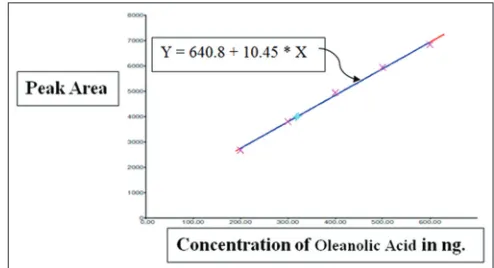
Graph of peak area and concentration of oleanolic acid in root extract of A. aspera Linn. when plotted, shows linear relationship. The linear regression equation is obtained from
Table 2: The Rf values and peak areas corresponding to the serial dilutions of standard compound‑oleanolic acid and fixed amount of root extract of A. aspera Linn.
Serial number Applicator sample Applicator volume (µl) Amount per spot (µg) Rf Peak area
1 Oleanolic acid 6.0 0.6 0.55 6816.70
2 Oleanolic acid 5.0 0.5 0.55 5920.54
3 Oleanolic acid 4.0 0.4 0.56 4923.12
4 Oleanolic acid 3.0 0.3 0.56 3790.93
5 Oleanolic acid 2.0 0.2 0.56 2655.74
8 Root extract 5.0 250 0.56 4011.00
9 Root extract 5.0 250 0.57 3971.71
10 Root extract 5.0 250 0.57 3961.49
A. aspera: Achyranthes aspera
Figure 4: Graph of peak area and concentration of Oleanolic Acid and root extract of Achyranthes aspera Linn
Figure 3: Chromatogram of of root extract of Achyranthes aspera Linn
Table 3: The amount of oleanolic acid per 5.0 µl of different root extracts of A. aspera
Serial
number Applicator sample volume (µl)Applicator Amount per spot (µg) Rf Peak area Amount of oleanolic acid per spot (ng)
1 Root extract 5.0 250 0.56 4011.00 322.51
2 Root extract 5.0 250 0.57 3971.71 318.70
3 Root extract 5.0 250 0.57 3961.49 317.72
Mean 319.64
SD 2.53
%CV/RSD 0.792
A. aspera: Achyranthes aspera, CV: Coefficient of variation, RSD: Relative standard deviation
this graph [Figure 4]. Using the regression equation of the linear regression graph, the amount of standard oleanolic acid applied on plate is calculated [Table 2]. Similarly, the amount of oleanolic acid a 10.0 µl root extract Sample was calculated and the results are given in Table 3. The concentration of oleanolic acid in the root of the plant is found to be 1.279 ng/µg.
CONCLUSION
The quantification of oleanolic acid from the methanolic extract of roots of A. aspera Linn. was done using a new HPTLC method. The developed HPTLC technique can be used for the routine quality control analysis and quantitative determination of oleanolic acid from A. aspera Linn. The oleanolic acid was found to be linear in the range of 0.20-0.60 µg/µl. Considering the wide therapeutic applications of oleanolic acid an alternative quantification technique of this marker constituent was generated to ensure identity and quality of the selected plant. This is a sensitive, specific and reproducible HPTLC method for the quantification of oleanolic acid from roots of A. aspera Linn.
REFERENCES
1. Anonymous. The Wealth of India-Raw Materials. New Delhi: Council of Scientific and Industrial Research; 2005. p. 55-7.
2. Gupta RK. Medicinal and Aromatic Plants. Chennai, India: CBS Publishers and Distributors; 2010. p. 190. 3. Paul D, De D, Ali KM, Chatterjee K, Nandi DK,
Ghosh D. Comparative study on the spermicidal activity of organic solvent fractions from hydroethanolic extracts of Achyranthes aspera and Stephania hernandifolia in human and rat sperm. Contraception 2010;81:355-61. 4. Sutar NG, Sutar UN, Sharma YP, Shaikh IK, Kshirsagar SS.
Phytochemical investigation and pharmacological screening of leaves of Achyranthes aspera Linn. as analgesic and antipyretic. Biosci Biotechnol Res Asia 2008;5:841-4. 5. Neogi NC, Garg RD, Rathor RS. Preliminary
pharmacological studies on achyranthine. Indian J Pharm 1970;32:43-6.
6. Girach RD, Khan AS. Ethnomedicinal uses of Achyranthes aspera leaves in Orissa (India). Int J Pharmacogn 1992;30:113-5.
7. Bhattaraj NK. Folk use of plants in veterinary medicine in central Nepal. Fitoterapia 1992;63:497-506.
8. Gupta RK. Medicinal and Aromatic Plants. New Delhi: CBS Publishers and Distributors; 2010. p. 190.
9. Elumalaii EK, Chandrasekaran N, Thirumalaii T, Sivakumari C, Viviyan Therasa S, David E. Achyranthes aspera leaf extracts inhibited fungal groth. Int J PharmTech Res 2009;1:1576-9.
10. Pollier J, Goossens A. Oleanolic acid. Phytochemistry 2012;77:10-5.
11. International Conference on Harmonization (ICH) of Technical Requirements for Registration of Pharmaceuticals for Human use, Harmonized Triplicate Guideline on Validation of Analytical Procedures: Methodology, Recommended for Adoption at Step 4 of the ICH Process on November 1996 by the ICH Steering Committee. Geneva: IFPMA.
12. Center for Drug Evaluation and Research (CDER) Reviewer Guidance. Validation of Chromatographic Methods, November; 1994.
Source of Support: Nil. Conflict of Interest: None declared.
Figure 5: Densitograms of Oleanolic Acid and root extract of Achyranthes aspera Linn