Issues
ISSN: 2146-4138
available at http: www.econjournals.com
International Journal of Economics and Financial Issues, 2017, 7(3), 398-403.
Does Complexity Audit Task, Time Deadline Pressure, Obedience
Pressure, and Information System Expertise Improve Audit
Quality?
Inyoman Agus Wijaya
1*, Mentari Tri Yulyona
21Faculty of Economics Maranatha Christian University, Bandung, Indonesia, 2Faculty of Economics Maranatha Christian University,
Bandung, Indonesia. *Email: [email protected]
ABSTRACT
A survey of 216 auditors was conducted to investigate about the potential determinants of audit quality. This study using multiple linear regression
technique. We find that complexity audit task, obedience pressure and information system expertise positively related to audit quality. This finding suggest that complexity audit task, obedience pressure and information system expertise play a significant part to improve the quality of audit. Further, complexity audit task and obedience pressure from superior can not make auditor fails to complete the required work and they remains improve audit quality. This study also find that there is no significant effect of time deadline pressure on audit quality. Information system expertise will greatly helpful auditors to expedite the auditing (shorten the time of the auditing) and will be useful in determination of audit procedures, so that can reduce the complexity of task and, in turn, can produce a quality audit reports.
Keywords: Complexity Audit Task, Time Deadline Pressure, Obedience Presure, Information System Expertise, Audit Quality
JEL Classifications: M42, M51, M15
1. INTRODUCTION
Much attention has been given recently to audit quality by regulators and researchers (Francis, 2011; Knechel et al., 2013; European Union, 2014; IAASB, 2014). The concept of audit quality is, however, difficult to define or describe, and there is still little consensus on how to measure it. Business-to-business (B2B) and business-to-customers (B2C) integration began with large and midsized companies mandating methods of receiving business information technology. B2B or B2C integration means the integration, automation and optimisation of key business processes of a companies organisation. B2B E-commerce is particularly challenging for auditors because it spans organizational boundaries that link firms through their collaborative work processes and interlinking transactions (Subramaniam and Youndt, 2005). An understanding of the information system will also assist the auditor in determining appropriate audit procedures that can reduce the complexity of auditing and reduce the pressure caused by limited time budget. In addition to knowledge of accounting and auditing, an E-commerce auditor must possess knowledge of
systems, networks, and data bases (Raghunathan and Raghunathan, 1994). Many studies showed that there were differences in auditor judgment taken on a high task complexity and task complexity is low (Abdolmohammadi and Wright, 1987; Chung and Monroe, 2001). The study showed that the high complexity of the audit appear as the high variability and ambiguity in the task of auditing and ultimately an indication of the cause of decline in audit quality.
Considerations on organizational and environmental pressure have prompted many researchers to focus his research on how auditors respond to the pressure of professional social influence that comes from within the company. In particular, some researchers have previously provided evidence that auditors are susceptible to social influence pressure from superior (boss) to perform the behavior deviates from the norm or professional standards (DeZoort and Lord, 1994) and co-workers (peers) (Ponemon, 1992) in the company.
necessarry to review the exact process that was used in varying time pressure to determine if the research was oriented toward examining time budget or time deadline pressure (Margheim et al., 2005). Auditors constantly have to trade off the time dedicated to auditing with the cost of performing it (Otley and Pierce, 1996). Pierce and Sweeney (2004) found that time pressure has increased in audit firms and is far higher than optimal on auditors performance. In general, time pressure has been shown to have a detrimental impact on individuals’ decision-making ability (Svenson and Edland, 1987). Research by Margheim et al. (2005) examined the impact of time budget pressure and time deadline pressure on auditor. The results indicated that both types of time pressure had negative effects on the occurance of the auditor quality. However, information system expertise will very helpful auditors to expedite the auditing (shorten the time of the auditing), which could ultimately result in a higher quality audit reports (Bierstaker et al., 2001). There is a scarce number of auditing research has assessed what interrelations the deadline pressure have on audit quality. When time deadline pressure incresed, audit effectiveness declined and their efficiency improved (McDaniel, 1990). Choo (1995) indicates that as deadline pressure increases to higher levels, performance declines because relevant cues are also ignored.
Issues regarding the need for audit quality resulting from the audit work by staff of auditors which the quality of any work produced auditor staff will ultimately affect the quality of the audit is the background of the research questions that will be answered in this study. The objective of this study is to investigate the effect of complexity audit task, time deadline pressure, obedience presure and information system expertise on audit quality. This study was conducted using a survey on auditors who work in a big4 and the second tier of accounting firm in Indonesia. The analysis units are the auditor in junior, senior, and supervisor. Data were analysed using multiple linear regression.
This paper will first discuss theoretical development followed by the research method, including data collection and measurement. Results will be presented empirically, with discussion and limitations establish the final section of this paper.
2. LITERATURE REVIEW AND
HYPOTHESES DEVELOPMENT
2.1. Complex Audit TasksThe complexity of the audit based on the individual’s perception of the difficulty of a task audit. Some of the audit assignment considered as task with high complexity and difficult while others perceive it as an easy task (Jiambalvo and Pratt, 1982).
Audits are becoming increasingly complex due to the difficulty (task difficulty) and the variability of the task (task variability) audit of the higher (Gupta et al., 1999). Further, Gupta et al. (1999) defines complexity as the complexity of the task and the ability to analyze a task and the availability of standard operating procedures. While the task is defined as the degree of variability in familiar task or not, regular or irregular, frequent or otherwise.
Research conducted by Abdolmohammadi and Wright (1987) found that there were differences in auditor judgment taken on a high task complexity and task complexity is low. Research conducted by Chung and Monroe (2001) also found that high task complexity affect the judgment taken by auditor. When high complexity of the audit appear as the high variability and ambiguity in the task of auditing and ultimately an indication of the cause of decline in audit quality.
H1: Complexity audit task is negatively related to audit quality.
2.2. Time Deadline Pressure
Time deadline pressure occurs when a spesific point in time (i.e., a deadline) for task completion is specified and it is difficult to complete the required work by the deadline. When time deadline pressure incresed, audit effectiveness declined and their efficiency improved (McDaniel, 1990). Choo (1995) indicates that as deadline pressure increases to higher levels, performance declines because relevant cues are also ignored. In contrast, research by Glover (1997) suggested that as time deadline pressure increases from low to moderate levels, auditor judgement performance improves due to the reduction in the usage of nondiagnostic (i.e., irrelevant) cues. Research by Margheim et al. (2005) examined the impact of time budget pressure and time deadline pressure on auditor. The results indicated that both types of time pressure had negative effects on the occurance of the auditor quality.
H2: Time deadline pressure is negatively related to audit quality.
2.3. Obedience Pressure
Research on social influence pressure has been performed by DeZoort and Lord (1994), DeZoort and Lord (1997). In the social psychology literature describe the three types of social influence pressure include: Compliance pressure, conformity pressure and obedience pressure (Brehm and Kassin, 1990). The theory underlying of the obedience pressure states instructions boss (superior) in an organization influence behavior of individuals who ruled (subordinate) because superior has the authority to give orders (DeZoort and Lord, 1997). The higher the obedience pressure, the lower the quality of the audit decision. Auditors under the orders of superiors to deviate from professional standards tend to obey the command, so the quality of the audit will be lower. Milgram’s (1974) obedience theory suggest that individuals subjected to obedience pressure will make decisions contrary to their own attitudes, beliefs, and values, in part, because they can remove themselves from responsibility for their judgements and decisions after an individual with authority directs them to an action.
H3: Obedience pressure is negatively related to audit quality.
2.4. Information System Expertise
very quickly (Bierstaker et al., 2001). This is also powered by Bierstaker et al. (2001) who argued that an understanding of the information systems very helpful auditors to expedite the auditing (shorten the time of the auditing), which could ultimately result in a higher quality audit reports. Auditor’s understanding of the information system will be useful in the determination of audit procedures that can reduce the complexity of the task and, in turn, can produce a quality audit reports.
H4: Information system expertise is positively related to audit quality.
3. METHODS
3.1. Sample SelectionThe sample is restricted to auditors in Indonesia. Initial sampel in this study were 231. Respondents in this study divided as a big 4 and non big 4 Public Accountant Firms in D.I. Yogyakarta and Bandung and who served as senior and junior auditor. The questionnaires distributed in October 2014 until December 2015. There are 186 respondents collected through snowball sampling technique and 45 questionnaires through paperbased techniques. However, 15 questionnaires were not returned. The final sample in this study totals 216 respondents.
3.2. Empirical Model
To test the hypotheses, we employ a multiple linear regression model and predict a positive sign on the coefficient of variables as presented below.
AQ = β0+β1CAT+β2TDP+β3OP+β4IS+ε (1)
Where, AQ is audit quality, CAT is complexity audit task of auditors, TDP is time deadline pressure of auditors, OP is obedience pressure that auditors perceived and IS is information system expertise of audiotors.
4. RESULTS
4.1. Descriptive Statistics and CorrelationRespondents were collected from 16 public accountant firms consist 4 public accountant firms as a big 4 international accountant firm that are located in Jakarta and 5 public accountant firms as a local public accountant firms (non big 4) that located in Yogyakarta and 3 public accountant firms as a local public accountant firms (non big 4) that located in Bandung. The big 4 public accountant firms according to the website www.big4.com consist PricewaterhouseCoopers, Deloitte Touche Tohmatsu, Ernst and Young and KPMG. There are 231 questionnaires had been send using snowball sampling technique comprised 186 questionnaires had been send by email and 45 questionnaires by paperbased techniques. However, there are 15 of 45 questionnaires that used by paperbased were not returned. The questionnaire can be used for this study is as much as 216 questionnaires.
We present descriptive statistics in Tabel 1 for the sample used in testing the hypotheses. As the data indicate, auditors in the
sample have higher complex audit task and obedience pressure from manager level in the audit firm. In the other hand, we note that auditors have information systems expertise to help them completing the audit task. Table 1 indicate that the respondent have higher time deadline pressure by superior level (supervisor or manager) in the audit firms. Table 2 present that 73.6% of auditors in the audit firm is male.
Table 1: Variable descriptive statistics
Variable N Minimum Maximum Mean±SD
Age 216 21.00 29.00 24.3796±1.68284
Gender 216 1.00 2.00 1.2639±0.44176
AQ1 216 3 5 4.88±0.354
AQ2 216 2 5 4.37±0.580
AQ3 216 3 5 4.79±0.432
AQ4 216 3 5 4.40±0.510
AQ5 216 3 5 4.59±0.529
AQ6 216 2 5 4.70±0.524
AQ7 216 3 5 4.65±0.516
AQ8 216 3 5 4.79±0.443
AQ9 216 3 5 4.81±0.424
AQ10 216 3 5 4.82±0.417
AQ11 216 3 5 4.81±0.427
AQ12 216 3 5 4.27±0.621
AQ13 216 3 5 4.76±0.467
AQ14 216 3 5 4.87±0.368
AQ15 216 3 5 4.78±0.456
AQ16 216 3 5 4.83±0.402
AQ17 216 2 5 4.83±0.435
AQ18 216 3 5 4.89±0.343
AQ19 216 3 5 4.88±0.362
AQ20 216 3 5 4.88±0.335
CAT1 216 2 5 3.91±0.707
CAT2 216 3 5 4.56±0.680
CAT3 216 2 5 4.19±0.665
CAT4 216 2 5 4.23±0.721
CAT5 216 2 5 4.37±0.722
CAT6 216 2 5 4.60±0.640
CAT7 216 2 5 4.73±0.558
CAT8 216 3 5 4.67±0.587
CAT9 216 3 5 4.68±0.560
CAT10 216 2 5 4.73±0.547
CAT11 216 2 5 4.49±0.632
TDP1 216 1 4 3.35±0.566
TDP2 216 1 5 3.58±1.045
TDP3 216 1 5 3.98±0.922
TDP4 216 1 5 3.37±0.772
OP1 216 1 5 3.97±1.063
OP2 216 1 5 3.67±1.020
OP3 216 2 5 4.25±0.994
OP4 216 1 5 3.80±1.023
OP5 216 1 5 4.00±1.080
OP6 216 1 5 2.69±1.058
IS1 216 2 5 4.51±0.765
IS2 216 1 5 4.26±0.782
IS3 216 2 5 4.67±0.639
IS4 216 2 5 4.50±0.625
IS5 216 2 5 4.34±0.677
IS6 216 1 5 4.44±1.005
IS7 216 2 5 3.73±0.802
IS8 216 1 5 4.56±0.903
Valid
N (listwise) 216
4.2. Assesment of Classical Assumptions Test
4.2.1. Normality test
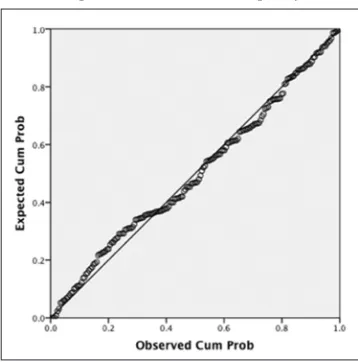
Figure 1 provide a histogram graph which indicate that the observed data have normal distribution. We also see Figure 2 provide that normal probability plot (normal P-P plot) very closed to diagonal linear and follow the pattern. Normality test results indicate that residual distributed normally in the regression model. So that, regression model meet the normality assumption.
4.2.2. Multicolinierity test
Tabel 3 presents Pearson correlation coefficients for the variables in the regression model. We note that only complexity audit task variable have a higher correlations with information system variable with correlations level as −0.459 or about 45.9%.
However, this correlations level are no more than 95%. Therefore, there is no potensial issue about multicollinearity in the regression model (Table 3).
We also note that Table 4 provide variance inflation factors (VIFs) for all variables are <10 and there is no independent variable have tolerance values <0.10. Kennedy (2008) suggest that VIFs <10 do not warrant concern for multicollinearity when interpreting results.
4.2.3. Heteroscedastisity test
Figure 3 present heteroscedastisity test result by scatterplot pattern. In the Figure 3, we can see that there is no obvious pattern in the result and the plot spread widely in the graph line. According to this result, we note that there is no potensial issue about heteroscedastisity in the regression model.
4.3. Multivariate Test Results
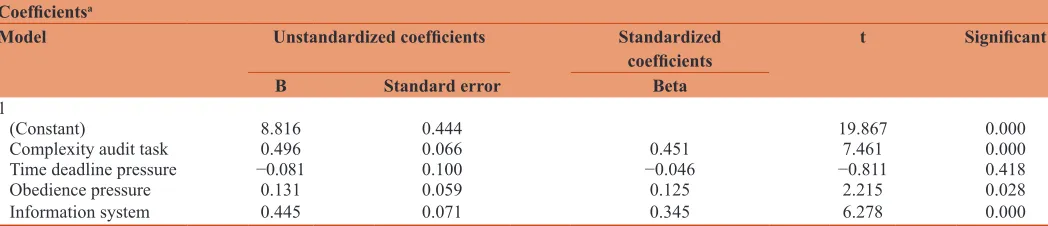
Table 5 present multivariate results for testing of H1. The positive coefficients (P < 0.05) on complexity audit task leads to rejections of H1 and confirm that complexity audit task is positively related to audit quality. The finding of this study are contrast to prior research that high task complexity affect the judgment taken by auditor. When high complexity of the audit appear as the high variability in the task of auditing, auditor will be able to complete the required work and they remains improve audit quality. However, we also find that no evidence of a significant (P > 0.05) relationship between time deadline pressure and audit quality. These evidence leads to the rejection of the H2. The findings of this study indicating that there is no significant effect of time deadline pressure that perceived in individual auditor when a spesific point in time (i.e., a deadline) for task completion is specified and they will able to complete the required work by the deadline. These results contrast with prior research that Time deadline pressure have no related to audit quality.
We also find that the positive coefficients (P < 0.05) on obedience pressure reject the H3. These results leads to rejection of the theory underlying of the obedience pressure. The theory states instructions boss (superior) in an organization influence behavior of individuals who ruled (subordinate) because superior has the authority to give orders (DeZoort and Lord, 2001). According to the regression result, obedience pressure is positively related to audit quality. These results indicating that the higher the obedience pressure, can not make the lower the quality of the audit decision. Auditors under the orders of superiors remain obey from professional standards, so the quality of the audit will be higher. The coefficients on information system of Table 6 are positif and significant (P < 0.05) and support H4. These results indicating that Information system expertise is positively related to audit quality. This study robust to the prior research. Information system expertise will help the individual auditor to complete the tasks assigned by the superior very quickly as described in prior research (Bierstaker et al., 2001). Auditors’ requisite knowledge for effective B2B E-commerce audits entails not only the nature of financial transactions and processes, but also the technologies
Figure 1: Regression standardized residual. Dependent variable: Audit
quality
Figure 2: Normal probability plot of regression standardized residual.
Dependent variable: Audit quality
Table 2: Gender
Valid Frequency (%) Valid percent Cumulative percent
Male 159 (73.6) 73.6 73.6
Female 57 (26.4) 26.4 100.0
that enable these transactions and processes to occur (Pathak et al., 2010). Thus, information system expertise will greatly helpful auditors to expedite the auditing (shorten the time of the auditing), which could ultimately result in a higher quality audit reports. Auditor’s understanding of the information system will be useful in the determination of audit procedures that can reduce the complexity of the task and, in turn, can produce a quality audit reports.
5. CONCLUSION AND IMPLICATIONS
In this study we investigate the effect of complexity audit task, time deadline pressure, obedience presure and information system expertise to audit quality. We find that high complexity of the audit appear as the high variability in the task of auditing, can not make auditor fails to complete the required work and they remains improve audit quality. In the other hand, this study also find that there is no significant effect of time deadline pressure that perceived in individual auditor when a spesific point in time (i.e., a deadline) for task completion is specified, so they will able to complete the required work by the deadline and remains to improve audit quality. This study confirm that the higher the obedience pressure, can not make the lower the quality of the audit decision. Auditors under the orders of superiors remain obey from professional standards, so the quality of the audit will be higher. These results also provide evidence of the significant impact that information system expertise will greatly helpful auditors to expedite the auditing (shorten the time of the auditing) and will be useful in the determination of audit procedures, so that can reduce the complexity of the task and, in turn, can produce a quality audit reports.
This study suggest that at the big 4 and non big 4 audit firm should be concern about audit quality and senior and junior auditor performance will be affect to the quality of audit. Our study is subject to a limitations. Our study no focusing on fee audit that could be associated with audit quality (Bills and Stephens, 2015). However, our recommendation to the future research, may be examine with focusing on particular issues such as audit risks and Table 3: Collinearity statistics
Coefficientsa
Model Unstandardized coefficients Standardized
coefficients t Significant Collinearity statistics
B Standard error Beta Tolerance VIF
1
(Constant) 8.816 0.444 19.867 0.000
Complexity audit task 0.496 0.066 0.451 7.461 0.000 0.586 1.708
Time deadline pressure −0.081 0.100 −0.046 −0.811 0.418 0.674 1.483
Obedience pressure 0.131 0.059 0.125 2.215 0.028 0.673 1.485
Information system 0.445 0.071 0.345 6.278 0.000 0.707 1.414
aDependent variable: Audit quality, VIFs: Variance inflation factors
Table 4: Coefficient correlationsa
Model Information system Time deadline pressure Obedience pressure Complexity audit task
Correlations
Information system 1.000 0.009 −0.080 −0.459
Time deadline pressure 0.009 1.000 −0.399 −0.255
Obedience pressure −0.080 −0.399 1.000 −0.206
Complexity audit task −0.459 −0.255 −0.206 1.000
Covariances
Information system 0.005 6.419E-005 0.000 −0.002
Time deadline pressure 6.419E-005 0.010 −0.002 −0.002
Obedience pressure 0.000 −0.002 0.004 −0.001
Complexity audit task −0.002 −0.002 −0.001 0.004
aDependent variable: Audit quality
Table 5: Model summary
Model R R2 Adjusted R2 Standard error
of the estimate
1 0.741a 0.549 0.541 0.55182
aPredictors: (Constant), information system, time deadline pressure, obedience pressure, complexity audit task
may be on the fee premiums (discounts) audit could be associated with higher (lower) audit quality.
REFERENCES
Abdolmohammadi, M., Wright, A. (1987), An examination of the effects of experience and task complexity on audit judgments. The Accounting Review, 62(1), 1-13.
Bierstaker, J.L., Burnaby, P., Thibodeau, J. (2001), The impact of
information technology on the audit process: An assessment of the state of the art and implications for the future. Managerial Auditing
Journal, 16(3), 159-164.
Bills, K.L., Stephens, N.M. (2015), Spatial Competition at the Intersection of the Large and Small Audit Firm Markets. Forthcoming at Auditing, a Journal of Practice & Theory.
Brehm, S.S., Kassin, S.M. (1990), Social Phsycology. Boston: Houghton Miffilin Co.
Choo, F. (1995), Auditors’ judgment performance under stress: A test of
the predicted relationship by three theoretical models. Journal of
Accounting, Auditing and Finance, 10, 611-641.
Chung, J., Monroe, G.S. (2001), A research note on the effects of gender and task complexity on an audit judgment. Behavioral Research in
Accounting, 13, 111-125.
DeZoort, F.T., Lord, A.T. (1994), An investigation of obedience pressure effects on auditors’ judgments. Behavioral Research in Accounting, 6 Suppl, 1-30.
DeZoort, F.T., Lord, A.T. (1997), A review and systhesis of pressure effects
research in accounting. Journal of Accounting Literature, 16, 28-85.
European Union. (2014), Directive 2014/56/EU of the European Parliament and of the Council of 16 April 2014 Amending Directive 2006/43/EC on Statutory Audits of Annual Accouants and Consolidated Accounts Text with EEA Relevance. Brussels:
European Union.
Francis, J.R. (2011), A framework for understanding and researching audit quality. Auditing: A Journal of Practice and Theory, 30(2), 52-125. Glover, S.M. (1997), The influence of time pressure and accountability
on auditors’ processing of nondiagnostic information. Journal of
Accounting Research, 35, 213-226.
Gupta, P.P., Umanath, N.S., Dirsmith, M.W. (1999), Supervision practices and audit effectiveness: An empirical analysis of GAO audits. Behavioral Research in Accounting, 11, 27-50.
International Auditing and Assurance Standards Board (IAASB).
(2014), A Framework for Audit Quality: Key Elements that Create an Environment for Audit Quality. New York: The International Federation of Accountants (IFAC).
Jiambalvo, J., Pratt, J. (1982), Task complexity and leadership effectiveness in CPA firms. The Accounting Review, 57(4), 734-750. Knechel, W.R., Krishnan, G.V., Pevzner, M.B., Shefchik, L., Velury, U.
(2013), Audit quality: Insight from the academic literature. Auditing: A Journal of Practice and Theory, 32 Suppl, 385-421.
Kennedy, P. (2008), A Guide to Econometrics. 6th edition. Malden, MA:
Blackwell Publishing.
Lord, A.T., DeZoort, F.T. (2001), The impact of commitment and moral
reasoning on auditors’ responses to social influence pressure.
Accounting, Organizations and Society 26 (3): 215-235.
Margheim, L., Kelley, T., Pattison, D. (2005), An empirical analysis of the
effects of auditor time budget pressure and time deadline pressure.
The Journal of Applied Business Research, 21(1) 23-36.
McDaniel, L.S. (1990), The effects of time pressure and audit program structure on audit performance. Journal of Accounting Research, 28(2), 267-285.
Milgram, S. (1974), Obedience to authority. An experimental view. Journal of Peace Research, 11(4), 350-351.
Otley, D.T., Pierce, B.J. (1996), Auditor time budget pressure:
Consequences and antecedents. Accounting, Auditing and
Accountability Journal, 9(1), 31-58.
Pathak, J., Lind, M., Abdolmohammadi, M. (2010), E-commerce audit judgment expertise: Does expertise in system change management
and information technology auditing mediate e-commerce audit
judgement expertise? Informatica Economica, 14, 5-20.
Pierce, B., Sweeney, B. (2004), Cost-quality conflict in audit firms: An empirical investigation. Europan Accounting Review, 13(1),
415-441.
Ponemon, L.A. (1992), Auditor underreporting of time and moral reasoning: An experimental lab study. Contemporary Accounting Research, 9, 171-189.
Raghunathan, B., Raghunathan, T.S. (1994), Adaptation of a planing
system success model to information systems planning. Information
Systems Research, 5(3), 326-340.
Subramaniam, M., Youndt, M.A. (2005), The influence of intellectual
capital on types of innovative capabilities. Academy of Management
Journal, 49(3), 450-463.
Svenson, O., Edland, A. (1987), Change of preferences under time
pressure: Choices and judgements. Scandinavian Journal of
Psychology, 29(4), 322-330.
Table 6: Multiple regression test
Coefficientsa
Model Unstandardized coefficients Standardized
coefficients t Significant
B Standard error Beta
1
(Constant) 8.816 0.444 19.867 0.000
Complexity audit task 0.496 0.066 0.451 7.461 0.000
Time deadline pressure −0.081 0.100 −0.046 −0.811 0.418
Obedience pressure 0.131 0.059 0.125 2.215 0.028
Information system 0.445 0.071 0.345 6.278 0.000