http://dx.doi.org/10.3926/jiem.472
- 457 -
A QoS aware services mashup model for cloud computing applications
Yee Ming Chen
,
Yi Jen Peng
Yuan Ze University
,
Hsin Sheng College of Medical Care and Management (Taiwan)
[email protected]
,
[email protected]
Received: March 2012 Accepted: November 2012
Abstract:
Purpose:
With the popularity of cloud computing, cloud services have become to be
application programming platform where users can create new applications
mashup(composing) the functionality offered by others. By composing of distributed, cloud
services dynamically to provide more complex tasks, services mashup provides an attractive
way for building large-scale Internet applications. One of the challenging issues of cloud
services mashup is how to find service paths to route the service instances provider through
while meeting the applications’ resource requirements so that the QoS constraints are satisfied.
However, QoS aware service routing problem is typically NP-hard.
The purpose of this paper
is to
propose a QoS Aware Services Mashup(QASM) model to solve this problem more
effectively.
Design/methodology/approach:
In this paper, we focus on the QoS aware services
selection problem in cloud services mashup, for example, given the user service composition
requirements and their QoS constraint descriptions, how to select the required service
instances and route the data flows through these instances so that the QoS requirements are
satisfied. We design a heuristic algorithm to find service paths to route the data flows through
while meeting the applications’ resource requirements and specific QoS constraints.
Findings:
This study propose a QoS Aware Services Mashup(QASM) model to solve this
problem more effectively. Simulations show that QASM can achieve desired QoS assurances
as well as load balancing in cloud services environment.
- 458 -
information might be outdated.
Practical implications:
It was found that each different cloud service should have distinct
business model. The QASM model is a tool for translating cloud computing technology into
customer value.
Social implications:
The purpose of this study was to explore QoS aspect of cloud
computing business model from services provider viewpoint. The cost structure should be
continued as economics as clouds are the key driving factor for both services providers and
customers.
Originality/value:
This paper present a QASM model for providing high performance
distributed applications in the cloud computing systems
Keywords:
QoS, cloud services, mashup, optimization
1. Introduction
- 459 -
CPU processing
Memory
usage StorageData
Network connectivity
Hardware Infrastructure (IaaS) Software Environment (PaaS)
Applications (SaaS)
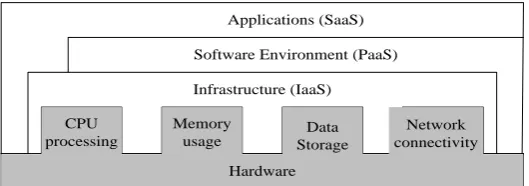
Figure 1. The basic cloud computing service
SaaS made available on a one-to-many basis over a network such as the Internet. The service providers are beginning to leverage their core competencies in so-called service value networks (SVNs) in order to jointly offer complex services (Buyya, Yeo & Venugopal, 2008). Meanwhile, SaaS brings a promising technique to create value-added business applications composed by dynamically selected “Internet of individual services”. Analogous to complex products, services will be composed of several modules provided by different supply chain partners. Therefore, research on cloud services brings a promising technique to create value-added business applications composed by dynamically selected individual cloud services. This technology is so-called service mashup. Mashup is a Web-based network resource that composes existing services resources, be it content, data or application functionality, from more than one resource in enterprise environments by empowering the actual end-users to create and adapt individual information centric and situational applications. In internet there are maybe many available web services with various QoS (Quality of Service) providing the same functionality specific to a specific task. So a selection needs to be made. Therefore services mashup have to search for an optimal set of services to construct a composite service and result in a best QoS, under user’s QoS constraints and resource requirements. And how to construct the cloud services mashup model is the main research subject of the paper. In this paper, we focus on the QoS aware services selection problem in cloud services mashup, for example, given the user service composition requirements and their QoS constraint descriptions, how to select the required service instances and route the data flows through these instances so that the QoS requirements are satisfied. We design a heuristic algorithm to find service paths to route the data flows through while meeting the applications’ resource requirements and specific QoS constraints. The rest of the paper is organized as follows. We introduce the cloud computing system model in Section 2. Section 3presents the design and algorithm of the QoS aware service mashup model, followed by the extensive simulation results, presented in Section 4. Finally, we conclude this paper in Section 5.
2. Cloud Computing System Model
- 460 -
mashup with QoS aware for Internet/Intranet-scale cloud computing systems. Then, we present the overview of the QoS aware services mashup.
2.1. QoS aware Services Mashup for Cloud Computing System
The term mashup originates from the practice of mixing song samples from two or more sources to produce a new sound track. Moreover, mashup stems from the emphasis on interactive user participation manner in which they aggregate and composite. Services mashup are websites or applications that combine service from more than one source into an integrated application. Based on the concept of services mashup in the Cloud Services environment, mashup provides flexible and dynamic services with rich experience. This technology also enables a dynamic form of service reusability in contrast to the traditional method of static “cut & paste” reusability. However, since mashup involves the aggregation of another party’s instances into some new service or application, we will not deal with the copy right problem. We assume that the service aggregation model always chooses service instances that the user is authorized to use.
- 461 -
End User Client Company Individual users
Integration Service Logic
Identity
Management Routing Engine Mashup
platform
Service
instances Service
instances
Gadgates or Widgets
Gadget 1 Pipe 1
Pipe n Pipe 2
Gadget 2 Pipe 1
Pipe n Pipe 2
Gadget n Pipe 1
Pipe n Pipe 2 Wiring
Piping
Resource layer
Existing Applications
Business Data
Document Data
SaaS Application
Intranet Intemet
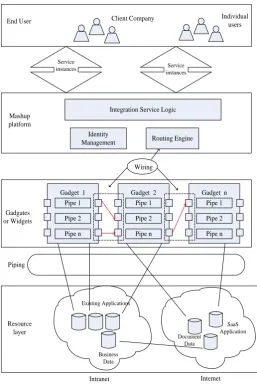
Figure 2. The Services Mashup for Cloud Computing System
As illustrated in the Figure 2, the composition takes place both in the resource layer (piping) and in the gadget (wiring) layer according to the enterprise mashup stack. Consequently, a mashup platform is a Web based tool that allows the creation of mashups by piping resources into gadgets and wiring gadgets together. Users access the services through a mashup platform of their choice. The mashup platforms are connected via APIs to the mashup integration services. To use the services, the users have to identify themselves against the user access control service; this service is connected to a user management service, which controls the users and their settings.
- 462 -
choose the one which has the minimum aggregated resource requirements so that the overall workload of a cloud computing system is minimized. The routing engine can be configured through an API. To simplify this, a gadget could be provided for the end-user. The routing engine is also connected to a message queue via an API. In this paper, we propose a QoS Aware Services Mashup (QASM) model for choosing and composing different cloud services into a service path satisfying the user’s quality requirements.
2.2 Overview of the QoS Aware Services Mashup
QoS aware services mashup has drawn much attention in recent years. Some works have been carried out on service selection algorithms for composing services with multiple QoS constraints to find an optimal solution, which is a NP-complete problem (Kirley & Stewart, 2007). Zeng, Benatallah, Ngu et al. (2004) suggested solving this problem by Linear Integer Programming (LIP). Although LIP is an optimal algorithm, its computation time tends to grow exponentially with the size of the problem instance, thus it is limited to use the LIP algorithm in real scenarios, especially in time-critical scenario. Several researchers put forward heuristic algorithms to find a near-optimal solution. Berbner, Spahn, Repp, Heckmann and Steinmetz (2006) presented an algorithm using the result of linear programming relaxation of LIP as the heuristic hint. The heuristic reveals that is extremely fast and outperforms linear programming based solutions with regard to computation time, especially with increasing number of candidate Web services and process tasks.
Currently, many experts and scholars do research on the problem of composed service routing focuses on how to find feasible and optimal paths that satisfy QoS requirements. Based on these forms QoS routing is broadly classified into two categories. MCP Routing (Multiple constrained path) (Wang & Crowcroft, 1996) and MCOP Routing (Multiple constrained optimal path) (Feng, Makki, Pissinou & Doulgeris, 2002). Where In MCP, the target is to find the feasible path satisfying multiple constraints, where as MCOP is a special case of MCP problem in which feasible path is found according to one of the constraints. Then from those optimal path is computed according to other constraint. Restricted Shortest Path (RSP) is a type of MCOP problem (Korkmaz & Krunz, 2001). Among the entire MCP problems RSP has received most attention. In general, MCP and MCOP both are NP-complete in nature that cannot be exactly solved in polynomial time. Hence the objective is to find the technique to reduce the computational complexity. To implement these technique, well known shortest path algorithms e.g. Dijkstra algorithm had been used by most of the researchers(Wang & Crowcroft, 1996; Kirley & Stewart, 2007). In this paper, based on the above ideas, proposing the Dijkstra-like algorithm of modeling and choosing as well as composing different cloud services into a service path satisfying the user’s quality requirements.
3. Formal Definition and Problem
- 463 - basic definition used in the rest of this paper.
Definition 1: (Abstract Service). Abstract service has function descriptions without implementation and standard service interfaces across different service providers. The user can directly name the requested distributed application, such as video-on-demand (e.g., video server
computation storage content video display). An abstract service is corresponding to a directed acyclic graph (DAG) of workflow tasks.
Definition 2: (Service Instance). Service instances are concrete services published by service providers. They could give the function implementation specified by abstract services. And some service instances may have the same function, but different QoS of all candidate service instances, according to the abstract service path.
Definition 3: (Service Function Graph). Constructing abstract services as a workflow to fulfill user’s requirement in functionality will obtain a service function graph. In the service function graph, there are service portals that serve as entrance/exit points.
Definition 4: (QoS aware Services Mashup).Transform the service function graph into a “candidate” graph and add “cost value” to the edges using an integrated metric which composes multiple QoS constraints (e.g. response time, availability) and resource requirements (e.g. CPU ratio and bandwidth ratio). The end user request speciation is represented by { } where is a set of services which have to be traversed in a particular order and is a set of QoS constraints, the problem of QoS aware services mashup is to compose a service path , from entrance portal) to exit portal), such that QoS constraints (equation (1) and (2)), i.e. , and also resource requirements (equation (3)
and (4)) i.e. and . The QoS constraints and resource requirements can be defined
as follows.
∑
(1)
∏
(2)
where
- 464 -
(4)
where is the service link on the edge ( ) .
3.1. On-demand services mashup
This section describes the QASM model. First, we present a scenario about finance-on-demand and content retrieval application. Then, we introduce the QASM model for services mashup application.
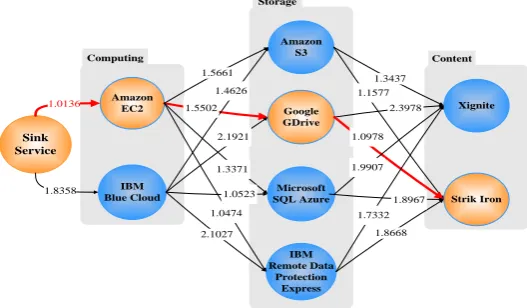
The scenario consists of a service provider who wants to offer a service mashup that optimizes a given portfolio. This finance service is based on a bundle of sub-services retrieved from decentralized subservice providers (Figure 3(a)). Suppose there are several sub-service providers which are competitors for each type of service such as computing, storage and content. In this scenario, computing is provided by either Amazon EC2 or IBM Blue Cloud (Yu & Lin, 2004). Storage is provided by Amazon S3, Google G Drive, Microsoft SQL Azure, or IBM Remote Data Protection (Foster, Kesselman, Nick & Tuecke, 2004). Finance content can be obtained by either Xignite or Strik Iron which offer services that provide historical and real time finance data such as stock prices, currency rates or various indices. In order to provide the functionality of optimizing the end user’s services portfolios, the final result generated by the service mashup is a QoS consistent service path satisfying the end user’s QoS constraints and also has the minimum aggregated resource requirements.
- 465 - Computing Storage Content Amazon EC2 IBM Blue Cloud Amazon S3 Google GDrive Microsoft SQL Azure IBM Remote Data Protection Express Xignite Strik Iron Computing Storage Content Source Service Amazon EC2 IBM Blue Cloud Amazon S3 Google GDrive Microsoft SQL Azure IBM Remote Data Protection Express Xignite Strik Iron Sink Service
(a) Services instances for all required (b) Add edges between two QoS consistent service instances abstract services
Figure 3. Illustration of on-demand finance service
The mapping from the user request to different composite service templates (mapping-1) is constrained by the user’s application-specific quality requirements and different pervasive client devices, such as PDAs and cell-phones. If multiple QoS consistent service paths exist, the service composer should choose the one which has the minimum aggregated resource requirements so that the overall workload of a cloud computing system is minimized. In order to guarantee a successful service delivery, the resource requirements of the instantiated service path have to be satisfied. For simplicity, we only consider the CPU resource for end hosts and bandwidth for
overlay links. In equation (3), the represents the required CPU resource for running a
new process. The epresents the available CPUresource in the physical hosting
environment of .The smaller the ,the more advantageous we choose the service instance interms of CPU load balancing because we start the new service process on a lightly loaded host. Similarly, we define the term bandwidth ratio (Equation (4)) for the service link
The mapping from the composite service template to an instantiated service path (mapping-2) is constrained by QoS constraints (e.g., availability, response time) and resource availability conditions (e.g., computing, network transport).The “cost value” on the edge ( )
. is defined using Equation (1) ~ (4). Intuitively, the ratio ) represents any of the above
attributes and R is the total value) represents the normalized cost of selecting a portion of the service path in terms of one specific factor (e.g., QoS constraints or resource requirements). For each link in the cloud computing system, we also use QoS constraints or resource conditions to represent it QoS attributes. For any path p from the entrance point to exit point, the following cost function is used to evaluate the feasible path:
- 466 -
Where )is the summation of i-th dimension QoS attribute along p, is the total constraint of
i-th dimension QoS value. [ ] denotes the weight of each QoS attribute which reflects their importance. The path with the minimum cost function value Min(C(p)) has the biggest possibility of being a feasible path. Run the Dijkstra-like algorithm to find the shortest path, which is returned as the result of the QoS aware services mashup, illustrated by Figure 4(thick line).
Computing Storage Content Sink Service Amazon EC2 IBM Blue Cloud 1.0136 1.8358 Amazon S3 Google GDrive Microsoft SQL Azure IBM Remote Data Protection Express 2.1027 Xignite Strik Iron 1.3437 1.8668 1.5661 1.5502 1.3371 1.0474 1.4626 2.1921 1.0523 1.1577 2.3978 1.0978 1.9907 1.8967 1.7332
Figure 4. QASM generate the consistent resource shortest service path
Thus, the final result generated by the QASM model is a QoS consistent service path satisfying the end user’s QoS constraints and also has the minimum aggregated resource requirements. The concrete computation process of our QASM algorithm is expressed in the following:
// initializations
For each node k in DAG do
C[j]=infinity; // Unknown distance from to j
optiPathPrev[j]=null; // Previous node in optimal path from End For
C[ ]=0; // Distance from to
Q= the set of all nodes in DAG; //initial no node in the optimal path
// seaching the nodes in the optimal path While Q is not empty do
u= the node in Q with the smallest C[];
if C[u]=infinity break; // all remaining nodes are inaccessible from
if u= break; // searching has reached the final node
remove u from Q;
- 467 - CTemp=C[u]+C_between(u,v);
if CTemp<C[v] C[v]=CTemp; optiPathPrev[v]=u;
End if End For End While
// reverse output the optimal path k= ;
While optiPathPrev[k]<> do
print(optiPathPrev[k]);
k=optiPathPrev[k];
End While
4. Performance Evaluation
In this section, we evaluate the performance of the QASM model by simulation. We first describe our evaluation methodology. Then we present and analyze the simulation results.
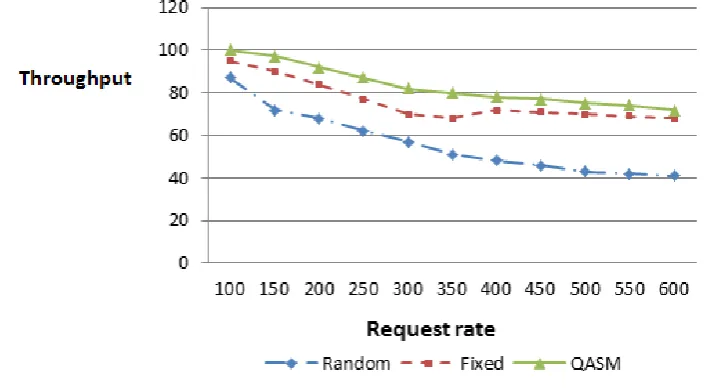
We simulated a large-scale cloud computing system of 104service providers. Each service provider is randomly assigned an initial resource attributes = [CPU; bandwidth; availability; response time], ranging from [200;100;0.97;0.05]to [800;1000;1;0.1] units. Different units reflect the heterogeneity in cloud computing systems. During each minute, certain number of end user requests are generated. The user request is represented by any of 40 composite service templates that comprise 2 to 6 services. The metrics we use for evaluating the QoS include the deviation rates of two QoS attributes: availability and response time, respectively. The QoS deviation rate is measured by the ratio of the requests during which QoS deviation happens over the total requests. For each request, the QoS deviation is said to happen if the measured average QoS attribute values (i.e., availability, response time) is worse than that specified in the . The other metric we use to evaluating the load balancing is the throughput. Throughput is defined as the number of setup sessions over total number of all requests. A request is setup if there are enough resources (i.e. CPU, bandwidth) for constructing the service path, ignoring its’ QoS conditions. Higher throughput represents better load balancing in the cloud computing system.
- 468 -
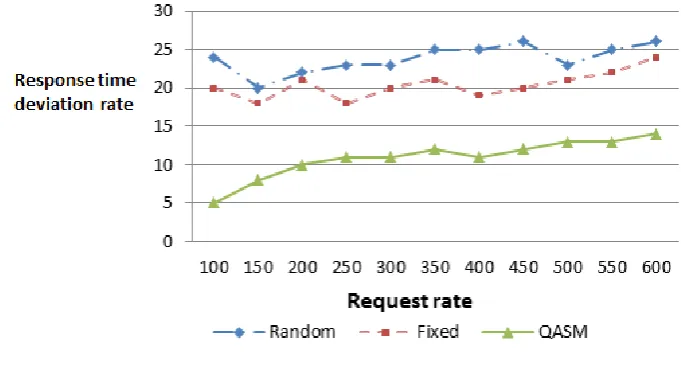
shows the average QoS deviation rate for the availability attribute, achieved by the fixed, random and our QASM algorithm. The fixed algorithm always picks the same service path for a distributed application delivery and chooses the dedicated service providers to instantiate the service path. The fixed algorithm actually represents the conventional client-server systems. The random algorithm randomly chooses service instances to compose the service path.
Figure 5. Average availability QoS deviation rate under different system load
In the even workload, we assume each service in the cloud computing system has equal probability being requested by the users. The results of QoS availability deviation rate show that the QASM algorithm achieved much lower than the fixed and random algorithms varying from 100 per minute to 600 per minute. As shown in Figure 5, QASM algorithm as the lowest QoS availability deviation rate, which is about 15% lower than that of random algorithm.
Figure 6. Average response time QoS deviation rate under different system load
- 469 -
QASM algorithm achieved much lower response time than fixed and random. Both simulation results prove that QASM tolerates topological variation best and uniformly achieves the highest QoS.
Figure 7 shows the result about throughput. Throughput is a metric of load balancing. We can see from Figure 7 that random algorithm performs the worst in load balancing as it has the lowest throughput. We observe that the throughput of QASM is consistently higher than those of fixed and random. The former may be higher than the latter two as much as 10%and 45%, respectively.
Figure 7. Throughput under different system load (load balancing)
In all of the above experiments, both simulation results prove that QASM tolerates topological variation best and uniformly achieves the highest throughput. The reason is that when QASM selects among candidate service providers for instantiating a service instance, it takes the service providers’ average uptimes into account but random and fixed do not.
5. Conclusions
- 470 -
implement a prototype of our model and test it in the real Internet environment. We will also investigate how to include other desirable system properties such as stability and fault tolerance into our model.
Acknowledgment
This research work was sponsored by the National Science Council, R.O.C., under project number NSC 101-2221-E-155 -032.
References
Berbner, R., Spahn, M., Repp, N., Heckmann, O., & Steinmetz, R. (2006). Heuristics for QoS-aware Web Service Composition, Proceedings of the 2006 IEEE International Conference on Web Services (ICWS06).
Buyya, R., Yeo, C.S., & Venugopal, S. (2008 Sept). Market Oriented Cloud Computing: Vision, Hype, and Reality for delivering IT Services as Computing Utilities. Keynote Paper, in
Proceedings of the 10th IEEE International Conference on High Performance Computing and Communications (HPCC 2008), IEEE CS Press, Los Alamitos, CA, USA, 25–27.
Broberg, J., Buyya, R., & Tari, Z. (2009). Metacdn: Harnessing Storage Clouds’ for high performance content delivery. Journal of Network and Computer Applications, 32(5), 1012– 1022. http://dx.doi.org/10.1016/j.jnca.2009.03.004
Cahon, S., Melab, N., & Talbi, E.G. (2004, May). Paradis EO: A Framework for the Reusable Design of Parallel and Distributed Metaheuristics. Journal of Heuristics, 10(3), 357–380.
http://dx.doi.org/10.1023/B:HEUR.0000026900.92269.ec
Chu, X., Nadiminti, K., Jin, C., Venugopal, S., & Buyya, R. (2007). Aneka: Next-Generation Enterprise Grid Platformfor e-Science and e-Business Applications. Proceedings of the 3rd IEEE International Conference on e-Science and Grid Computing, IEEE Computer Society Press, Los Alamitos, CS, 151–159.
Dijkstra, E. (1959). A note on two problems in connection with graphs, Numerische Mathematik, l.1 269-271. http://dx.doi.org/10.1007/BF01386390
Foster, I., Kesselman, C., Nick, J.M., & Tuecke, S. (2002). Grid service for distributed system integration, IEEE Computer, 35(6), 37-46. http://dx.doi.org/10.1109/MC.2002.1009167
Feng, G., Makki, K., Pissinou, N., & Doulgeris, C. (2002). Heuristic andExact Algorithms for QoS Routing with Multiple Constraints. IEICETrans. Communications, E85-B(12), 2838-2850.
- 471 -
the QoS routing problem. Proceedings of the IEEE INFOCOM, 2, 859–868.
Korkmaz, T., & Krunz, M. (2001). A randomized algorithm for finding a path subject to multiple
QoS constraints. Computer Networks, 36(2-3), 251-268.
http://dx.doi.org/10.1016/S1389-1286(00)00209-7
Kirley, M., & Stewart, R. (2007). Multi-objective evolutionary algorithms on complex networks.
Proceedings of the Fourth International Conference on Evolutionary Multi-Criterion Optimization, Lecture Notes Computer Science 4403, Springer Berlin, Heidelberg, 81–95.
Wang, Z., & Crowcroft, J. (1996). Quality-of-service routing for supporting multimedia applications. IEEE Journal on Selected Areas in Communications, 14,1228-1234.
http://dx.doi.org/10.1109/49.536364
Yu, T., & Lin, K. J. (2004). Service selection algorithms for web services with end-to-end QoS constraints. IEEE International Conference onE-Commerce Technology (CEC’04), 129–136.
Zeng, L., Benatallah, B., Ngu, A., et al. (2004). QoS-aware middleware for Web service composition. IEEE Transactions on Software Engineering, 5(30), 311–328.
http://dx.doi.org/10.1109/TSE.2004.11
Journal of Industrial Engineering and Management, 2012 (www.jiem.org)
El artículo está con Reconocimiento-NoComercial 3.0 de Creative Commons. Puede copiarlo, distribuirlo y comunicarlo públicamente
siempre que cite a su autor y a Intangible Capital. No lo utilice para fines comerciales. La licencia completa se puede consultar en
http://creativecommons.org/licenses/by-nc/3.0/es/