JIEM, 2012 – 5(1):4-21 – Online ISSN: 2013-0953 – Print ISSN: 2013-8423 http://dx.doi.org/10.3926/jiem.415
Development and evaluation of an integrated emergency
response facility location model
Jae-Dong Hong
1, Yuanchang Xie
2, Ki-Young Jeong
31
South Carolina State University,
2University of Massachusetts Lowell,
3University of Houston-Clear
Lake (UNITED STATES)
[email protected], yuanchang
_
[email protected], [email protected]
Received October 2011 Accepted February 2012
Abstract:
Purpose: The purpose of this paper is to propose and compare the performance
of the “two” robust mathematical models, the Robust Integer Facility Location
(RIFL) and the Robust Continuous Facility Location (RCFL) models, to solve the
emergency response facility and transportation problems in terms of the total
logistics cost and robustness.
Design/methodology/approach: The emergency response facilities include
distribution warehouses (DWH) where relief goods are stored, commodity
distribution points (CDP), and neighborhood locations. Authors propose two
robust models: the Robust Integer Facility Location (RIFL) model where the
demand of a CDP is covered by a main DWH or a backup CDP; the Robust
Continuous Facility Location (RCFL) model where that of a CDP is covered by
multiple DWHs. The performance of these models is compared with each other
and to the Regular Facility Location (RFL) model where a CDP is covered by one
main DWH. The case studies with multiple scenarios are analyzed.
those of other models while the performance of RFL and RIFL is mixed between
the cost and robustness index.
Originality/value: Two new emergency distribution approaches are modeled, and
evaluated using case studies. In addition to the total logistics cost, the robustness
index is uniquely presented and applied. The proposed models and robustness
concept are hoped to shed light to the future works in the field of disaster logistics
management.
Keywords: emergency response, facility location, disaster recovery, emergency relief
goods, spreadsheet model, facility disruptions
1 Introduction
After emergency events such as natural disasters or terrorist attacks, it is critical through emergency response facilities to distribute for rapid recovery emergency supplies to the affected areas in a timely and efficient manner. The emergency response facilities considered in this paper include distribution warehouses (DWHs), where emergency relief goods are stored, intermediate response facilities termed Disaster Recovery Centers (DRCs), sometimes referred to as break of bulk points (BOBs), where emergency relief goods can be sent to the affected area in a timely manner for rapid recovery, and neighborhood locations in need of relief goods. The distribution of emergency supplies from these facilities to the affected areas must be done via a transportation network. Given the significance of transportation costs and the time involved in transporting the relief goods, the importance of optimally locating DWHs and BOBs in the transportation network is apparent.
prior-disaster transportation costs minimized by the traditional facility location models, the actual or post-disaster transportation costs can be substantially higher. Thus, it is very important to take into account the post-disaster costs as well as the prior-disaster costs in emergency response facility location modeling.
In light of the significant difference in siting between emergency response facilities and other types of facilities and the paucity of the research literature in this area, we propose a new emergency response facility location model that can better account for the uncertainty caused by the disruptions of critical infrastructure and that would minimize the post-disaster costs. Assuming that some DWHs might be unavailable after disastrous events, we compare the new model with a traditional facility location model based on case studies to demonstrate the developed model’s capability to better deal with the risks in emergency response caused by the disruptions of critical infrastructure.
2 Literature review
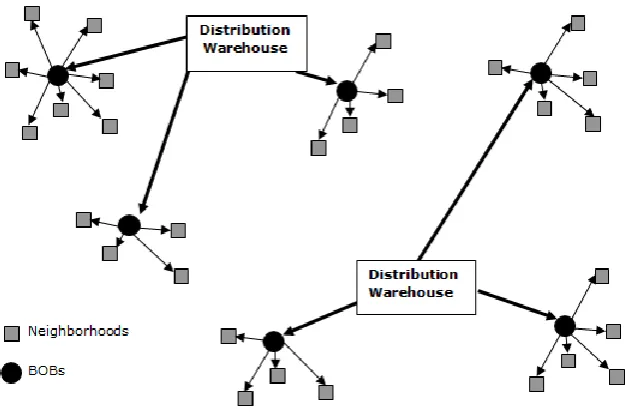
Facility location models have been extensively researched for decades. Dekle et al. (2005) develop a set-covering model and a two-stage modeling approach to identify the optimal DRC sites. Their objective is to minimize the total number of DRCs, subject to each county’s residents being within a certain distance of the nearest DRC. Horner and Downs (2007) conduct a similar study to optimize BOB locations (in our paper, BOBs and DRCs are used interchangeably). As shown in Figure 1, emergency relief goods are shipped from central distribution warehouses to BOBs and distributed to victims of catastrophes. Given the number and locations of initial warehouses, Horner and Downs formulate the problem as a multi-objective integer programming. Two objectives are considered. The first objective is to minimize the transportation costs of servicing BOBs from warehouse locations, and the second one is to minimize the transportation costs between BOBs and neighborhoods in need of relief goods.
develop a reliable facility location model based on the p-median problem. In their research, each facility is assigned a failure probability. The objective is to minimize the expected weighted transportation cost and the expected penalty for certain customers not being served. The developed model has a nonlinear objective function and is difficult to solve by exact algorithms. These authors thus proposed a greedy heuristic for their model.
Figure 1. Distribution strategy for emergency relief goods (Horner & Downs, 2007)
Hassin, Ravi and Salman (2010) investigate a facility location problem considering the failures of network edges. Their goal is to maximize the expected demand that can be served after disastrous events. In their study, it is assumed that a demand node can be served by a facility if it is within a certain distance of the entity in the network that survived disaster. The failures of network edges are assumed to be dependent on each other. These authors formulate the problem as an exact dynamic programming model and develop an exact greedy algorithm to solve it. Eiselt, Gendreau and Laporte (1996) also propose a reliable model for optimally locating p facilities in a network that takes into account the potential failures of road network links and nodes. These authors develop a low-order polynomial algorithm to solve the proposed facility location model.
authors consider two methods to model the spatial correlation of disruptions, including positively correlated Beta-Binomial facility failure.
Cui, Ouyang & Shen (2010) investigate a discrete reliable facility location design problem under the risk of disruptions. Their model considers a set of i customers and j facilities, with the goal of minimizing the sum of fixed facility and expected transportation costs. Similar to Snyder and Daskin (2005), Cui et al. (2010) assign each customer to multiple levels to ensure the robustness of the final facility location design. They also develop a Lagrangian relaxation algorithm to solve the proposed model.
Our research is built upon the work done by Horner and Downs (2007) and also motivated by the recent trend in facility location studies to consider the risk caused by critical infrastructure disruptions. Contrary to the one-stage model developed by Horner and Downs and which optimized the location of BOBs only, we develop a two-stage integrated facility location model that simultaneously optimizes the locations of DWHs and BOBs. In addition, we propose two robust models for the case of disasters.
The rest of this paper is organized as follows. In the next section, an integrated facility location model is introduced. Based on this integrated model formulation, robust integrated facility location models are proposed and described in detail. Following the description of the model formulations, case studies are conducted and the resulting analysis is presented. The last section summarizes the developed models and research findings. It also provides recommendations for future research directions.
3 Development of integrated facility location model
costs from DWHs to BOBs and between BOBs and neighborhoods/candidate DWH locations that are not selected:
(1)
Subject to
(2)
(3)
(4)
(5)
(6)
(7)
(8)
(9)
(10)
where,
ai: fixed cost for contructing and operating DWHi;
Bj: 1 if neighborhood j is selected as a BOB, 0 otherwise (decision variable);
dij: distance between DWHi and BOBj;
dim: distance between DWHi amd location m;
djm: distance between BOBjand location m;
DB: maximum number of BOBs can be built (set to 5);
Dm: demand of location (can be either neighborhood or DWH) m;
Dw: maximum number of DWHs can be built (set to 3 in this study);
ki: maximum number of BOBs a DWH must handle (set to 1 in this study);
Ki: maximum number of BOBs a DWH can handle (set to 5 in this study);
Lj: minimum number of neighborhoods a BOB needs to cover (set to 2);
Uj: maximum number of neighborhoods a BOB can cover (set to 6);
Wi: 1 if a candidate warehouse i is selected, 0 otherwise (decision variable);
xij: 1 if BOBj is covered by DWHi, 0 otherwise (decision variable);
yjm: 1 if location m is covered by CDPj, 0 otherwise (decision variable).
Since the main purpose of this paper is to demonstrate how the proposed model works, we further simplify the objective function by excluding the fixed cost terms for BOBs and for DWH. Also, the numbers of BOBs and DWHs to be built are pre-specified. For real-world applications, once the real data are available, such restrictions can be readily relaxed to generate meaningful results. In this paper, we use the following simplified objective function for the simultaneous optimization of DWH and BOB locations.
(11)
Constraints (3) ensure that the potential DWH location will not be selected simultaneously as both DWH and BOB.
Constraints (4) ensure that if a potential DWH location i is not selected (i.e., Wi=0) (its demand must be satisfied by a BOB).
Constraints (5) make certain that each neighborhood ( ) is assigned to exactly one BOB.
Constraints (6) limit the minimum and maximum number of BOBs to be served by each DWH.
Constraint (7) ensure that DWHs only supply the selected BOBs, not all candidate BOBs.
Constraints (8) limit the total number of selected BOBs to be less than or equal to a user-specified number, DB.
Constraints (9) ensure that neighborhoods or unselected DWH locations can only be assigned to the candidate BOBs that are finally selected.
Constraints (10) ensure that each selected candidate BOB must cover a minimum number of Lj neighborhoods and can only cover a maximum of Uj neighborhoods. Hereafter, this newly introduced model given by Equations (2)-(11) is referred to as
the Integrated Facility Location (IFL) model.
4 Development of robust optimization models
An alternative way of developing the robust model is to add the capacity constraints of candidate DWHs in a disaster-prone area. For instance, if a DWH has a high probability of being damaged in disastrous events, one can specify that all BOBs assigned to this DWH can only have up to certain percentages of their demand satisfied by it. This strategy would avoid putting all eggs in one basket and improve the robustness of the model. In fact, if a DWH is partially damaged due to disaster, this model would be useful. Now, let xij be a continuous decision variable between 0
and 1, denoting the fraction of BOBj’s demand satisfied by DWHi. Then, the following capacity constraint is added to the IFL model:
(12)
Where, Ci: maximum fraction of BOB’s demand that can be satisfied by DWHi
For candidate DWHs with a high probability of damage or shutdown during disastrous events, Ci would take relatively smaller values, whereas for DWHs in stable and safe areas, Ci would take larger values. By making xij a continuous decision variable, the robust facility location model becomes a mixed integer quadratic programming (MIQP) problem, which can be linearized by defining a new decision variable as follows:
zijm = xij · yjm, (13)
Where zijm denotes the fraction of neighborhood m’s demand satisfied by DWHi via BOBj. Then solving this robust facility location problem is equivalent to solving the following mixed integer linear programming (MILP) problem:
(14)
Subject to equations 2, 3, 4, 5, 7, 8, 9 and 10;
(15)
(16)
(18)
We call the above model the Robust Continuous Facility Location (RCFL) model. Note that if Ci=1, ∀i, the RCFL model is equivalent to the IFL model and produces exactly the same solutions. To find the pre-disaster cost for the RCFL model, we solve the RCFL model by adjusting Ci, such that the post-disaster cost is minimized. Then with Wi* and Bj* obtained for the minimum post-disaster cost fixed and Ci=1,
∀i, we solve the RCFL model again and the resulting total cost will be the pre-disaster cost.
5 Case study and observations
The integrated model and two robust models can be solved by a variety of optimization software packages, such as LINDO, LINGO, or GAMS. However, coding the developed MILP model using these tools may not be an easy task, since so many decision variables and constraints are involved. Recently, many researchers and practitioners are paying significant attention to Microsoft Excel spreadsheet-based optimization modeling because of its non-algebraic approach. Several powerful software packages based on the Excel spreadsheet model, such as Solver, What’s Best, CPLEX, etc., make Excel spreadsheet-based modeling attractive. In this paper, a CPLEX for Microsoft Excel Add-In is used to solve the proposed MILP model.
Figure 2. Candidate Warehouses, BOBs, and Neighborhoods
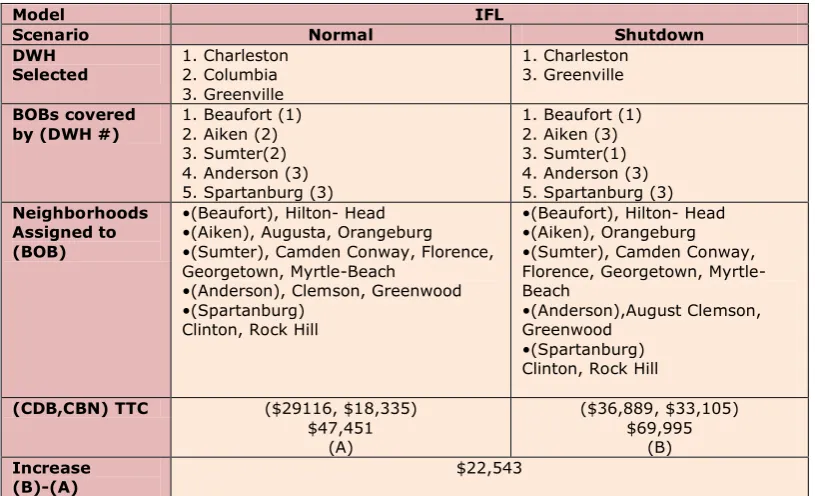
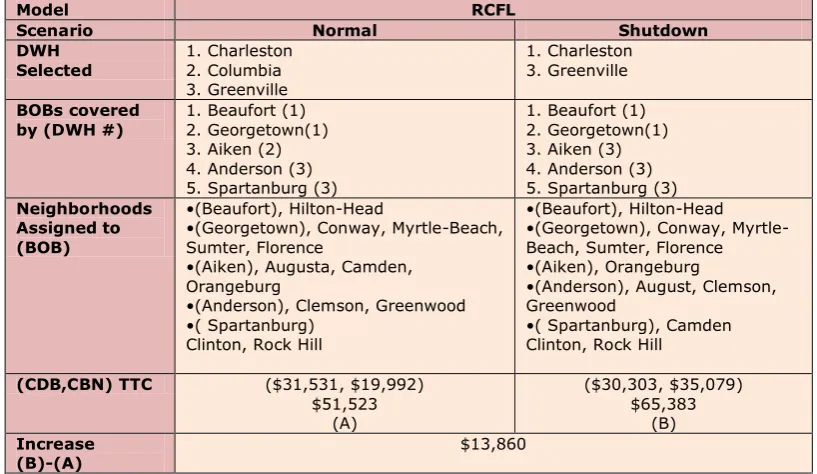
We solve the three models, IFL, RIFL, and RCFL. To show how robust the RIFL and RCFL models are, two scenarios are considered. The first (normal) scenario assumes that all candidate DWHs remain available after disastrous events, whereas the second considers the shutdown/unavailability of a DWH. Hereafter, these scenarios are referred to as normal and shutdown scenarios, respectively. For normal scenario, we evaluate and present the results of facility location and transportation scheme as shown in Tables 2(a), 2(b) and 2(c). From the results under normal scenario in Tables 2(a), 2(b) and 2(c), we see that all three models include Columbia and Charleston as DWHs. Thus, it would be interesting to see what would happen if one of DWHs is unavailable and to compare the post-disaster costs of the three models. We select DWH Columbia to be unavailable after disaster, evaluate the three models, and present the results in Tables 2(a), 2(b) and 2(c), under the shutdown scenario.
Note that in Tables 2(a), 2(b) and 2(c), we assume that Columbia, the unavailable DWH for the shutdown case, can still cover the Columbia area and consequently is not assigned to any BOB. We call this Case I. But, more likely, the unavailable DWH after disaster can’t even operate for its own area. Thus, it might be necessary for the affected area to be assigned to a BOB. We call this situation Case II.
No. Neighborhoods Aiken Anderson Augusta Beaufort Camden Clemson Clinton
1 Aiken 0.00 99.69 16.98 121.37 86.19 120.42 69.85
2 Anderson 99.69 0.00 92.34 246.70 148.32 18.05 50.04
3 Augusta 16.98 92.34 0.00 127.63 128.68 110.82 81.00
4 Beaufort 121.37 246.70 127.63 0.00 166.79 271.49 181.15
5 Camden 86.19 148.32 128.68 166.79 0.00 169.48 87.01
6 Clemson 120.42 18.05 110.82 271.49 169.48 0.00 63.95
7 Clinton 69.85 50.04 81.00 181.15 87.01 63.95 0.00
8 Conway 186.02 253.07 228.30 188.83 110.14 264.79 190.71
9 Georgetown 206.74 269.41 224.91 137.08 113.48 247.81 226.23
10 Greenwood 55.53 39.50 62.00 167.60 102.90 56.53 26.97
11 Hilton Head 152.40 277.66 158.59 41.02 198.23 239.42 196.77
12 Myrtle Beach 207.12 266.99 225.29 202.69 124.06 262.91 204.74
13 Rock Hill 124.47 120.98 142.64 206.76 71.32 120.00 65.57
14 Spartanburg 142.14 60.36 160.32 225.30 125.80 59.19 35.54
15 Sumter 112.39 172.26 130.57 125.70 29.34 168.17 104.57
16 Charleston 162.96 226.73 207.56 70.32 146.74 248.36 170.50
17 Columbia 56.41 116.50 75.10 134.16 34.69 128.22 61.20
18 Florence 132.44 192.92 136.00 150.80 50.43 201.61 137.72
19 Greenville 150.96 31.00 120.94 234.12 134.62 30.10 41.61
20 Orangeburg 53.75 135.02 76.00 83.91 62.98 161.39 97.82
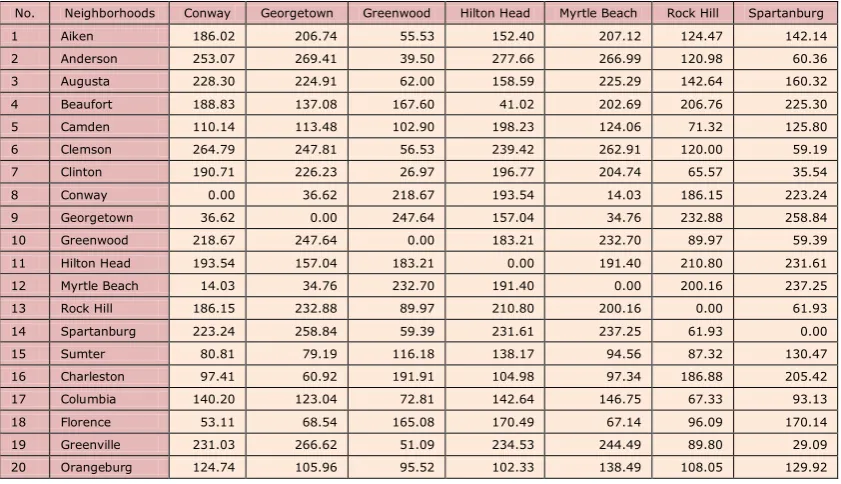
Table 1(a). Distances (in miles) between Neighborhoods
No. Neighborhoods Conway Georgetown Greenwood Hilton Head Myrtle Beach Rock Hill Spartanburg
1 Aiken 186.02 206.74 55.53 152.40 207.12 124.47 142.14
2 Anderson 253.07 269.41 39.50 277.66 266.99 120.98 60.36
3 Augusta 228.30 224.91 62.00 158.59 225.29 142.64 160.32
4 Beaufort 188.83 137.08 167.60 41.02 202.69 206.76 225.30
5 Camden 110.14 113.48 102.90 198.23 124.06 71.32 125.80
6 Clemson 264.79 247.81 56.53 239.42 262.91 120.00 59.19
7 Clinton 190.71 226.23 26.97 196.77 204.74 65.57 35.54
8 Conway 0.00 36.62 218.67 193.54 14.03 186.15 223.24
9 Georgetown 36.62 0.00 247.64 157.04 34.76 232.88 258.84
10 Greenwood 218.67 247.64 0.00 183.21 232.70 89.97 59.39
11 Hilton Head 193.54 157.04 183.21 0.00 191.40 210.80 231.61
12 Myrtle Beach 14.03 34.76 232.70 191.40 0.00 200.16 237.25
13 Rock Hill 186.15 232.88 89.97 210.80 200.16 0.00 61.93
14 Spartanburg 223.24 258.84 59.39 231.61 237.25 61.93 0.00
15 Sumter 80.81 79.19 116.18 138.17 94.56 87.32 130.47
16 Charleston 97.41 60.92 191.91 104.98 97.34 186.88 205.42
17 Columbia 140.20 123.04 72.81 142.64 146.75 67.33 93.13
18 Florence 53.11 68.54 165.08 170.49 67.14 96.09 170.14
19 Greenville 231.03 266.62 51.09 234.53 244.49 89.80 29.09
20 Orangeburg 124.74 105.96 95.52 102.33 138.49 108.05 129.92
No. Neighborhoods Sumter Charleston Columbia Florence Greenville Orangeburg Demand (in 1000s)
1 Aiken 112.39 162.96 56.41 132.44 150.96 53.75 29
2 Anderson 172.26 226.73 116.50 192.92 31.00 135.02 26
3 Augusta 130.57 207.56 75.10 136.00 120.94 76.00 196
4 Beaufort 125.70 70.32 134.16 150.80 234.12 83.91 13
5 Camden 29.34 146.74 34.69 50.43 134.62 62.98 8
6 Clemson 168.17 248.36 128.22 201.61 30.10 161.39 12
7 Clinton 104.57 170.50 61.20 137.72 41.61 97.82 9
8 Conway 80.81 97.41 140.20 53.11 231.03 124.74 12
9 Georgetown 79.19 60.92 123.04 68.54 266.62 105.96 9
10 Greenwood 116.18 191.91 72.81 165.08 51.09 95.52 23
11 Hilton Head 138.17 104.98 142.64 170.49 234.53 102.33 48
12 Myrtle Beach 94.56 97.34 146.75 67.14 244.49 138.49 32
13 Rock Hill 87.32 186.88 67.33 96.09 89.80 108.05 72
14 Spartanburg 130.47 205.42 93.13 170.14 29.09 129.92 37
15 Sumter 0.00 106.14 43.41 39.28 150.20 56.99 41
16 Charleston 106.14 0.00 114.54 109.92 214.24 75.98 121
17 Columbia 43.41 114.54 0.00 79.49 100.91 40.83 130
18 Florence 39.28 109.92 79.49 0.00 177.93 90.34 38
19 Greenville 150.20 214.24 100.91 177.93 0.00 137.71 62
20 Orangeburg 56.99 75.98 40.83 90.34 137.71 0.00 13
Table 1(c). Distances (in miles) between Neighborhoods (continued) and Demands
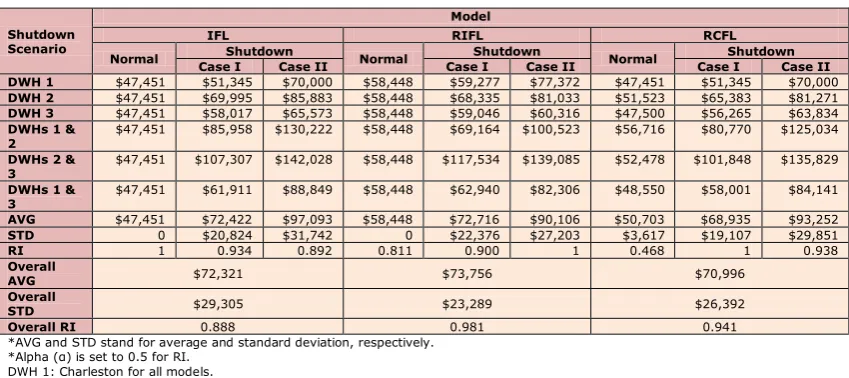
To further investigate the effects of the shutdown of DWHs and to see the performance of the robust models, we consider various shutdown scenarios, present the resulting costs for both cases in Table 3, and compare the results for the three models.
As expected, the total transportation cost (TTC) for each model increases under the shutdown scenario and the increase in TTC are also reported in Tables 2(a), 2(b), 2(c) and 3. For the IFL model, the TTC goes from $47,451.54 to 69,995.04, a 47.5% increase. We observe that, on average, two robust models, RIFL and RCFL, outperform than the non-robust IFL model under the shutdown scenario, though they underperform under the normal scenario.
Now, we propose a performance measure index, which is called a robustness index (RI) to show how much the results from each model are robust enough to cover the diverse scenarios in terms of cost minimization. Although there are many definitions of robustness, we adopt the one from Dong (2006) as “the extent to which the network is able to perform its function despite some damage done to it, such as the removal of some of the nodes and/or link in a network.” In this paper, each model’s performance may be evaluated by comparing it with the best performing model in terms of average TTC and its standard deviation. Hence we propose the following robustness index (RI):
(19)
where AVG(λ) and STD(λ) stand for average and standard deviation of each model λ’s cost under given scenarios and α denotes the weight between the average and the standard deviation. Note that as RI for the model becomes closer to 1, the more robust the model would be. And RI can be used to decide the rank of each model in terms of robustness. We calculate RI for the three models for all possible shutdown scenarios and present them in Table 3. We calculate three different RIs- RI for a normal scenario and for Case I and Case II under the shutdown scenario, and an overall RI for both cases with the assumption that all individual scenarios have the same weight. As the RI values indicate, the IFL is most efficient under normal scenario, whereas the RIFL and RCFL seem to be the most robust for Case II and for Case I, respectively, under shutdown scenario. That is, on average, these robust models generate a slightly higher TTC for the normal scenario, but produce a lower TTC for the shutdown case than IFL.
Model IFL
Scenario Normal Shutdown
DWH
Selected 1. Charleston 2. Columbia 3. Greenville
1. Charleston 3. Greenville
BOBs covered by (DWH #)
1. Beaufort (1) 2. Aiken (2) 3. Sumter(2) 4. Anderson (3) 5. Spartanburg (3)
1. Beaufort (1) 2. Aiken (3) 3. Sumter(1) 4. Anderson (3) 5. Spartanburg (3) Neighborhoods
Assigned to (BOB)
•(Beaufort), Hilton- Head •(Aiken), Augusta, Orangeburg •(Sumter), Camden Conway, Florence, Georgetown, Myrtle-Beach
•(Anderson), Clemson, Greenwood •(Spartanburg)
Clinton, Rock Hill
•(Beaufort), Hilton- Head •(Aiken), Orangeburg •(Sumter), Camden Conway, Florence, Georgetown, Myrtle-Beach
•(Anderson),August Clemson, Greenwood
•(Spartanburg) Clinton, Rock Hill
(CDB,CBN) TTC ($29116, $18,335)
$47,451 (A) ($36,889, $33,105) $69,995 (B) Increase (B)-(A) $22,543
CDB: Cost from DWHs to BOBs, 1st Term in Eq. (12). CBN: Cost from BOBs to Neighbors, 2nd Term in Eq. (12). TTC= CDB+CBN
Model RIFL
Scenario Normal Shutdown
DWH
Selected 1. Charleston 2. Columbia 3. Orangeburg
1. Charleston 3. Orangeburg
BOBs covered by (DWH #)
1. Beaufort (1) 2. Camden(2) 3. Sumter (2) 4. Clinton (2) 5. Aiken (3)
1. Beaufort (1) 2. Camden(3) 3. Sumter (3) 4. Clinton (3) 5. Aiken (3) Neighborhoods
Assigned to (BOB)
•(Beaufort), Hilton-Head •(Camden), Rock Hill
•(Sumter), Conway, Florence, Georgetown, Myrtle-Beach •(Clinton),Anderson, Clemson, Greenwood, Spartanburg, Greenville, •(Aiken), Augusta
•(Beaufort), Hilton- Head •(Camden), Rock Hill
•(Sumter), Conway, Florence, Georgetown, Myrtle-Beach •(Clinton), Anderson, Clemson, Spartanburg, Greenville, •(Aiken), Augusta, Greenwood
(CDB,CBN) TTC ($35,231, $23,216)
$58,448 (A) ($44,462, $23,873) $68,335 (B) Increase
(B)-(A) $9,887
CDB: Cost from DWHs to BOBs, 1st Term in Eq. (12). CBN: Cost from BOBs to Neighbors, 2nd Term in Eq. (12). TTC= CDB+CBN
Table 2(b). Results comparison for normal/shutdown scenarios for three models (continued)
Model RCFL
Scenario Normal Shutdown
DWH Selected 1. Charleston 2. Columbia 3. Greenville 1. Charleston 3. Greenville BOBs covered by (DWH #)
1. Beaufort (1) 2. Georgetown(1) 3. Aiken (2) 4. Anderson (3) 5. Spartanburg (3)
1. Beaufort (1) 2. Georgetown(1) 3. Aiken (3) 4. Anderson (3) 5. Spartanburg (3) Neighborhoods
Assigned to (BOB)
•(Beaufort), Hilton-Head
•(Georgetown), Conway, Myrtle-Beach, Sumter, Florence
•(Aiken), Augusta, Camden, Orangeburg
•(Anderson), Clemson, Greenwood •( Spartanburg)
Clinton, Rock Hill
•(Beaufort), Hilton-Head •(Georgetown), Conway, Myrtle-Beach, Sumter, Florence •(Aiken), Orangeburg
•(Anderson), August, Clemson, Greenwood
•( Spartanburg), Camden Clinton, Rock Hill
(CDB,CBN) TTC ($31,531, $19,992)
$51,523 (A) ($30,303, $35,079) $65,383 (B) Increase
(B)-(A) $13,860
CDB: Cost from DWHs to BOBs, 1st Term in Eq. (12). CBN: Cost from BOBs to Neighbors, 2nd Term in Eq. (12). TTC= CDB+CBN
Shutdown Scenario
Model
IFL RIFL RCFL
Normal Case I Shutdown Case II Normal Case I Shutdown Case II Normal Case I Shutdown Case II DWH 1 $47,451 $51,345 $70,000 $58,448 $59,277 $77,372 $47,451 $51,345 $70,000
DWH 2 $47,451 $69,995 $85,883 $58,448 $68,335 $81,033 $51,523 $65,383 $81,271
DWH 3 $47,451 $58,017 $65,573 $58,448 $59,046 $60,316 $47,500 $56,265 $63,834
DWHs 1 &
2 $47,451 $85,958 $130,222 $58,448 $69,164 $100,523 $56,716 $80,770 $125,034
DWHs 2 &
3 $47,451 $107,307 $142,028 $58,448 $117,534 $139,085 $52,478 $101,848 $135,829
DWHs 1 &
3 $47,451 $61,911 $88,849 $58,448 $62,940 $82,306 $48,550 $58,001 $84,141
AVG $47,451 $72,422 $97,093 $58,448 $72,716 $90,106 $50,703 $68,935 $93,252
STD 0 $20,824 $31,742 0 $22,376 $27,203 $3,617 $19,107 $29,851
RI 1 0.934 0.892 0.811 0.900 1 0.468 1 0.938
Overall
AVG $72,321 $73,756 $70,996
Overall
STD $29,305 $23,289 $26,392
Overall RI 0.888 0.981 0.941
*AVG and STD stand for average and standard deviation, respectively. *Alpha (α) is set to 0.5 for RI.
DWH 1: Charleston for all models. DWH 2: Columbia for all models.
DWH 3: Greenville for IFL and RCFL, Orangeburg for RIFL
Table 3. Comparison between integrated and two robust models
For Case I under the shutdown scenario, RIFL generates the highest TTC among the three models for the normal scenario and generates a slightly lower TTC than IFL. For the same weight between the average and the standard deviation, i.e., , the overall RI also indicates that RIFL has the highest robustness, followed by RCFL and IFL in this order. The threshold value for α, denoted by ̃, turns out to be 0.7586. It implies that for ̃, RCFL seems to be the most robust model, followed by RIFL and IFL.
From Table 3, we recommend that the proposed robust models, RIFL and RCFL, be used for optimally locating DWHs under the risk of disruptions. As discussed previously, transport of relief goods happens mostly after disaster. Therefore, for siting emergency response facilities, it would be more important to minimize the post-disaster cost rather than the pre-disaster cost and to better consider the unavailability of emergency facilities. The example provided here clearly demonstrates that the proposed robust facility location models can well suit the needs of siting emergency response facilities.
6 Summary and conclusions
we set the constraint requiring each BOB to be served by multiple DWHs (two DWHs in this paper) on the IFL model, which requires each BOB to be served by one DWH. We propose a performance measure index to show how well the models perform after disaster, RI, defined in (19). Using numerical examples, we show that the two robust models, RIFL and RCFL, yield emergency response facility location plans of slightly higher TTCs (total transportation cost) than the IFL model under normal situations. However, they generate more robust facility location plans in the sense that they can perform better when some of the selected DWHs are shut down after disaster and these unavailable DWHs can’t distribute emergency supplies to the affected areas (Case II).
The purpose of establishing emergency response facilities is for distributing relief goods after disaster. Therefore, when evaluating the efficiency and robustness of emergency response facility location plans, more weight should be given to their post-disaster performance. The resulting RIFL and RCFL models are designed in a robust manner such that they can better address scenarios with failures of key transportation infrastructure. Case studies are conducted to demonstrate the developed model’s capability to deal with uncertainties in transportation networks. Thus, the developed robust models can help federal and local emergency response officials develop efficient and robust disaster relief plans.
For future research, it would be necessary to develop a robust model when both a DWH and a BOB could be unavailable in the shutdown scenario. In addition, we implicitly assume that each DWH always carries enough inventories of emergency relief goods, so that for the shutdown scenario the other DWH(s) can ship enough relief goods to the extra BOBs. Thus, it would be also interesting to include the constraint on the capacity of DWHs in any proposed model.
References
Berman, O., Krass, D., & Menezes, M.B.C. (2007). Facility reliability issues in network p-median problems: Strategic centralization and co-location effects. Operations Research, 55(2), 332-350. http://dx.doi.org/10.1287/opre.1060.0348
Cui, T.Y., Ouyang, Y., & Shen, Z.J. (2010). Reliable facility locations design under the risk of disruptions. Operations Research, 58(4), 998-1011.
Daganzo, C. (2005). Logistics System Analysis, (4th Ed.). Berlin, Germany:
Springer.
Dekle, J., Lavieri, M.S., Martin, E., Emir-Farinas, H., & Francis, R. (2005). A Florida county locates disaster recovery centers. Interfaces, 35(2), 133-139.
http://dx.doi.org/10.1287/inte.1050.0127
Dong, M. (2006). Development of supply chain network robustness index. International Journal of Services Operations and Informatics, 1(1/2), 54-66.
Eiselt, H.A., Gendreau, M., & Laporte, G. (1996). Optimal location of facilities on a network with an unreliable node or link. Information Processing Letters, 58(2), 71-74. http://dx.doi.org/10.1016/0020-0190(96)00024-5
Hassin, R., Ravi, R., & Salman, F.S. (2010). Facility location on a network with unreliable links, Working paper. Retrieved May 30, 2010, from
http://www.di.unipi.it/di/groups/optimize/Events/proceedings/M/B/4/MB4-4.pdf.
Horner, M.W., & Downs, J.A. (2007). Testing a flexible geographic information system-based network flow model for routing hurricane disaster relief goods. Transportation Research Record, 2022, 47-54. http://dx.doi.org/10.3141/2022-06
Langevin, A., Mbaraga, P., & Campbell, J. (1996). Continuous approximation models in freight distribution: An Overview. Transportation Research Part B, 30 (3), 163-188. http://dx.doi.org/10.1016/0191-2615(95)00035-6
Li, X., & Ouyang, Y. (2010). Effects of failure correlation on reliable facility location: A continuum approximation approach. Proceedings of the 89th Transportation Research Board 2010 Annual Meeting, in CD-ROM support. Washington DC.
Snyder, L.V., & Daskin, M.S. (2005). Reliability models for facility location: The expected failure cost case, Transportation Science, 39(3), 400-416.
http://dx.doi.org/10.1287/trsc.1040.0107
Journal of Industrial Engineering and Management, 2012 (www.jiem.org)
Article's contents are provided on a Attribution-Non Commercial 3.0 Creative commons license. Readers are allowed to copy, distribute and communicate article's contents, provided the author's and Journal of Industrial Engineering and
Management's names are included. It must not be used for commercial purposes. To see the complete license